The 30 Minute Rule begins September 24 at 7:00 PM EDT. An Initial Bid Must Be Placed By September 24 at 6:00 PM EDT To Participate After 6:00 PM EDT
Archive of presidential letters to pioneering polar explorer Rear Admiral Richard E. Byrd, consisting of (44) letters from Franklin D. Roosevelt—including two autograph letters signed and 42 typed letters signed or initialed—and two typed letters signed by Dwight D. Eisenhower, spanning 1927 to 1954. Written on Roosevelt & O’Connor, Fidelity and Deposit Company of Maryland, New York Executive Mansion, White House, and other official letterhead, the correspondence traces Byrd’s long friendship with Roosevelt from the years before his presidency through World War II, followed by Eisenhower’s expressions of admiration and gratitude during the early Cold War. Roosevelt generally addresses Byrd familiarly as “Dear Dick” and signs with his full name or characteristic initials, “FDR.” Highlights from the Roosevelt letters include:
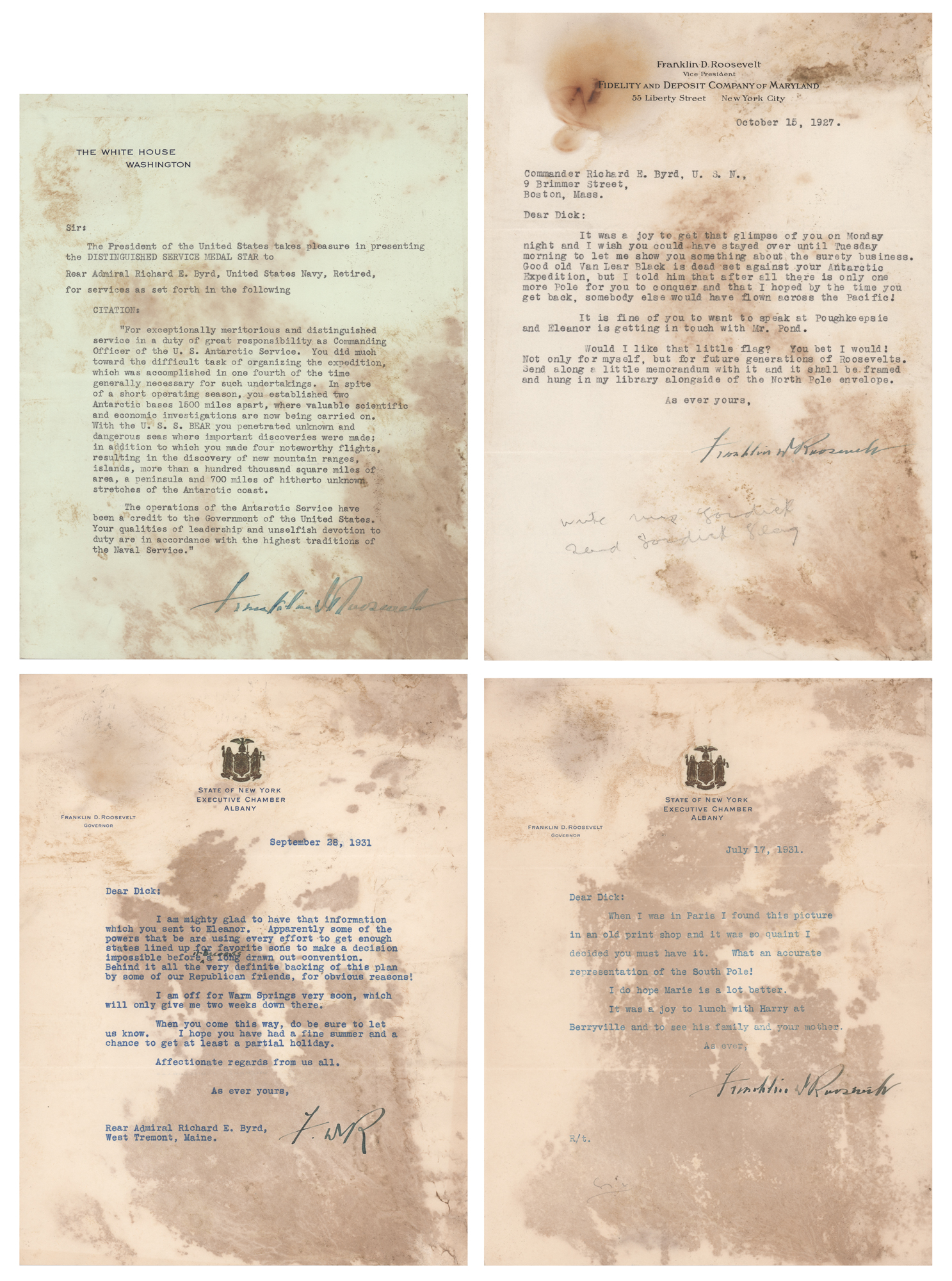
October 15, 1927 (signed "Franklin D. Roosevelt"): "Good old Van Lear Black is dead set against your Antarctic Expedition, but I told him that after all there is only one more Pole for you to conquer and that I hoped by the time you get back, somebody else would have flown across the Pacific! Would I like that little flag? You bet I would! Not only for myself, but for future generations of Roosevelts. Send along a little memorandum with it and it shall be framed and hung in my library alongside of the North Pole envelope."
December 6, 1930 (signed "FDR"): "It was a perfectly fine election, wasn't it?"
July 3, 1931 (signed "FDR): "I have written to Herbert Lehman. I am sure he will be glad to talk with Captain McKinley. It sounds like an interesting proposition."
September 28, 1931 (signed "FDR"): "I am mighty glad to have that information which you sent to Eleanor. Apparently some of the powers that be are using every effort to get enough states lined up for favorite sons and to make a decision impossible before it becomes a long drawn out convention. Behind it all the very definite backing of this plan by some of our Republican friends, for obvious reasons!"
July 17, 1931 (signed "Franklin D. Roosevelt"): "When I was in Paris I found this picture in an old print shop and it was so quaint I decided you must have it. What an accurate representation of the South Pole!"
February 11, 1932 (signed "Franklin D. Roosevelt"): "That was such a nice letter which they read me at my birthday luncheon. I need not tell you how much I appreciate it, for you know of my real affection for you."
January 14, 1933 (signed "Franklin D. Roosevelt"): "I know much about the National Economy League and, quite frankly, I think it would be much better for both if you did not come here to discuss it with me. I am sure you will understand the spirit in which I say this."
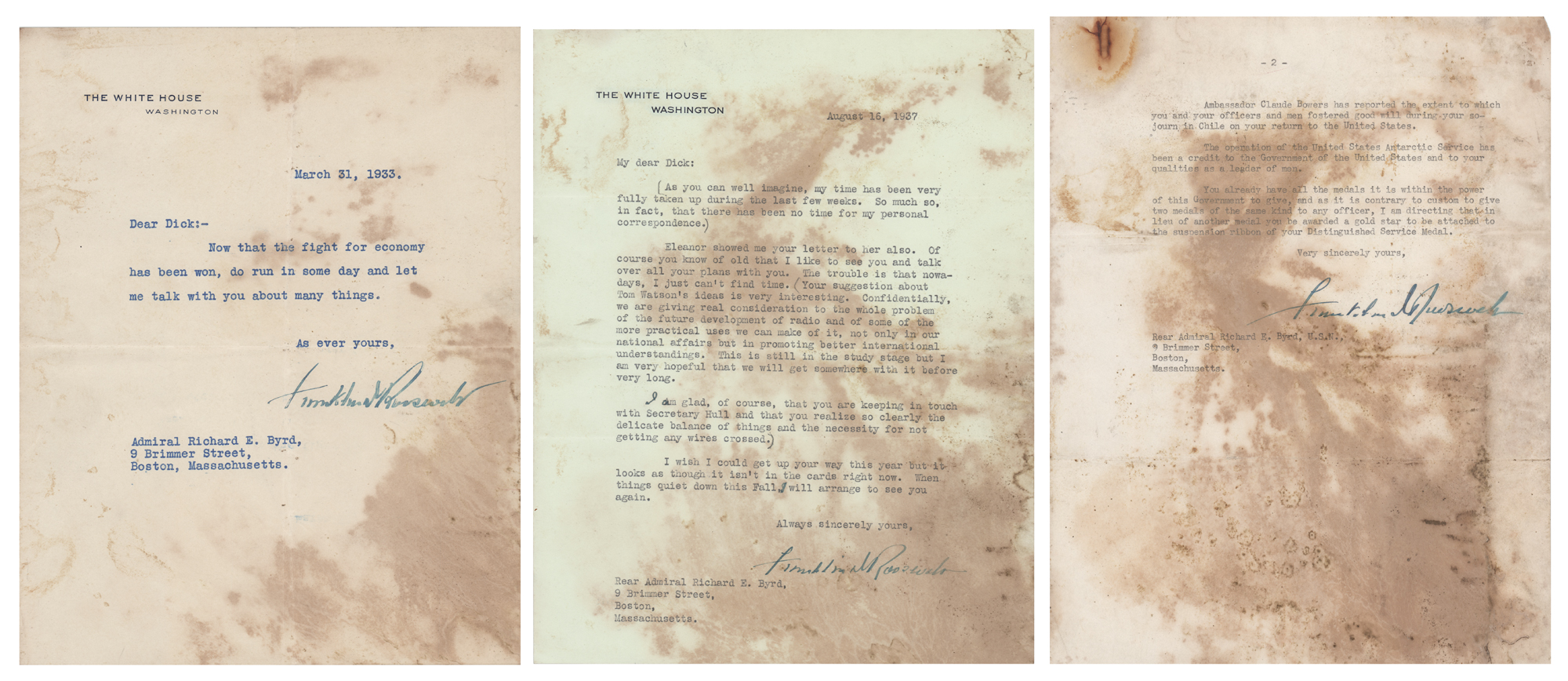
March 31, 1933 (signed "Franklin D. Roosevelt"): "Now that this fight for economy has been won, do run in some day and let me talk with you about many things."
September 7, 1933 (signed "Franklin D. Roosevelt"): "I am delighted that you have had the faith to go ahead with this scientific expedition to the Antarctic Continent and that you have definitely set the date of departure for September 25th…I realize the importance of your excellent preparations for scientific discovery, and the fact that you will make a detailed survey of a large area of new continent previously unexplored. It is worth while to serve twelve branches of science. I am especially interested in the exhaustive study of weather on the Antarctic Continent—a territory in the clutches of the ice age, and a weather maker for the greater part of the South American Continent. Your weather observations will undoubtedly be of great importance to South America and to the scientific knowledge of world weather conditions…I want you to feel that on your expedition you have the full support of the United States Government and that you can call on the Government in case of need or emergency."
August 2, 1935 (signed "FDR"): "It is certainly good to get a letter signed by your own hand, for I have been greatly worried by various newspaper stories about your health. I have discounted them, of course, because of the general unreliability of so much of the newspaper 'so-called news.' I do wish I could get up to Maine and visit you. There is not a chance, alas, for Congress will be here, without much question, for another three weeks."
August 16, 1937 (signed "Franklin D. Roosevelt"): "Your suggestion about Tom Watson's ideas is very interesting. Confidentially, we are giving real consideration to the whole problem of the future development of radio and of some of the more practical uses we can make of it, not only in our national affairs but in promoting better international understandings. This is still in the study stage but I am very hopeful that we will get somewhere with it before very long."
June 8, 1939 (signed "Franklin D. Roosevelt"): "That gift of the little flag is magnificent. In my room at Hyde Park I have framed, next to my bed, the envelope you carried to the North Pole and also, in another frame, the little flag you carried on the transatlantic flight to France. This goes with them."
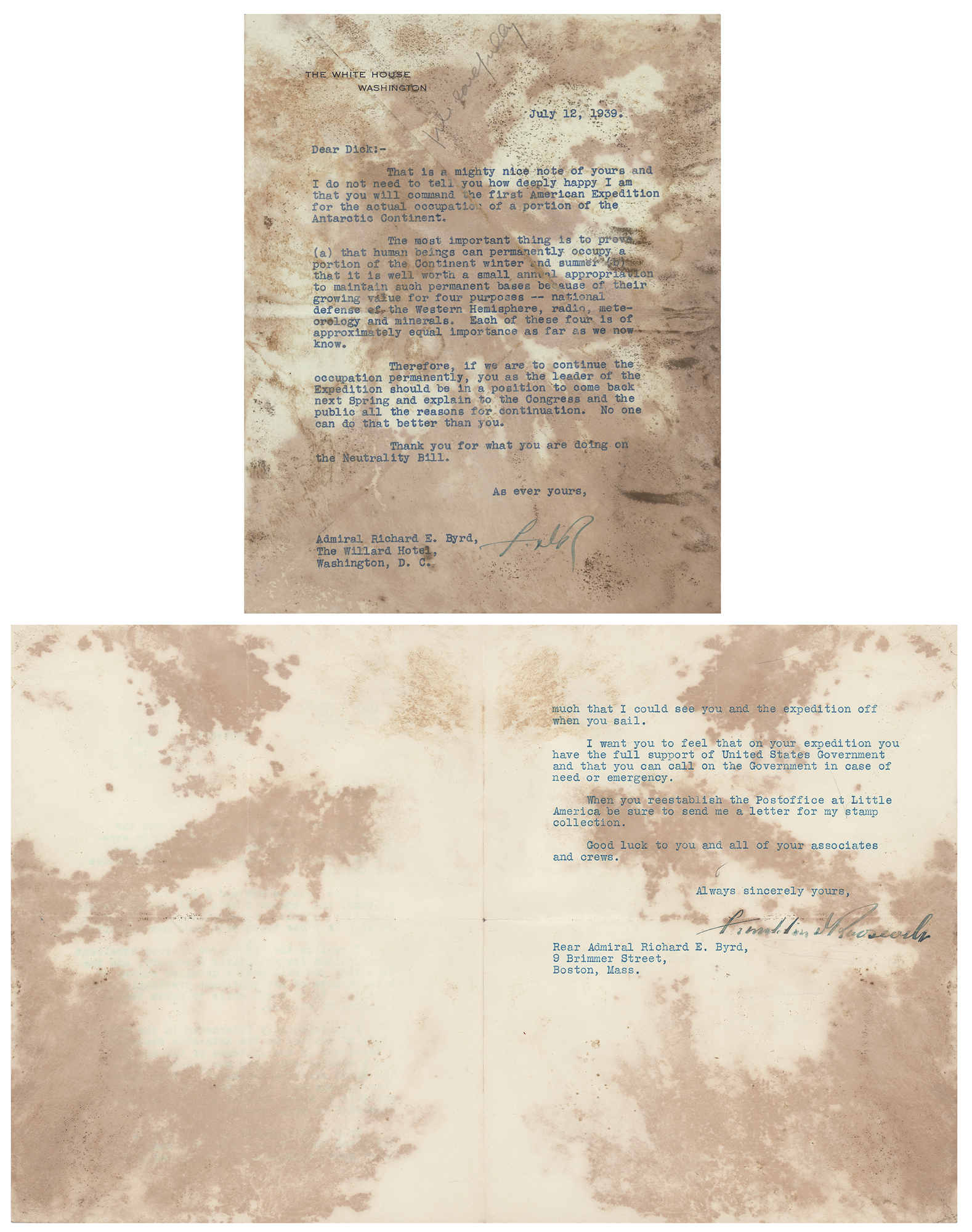
July 12, 1939 (signed "FDR"): "I do not need to tell you how deeply happy I am that you will command the first American Expedition for the actual occupation of a portion of the Antarctic Continent. The most important thing is to prove (a) that human beings can permanently occupy a portion of the Continent winter and summer (bookplate) that it is well worth a small annual appropriation to maintain such permanent bases because of their growing value for four purposes—national defense of the Western Hemisphere, radio, meteorology, and minerals. Each of these four is of approximately equal importance as far as we now know."
November 2, 1939 (signed "FDR"): "I am grateful for your work among the Republicans and Democrats in support of our neutrality position. I feel sure that we will win in the end, but we must not let up until a good majority in the house is assured."
September 19, 1940 (signed "Franklin D. Roosevelt"): "Last year when I asked you to take command of the United States Antarctic Service I did so in the knowledge that, despite the personal sacrifice which absence from the country at that tie would require of you, I could always count on your willingness unselfishly to serve your Government in case of need…You did much toward the difficult task of fitting the Antarctic Service into the existing departments of the Government. Because of the delay in the making of the appropriation you had to organize the expedition in one-fourth the time generally necessary for such undertakings. With the handicap of a short summer and therefore a short operating season, you established, pursuant to my instructions, two Antarctic Bases 1,500 miles apart, where valuable scientific and economic investigations are now being carried on. With one of the ships under your command, the U.S.S. 'Bear,' you penetrated into unknown and dangerous seas where important discoveries were made. You made noteworthy flights which resulted in the discovery of five new mountain ranges; five islands, more than 100,000 square miles of area, a large peninsula, and 700 miles of hitherto unknown stretches of Antarctic coast. You accomplished this without the loss of a single man…The operation of the United States Antarctic Service has been a credit to the Government of the United States and to your qualities as a leader of men. You already have all the medals it is within the power of this Government to give, and as it is contrary to custom to give two medals of the same kind to any officer, I am directing that in lieu of another medal you be awarded a gold star to be attached to the suspension ribbon of your Distinguished Service medal."
[September 1940] (signed "Franklin D. Roosevelt": "The President of the United States takes pleasure in presenting the Distinguished Service Medal Star to Rear Admiral Richard E. Byrd…For exceptionally meritorious and distinguished service in a duty of great responsibility as Commanding Officer of the U.S. Antarctic Service."
April 17, 1941 (signed "Franklin D. Roosevelt"): "I have received your letter of April 9 concerning funds for the completion of the work of the Antarctic Expedition and suggesting that I communicate with Mr. Johnson concerning the necessity for including funds in the 1942 Interior Department appropriation bill for this purpose. I am today transmitting to the Speaker of the House of Representatives a supplemental estimate in the amount of $19,610, together with the unexpended balance of the 1941 appropriation."
June 18, 1943 (signed "Franklin D. Roosevelt"): "I am deeply indebted to you for your thoughtfulness in sending me that framed South Polar chart, from which I have learned the location of those southernmost islands bearing my name."
November 10, 1944 (signed "Franklin D. Roosevelt"): "Thank you for your telegram of 9 November expressing the reaction by the people you meet over there to the results of the National Election."
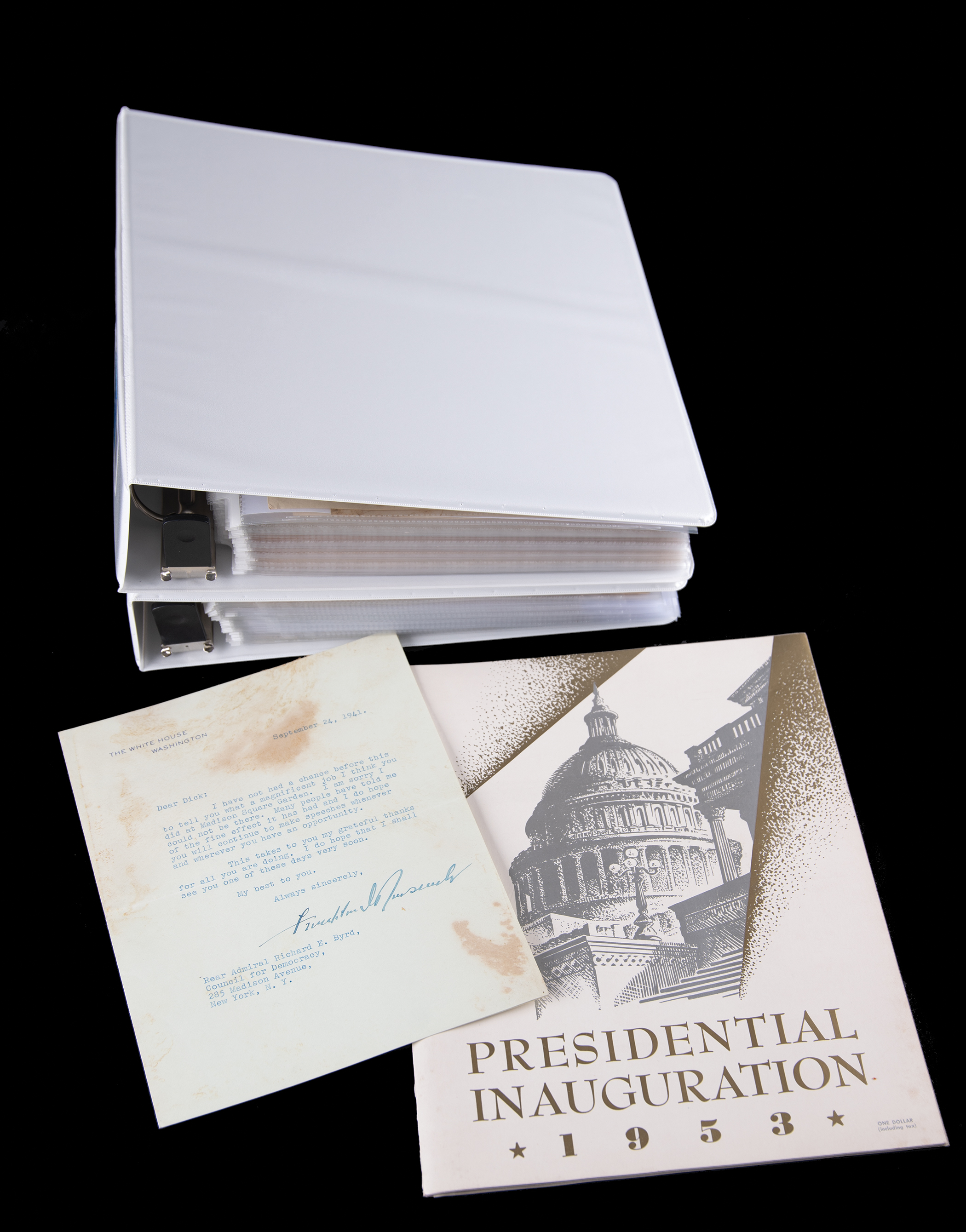
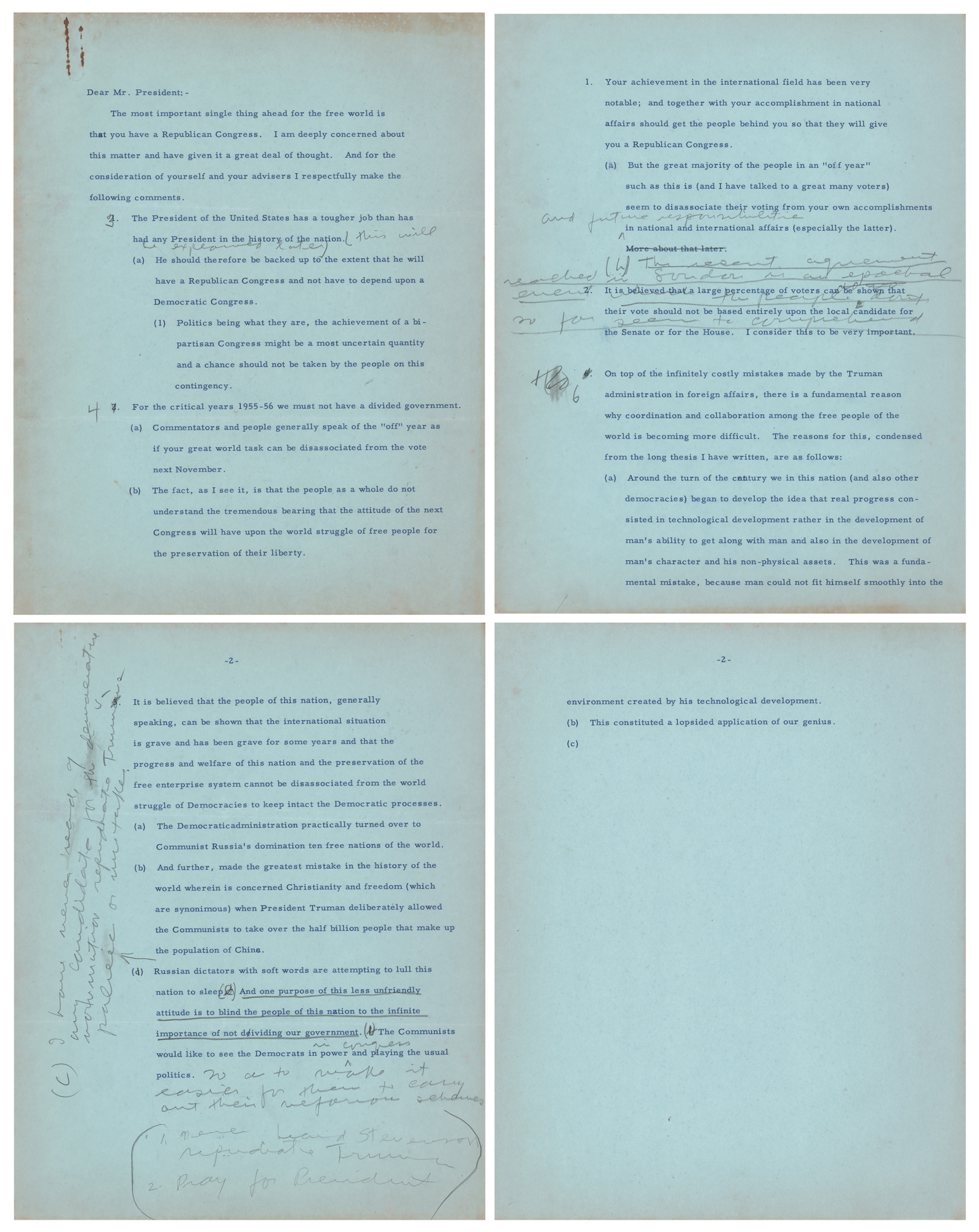
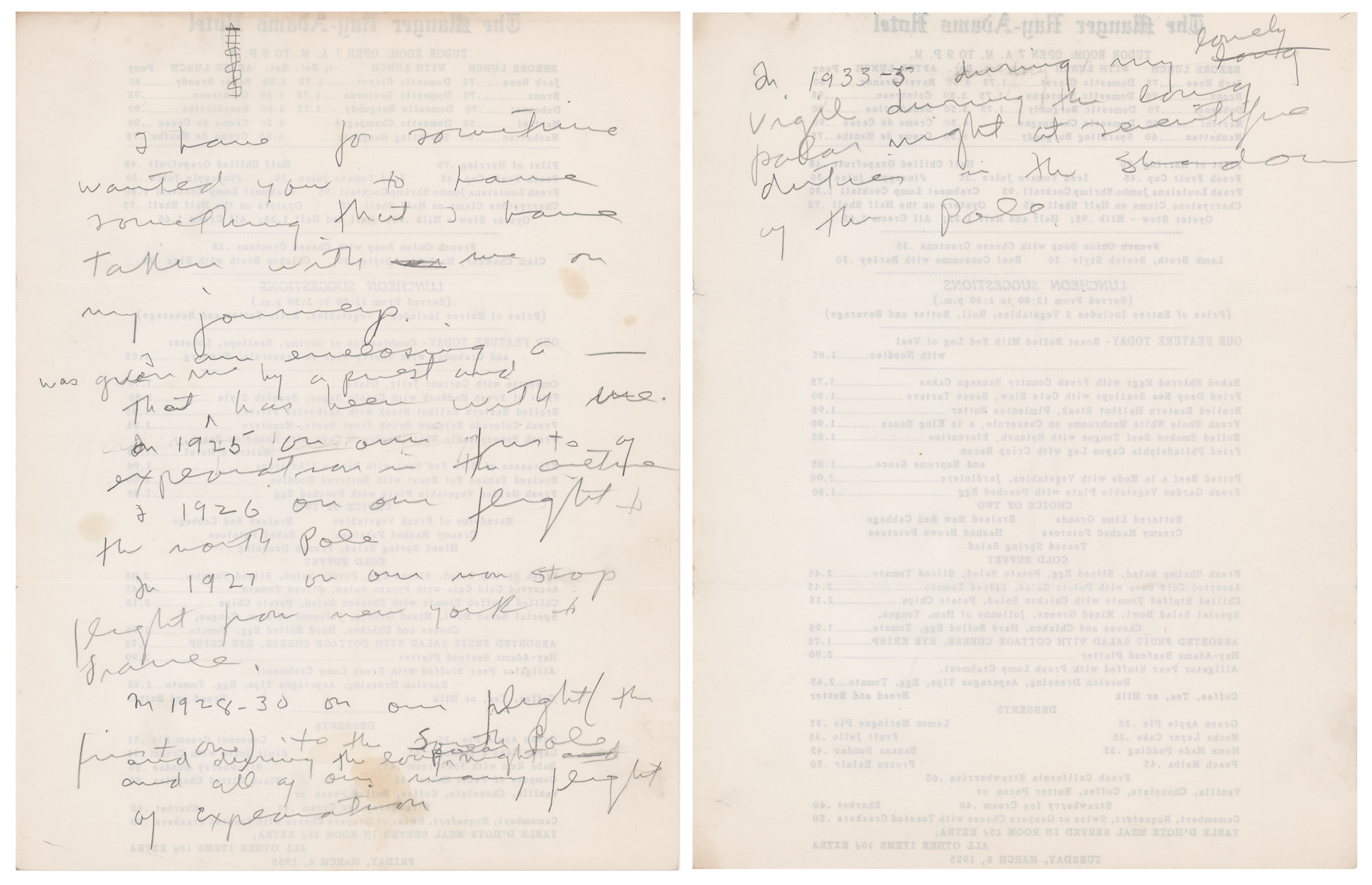
The archive additionally includes a binder of Byrd's retained typescripts of sent letters, mostly to President Eisenhower, with a few pages incorporating Byrd's own handwritten notes and amendments. A third binder carries Byrd's retained ephemera from Dwight D. Eisenhower's presidential inauguration in 1953, including official programs, tickets to the "Inauguration Ceremonies" and "Inaugural Ball," and some official correspondence.
In overall poor to very good condition, with pervasive dampstaining, foxing, toning, fading, and discoloration throughout; large portions of the autograph letters are difficult to decipher. Despite the extensive condition issues, the presidential signatures and initials generally remain visible, with many retaining strong contrast.
Far more significant than routine political correspondence, the archive documents Byrd’s sustained access to the highest levels of American government across nearly three decades. Roosevelt’s letters move easily between personal friendship, Antarctic exploration, aviation, naval affairs, electoral politics, and international diplomacy, frequently addressing Byrd as “Dick” and welcoming his advice. Eisenhower’s letters continue that relationship into the 1950s, recognizing not only Byrd’s achievements as an explorer but also his contributions to the Republican Party.
Richard E. Byrd (1888–1957) was one of the most celebrated American explorers of the 20th century, renowned for his pioneering polar flights and leadership of major expeditions to Antarctica. A naval aviator and Medal of Honor recipient, he became an influential advocate for polar research and maintained close relationships with several presidential administrations. His correspondence with Roosevelt and Eisenhower reflects his unusual position as both a heroic public figure and a trusted adviser on exploration, strategy, and international affairs.

