The 30 Minute Rule begins August 12 at 7:00 PM EDT. An Initial Bid Must Be Placed By August 12 at 6:00 PM EDT To Participate After 6:00 PM EDT
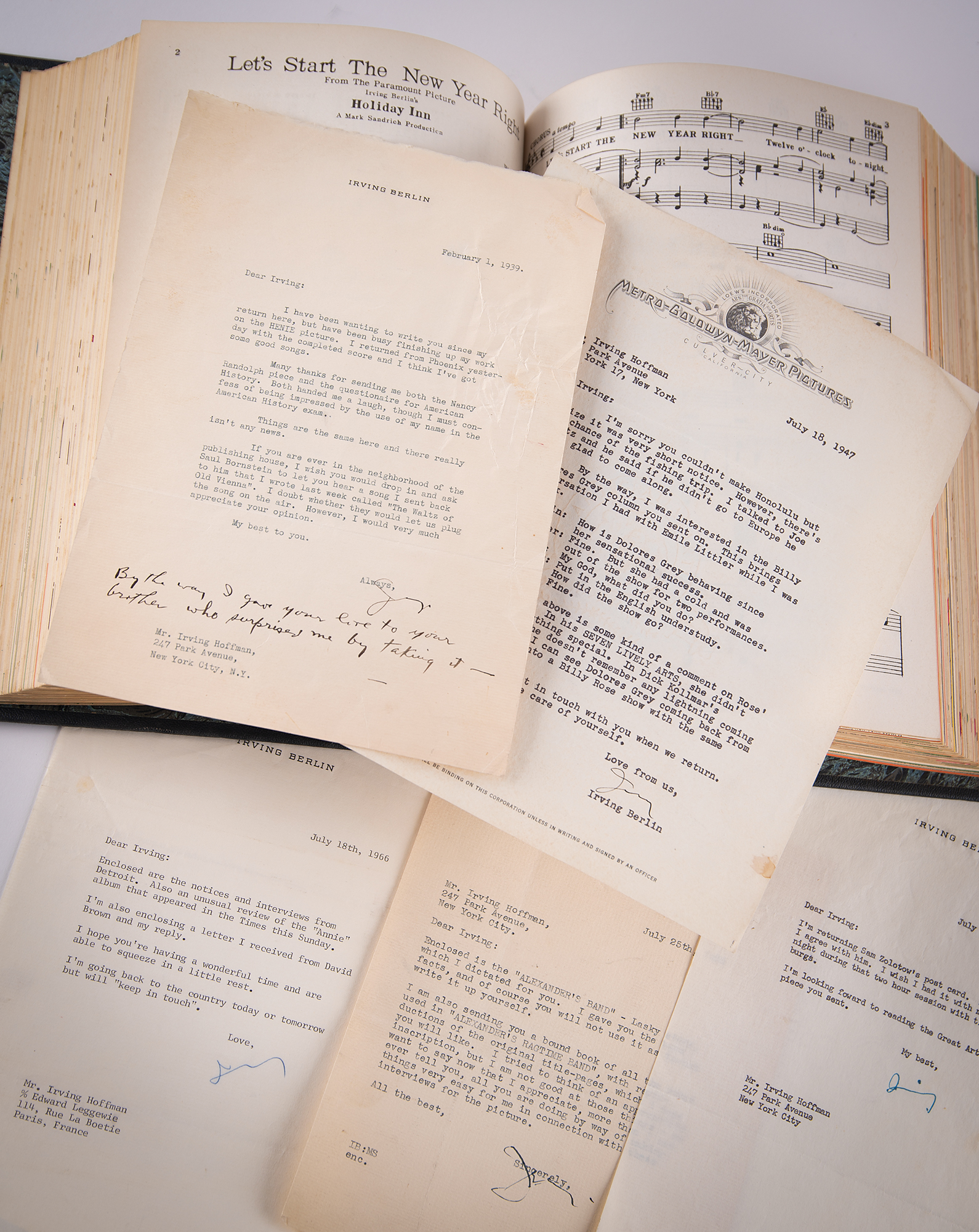
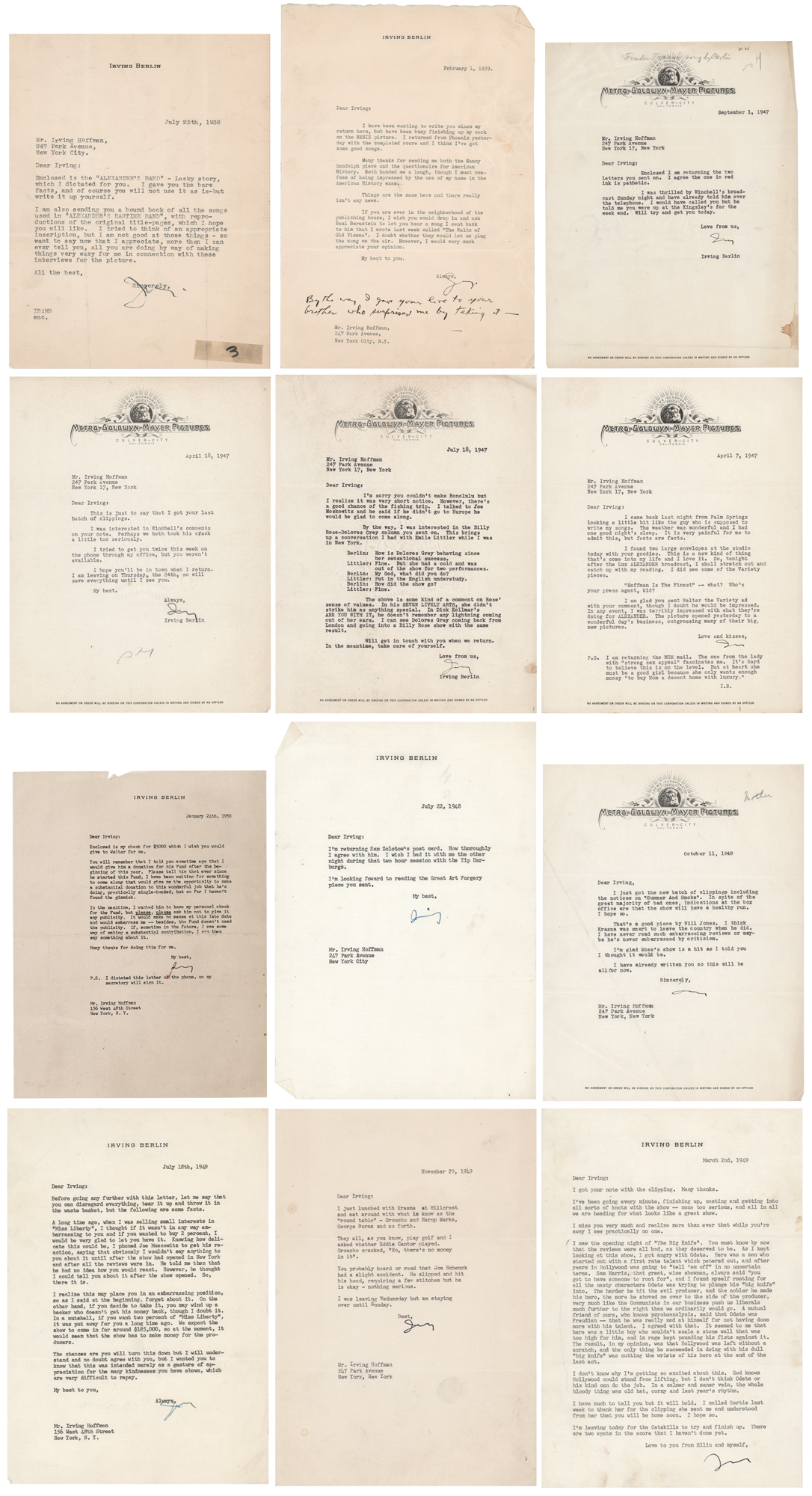
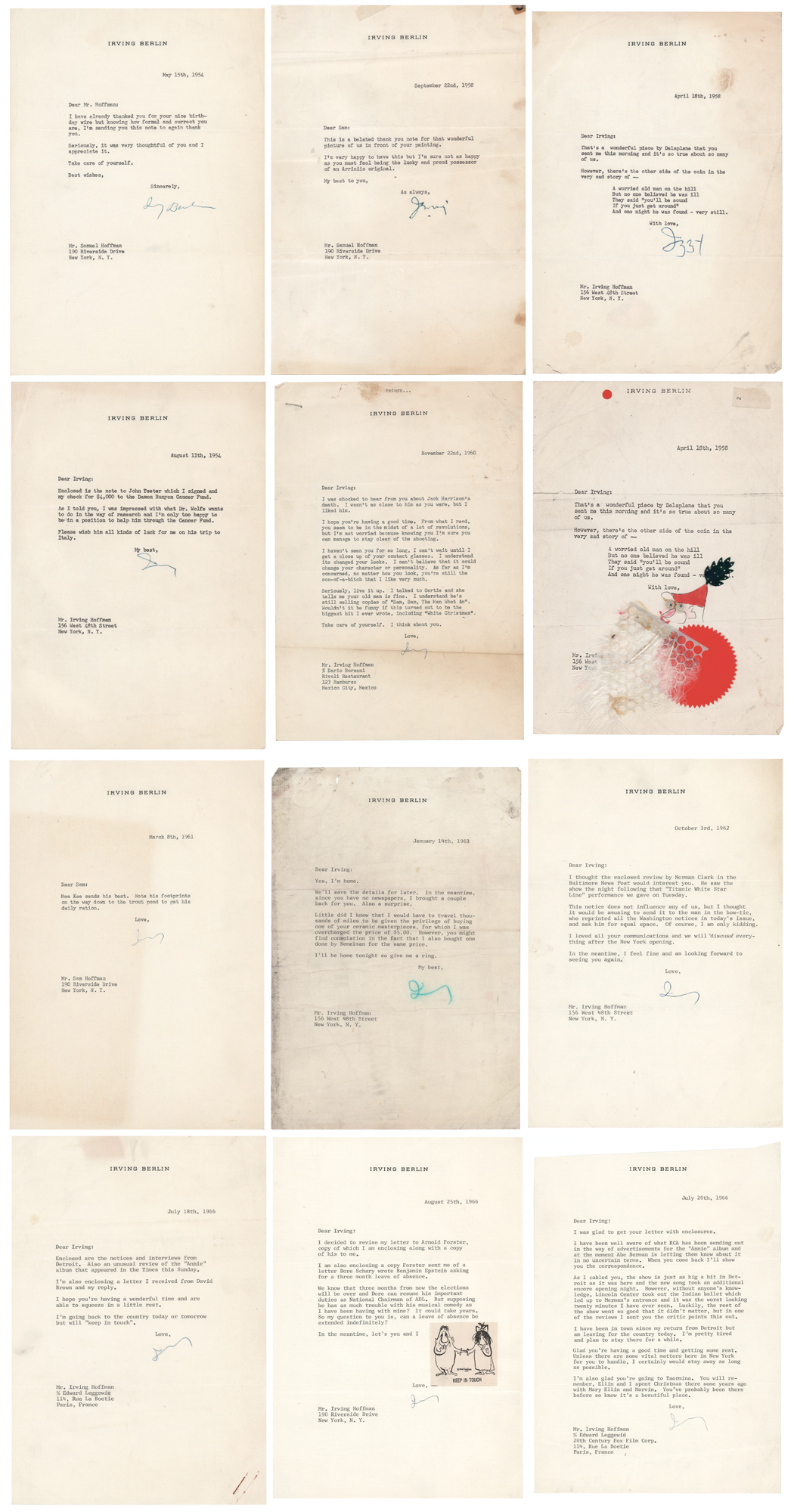
Archive of 24 typed letters from Irving Berlin to his best friend, Irving Hoffman, and his father, Sam Hoffman, most signed "Irving" (with one signed "Irving Berlin" and two signed "Izzy"), all one page, Metro-Goldwyn-Mayer Pictures and personal letterheads, dated from 1938 to 1966. Berlin's letters offer a warm and often witty candid record of Berlin’s career on Broadway and in Hollywood, his handling of publicity, his philanthropy, and his friendships over nearly three decades. One letter, dated January 24, 1950, is noted in a typed postscript as having been signed by his secretary. Additionally includes three albums signed by Berlin, and a signed collection of his sheet music.
The correspondence opens with a strong Alexander’s Ragtime Band letter of July 25, 1938, in which Berlin forwards material for publicity: “Enclosed is the ‘ALEXANDER’S BAND’—Lasky story, which I dictated for you,” adding that he is sending “a bound book of all the songs used in ‘ALEXANDER’S RAGTIME BAND,’ with reproductions of the original title-pages.” In a February 1, 1939 letter, he writes while finishing work on a Sonja Henie picture: “I returned from Phoenix yesterday with the completed score and I think I’ve got some good songs,” and asks Hoffman to hear “a song I sent back…called ‘The Waltz of Old Vienna.’”
The MGM-era letters are especially colorful. Writing on April 7, 1947, Berlin jokes, “The weather was wonderful and I had one good night’s sleep. It is very painful for me to admit this, but facts are facts,” before praising the reception for Alexander: “The picture opened yesterday to a wonderful day’s business, outgrossing many of their big, new pictures.” Other MGM letters mention Walter Winchell, Billy Rose, Dolores Gray, Emile Littler, and Hollywood publicity clippings.
A superb March 2, 1949 letter finds Berlin in unusually frank form after seeing the opening night of Clifford Odets’s The Big Knife. Berlin writes that the reviews “were all bad, as they deserved to be,” and offers a sharp critique of Odets’s treatment of Hollywood, concluding that the play “was old hat, corny and last year’s rhythm.” In the same year, Berlin offers Hoffman a private opportunity to buy “two percent of ‘Miss Liberty,’” explaining that the show was expected to come in for around $185,000 and that the gesture was intended as appreciation for Hoffman’s kindnesses.
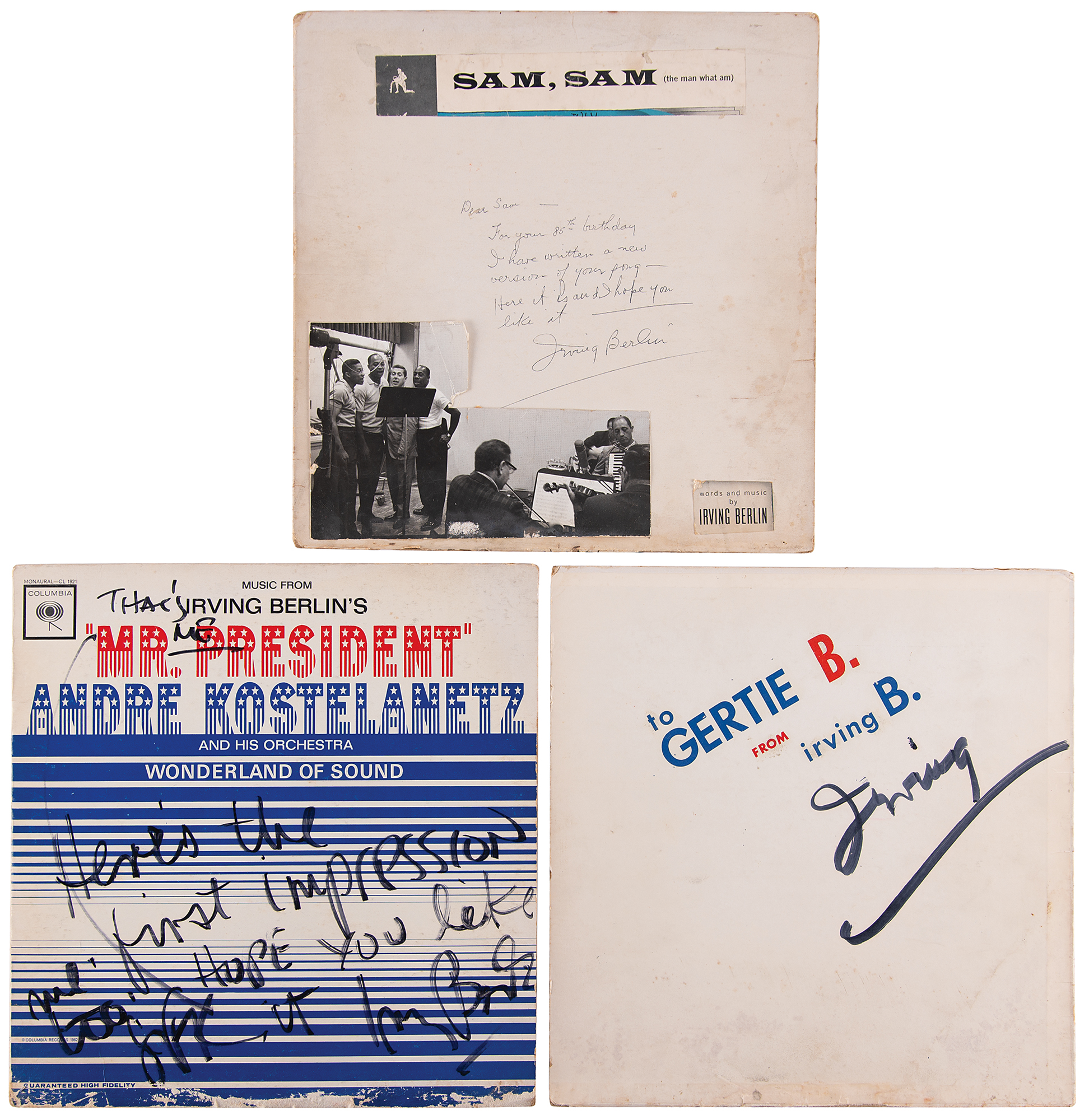
In a 1960 letter, he reflects on Jack Harrison’s death and jokes about the song "Sam, Sam, The Man What Am," which he annually re-wrote to celebrate Sam Hoffman's birthday: "I talked to Gertie and she tells me your old man is fine. I understand he's still selling copies of 'Sam, Sam, The Man What Am.' Wouldn't it be funny if this turned out to be the biggest hit I ever wrote, including 'White Christmas.'" The archive notably includes two rare acetate pressings of the song in sleeves custom-made by Irving Berlin, one signed and inscribed in ballpoint to the song's subject: "Dear Sam—For your 85th birthday I have written a new version of your song—Here it is and I hope you like it—Irving Berlin." The other sleeve has an applied presentation inscription to "Gertie B.," signed below in thick black felt tip, "Irving."
Other highlights include Berlin mentioning a lunch with “the ‘round table’—Groucho and Harpo Marx, George Burns and so forth”; a 1954 letter enclosing a $4,000 check for the Damon Runyon Cancer Fund; a 1962 letter referring to a rough out-of-town performance as a “‘Titanic White Star Line’ performance”; two versions of an April 18, 1958 letter containing Berlin’s wry verse about “a worried old man on the hill,” one example decorated with an affixed handmade Santa figure; and several 1966 letters concerning Annie Get Your Gun, RCA advertising for the “Annie” album, Abe Berman, Ethel Merman’s entrance, Detroit notices, and related publicity.
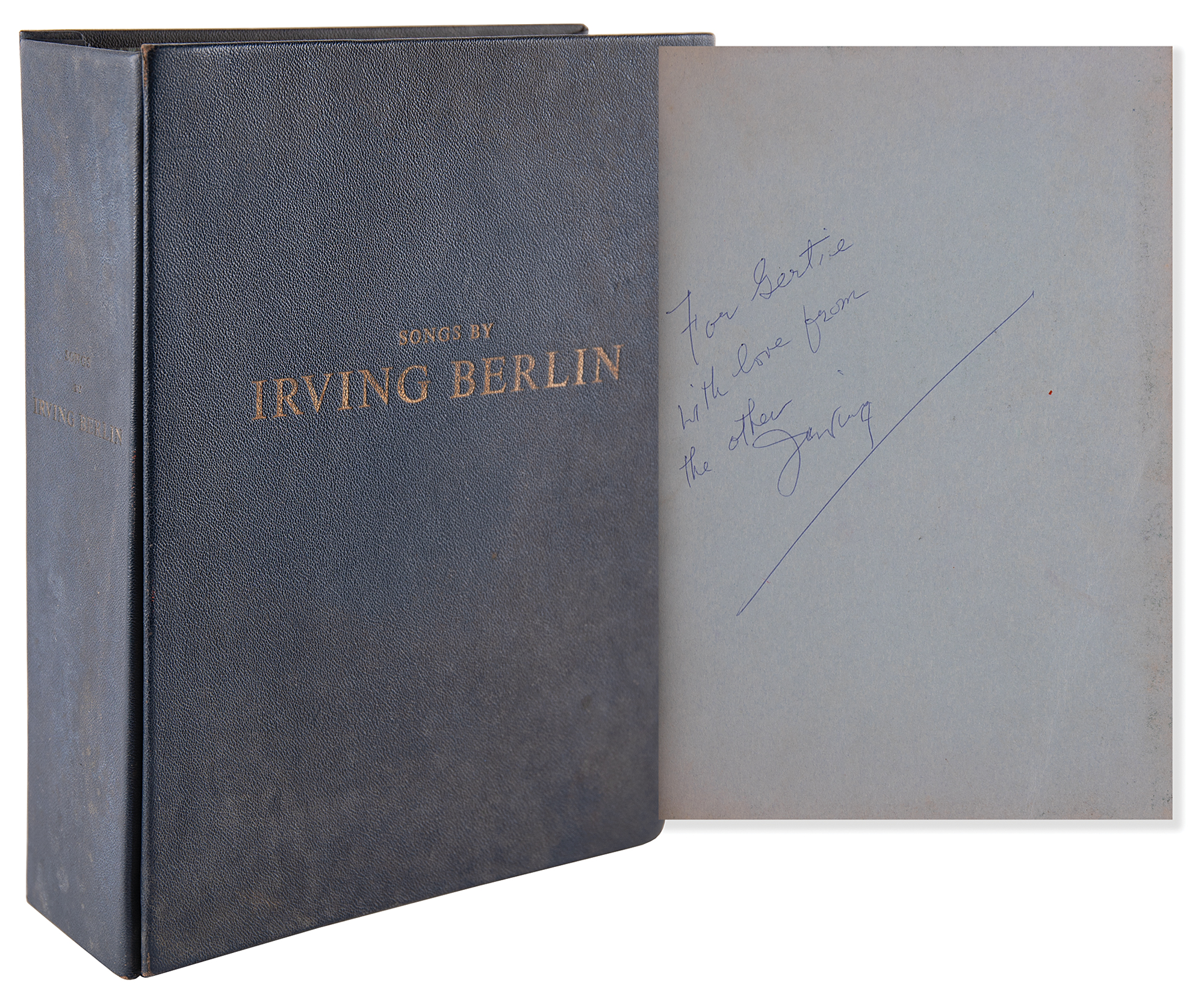
Additionally includes a Columbia Records sleeve for Music from Irving Berlin's 'Mr. President,' prominently signed on the front in black felt tip, "Here's the first impression, hope you like it, Irving Berlin," with two promo vinyl records inside. The sheet music collection, bound together in an oversized, gilt-edged volume, is signed and inscribed on the first free end page in blue ballpoint, "For Gertie, with love from the other Irving."
In overall very good to fine condition, with expected mailing folds, scattered toning and soiling, small chips and tears, paperclip and staple marks, and heavier wear to a few letters; the signatures remain generally bold and attractive. Accompanied by a color print of one of Berlin's artworks featuring an image of him and Hoffman at center, and a color print of one of Hoffman's caricatures of Berlin.
Irving Hoffman was a New York journalist, publicist, and press agent with deep ties to Broadway, Hollywood, and the entertainment industry, whose column in the 'Hollywood Reporter' and personal connections made him a useful confidant. A remarkably broad and intimate Irving Berlin archive, tracing his private voice from the Alexander’s Ragtime Band era through Miss Liberty, Hollywood commentary, charitable work, and the later Annie Get Your Gun revival period.

