The 30 Minute Rule begins December 9 at 7:00 PM EST. An Initial Bid Must Be Placed By December 9 at 6:00 PM EST To Participate After 6:00 PM EST
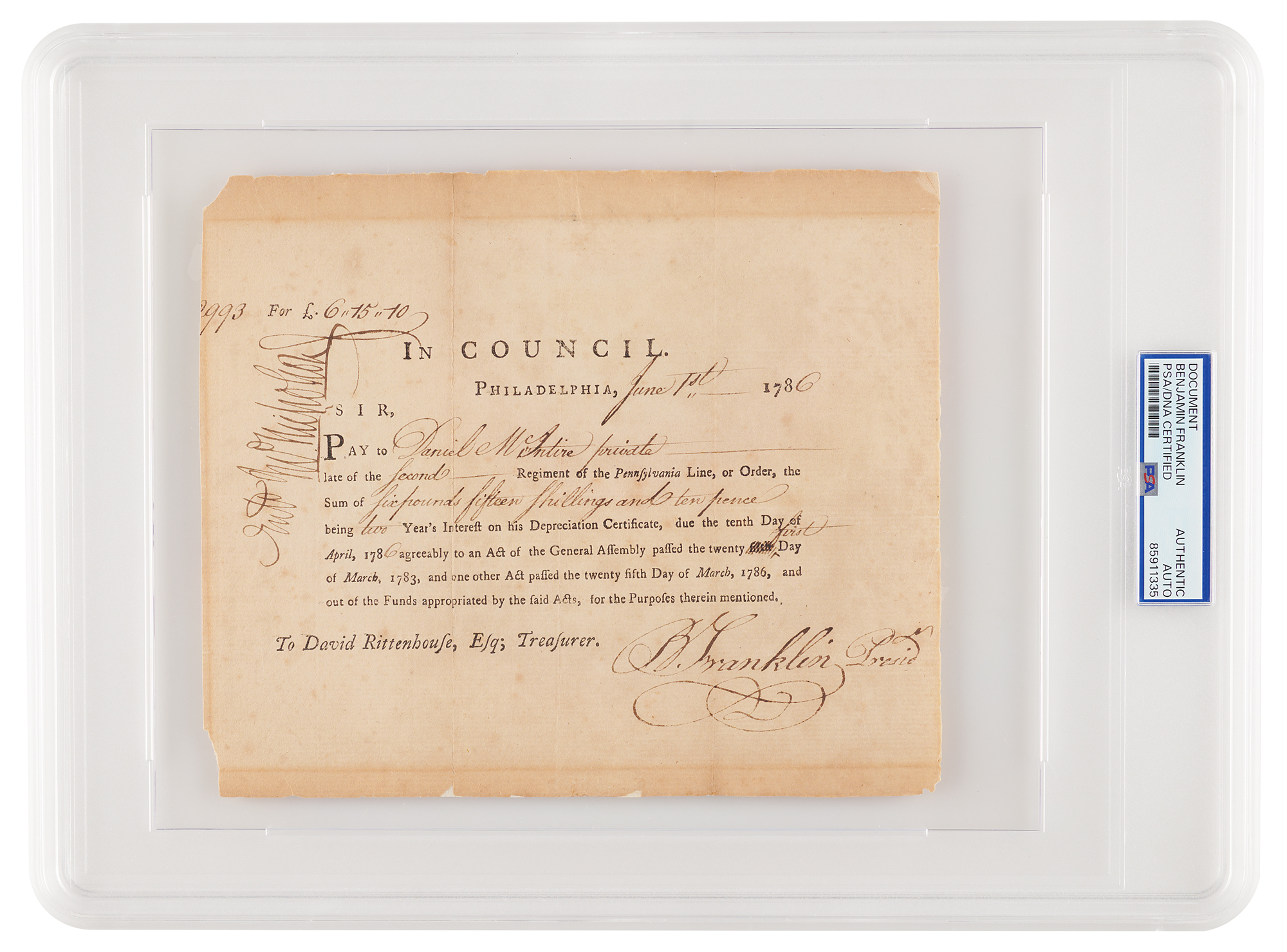
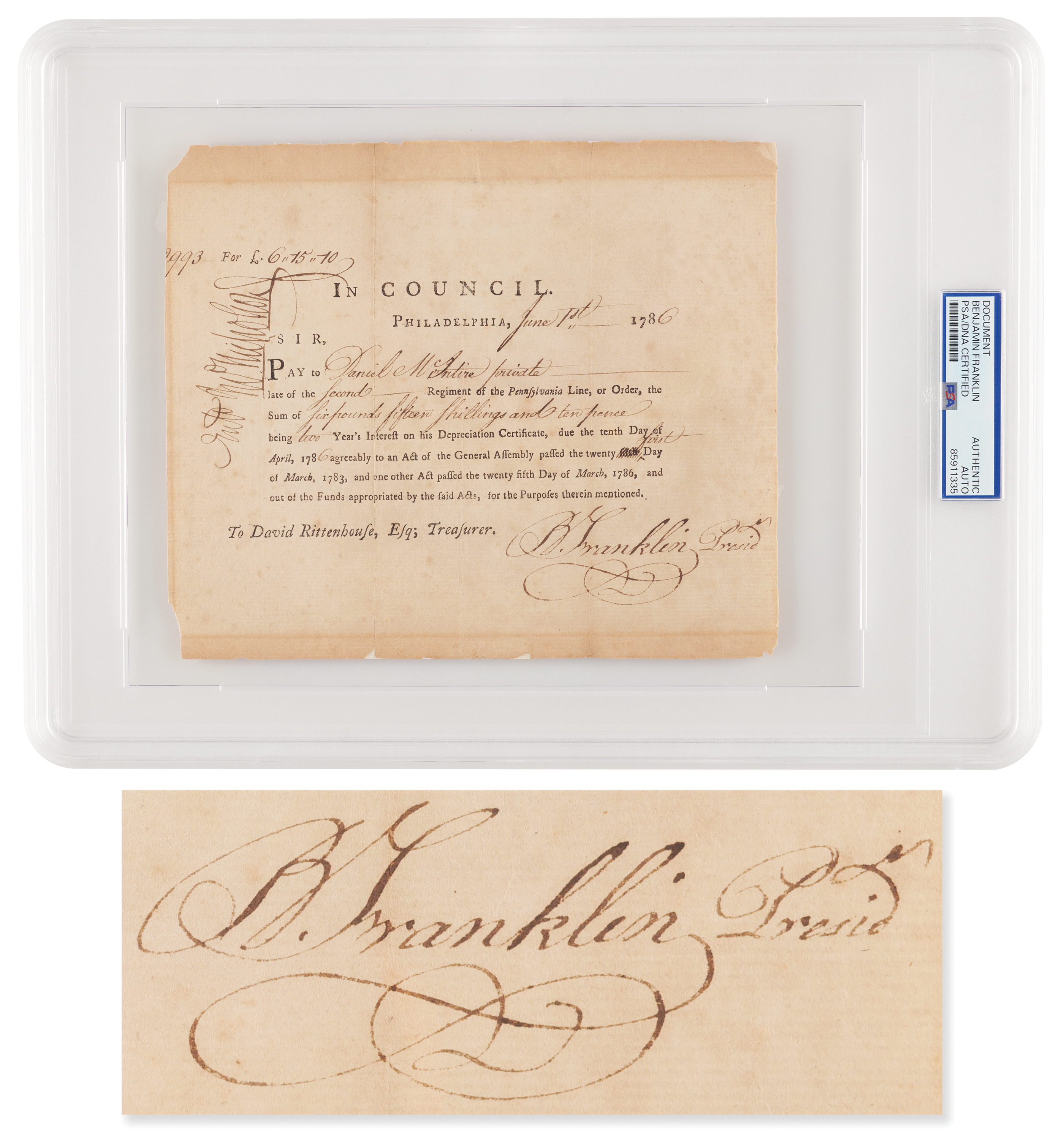
Partly-printed DS, signed “B. Franklin, Presid't,” one page, 7.75 x 6.75, June 1, 1786. As president of Pennsylvania’s Supreme Executive Council, Benjamin Franklin approves an order directing state treasurer David Rittenhouse to pay Daniel McIntire, a private in the Second Regiment of the Pennsylvania Line, the sum of £6.15.10, representing two years’ interest on his depreciation certificate due April 10, 1786. The document cites acts of the Pennsylvania General Assembly passed in March 1783 and March 1786 authorizing payment from funds appropriated for that purpose. Boldly signed at the conclusion by Franklin as council president. In fine condition, with minor edge loss and light toning from prior display. Encapsulated in a PSA/DNA authentication holder.
Pennsylvania issued Depreciation Pay Certificates to compensate Continental soldiers for wages whose value had been eroded by the severe depreciation of wartime currency. The state’s continuing obligations required subsequent appropriations to meet interest payments, including the acts of the General Assembly cited in this document. Franklin signed the document during his first term as president of Pennsylvania’s Supreme Executive Council, the state’s chief executive body under the Constitution of 1776. Elected to the presidency in October 1785, the 80-year-old Franklin would serve three consecutive one-year terms, remaining in office until 1788.
The payment came amid the severe financial difficulties confronting the United States under the Articles of Confederation. Revolutionary War debts burdened both the states and the national government, while Congress lacked an independent power to levy taxes and depended upon state contributions to meet its obligations. Disputes over taxation and debt contributed to Shays’ Rebellion in Massachusetts beginning later in 1786, while concerns over the weaknesses of the Confederation government brought delegates to the Annapolis Convention that September. That meeting called for a new convention in Philadelphia the following year to consider changes to the federal system. Franklin would attend the resulting Constitutional Convention in 1787 as Pennsylvania’s senior delegate, participating at age 81 in the framing of the new Constitution.

