Sold For $7,499
*Includes Buyers Premium
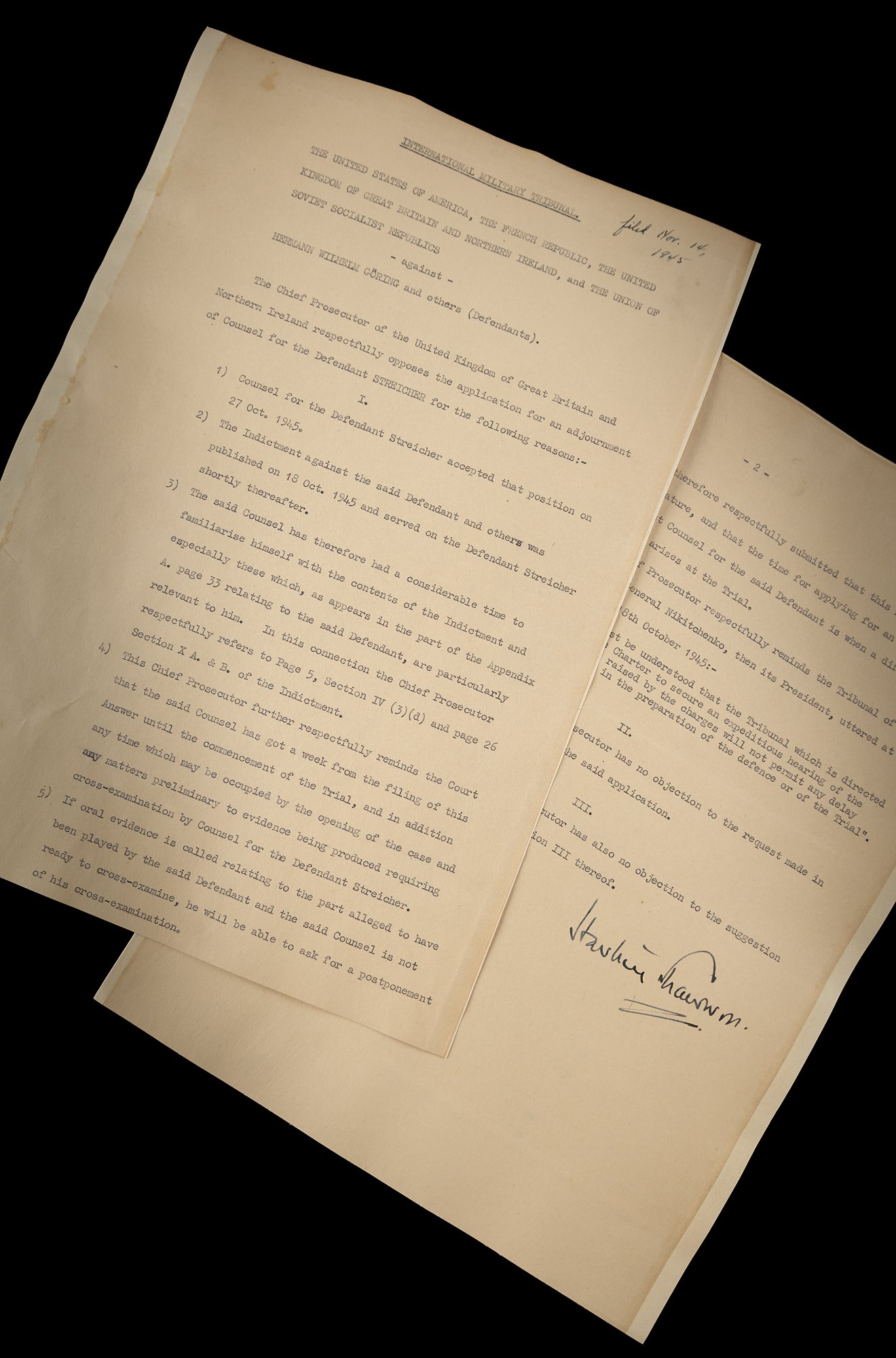
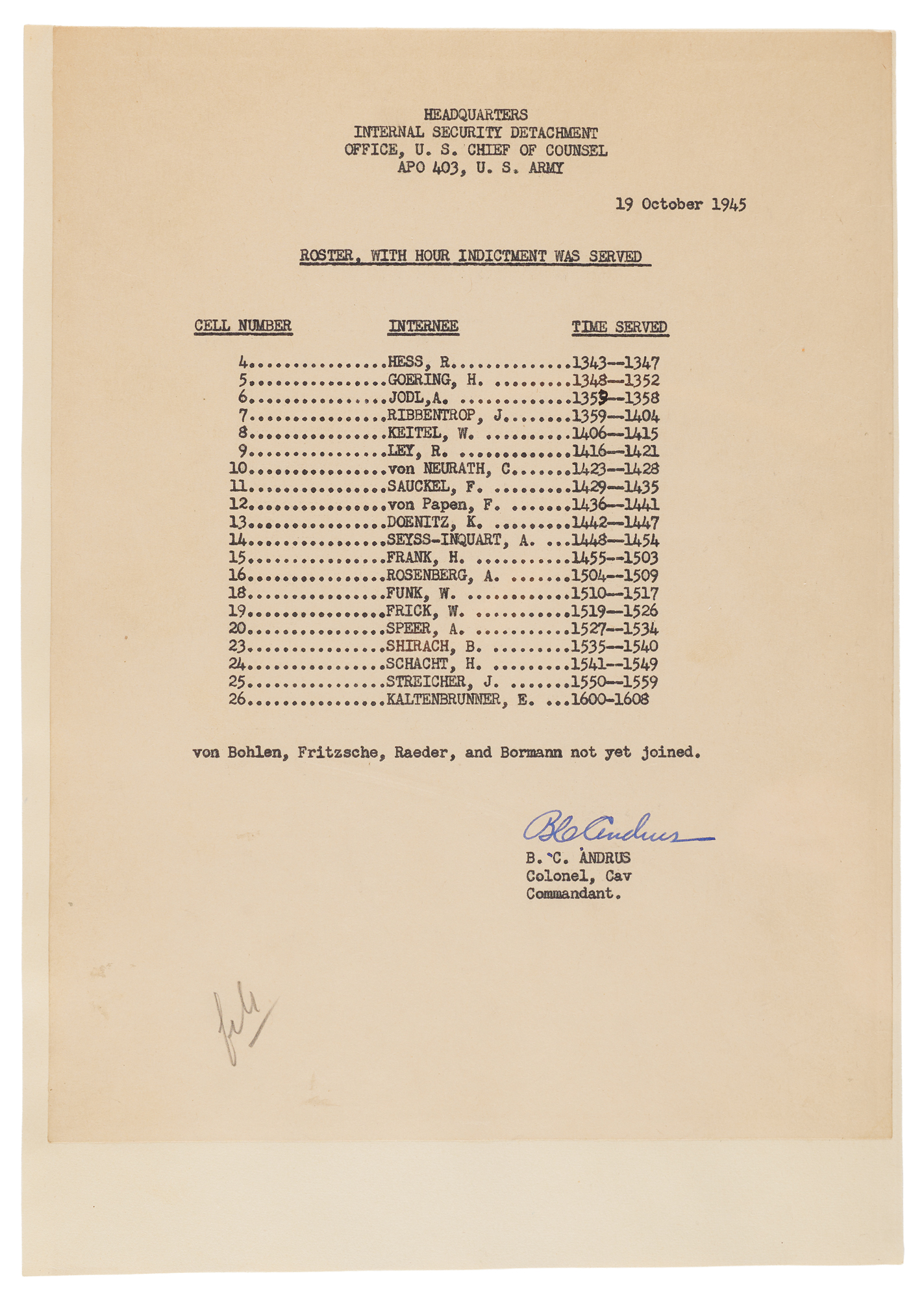
British barrister (1902–2003) who acted as the lead British prosecutor at the Nuremberg War Crimes tribunal, who famously said: 'There comes a point when a man must refuse to answer to his leader if he is also to answer to his own conscience.' Extraordinary Nuremberg artifact pairing an original prison roster of the Nazi high command in custody with a signed tribunal filing from the British Chief Prosecutor. The reverse of the document carries a Nuremberg Prison roster signed by commandant Burton C. Andrus, "B. C. Andrus," dated October 19, 1945, listing each internee, their cell number, and the time that their indictment was served. Among the prisoners listed are Rudolf Hess, Hermann Goering, Alfred Jodl, Karl Doenitz, Joachim von Ribbentrop, and Wilhelm Keitel.
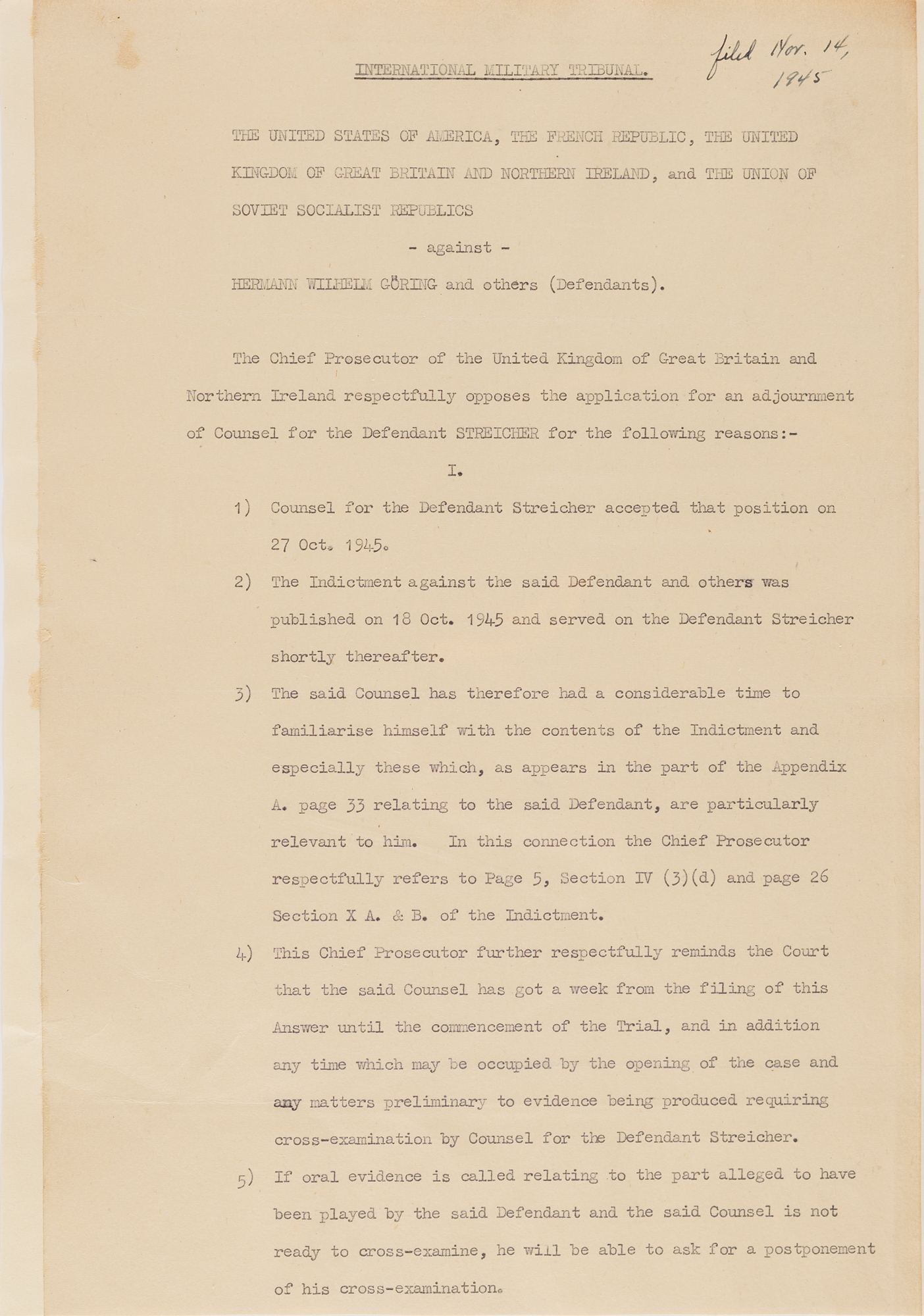
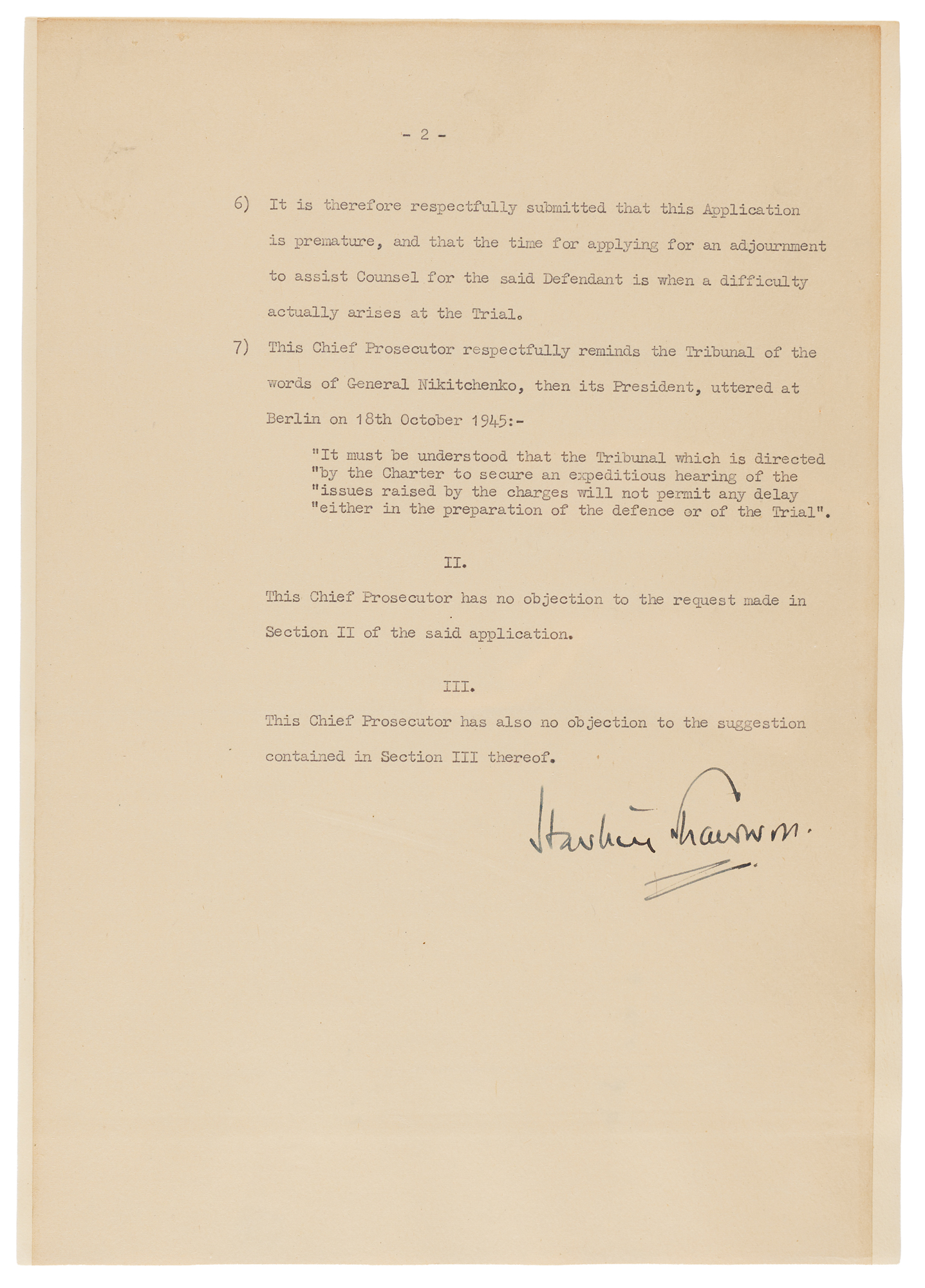
Affixed to the front is a DS signed "Hartley Shawcross," two pages, 8 x 11.75, marked as "filed, Nov. 14, 1945." Document headed, "International Military Tribunal. The United States of America, the French Republic, the United Kingdom of Great Britain And Northern Ireland, and the Union of Soviet Socialist Republics—against—Hermann Wilhelm Göring and Others (Defendants)," concerning the indictment of Nazi propagandist Julius Streicher. Shawcross (1902–2003) acted as the lead British prosecutor at the Nuremberg War Crimes tribunal, who famously said: "There comes a point when a man must refuse to answer to his leader if he is also to answer to his own conscience."
In part: "The Chief Prosecutor of the United Kingdom of Great Britain and Northern Ireland respectfully opposes the application for an adjournment of Counsel for the Defendant Streicher for the following reasons:—
1) Counsel for the Defendant Streicher accepted that position on 27 Oct. 1945.
2) The Indictment against the said Defendant and others was published on 18 Oct. 1945 and served on the Defendant Streicher shortly thereafter.
3) The said Counsel has therefore had a considerable time to familiarise himself with the contents of the Indictment and especially these which, as appears in the part of the Appendix A. page 33 relating to the said Defendant, are particularly relevant to him. In this connection the Chief Prosecutor respectfully refers to Page 5, Section IV (3) (d) and page 26 Section X A. & B. of the Indictment.
4) This Chief Prosecutor further respectfully reminds the Court that the said Counsel has got a week from the filing of this Answer until the commencement of the Trial, and in addition any time which may be occupied by the opening of the case and any matters preliminary to evidence being produced requiring cross-examination by Counsel for the Defendant Streicher.
5) If oral evidence is called relating to the part alleged to have been played by the said Defendant and the said Counsel is not ready to cross-examine, he will be able to ask for a postponement of his cross-examination.
6) It is therefore respectfully submitted that this Application is premature, and that the time for applying for an adjournment to assist Counsel for the said Defendant is when a difficulty actually arises at the Trial.
7) This Chief Prosecutor respectfully reminds the Tribunal of the words of General Nikitchenko, then its President, uttered at Berlin on 18th October 1945:—'It must be understood that the Tribunal which is directed by the Charter to secure an expeditious hearing of the issues raised by the charges will not permit any delay either in the preparation of the defence or of the Trial.'"
Each page is affixed to a slightly larger cardstock sheet. In fine condition.
The prison roster, signed by Nuremberg jailer Burton Andrus, captures the extraordinary moment at the very beginning of the International Military Tribunal: the leading figures of the Third Reich—Göring, Hess, Ribbentrop, Keitel, and others—were now prisoners awaiting trial under a new system of international law, each defendant logged by cell and by the precise hour his indictment was served. The Shawcross filing, dated weeks later, reflects the Allies' determination to avoid procedural delay and to demonstrate that the trials would be both fair and efficient. The insistence on denying an adjournment to Julius Streicher's counsel underscores how the Tribunal balanced due process with its mandate, articulated by Soviet judge Iona Nikitchenko, to ensure an "expeditious hearing."
In the case of Julius Streicher, the outcome would become one of the most historically significant aspects of Nuremberg. Unlike many defendants, Streicher was not a military commander or government administrator; he was a propagandist, publisher of the virulently antisemitic newspaper Der Stürmer. The Tribunal ultimately convicted him not for direct participation in planning or executing the war, but for crimes against humanity—specifically, for inciting hatred and persecution that contributed to the Holocaust. His conviction and execution in October 1946 established a lasting precedent: that sustained propaganda and incitement to genocide can constitute criminal responsibility under international law. This marked a critical expansion of legal accountability beyond those who physically carried out atrocities to include those who helped create the ideological conditions that made them possible.

