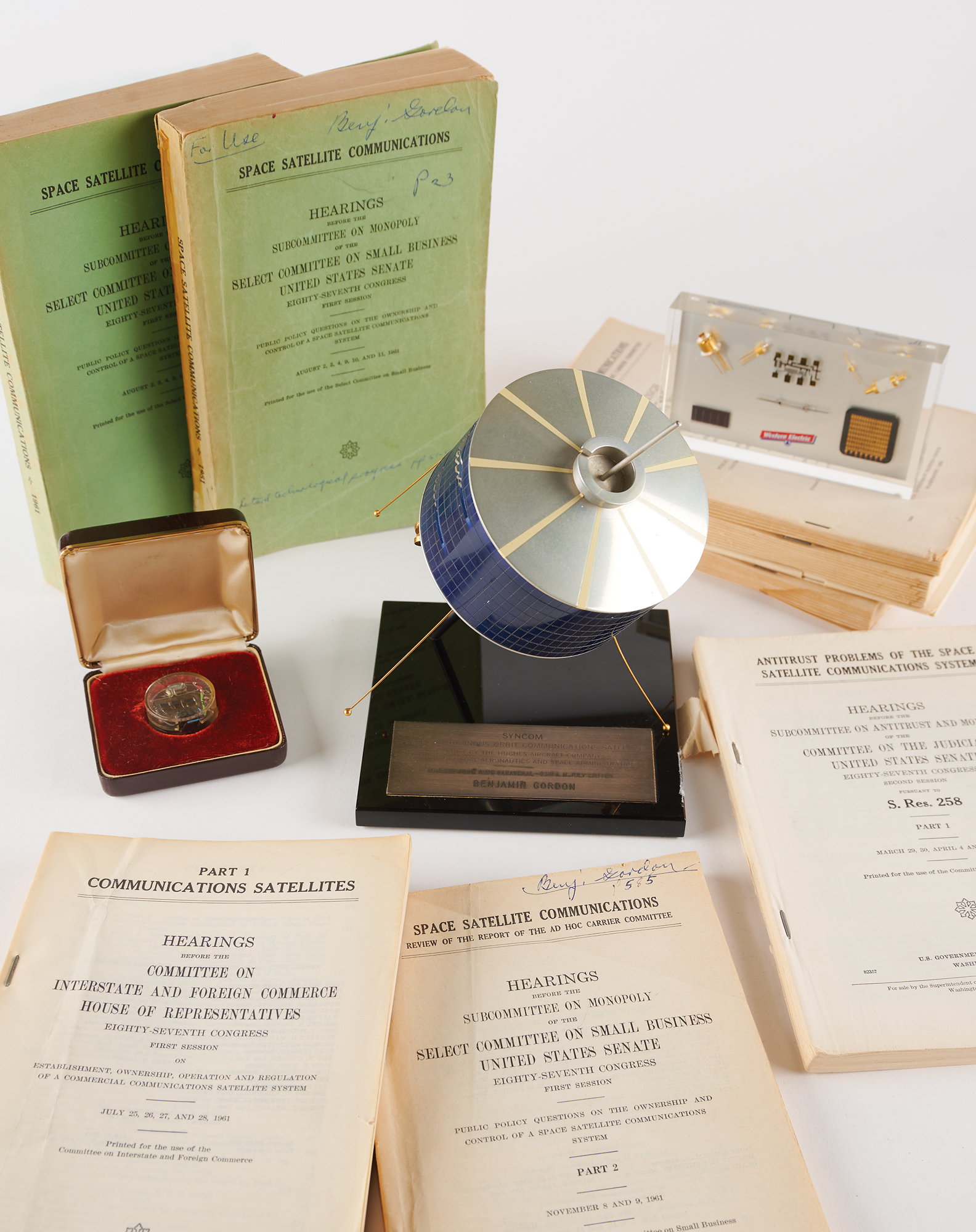
Collection of artifacts, technical demonstration pieces, presentation models, and congressional hearing records from the estate of Benjamin Gordon, Staff Economist of the U.S. Senate Select Committee on Small Business, assembled during the formative years of the American communications satellite program between 1961 and 1963. The collection reflects Gordon's direct involvement in congressional investigations and hearings concerning the future of satellite communications and includes contemporary policy documents, Bell System technology demonstrations, and aerospace presentation pieces associated with the emergence of commercial space-based communications.
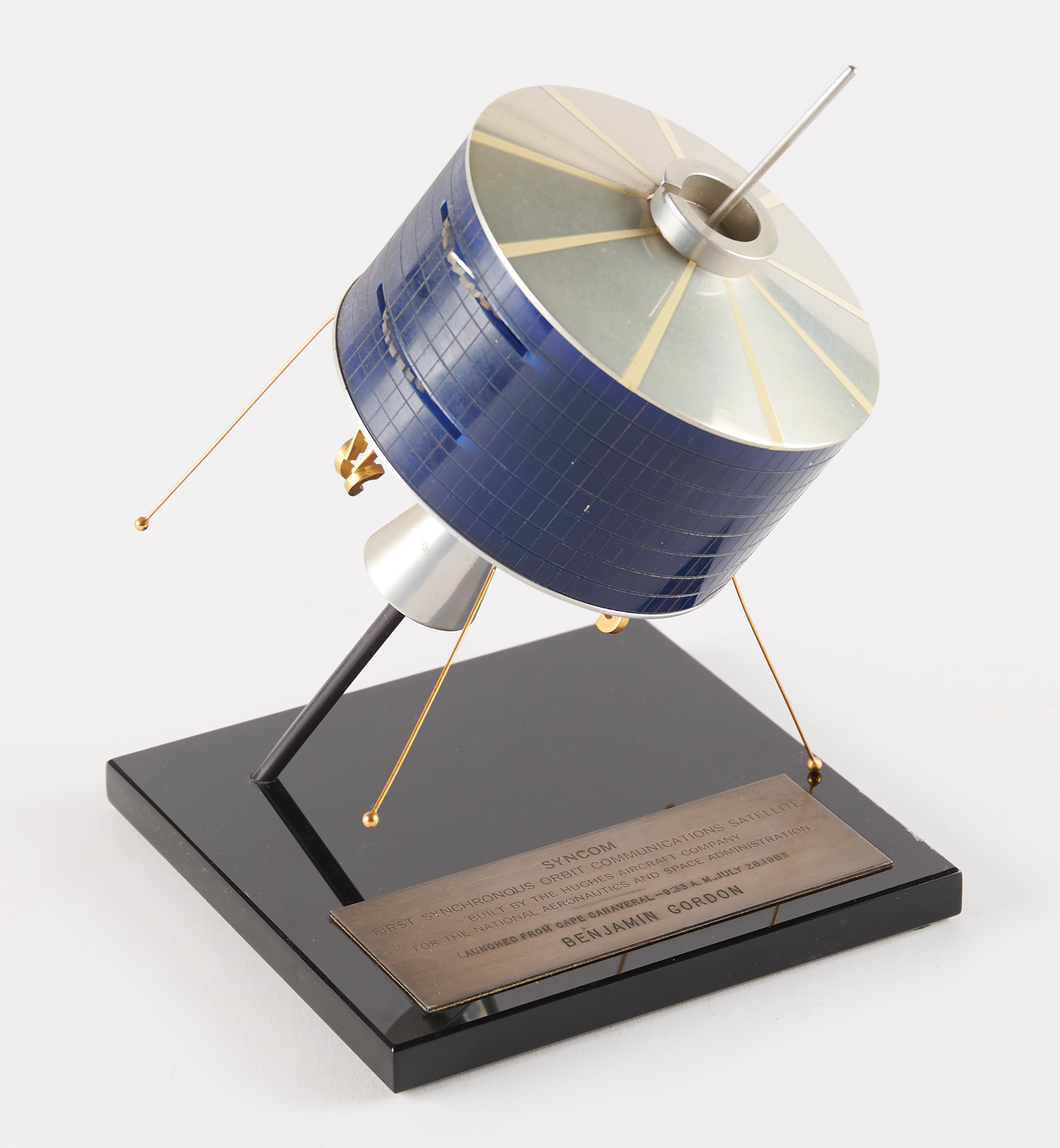
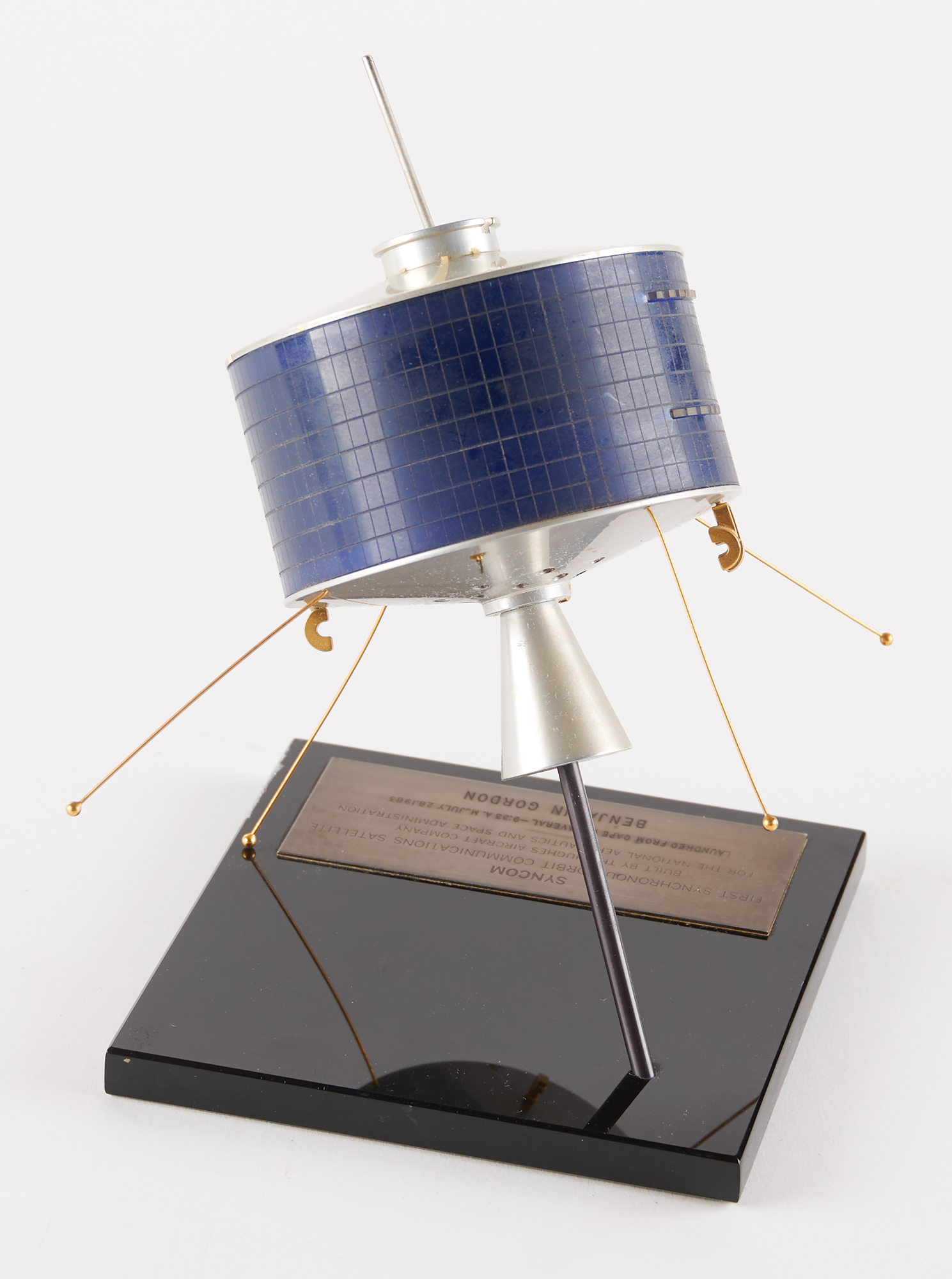
A centerpiece of the collection is a Hughes Aircraft presentation model of the Syncom 2 communications satellite, measuring 7.5˝ tall and 8˝ across, mounted on a 5.5˝ x 5.5˝ display base with an engraved plaque: “Syncom / First Synchronous Orbit Communications Satellite / Built by the Hughes Aircraft Company for the National Aeronautics and Space Administration / Launched from Cape Canaveral, 9:33 A.M., July 26, 1963 / Benjamin Gordon.” Syncom 2 demonstrated the feasibility of communications from geosynchronous orbit, establishing the technological foundation for the global satellite communications networks that followed. The model faithfully reproduces the spacecraft's cylindrical, solar-cell-covered design and incorporates a built-in AM radio.
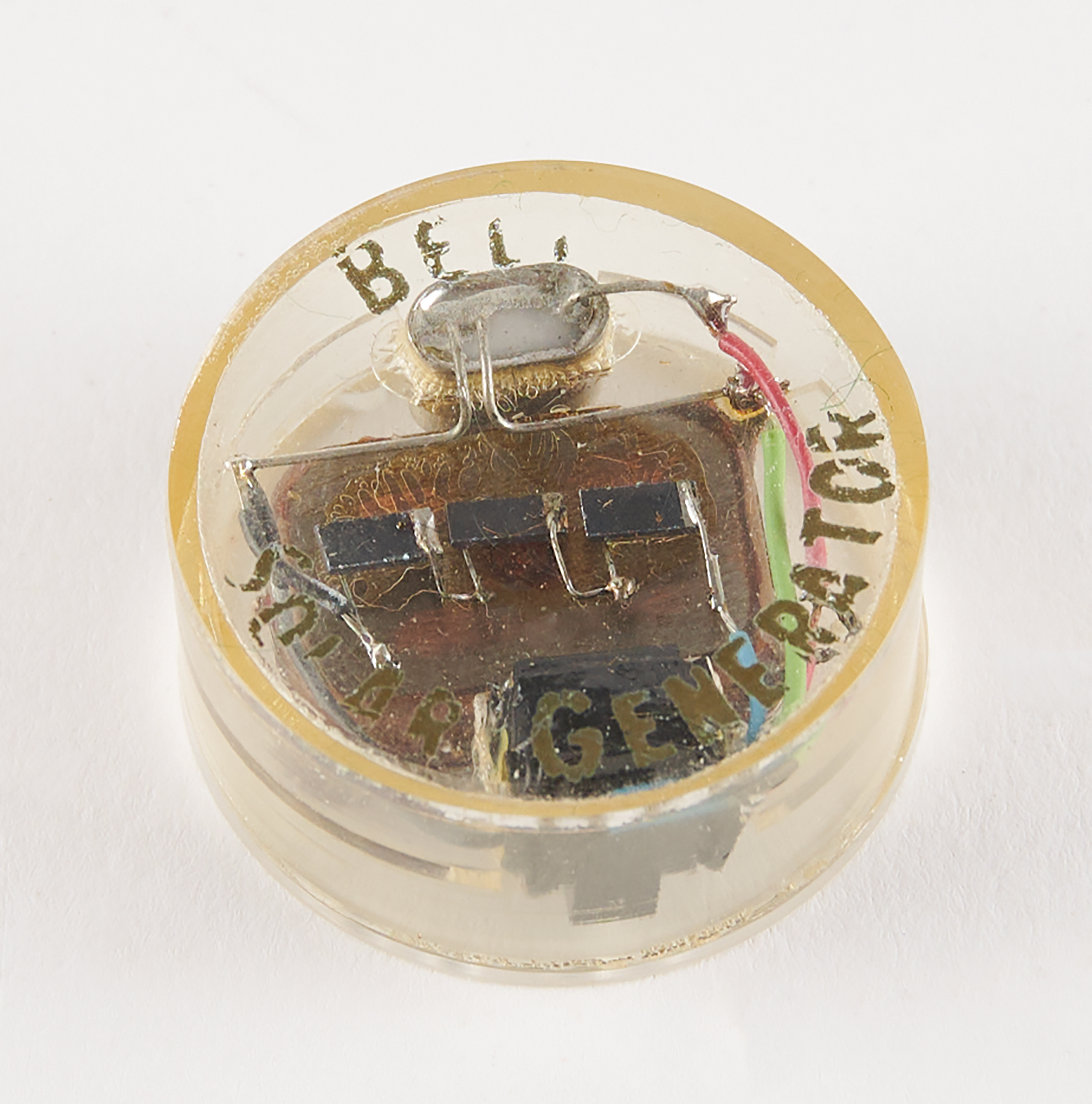
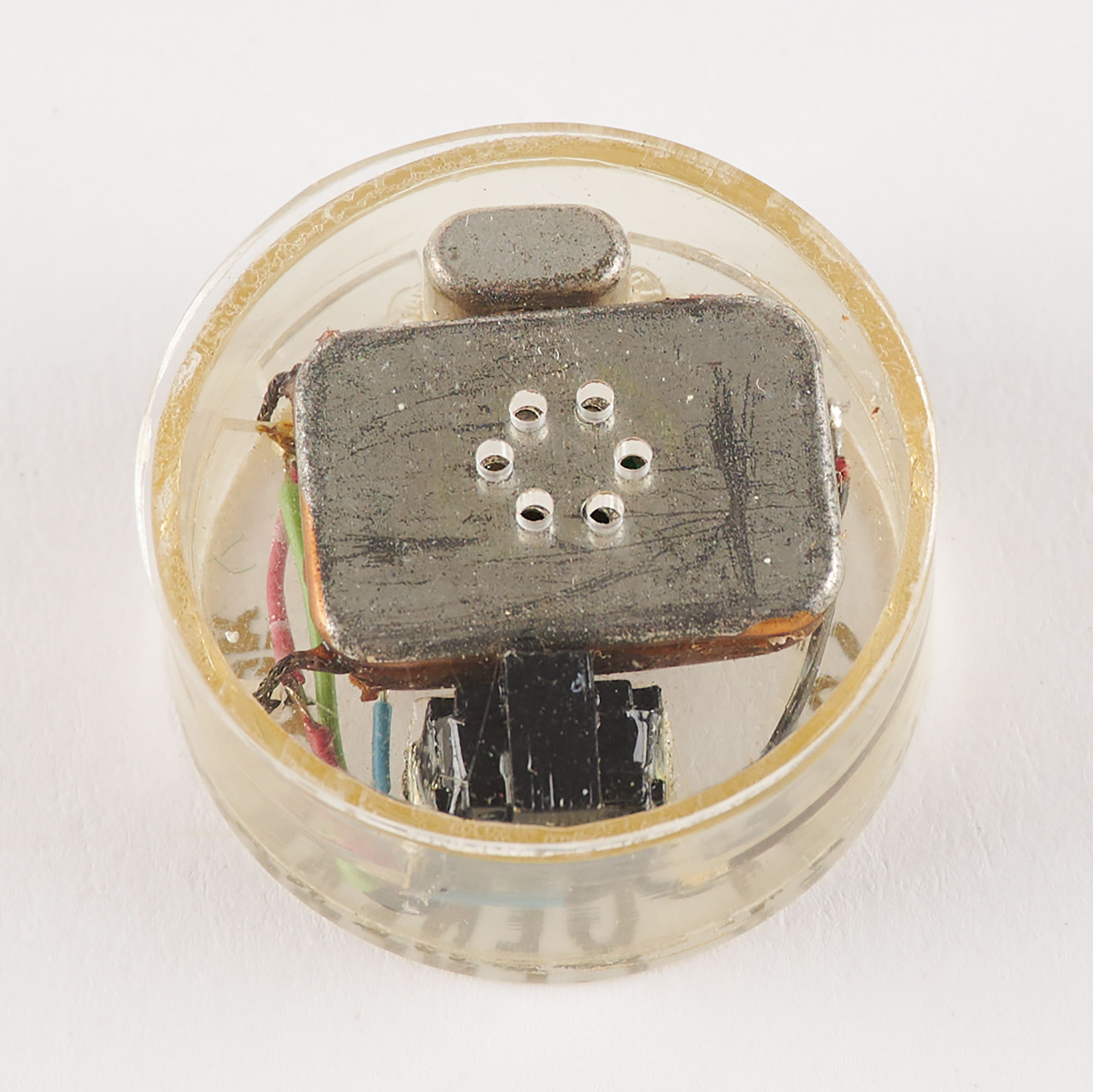
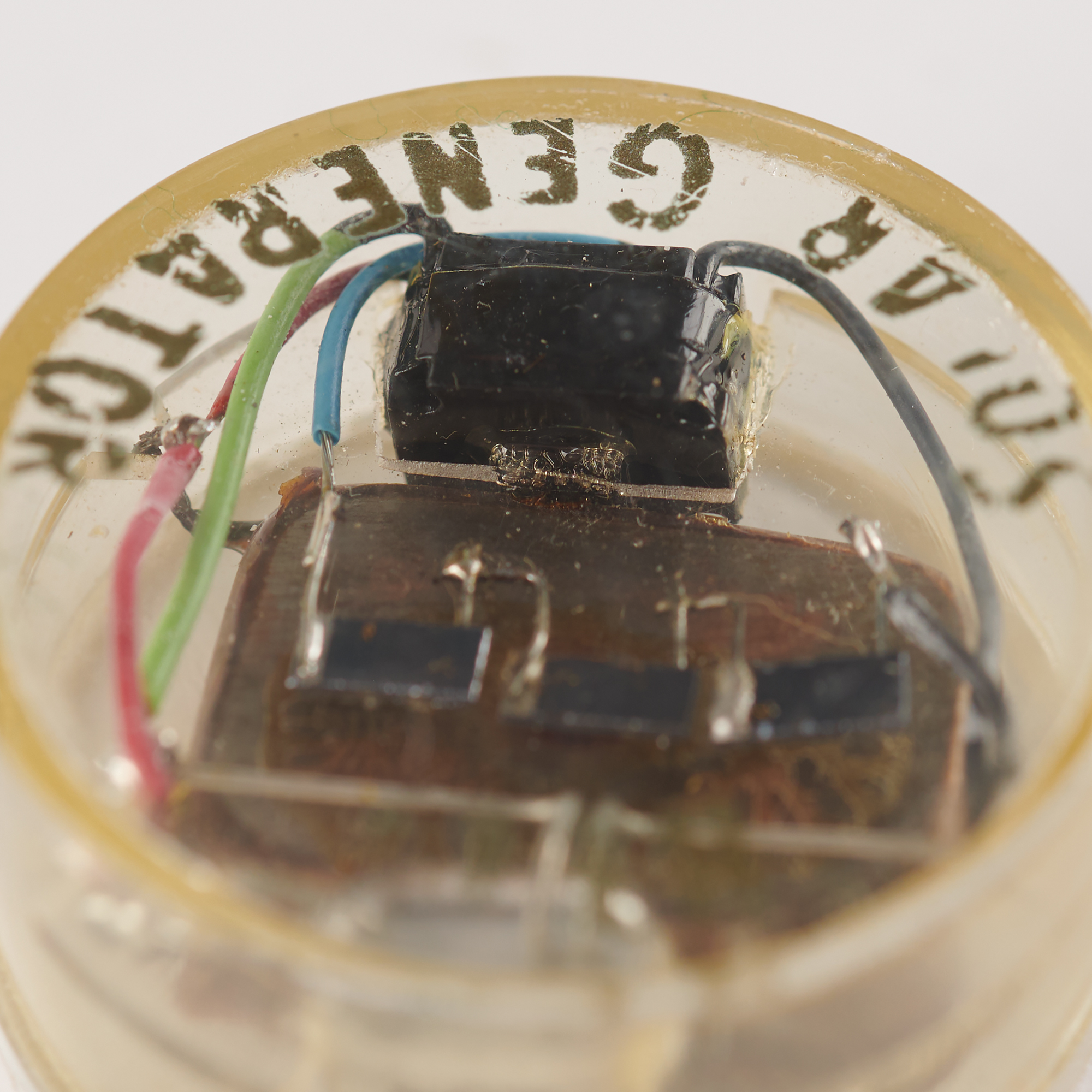
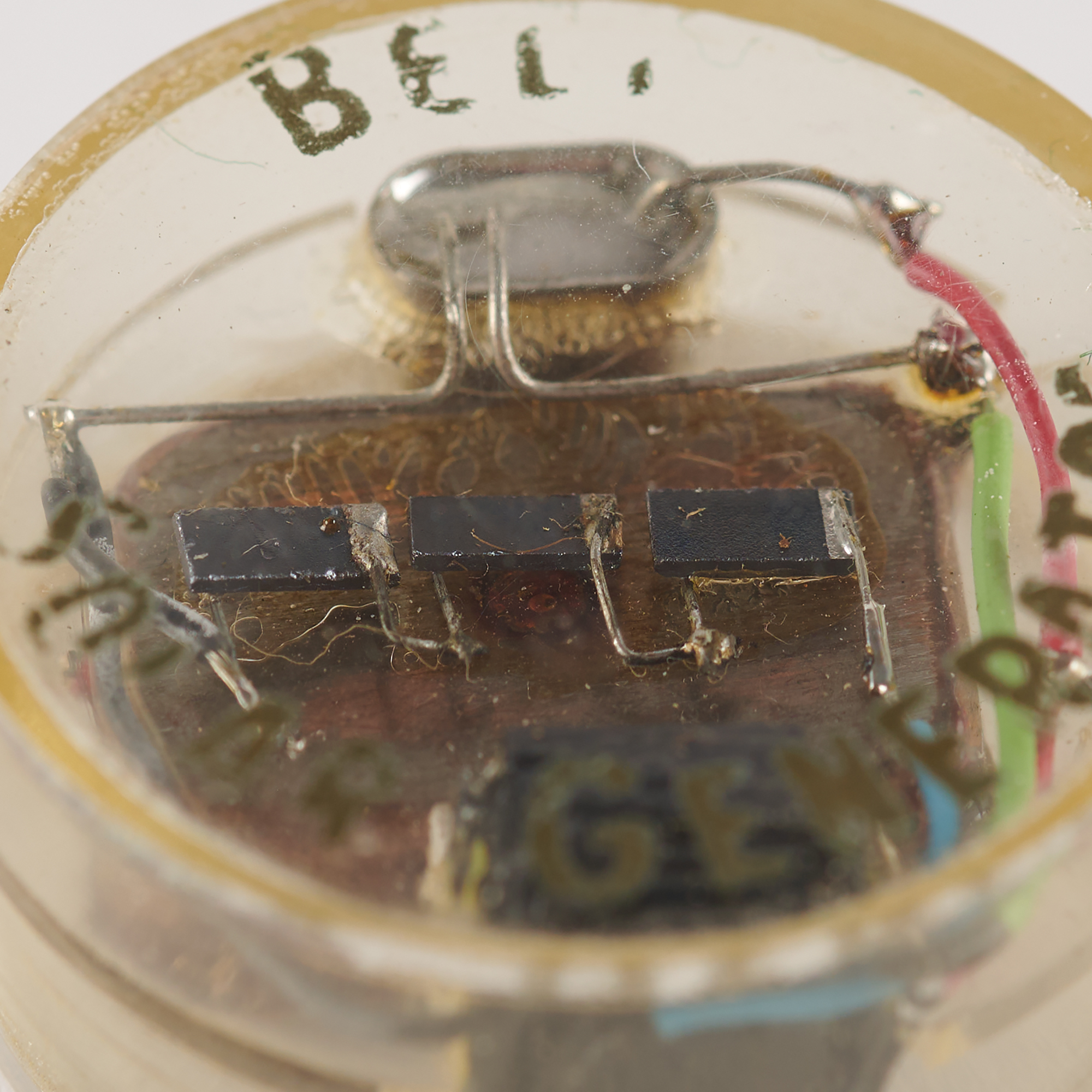
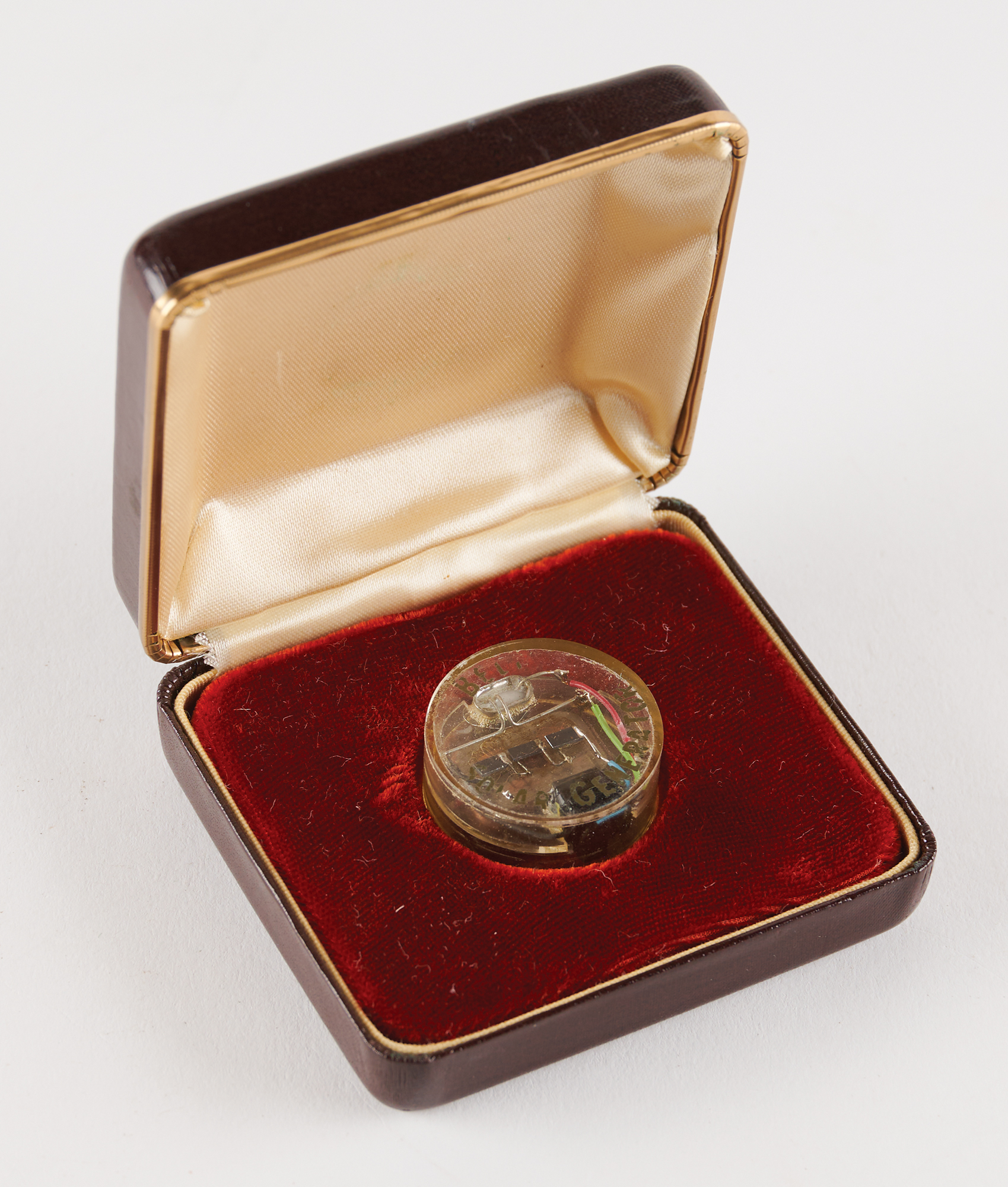
Included is a Bell Laboratories "Solar Generator" demonstration device, 1.25˝ x .5˝, a compact solar-powered exhibit created to illustrate the practical application of the monocrystalline silicon photovoltaic cell developed by Bell Telephone Laboratories in 1954. When exposed to bright light, the unit generates enough electrical current to power an internal buzzer. Bell Labs' silicon solar cell was the first practical photovoltaic device capable of converting sunlight into usable electrical power, and its development would prove essential to the operation of long-duration communications satellites and spacecraft. Housed in its original leather presentation case.
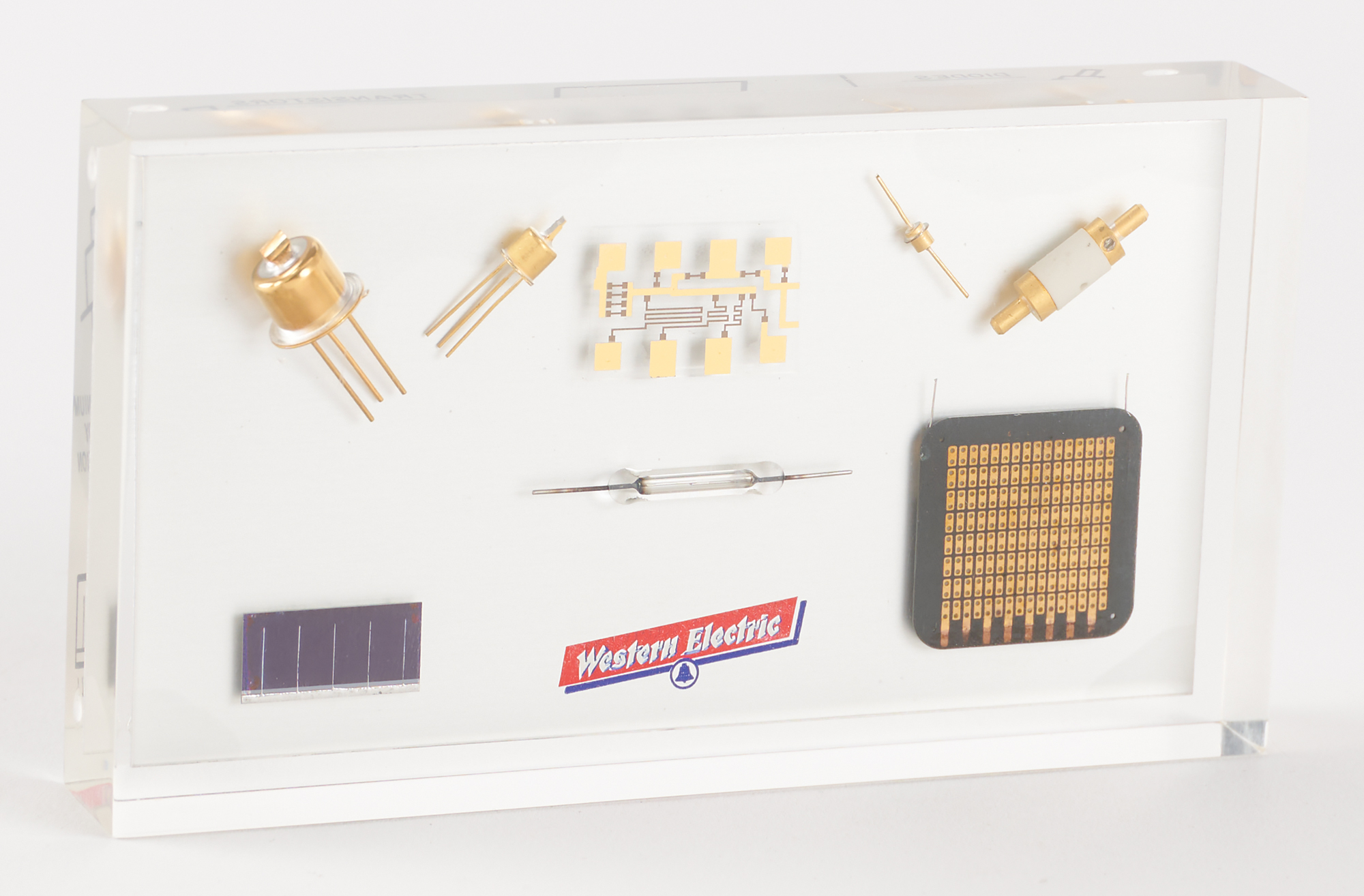
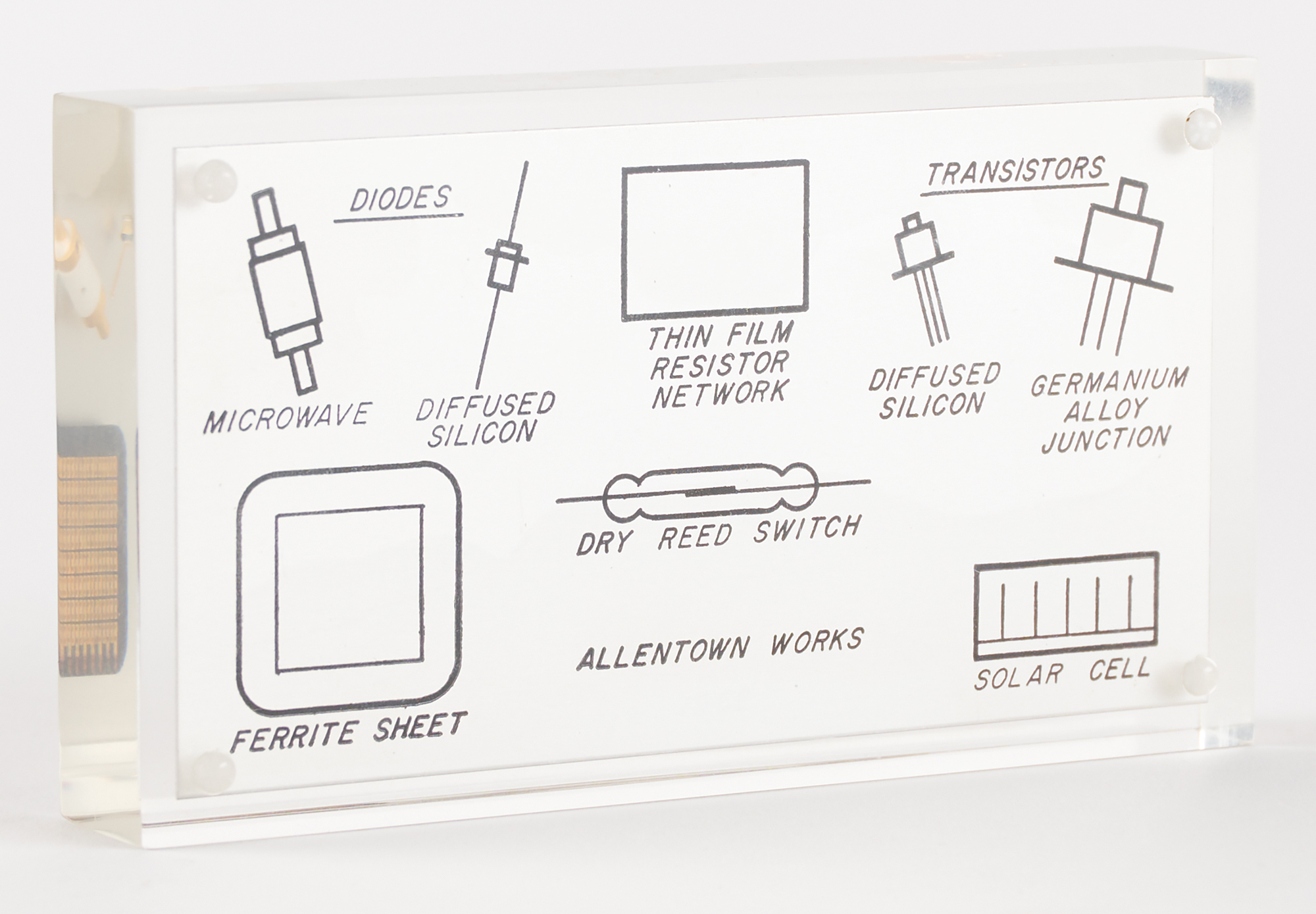
Also present is a Western Electric semiconductor technology paperweight from the company's Allentown Works facility, a Lucite display measuring 5.25˝ x 3˝ x .75˝ and containing representative examples of transistors, microwave and silicon diodes, a solar cell, a dry reed switch, thin-film circuitry, and a ferrite-core memory matrix. The underside is printed with diagrams identifying each component and marked "Allentown Works." Includes its original paper box and explanatory brochure. The paperweight was produced to showcase the advanced semiconductor and electronic technologies manufactured by Western Electric for Bell System communications, computing, and electronic switching applications during the early Space Age. Particularly notable is the ferrite-core memory matrix, an example of the magnetic-core memory technology that served as the principal form of computer memory during the 1950s and 1960s. The display also incorporates a silicon solar cell, reflecting Bell Laboratories' pioneering work in photovoltaic technology.
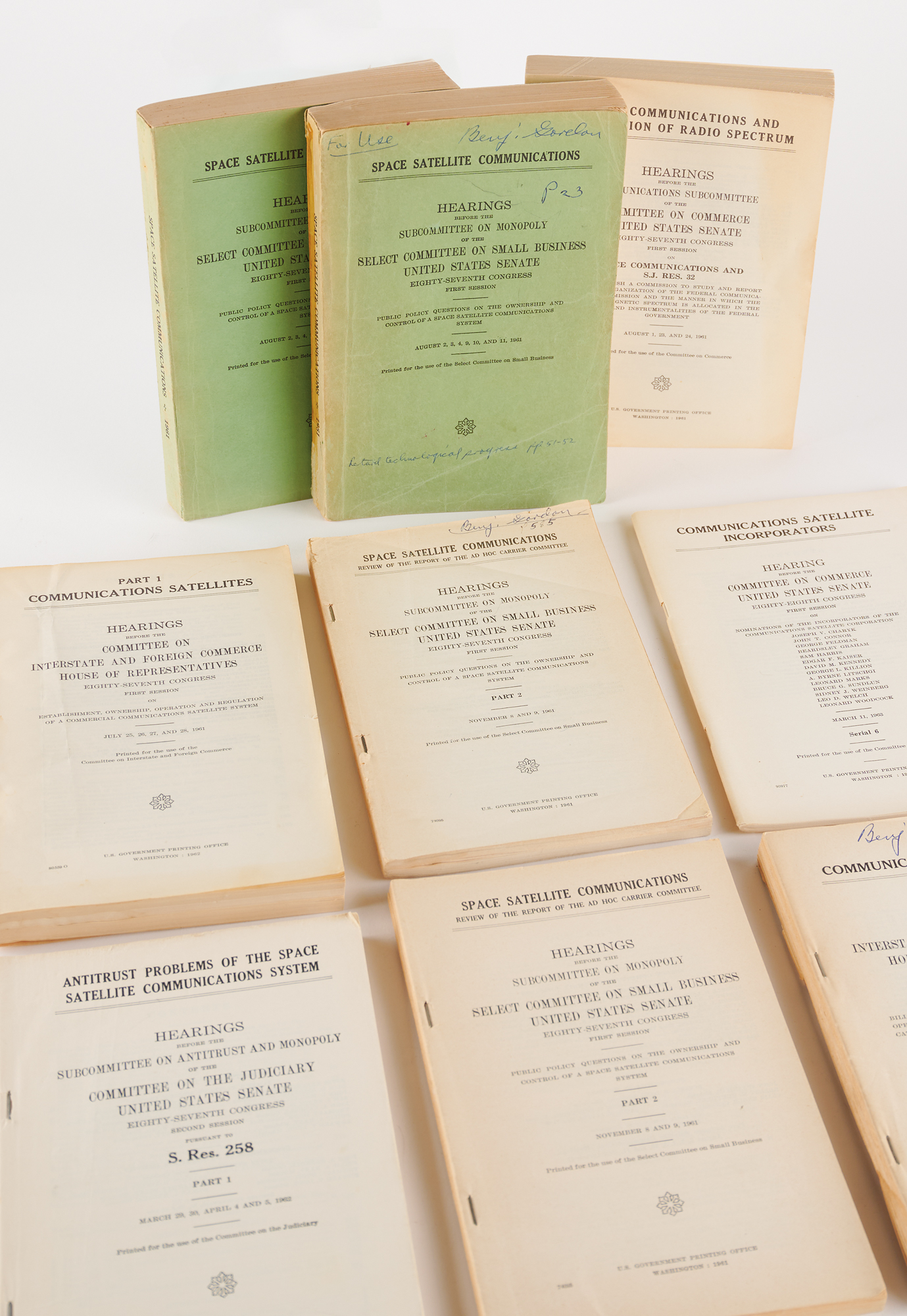
Complementing these artifacts is a group of nine congressional hearing volumes and legislative reference materials assembled and used by Gordon in connection with the satellite communications hearings, including:
- Space Communications and Allocation of Radio Spectrum: Hearings Before the Communications Subcommittee of the Committee on Commerce, United States Senate, 87th Congress, 1st Session, on Space Communications and S.J. Res. 32, August 1, 23, and 24, 1961.
- Communications Satellites, Part 1: Hearings Before the Committee on Interstate and Foreign Commerce, House of Representatives, 87th Congress, 1st Session, on the Establishment, Ownership, Operation and Regulation of a Commercial Communications Satellite System, July 25, 26, 27, and 28, 1961.
- Space Satellite Communications: Hearings Before the Subcommittee on Monopoly of the Select Committee on Small Business, United States Senate, 87th Congress, 1st Session, on Public Policy Questions on the Ownership and Control of a Space Satellite Communications System, August 2, 3, 4, 9, 10, and 11, 1961, with one copy bearing Gordon’s ownership inscription and working notations.
- Space Satellite Communications: Review of the Report of the Ad Hoc Carrier Committee, Hearings Before the Subcommittee on Monopoly of the Select Committee on Small Business, United States Senate, 87th Congress, 1st Session, Part 2, November 8 and 9, 1961, with one copy bearing Gordon’s ownership inscription and page notation.
- Communications Satellites, Part 2: Hearings Before the Committee on Interstate and Foreign Commerce, House of Representatives, 87th Congress, 2nd Session, on H.R. 10115 and H.R. 10138, March 13, 14, 15, 16, 20, 21, and 22, 1962, signed on the front cover by Benjamin Gordon with page notations.
- Antitrust Problems of the Space Satellite Communications System: Hearings Before the Subcommittee on Antitrust and Monopoly of the Committee on the Judiciary, United States Senate, 87th Congress, 2nd Session, pursuant to S. Res. 258, Part 1, March 29, 30, April 4, and 5, 1962.
- Communications Satellite Incorporators: Hearing Before the Committee on Commerce, United States Senate, 88th Congress, 1st Session, on Nominations of the Incorporators of the Communications Satellite Corporation, March 11, 1963, Serial 6.
In overall fine condition, with scattered wear to the booklets, including creases, tears, and a detached page.
As government agencies, private industry, and research laboratories raced to establish the technological and regulatory foundations of space-based communications, Congress confronted fundamental questions concerning ownership, competition, and access to emerging satellite networks. Serving as Staff Economist of the U.S. Senate Select Committee on Small Business, Benjamin Gordon helped organize and support a series of congressional hearings that examined the future of satellite communications and challenged proposals for exclusive control of the emerging technology. The resulting legislative debates contributed to the Communications Satellite Act of 1962, signed by President John F. Kennedy, which established the framework for commercial satellite communications in the United States and ultimately led to the formation of the Communications Satellite Corporation (COMSAT) and the international satellite consortium INTELSAT. The artifacts, hearing records, and presentation pieces preserved in this collection document both the technological innovations and public-policy decisions that shaped the development of the modern global communications satellite system.

