The 30 Minute Rule begins July 15 at 7:00 PM EDT. An Initial Bid Must Be Placed By July 15 at 6:00 PM EDT To Participate After 6:00 PM EDT
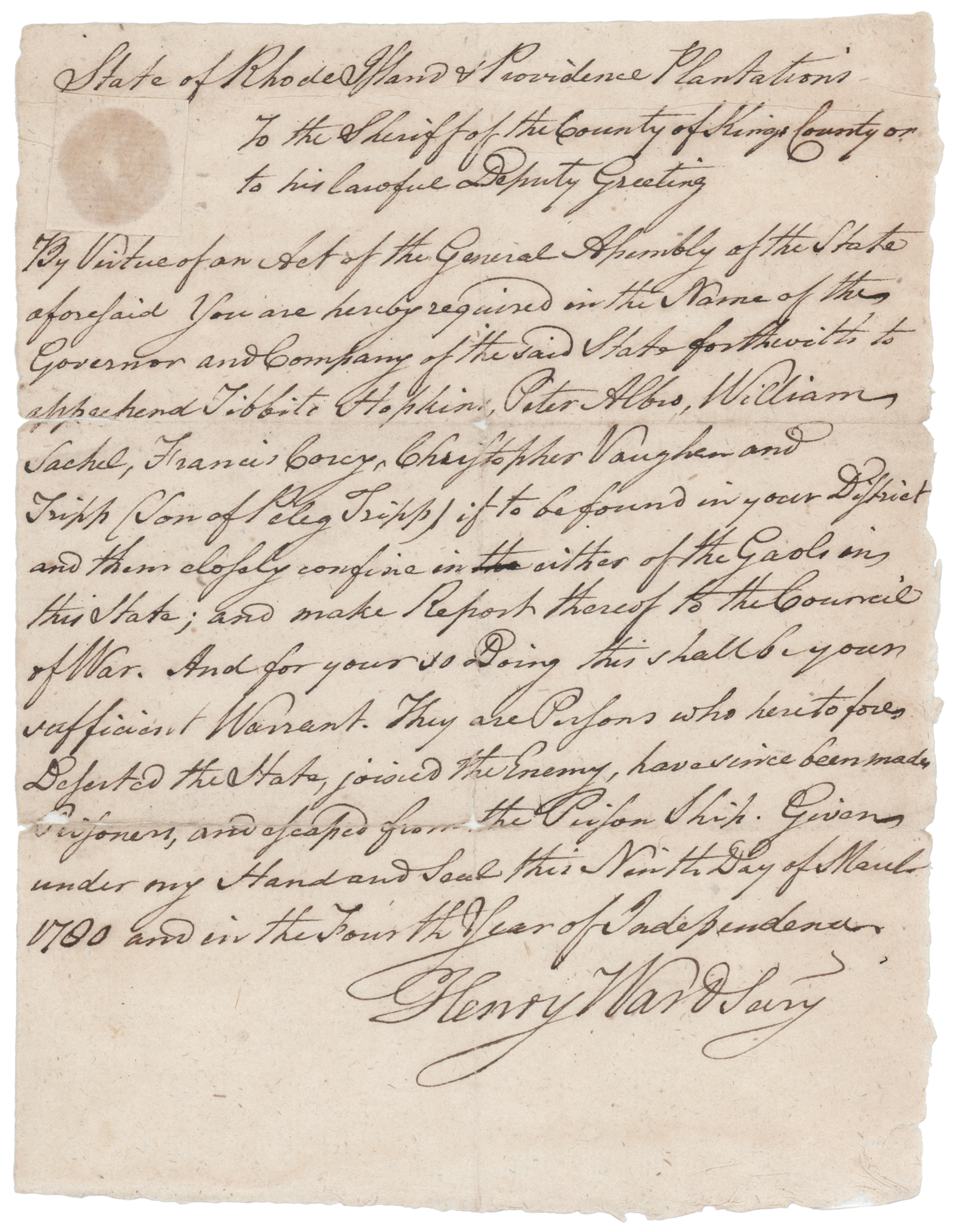
Revolutionary War-dated manuscript DS, signed “Henry Ward, Sec'ry,” one page, 6.25 x 8, March 9, 1780. Arrest warrant issued by the “State of Rhode Island & Providence Plantations To the Sheriff of the County of King's County or to his lawful Deputy,” in full: “By Virtue of an Act of the General Assembly of the State aforesaid You are hereby required in the Name of the Governor and Company of the said State forthwith to apprehend Tibbite Hopkins, Peter Albis, William Sachel, Francis Corcy, Christopher Vaughan, and Tripp (Son of Peleg Tripp) if to be found in your District and them closely confine in either of the Gaols in this State; and make Report thereof to the Council of War. And for your so Doing this shall be your sufficient Warrant. They are Persons who heretofore Deserted the State, joined the Enemy, have since been made Prisoners, and escaped from the Prison Ship.” Signed at the conclusion by Ward as secretary. In fine condition.
The warrant concerns a group of Rhode Island men who had “Deserted the State” during the Revolutionary War, “joined the Enemy,” were later captured as prisoners, escaped from a prison ship, and were now being actively sought by state authorities. In tracing desertion, allegiance to the British, imprisonment, escape, and renewed pursuit, the document conveys an unusually complete wartime narrative through its concise text. Particularly notable is its reference to a “Prison Ship,” a term closely associated with the British prison hulks anchored in and around New York Harbor during the Revolution, where overcrowding, disease, and high mortality rates became infamous among American prisoners. Although the vessel referenced here is unidentified, the phrase immediately invokes one of the conflict’s harshest realities and lends the manuscript an especially vivid wartime context.
Signed by Henry Ward (1735-1788), an important Rhode Island political figure who served as a delegate to the Stamp Act Congress of 1765, the document bears the signature of a participant in one of the earliest coordinated intercolonial protests against British taxation. The reference to the “State of Rhode Island & Providence Plantations” reflects Rhode Island’s official name during the Revolutionary era; notably, Rhode Island was among the first colonies to formally renounce allegiance to King George III, doing so in May 1776, two months before the Declaration of Independence. Addressed to officials in “King’s County,” the manuscript also preserves a colonial-era place name retained during the Revolution despite its royal association, as King’s County was later renamed Washington County.

