
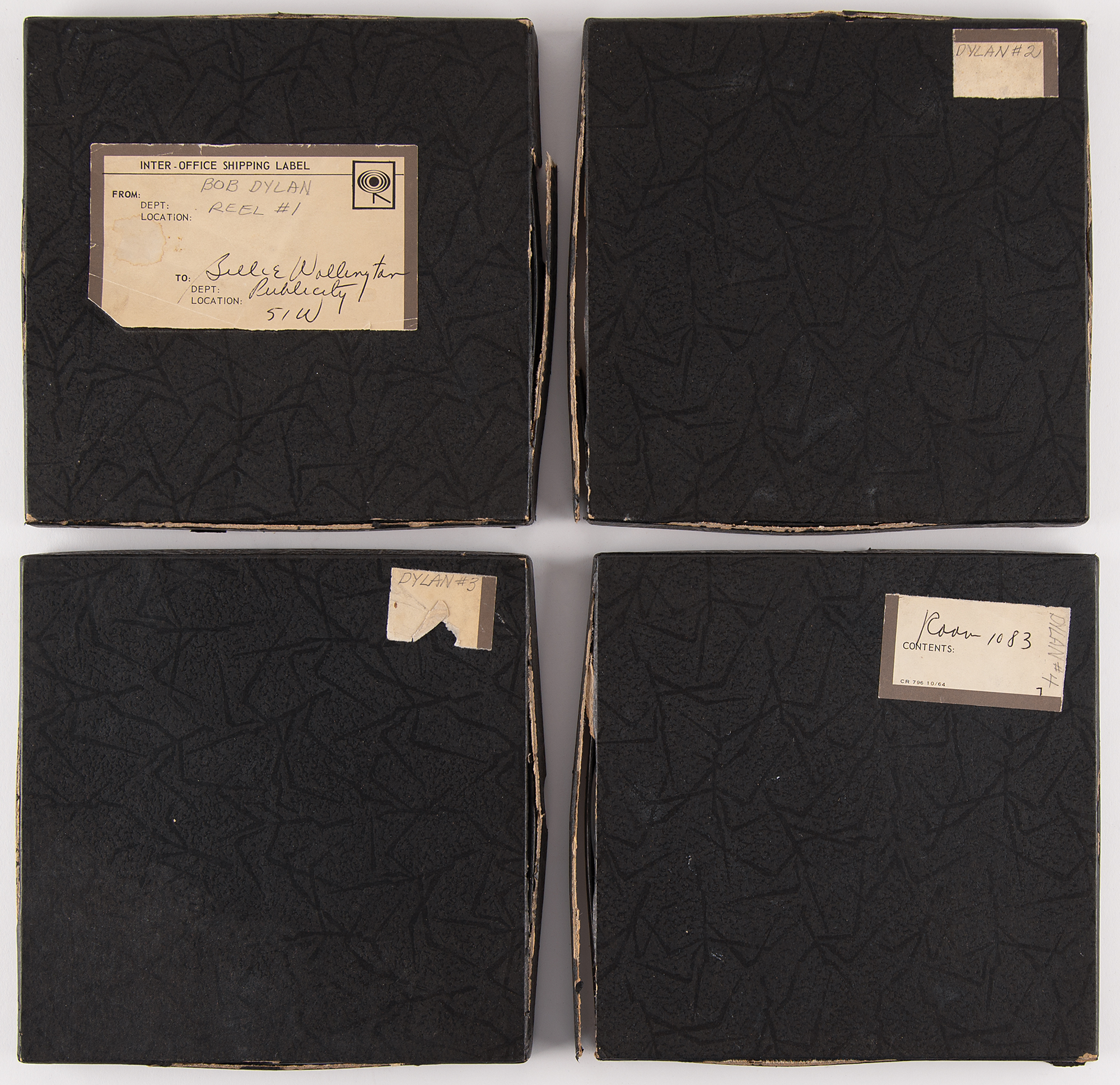
Set of four original reel-to-reel audio tapes (¼˝) of historian, music critic, and free speech activist Nat Hentoff's unpublished interview with Bob Dylan, conducted for Playboy in New York City in October–November 1965, totaling about two hours of content. Dylan exercised veto power over the interview and ultimately refused to allow it to be published; the version that ultimately appeared in the March 1966 issue of Playboy is an entirely different interview, famed for its humor and stream of consciousness style, fabricated for publication by Dylan and Hentoff. The reels are housed in their original black boxes, one with a Columbia Records "Inter-Office Shipping Label" affixed on the front; the boxes are worn, with splits to the edges, but the tapes themselves remain in fine condition. Accompanied by a USB drive carrying a digital transfer of the tapes' audio. Consigned by Nat Hentoff's son, these tapes were returned to Hentoff by the CBS Records publicity department and have remained in the family since.
The wide-ranging conversation preserved here captures Dylan at a pivotal moment just after the release of Highway 61 Revisited, as he rejects easy labels, reflects on rock and roll, folk music, fame, protest songs, politics, education, drugs, money, and the burdens of being treated as a generational spokesman—a label he refuses to embrace.
Dylan begins by dismissing the newly fashionable term “folk-rock,” saying he thinks more in terms of “sound” than categories, and praises the emotional force of early rock and roll, country, rhythm and blues, Motown, Otis Redding, Wilson Pickett, Johnny Cash, Carl Perkins, Elvis Presley’s early records, and the Beatles. He says of rock and roll: “It was just a total other kind of form of sound, and which puts your head in a different place.” Discussing his own turn toward electric performance with Levon and the Hawks, Dylan insists that the change was not new to him, but rather something he had long intended: “It’s not new in my mind. It’s new in a lot of other peoples minds though, I guess.”
Much of the interview centers on Dylan’s refusal to be confined by the folk revival or by expectations that he continue writing “protest songs.” Asked about criticism that he had stopped singing protest material, Dylan responds coolly that he has “absolutely no contact with that,” and rejects the very idea of the “message song,” calling it “vulgar” and saying: “I’m not trying to say anything any more…The songs are just somebody else is hearing them, that’s all it is…They exist, and whoever listens to them, that’s none of my business.” He is equally resistant to being called a folk singer, explaining that he has “a very deep respect” for folk music but no interest in the commercial folk scene: “I’m not a folk singer really at all, you know…I don’t call myself anything, I really don’t. I’m sort of a slot machine. Slot machine wonder!”
Hentoff presses Dylan repeatedly on social movements, politics, civil rights, Vietnam, the Free Speech Movement, Joan Baez’s activism, and whether songs can change society. Dylan answers in an elusive but revealing manner, praising Baez’s commitment—"I think what Joan Baez is doing is just marvelous"—while saying it is “just not” his way to go out looking for protests and demonstrations, that he has “gone through all that.” Asked whether or not we could form a new society, Dylan adds: “I don’t even think in terms of society.” He also offers a characteristically mordant fantasy of becoming president, saying he would bring his friends into the White House, redecorate it with “swings and teeter totters,” and invite Mao “to come over and see what we were like.”
The interview is especially strong on Dylan’s thoughts about fame and privacy. He speaks candidly about the limits of celebrity, saying he can no longer simply get on a Greyhound bus and disappear: “I can’t do that any more…it’s up to, you know…get the Greyhound bus to come to me.” Yet he denies feeling trapped by popularity, insisting that future records will not necessarily be “better,” only “different,” and that he has no anxiety about fading in or out of public attention. On money, he says that songwriting income merely allows him to stay away from “all the people that grab at you,” adding that he does not touch it and imagines it will “just blow away, back where it came from.”
Finally, Dylan reflects at length on his musical roots and artistic development, tracing his path from country and western, rock and roll, and polka music in Minnesota to Harry Belafonte, Odetta, Josh White, Woody Guthrie, and older folk traditions. He explains that Guthrie’s influence shaped his early records but had largely disappeared by the time of Highway 61 Revisited: "Woody Guthrie really hasn’t influenced that… what I’m doing now…The influence has all been on the first record, second record, third record. The fourth one, it was kind of wearing off a little bit. But that was still confined to the folk music circle. When I say influence, I mean total influence. I mean either writing or singing, you know. I mean, his influence is… is in his manner of speaking, you know. His influence is in his topics that he writes about. His influence lies in his phrasing, you know, and stuff like that. Now there’s really no influence and I don’t know what it is any more. It’s not influenced by him really at all as much as… the songs are influenced by sounds.” Describing the surreal quality of his newer writing, Dylan resists the idea that the songs are merely imaginative images: “They’re not really images to me…they’re real.”
Taken as a whole, the interview offers an unusually candid portrait of Dylan at the height of his mid-1960s transformation: sharp, funny, elusive, and often deliberately contrary, but never careless in his answers. He resists nearly every label Hentoff offers him—folk singer, protest writer, spokesman, social critic—not out of indifference, but because each seems too small for what he is trying to do. Moving from music to politics, fame, money, education, drugs, and artistic influence, Dylan comes across as a restless thinker who distrusts fixed positions and easy explanations: the result is a revealing glimpse of an artist determined to remain unclassifiable, even as the culture around him was trying hard to make him stand for something.

