The 30 Minute Rule begins July 15 at 7:00 PM EDT. An Initial Bid Must Be Placed By July 15 at 6:00 PM EDT To Participate After 6:00 PM EDT
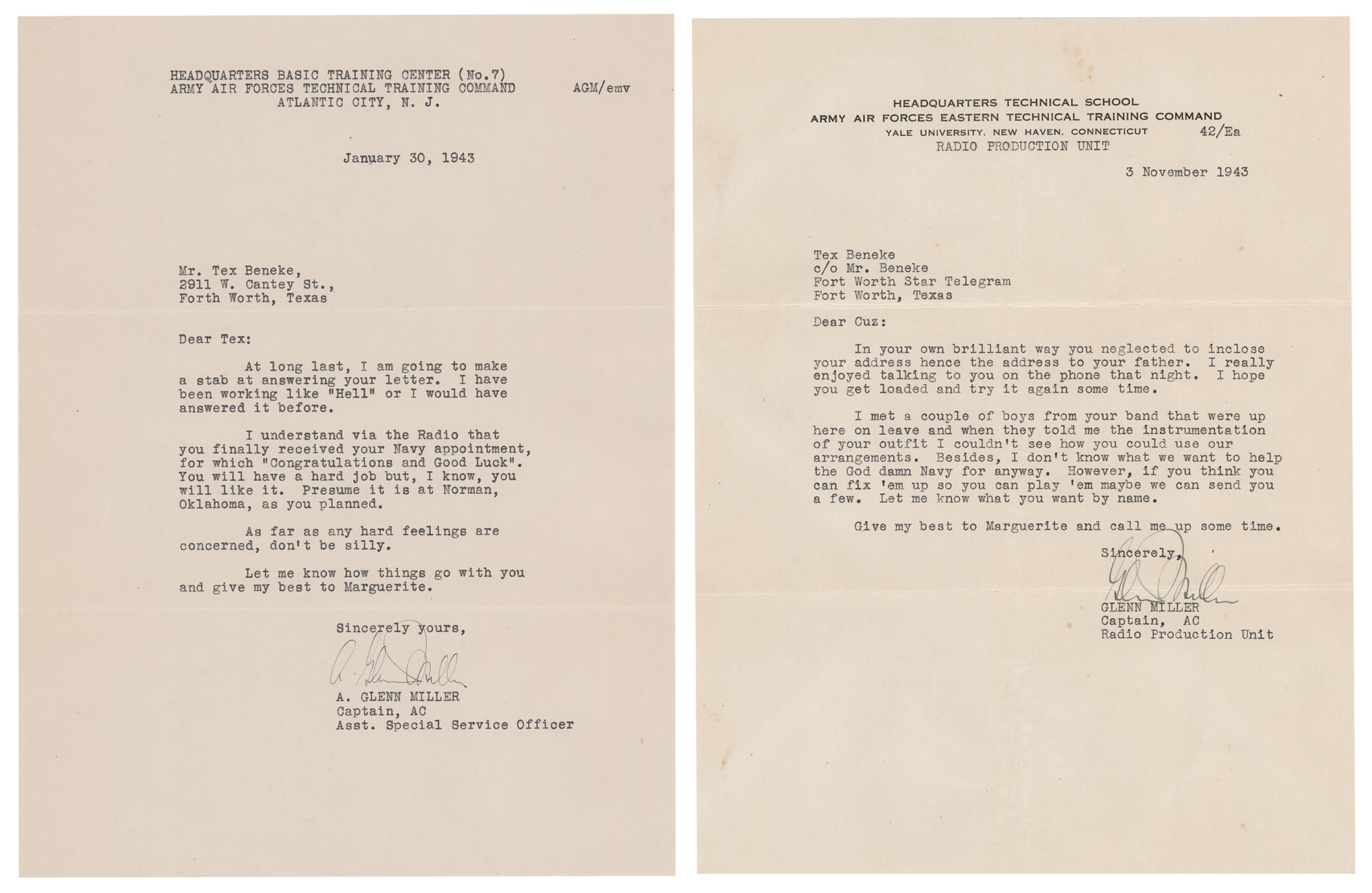
Two World War II-dated TLSs, one signed “A. Glenn Miller” and “Glenn Miller,” both one page, 8 x 10.5, dated to 1943, and addressed to Tex Beneke, his trusted saxophonist and vocalist, who had recently joined the U.S. Navy. The earlier letter, January 30, 1943, typed on Headquarters Basic Training Center, No. 7 (Army Air Force's Technical Training Command) letterhead: “At long last, I am going to make a stab at answering your letter. I have been working like ‘Hell’ or I would have answered it before. I understand via the Radio that you finally received your Navy appointment, for which ‘Congratulations and Good Luck.’ You will have a hard job but, I know, you will like it. Presume it is at Norman, Oklahoma, as you planned. As far as any hard feelings are concerned, don't be silly. Let me know how things go with you and give my best to Marguerite.”
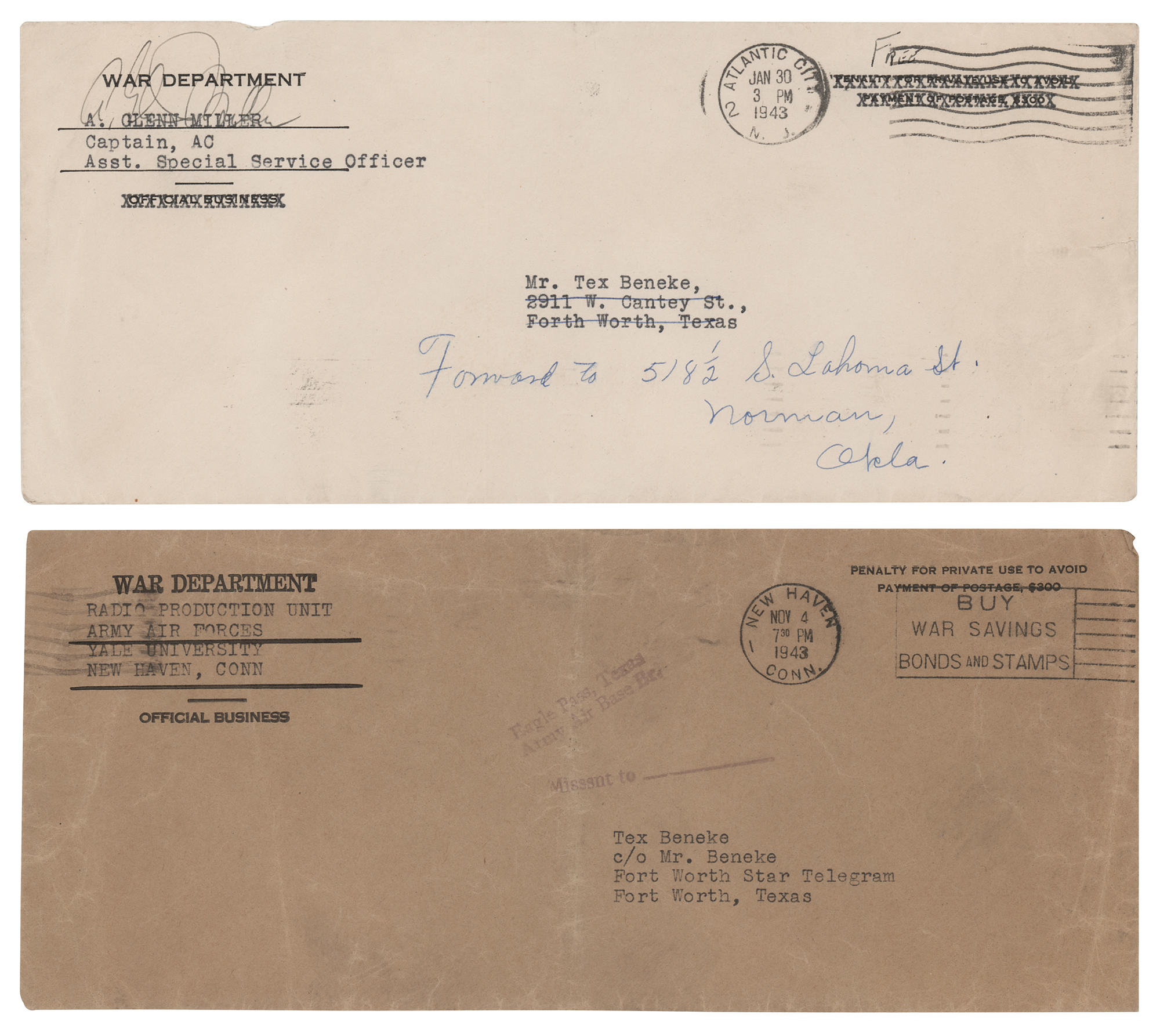
The second letter, November 3, 1943, on Headquarters Technical School (Army Air Force's Eastern Technical Training Command) letterhead marked “Radio Production Unit,” in full: “In your own brilliant way you neglected to inclose your address hence the address to your father. I really enjoyed talking to you on the phone that night. I hope you get loaded and try it again some time. I met a couple of boys from your band that were up here on leave and when they told me the instrumentation of your outfit I couldn't see how you could use our arrangements. Besides, I don't know what we want to help the God damn Navy for anyway. However, if you think you can fix 'em up so you can play 'em maybe we can send you a few. Let me know what you want by name. Give my best to Marguerite and call me up some time.” In overall fine condition. Accompanied by the original War Department mailing envelope and two documents related to Beneke: a war-dated certified copy of his birth certificate, and a Tarrant County marriage license for “Gordon Beneke and Mary Marguerite Griffith.”
At the height of his fame, Glenn Miller disbanded his enormously popular civilian orchestra in August 1942 to enter military service, joining the U.S. Army Air Forces and organizing what became the celebrated Army Air Forces Band. Stationed in both the United States and England during World War II, Miller devoted himself to boosting troop morale through military radio broadcasts and live performances, transforming the swing orchestra into one of the war’s most recognizable musical institutions.
Among Miller’s closest collaborators was tenor saxophonist and vocalist Tex Beneke, whose smooth vocals and saxophone work had helped define the signature sound of the Glenn Miller Orchestra on hits like 'Chattanooga Choo Choo' and 'Kalamazoo.' After Miller dissolved the band, Beneke briefly performed with Horace Heidt before entering the U.S. Navy, where he led a Navy band in Oklahoma while serving as a chief petty officer. These wartime letters capture the close personal relationship between the two musicians as they served in rival branches of the military, with Miller jokingly remarking in November 1943 that he did not know “what we want to help the God damn Navy for anyway” while discussing the possibility of sharing Army Air Forces musical arrangements with Beneke’s Navy ensemble.
Miller disappeared on December 15, 1944, while flying from England to France to perform for Allied troops, his aircraft vanishing over the English Channel. Prior to his disappearance, Beneke had expected to reunite with Miller after the war. Instead, following the conflict, the Miller estate authorized Tex Beneke to lead the official Glenn Miller ‘ghost band,’ reuniting former members of the orchestra and helping preserve Miller’s music for a postwar audience.

