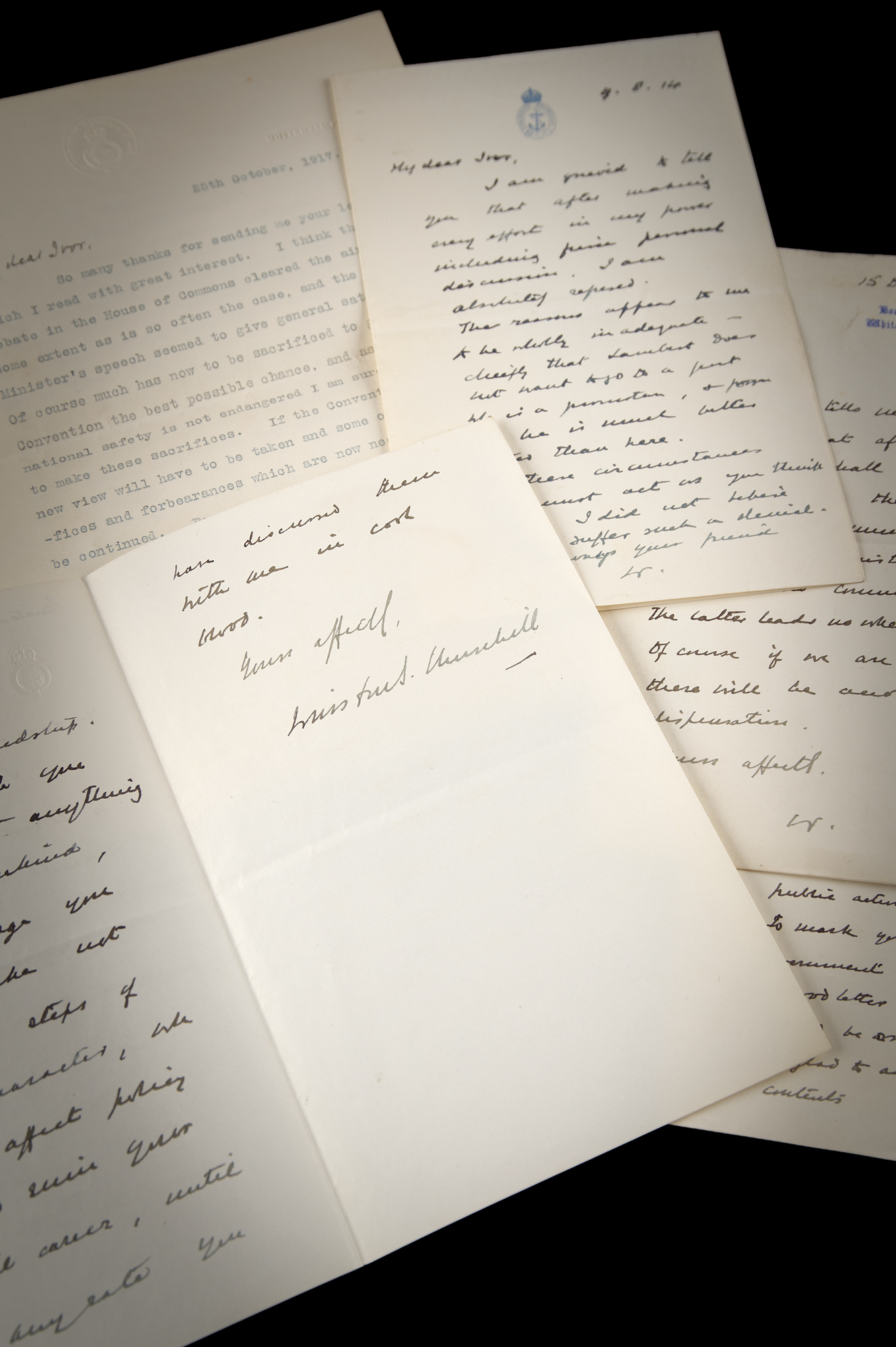
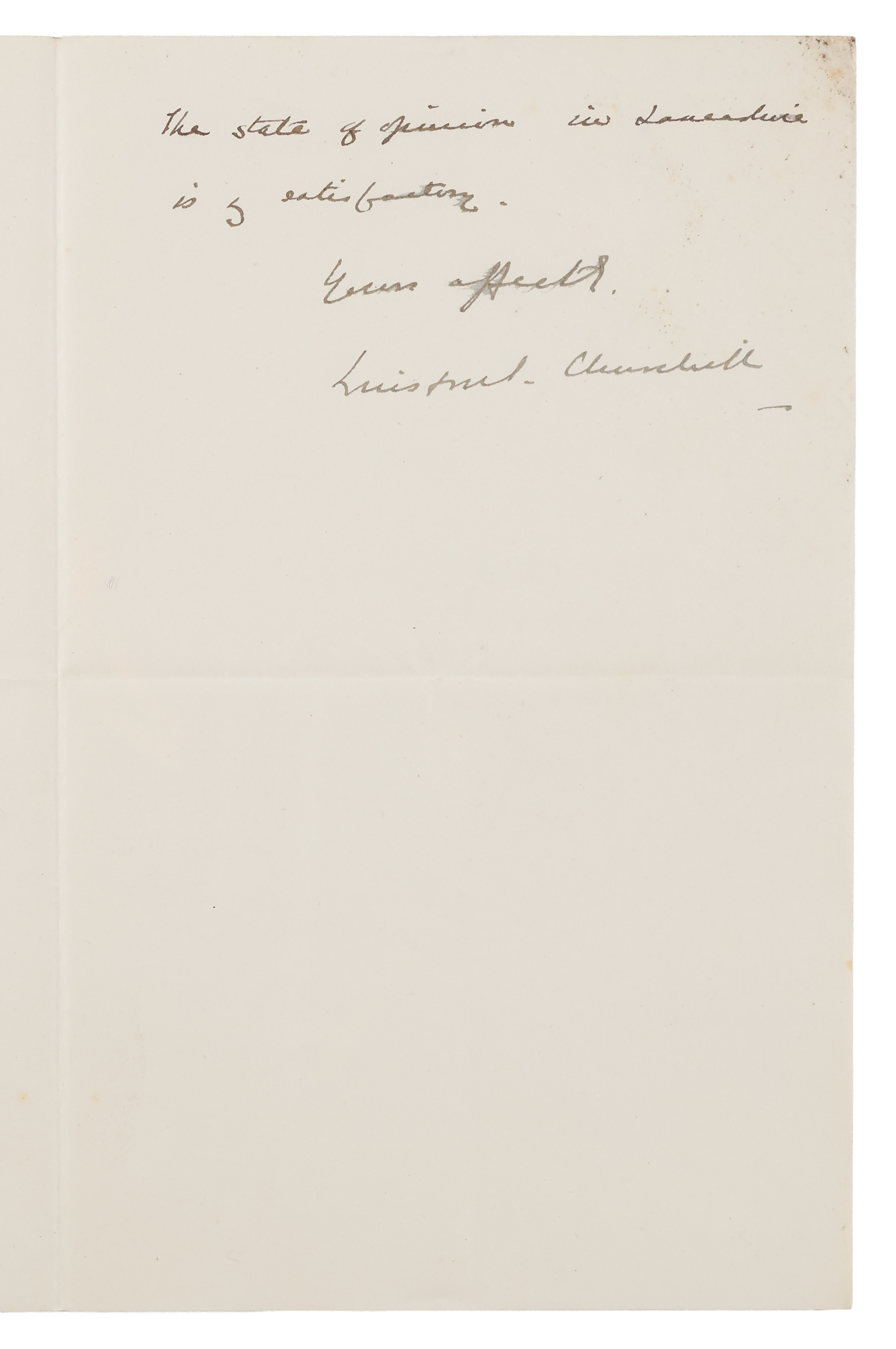
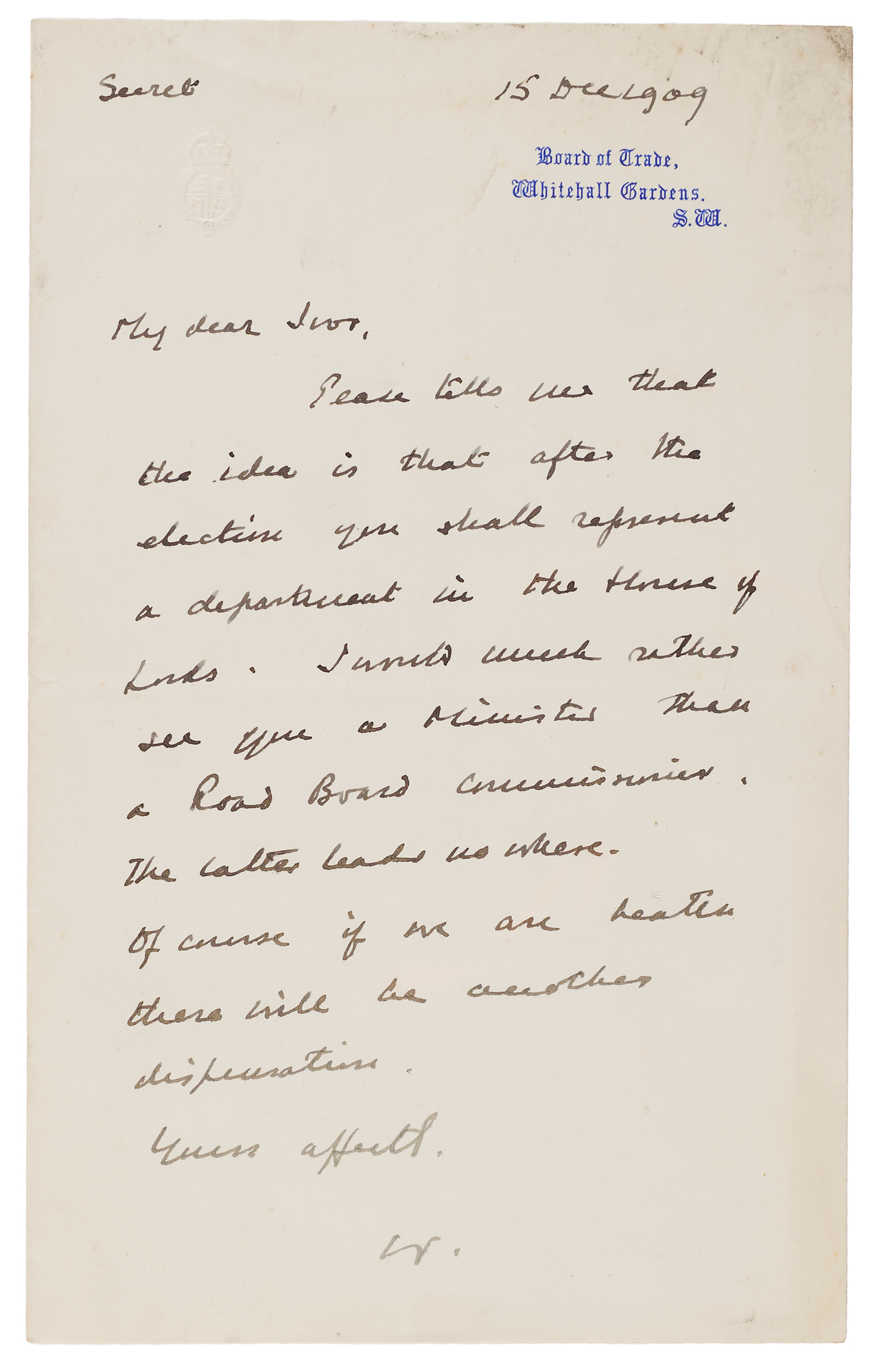
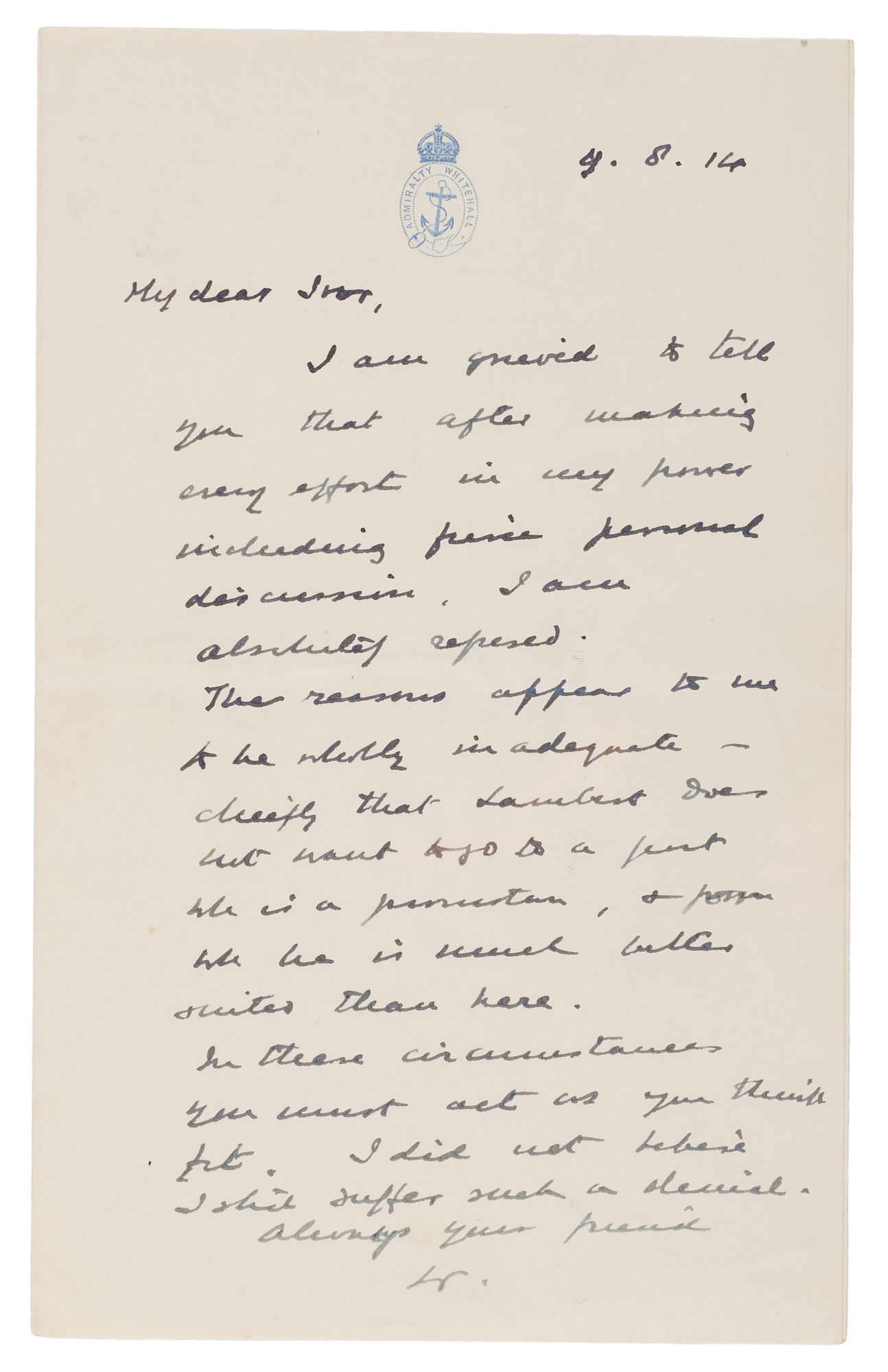
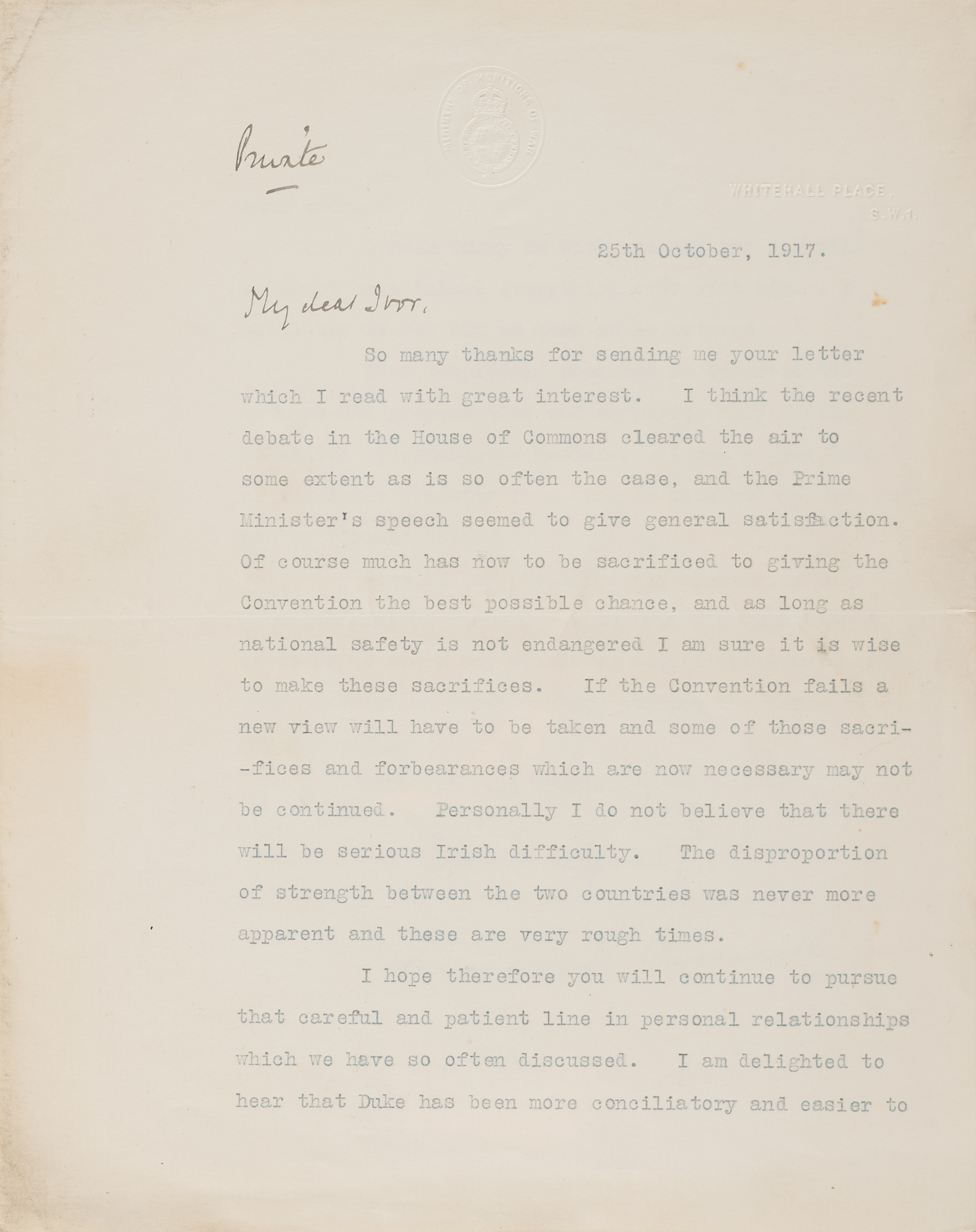
Five letters from Winston Churchill to his first cousin, Ivor Churchill Guest, 1st Viscount Wimborne, dated between 1909 and 1917, comprised of four ALSs and one TLS, nine total pages, ranging in size from 5 x 8 to 8 x 10, four marked “Secret,” “Private,” or Confidential,” with two signed “W,” and three signed “Winston S. Churchill.” The letters include intimate correspondence in which Churchill advises, cautions, and advocates for his cousin’s political decisions and career, offering candid guidance on strategy, public conduct, and appointments during pivotal moments.
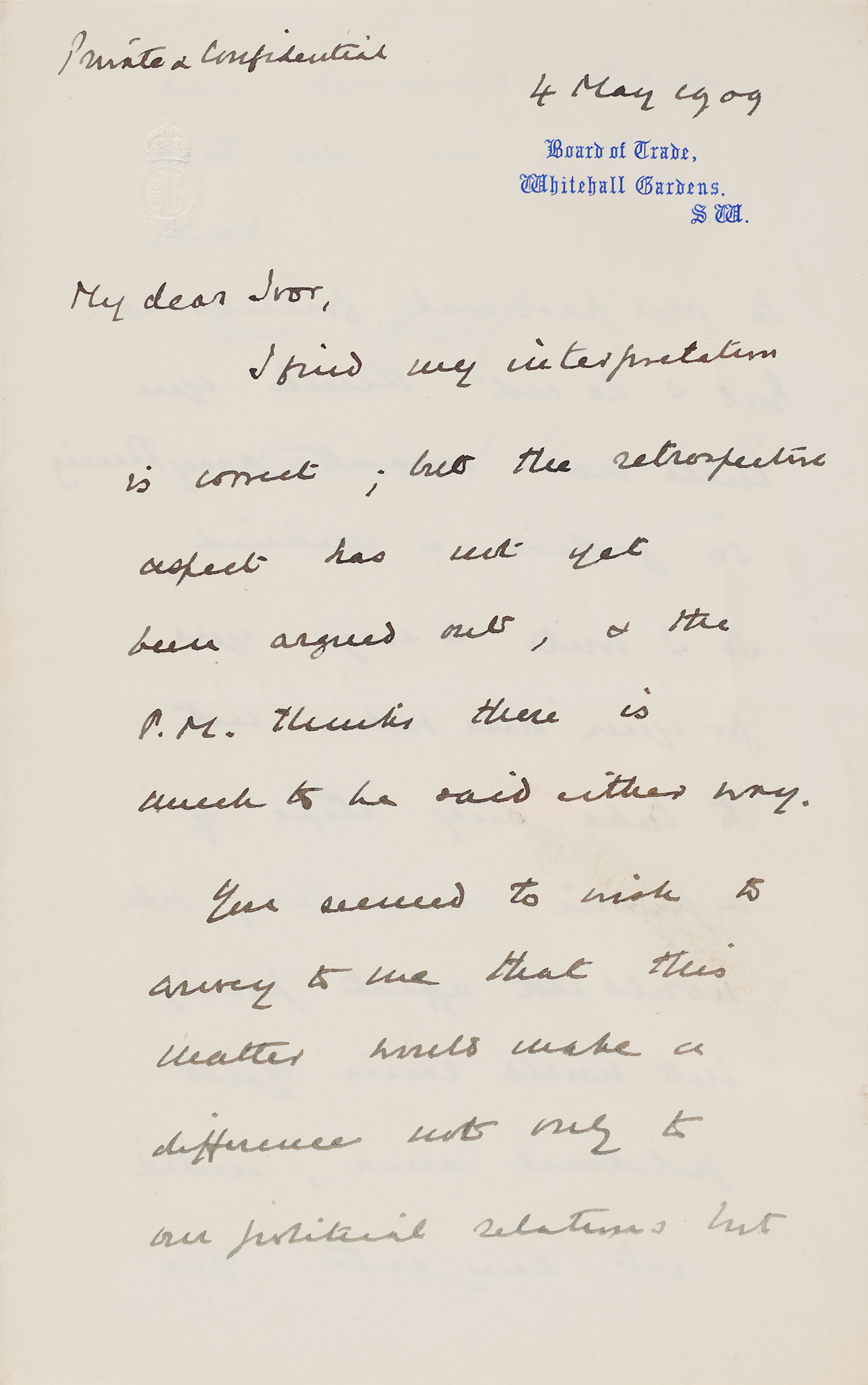
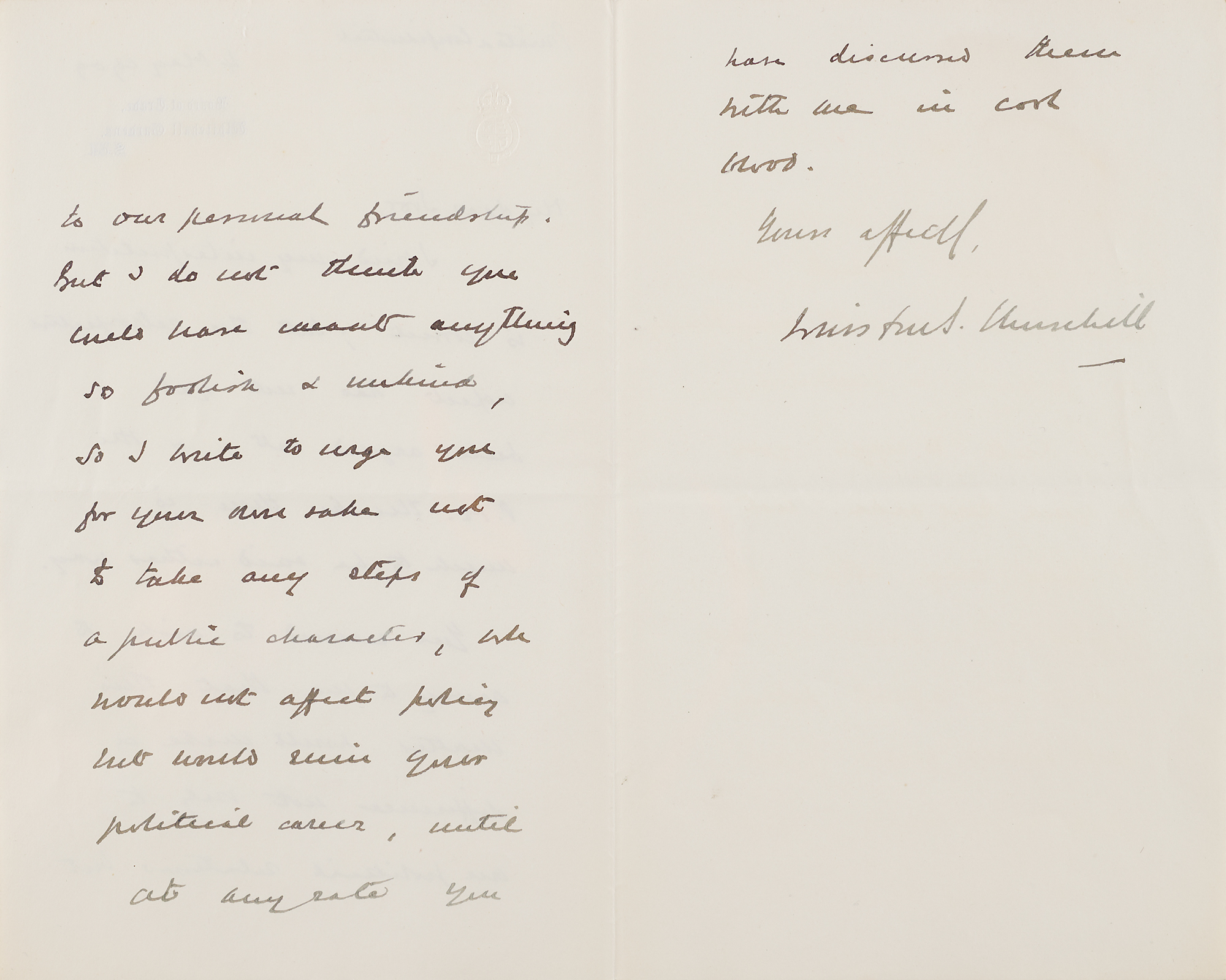
The earliest handwritten letter, penned on Board of Trade letterhead on May 4, 1909, responds to a letter in which Guest wrote, ‘this matter would make a difference not only to our political relations but to our personal friendship.’ To this, Churchill replies emphatically: “I do not think you could have meant anything so foolish & unkind,” and urges him “not to take any steps of a public character, which would not affect policy but would ruin your political career, until at any rate you have discussed them with me in cool blood.”
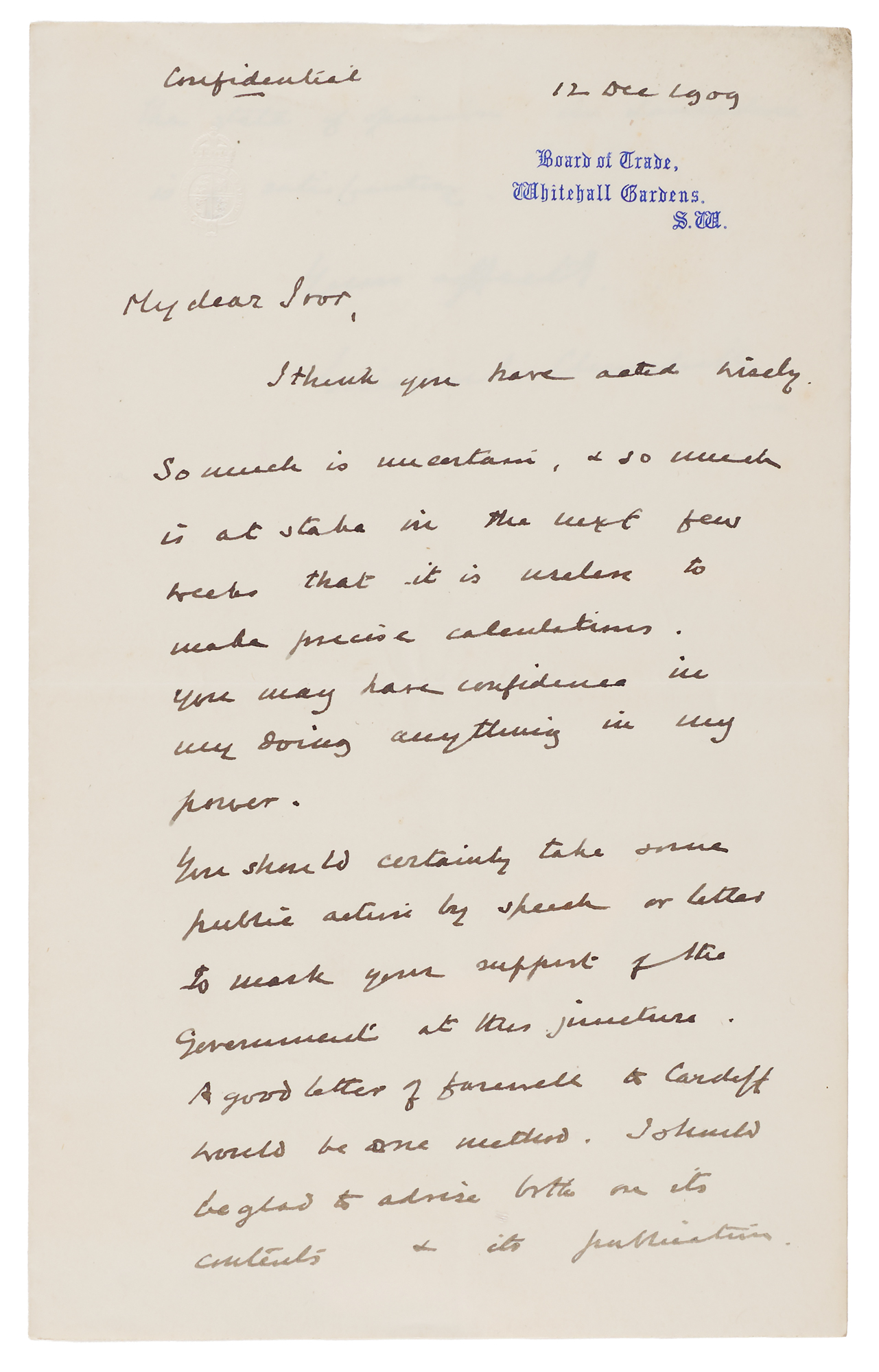
The next letter, December 12, 1909, begins: “I think you have acted wisely. So much is uncertain, & so much is at stake in the next few weeks that it is useless to make precise calculations. You may have confidence in my doing anything in my power. You should certainly take some public action by speech or letter to mark your support of the government at this juncture. A good letter of farewell to Cardiff would be one method. I should be glad to advise both on its contents & its publication.”
The third, December 15, 1909, in full: “Please tell me that the idea is that after the election, you show up as a department in the House of Lords. I would much rather see you a Minister than a Road Board commissioner. The latter leads no where. Of course, if we are beaten, there will be another dispensation.”
The fourth and last ALS finds Churchill at a loss: “I am grieved to tell you that after making every effort in my power including fierce personal discussion, I am absolutely refused. Their reasons appear to me to be wholly inadequate…In these circumstances you must act as you think fit. I did not believe I should suffer such a denial.”
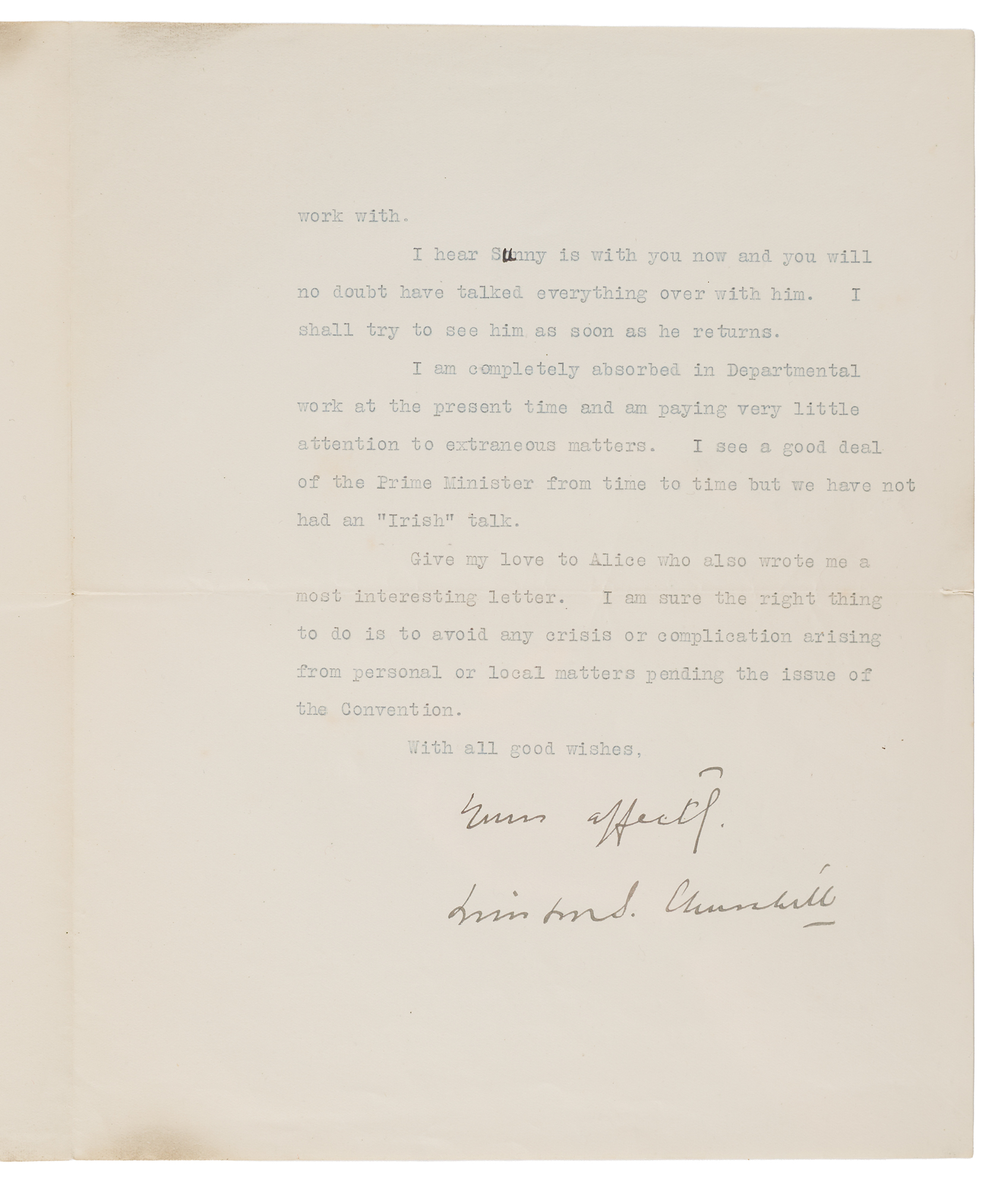
The final letter, a TLS, concerns the Irish Convention: “I think the recent debate in the House of Commons cleared the air to some extent as is so often the case, and the Prime Minister’s speech seemed to give general satisfaction. Of course much has now to be sacrificed to giving the Convention the best possible chance, and as long as national safety is not endangered I am sure it is wise to make these sacrifices. If the Convention fails a new view will have to be taken and some of those sacrifices and forbearances which are now necessary may not be continued. Personally I do not believe that there will be serious Irish difficulty. The disproportion of strength between the two countries was never more apparent and these are very rough times…I am completely absorbed in Departmental work at the present time and am paying very little attention to extraneous matters. I see a good deal of the Prime Minister from time to time but we have not had an ‘Irish’ talk.” In overall fine condition.
Addressing the ongoing Irish Convention, Churchill writes in support of a policy of restraint to give the proceedings the best possible chance of success, while making clear that such forbearance is conditional should the effort fail. The Convention itself, which met at Trinity College Dublin from July 25, 1917, to April 5, 1918, brought together Nationalists, Ulster Unionists, Southern Unionists, Labour, and the Catholic hierarchy in an effort to reach agreement on an all-Ireland Home Rule settlement, but ultimately failed to produce a consensus. Written shortly after his return to government as Minister of Munitions following the Gallipoli setback, the letter shows him carefully navigating a sensitive political issue while remaining closely connected to the highest levels of power, noting his regular contact with the Prime Minister. His measured tone and qualified optimism, expressing doubt that there would be “serious Irish difficulty,” offer a revealing snapshot of contemporary British attitudes at a pivotal stage in the Irish Question.
This correspondence reveals Churchill’s role as a trusted adviser and political confidant to his cousin, Ivor Churchill Guest, whose mother was Churchill’s aunt, Lady Cornelia Spencer-Churchill. Written after Guest crossed the floor with Churchill to the Liberal Party in support of free trade and was elected MP for Cardiff, the letters show Churchill’s active influence over his cousin’s political decisions and public course at a formative stage in his career. Despite Churchill’s counsel, Guest accepted a peerage in 1910 as Viscount Wimborne, later serving as Paymaster-General and Lord-in-Waiting to George V. From 1915 to 1918, during the period of the Easter Rising, he served as Lord Lieutenant of Ireland, lending added context to Churchill’s remarks on Irish affairs.
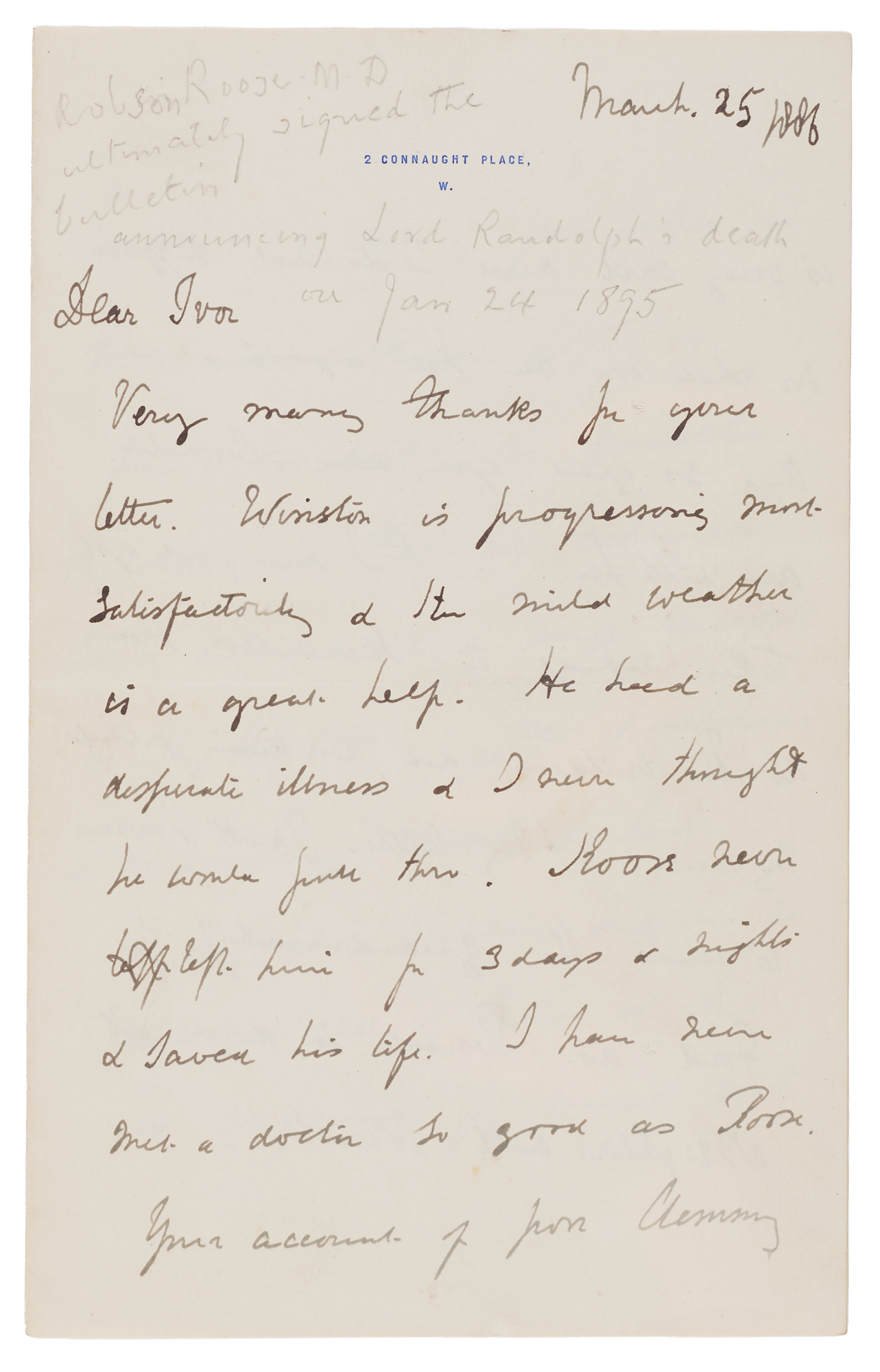
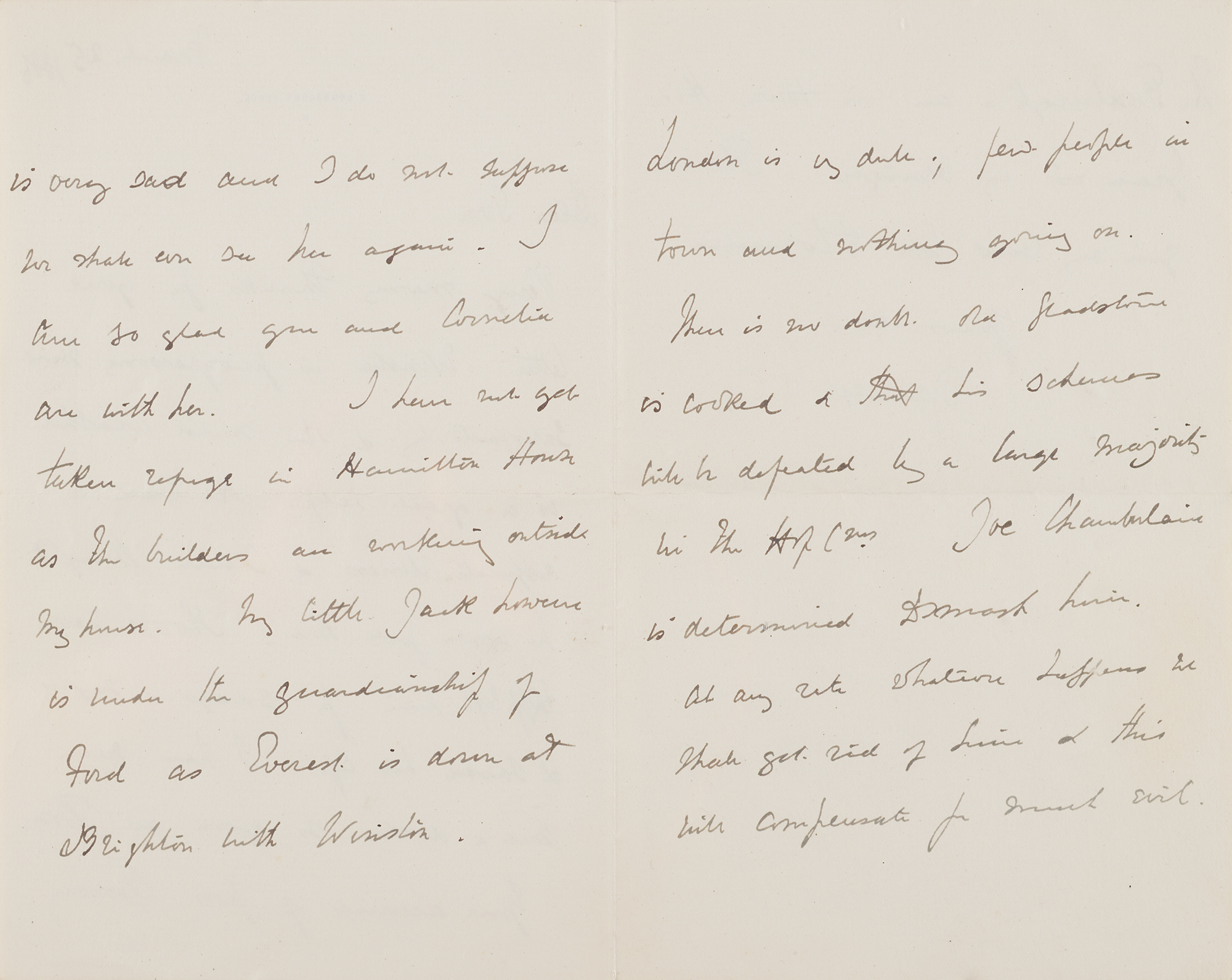
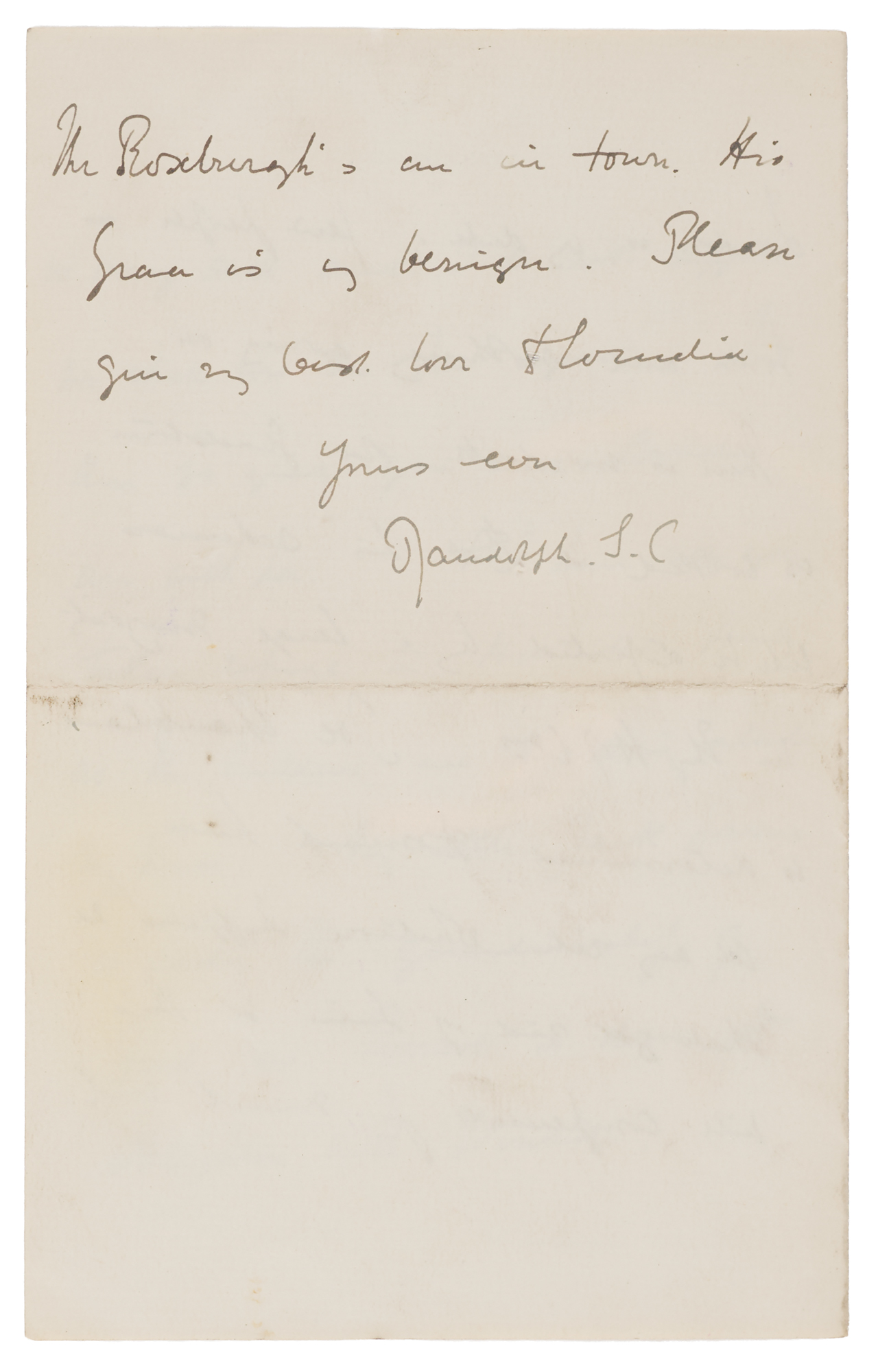
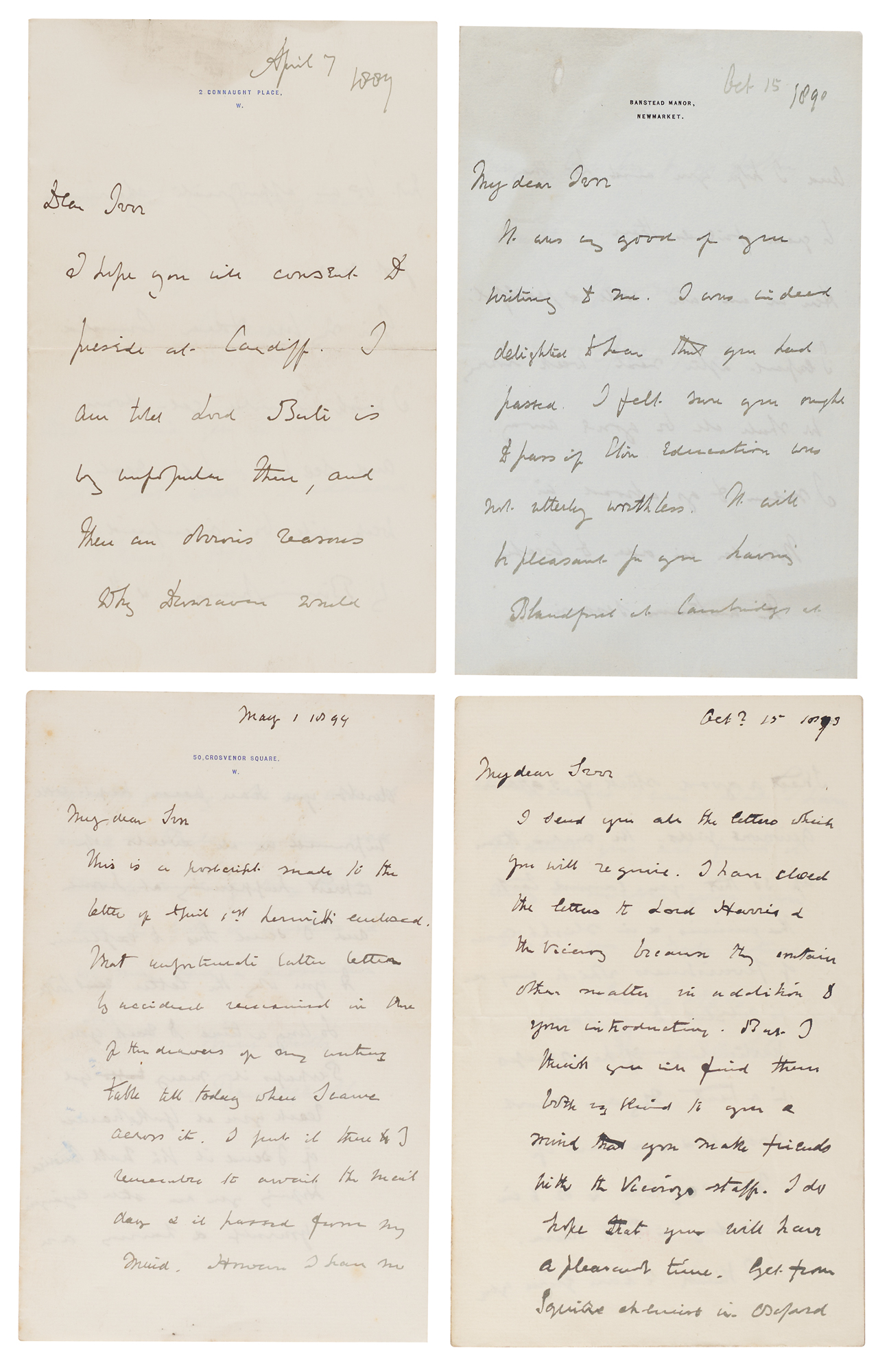
Accompanied by nine additional letters from the future King George V, Alfonso XIII of Spain (2), A. J. Balfour, and Randolph S. Churchill (5), which further reflect the Guest family’s close connections within the highest circles of British political, royal, and international society. Of considerable interest is the first letter from Randolph Churchill sent to Ivor Guest, 1st Baron Wimborne, dated March 25, 1886, which begins: “Very many thanks for your letter. Winston is progressing most satisfactorily, and the mild weather is a great help. He had a desperate illness, and I never thought he would pull through. Roose never left him for three days and nights and saved his life. I have never met a doctor so good as Roose.”
Robson Roose (1848-1905) was an English physician and the family doctor to Lord Randolph Churchill and Jennie Churchill. In March 1886, at age 11, Winston Churchill suffered a severe case of pneumonia, likely affecting his right lung, while at Brunswick School in Hove, near Brighton. Treated by Dr. Roose, the illness required intensive care with nourishment and stimulants. The severity of this early respiratory illness, often referred to as a ‘weak chest,’ influenced the choice to send him to the bracing climate of Harrow School.
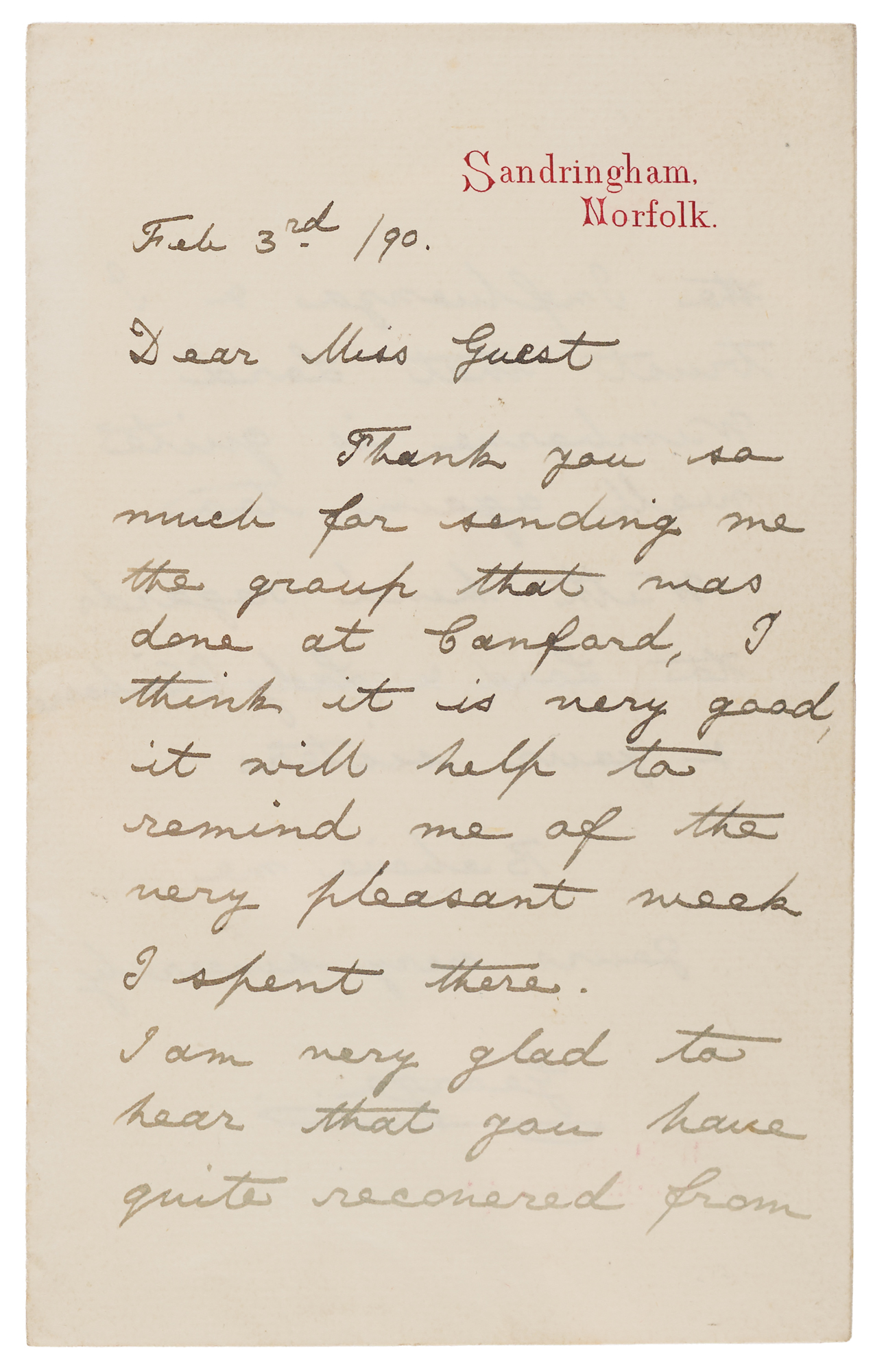
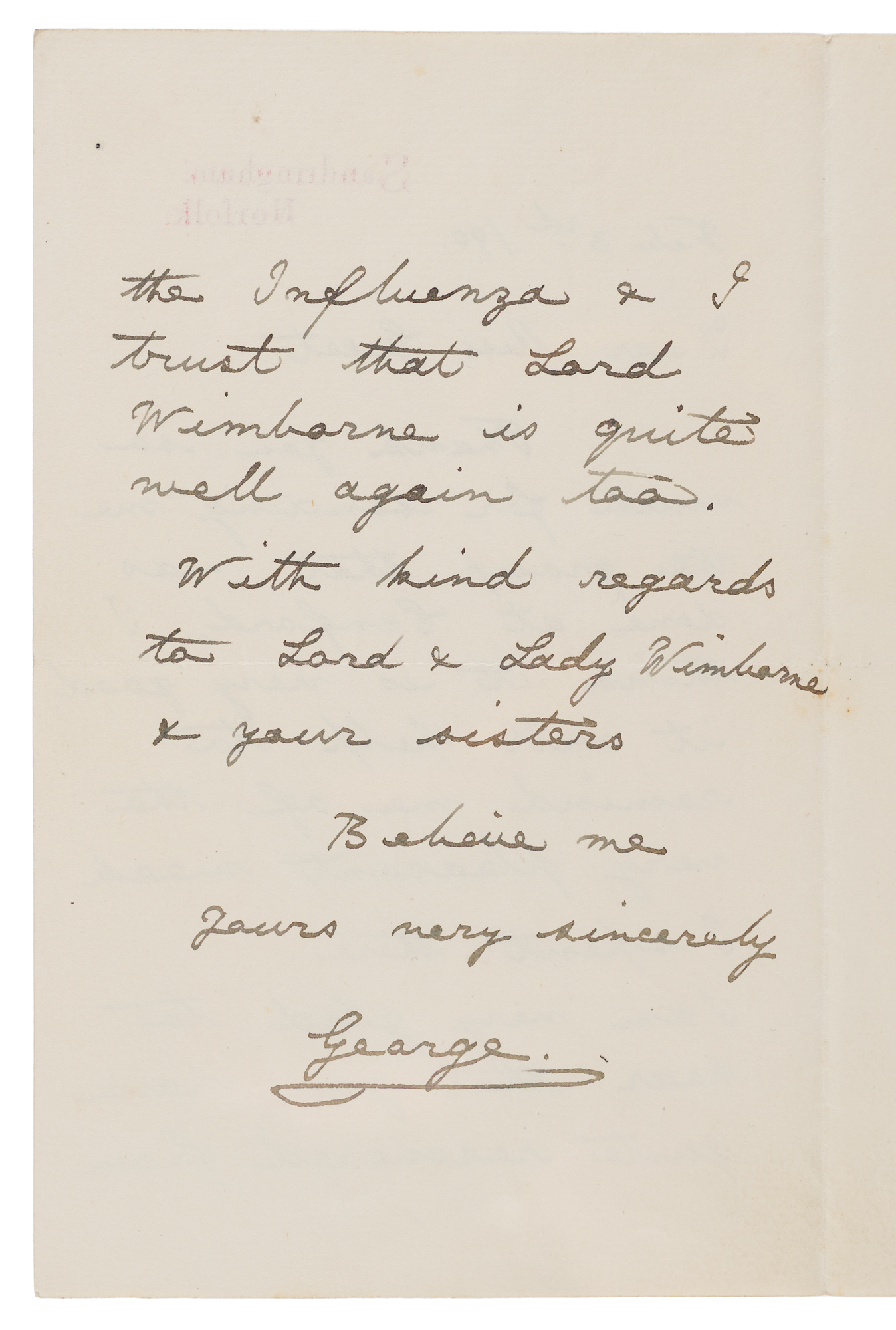
The handwritten letter from George V, dated February 3, 1890, signed “George,” sent to Guest’s wife, Cornelia Guest, Baroness Wimborne, in part: “Thank you so much for sending me the group that was done at Canford, I think it is very good, it will help to remind me of the very pleasant week I spent there. I am very glad to hear that you have quite recovered from the influenza, and I trust that Lord Wimborne is quite well again too.”
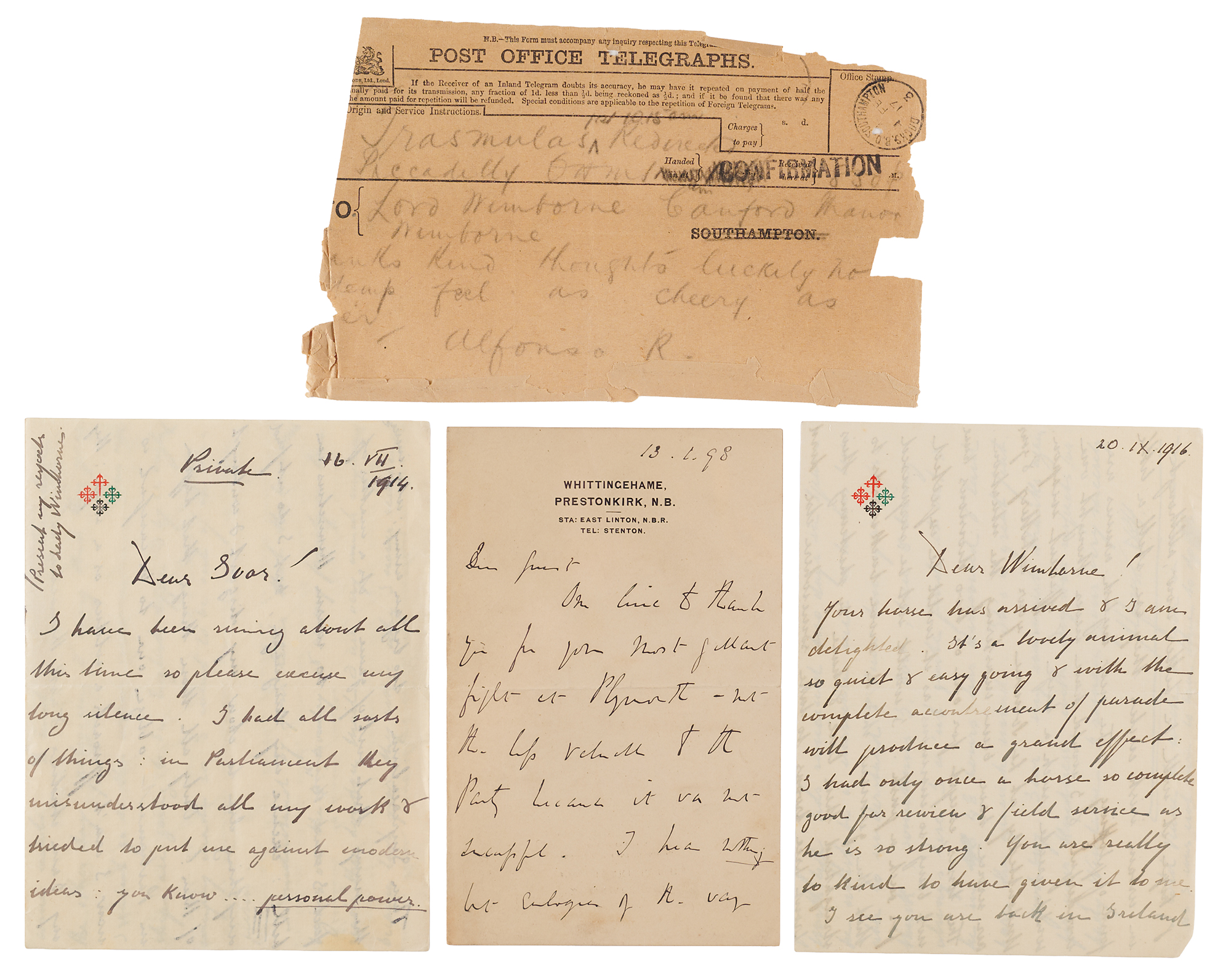
A war-dated letter from Alfonso XIII, sent to Baron Wimborne on September 20, 1916, in part: “I see you are back in Ireland. I hope it will be better now, although in certain average circles they are still a little fond of plotting. The new English armies are wonderful, and I would have never thought one would be such a huge and efficient weapon. Undoubtedly, at the Somme your artillery and your air service have been mastering the situation. The losses, except for one or two divisions, have not been so enormous as would be expected for such a push. I would not be surprised that the Germans should move backwards to straighten their line and have by shortening the front, free troops take somewhere else."

