Sold For $688
*Includes Buyers Premium
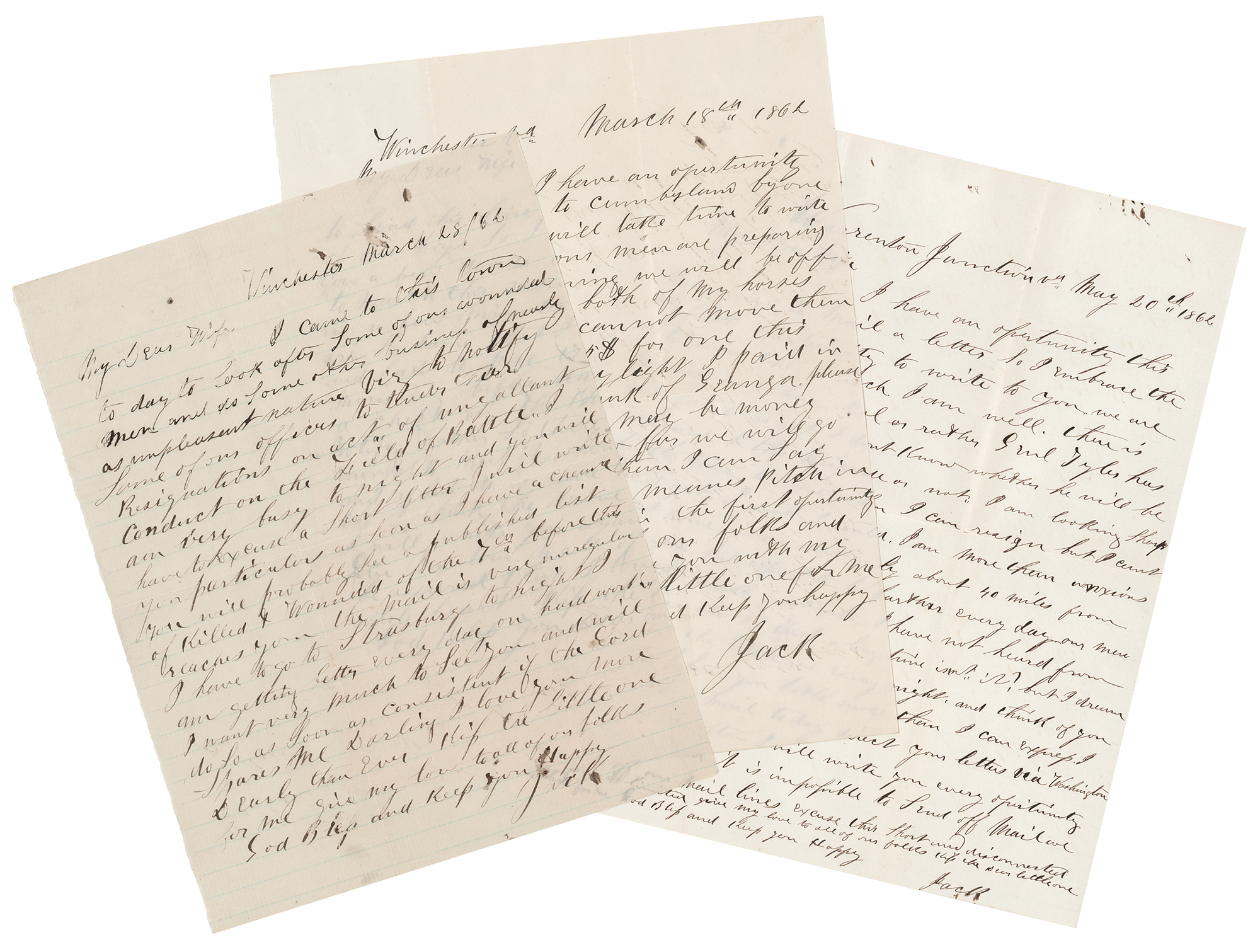
Three Civil War-dated ALSs from John S. Casement, each signed “Jack” and addressed to his wife, the noted suffragist Frances Jennings Casement, written between March and May 1862, as he prepared and battled in the Shenandoah Campaign against Stonewall Jackson's Confederate forces. The earliest handwritten letter, sent from Winchester, Virginia, on March 18, 1862, as the regiment was preparing to meet Stonewall Jackson's cavalry at the start of the Shenandoah Campaign, reads: “Our men are preparing to march this morning. We will be off in a few minutes. Both of my horses are so lame that I cannot move them and had to pay 175$ for one this morning before daylight.”
The second letter, again from Winchester, dated March 28th, five days after helping to defeat Jackson at the Battle of Kernstown, reads, in part: “I came to this town today to look after some of our wounded men and do some other business of nearly as unpleasant nature, viz., to notify some of our officers to tender their resignations on acts of ungallant conduct on the field of battle. I am very busy tonight, and…you will probably see a published list of killed & wounded of the 7th before this reaches you."
The last letter, written from Warrenton, VA, on May 20, 1862, at the heart of the Shenandoah Valley campaign: “We are still on the march…Col., or rather Genl. [Erastus] Tyler has not joined us yet. I don't know whether he will be assigned to this brigade or not. I am looking sharp for the time to come when I can resign, but I can't see it yet. I wish I could…We are now only about 40 miles from Washington." In overall fine condition. Casement's correspondence with his wife is of such consequence that it was showcased in Ken Burns' American Experience production, Transcontinental Railroad. With a few exceptions, the Casement letters now reside at Kansas State University. These are the only Casement letters to have ever been auctioned.
John Stephen Casement (1829–1909) was a prominent American Civil War general and railroad executive. Born in New York, Casement began his career in construction before enlisting in the Union Army at the onset of the Civil War, eventually rising to the rank of brigadier general. He played a significant role in several key battles, including the Shenandoah Valley Campaign, the Siege of Vicksburg, and the Atlanta Campaign. After the war, Casement became a notable figure in the railroad industry, working on the Union Pacific Railroad and overseeing the construction of the transcontinental railroad. His post-war contributions were instrumental in the expansion of the American railway system, marking him as a key figure in both military and transportation history.
The Shenandoah Valley Campaign, a significant series of military operations during the American Civil War, involved two notable campaigns in 1862 and 1864. In 1862, Confederate General Thomas ‘Stonewall’ Jackson led a brilliant campaign through the Shenandoah Valley, employing rapid and unpredictable movements to tie down larger Union forces and divert attention from Richmond. Jackson's actions, including victories at battles such as Kernstown, Winchester, and Port Republic, not only boosted Confederate morale but also disrupted Union plans and protected the Confederate capital from early capture.
In 1864, the Shenandoah Valley saw intense conflict again as Union General Philip Sheridan launched a campaign to decisively defeat Confederate forces and deny the South the Valley's agricultural resources. Sheridan's aggressive tactics led to key victories at the Third Battle of Winchester, the Battle of Fisher's Hill, and the Battle of Cedar Creek. These successes secured Union control over the Valley and contributed to the eventual downfall of the Confederacy by depriving it of essential supplies and weakening its military strength. The Shenandoah Valley Campaigns thus played a critical role in the broader context of the Civil War, influencing its outcome significantly.

