The 30 Minute Rule begins May 13 at 7:00 PM EDT. An Initial Bid Must Be Placed By May 13 at 6:00 PM EDT To Participate After 6:00 PM EDT
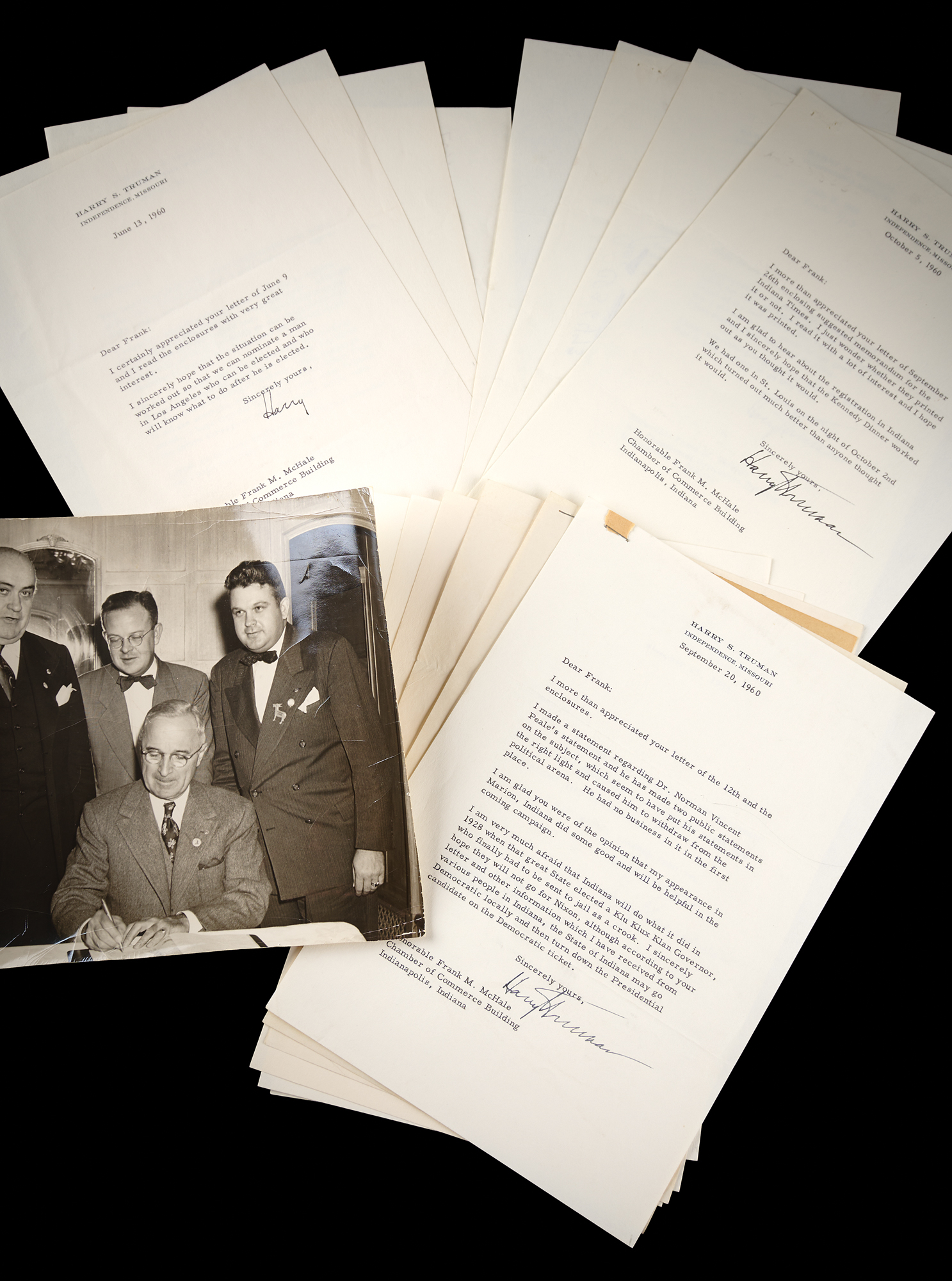
Collection of 14 TLSs signed as either “Harry” or “Harry S. Truman,” each one page, typed on his personal 7.25 x 10.5 letterhead, all addressed to Indianapolis politician Frank M. McHale, a longtime Democratic Party strategist and influential Indiana party leader. Although the letters date between 1953 and 1965, the majority (10) were sent by Truman during the year 1960 and offer a candid, behind-the-scenes view of his continued influence within the Democratic Party during a pivotal election year.
In these 1960 letters, Truman discusses the forthcoming Democratic National Convention and the presidential election itself, expressing concern over party leadership and strategy while signaling clear support for John F. Kennedy as the Democratic nominee. He corresponds closely with McHale on Indiana politics, including gubernatorial prospects, voter turnout efforts, and campaign events, while warning that the state might support Democrats locally but reject the national ticket. Truman also addresses the religious controversy surrounding Kennedy’s candidacy and cautions against a return to reactionary politics by invoking Indiana’s Ku Klux Klan past.
Highlights include:
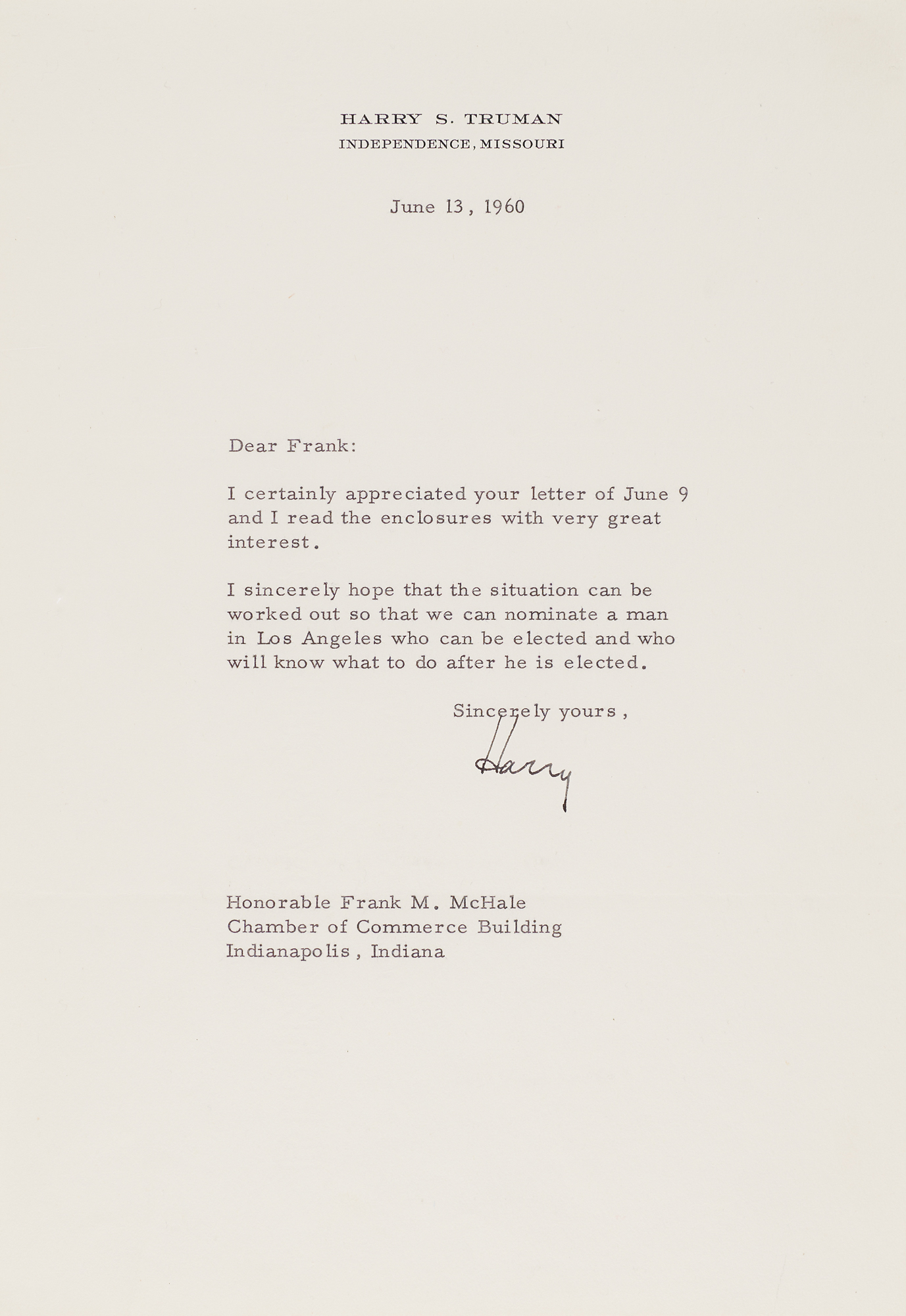
June 13, 1960: “I sincerely hope that the situation can be worked out so that we can nominate a man in Los Angeles who can be elected and who will know what to do after he is elected.”
Although Truman declined to attend the 1960 Democratic National Convention, issuing a public statement criticizing the way Kennedy’s supporters had gained control of the nominating process, he favored the nomination of Stuart Symington and even urged Kennedy to step aside—an appeal Kennedy bluntly rejected at a press conference—before ultimately supporting him in the general election.
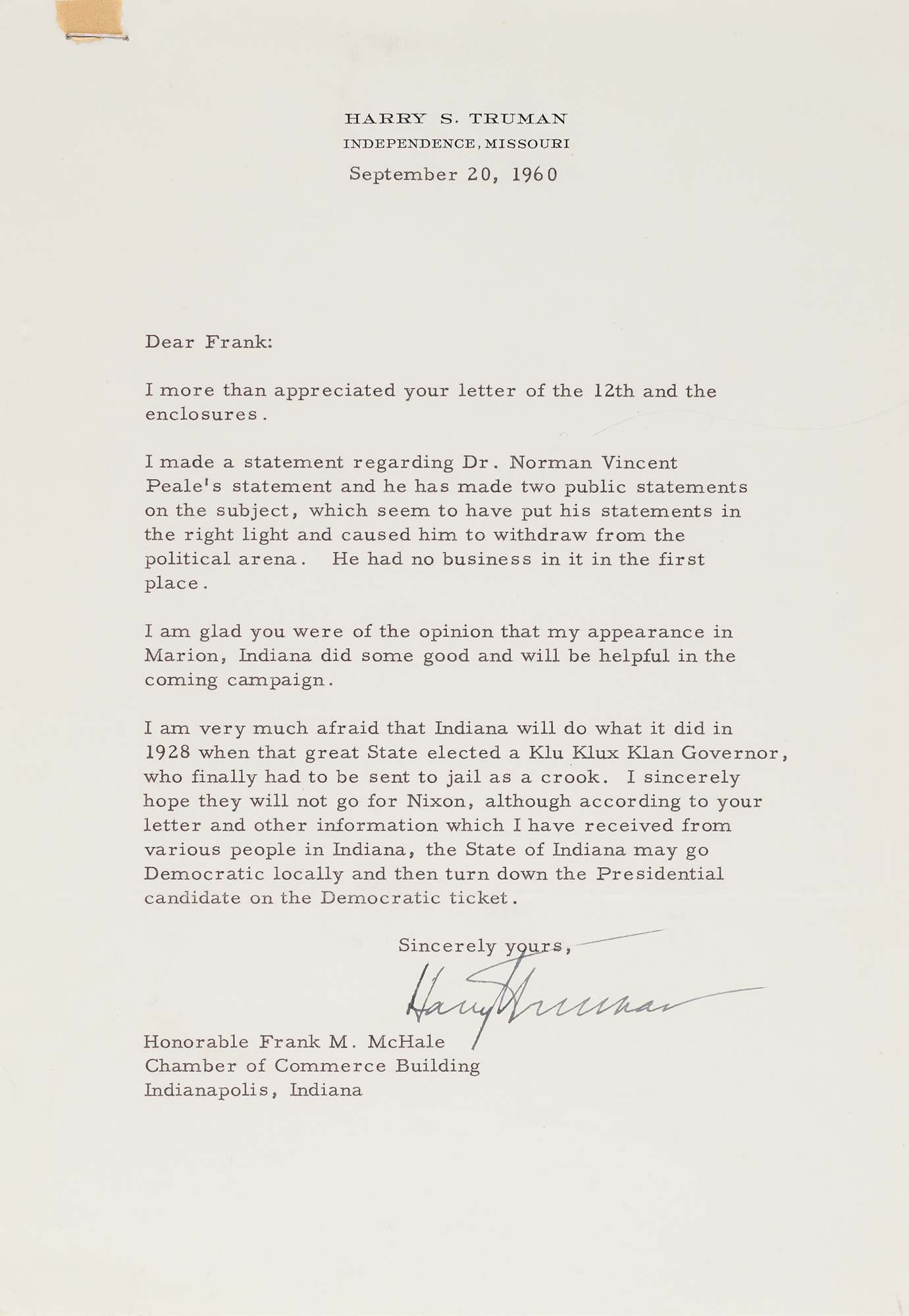
September 20, 1960: “I made a statement regarding Dr. Norman Vincent Peale's statement and he has made two public statements on the subject, which seem to have put his statements in the right light and caused him to withdraw from the political arena. He had no business in it in the first place…I am very much afraid that Indiana will do what it did in 1928 when that great State elected a Klu Klux Klan Governor, who finally had to be sent to jail as a crook. I sincerely hope they will not go for Nixon, although according to your letter and other information which I have received from various people in Indiana, the State of Indiana may go Democratic locally and then turn down the Presidential candidate on the Democratic ticket.”
In September 1960, renowned minister Norman Vincent Peale led a group of Protestant clergy in questioning whether a Catholic could serve as president without being influenced by the Pope. Peale’s opposition, rooted in fears of Catholic control over public policy, ultimately backfired, strengthening Kennedy’s campaign. In this letter, Truman dismisses the controversy, warns against a return to Klan-era politics in Indiana—i.e., the 1928 election of Edward L. Jackson—and expresses concern that the state might favor Nixon while supporting Democrats locally.
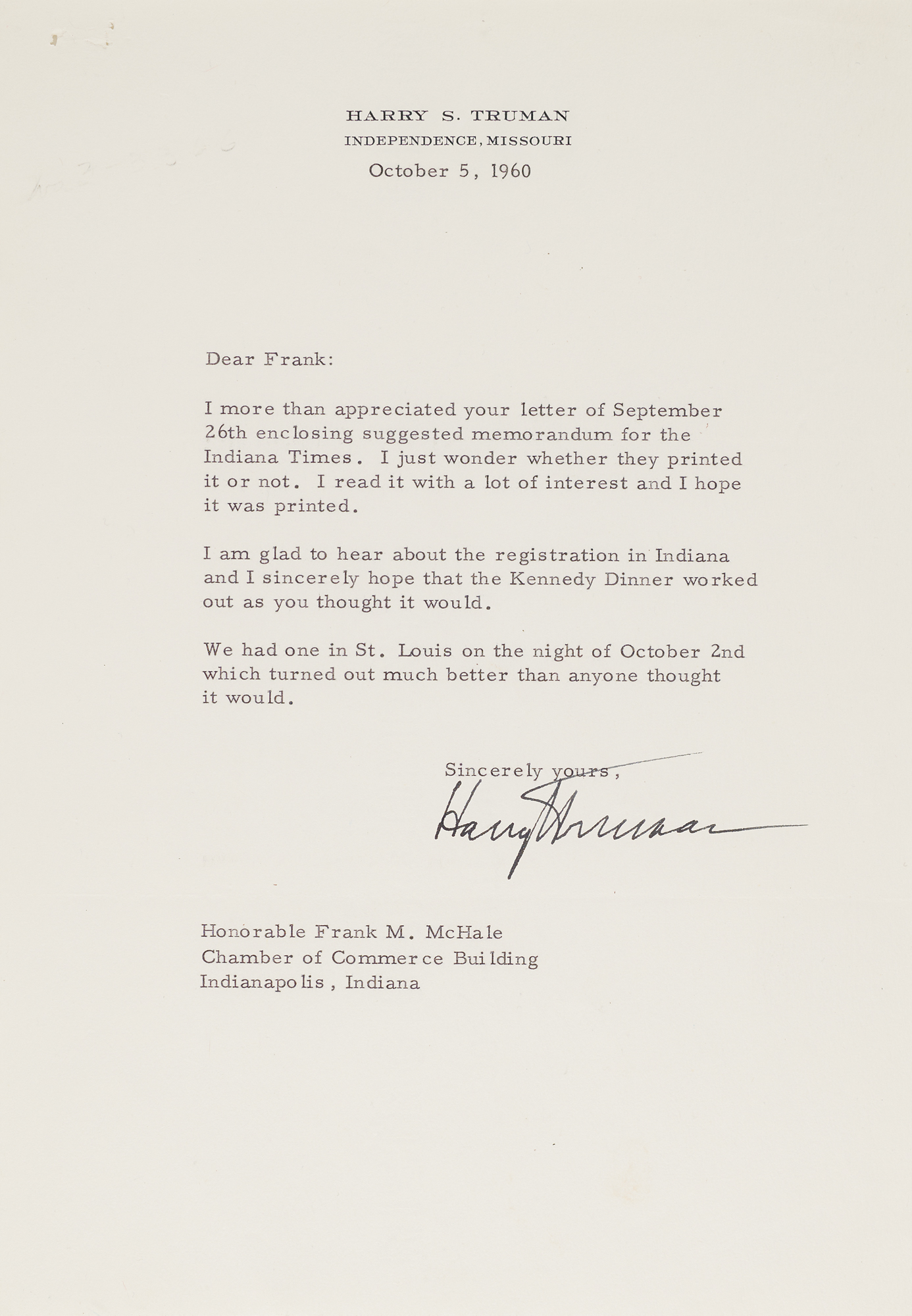
October 9, 1960: “That certainly was a dinner to go on the record, especially for Indiana, and I know that you and McKinney were to be credited entirely for its success. I was most happy to have all the information you gave me and I want to remain optimistic for Indiana not to do what it did in 1928. If you remember they elected a Klu Kluxan for Governor and finally had to send him to the penitentiary. I sincerely hope that not only the Democratic Governor, but the whole ticket will go over in Indiana.”
October 26, 1960: “I certainly wish that there could be a way to inform the people of Indiana on this religious issue. I thought your statement was a good one. I have been making statements all over the South on the subject but this situation in Puerto Rico may cost us a lot of votes. Whenever a state decides to separate the national Democrats from the local ones, we have the same trouble you are having in Indiana. That happened in all the southern states that voted for Strom Thurmond. I hope that the time will come when Indiana can follow through on what the people really want. I think we have the South awakened to this situation and I hope they stay that way.”
Amid heightened tensions over Kennedy’s Catholicism, Truman points to developments in Puerto Rico—where Kennedy was actively courting the vote through ‘Viva Kennedy’ clubs and strengthening ties with Governor Luis Muñoz Marín—as a potential political liability, fearing such visibility could amplify anti-Catholic sentiment among mainland voters. He also compares Indiana’s risk of abandoning the national Democratic ticket to the Dixiecrat revolt of 1948, when Southern Democrats, opposing the party’s civil rights platform, backed Strom Thurmond for president while continuing to support Democrats in local races.
November 16, 1960: “I think you took them to town in those statements which you made. I am glad the Governor is a Democrat for the next four years in Indiana. I understood the situation there, as you and Frank McKinney explained it to me, and I didn't expect anything but the result which we received. It is too bad that the ticket in Indiana did not carry. In Missouri the Presidential ticket ran nearly 250,000 behind the State ticket and, of course, you know why.”
Following the 1960 election, Truman reflects on the outcome in Indiana, where his earlier concerns proved accurate: while Democrat Matthew E. Welsh won the governorship with stronger voter turnout at the state level, Richard Nixon carried Indiana over John F. Kennedy in the presidential race. He acknowledges this split result—echoed in Missouri as well—as evidence of voters supporting Democrats locally while rejecting the national ticket. In overall fine condition.

