The 30 Minute Rule begins May 21 at 7:00 PM EDT. An Initial Bid Must Be Placed By May 21 at 6:00 PM EDT To Participate After 6:00 PM EDT
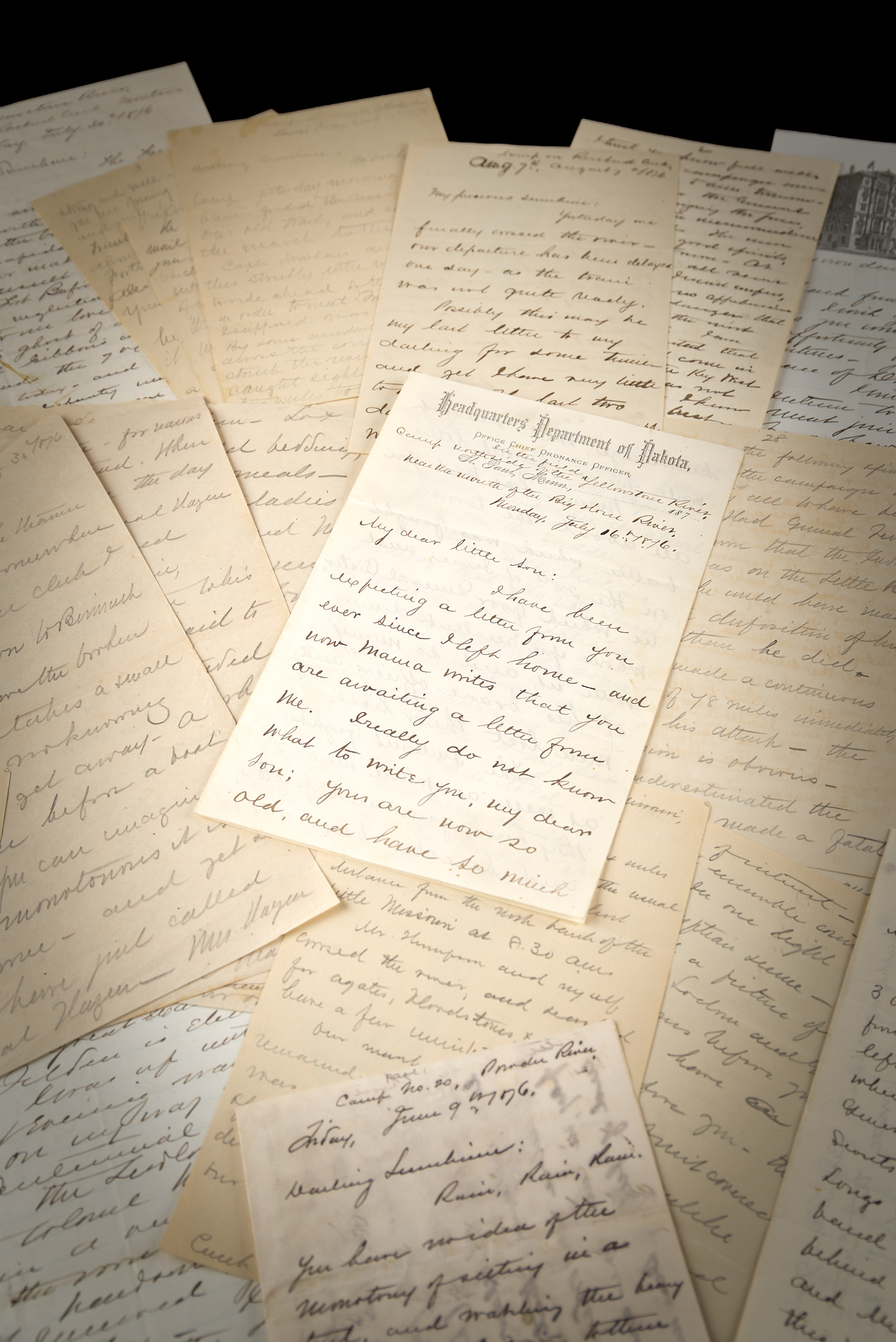
Archive of 29 autograph letters signed by Captain Otho Ernest Michaelis, most signed “Otho,” addressed primarily to his wife Kate and occasionally to his son, totaling over 100 pages, mostly 5 x 8, dated from May 17, 1876, to November 9, 1876. These letters constitute the most sustained and analytically penetrating eyewitness account of the 1876 Little Bighorn campaign known to exist in private hands, written by the Ordnance Officer of the Seventh Cavalry who marched with Custer from Fort Abraham Lincoln, remained with Terry’s column when Custer rode south to his death, and was among the first men to reach the battlefield on June 27th to help identify the dead.
In early 1876, the Army of the United States launched a three-pronged campaign to force the Sioux and their allies back onto the reservation. Colonel John Gibbon marched east from Fort Ellis, Brigadier General George Crook moved north from Fort Fetterman, and Lieutenant Colonel George Armstrong Custer led the Seventh Cavalry west from Fort Abraham Lincoln. Michaelis, as Ordnance Officer, marched with Custer from the first step. His letters open on the morning of departure, May 17, describing reveille at three in the morning, the Indian scouts singing, the band playing “The Girl I Left Behind Me,” Libbie Custer riding at the head of the column before turning back with the paymaster. The letters track every mile of the westward march—the struggle to push Gatling guns through the badlands, eight creek crossings and five bridges built in a single day on Davis Creek, and Custer’s reconnaissance parties probing ahead into increasingly hostile country.
By early June the correspondence reflects growing impatience and strategic complexity. The three-pronged convergence was already breaking down—Gibbon unable to hold his position, Crook’s command turned back at the Rosebud on June 17—while Michaelis tracks the movements of the Far West steamer up the Yellowstone and Reno’s reconnaissance up the Powder River. On June 8 he writes: “We shall have about 600 effective men with us, and if we can strike a blow—we shall be home sooner than was expected. It was a bold movement on the General's part to leave O'Fallen Creek, and strike at once due west across…to Powder River…I am glad I am going on this scout for I want to see an Indian campaign…General Custer does not think that we shall strike any Indians. We are going into the country near which the Crazy Horse fight took place last winter General Custer however does not think that the Indians would remain there. He thinks that they are on the Yellowstone.”
On June 12, he discusses the movements of Marcus Reno: "Reno's right wing of the 7th Cav'y with one Gatling gun went up Powder river on the 9th—are then to strike across to Tongue River—near where the Indians are supposed to be camped. We shall stay here a day or two, and then go up the Yellowstone with pack train to meet Reno. If we meet the redskins, and strike a serious blow, I suppose the expedition will have accomplished its purpose. The stockade has been abandoned, or rather will be this afternoon, and our base of supplies will be here…This, darling sunshine, will be the last chance for sending a letter for some time, for we are about to cut loose entirely from civilization."
On June 22, three days before the battle, writing from the Far West near the Rosebud: “Custer is about to leave with his full regiment, rationed for 15 days—on a scout to the East and South. He will march to the Little and Big Horn—where the Indians are now supposed to be. General Gibbon is on board, but his column is marching for the Big Horn on the left bank. We shall steam up the same river. My impression [is] that this last plan—after its execution, will end the campaign.”
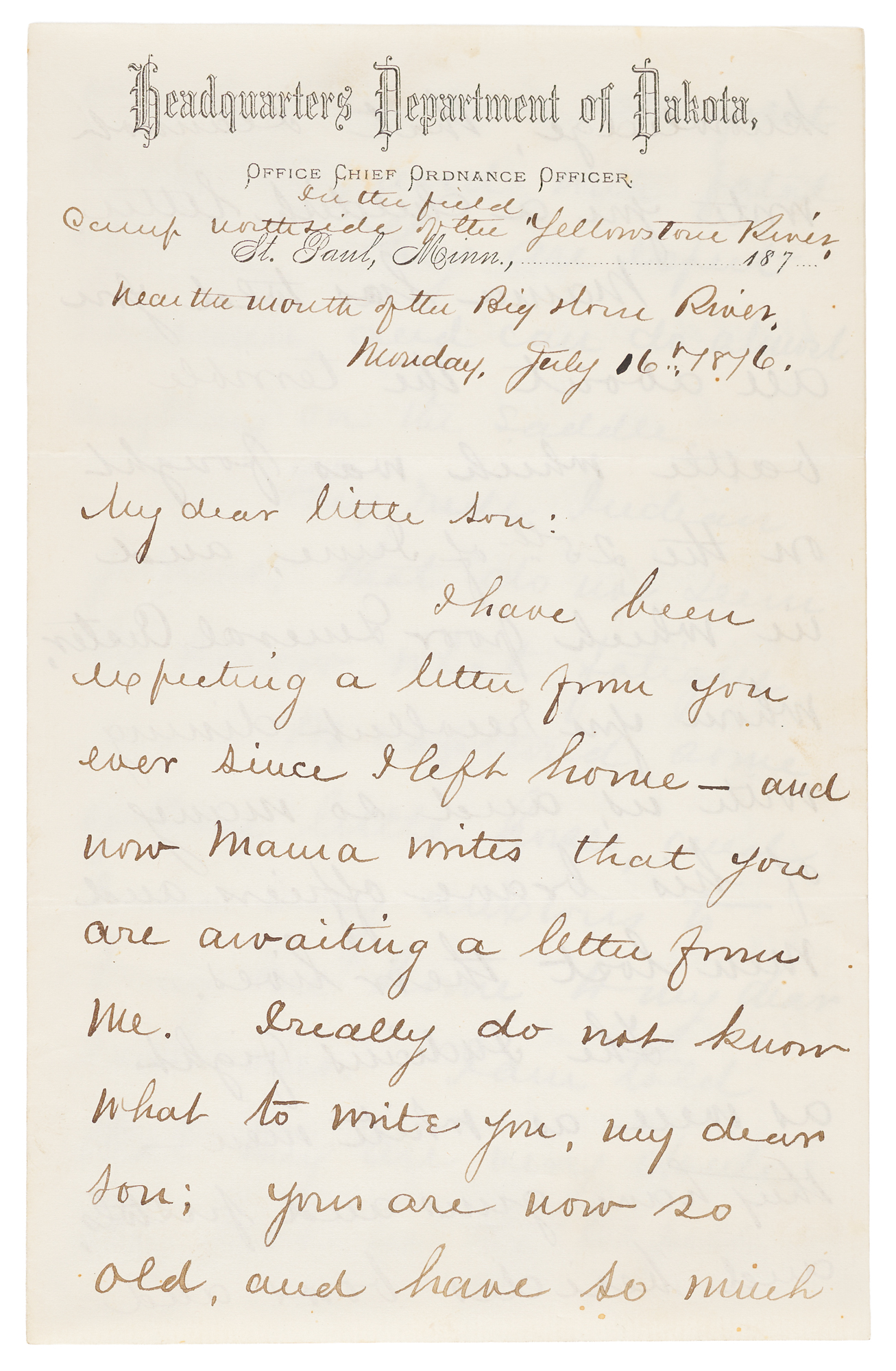
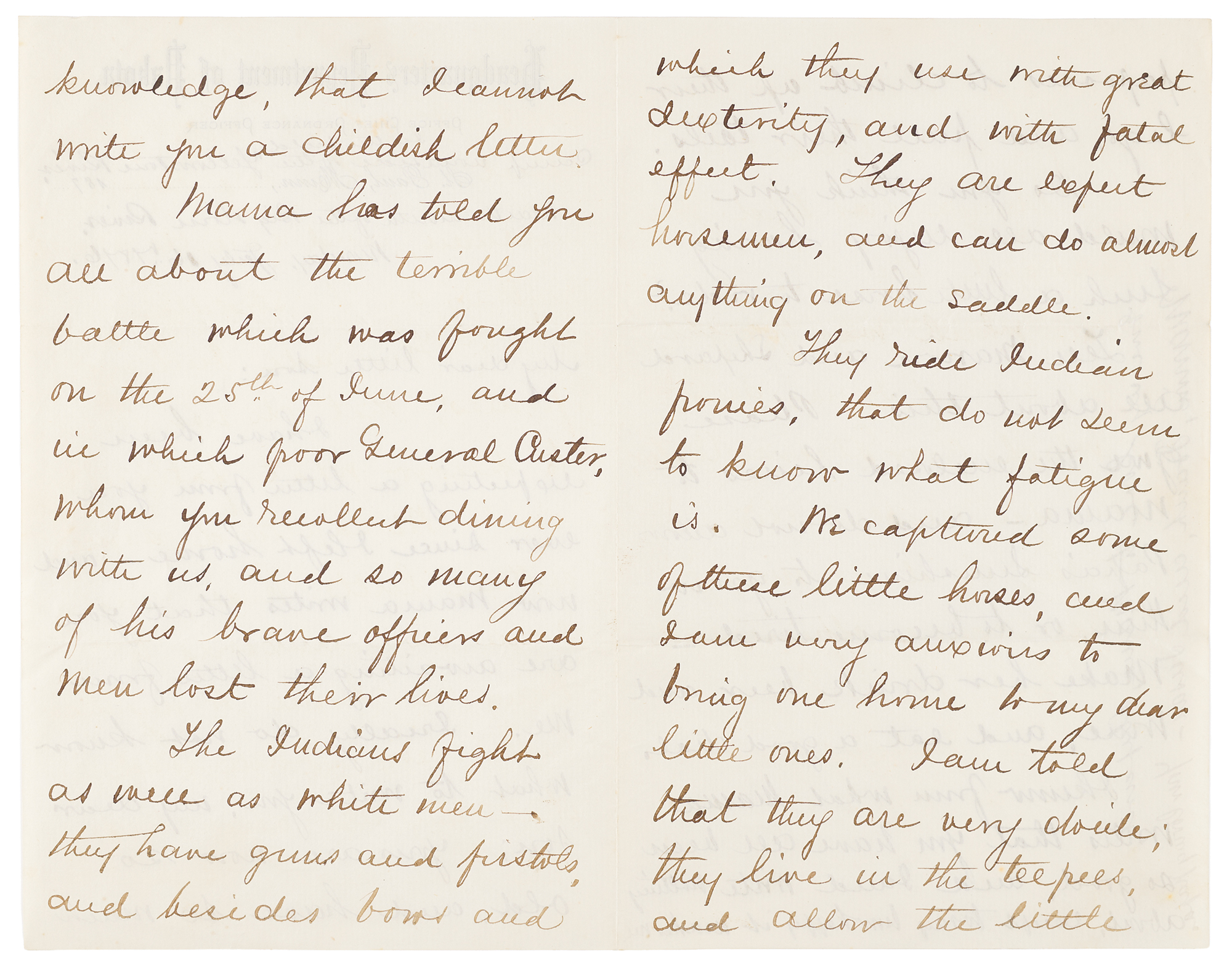
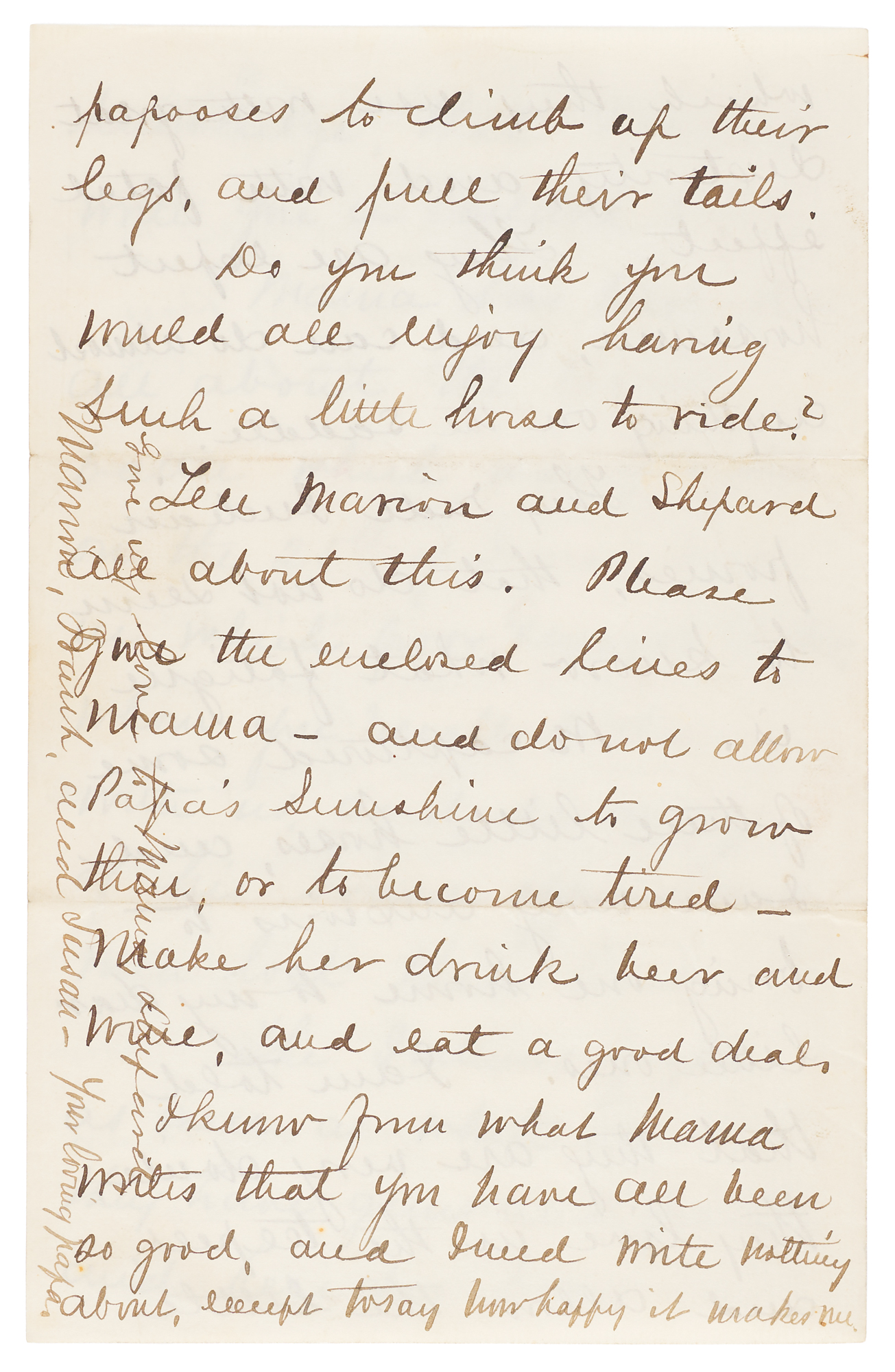
His next letter is dated July 16—three weeks after Custer’s death—written to his young son, gently explaining what had happened to General Custer: "Mama has told you all about the terrible battle which was fought on the 25th of June, and in which poor General Custer, whom you recollect dining with us, and so many of his brave officers and men lost their lives. The Indians fight as well as white men—they have guns and pistols, and besides bows and [arrows] which they use with great dexterity, and with fatal effect. They are expert horsemen, and can do almost anything on the saddle. They ride Indian ponies, that do not seem to know what fatigue is. We captured some of these little horses, and I am very anxious to bring one home to my dear little ones. I am told that they are very docile; they live in the teepees and allow the little papooses to climb up their legs, and pull their tails."
By late July and into August, the correspondence reflects the army’s efforts to recover its footing. Michaelis tracked the arrival of reinforcements, the resumed pursuit of Sitting Bull and Crazy Horse, the internal tensions between Terry and Crook over strategy and glory, and the gradual dissolution of the campaign as the Indians scattered. On July 30 he writes frankly about Crook: “I do not think that Crook is anxious to cooperate—as soon as he has force enough he will take the aggressive—irrespective of our movements. He wants all the glory…Our present intended move will bring us…to a position which will enable us to connect with Crooks right. I do not think however, that Sitting Bull will await this junction. He will offer battle either to Crook or Terry before we unite, or he will consider our combined ores, as they say here, 'bad medicine and 'light out.'”
On August 7, before the command moved again, he makes his will, "not that I fear any think may happen—but that if it should please God that I remain out here, where so many gallant fellows lie—no questions may arise as to the guardianship of our dear little ones." He further expresses hopes of revenge: "I hope we may meet the savages, and give them a good drubbing. They will fight though when pushed, and fight well, three men went ashore from the Far West the other day at Powder River, and were attacked by six Sioux. One, bolder than the others, rose close up to our men, wounded one to the death, and was himself shot from his pony by one of the survivors. One the ground, mortally shot, he just tried to crawl to the dying white man to scalp him. He did not succeed. In his possession was found a carbine taken at Custer's fight."
On August 18, after a skirmish with hostiles near Powder River, he describes giving his horse the spurs and rushing through ravines toward the column, not daring to show himself on the bluffs: "Some friendly Indians were a mile or so behind us. We heard a shot on our right. The Indians galloped away. We were somewhat alarmed—thinking a small party of hostiles might perhaps have been watching the boat. The only time to run from Indians is before they see you. We gave our horses the spurs—and rushed through the ravines—in the direction of the column…we did not dare show ourselves on the bluffs…The trails seem to diverge hereabouts. Some of the Indians have crossed—some have gone toward the Little Missouri—probably to their agencies." Shortly afterward he was injured and evacuated aboard the Far West.
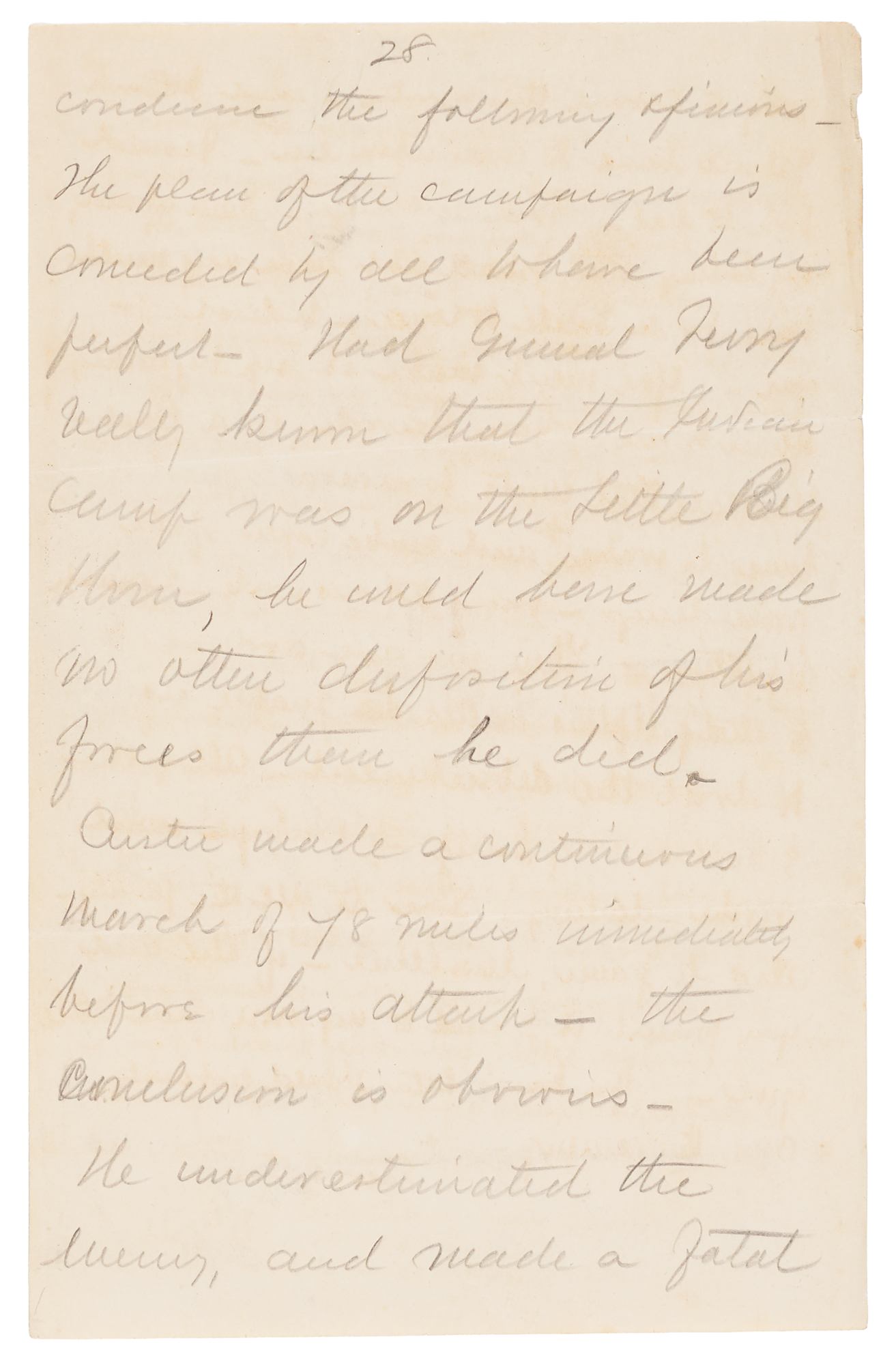
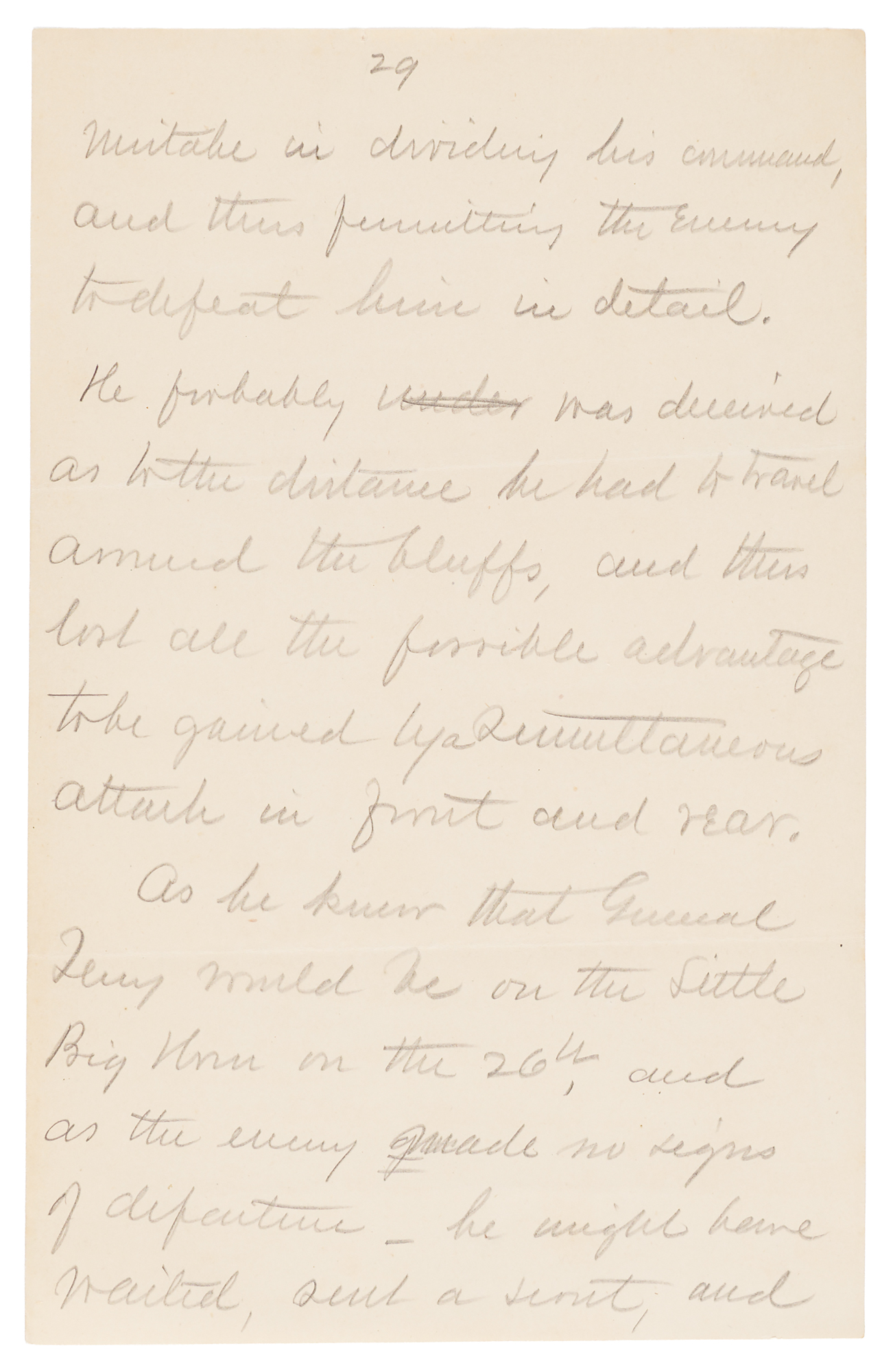
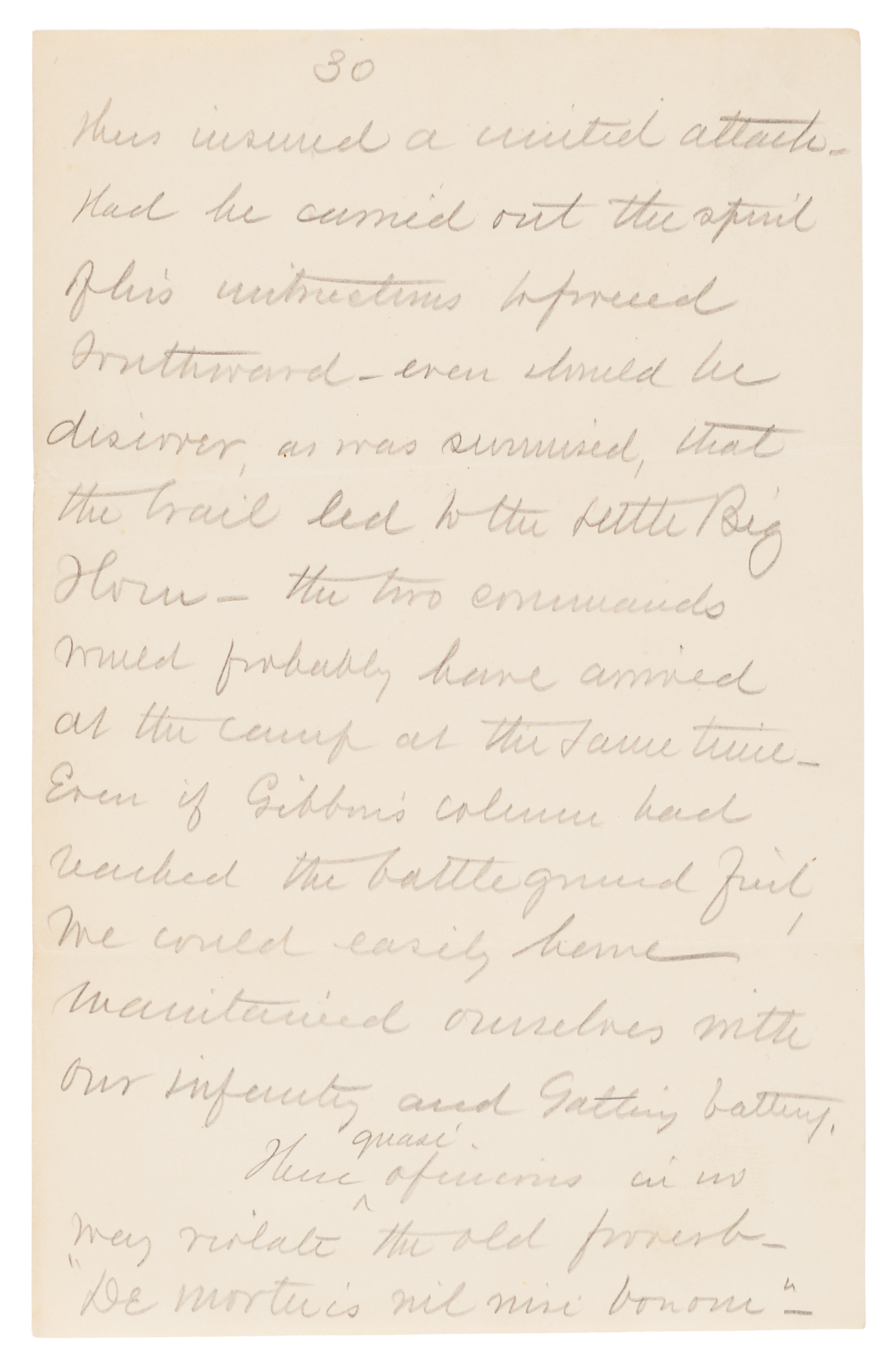
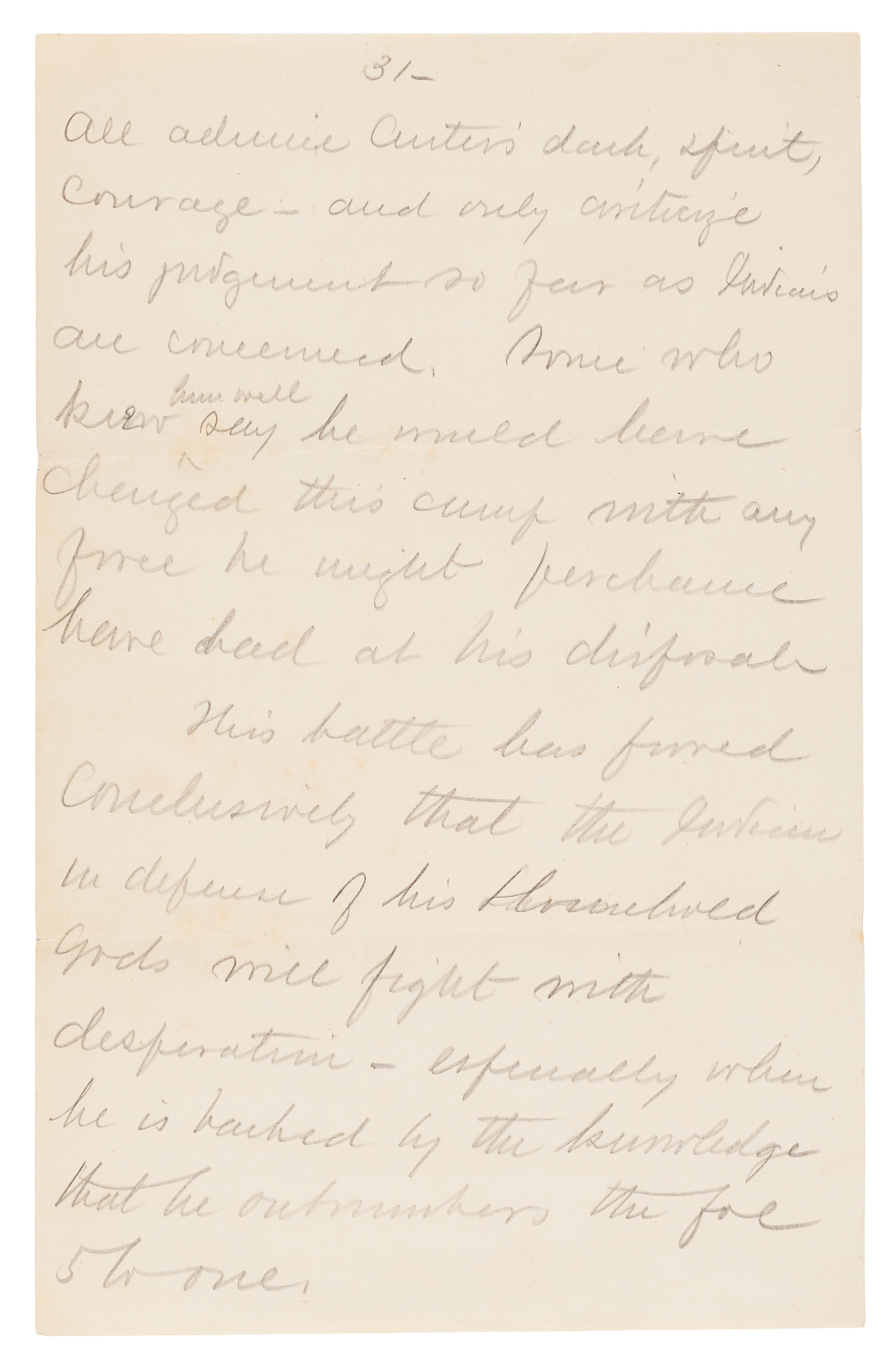
Within in the collection is a few pages of an autograph manuscript written for public consumption and intended for Whitelaw Reid at the New York Tribune—several letters include explicit instructions to forward passages to Reid—in which Michaelis analyzes Custer’s defeat with the dispassion of a trained ordnance officer: “He underestimated the enemy, and made a fatal mistake in dividing his command, and thus permitting the enemy to defeat him in detail…All admire Custer’s dash, spirit, courage—and only criticize his judgement so far as Indians are concerned. Some who knew him well say he would have charged this camp with any force he might perchance have had at his disposal. This battle has proved conclusively that the Indian in defense of his Household Gods will fight with desperation - especially when he is backed by the knowledge that he outnumbers the foe 5 to one.” The archive concludes with letters from the Philadelphia Centennial Exhibition in November, where Michaelis attended the closing ceremonies as a member of both the Seventh Cavalry and the American Society of Civil Engineers, and noted almost in passing that Tilden appeared to have won the presidency.
In overall very good to fine condition, with edge tears to a few letters.
Otho Ernest Michaelis (1843–1890) emigrated from Germany to the United States as an infant and graduated as valedictorian of New York’s Free Academy in 1862. Entering the army, he became the first non–West Point graduate admitted to the ordnance corps and served as chief of ordnance to General George H. Thomas during the Gettysburg campaign. Following service with the Seventh Cavalry, he held posts at various federal arsenals, where he developed numerous innovations to improve ordnance management, and later joined Professor S. P. Langley’s expedition to Mt. Whitney, establishing a signal station.
The Western Americana auction of Jochen Zeitz.

