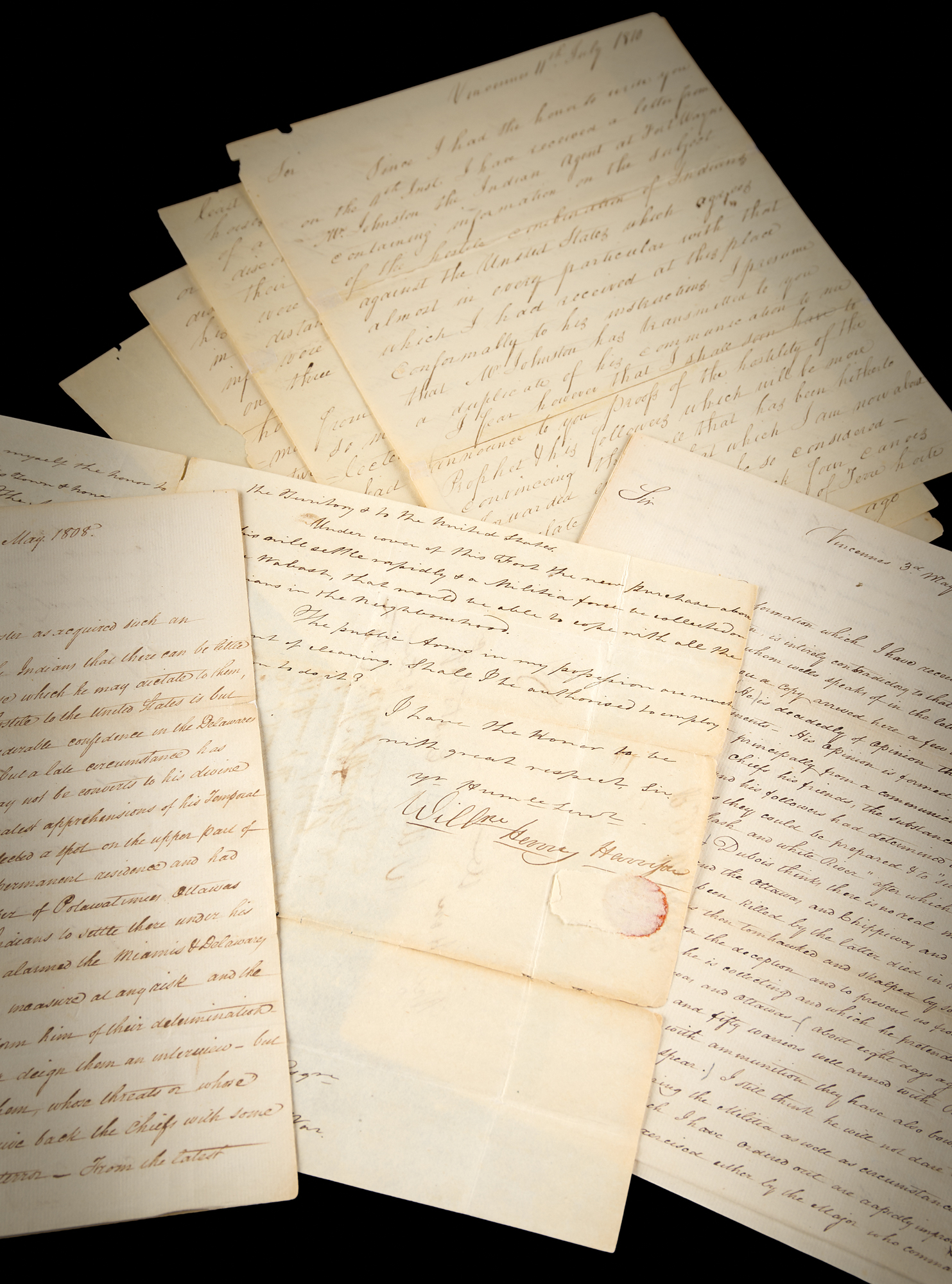
Four LSs signed 'Will'm Henry Harrison," totaling twelve pages, 8 x 10, dated from May 19, 1808, to July 11, 1810. Appointed the first governor of the Indiana Territory in 1800, Harrison writes to the Secretary of War—first Henry Dearborn, then William Eustis—on the state of relations with the frontier tribes, some friendly and others hostile, as American settlers pushed deeper into Indiana in increasing numbers. His letters focus on the growing power of the Shawnee leaders, Tecumseh and his brother, "the Prophet," and describe increasingly hostile activities by their followers, warning of imminent attacks on American settlements. These tensions culminated in the Battle of Tippecanoe in November 1811, where Harrison led the victorious American forces to national fame—and a campaign slogan. He relates to Washington news of growing Indian forces under the influence of Tecumseh and the Prophet, the state of readiness of the increasingly outnumbered local militias, Indian incursions into white settlements, the theft of property and other provocations, and the constant backdrop of imminent attack. An interesting aspect of the letters is Harrison's emphasis on the perceived power and influence of the Prophet, above and beyond that of Tecumseh.
Excerpts from the letters:
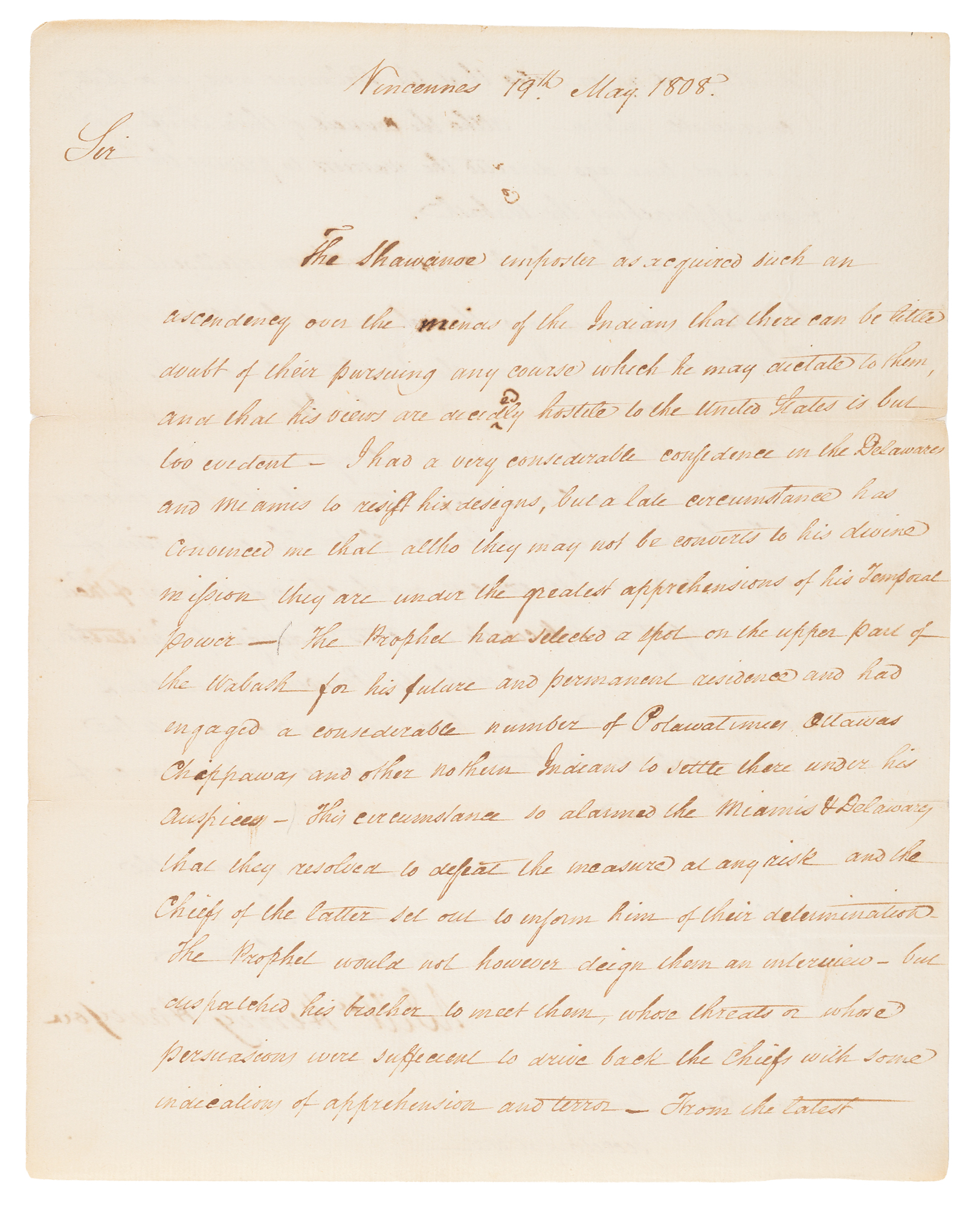
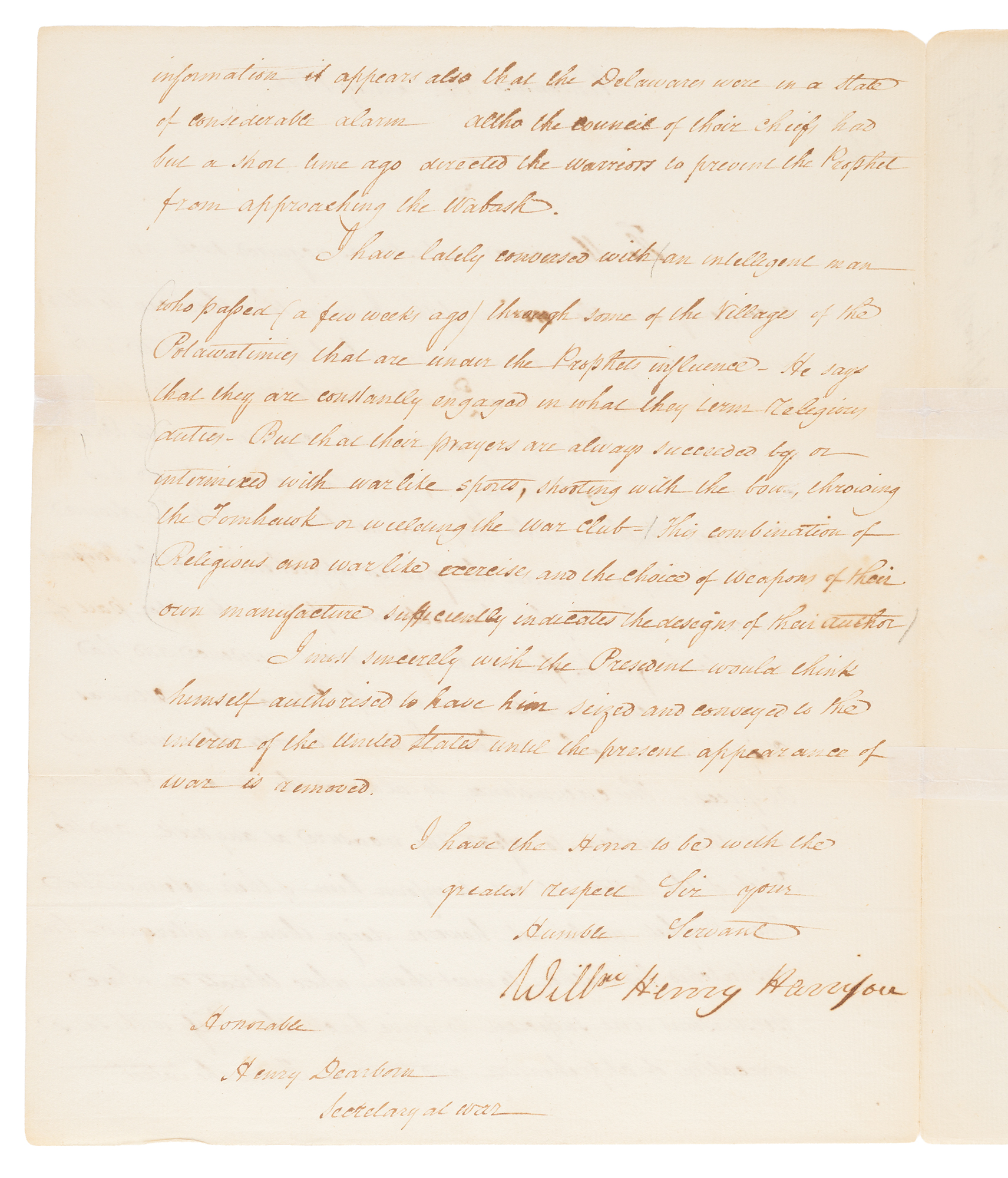
May 19, 1808, to Henry Dearborn, in part: "The Shawanoe imposter [the Prophet] has acquired such an ascendancy over the minds of the Indians that there can be little doubt of their pursuing any course which he may dictate to them, and that his views are already hostile to the United States is but too evident. I had a very considerable confidence in the Delawares and Miamis to resist his designs, but a late circumstance has convinced me that altho they may not be converts to his divine mission they are under the greatest apprehensions of his temporal power—The Prophet had selected a spot on the upper part of the Wabash for his future and permanent residence and had engaged a considerable number of Potawatomies, Ottawas, Chippawa, and other northern Indians to settle there under his auspices…I have lately conversed with an intelligent man who passed (a few weeks ago) through some of the villages of the Potawatomies that are under the Prophet's influence. He says that they are constantly engaged in what they term religious duties. But that their prayers are always succeeded by or intermixed with warlike sports, shooting with the bow, throwing the Tomahawk or wielding the war club. This combination of religious and warlike exercise and the choice of weapons of their own manufacture sufficiently indicates the designs of their author. I most sincerely wish the President would think himself authorized to have him seized and conveyed to the interior of the United States until the present appearance of war is removed." Harrison gives other examples of the growing influence of the Prophet. He describes how the Shawnee leader seeks to persuade members of the other tribes to follow his will, but also resorts to shows of force by Tecumseh if the Pottawatomi, Ottawa, Chippewa, and others do not fall into line.
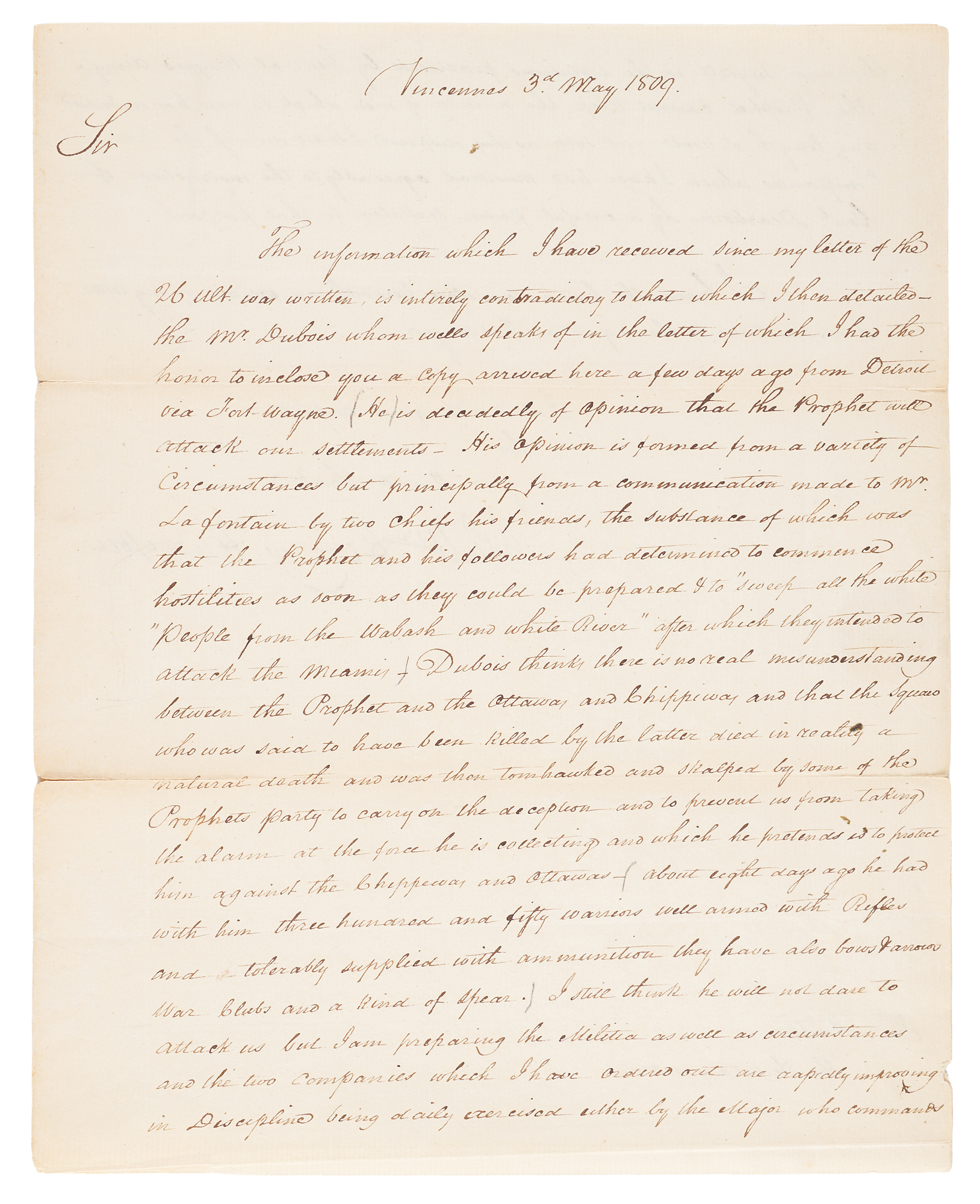
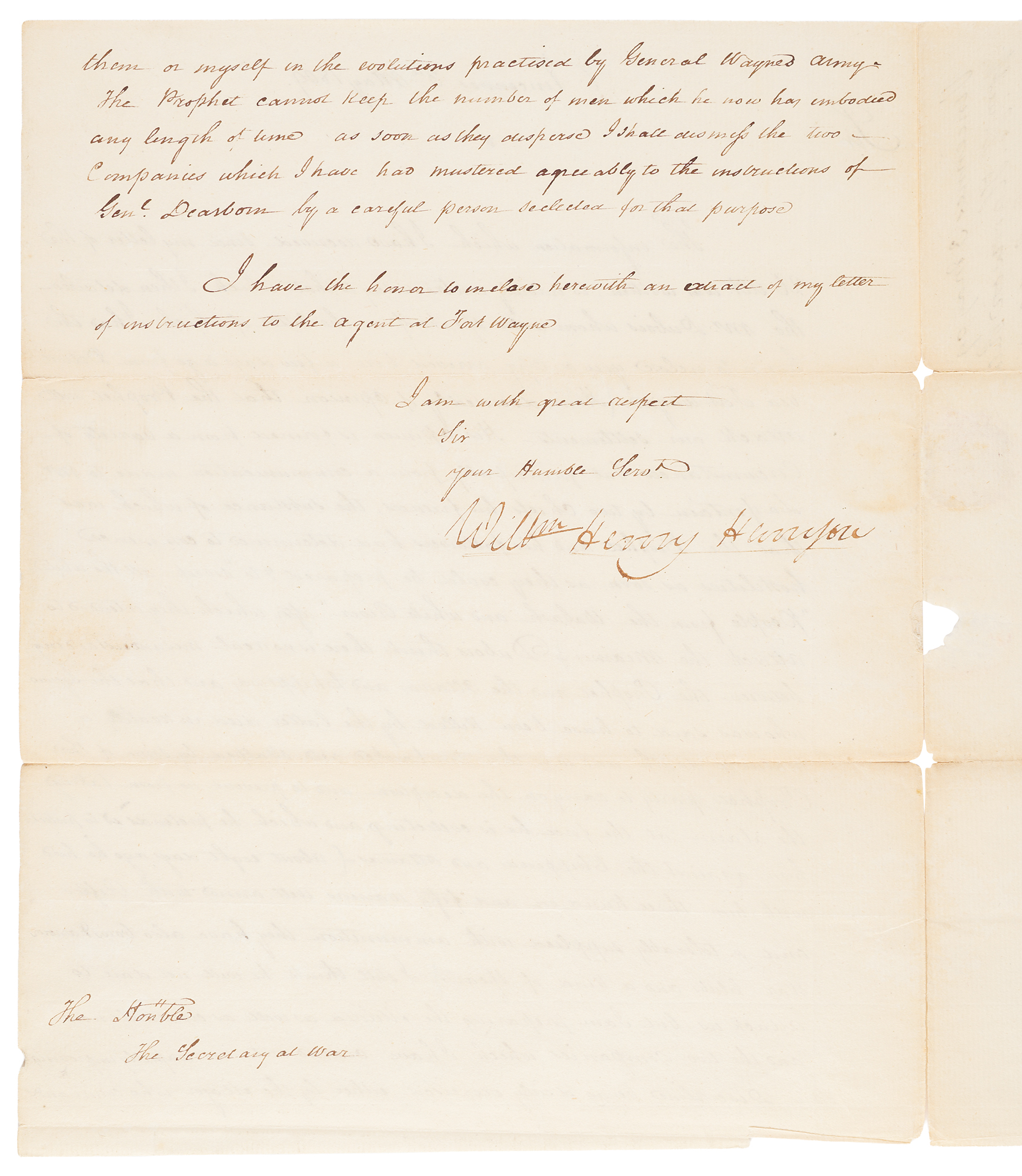
May 3, 1809, to William Eustis, carrying the latest intelligence he has gathered about the activities of the Shawnee leaders, and alarming news of their increasingly militant behavior. In part: "Mr. Dubois…arrived here a few days ago from Detroit via Fort Wayne. He is decidedly of opinion that the Prophet will attack our settlements. His opinion is formed from a variety of circumstances but principally from a communication made to Mr. LaFontaine by two chiefs his friends, the substance of which was that the Prophet and his followers had determined to commence hostilities as soon as they could be prepared & to 'sweep all the white people from the Wabash and White River' after which they intend to attack the Miamis…About eight days ago he had with him three hundred and fifty warriors well armed with rifles and tolerably supplied with ammunition. They have also bows & arrows, war clubs, and a kind of spear. I still think he will not dare to attack us but I am preparing the militia as well as circumstances and the two companies which I have ordered out are rapidly improving in discipline being daily exercised either by the Major who commands them or myself in the evolutions practiced by General Wayne's army. The Prophet cannot keep the number of men which he now has embodied any length of time. As soon as they disperse I shall dismiss the two companies which I have had mustered agreeably to the instructions of Gen. Dearborn by a careful person selected for that purpose." Harrison also discusses a ploy being used by the Prophet, involving the purported scalping of an Indian woman to disguise the fact that he is raising his forces for use against the white settlements.
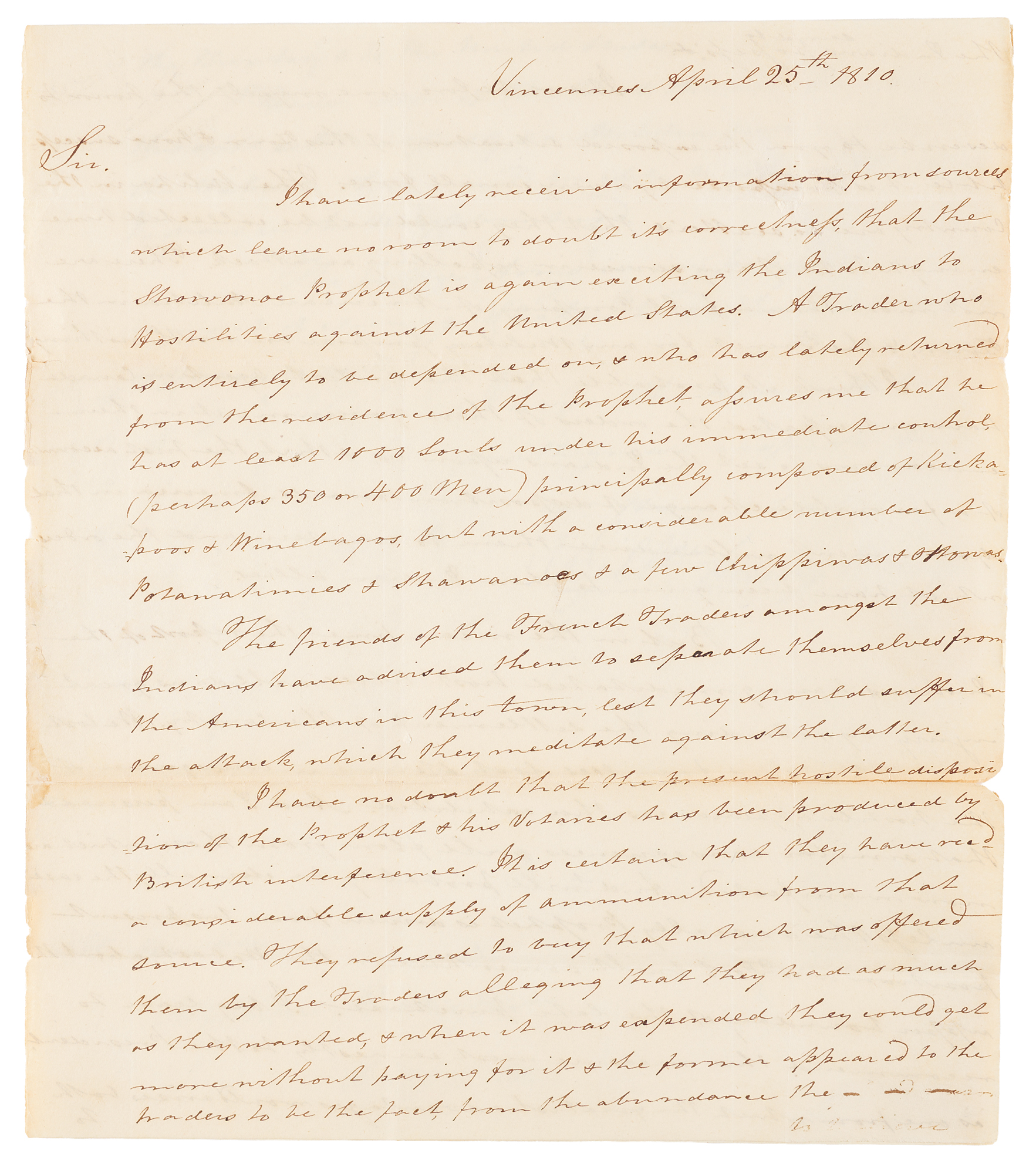
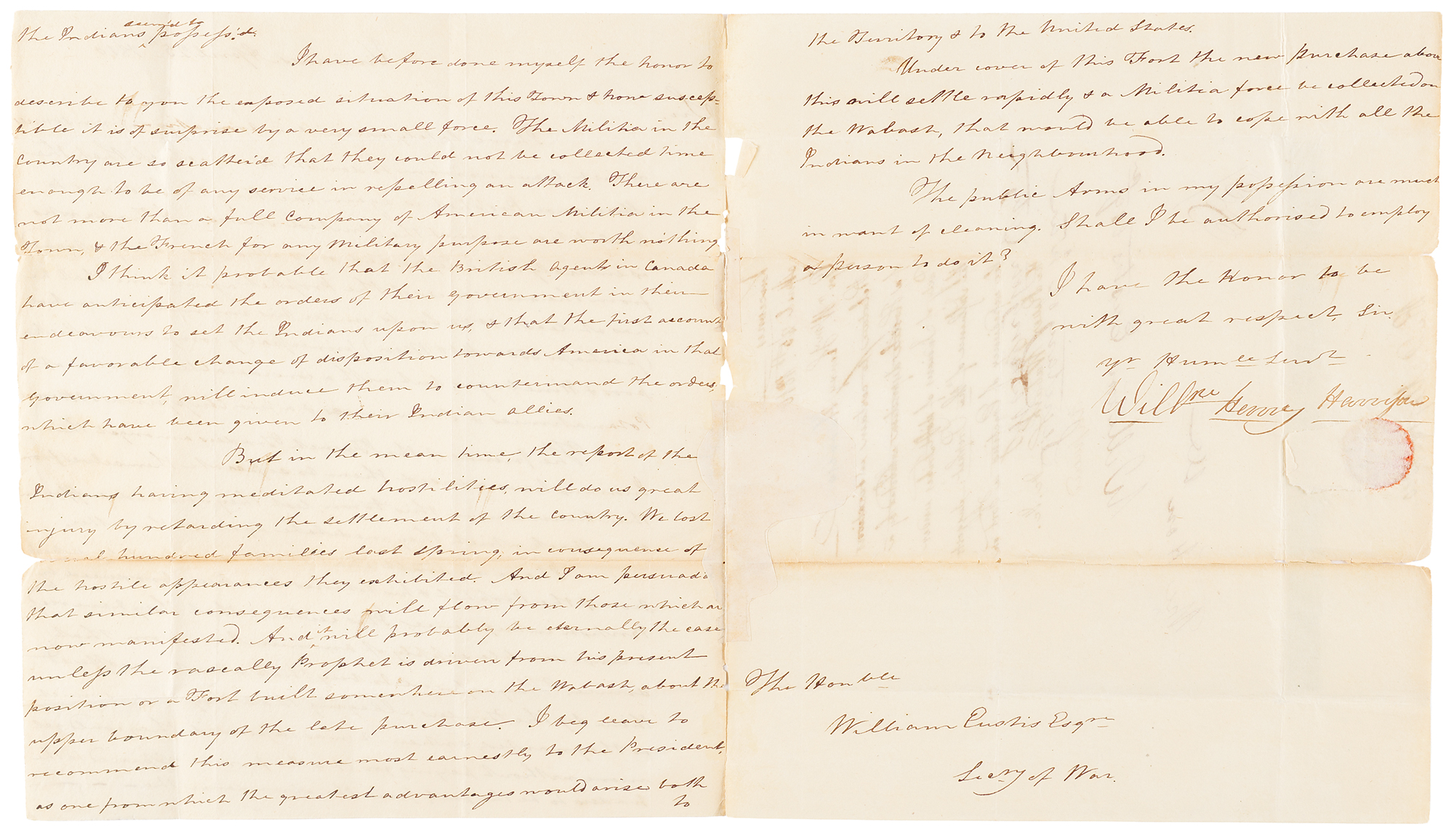
April 25, 1810, to William Eustis, containing an alarming report of hostile Indian intentions, and informing Washington that he has strong evidence that the British in the area are supplying the Shawnee with arms: "I have lately received information from sources which leave no room to doubt its correctness, that the Shawnee Prophet is again exciting the Indians to hostilities against the United States. A trader who is entirely to be depended on, & who has lately returned from the residence of the Prophet, assures me that he has at least 1000 souls under his immediate control (perhaps 350 or 400 men)…. The friends of the French traders amongst the Indians have advised them to separate themselves from the Americans in this town, lest they should suffer in the attack, which they meditate against the latter. I have no doubt that the present hostile disposition of the Prophet & his votaries has been produced by British influence. It is certain that they have rec'd. a considerable supply of ammunition from that source. They refused to buy that which was offered them by the traders alleging that they had as much as they wanted, & when it was expended they could get more without paying for it….I have before done myself the honor to describe to you the exposed situation of this town & how susceptible it is of surprise by a very small force. The militia in the country are so scattered that they could not be collected in time enough to be of any service in repelling an attack. There are not more than a full company of American militia in the town, & the French for any military purpose are worth nothing…. The report of the Indians having meditated hostilities will do us great injury by retarding the settlement of the country. We lost several hundred families last spring, in consequence of the hostile appearances they exhibited. And I am persuaded that similar consequences will flow from those which are now manifested. And it will probably be eternally the case unless the rascally Prophet is driven from his present position or a Fort built somewhere on the Wabash….I beg leave to recommend this measure most earnestly to the President, as one from which the greatest advantages would arise both to the Territory & to the United States."
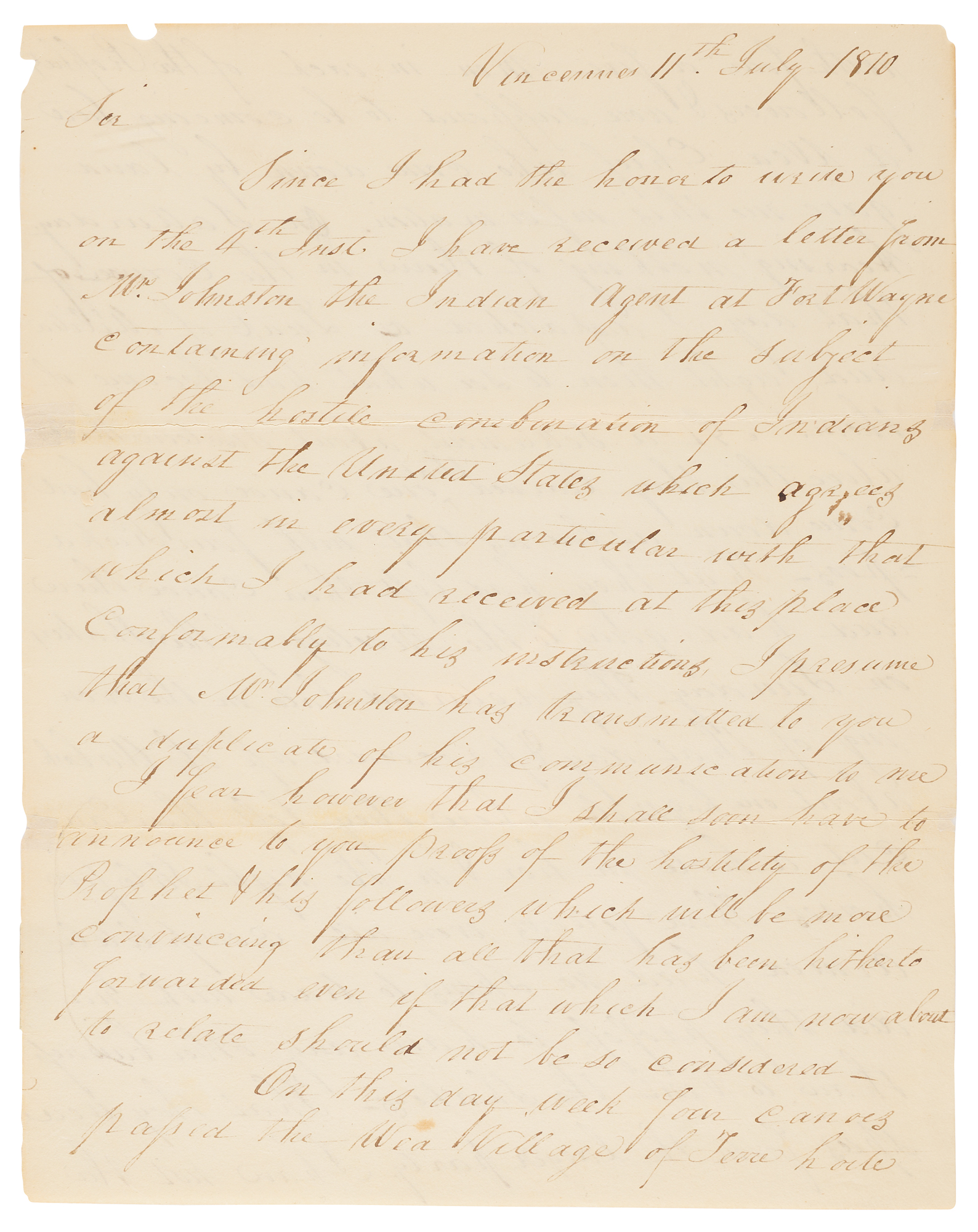
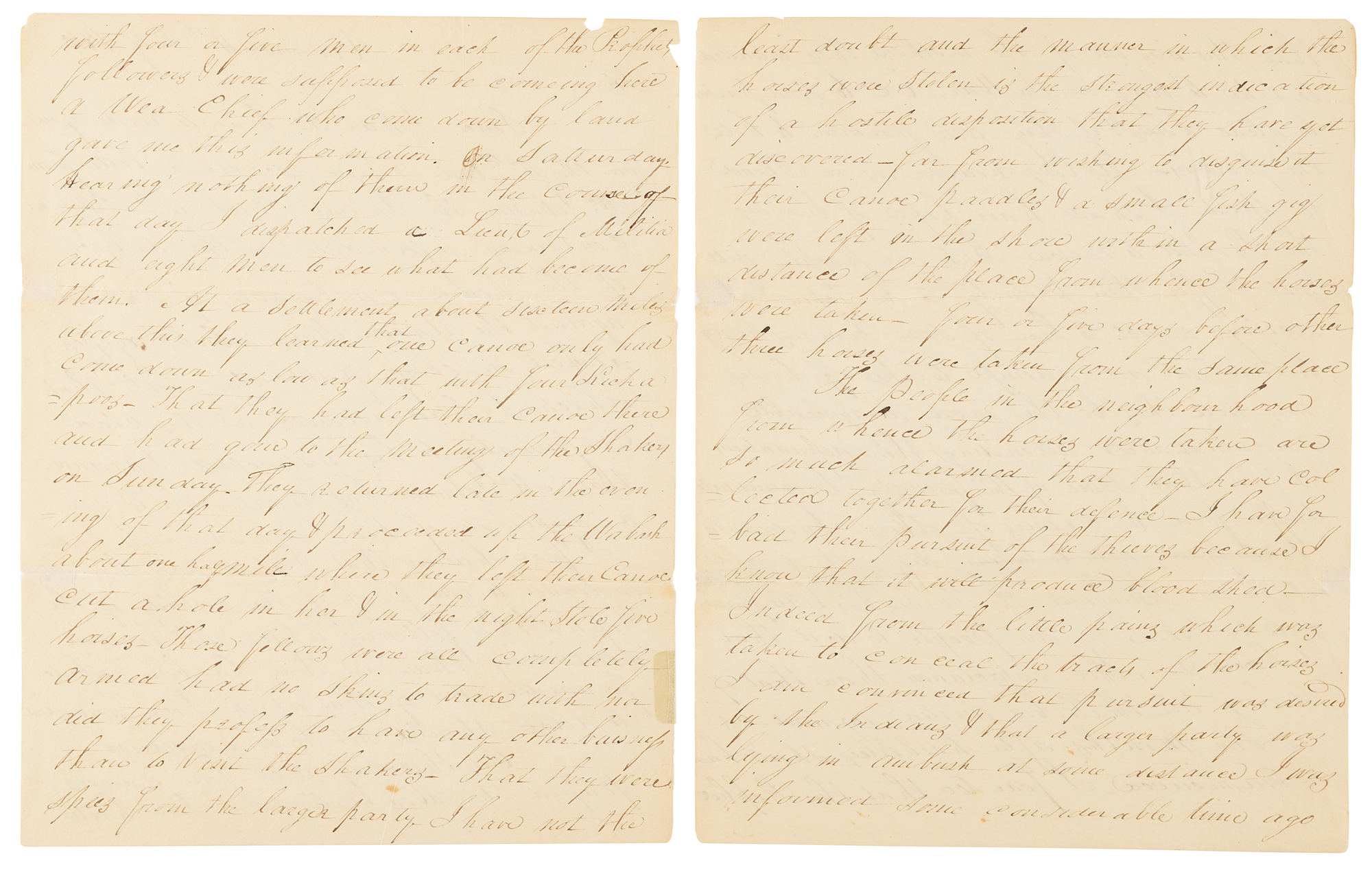
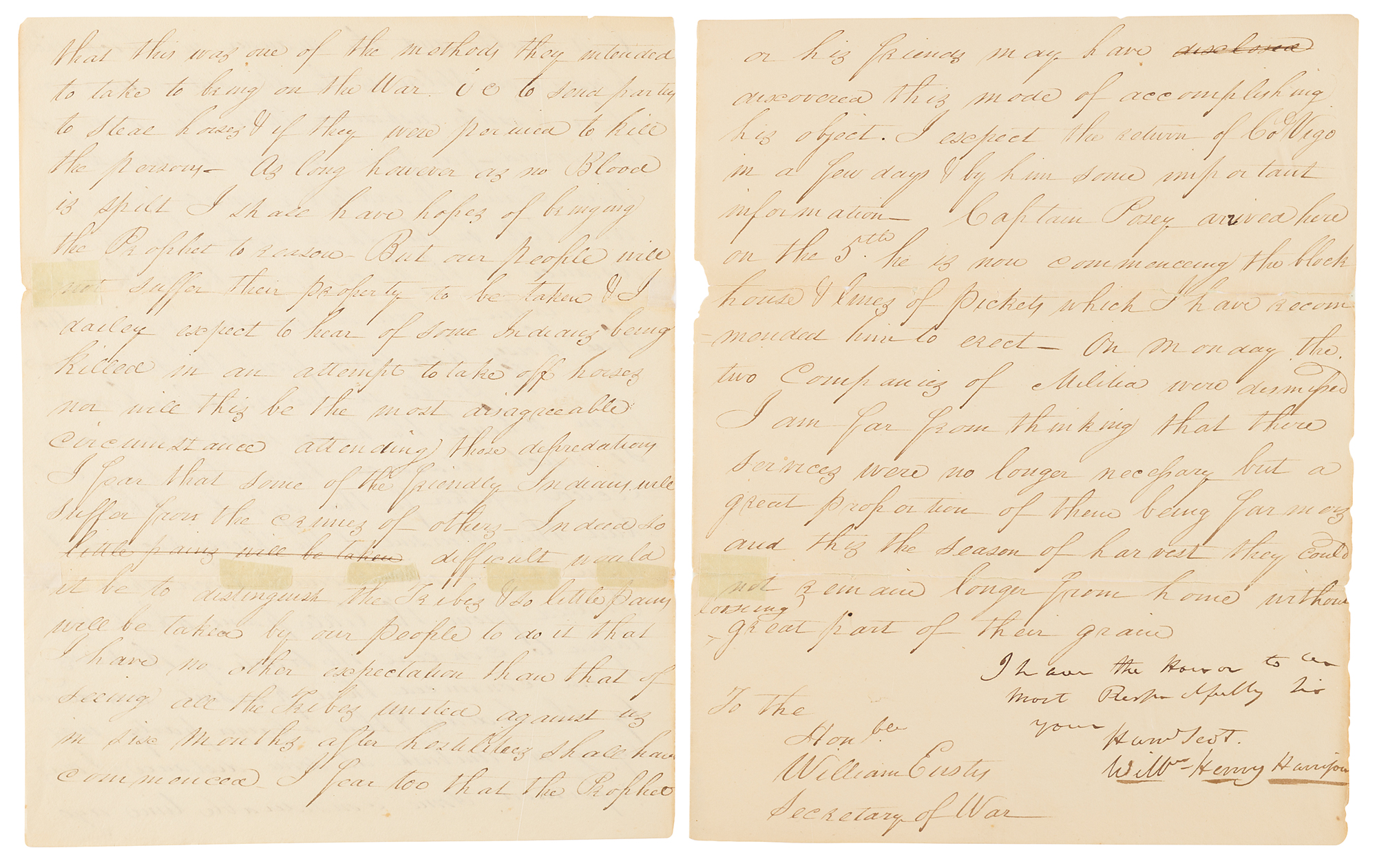
July 11, 1810, to William Eustis, discussing activities of scouting parties of hostile Indians, who have been stealing the horses of farmers and trying to goad the Americans into an attack. He warns Eustis that these actions are ratcheting up tensions in his Territory, and that it might cause American settlers to take matters into their own hands. He writes that a week ago "four canoes passed the Wea Village of Terre Hoite [sic] with four or five men in each." Of these, one descended as far as a local Shaker settlement: "They had left their canoes there and had gone to the meeting of the Shakers on Sunday. They returned late in the evening of that day & proceeded up the Wabash about one half mile where they left their canoes, cut a hole in her & in the night stole five horses. These fellows were all completely armed, had no skins to trade with, nor did they profess to have any other business than to visit the Shakers. That they were spies from the larger party I have not the least doubt…The people in the neighborhood from whence the horses were taken are so much alarmed that they have collected together for their defence. I have forbad their pursuit of the thieves because I know that it will produce blood shed. Indeed from the little pains which was taken to conceal the tracks of the horses I am convinced that pursuit was desired by the Indians & that a larger party was lying in ambush at some distance. I was informed some considerable time ago that this was one of the methods they intended to take to bring on the War…. As long however as no blood is spilt I shall have hopes of bringing the Prophet to reason. But our people will not suffer their property to be taken & I dailey [sic] expect to hear of some Indians being killed in an attempt to take off horses, nor will this be the most disagreeable circumstance attending those depredations."
In overall very good to fine condition, with varying degrees of splitting to folds and hinges, some of which have been partially repaired. Accompanied by a custom-made quarter-leather clamshell case. An outstanding group of letters from William Henry Harrison, ably transmitting the increasing tensions, fears, and hostilities on the Indiana frontier that led to the Battle of Tippecanoe.
The Western Americana auction of Jochen Zeitz.

