Sold For $1,251
*Includes Buyers Premium
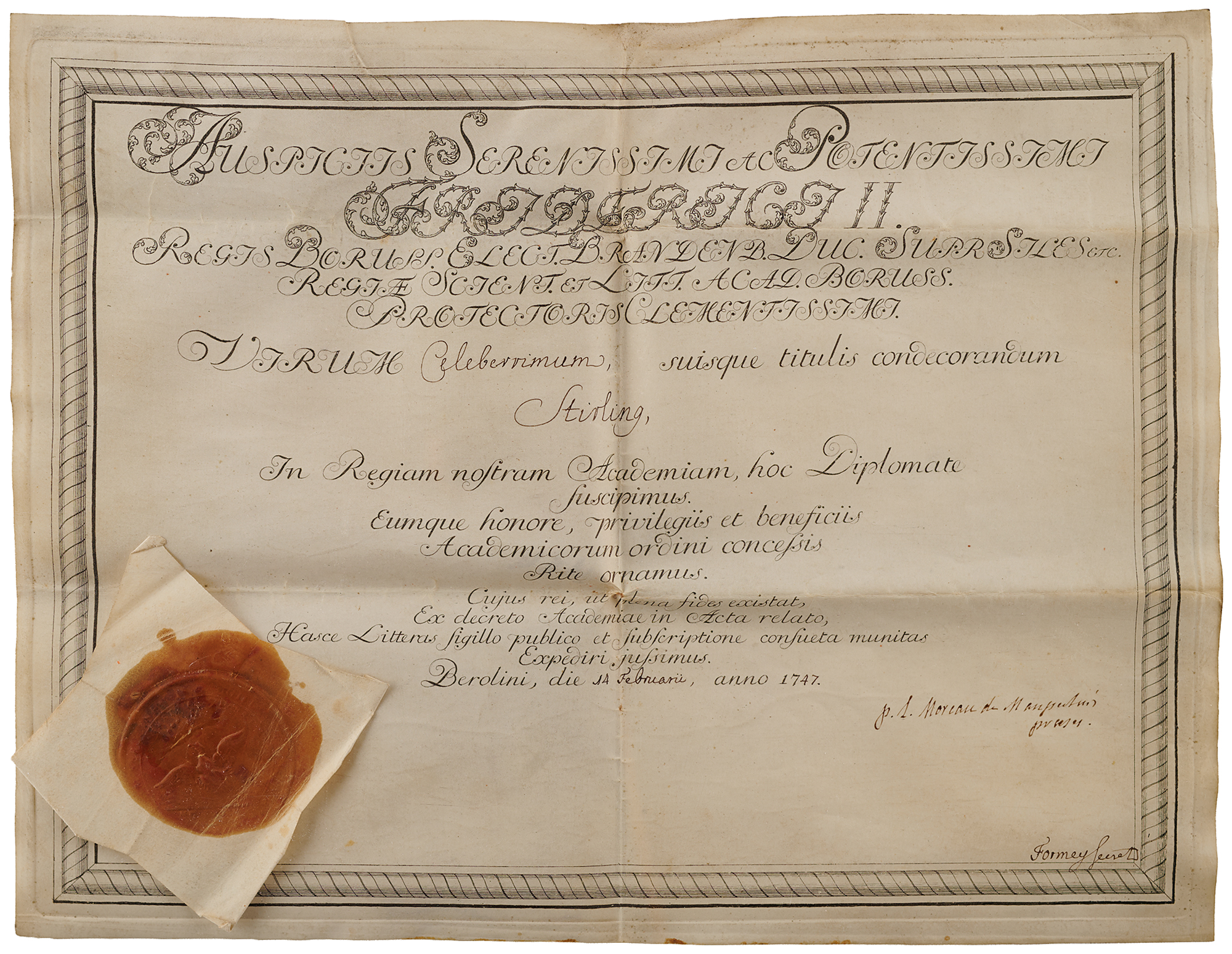
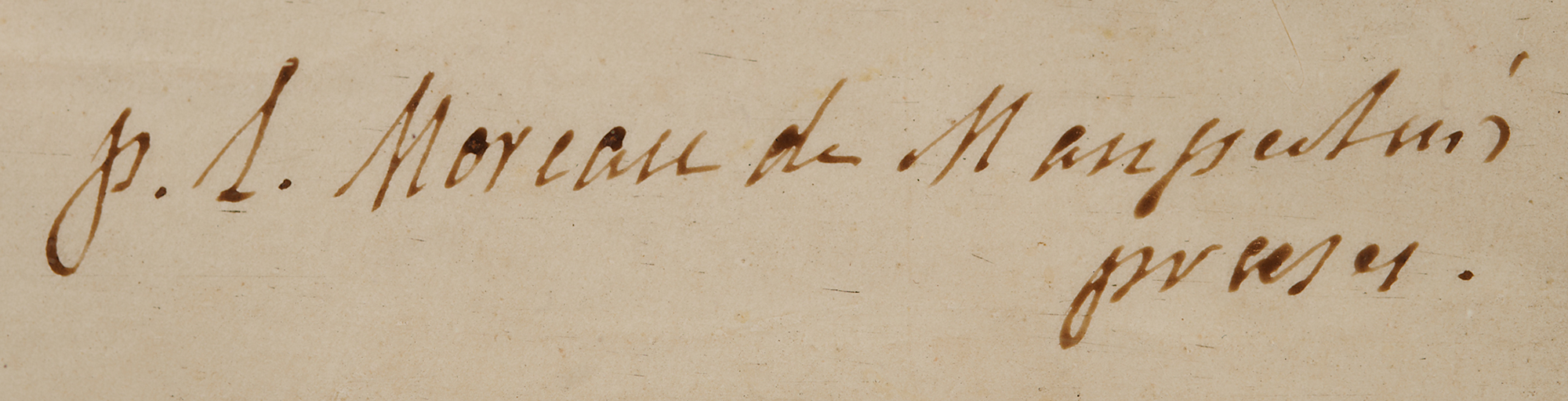
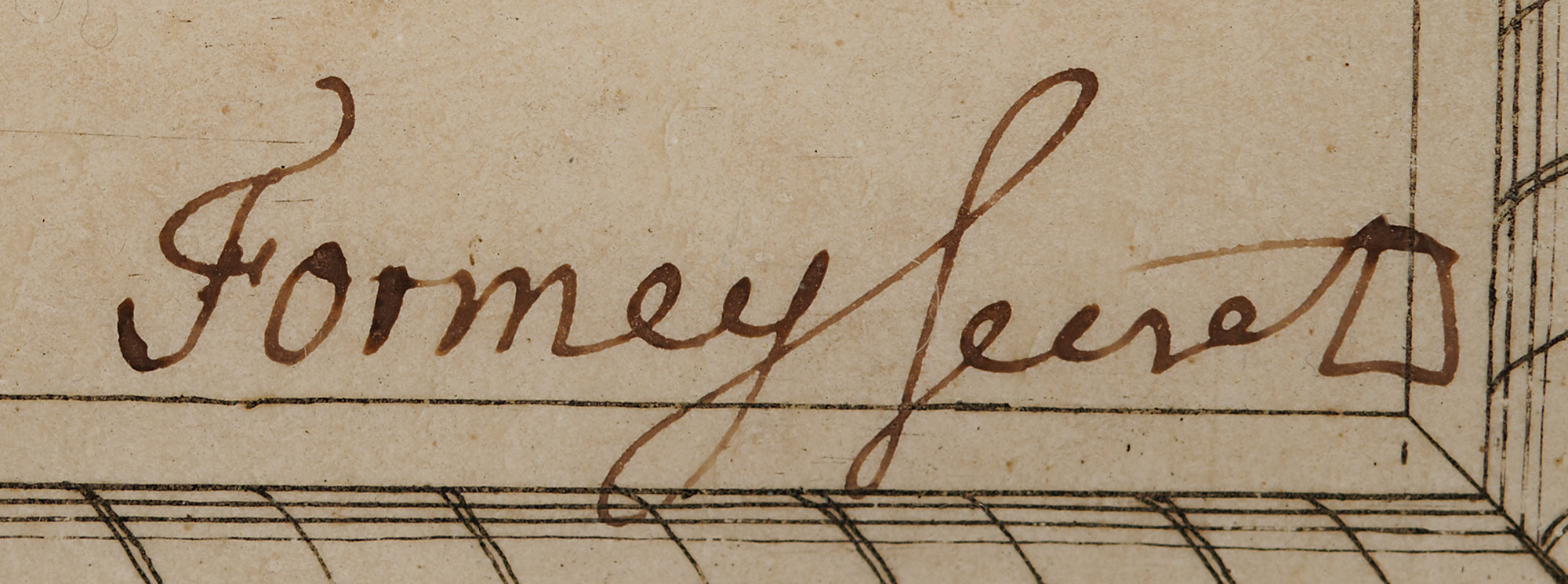
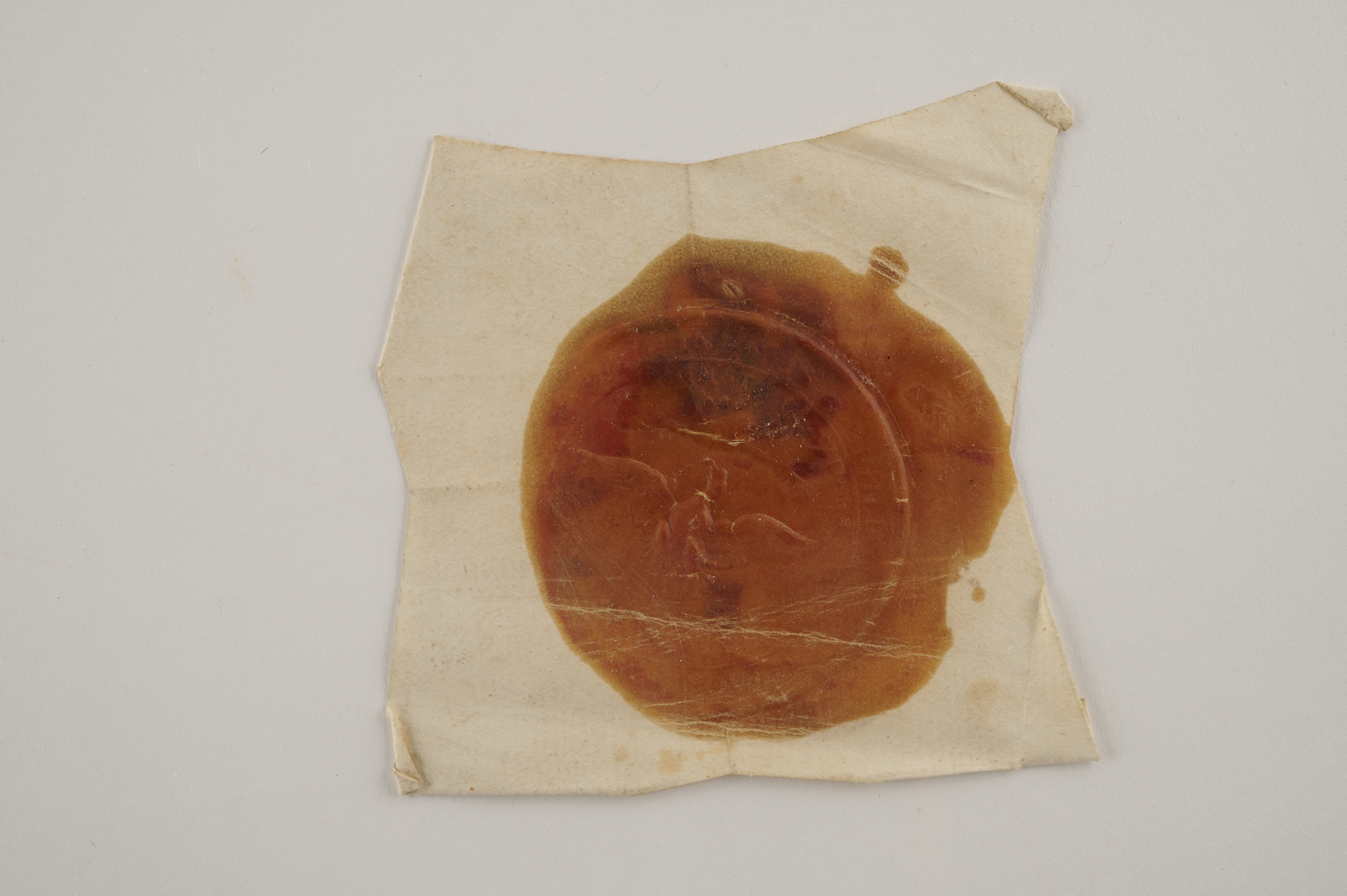
French mathematician, philosopher, and man of letters (1698-1759) who served as director of the Académie des Sciences and, at the invitation of Frederick the Great, became the first president of the Prussian Academy of Sciences. He led a famous expedition to Lapland to determine the shape of the Earth and is often credited with formulating the principle of least action, known as Maupertuis’s principle, expressed as an integral equation governing the path of physical systems. Partly-printed vellum DS in Latin, signed “P. L. Moreau de Maupertuis, pres’t,” one page, 14 x 10.75, issued from Berlin, Germany, on February 14, 1747. A membership diploma from the Royal Prussian Academy of Sciences presented to Scottish mathematician James Stirling, which reads (translated): “Under the auspices of the Most Serene and Most Powerful Frederick II, King of Prussia, Elector of Brandenburg, Duke of Silesia, etc., Most Clement Protector of the Royal Prussian Academy of Sciences and Letters, We receive, by this diploma, the most renowned man, Stirling, to be honored and adorned with his titles, into our Royal Academy; and we duly invest him with the honor, privileges, and benefits granted to the order of Academicians.” Signed at the conclusion by Maupertuis as the academy’s president, and by Johann Heinrich Samuel Formey as secretary. The original wax seal is detached but present.
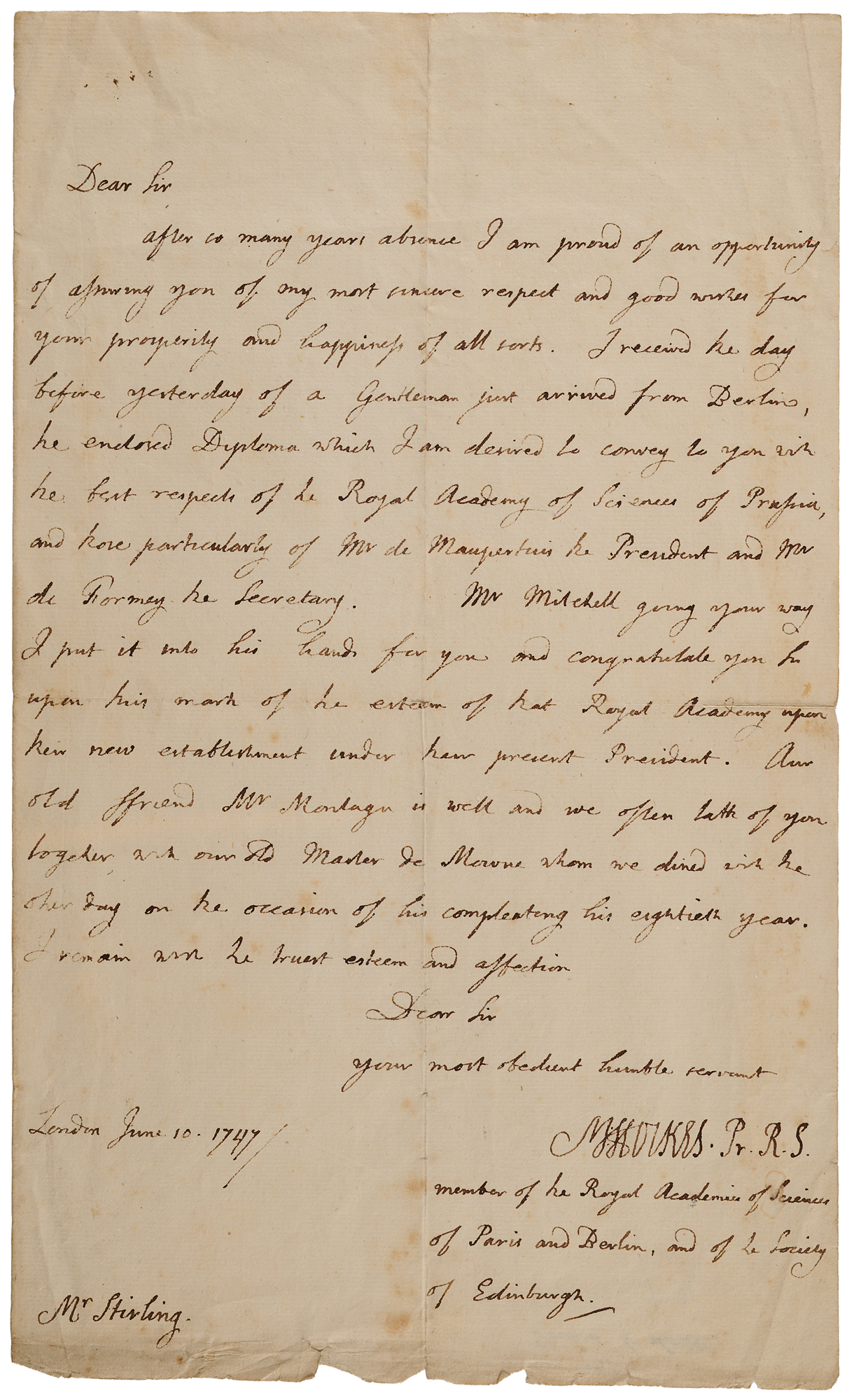
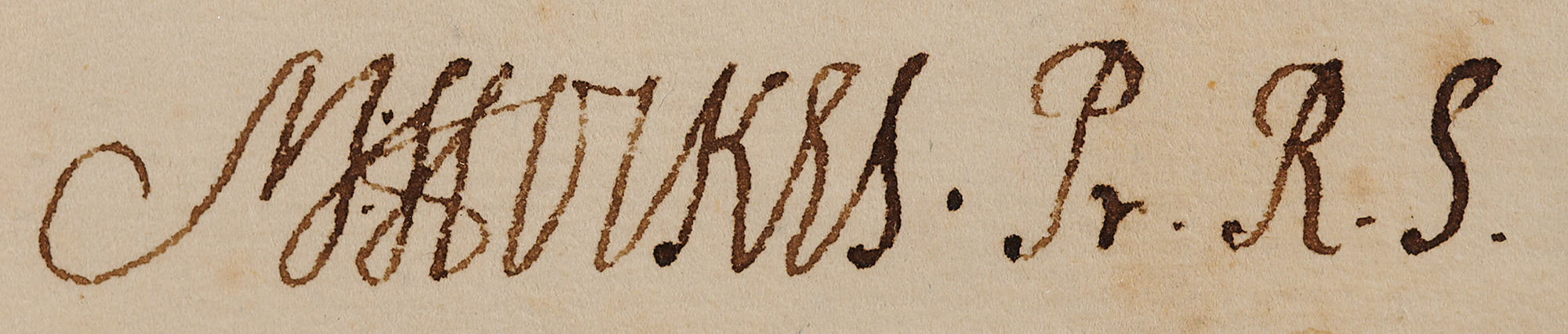
Included with the diploma is an LS from British polymath Martin Folkes, then serving as president of the Royal Society of London, forwarding the honor to “Mr. Stirling” on June 10, 1747. The letter, signed “M: Folkes, Pr., R.S.,” one page, 7.25 x 11.75, reads, in part: “After so many years absence I am proud of an opportunity of assuring you of my most sincere respect and good wishes for your prosperity and happiness of all sorts. I received the day before yesterday of a Gentleman just arrived from Berlin, the endorsed Diploma which I am desired to convey to you with the best respects of the Royal Academy of Sciences of Prussia, and those particularly of Mr. de Maupertuis the President and Mr. de Formey the Secretary.” In overall fine condition, with heavy intersecting folds to the document, and light edgewear and spotting to the letter.
James Stirling (1692–1770) was a Scottish mathematician, known as ‘The Venetian,’ whose name is commemorated in the Stirling numbers, Stirling permutations, and Stirling’s approximation, and who proved the correctness of Isaac Newton’s classification of cubic plane curves. In 1717, he published Lineae tertii ordinis Newtonianae at Oxford, and while in Venice, he communicated, through Newton, a paper to the Royal Society titled ‘Methodus differentialis Newtoniana illustrata’ (1718). After returning to London around 1725 with Newton’s assistance, Stirling spent about a decade connected with an academy in Tower Street, pursuing mathematics and corresponding with leading scholars; his most important work, Methodus differentialis, sive tractatus de summatione et interpolatione serierum infinitarum, appeared in 1730, and in 1735 he presented to the Royal Society a paper on the figure of the Earth and the variation of gravity at its surface. The Methodus differentialis was especially influential for systematizing finite-difference methods, interpolation, and asymptotic approximations, including the first clear derivation of what is now known as Stirling’s approximation.
Johann Heinrich Samuel Formey (1711–1797) was a German churchman, philosopher, and Enlightenment intellectual who served as the perpetual secretary of the Royal Prussian Academy of Sciences and Belles-Lettres in Berlin from 1748 until his death. Under Frederick the Great, he played a central role in administering and disseminating learned culture. A prolific writer and contributor to Diderot’s Encyclopédie, he engaged critically with contemporary debates—most notably responding to Jean-Jacques Rousseau on the relationship between knowledge, morals, and society—while advocating for institutional reforms that aligned the sciences and arts with moral and civic utility.
Martin Folkes FRS (1690–1754) was an English polymath and antiquary whose scholarly interests ranged from mathematics and astronomy to numismatics and classical antiquities, and who served as president of the Royal Society from 1741 to 1752. Born in Westminster and educated at Clare College, Cambridge, he distinguished himself early in mathematics and was elected a Fellow of the Royal Society at just twenty-three, later serving as its vice-president under Sir Isaac Newton before succeeding Sir Hans Sloane as president. Folkes was also a leading figure in antiquarian studies, presiding over the Society of Antiquaries from 1749 until his death and publishing influential studies on ancient and English coinage and Roman monuments, many inspired by his travels in Italy. Elected to the French Royal Academy of Sciences, honored by both Oxford and Cambridge, active in Freemasonry, and a founding vice-president of London’s Foundling Hospital, Folkes exemplified the civic-minded, interdisciplinary scholarship of the early Enlightenment.

