Sold For $3,223
*Includes Buyers Premium
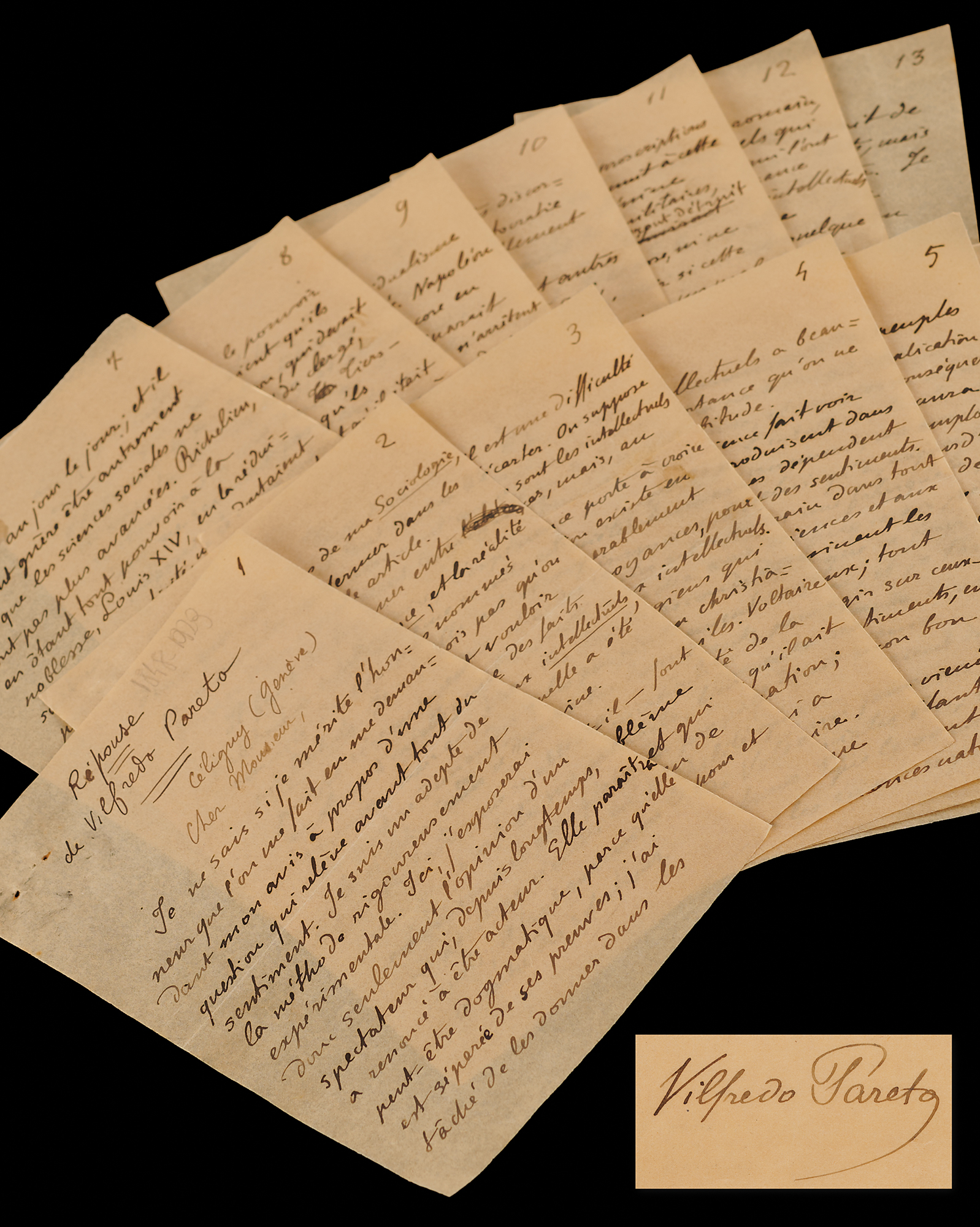
Economist, sociologist, and philosopher (1848-1923) known for his studies of income distribution and the analysis of individuals' choices; the Pareto principle was named after him, based on his observations that 80% of the wealth in Italy belonged to about 20% of the population. AMS in French, signed "Vilfredo Pareto," thirteen pages, 5 x 7, no date but circa 1917–1923. Lengthy handwritten reply on the subject of the intellectual's role in society and history. In part (translated): "I do not know if I deserve the honour that you are doing me to ask for my opinion about a matter that is essentially a question of feeling. I really believe in the method of rigorous experiment. I am here exposing the opinion of a spectator who has given up to have any role. It may be seen as dogmatic, as it is separated from its evidence. I have tried to give it in the big volumes of my Sociology and I cannot sum it up in a simple article.
There is a difference between abstract intelligence and the concrete reality of men named intellectuals. I do not think you can really exclude intelligence from social facts, but as far as intellectuals are concerned, you can wonder what was their action in this field.
Facts—I suppose—show that this is a very complex problem that cannot be solved in so few words. You have to examine the pros and cons of the solutions.
First, there is a difficulty we have to eliminate: we generally believe that intellectuals are the origin of beliefs, but on the contrary, experience tends to prove that, whereas this can be partly true, it is incomparably less important than the fact that beliefs give authority to intellectuals.
Theologians are not the ones who have converted people to Christianity, the Gospels have. Voltaire is not the creator of disbelief at the end of the 18th century, even if he may have helped to spread it. It is disbelief that helped Voltaire to be famous. We must understand that the works of intellectuals have much less importance than what we generally think.
Second, experience shows that facts that happen in human societies are the consequence of reasoning and feelings. The first is more important in all the fields of sciences and the arts, the second prevails in purely social facts. All reasoning, in order to be effective, must turn into feelings, into myths, as a good friend of mine, G. Sorel, would say.
I do not know if one day will come when social sciences, being as advanced as natural sciences today, the government of the people will be a simple application of these sciences, and when, in consequence, the intellectual will have in this government a role that is equivalent to the role of the chemist in the chemical industry. But I know for sure that this day has not come yet and I leave to others the dream of a far future.
The Ancients already said that there is nothing worse than the reign of philosophers. We can assert as well that nothing would be worse than the reign of intellectuals. Politics need intelligent and practical people, empirically educated people. It is especially necessary that these people limit themselves to using feelings that already exist, not trying to create new ones. This point of view is already in Buckle's works, I have developed it in my Sociology where I have studied the importance for social utility of the difference between the characters of rulers and ruled.
Politicians almost always ignore the far effects of the measures they take and evaluate each day. It cannot be different as long as social sciences will not be more developed. Richelieu, removing all powers from nobility, and Louis XIV, reducing the nobility to domesticity, did not realize that they were sharpening the guillotine blade that would cut Louis XVI's head. Nicholas I of Russia used to say: ‘There is no other great lord than the one I am talking to, at the moment I am talking to him.’ That is why nobody wanted to defend Nicholas II. In France, Parliaments which weakened the royal power did not know they were preparing the French Revolution that would destroy them. The deputies of the clergy who reunited the Third Estate did not know they were preparing the tempest in which they and many of their electors would die.
The first Revolution and Napoleon I prepared, without seeing the consequences, the unity of Germany; this unity was completed, partly thanks to Napoleon III's action, and is now finalized by our plutocrats who feared, maybe legitimately, the individualism of several separate States. Napoleon III in 1859 and even more in 1866 did not realize he was preparing Sedan. Our plutocrats do not think about the future they are creating. They have already brooded the egg out of which came Bolshevism. They are as well brooding other eggs, just as a hen can brood the eggs of a duck.
Intellectuals are chained to the trailer of plutocrats, criticizing them harshly at the same time. You only have to flatter some of their feelings in order to get their cooperation.…Demogogical plutocracy rules the world.
Tolstoy and his followers and other decadent intellectuals have prepared Kerensky. And Kerensky prepared Lenin. The intellectuals from Petrograd—if there are still intellectuals there—must remember the tale of the frogs asking for a king to Jupiter.
Cicero was, without any doubt, an important intellectual but it's Octavian with his legions who saved the roman world.…If Lenin falls, his government will have been destroyed by the army, not by the intellectuals. I do not ask the question to know if this fall will be a good or a bad thing, neither do I answer it.
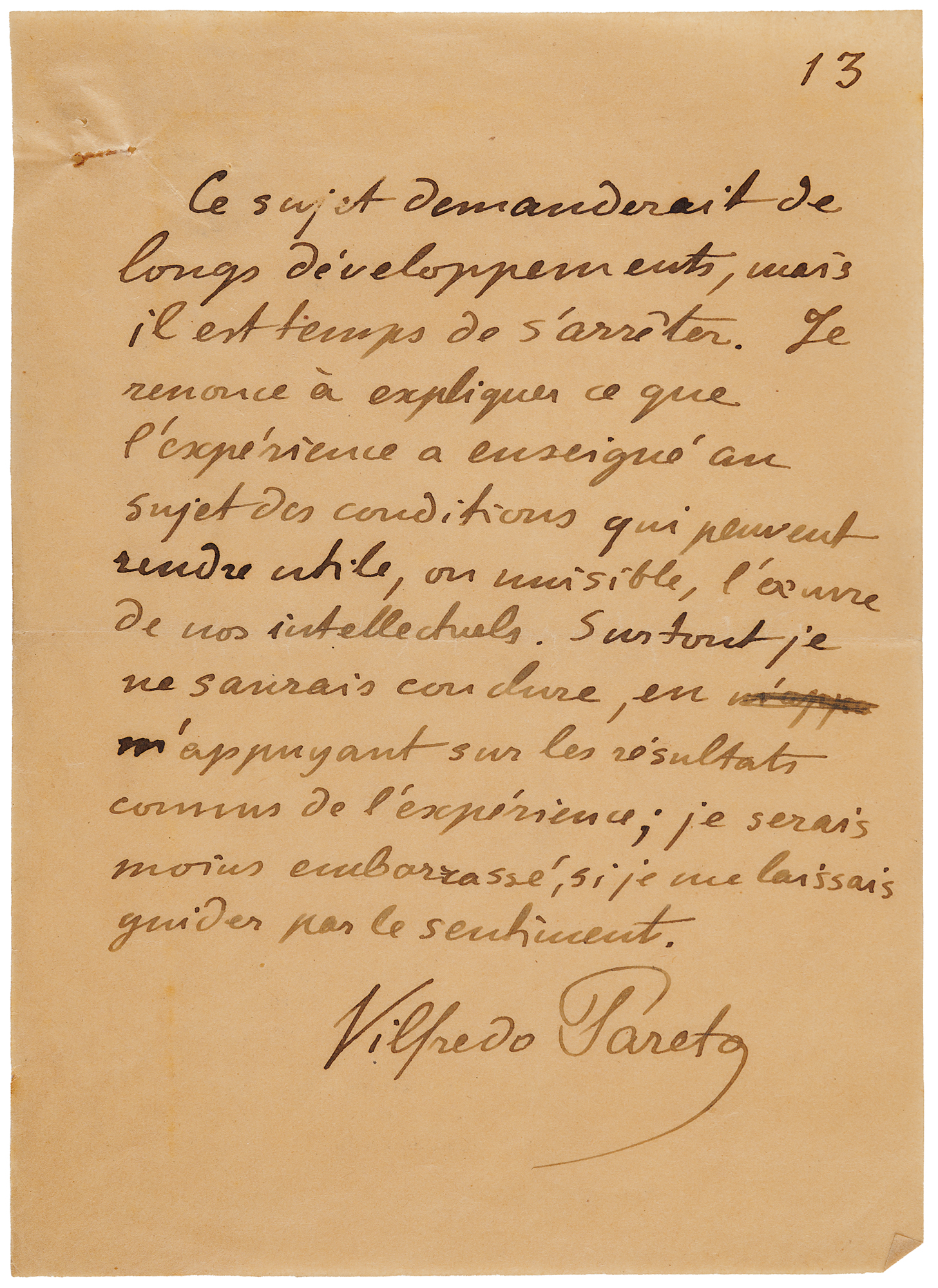
We have criticized intellectuals. It's time to turn the page. Unclear, indistinct and ineffective feelings take a more precise and more effective form thanks to the work of intellectuals. Democracy in Athens owes a lot to Pericles. Roman law, which is one of the highest conceptions in humanity, finds its source…in the intellectuals who shaped it and made it immortal. Renaissance owes a lot to the great intellectuals from Antiquity. If the great French Revolution is more than a pure explosion of violence, it owes a lot to intellectuals, and their works will be read as long as our civilization will last. Maybe at the present moment our intellectuals are developing, even accidentally, principles of the movement that seems to end in a tempest that will swoop on humanity? This subject would require too many developments and it is time to stop now. I cannot explain what experience has taught about conditions that can make useful or harmful the works of our intellectuals. Especially as I would not be able to conclude, based on the known results of experience; I would be less embarrassed if I allowed myself to be led by feeling." In fine condition, with Pareto's name annotated at the head of the first page in an unknown hand.

