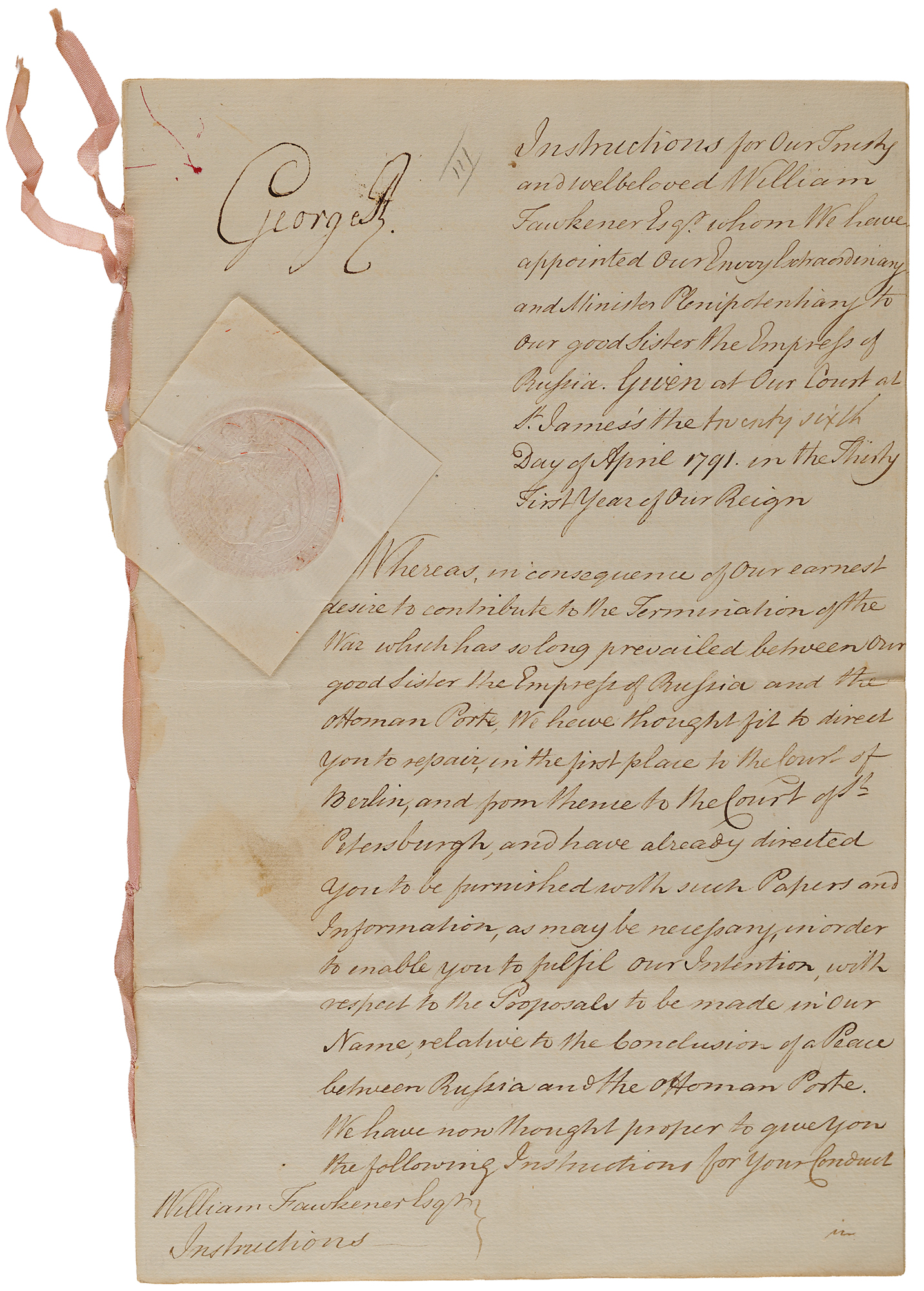
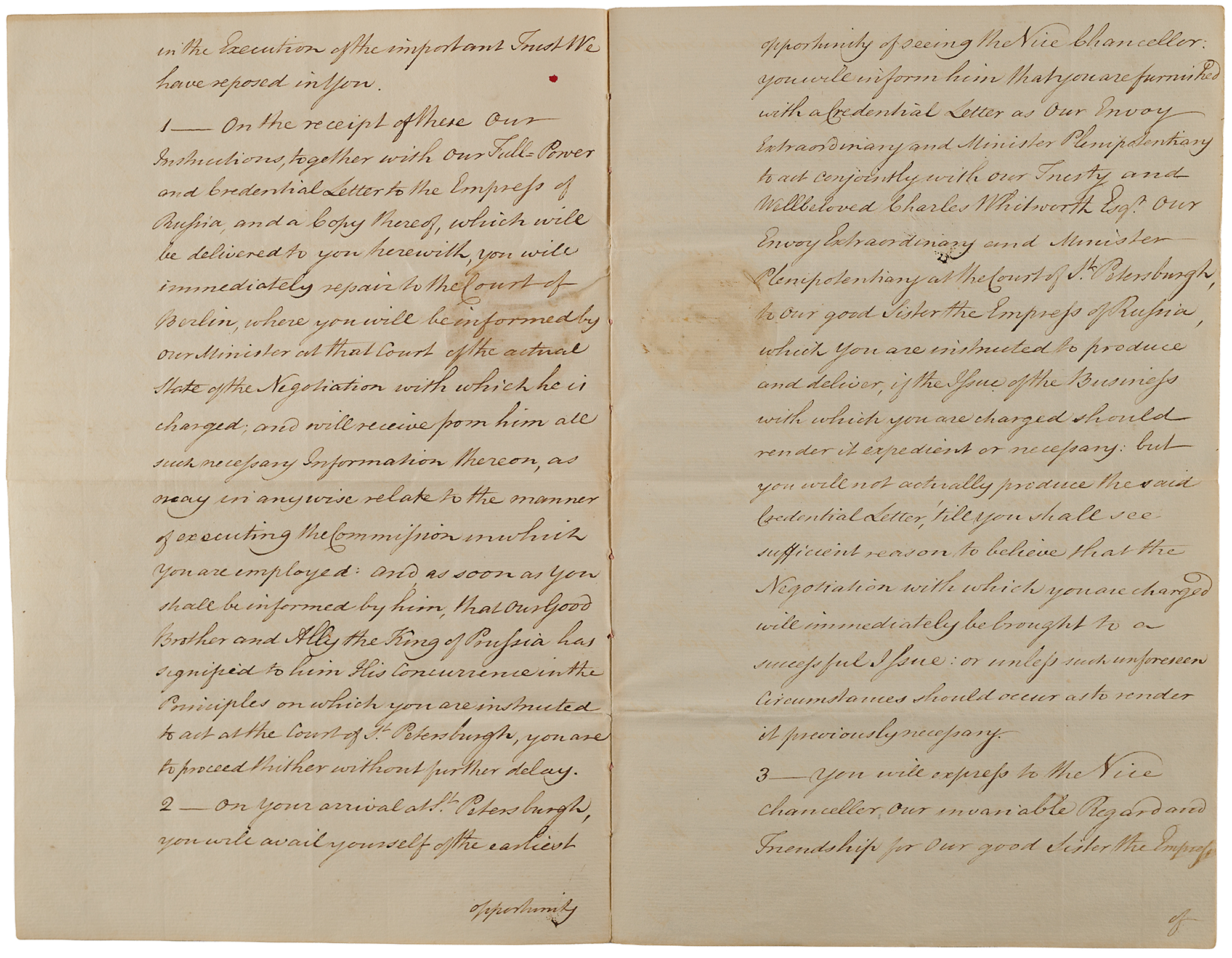
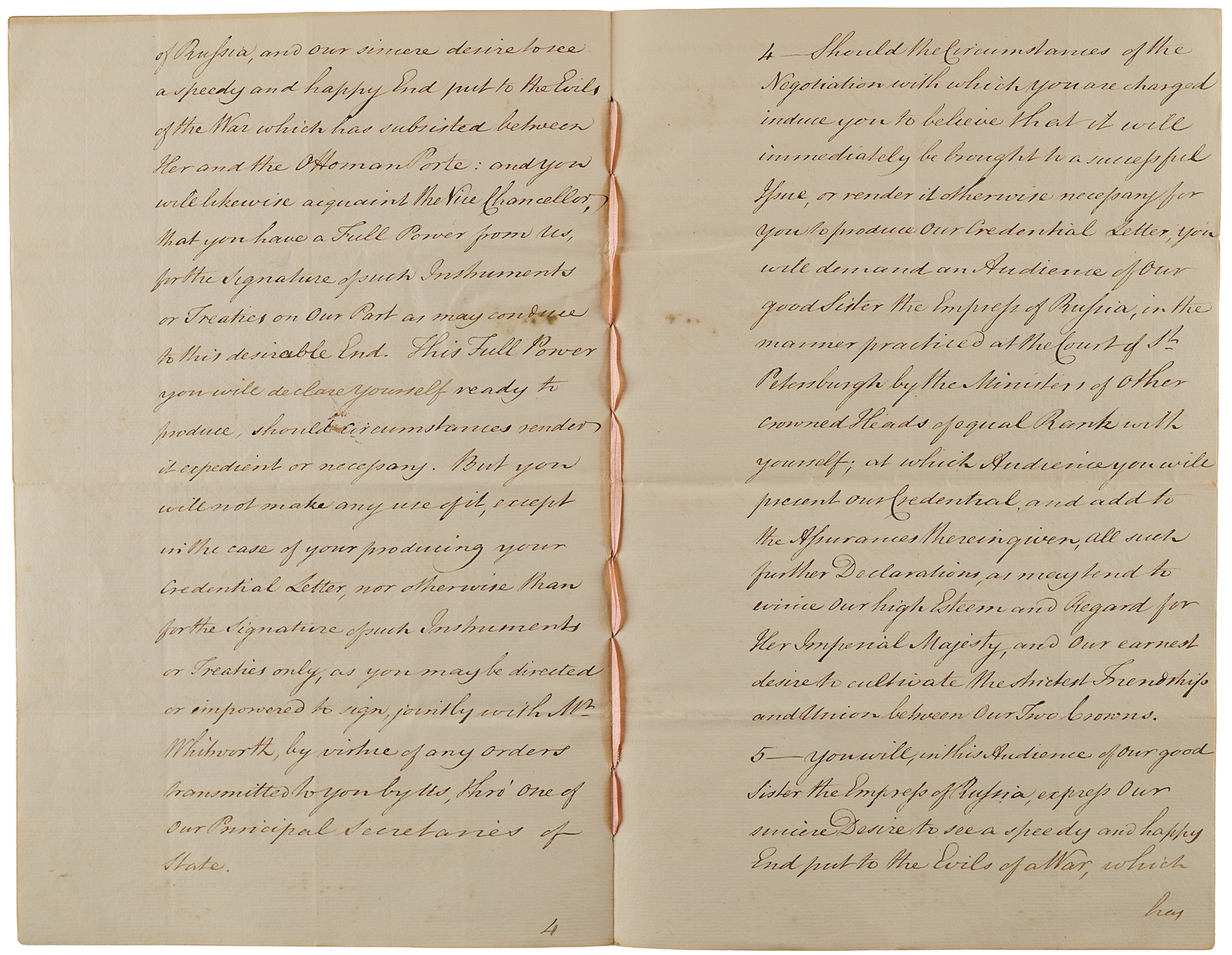
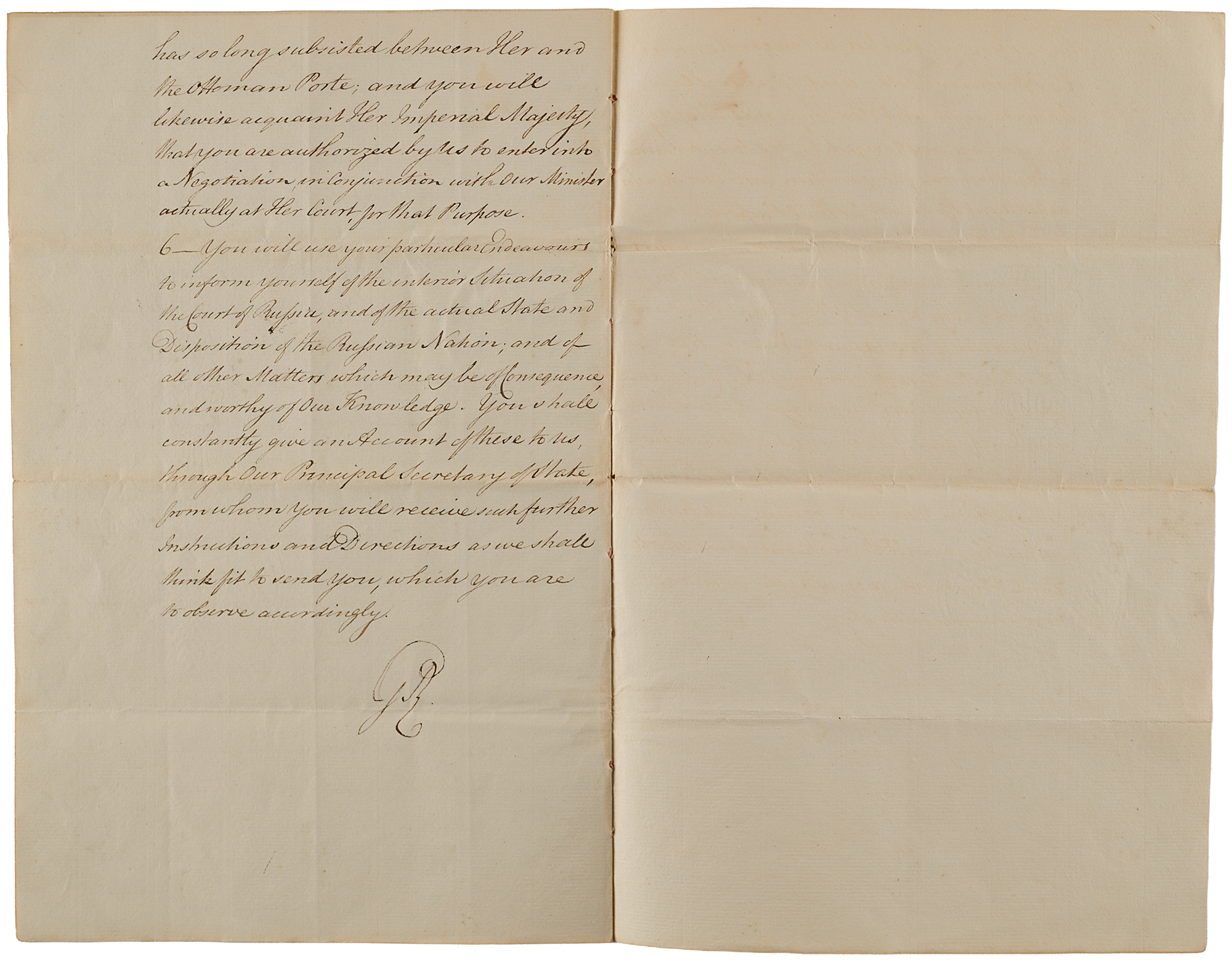
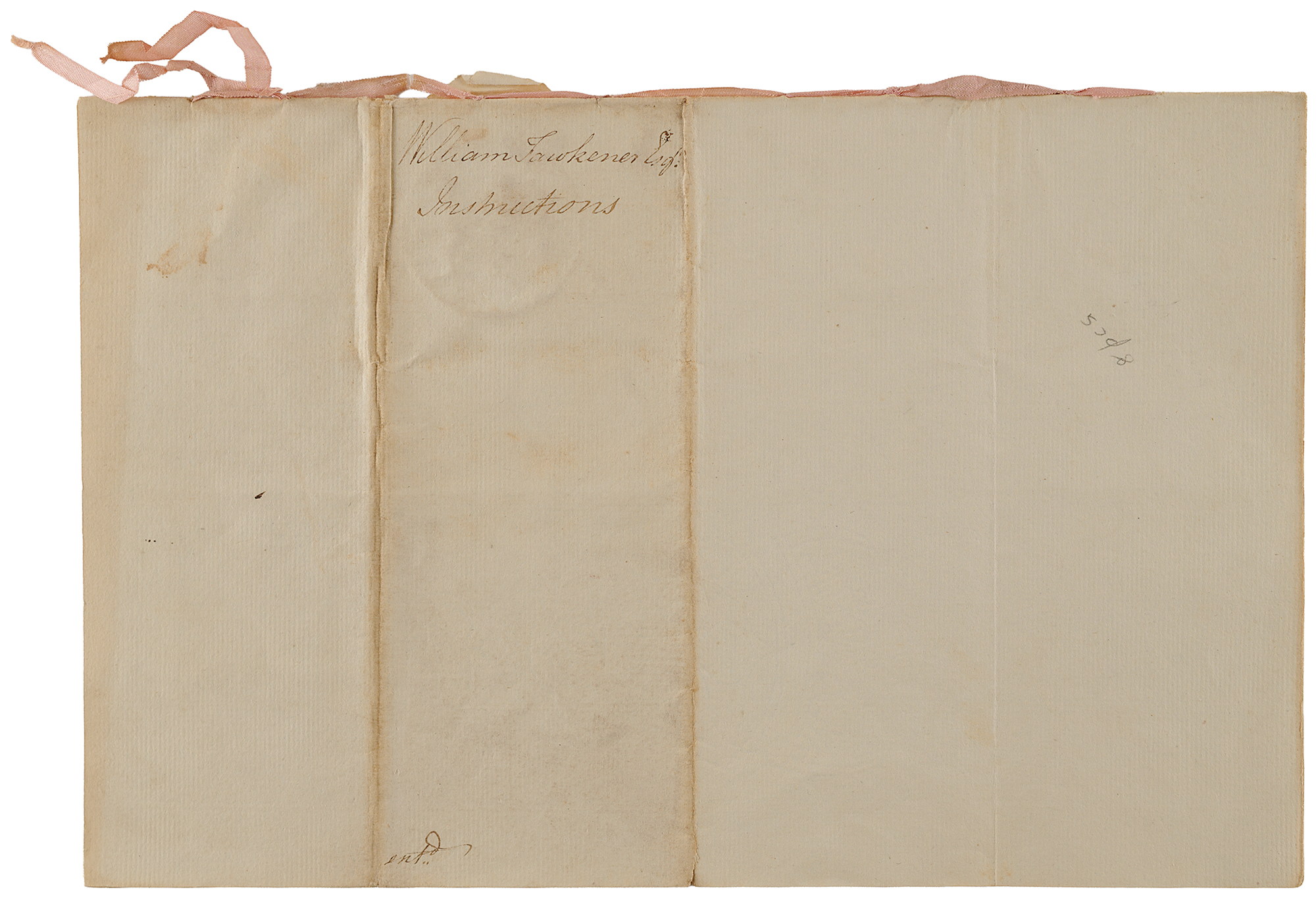
Manuscript DS, signed "George R" and "GR," six pages adjoining sheets, 7.75 x 12, April 26, 1791. Document headed "Instructions for Our Trusty and welbeloved William Fawkener Esq'r whom we have appointed our Envoy Extraordinary and Minister Plenipotentiary to our good Sister the Empress of Russia." In part: "In consequence of our earnest desire to contribute to the Termination of the war which has so long prevailed between out good Sister the Empress of Russia and the Ottoman Porte, We have thought fit to direct you to repair, in the first place to the Court of Berlin, and from thence to the Court of St. Petersburgh, and have already directed you to be furnished with such Papers and Information, as may be necessary, in order to enable you to fulfil our Intention…relative to the conclusion of a Peace between Russia and the Ottoman Porte."
Fawkener is instructed to first visit the Court of Berlin to obtain information from Ewart, the minister in Prussia, "of the actual state of the negotiation with which he is charged" and upon hearing of the concurrence of the King of Prussia "in the principles on which you are instructed to act at the Court of St. Petersburg, you are to proceed thither without delay." In Russia, he is to join with Charles Whitworth, the present minister to Russia, in entreating the Vice Chancellor to bring an end to the war. Signed at the head in ink by King George III, and signed at the conclusion with his initials. Bound with a pink ribbon and retains its affixed white paper seal. In fine condition.
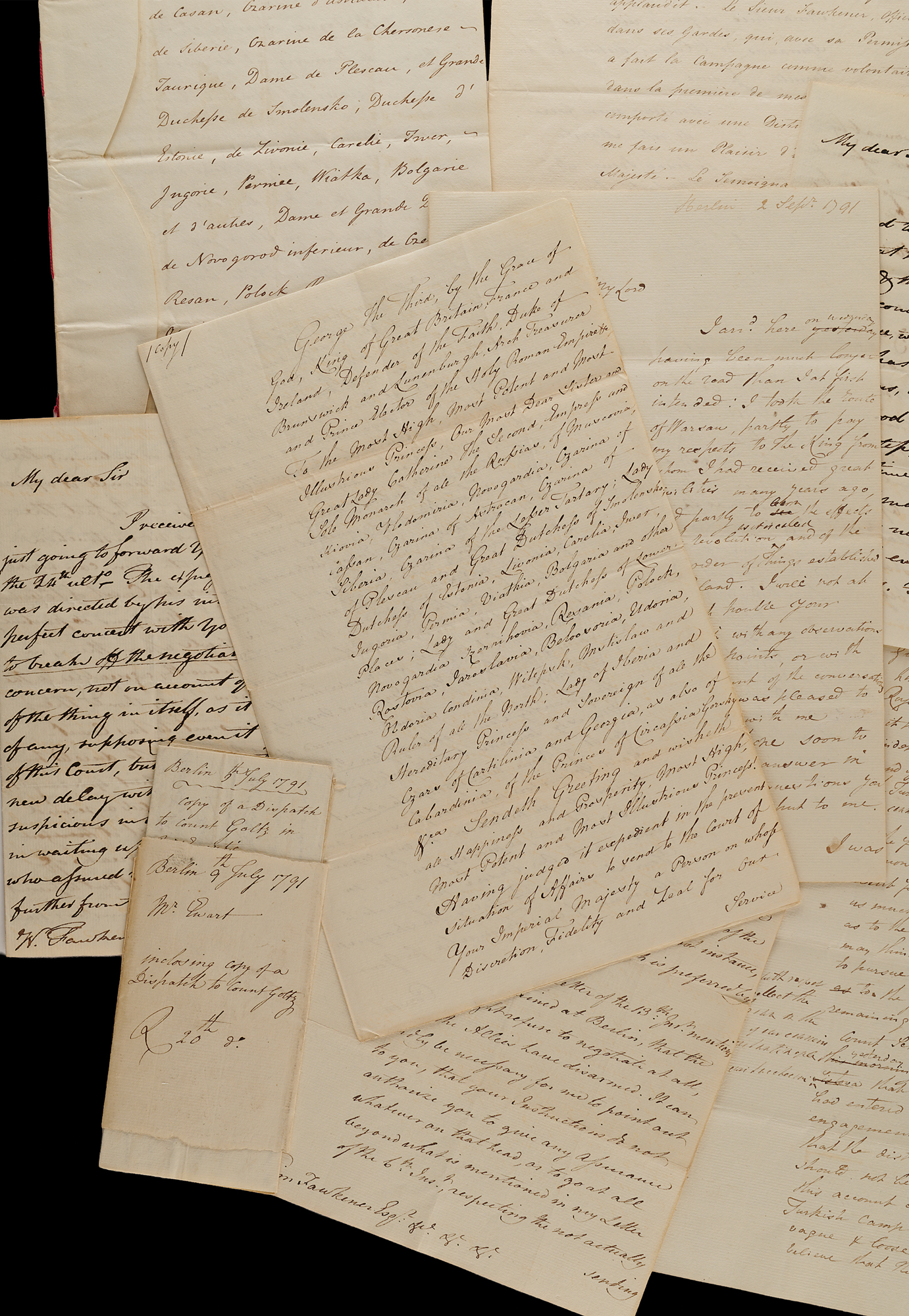
Accompanied by contemporary manuscript copies of Fawkener's credentials to Catherine II; further instructions to Fawkener from Lord Grenville; dispatches from Joseph Ewart, British minister at the Court of Berlin; a draft of a letter from Fawkener to George III, detailing his arrival in Berlin; and a French translation of Catherine II's letter to George III.
In 1791, Catherine II was grappling with the Ottoman Empire in her self-appointed role of Christian crusader; the second Russo-Turkish war was the result of Turkish intriguing with the Crimean Tartars and of Russian designs on Georgia. England, traditional ally of the Turks, hoped to persuade Frederick William II to pressure Austria to desist in its alliance with Russia. This was accomplished under the Treaty of Sistova in August, 1791. Russia, worried by Prussian activity in Poland and deserted by Austria, agreed to the Treaty of Jassy in January of the following year.

