



Sold For $1,563
*Includes Buyers Premium
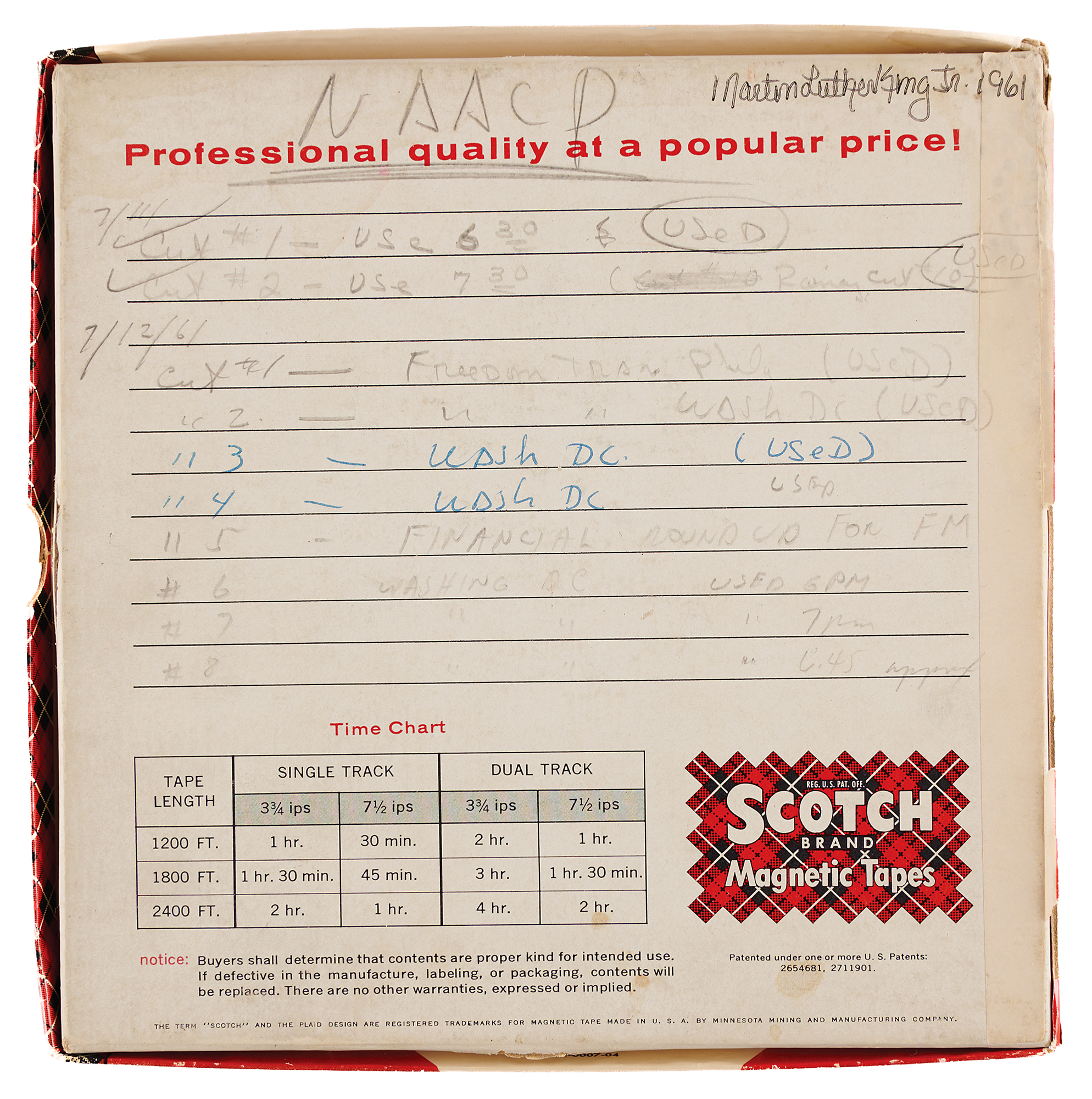
Original circa 1961 reel-to-reel audio tape (¼˝) of WDAS radio personality Joe Rainey's interview with Martin Luther King, Jr., approximately 19 minutes long, discusses the slow pace of civil rights progress in the United States, emphasizing that despite legal victories like school desegregation, meaningful change has been far too gradual. He calls for stronger federal action, increased nonviolent activism, and especially greater Black voter registration in the South as the key to transforming political power and ending resistance to civil rights laws.
King says: "I don't think civil rights advances are being made as rapidly as they could be made. I'm not unmindful of the fact that we have made some real and meaningful strides in the last few years in the area of civil rights, but we must admit that the process has been all too slow. For instance, in 1954 the Supreme Court rendered its momentous decision outlawing segregation in the public schools, and seven years have passed since that decision was rendered, and only 7% of the Negro children of the South are attending integrated schools. This means that we have only made about 1% progress a year. Now, if we continue to move at this snail like pace, it will take 93 more years to integrate public schools in the South. I could say the same thing about other areas of discrimination, such as employment discrimination, the whole problem of economic injustice."
King expresses optimism that increased Black political participation could soon lead to Black representatives elected to Congress from Southern states. He says: "I think the increase in voting on the part of the Negro in the south is growing every day. There is a new interest in and awareness of the need for more voters in the Negro community in the south. We have come to see that one of the most significant steps that the Negro can take at this hour is that short walk to the voting booth. And I'm convinced that if we can double the number of Negro registered voters in the South in the next year or two, this will liberalize a total political structure of the south and thereby liberalize the political structure of the nation…If we can get Negroes registered by the hundreds and thousands, it will be possible to get Negroes in Congress from the South."
He explains that he turned down a role in the political drama Advise & Consent, directed by Otto Preminger, explaining: "I'm not an actor. I'm a leader in the civil rights struggle and I have no ability in acting, and also I didn't see where my role in this particular film could serve any concrete purpose for the civil rights cause."
On issues of religion and community unity, he stresses the importance of unity rather than denominational uniformity among Black Americans: "I think we have to face a realistic fact, and that is that all of the denominations will not merge. This is not only true in the Negro community. There are some 256 denominations within Protestantism alone in the United States, and this is the general situation, so that white Christians confront this problem as well as Negro Christians…I think what we must seek to do is to create within all Negroes an awareness of our common problem and our basic unity in the fact that we are caught in in an inescapable network of mutuality, so to speak, that we are we are caught in this system together, and every Negro in some way, experiences the indignities and the injustices which are attendant to or with a system of segregation and discrimination."
He also addresses social and economic pressures within the Black community, noting that discrimination distorts identity. King evaluates the Kennedy administration positively for appointments, voting-rights enforcement, and employment measures, while urging stronger civil rights legislation: "President Kennedy has made some very significant appointments, more than ever before, in from from the Negro community. And this is, this is very good… Also, we have gained more vigorous action from the Justice Department in defending individuals who are seeking to become registered voters, in assuring the right to vote… I think the one thing that the President has not been vigorous on, and that I must respectfully disagree with him on, and that is civil rights legislation. He has had the feeling that civil rights legislation isn't necessary now, and he feels that it can't get through."
Finally, he highlights how racial discrimination damages America’s global reputation and insists that resolving racial injustice is essential to the nation’s moral authority and future standing in the world: "There is no doubt about the fact that this problem, this internal problem of racial injustice, is our real Achilles heel. And if we don't solve this problem, we will be relegated to a second rate power in the world, and all of our words will be null and void. I have traveled in recent years in Asia, Africa and South America and Europe, and in almost every instance, this is the first question that comes up, something about the race problem in the United States. This issue is well publicized throughout the nations of the world. And I have been in places where people could not speak English at all, but they could say Little Rock, or any other situation where the racial crisis had developed to the sense that it became international to the point that it became international news." In fine condition. Accompanied by a USB drive carrying a digital transfer of the tape's audio.
The interviewer, Joe Rainey, was a pioneering African-American broadcaster at Philadelphia’s WDAS, best known for hosting 'The Listening Post,' one of the first interview talk shows in the United States hosted by a Black broadcaster, giving a powerful platform to civil rights leaders and voices in the community.

