Sold For $4,230
*Includes Buyers Premium
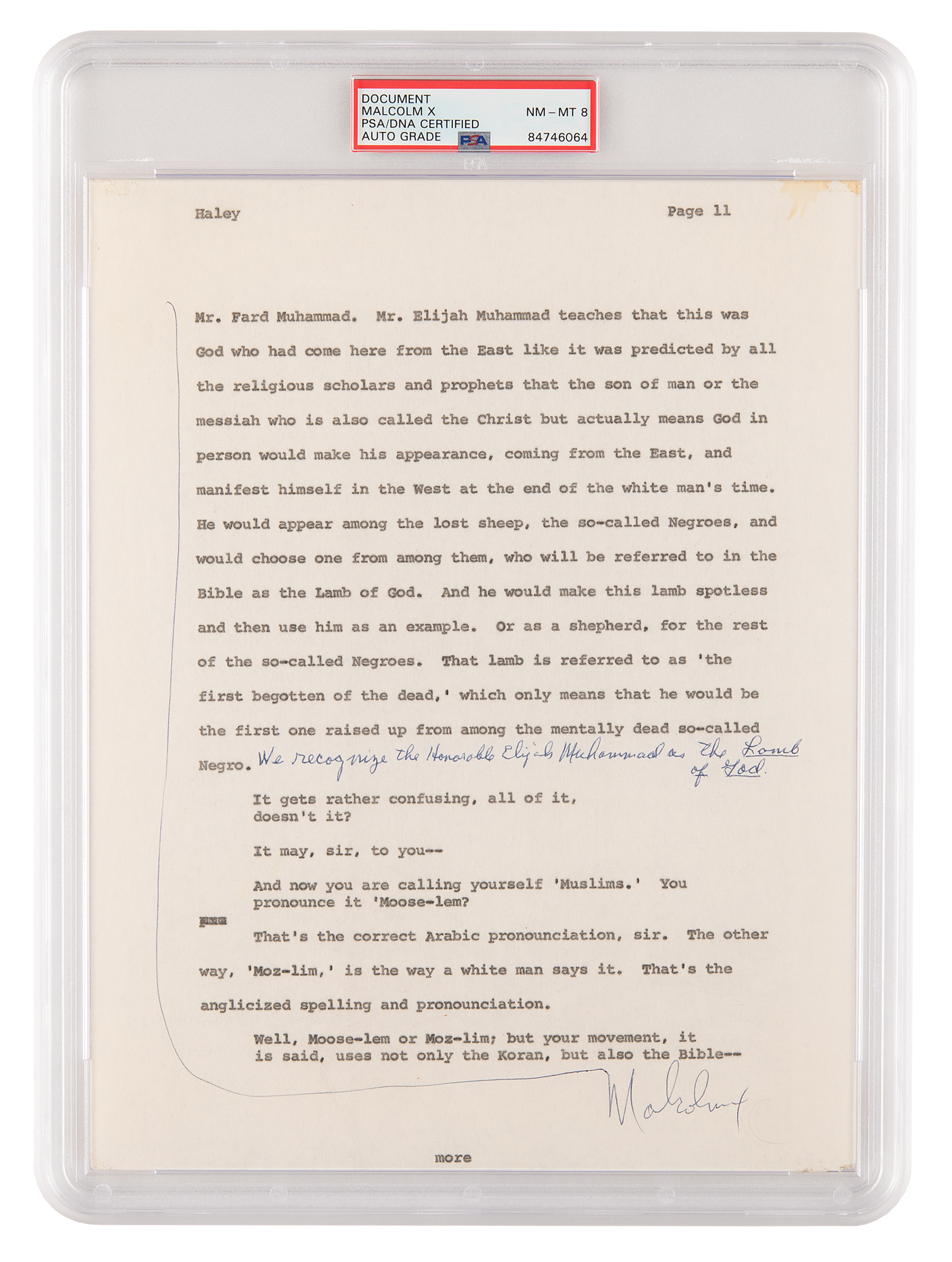
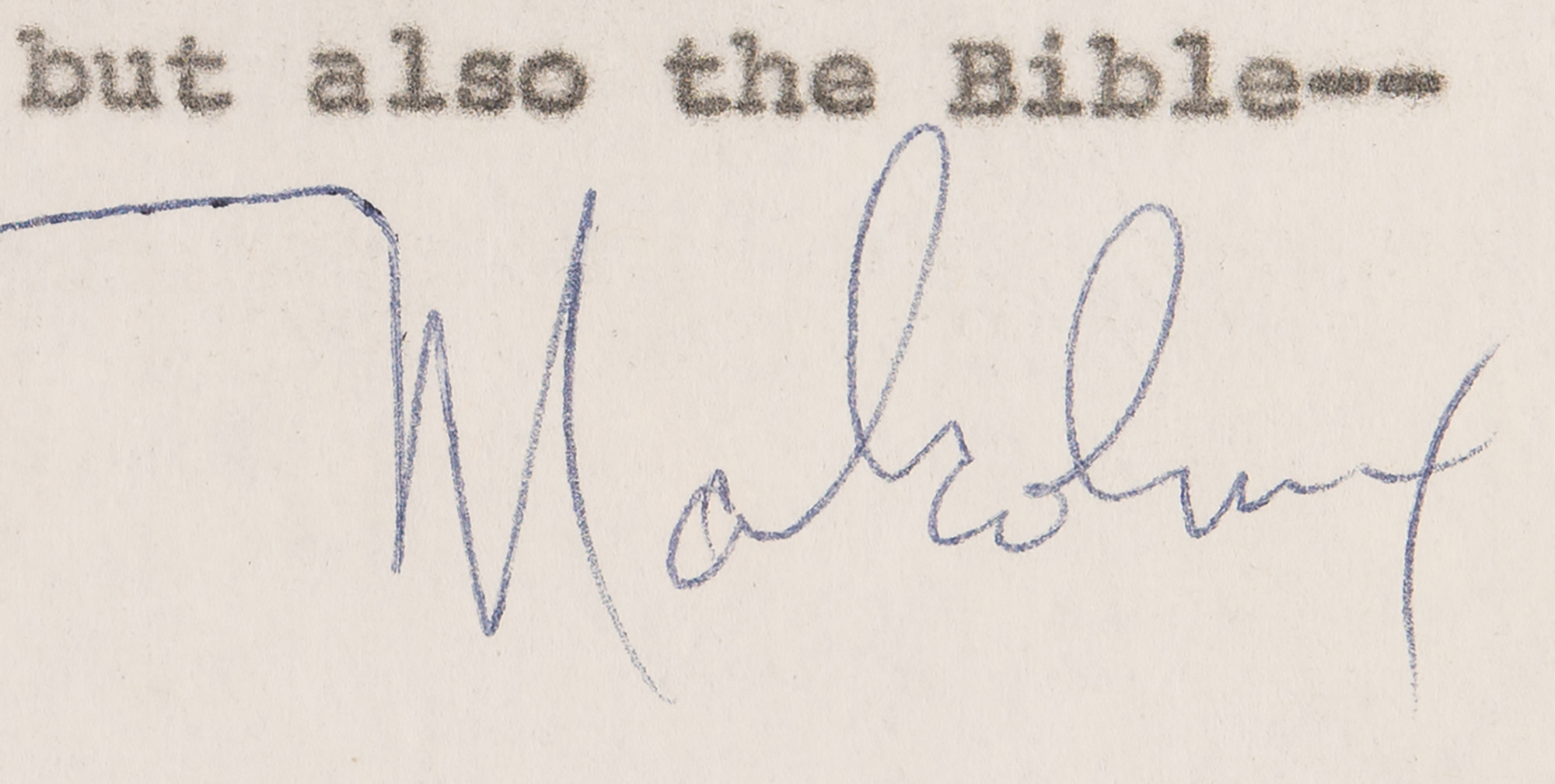
Page 11 from the original typescript of Alex Haley’s 1963 interview of Malcolm X for Playboy magazine, one page, 8.5 x 11, signed "Malcolm X" in the bottom margin (with a marginal line indicating his approval of the contents). In full: [Malcolm X] “Mr. Fard Muhammad. Mr. Elijah Muhammad teaches that this was God who had come here from the East like it was predicted by all the religious scholars and prophets that the son of man or the messiah who is also called the Christ but actually means God in person would make his appearance, coming from the East, and manifest himself in the West at the end of the white man's time. He would appear among the lost sheep, the so-called Negroes, and would choose one from among them, who will be referred to in the Bible as the Lamb of God. And he would make this lamb spotless and then use him as an example. Or as a shepherd, for the rest of the so-called Negroes. That lamb is referred to as 'the first begotten of the dead,' which only means that he would be the first one raised up from among the mentally dead so-called Negro.
[Haley] It gets rather confusing, all of it, doesn't it?
[Malcolm X] It may, sir, to you –
[Haley] And now you are calling yourself 'Muslims.' You pronounce it 'Moose-lem?
[Malcolm X] That's the correct Arabic pronounciation, sir. The other way, 'Moz-lim,' is the way a white man says it. That's the anglicized spelling and pronounciation.
[Haley] Well, Moose-lem or Moz-lim; but your movement, it is said, uses not only the Koran, but also the Bible – .” An editorial hand has added to the end of Malcolm X’s first paragraph: “We recognize the Honorable Elijah Muhammad as the Lamb of God.” In fine condition. Encapsulated and graded by PSA/DNA as “NM-MT 8.”
Playboy's May 1963 interview with Malcolm X was one of the most famous of Haley’s career and gave most readers their first in-depth look at Malcolm X’s teachings and personality. Supporters and critics viewed the Muslim minister in very different terms. Admirers saw him as a courageous advocate for the rights of African-Americans and condemned crimes against black Americans; detractors accused him of preaching racism, black supremacy, and violence. Nevertheless, he has been described as one of the greatest and most influential African-American leaders in history. Within a year of granting this interview, with America still gripped by ever-growing racial tension, the once-combative black nationalist Malcolm X had repudiated almost every stance in the interview. He had broken with the Nation of Islam movement, fallen out with its leader, Elijah Muhammad, renounced black supremacy, and embraced racial equality and human rights. He was assassinated in Harlem in 1965.
The Marc and Mary Perkins Collection.

