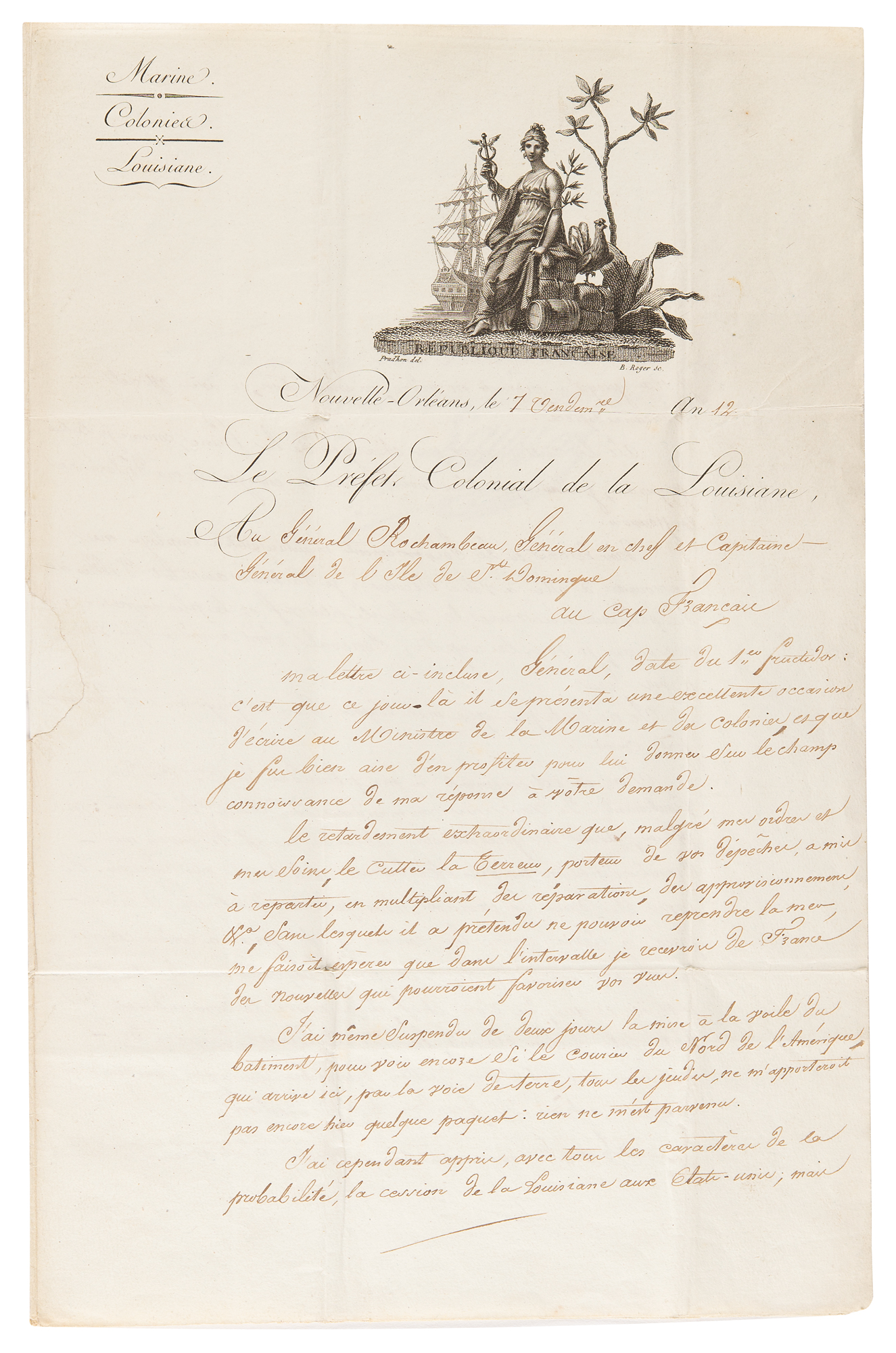
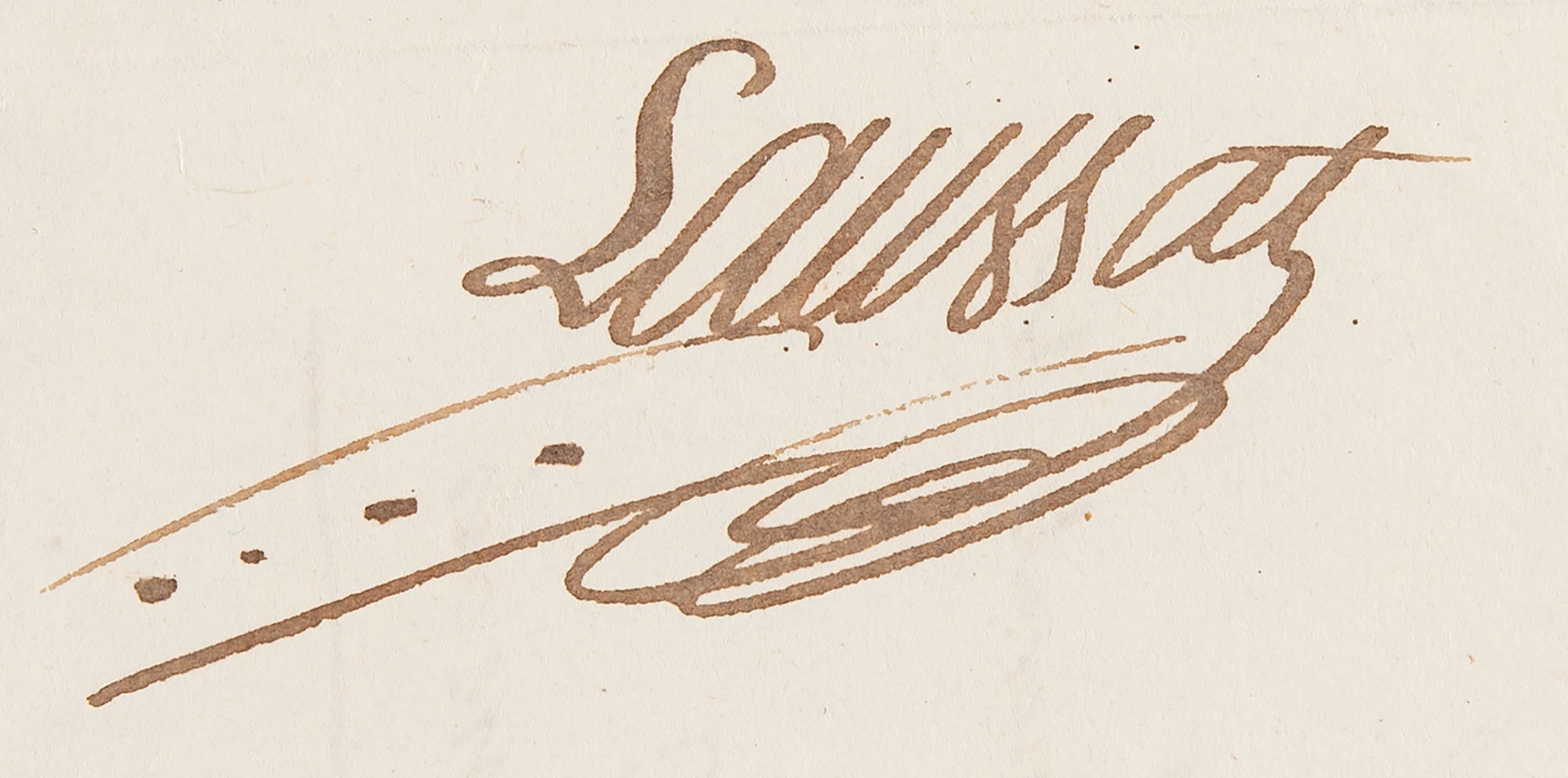
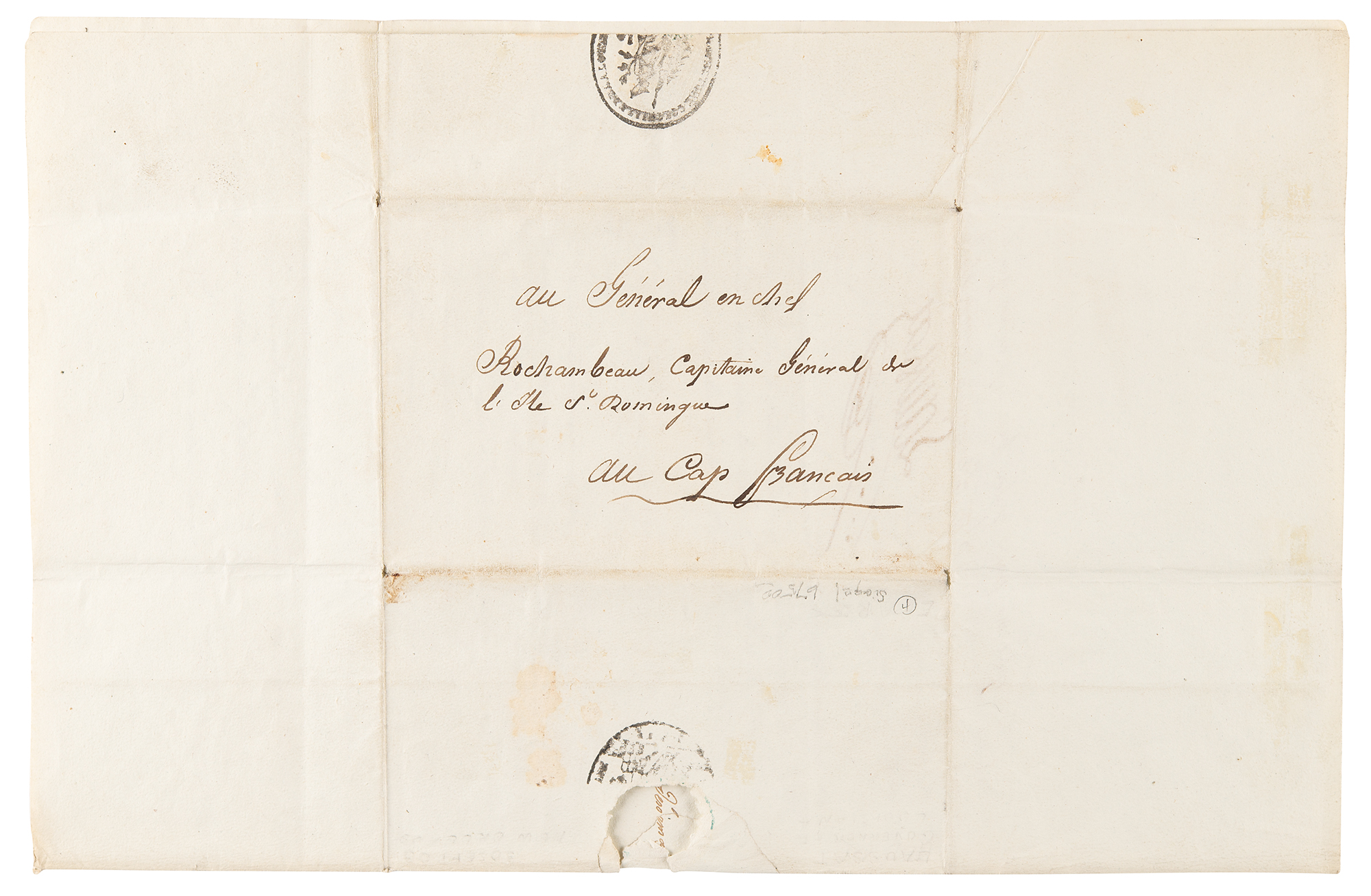
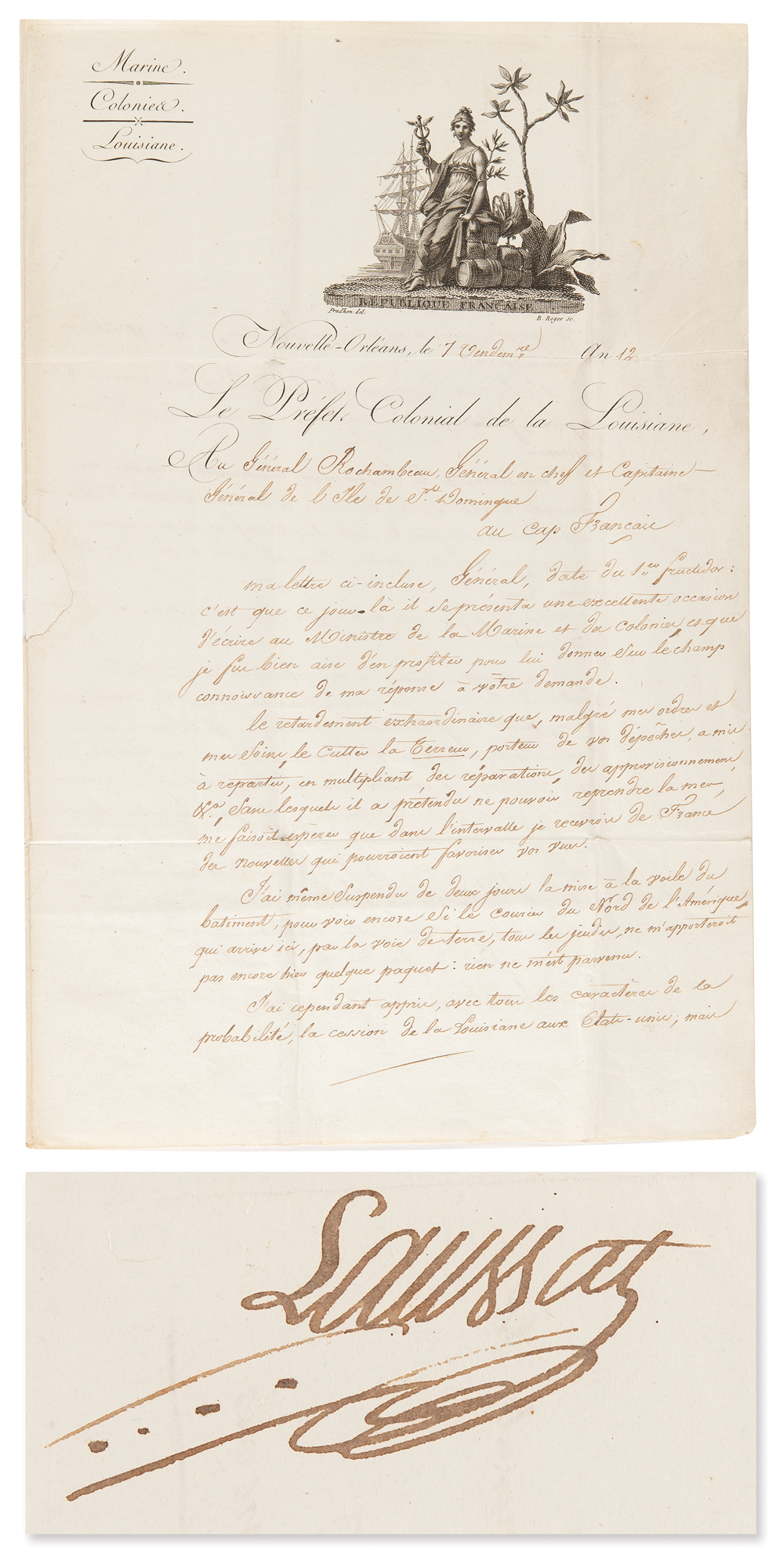
LS in French, signed “Laussat,” three pages on two adjoining sheets, 8 x 12.5, Republique Francaise, Marine Colonie Louisiane letterhead, 7 Vendémiaire, an 12 [September 30, 1803]. Letter to General Donatien de Rochambeau, Commander-in-Chief and Captain General of the Island of Saint-Domingue, remarking on the impending transfer of the territory of Louisiana to the United States.
In full (translated): "My enclosed letter, General, is dated 1st Fructidor: On that day an excellent opportunity arose to write to the Minister of the Navy and the Colony, and I was very glad to take advantage of it to give him immediate informal notice of my response to your request.
The extraordinary delay that, despite my orders and my efforts, the cutter La Terreur, carrying your dispatches, has taken to set sail again, while making numerous repairs and taking on supplies, without which it claimed it could not return to sea, led me to hope that in the meantime, I would receive from France news that might favor your interests.
I even suspended the ship's sailing for two days to see if the mail from North America, which arrives here overland every Thursday, might bring me some package yesterday: nothing reached me.
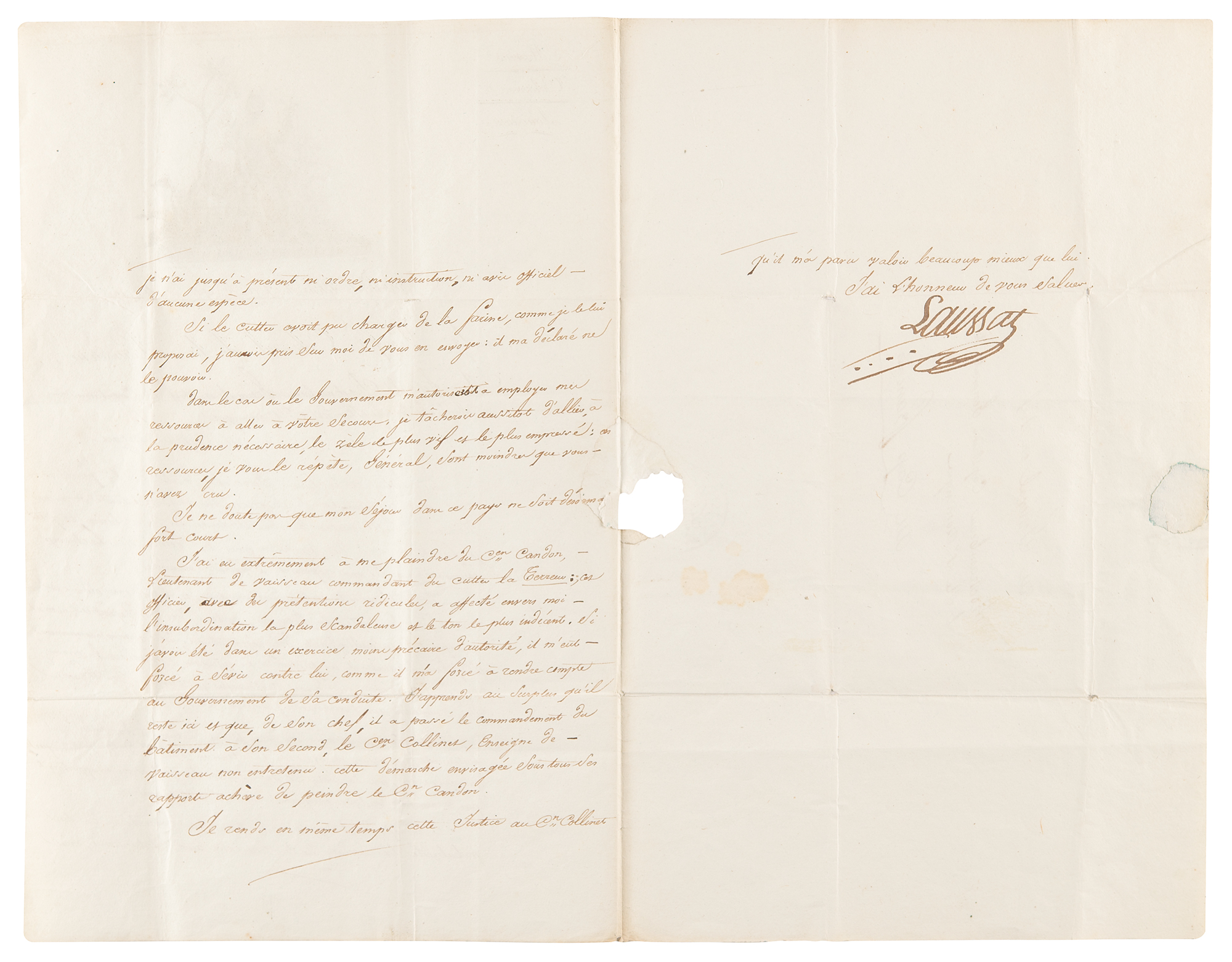
I have, however, learned—with every mark of probability—of the cession of Louisiana to the United States; but I have, up to the present, neither order, nor instruction, nor official notice of any kind whatsoever.
If the Cutter had been able to load flour, as I suggested, I would have taken it upon myself to send some to you: he declared he could not.
Should the government authorize me to use my resources to come to your aid, I will immediately try to combine the necessary prudence with the most ardent and eager zeal; these resources, I repeat, General, are less than you thought.
I have no doubt that my stay in this country will be decidedly very short.
I have had enormous cause to complain about Commander Candon, Lieutenant Commander of the cutter La Terreur; these officers, with ridiculous pretensions, affected towards me—the most scandalous insubordination and the most indecent tone. If I had been in a less precarious position of authority, he would have forced me to take action against him, just as he forced me to report his conduct to the government.
I have also learned that he is staying here and that, on his own initiative, he has passed command of the ship to his second-in-command, Commander Collinet, an Ensign of an unmaintained ship. This action, considered from all points, completes the picture of Commander Candon. I also acknowledge that Commander Collinet was far superior to him." In fine condition, with a seal-related tear to the left edge.
Pierre Clément de Laussat writes at a moment of extraordinary geopolitical transition, remarking upon both his inability to furnish supplies to the embattled French forces in Saint-Domingue and the imminent transfer of Louisiana to the United States. Laussat’s communication to General Donatien-Marie-Joseph de Vimeur, Vicomte de Rochambeau—who was charged with suppressing the Haitian independence movement—underscores the dire scarcity of French resources in the Caribbean and the uncertain political atmosphere in New Orleans. “I have learned—with every mark of probability—of the cession of Louisiana to the United States,” he writes, “but I have, up to the present, neither order, nor instruction, nor official notice of any kind whatsoever.” His admission that he could send no flour and possessed only limited resources—“less than you thought”—illustrates the collapsing state of French colonial logistics in the Americas.
The Louisiana Purchase Treaty had been signed months earlier, on April 30, 1803, but its terms remained closely guarded, and official news of the transaction traveled slowly through French military and administrative circles. At the time of this letter—just weeks before the U.S. Senate’s ratification of the deal—the prospective sale was still effectively a state secret. Napoleon Bonaparte’s decision to abandon his North American ambitions was shaped directly by the catastrophe unfolding in Haiti, where France was losing thousands of soldiers and exhausting its treasury in a failing attempt to suppress the revolution.
With war in Europe newly resumed, the Royal Navy threatened to sever French supply lines entirely. Under these pressures, Napoleon resolved to sell Louisiana, raising funds while denying Britain a potential foothold. Laussat, who had arrived in Louisiana in March 1803 to oversee its transfer from Spain back to France, now found himself unexpectedly responsible for delivering the territory to the United States instead. Within three months of this letter, Louisiana would belong to the Americans, and Rochambeau—defeated at the Battle of Vertières on November 18th—would surrender his remaining forces in Saint-Domingue to the British rather than face destruction by the insurgent army.
Despite holding only a fragile and temporary authority, Laussat acted as France’s final civil representative in Louisiana during this tumultuous period. Having heard rumors of the potential sale since his arrival, Laussat finally received official confirmation in August 1803, but no further instructions. His frustrations here with poor communication, the insubordination of the cutter La Terreur’s officers, and the lack of provisions available to support Rochambeau, capture the breakdown of French command in the region. Finally, on December 20, 1803, he presided over the formal ceremony transferring Louisiana to the United States, closing the brief and final chapter of French rule.
A unique, historically important letter that offers a rare, firsthand view of the confusion, strain, and swift imperial recalculations that culminated in one of the most consequential land transactions in American history.

