Sold For $2,030
*Includes Buyers Premium
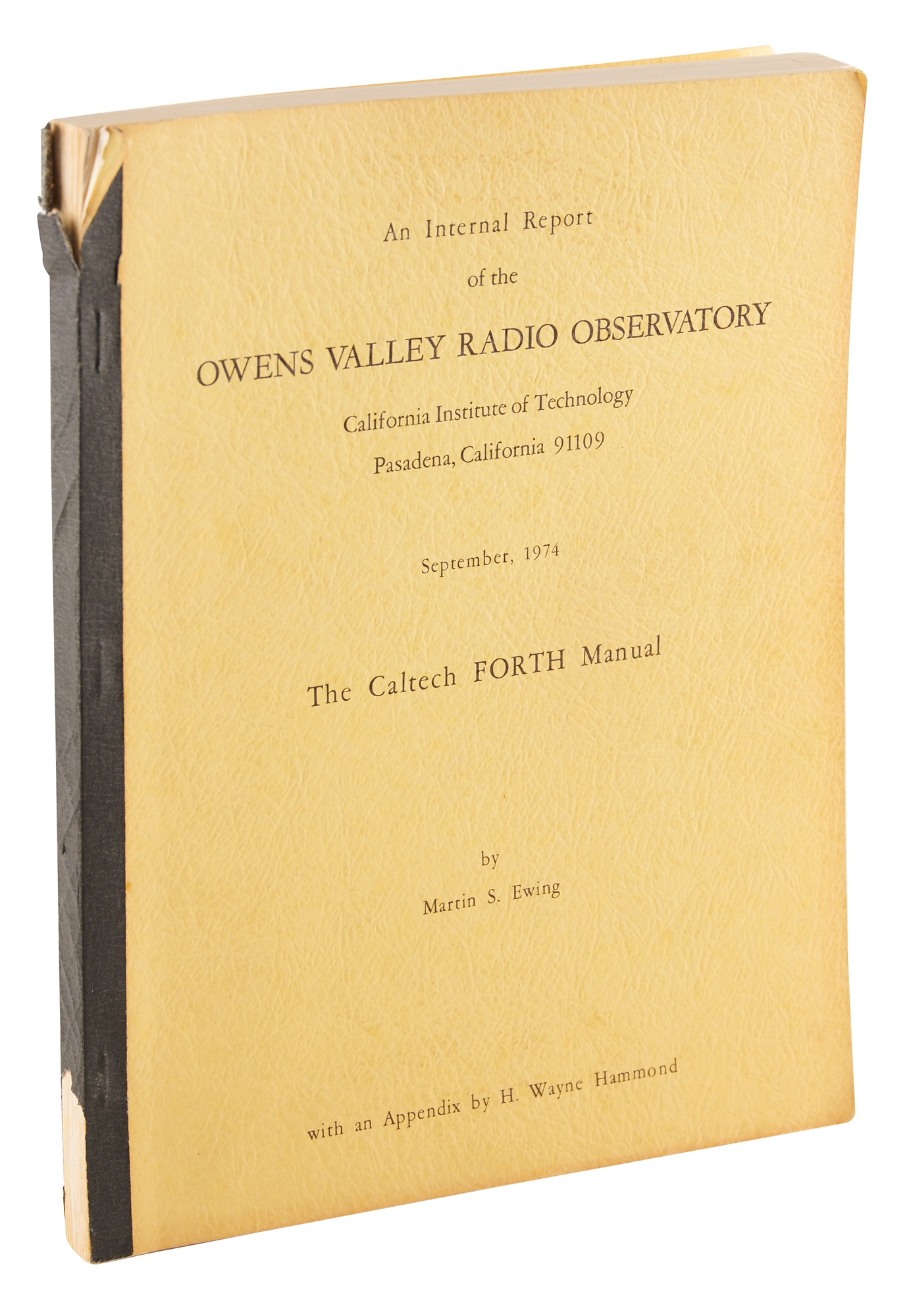
Steve Jobs's personally-owned report entitled "An Internal Report of the Owens Valley Radio Observatory, California Institute of Technology, Pasadena, California 91109, September, 1974, The Caltech FORTH Manual by Martin S. Ewing, with an Appendix by H. Wayne Hammond." Bound in the original softcover wrappers, 8.25 x 10.75, 108 pages. The manual describes Caltech FORTH, a programming language developed for controlling the Owens Valley Radio Observatory's 40-meter telescope.
The introduction begins: "The rapid acceptance of minicomputers for data acquisition and system control has created a need for matching software systems. High level languages like FORTRAN, ALGOL, or PL/1 are not normally effective in environments with less than 16K words and limited peripheral devices. Even when these languages can be used, they are all designed for batch processing and lack features needed for direct interaction with the operator. By default most programmers have been forced to use assembly language. This is efficient for small programs, but there can be great practical difficulties in writing and maintaining larger assembly programs.
The FORTH system meets the problem described above; it provides a flexible operating system for minicomputers of moderate size. A machine with 8K 16-bit words and at least one mass storage device can make effective use of FORTH. Most new laboratory computers will have at least this size; the programming difficulties with smaller machines will more and more outweigh the falling cost of memory and peripherals."
The manual provides a comprehensive overview of FORTH, covering its history, structure, vocabulary, and operations. In very good to fine condition, with losses to the head and tail of the spine.
This was found amongst the reports and papers within Steve Jobs's childhood desk. His ownership of this early programming manual situates him within the intellectual milieu that directly inspired the personal computing revolution. FORTH’s focus on simplicity, efficiency, and tight hardware–software integration prefigured the core design philosophy of Apple’s earliest machines: powerful tools that placed interactive computing in the hands of individuals. A remarkable convergence of institutional research and Silicon Valley vision, this volume bridges the gap between the mainframe era and the microcomputing world that Steve Jobs would soon help transform.
Provenance: from the personal collection of John Chovanec, stepbrother of Steve Jobs.

