Sold For $83,188
*Includes Buyers Premium
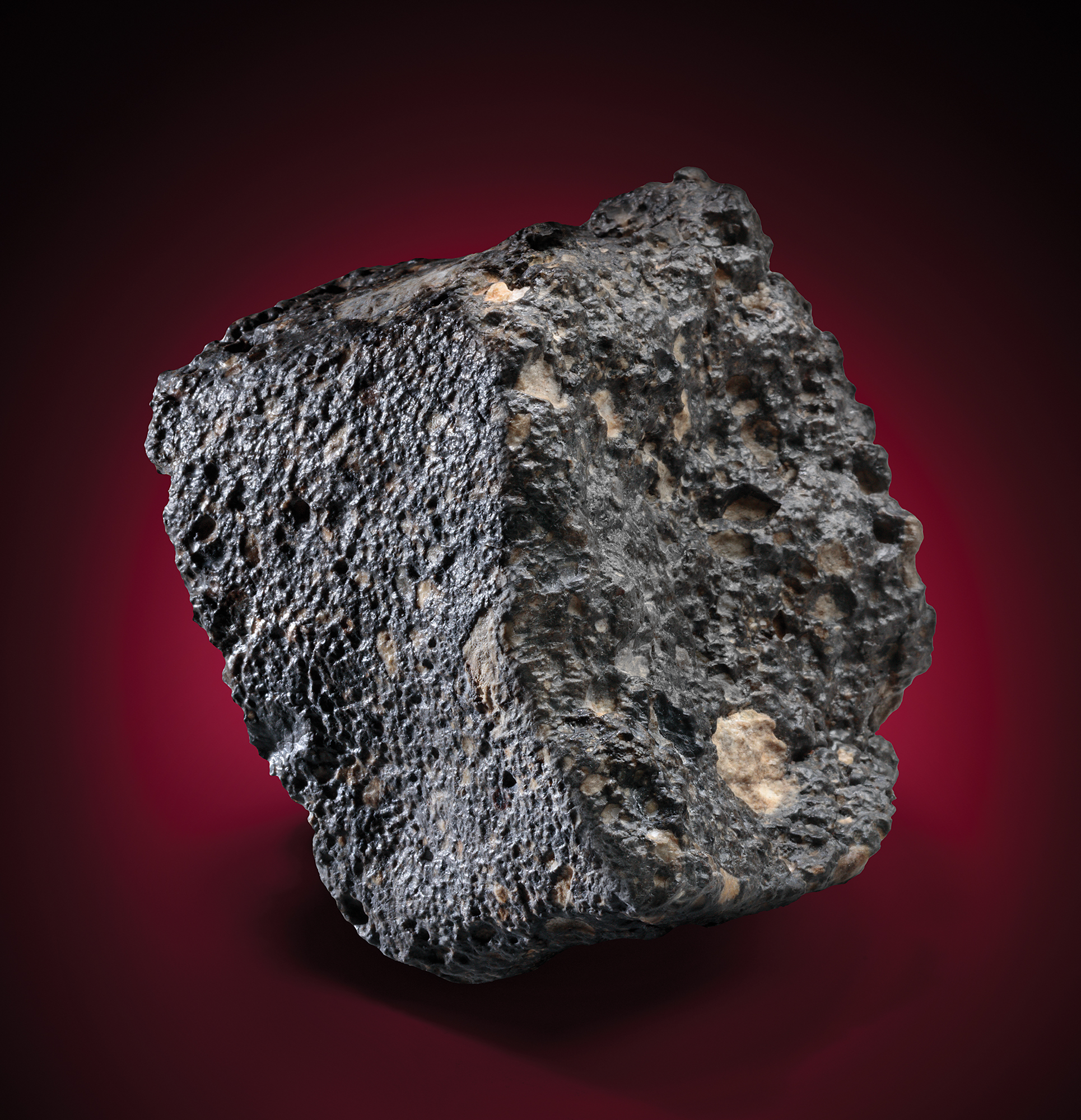
Moon rock, lunar feldspathic breccia
Sahara Desert, North West Africa
127 mm x 95 mm x 89 mm
2100.2 grams
The weight of every meteorite known is less than the world’s annual output of gold. Lunar meteorites, i.e., pieces of the Moon ejected off the Moon’s surface as a result of an asteroid impact—and nearly all of the Moon’s craters are the result of such impacts—are far more rare. Every lunar meteorite documented would fit in the back of a mid-size pick-up truck and a good deal of this material is in museums and research institutions. It should also be noted that every milligram of the nearly 400 kilos of Moon rocks returned to Earth from NASA’s Apollo missions are untouchable.
NWA 10309 is the 10,309th meteorite to be recovered from the North West African grid of the Sahara Desert to be analyzed and classified by scientists. The submitted analysis was peer reviewed prior to publication in the Meteoritical Bulletin, the journal of record. The authentication work in this instance was done by Dr. Anthony Irving—one of the world's foremost experts in the classification of lunar and Martian meteorites.
Lunar samples are readily identified by their highly specific geological, mineralogical, chemical and radiation signatures. The minerals comprising the Moon's crust are limited and conversely the most common of Earth's minerals are not found on the Moon. Lunar specimens also contain gases originating from the solar wind with isotope ratios that are markedly different from the same gases found on Earth.
This large chunk of the Moon is a lunar breccia, which is to say it contains innumerable fragments of different lunar minerals 'cemented' together from the pressure and heat generated by repeated impacts on the lunar surface.
The exterior of this somewhat rectangular mass exhibits a natural desert varnish—the result of being exposed to natural sandblasting for hundreds of years. The numerous and prominent white clasts seen are anorthite, an exceedingly rare mineral on Earth but not on the Moon. Hundreds of signature anorthositic clasts are seen as large as one inch in diameter. This breccia contains angular anorthite clasts, pigeonite, orthopyroxene, augite, olivine, chromite and the iron alloys kamacite and taenite—which did not originate on the Moon but are from the core of at least one asteroid which pulverized the lunar surface.
As would be expected would be the case for some lunar meteorites, NWA 10309 is among those that are extremely similar to some of the Moon rocks returned to Earth by Apollo missions. Ejected off the lunar surface following an asteroid impact prior to landing on Earth this is a substantial and quintessential sample of the Moon.
The analysis of this meteorite was helmed by Dr. Anthony Irving, among the world’s foremost meteorite classification experts. Its classification was published in the 104th edition of the Meteoritical Bulletin—the official registry of meteorites—a copy of which accompanies this offering.
From the Stifler Collection of Meteorites, Brookline, MA.

