Sold For $5,040
*Includes Buyers Premium
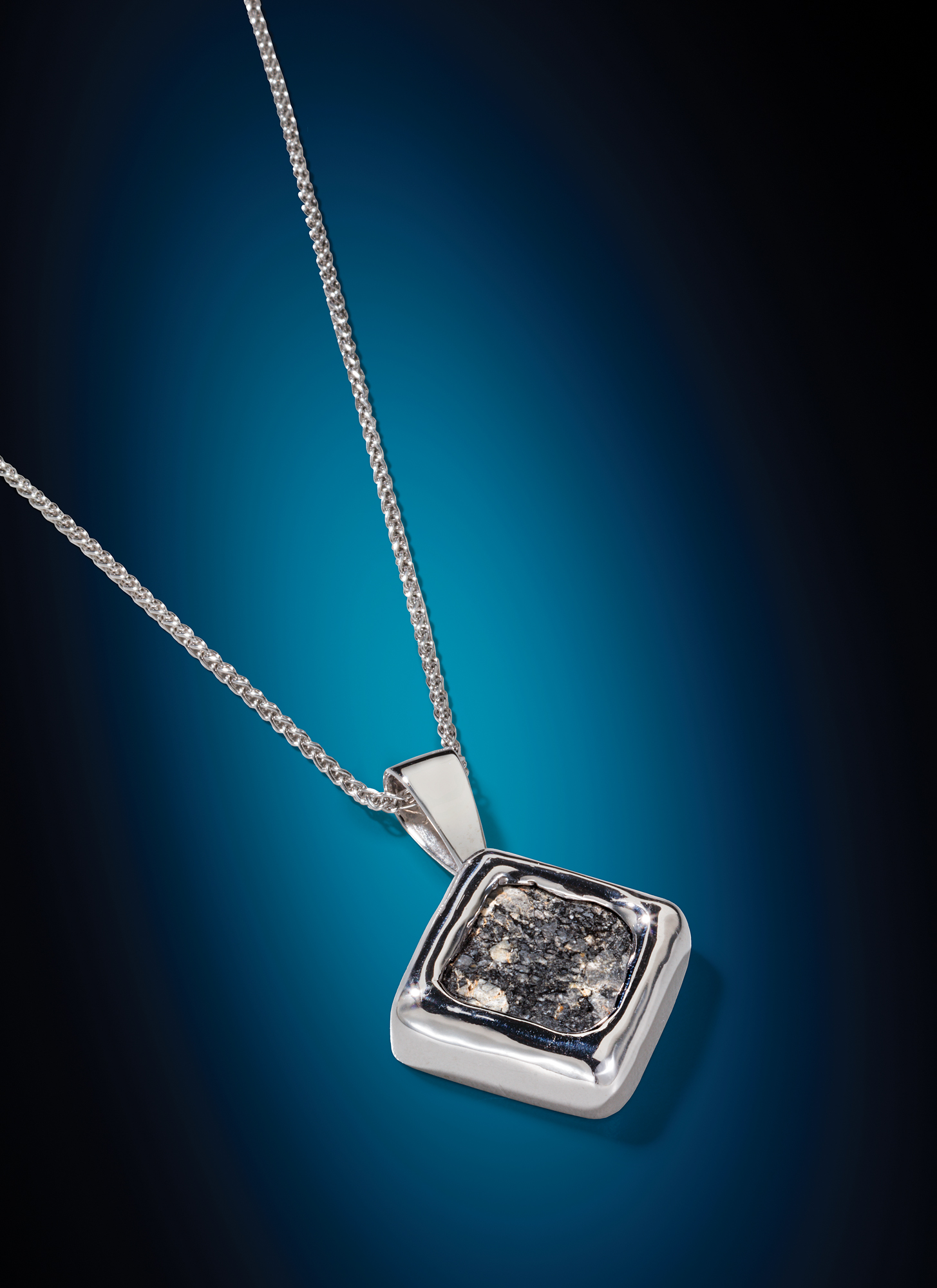
Lunar meteorite (anorthositic breccia)
18 mm x 18 mm x 4 mm (setting on a 19-inch necklace chain)
2.58 grams (weight of lunar specimen)
Handsome necklace with a white gold pendant containing a sample of the Moon—a specimen Dar al Gani ('DaG') 262, the meteorite which became a major catalyst to what continues to be among the most successful and scientifically important treasure hunts of all time: the search for meteorites in the Sahara Desert.
It was in 1995, as part of the first natural history auction ever, Darryl Pitt assembled what was the first grouping of meteorites to be offered by a major auction house. The unexpectedly high prices attained at this sale and the following worldwide media attention inspired a new generation of meteorite hunters.
At that time, there were only twelve lunar meteorites with a total weight of a little more than two kilograms. Of the twelve, eleven were found by scientists in Antarctica and one was discovered in Australia. In 1997, DaG 262 became the first piece of the Moon to be found in the Sahara.
Today there are 754 lunar meteorites and 624 have been found in the Sahara—and the Moon is still among the rarest substances on our planet. Every gram of the 2000 kilograms of lunar meteorites known to exist could fit in the back of a single mid-size pick-up truck—and a good portion of this material now resides in the world’s great museums and research centers. Also, while Apollo astronauts returned with 382 kg of Moon rocks, not one gram can be privately owned.
Lunar meteorites are chunks of the Moon ejected into space which landed on Earth following asteroid impacts on the lunar surface—and nearly all of the Moon’s craters are the result of such impacts. Scientists identify Moon rocks by specific textural, mineralogical, chemical, and isotopic signatures. Many of the common minerals found on Earth’s surface are rare or absent on the Moon and some lunar minerals are unknown on Earth. In addition, Moon rocks contain gases captured from the solar wind with isotope ratios very different from the same gases found on Earth.
Dar al Gani 262 features clasts of anorthosite, a mineral which is rare on Earth and common on the Moon, mixed with fragmentary crystallized melt breccias bound together by a fine matrix. The breccia seen is the result of the crushing and melting action caused by repeated asteroid impacts on the lunar surface—the last of which launched this to Earth.
One of the rarest objects on Earth, this sample of the Moon has been cut and polished and is held in an elegant white gold setting whose backplate features a die-cut crescent Moon.
The peer-reviewed classification and publication of Dar al Gani 262 appears in the 81st edition of the Meteoritical Bulletin, the journal of record—a copy of which accompanies this offering.
From the Philip C. Mani Collection of Meteorites, Fort Worth, Texas.

