Sold For $4,973
*Includes Buyers Premium
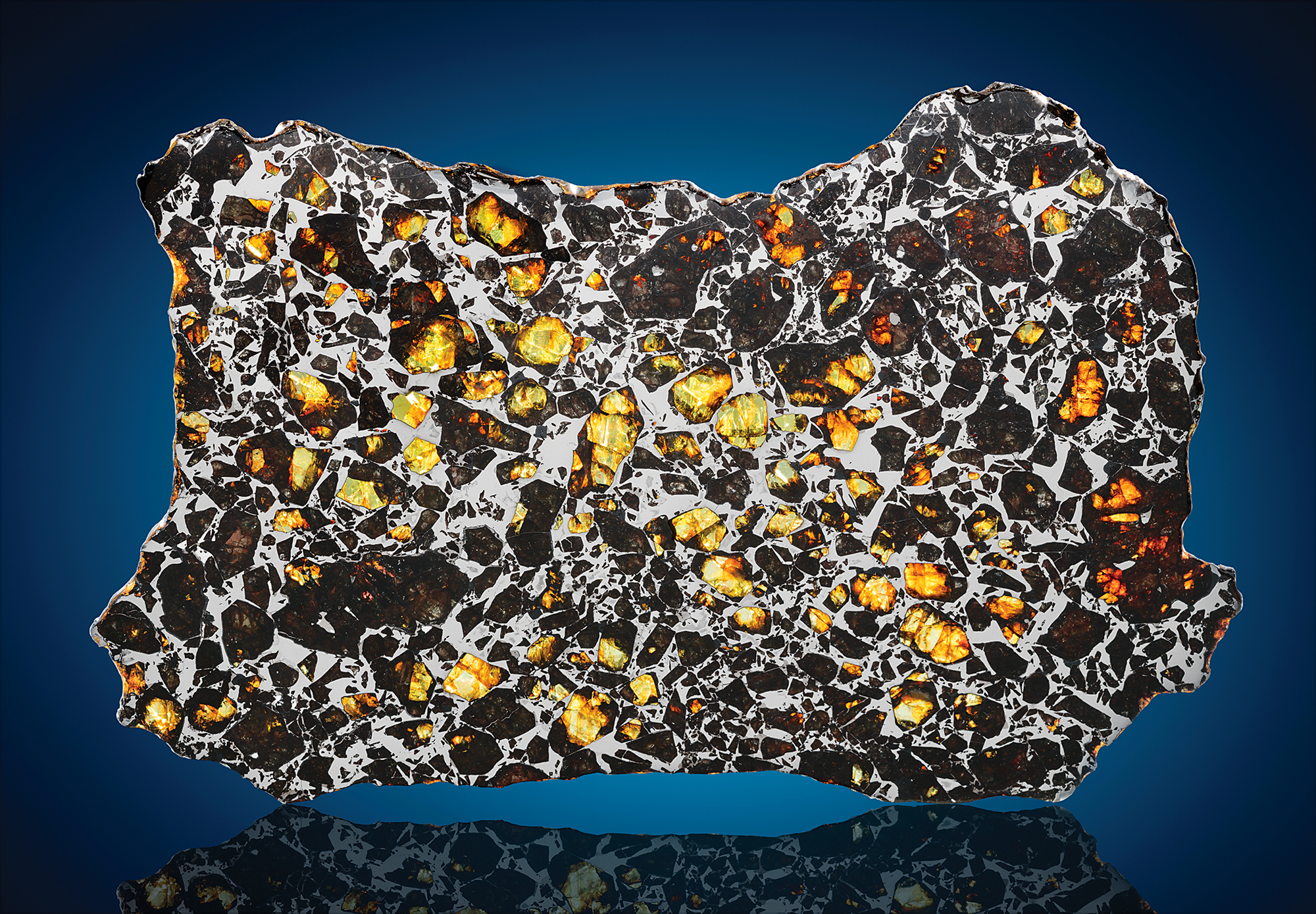
Pallasite – PAL
Admire, Lyon County, Kansas (38° 42'N, 96° 6'W)
219 mm x 143 mm x 3 mm
339.7 grams
Just 0.2% of all meteorites are pallasites—the most beautiful extraterrestrial substance known—and here offered is a superb example.
Pallasites result from molten metal from an asteroid’s core mixed with chunks of olivine from the adjacent mantle. The fact of this having formed in a boundary region is the reason for its rarity. It was a catastrophic collision with another asteroid which resulted in the shattering of the asteroid which contained this material thereby liberating it.
This complete slice is delimited by the meteorite’s natural external surface. Suspended in the iron-nickel matrix, the glimmering, translucent chartreuse-to-mango hued crystals in evidence are extraterrestrial olivine and peridot—the birthstone of August. One side of this slice is highly polished while the other side exhibits the meteorite’s metallic crystalline structure—which is further proof of the otherworldly origin of this material as iron-nickel does not crystallize on Earth’s crust due to the insufficiently long cooling curve provided.
The pallasite group of meteorites was named after the 18th Century scientist Peter Pallas who studied a large unusual rock in Siberia which he asserted could not have possibly fallen out of the sky—but it did, and it became the first pallasite ever found.
Originating from an asteroid that no longer exists, the crystals of the majority of all pallasites are completely opaque—which is clearly not the case in this compelling example of the most beautiful extraterrestrial substance known. Modern cutting.

