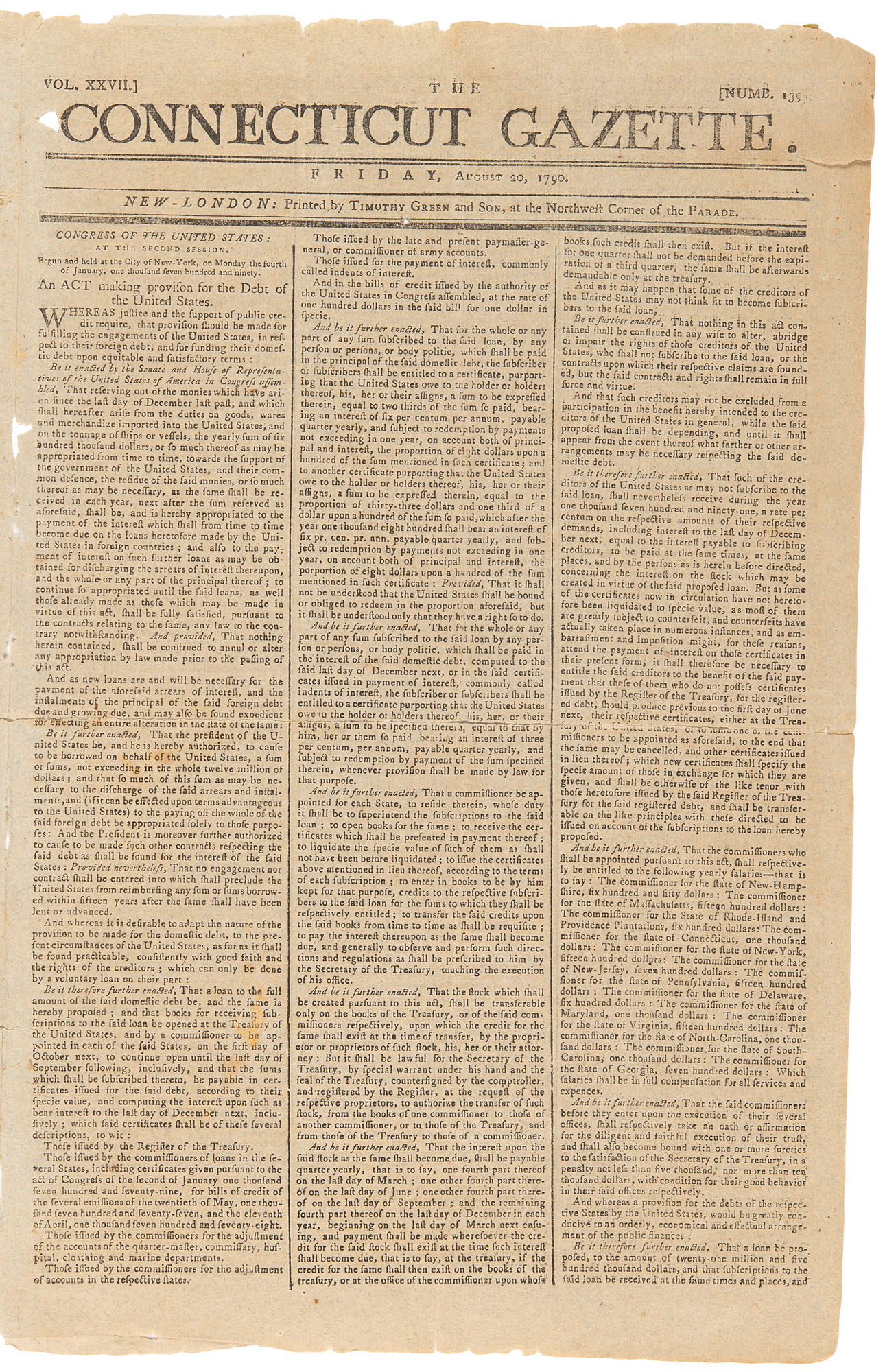
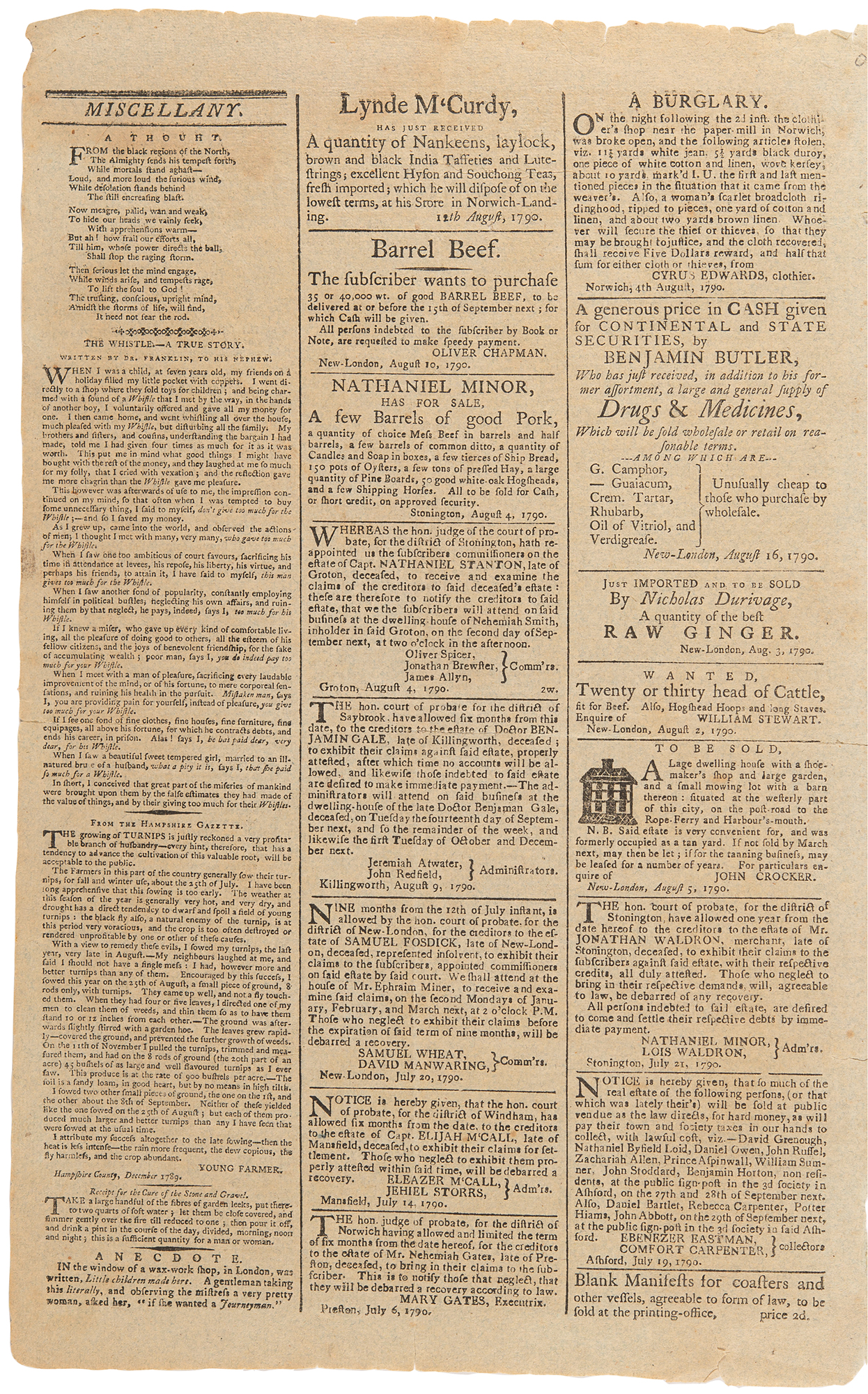
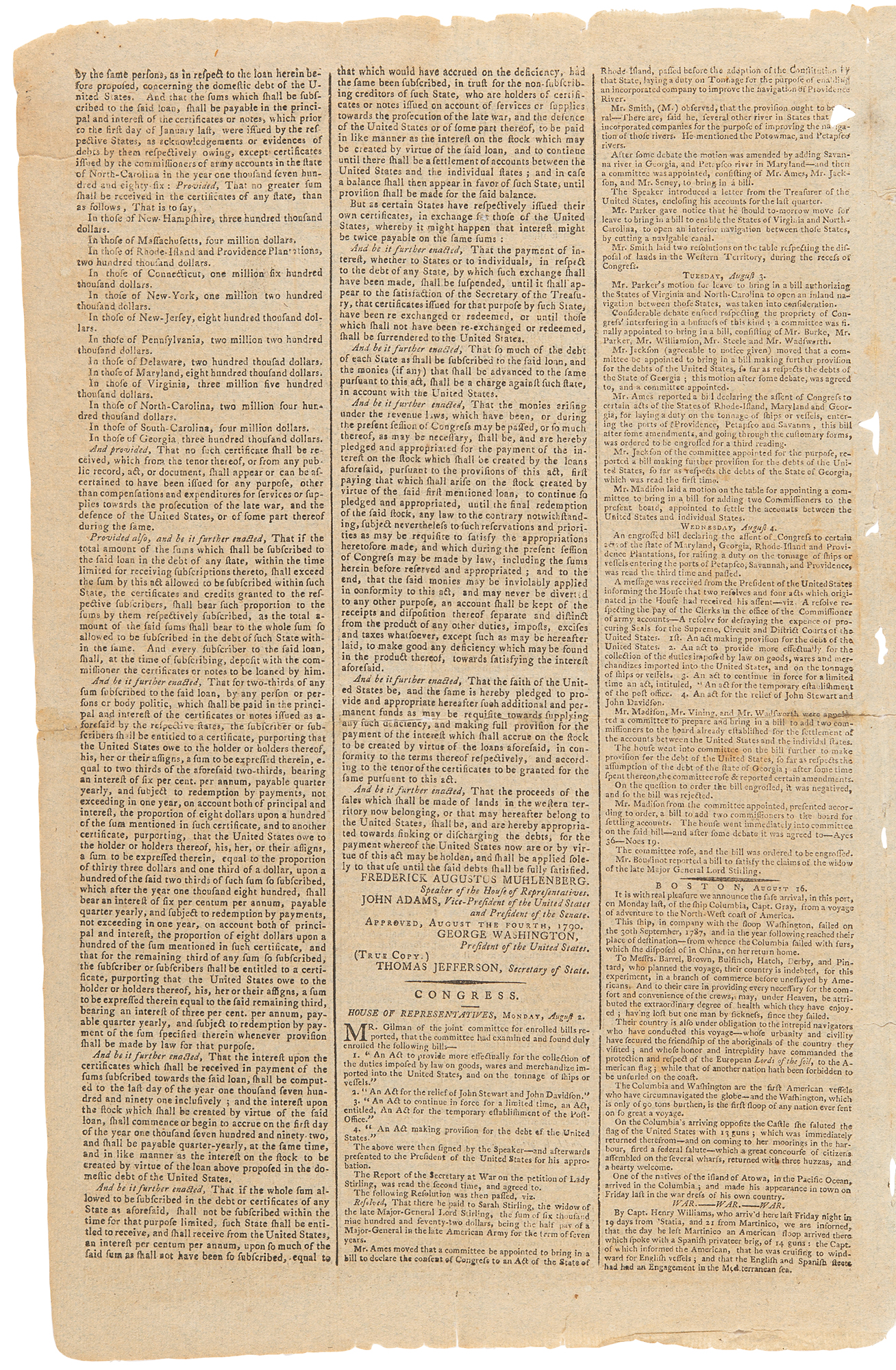
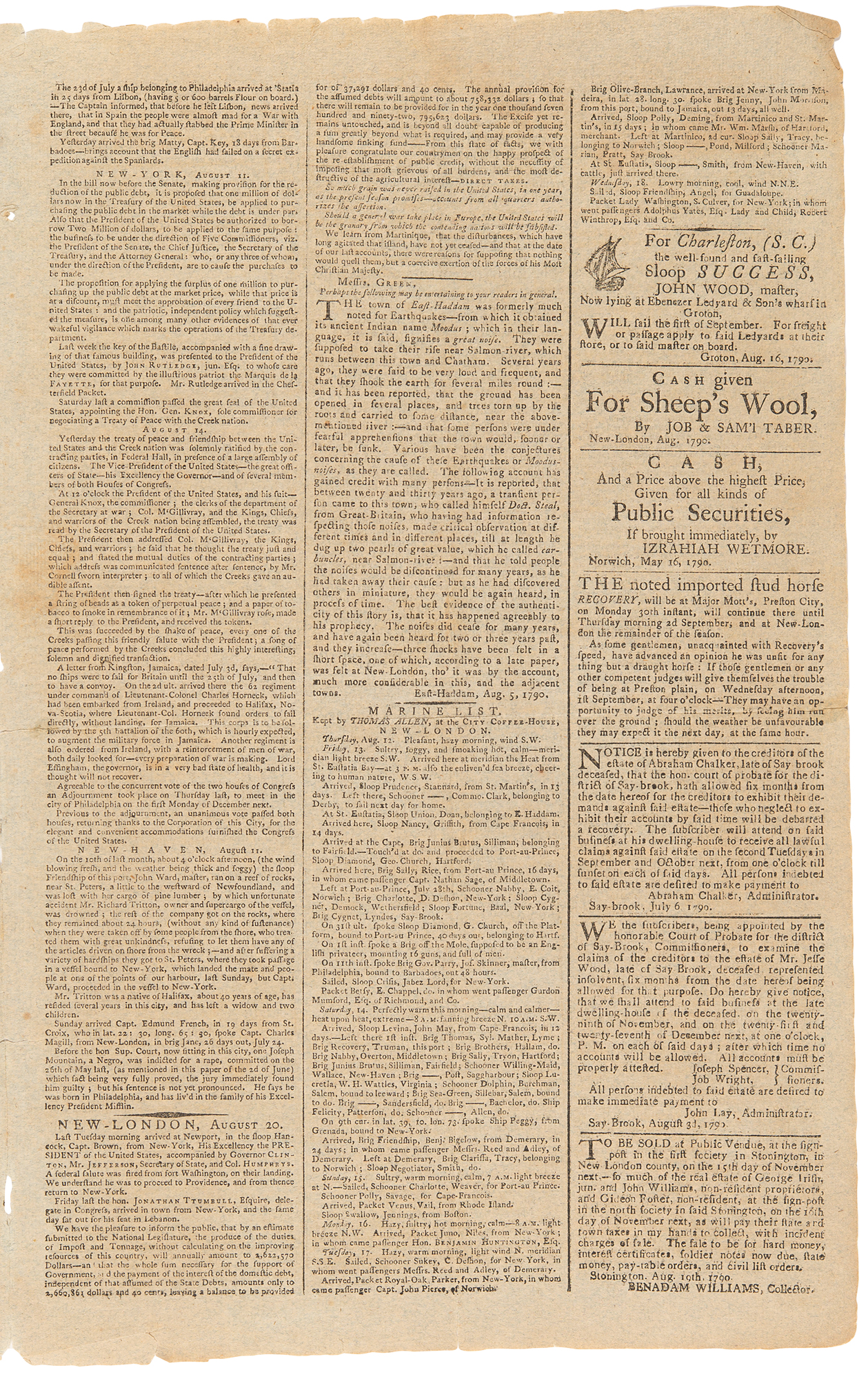
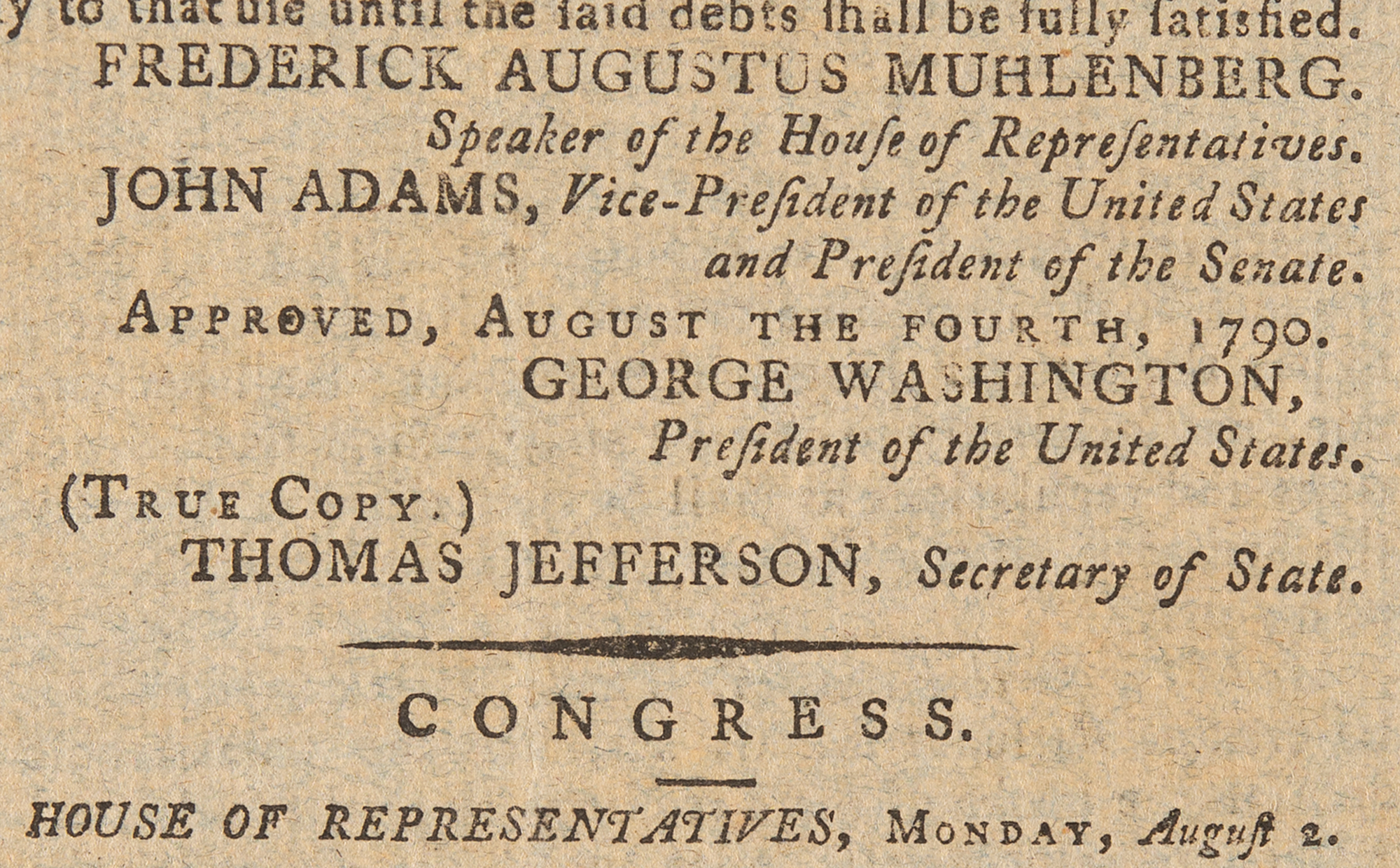
Complete issue of The Connecticut Gazette from August 20, 1790, 10 x 15.75, four total pages, featuring the full text of the Funding Act (or the ‘Assumption Act’) of August 4, 1790, which bears the print signatures of George Washington, John Adams, and Thomas Jefferson at the conclusion. Passed in New York a little over two weeks prior, the act authorized the federal government to receive certificates of all state war-incurred debts and to issue federal securities in exchange. The legislation was likely eased to passage by the Compromise of 1790, in which southern states resisting approval would gain the benefit of a closer sitting for the new seat of government.
When the thirteen United States transformed themselves from a loose confederation into a tighter arrangement with a pro-active central government, one of the largest and most difficult projects was their consolidation of finances from the states' administration. As the first Secretary of the Treasury, Alexander Hamilton was assigned by Congress the job of determining a workable mechanism, and then had to obtain their approval, as the latter had the highest Constitutional authority over financial matters. To address this, in early 1790, Hamilton issued his First Report on the Public Credit. Unfortunately, there was much opposition to his initial proposal due to the conflicting interpretations among the states of what would constitute a fair distribution of the debt burdens, and the lack of sufficient federal accounting to determine the actual size of the debts. In particular, several southern states had prioritized paying debt quickly but had neglected record-keeping, including proofs, which likely left them shortchanged if current debt figures were used and applied evenly going forward.
A significant breakthrough in finalizing the two laws, breaking a congressional stalemate, was the legendary Compromise of 1790. It was reached under a strategy settled in secret with the northerner Hamilton, meeting with southerner Representative James Madison and Secretary of State Thomas Jefferson, at the last's invitation. Essentially, Hamilton's proposal would be approved with help from the leadership of Madison and Jefferson in exchange for locating the national capital on the Potomac River, roughly central by geography. This event was dramatized in the hit play Hamilton as ‘The Room Where It Happens.’ In very good to fine condition.

