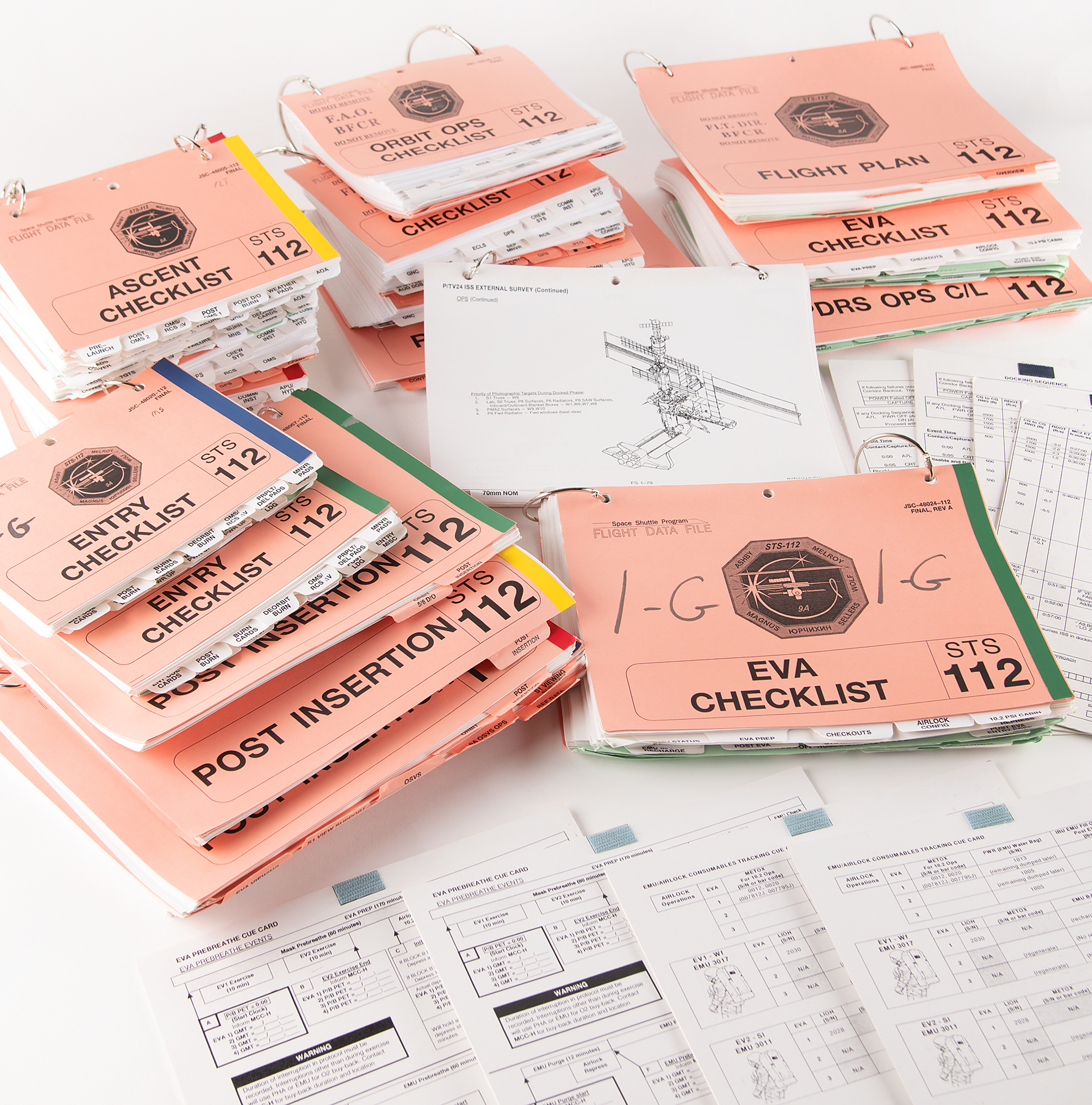
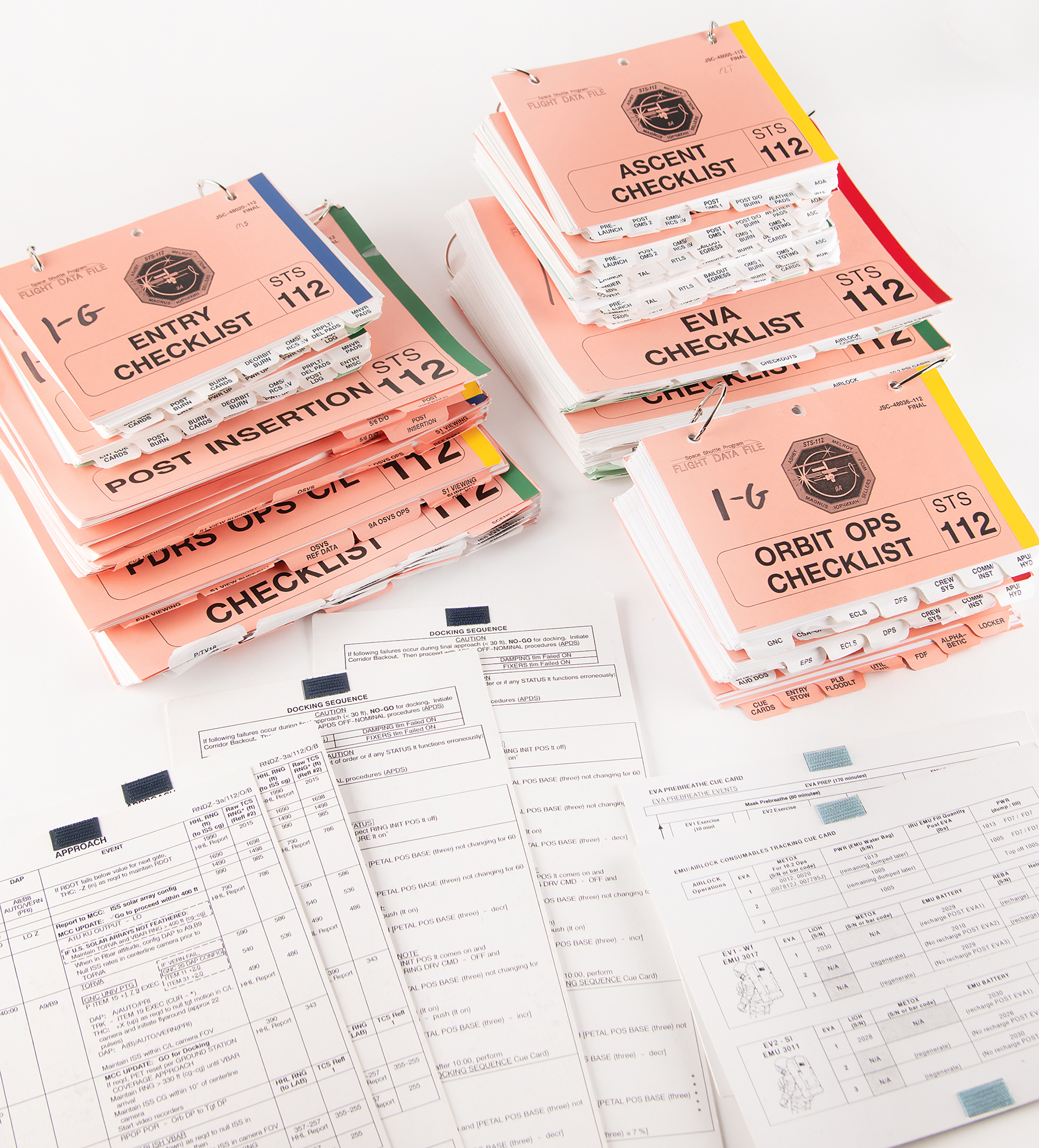
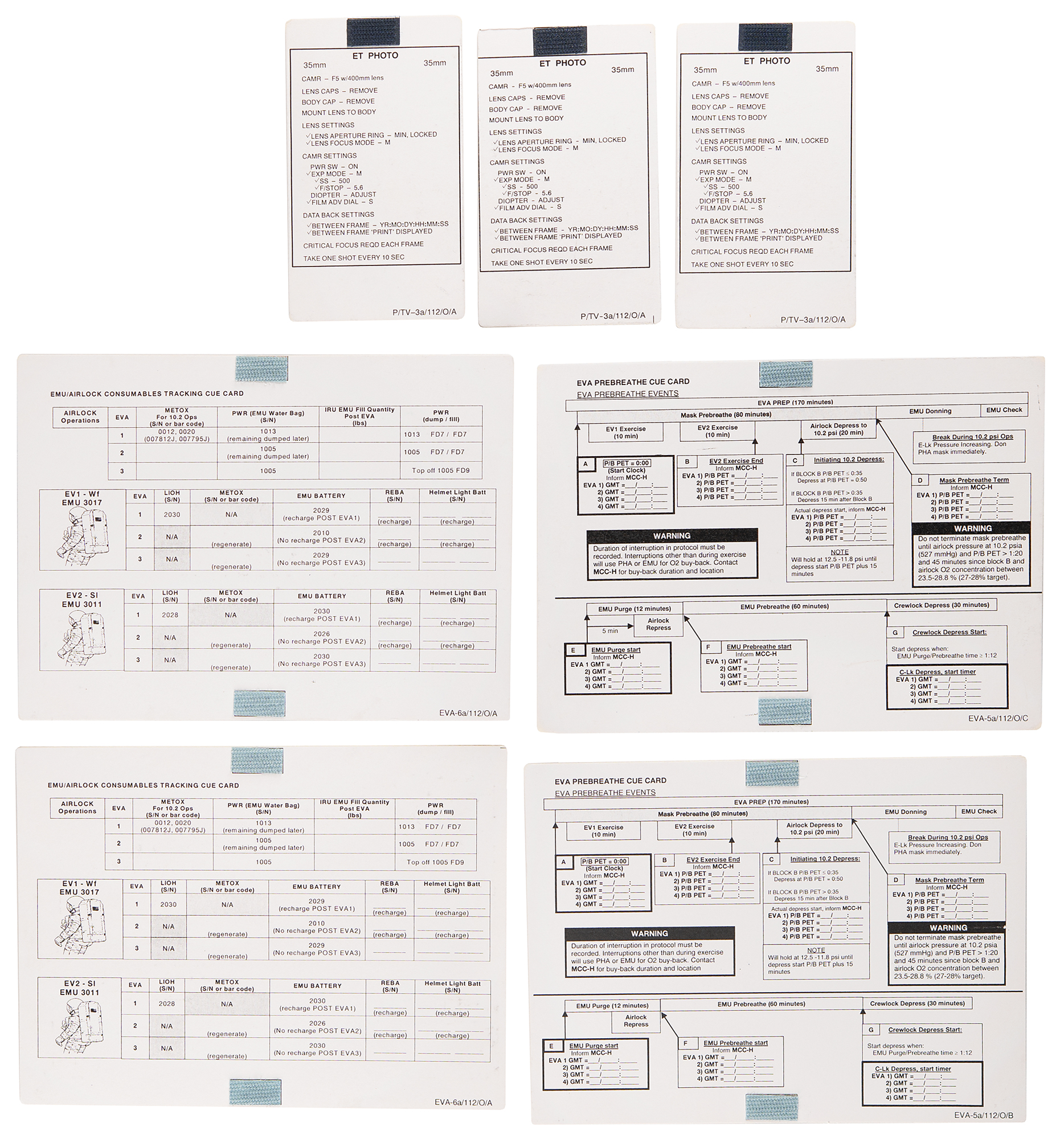
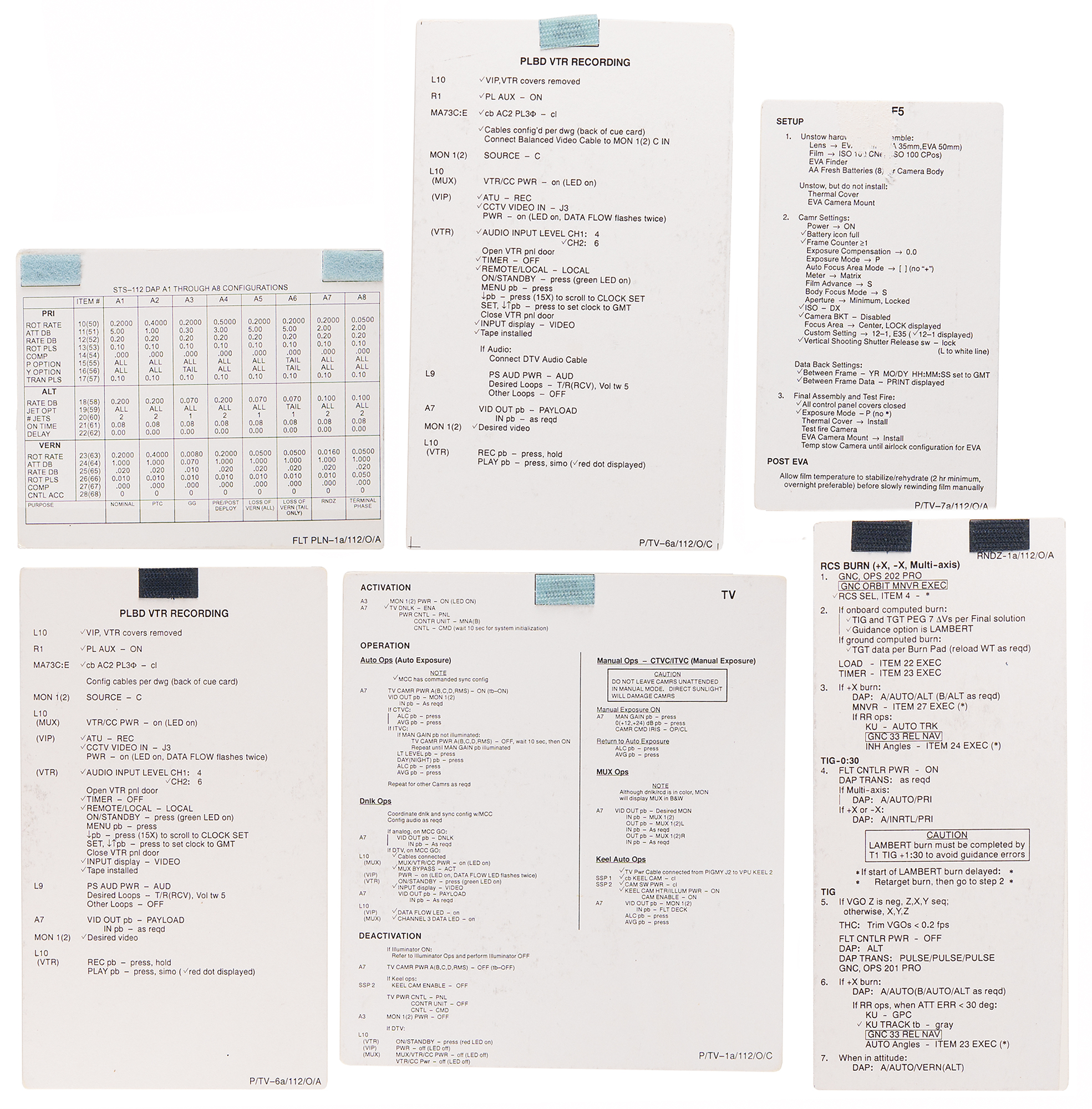
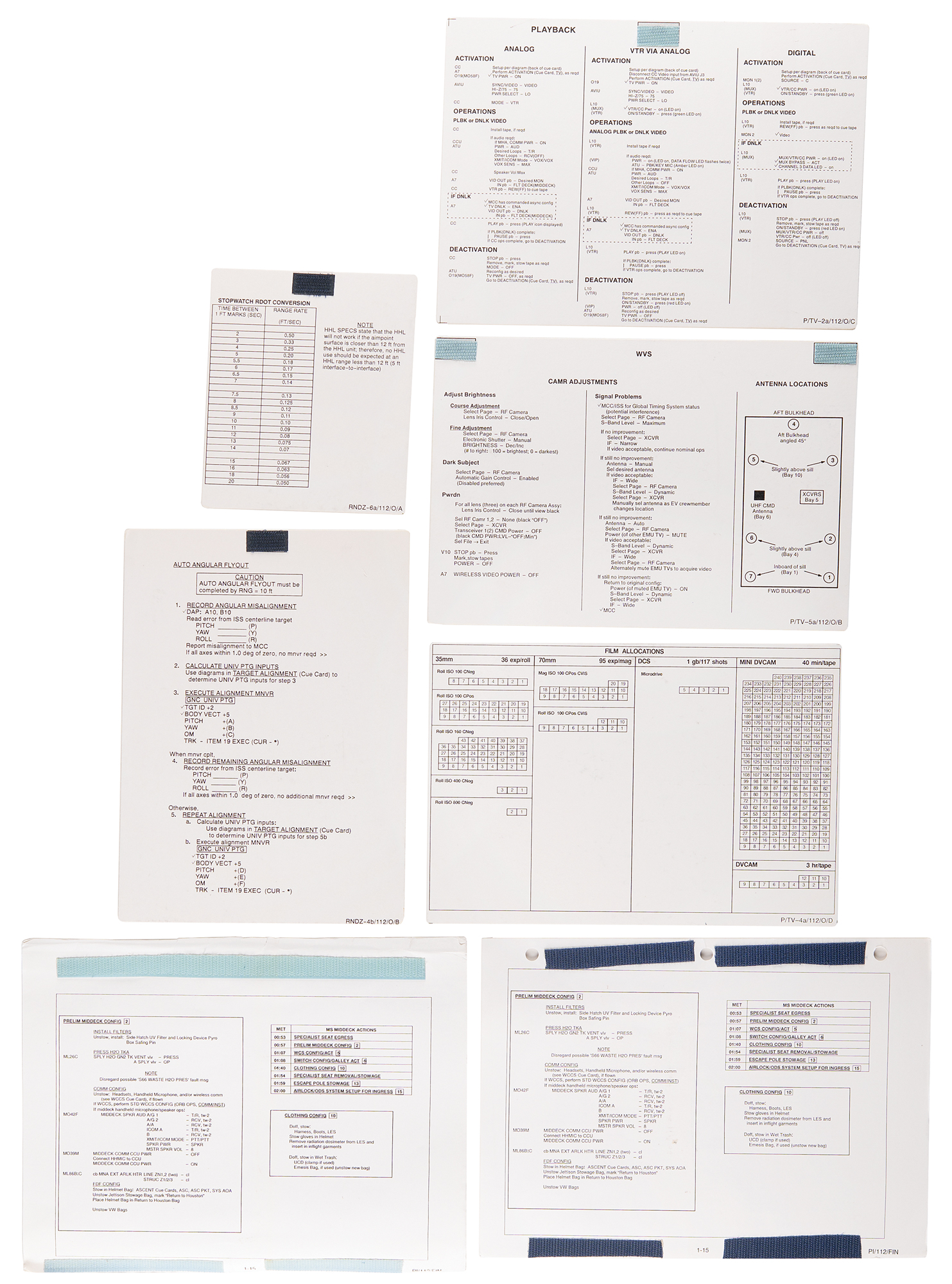
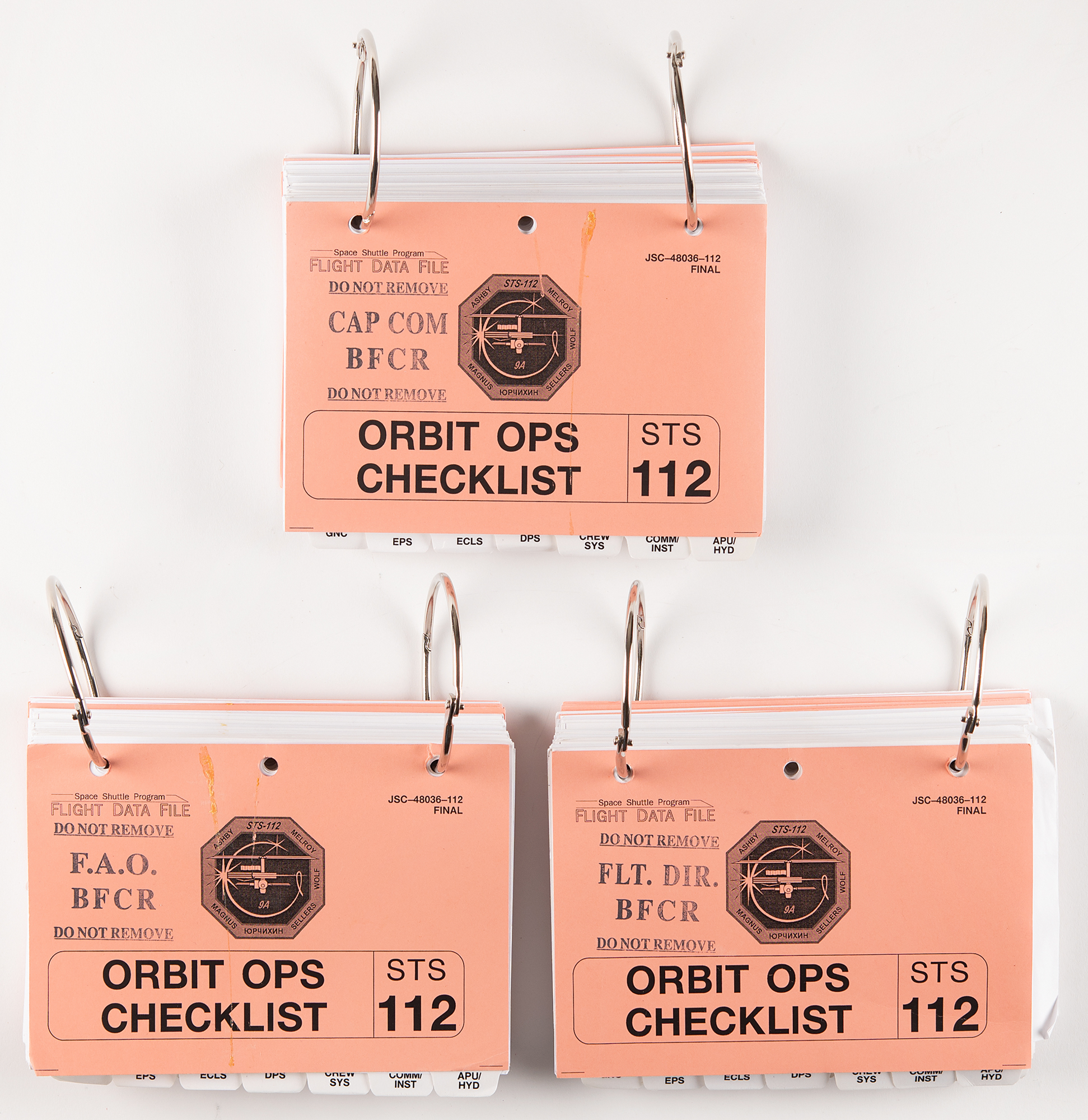
Extensive Flight Data File (FDF) archive from the STS-112 mission, an 11-day Space Shuttle mission to the International Space Station (ISS) flown by Space Shuttle Atlantis. The collection comprises 18 ring-bound FDF checklists used by the STS-112 crew during 1-G simulation training, an assortment of 25 training-used cue cards, and 15 ring-bound FDF checklists employed by Mission Control?s Backroom Flight Control Center at Johnson Space Center to document the real-time operations of the STS-112 mission.
STS-112 delivered and installed the S1 truss segment on the ISS, conducted three spacewalks, and executed complex rendezvous, docking, and robotic operations?activities directly supported by the checklists and cue cards in this archive, which guided both the crew and mission controllers through each critical procedure.
The crew-used training checklists, which were employed with the shuttle mission simulator and the 1-G trainer, served as a rehearsal framework for the very milestones Atlantis achieved on STS-112 ? ascent, docking, EVA, truss installation, photo documentation, and safe return. With crew-specific color coding, these checklists are directly associated with the astronauts responsible for those procedures: red (CDR Jeff Ashby), yellow (Pilot Pamela Melroy), green (Mission Specialists Piers Sellers and David Wolf), and blue (Mission Specialist Sandra Magnus).
The 18 crew-used training checklists are as follows:
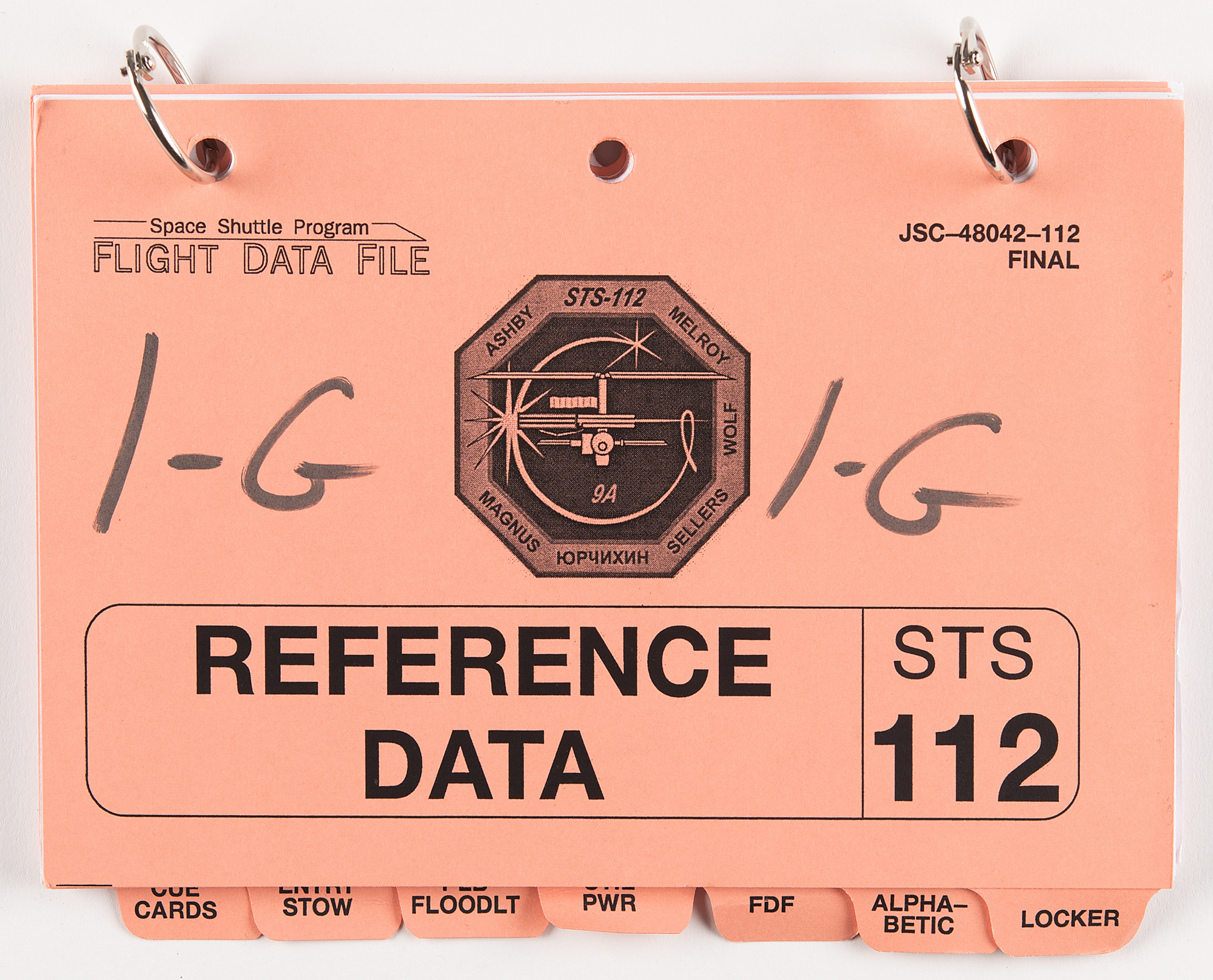
Reference Data (JSC-48042-112, Final), marked twice ?1-G?
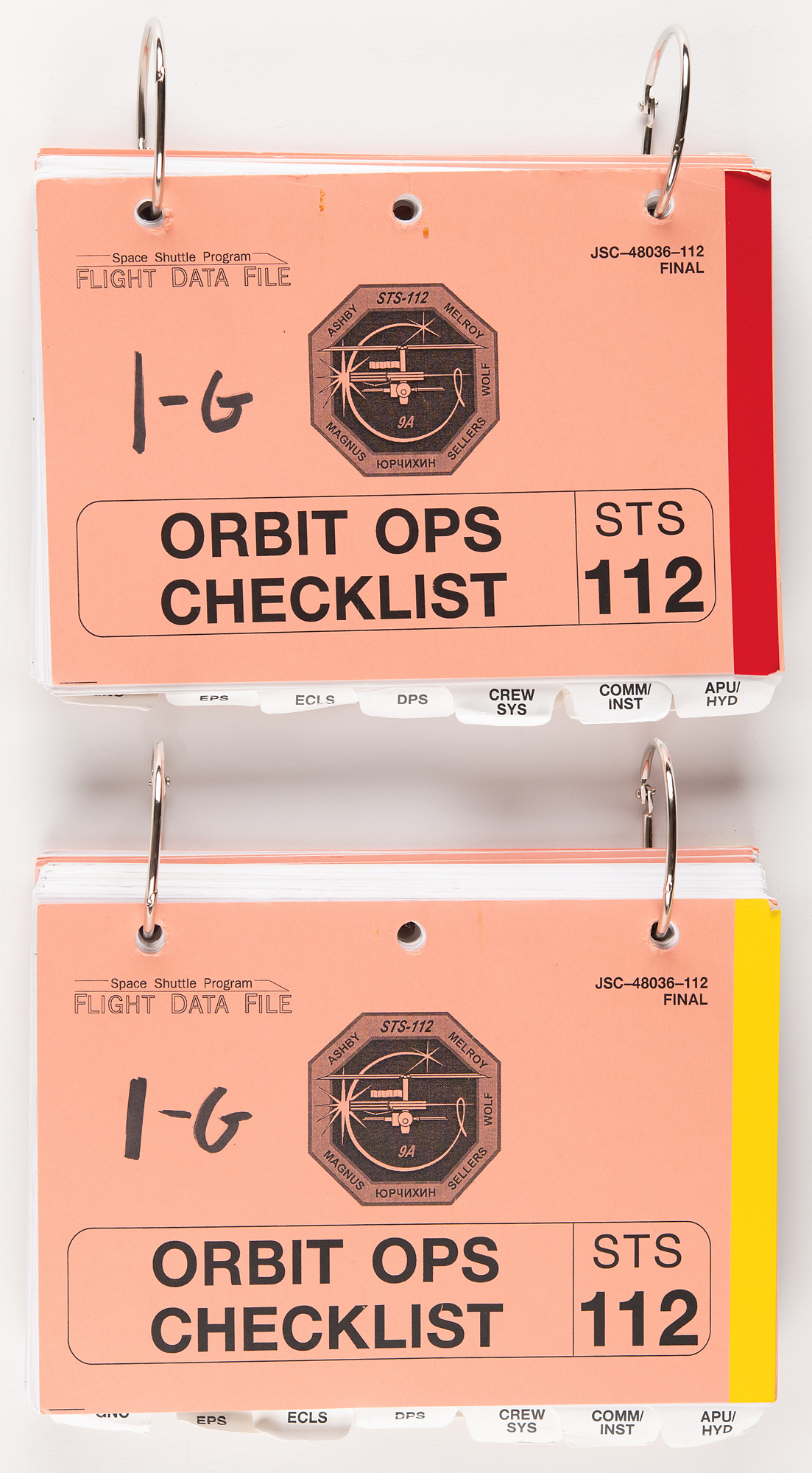
(2) Orbit OPS Checklists (JSC-48036-112, Final), both marked ?1-G,? with one featuring red strips affixed to the front and back covers (indicating that it was used by CDR Ashby), and the other with yellow strips in the same areas (used by Pilot Melroy)
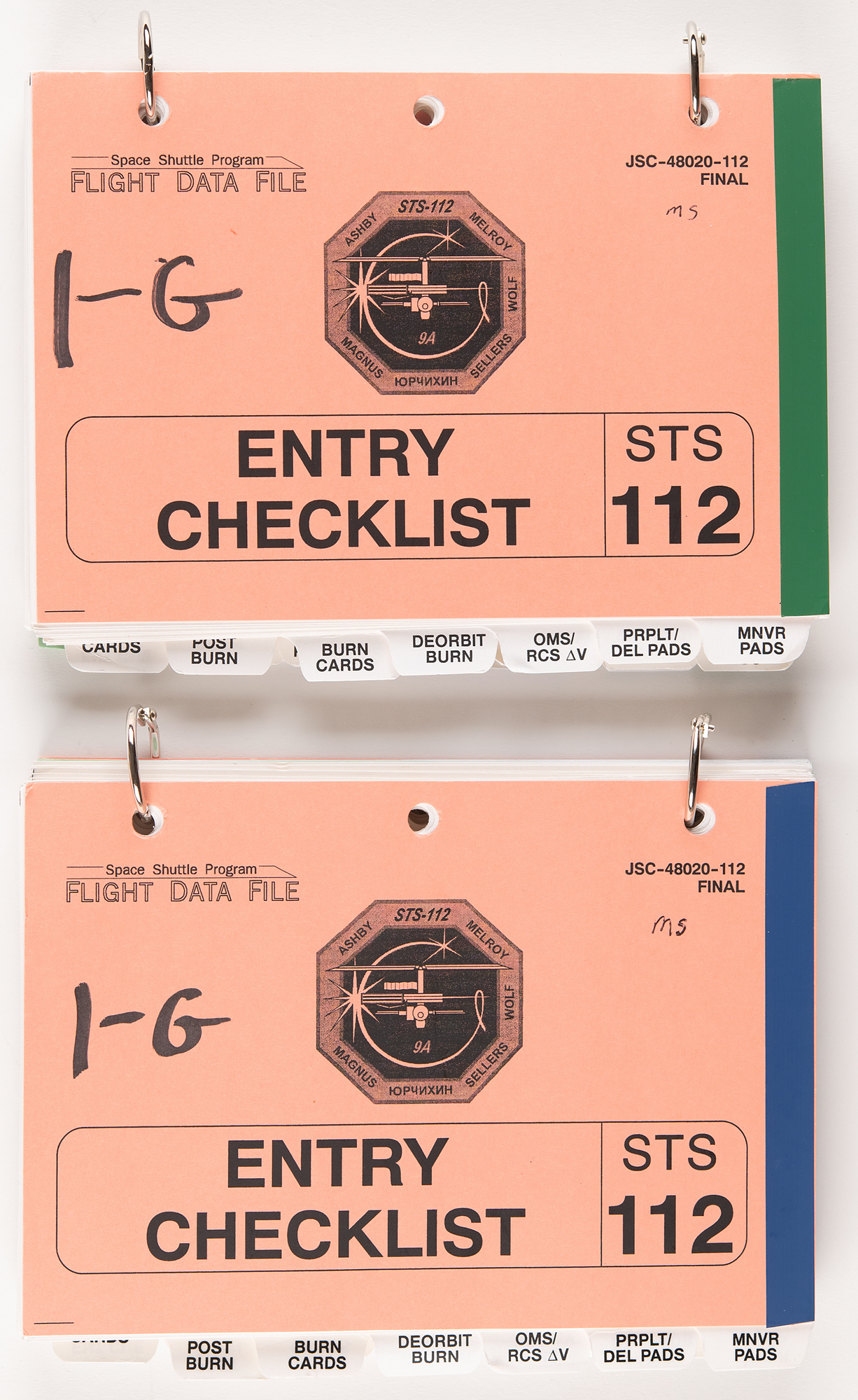
(2) Entry Checklists (JSC-48020-112, Final), both marked ?1-G? and ?MS,? with one featuring green strips to the covers (used by Mission Specialist Sellers), and the other with blue strips (used by Mission Specialist Magnus)
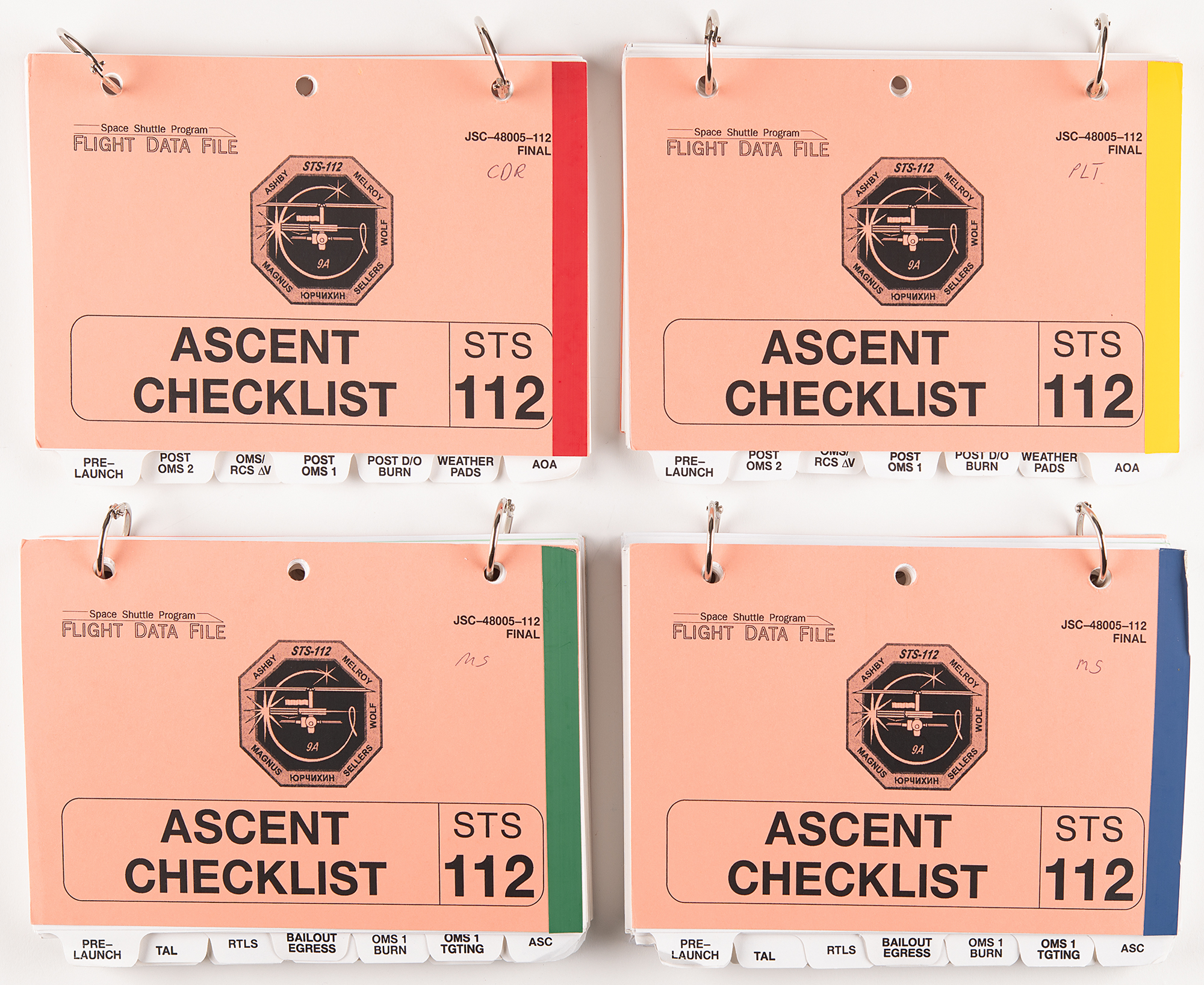
(4) Ascent Checklists (JSC-48005-112, Final), individually marked on the cover, ?CDR,? ?PLT,? and ?MS,? each with the corresponding color strips: red (Ashby), yellow (Melroy), green (Sellers), and blue (Magnus)
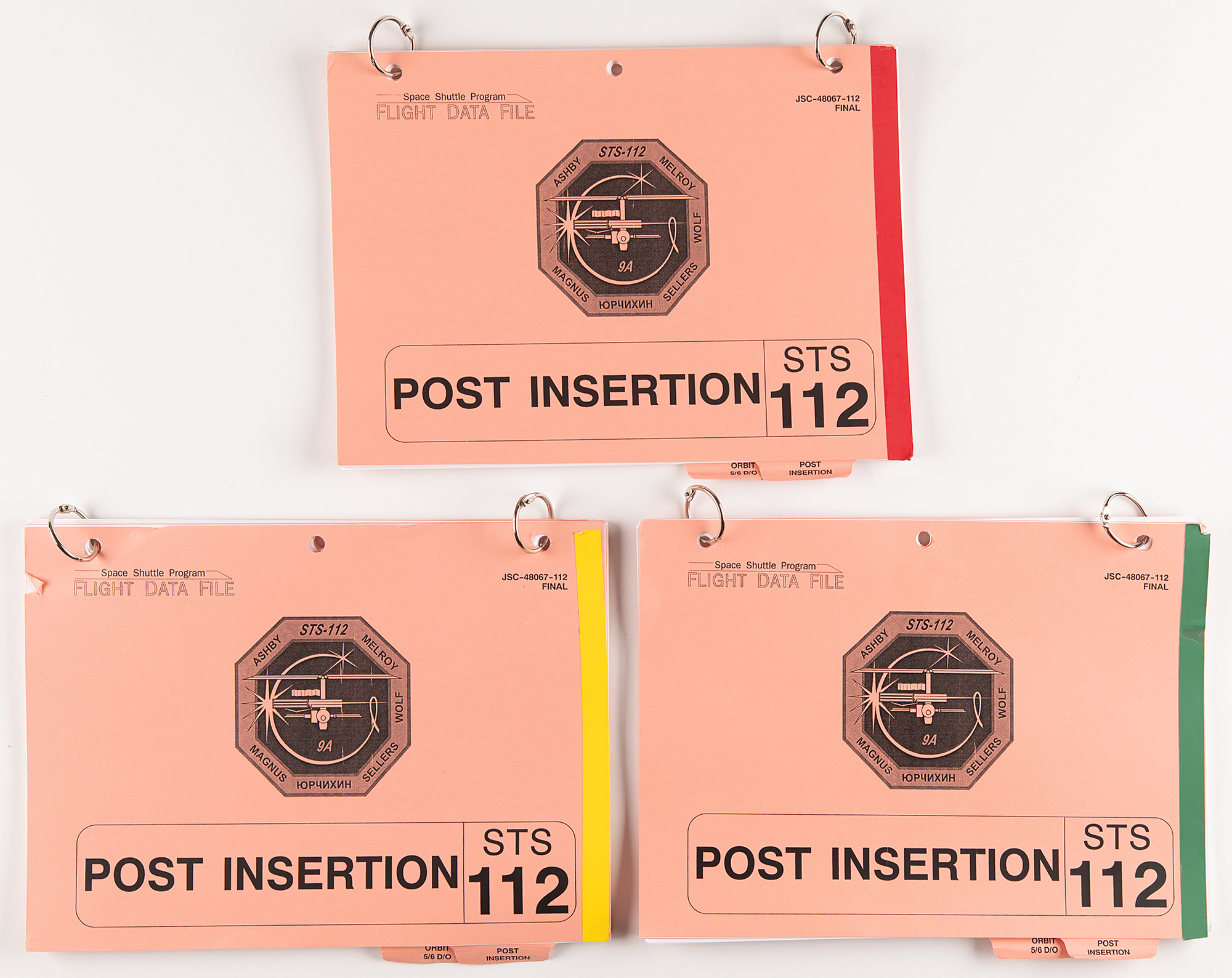
(3) Post Insertion checklists (JSC-48067-112, Final), each with the corresponding color strips on the covers: red (Ashby), yellow (Melroy), and green (Sellers)
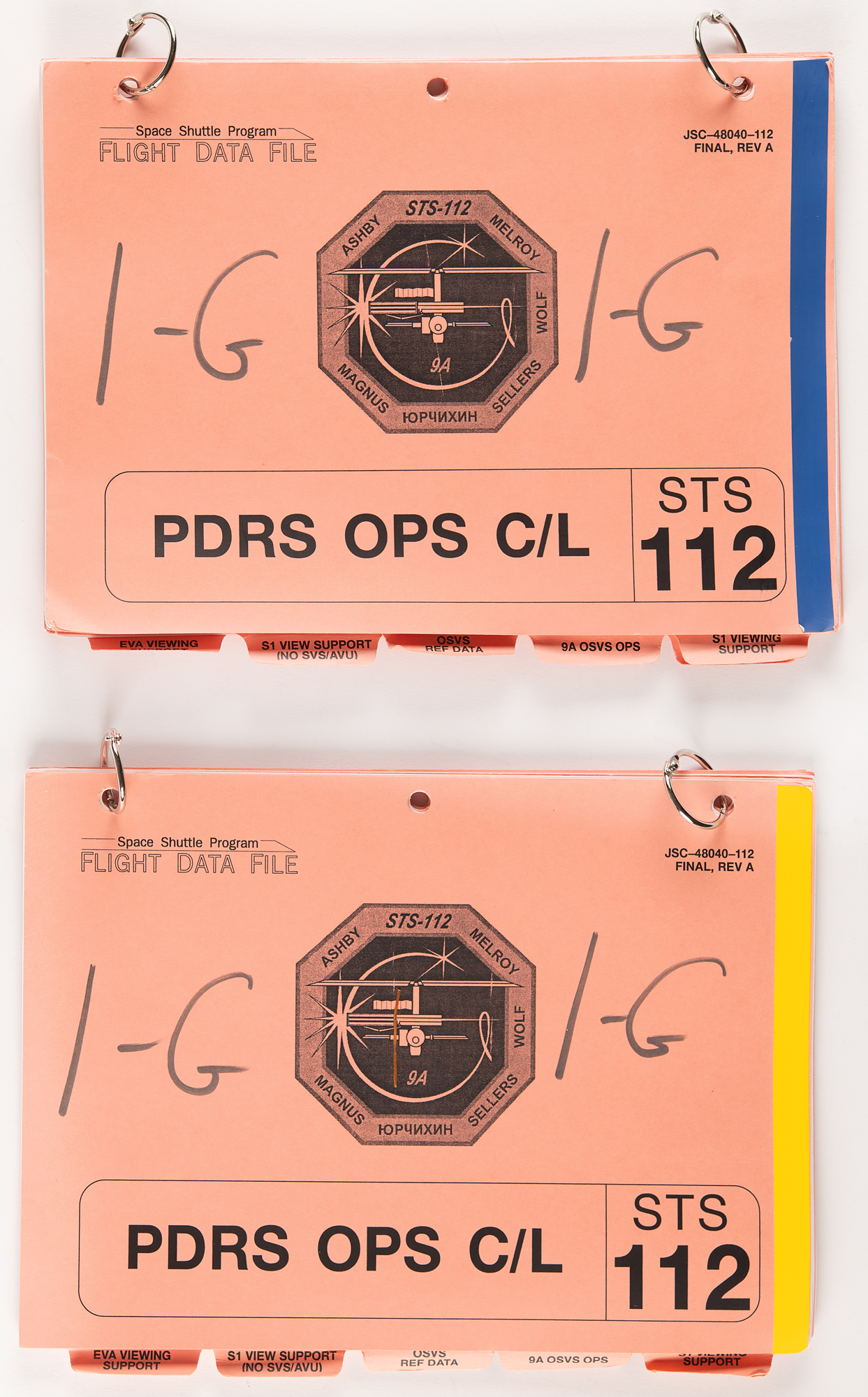
(2) PDRS OPS C/L checklists (JSC-48040-112, Final REV A), both marked twice ?1-G,? both with color strips: yellow (Melroy) and blue (Magnus)
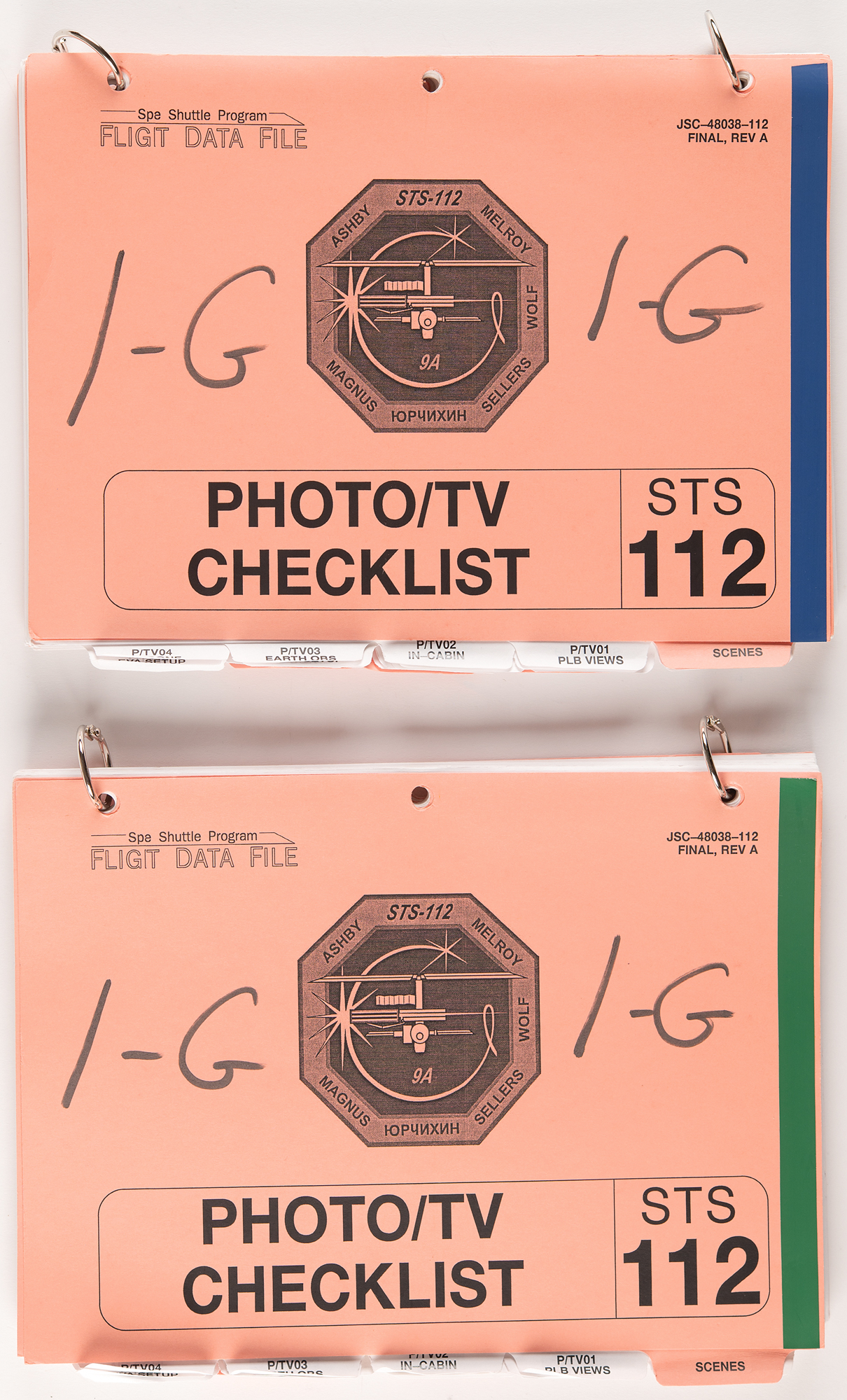
(2) Photo/TV Checklists (JSC-48038-112, Final REV A), both marked twice ?1-G,? both with color strips: blue (Magnus) and green (Sellers)
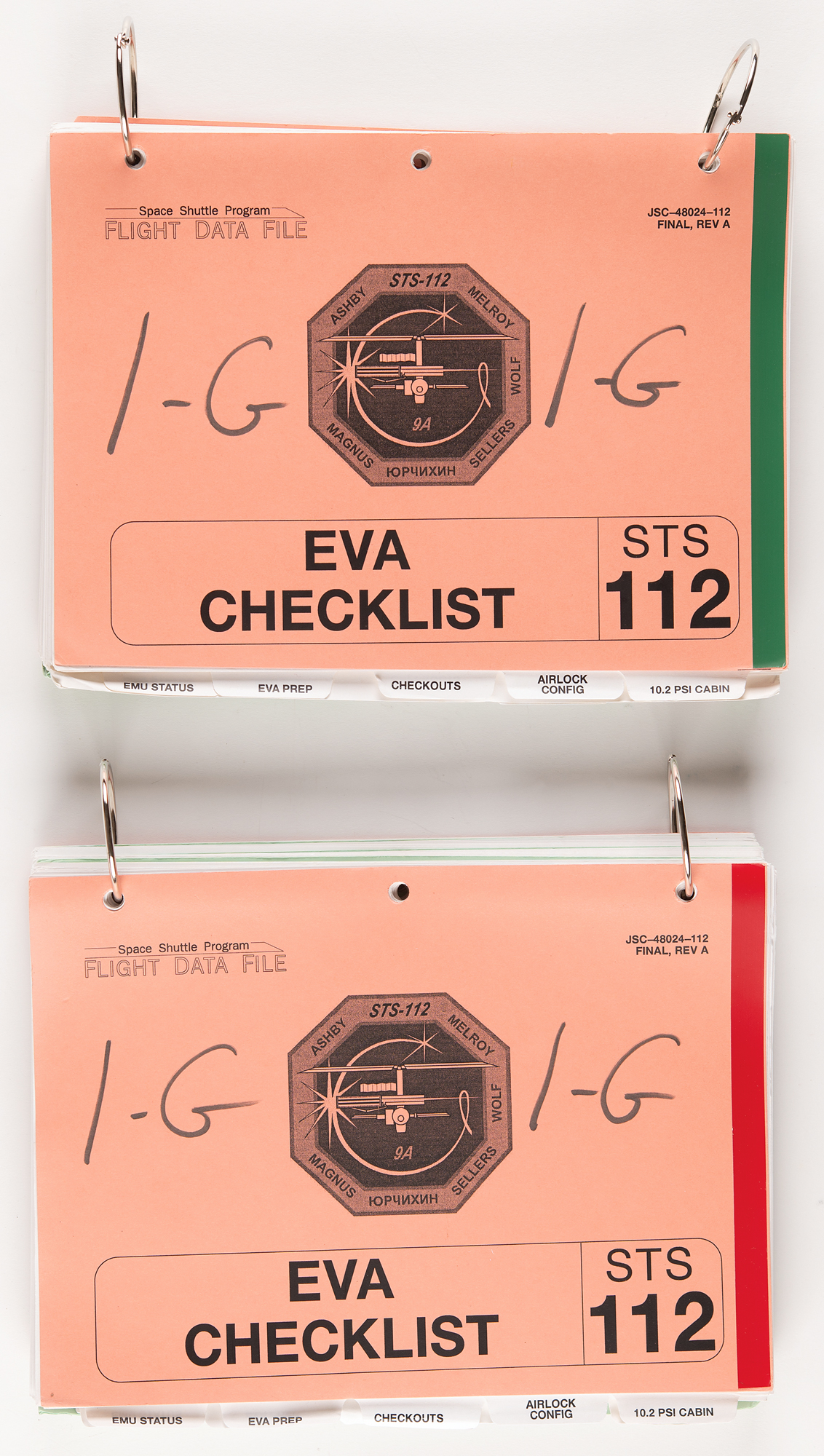
(2) EVA Checklists (JSC-48024-112, Final REV A), both marked twice ?1-G,? both with color strips: red (Ashby) and green (Sellers and MS David Wolf)
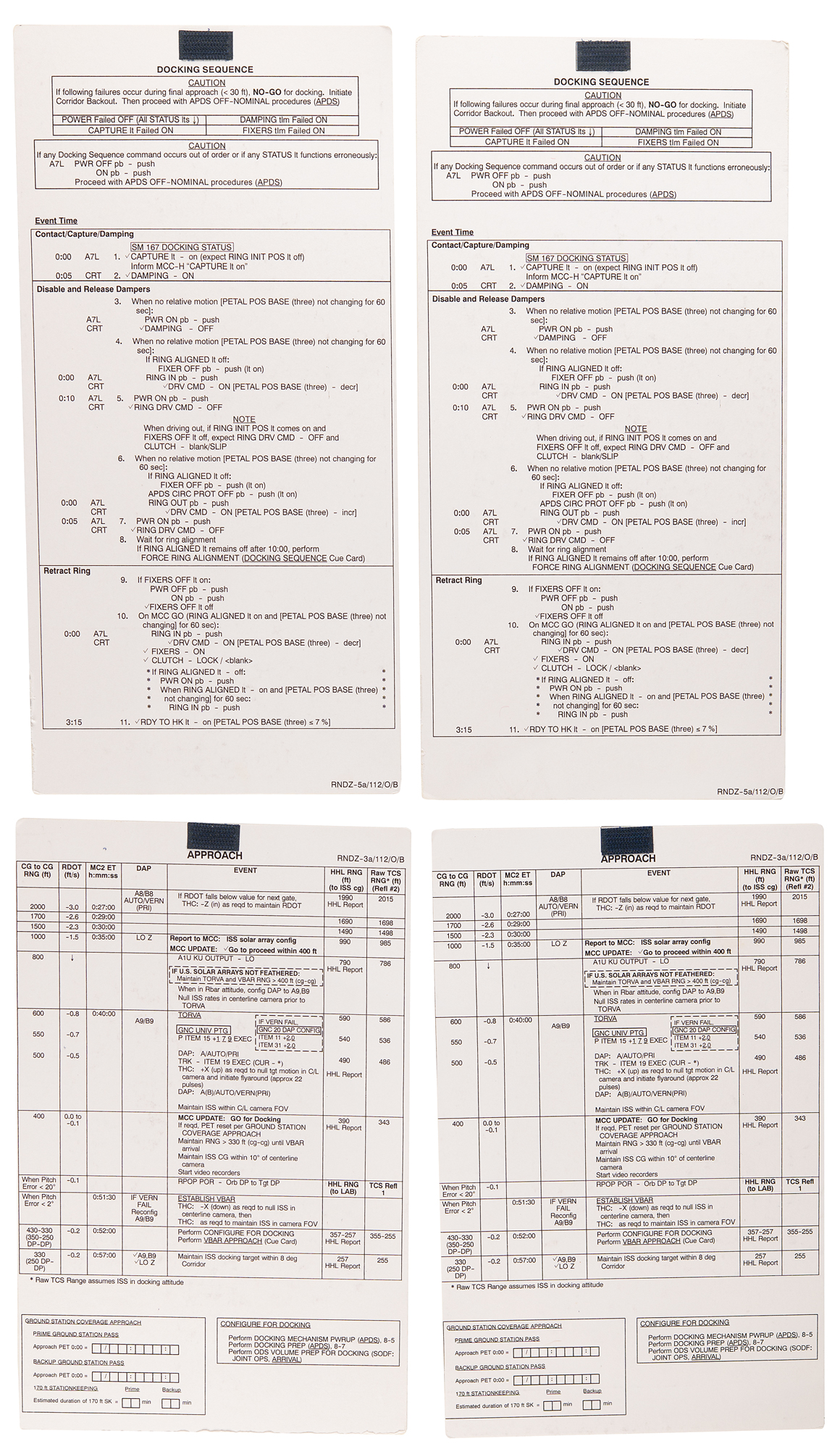
The assortment of 25 training-used cue cards, which range in size from 3.5 x 6 to 7.25 x 14, relates to the following sections: P/TV (Photo/Television), RNDZ (Rendezvous), EVA (Extravehicular Activity), FLT PLN (Flight Plan), and PI (Post-Insertion). Examples of cue card titles include: ?ET Photo,? ?PLBD VTR Recording,? ?Rendezvous PRPLT Pad,? ?C/L Camera Target Alignment (+VBAR),? ?EVA Prebreathe Cue Card,? ?EMU/Airlock Consumable Tracking Cue Card,? ?Alert MSG Troubleshooting,? ?VBAR Approach,? and ?Docking Sequence.? Each cue card features one or more affixed Velcro swatches.
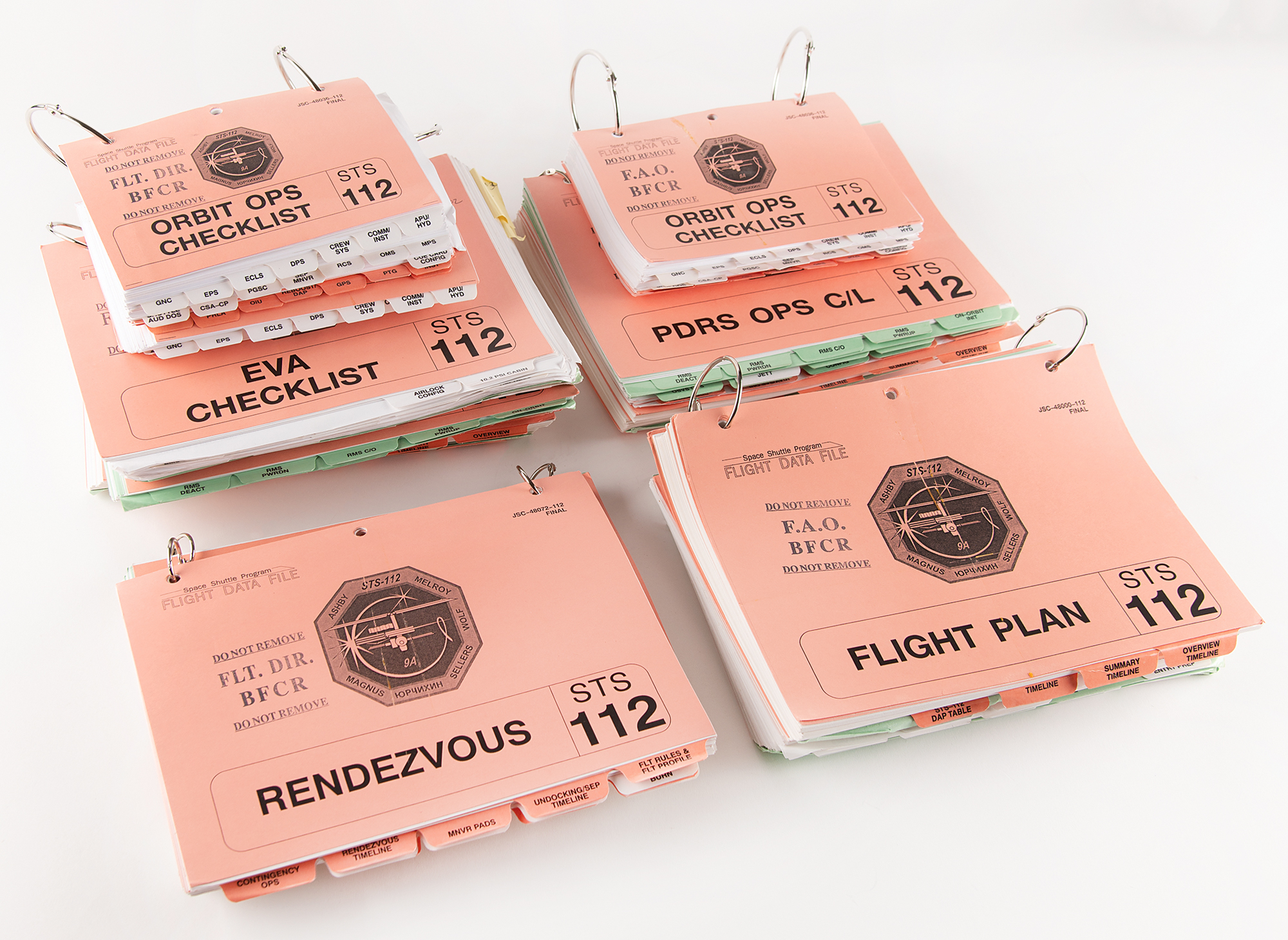
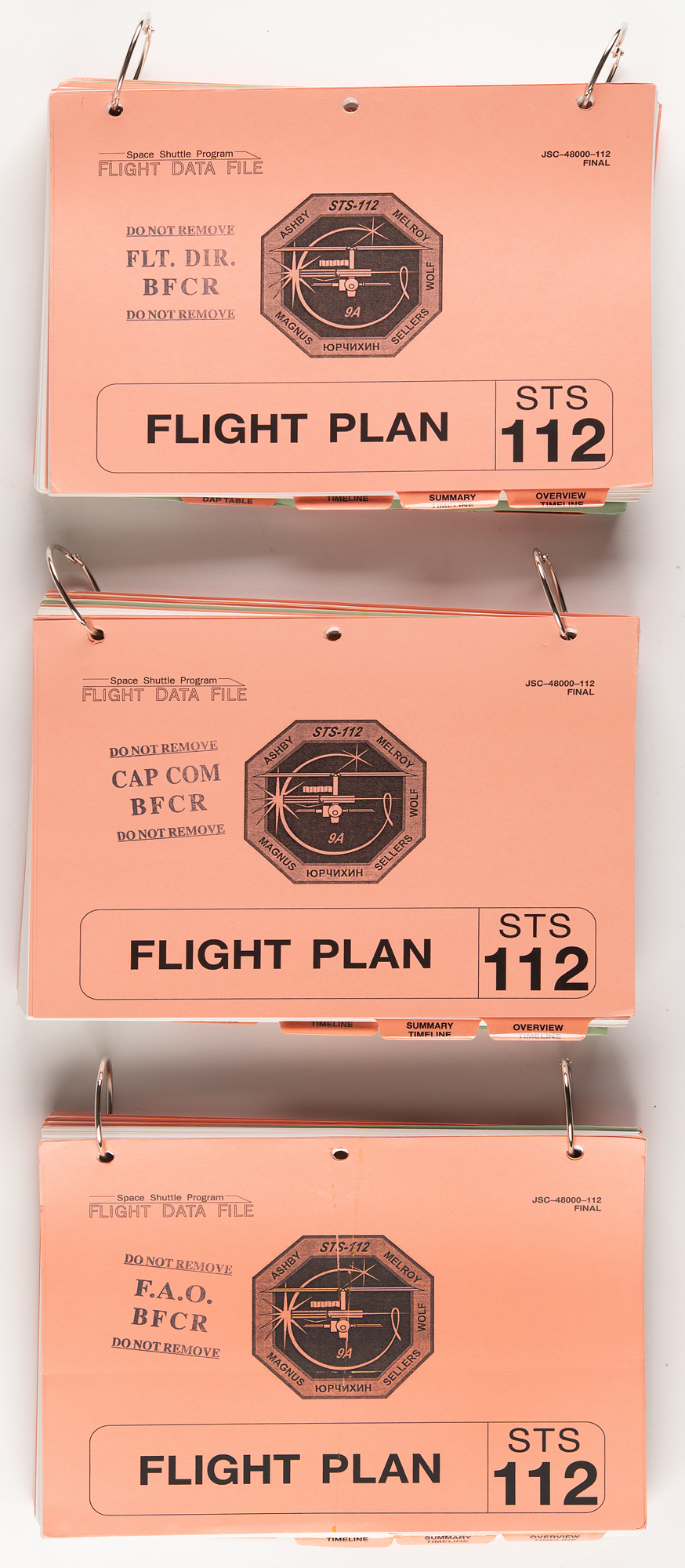
The 15 mission-used checklists were utilized by the Backroom Flight Control Center (BFCR), a second layer of high-level engineers who were constantly monitoring, troubleshooting, and providing detailed analysis to support the front-room controllers. These checklists served as the ground controllers? operational guides as they helped ensure each critical milestone of STS-112 ? ascent through docking, robotic installation of the S1 truss, spacewalks, and safe undocking/entry. They are as follows:
(3) Orbit OPS Checklists (JSC-48036-112, Final), with individual ?Do Not Remove / BFCR? stamps issued to the ?FLT. DIR.? (Flight Director), the ?CAP COM? (Capsule Communicator), and the ?F.A.O.? (Flight Activities Officer) of the Backroom Flight Control Center (BFCR). Also known as the Multi-Purpose Support Room, the BFCR is Mission Control?s second layer of brainpower, which includes engineering specialists who work behind the scenes to provide detailed analysis and recommendations to the front-room flight controllers.
(3) Flight Plan checklists (JSC-48000-112, Final), with individual ?Do Not Remove / BFCR? stamps issued to the ?FLT. DIR.,? the ?CAP COM,? and the ?F.A.O.? of the BFCR.
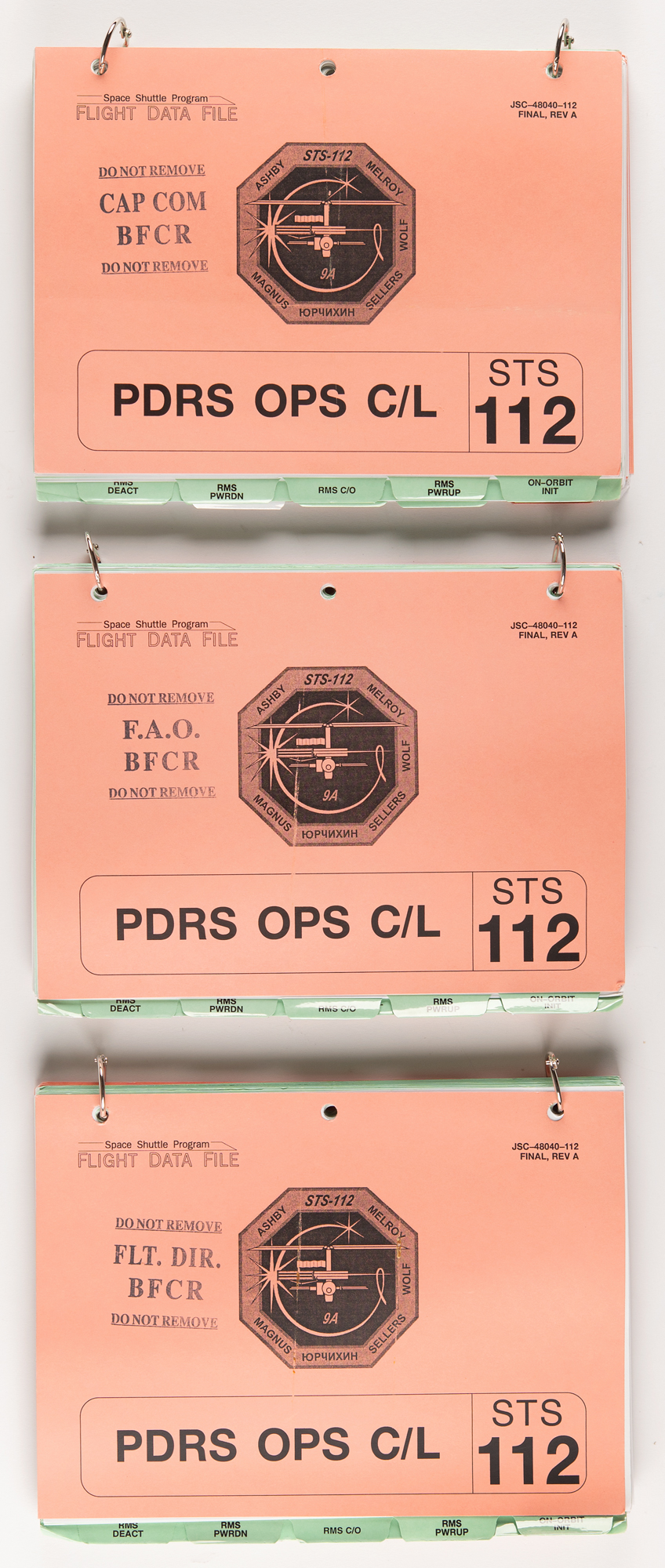
(3) PDRS OPS C/L checklists (JSC-48040-112, Final, REV A), with individual ?Do Not Remove / BFCR? stamps issued to the ?FLT. DIR.,? the ?CAP COM,? and the ?F.A.O.? of the BFCR.
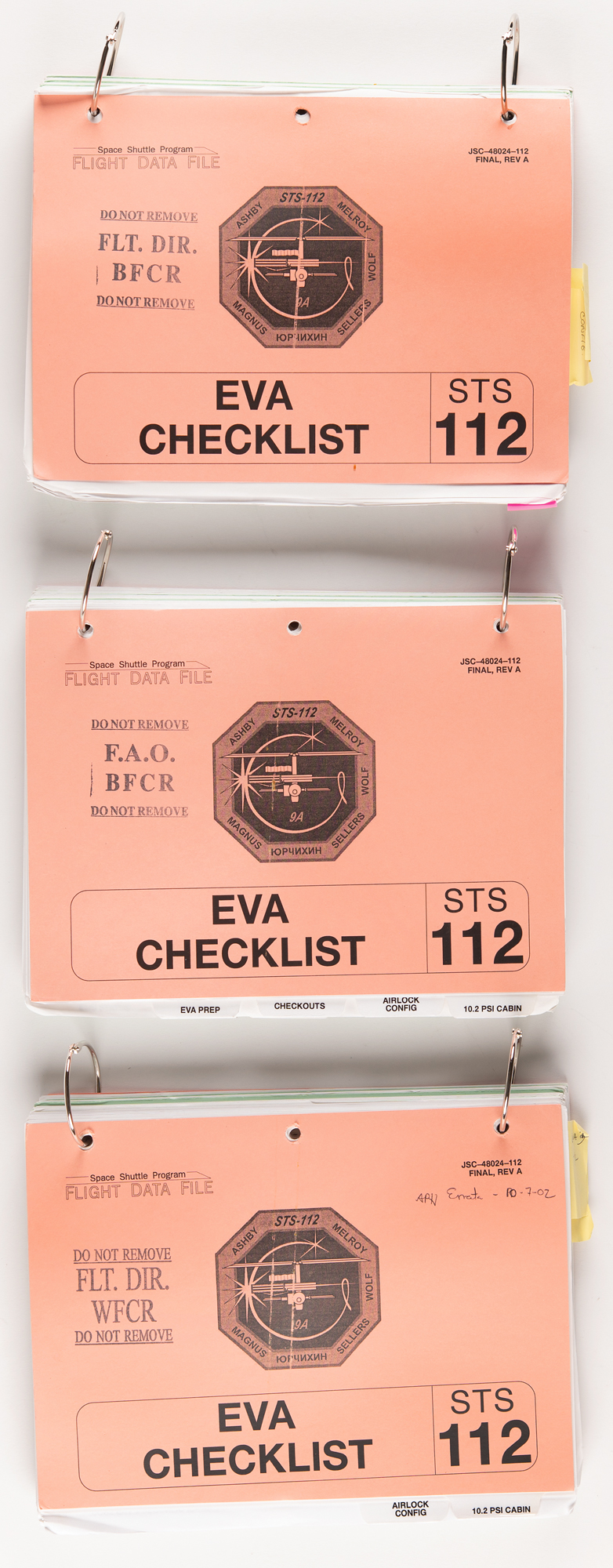
(3) EVA Checklists (JSC-48024-112, Final REV A), with individual ?Do Not Remove / BFCR? stamps issued to the ?FLT. DIR.? and the ?F.A.O.? of the BFCR. The third checklist is issued to ?FLT. DIR. WFCR,? indicating that it was used by the flight director of the White Flight Control Room.
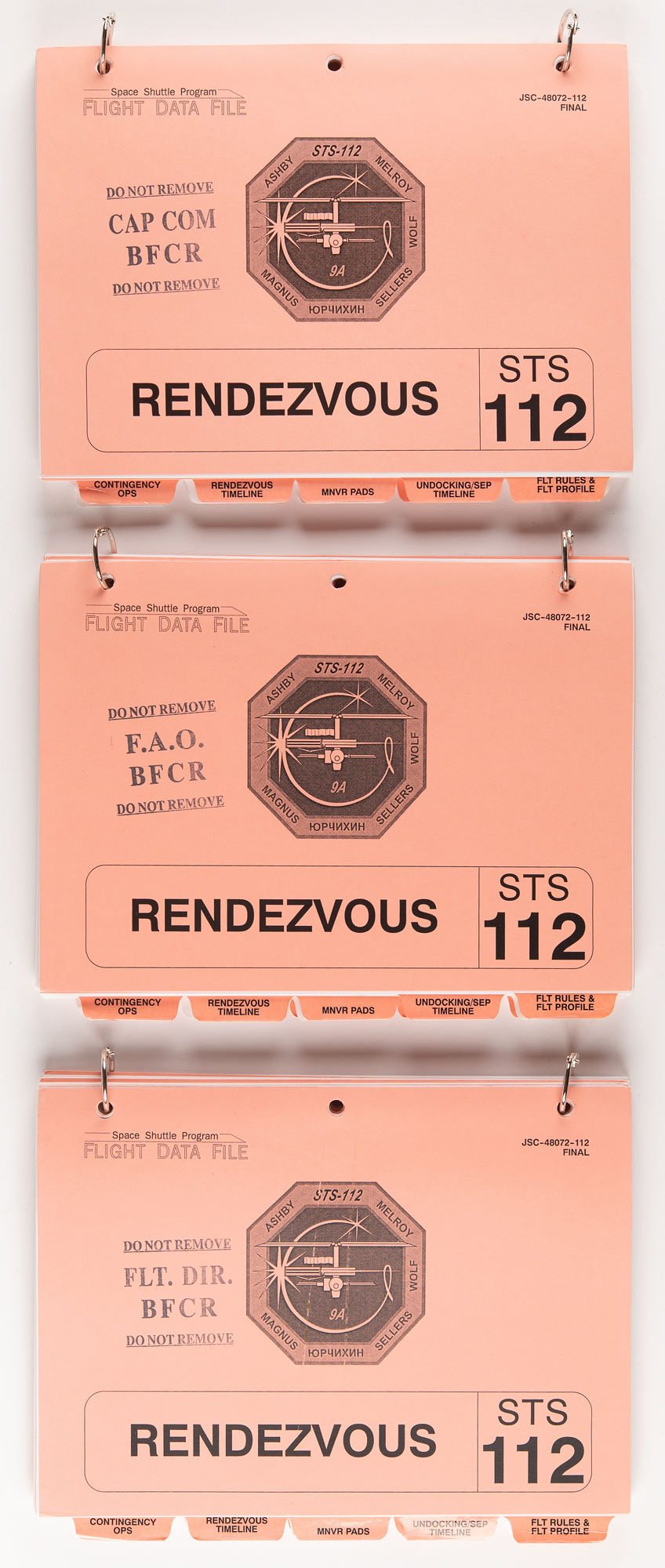
(3) Rendezvous checklists (JSC-48072-112, Final), with individual ?Do Not Remove / BFCR? stamps issued to the ?FLT. DIR.,? the ?CAP COM,? and the ?F.A.O.? of the BFCR.
In overall fine condition, with some slight edgewear. Accompanied by excised sections of two delivery packages, each bearing an original NASA mailing address label, both postmarked October 30, 2002.
An archive of this scope?spanning astronaut training, in-flight operations, and Mission Control support?is exceptionally rare. Not only do the contents offer an unusually complete view into the operational framework of a Space Shuttle mission, but these checklists and cue cards served as the essential tools that enabled Atlantis and her crew to accomplish the demanding objectives of STS-112. Of particular note are the FDFs used by Pilot Pamela Melroy, who later became just the second woman to command a Space Shuttle (SRS-120) and then went on to serve as NASA?s 15th Deputy Administrator, from 2021-2025. A significant and uncommon collection that directly connects the crew, controllers, and mission events of STS-112.

