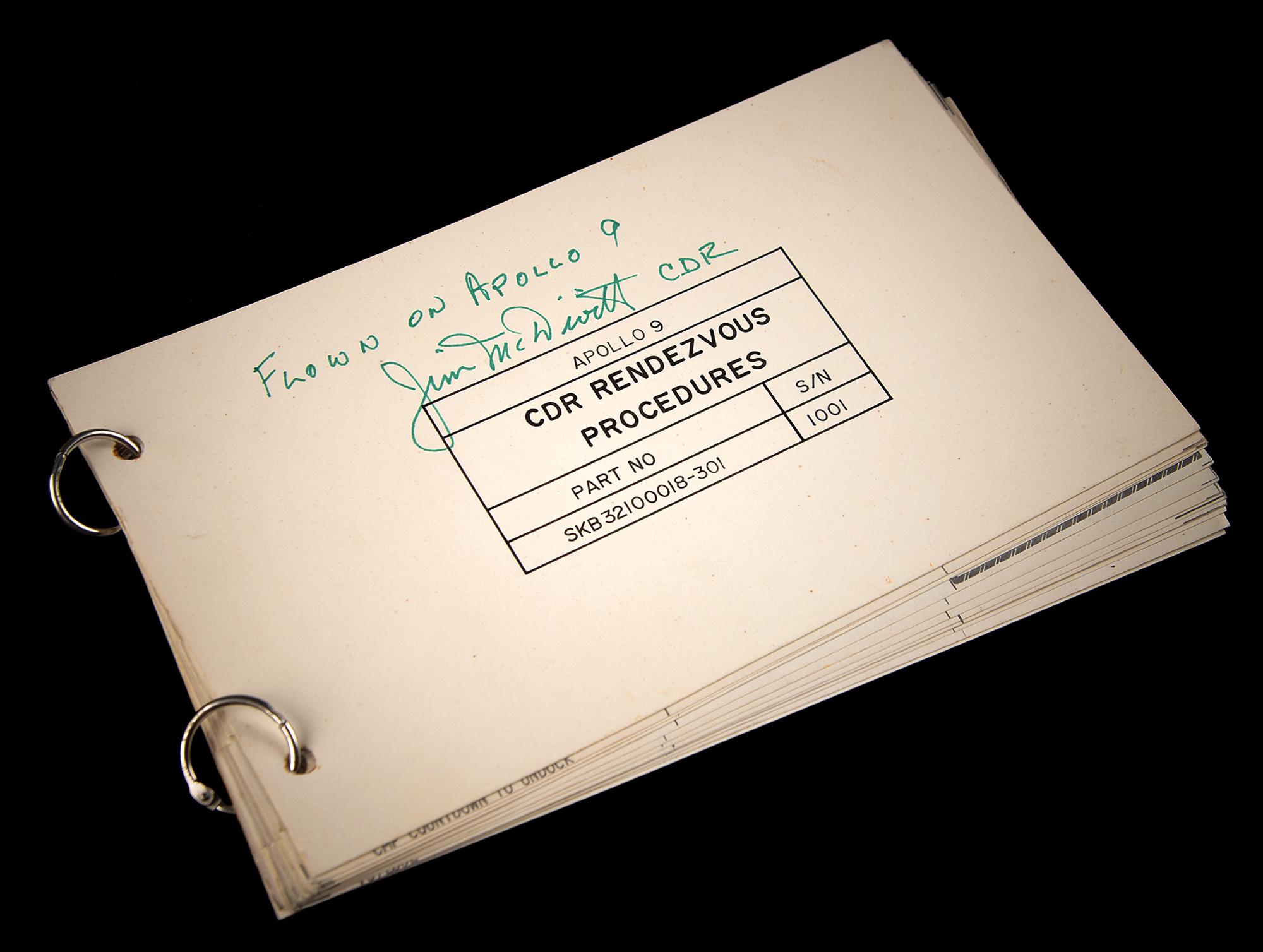
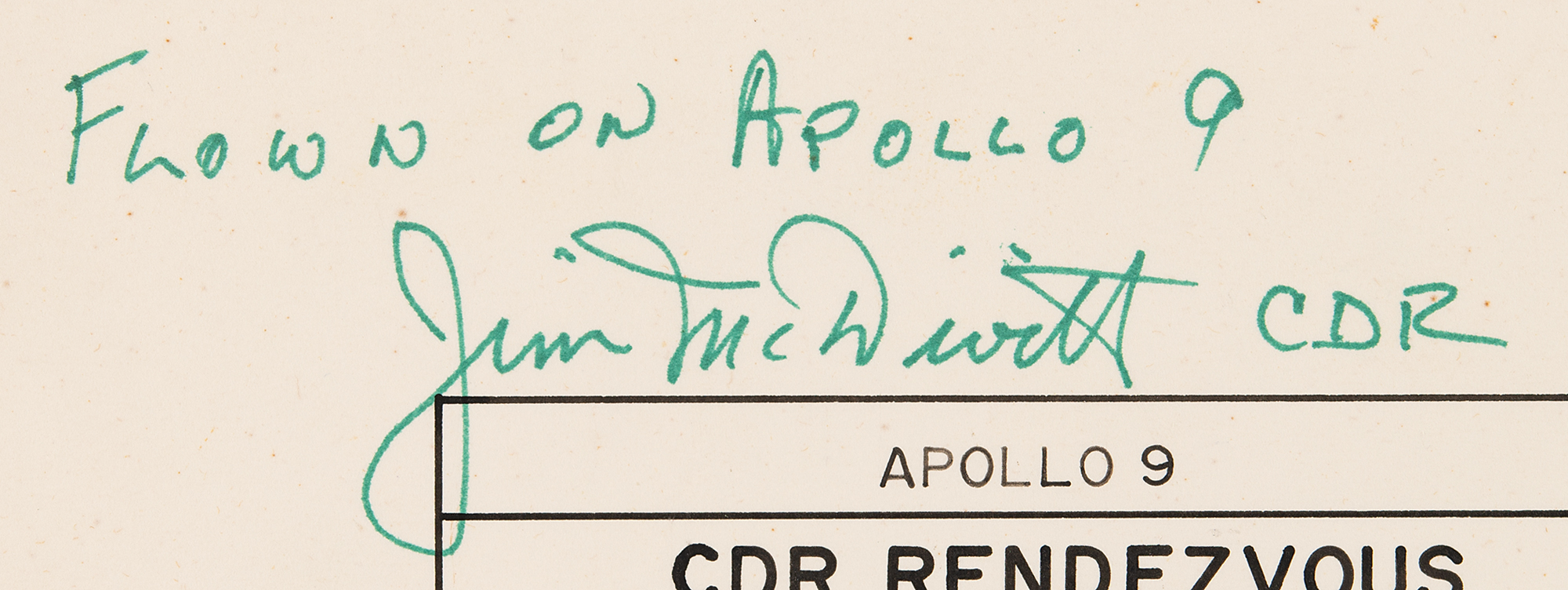
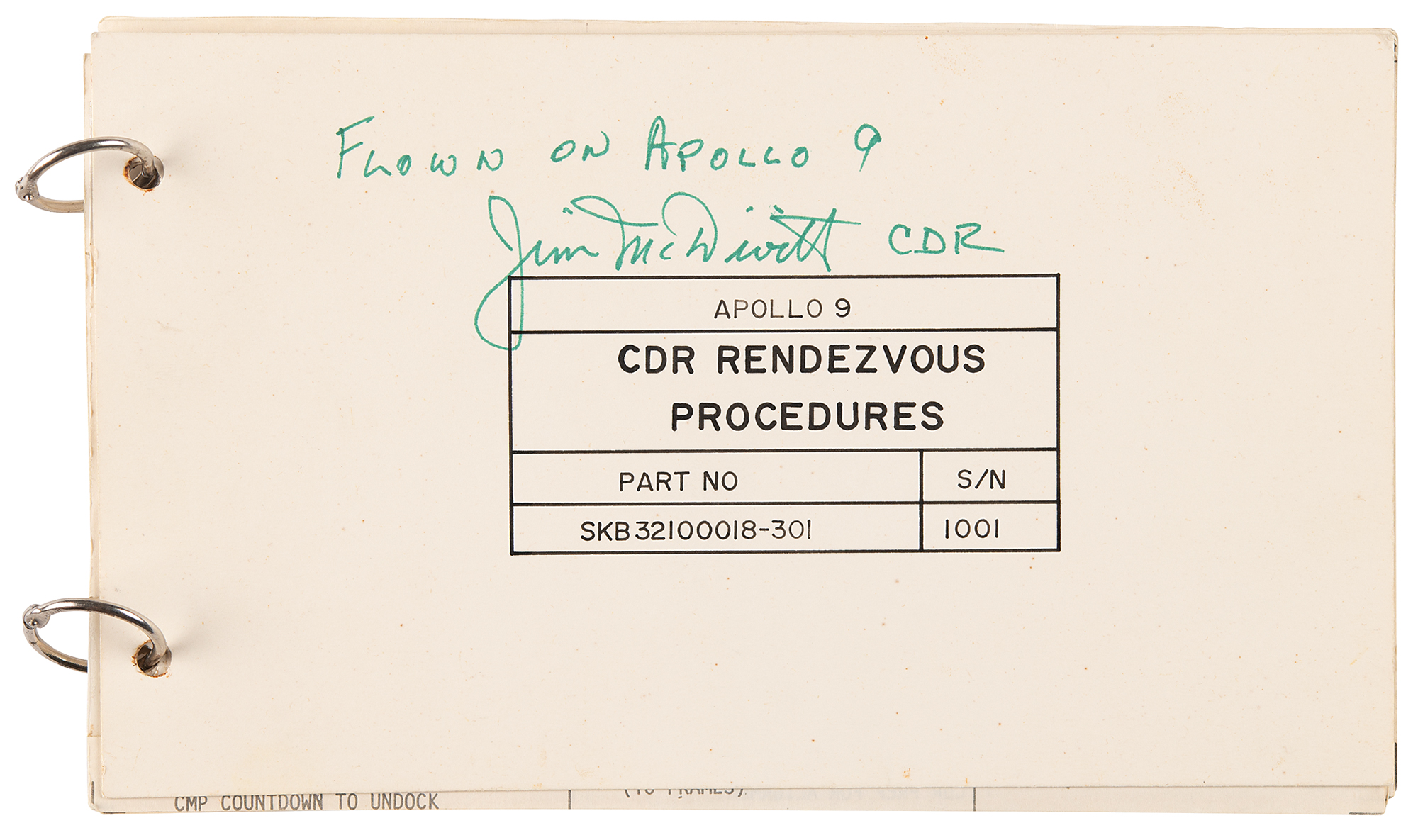
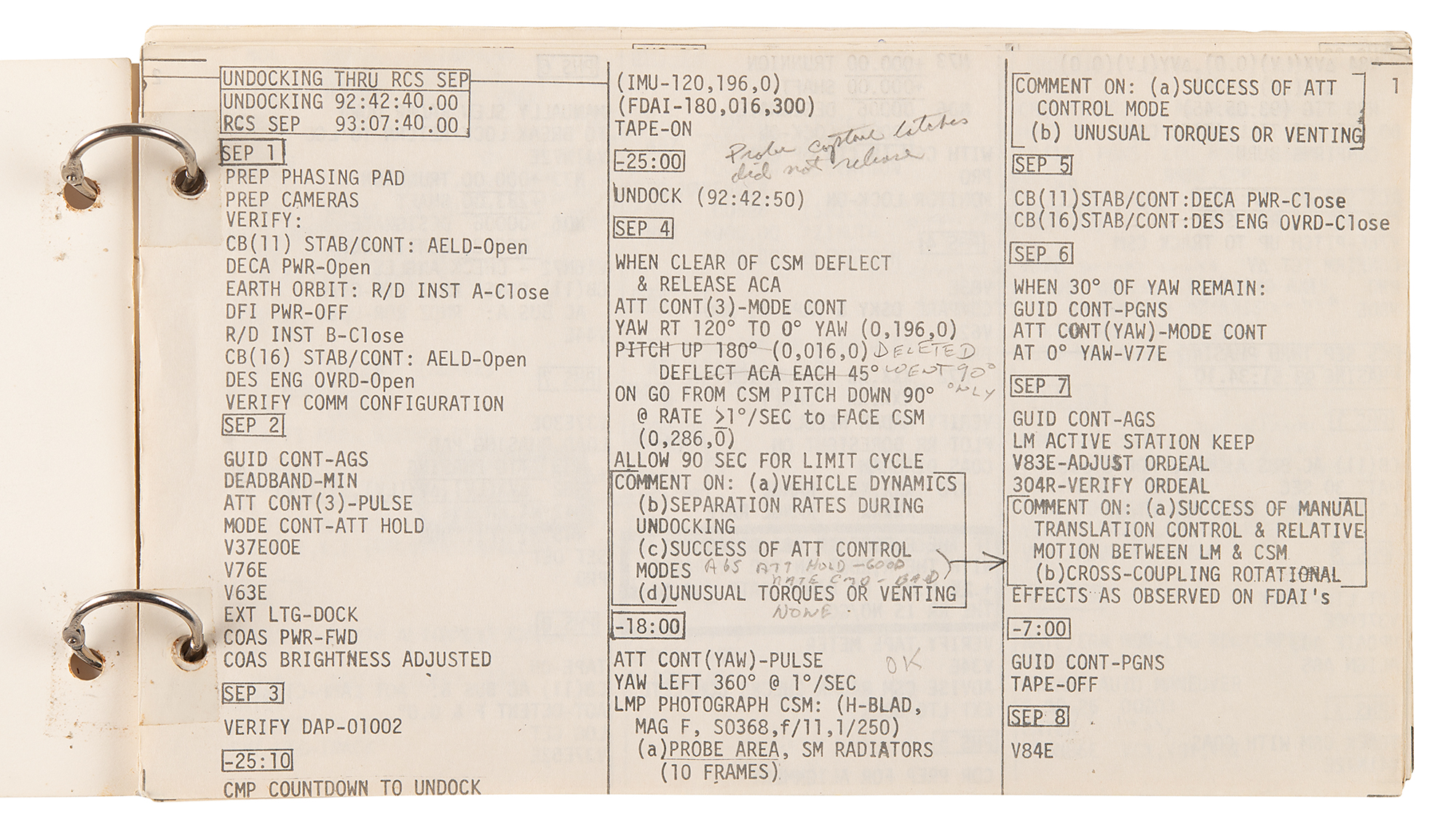
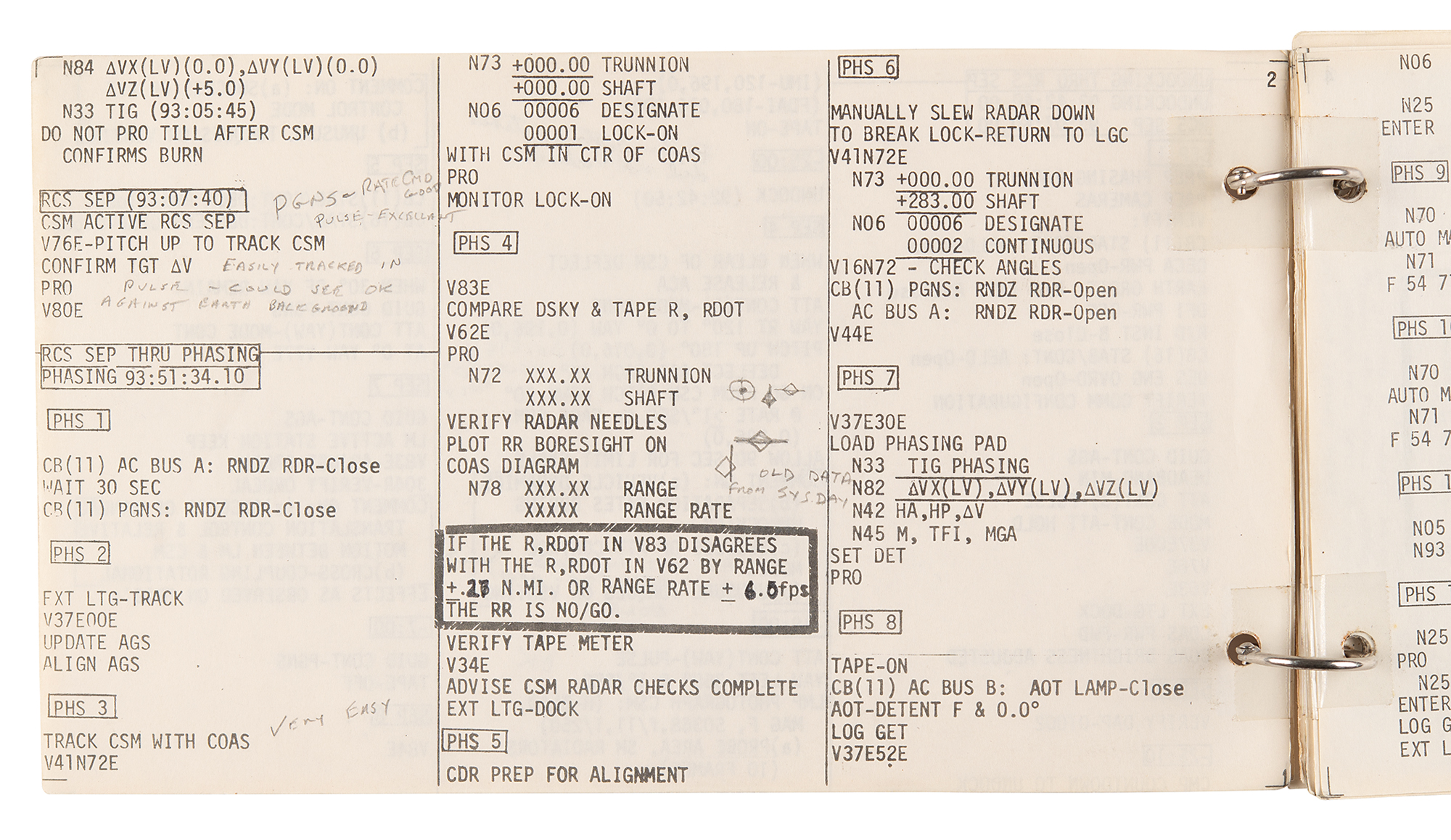
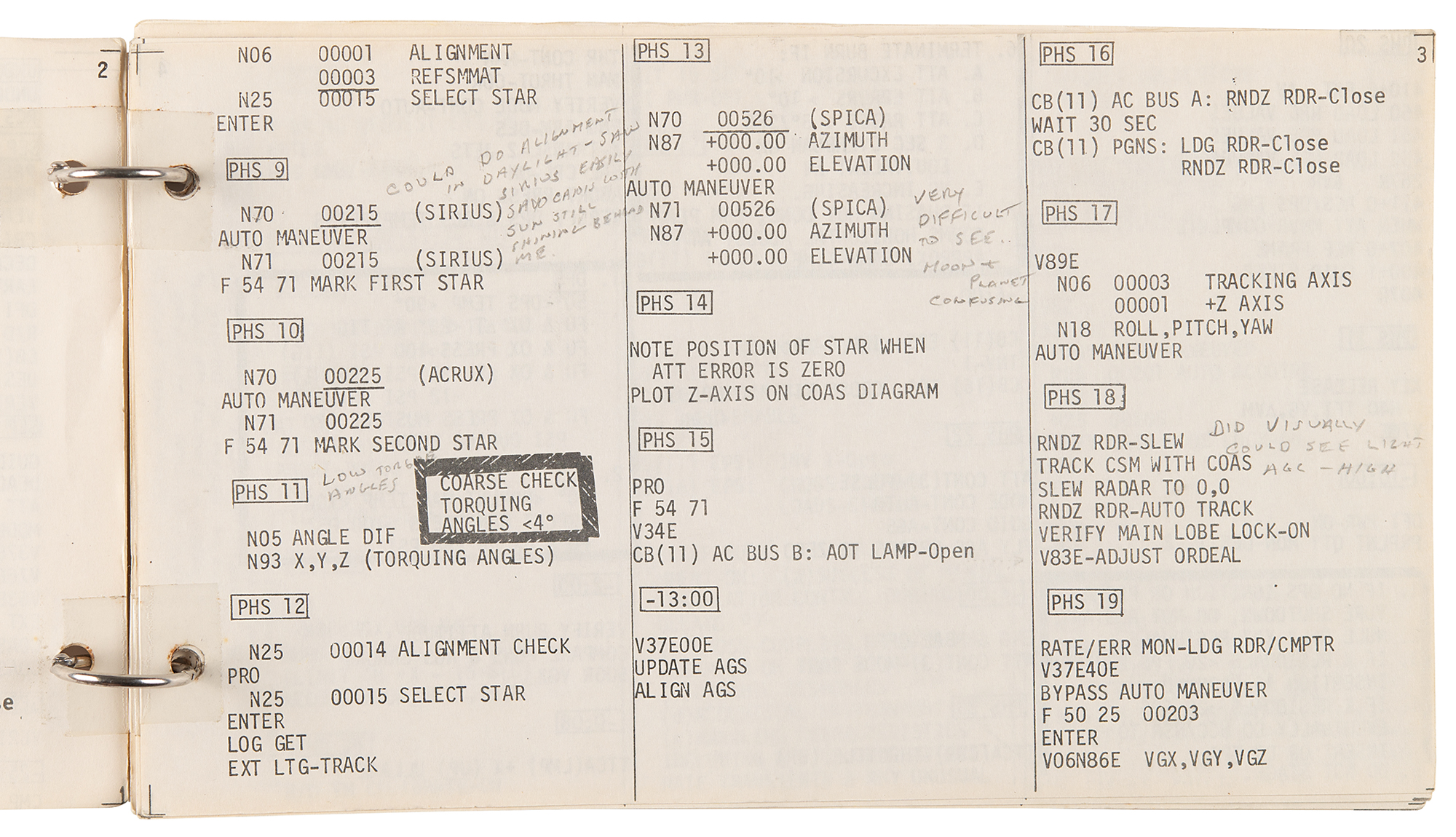
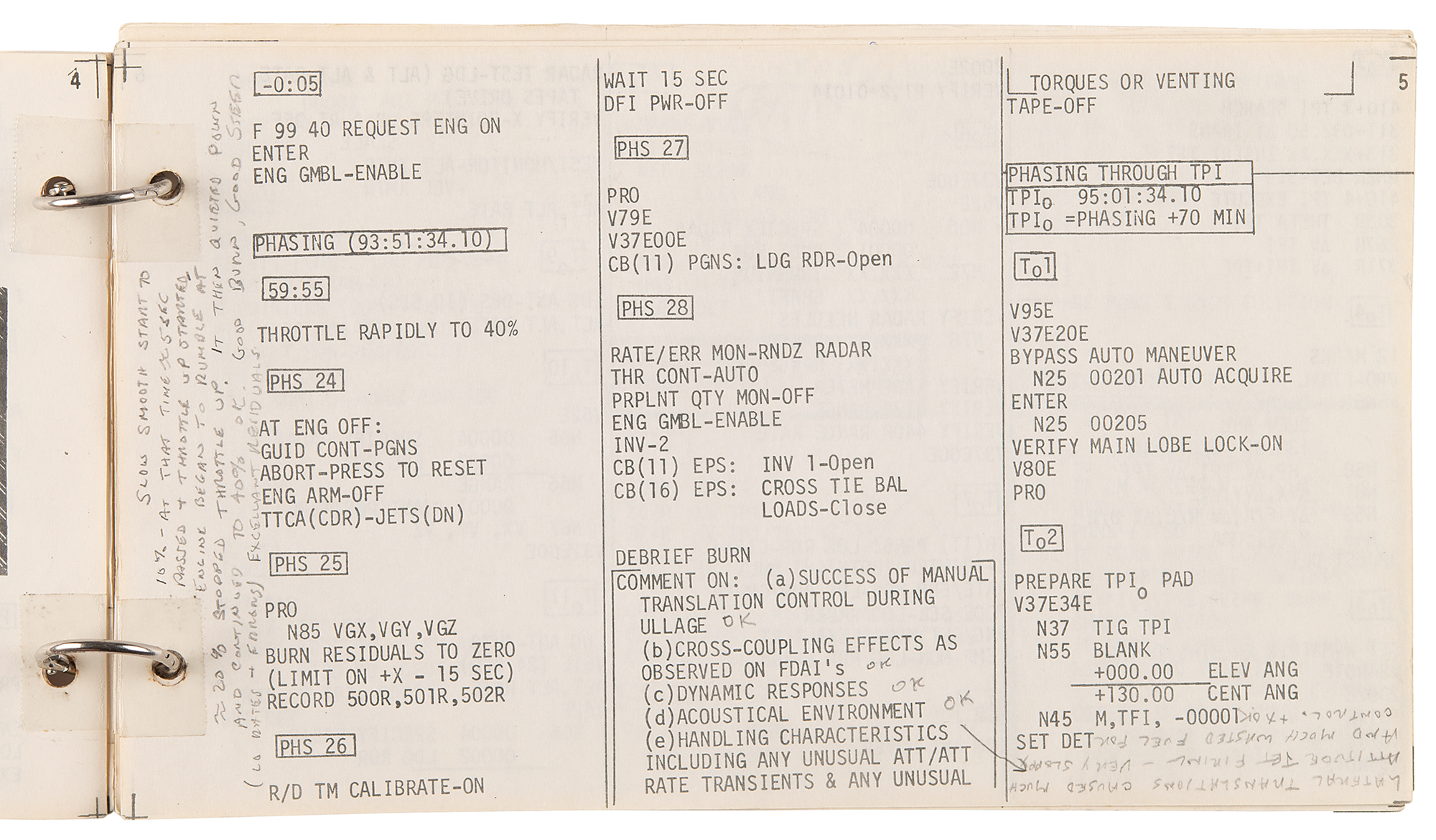
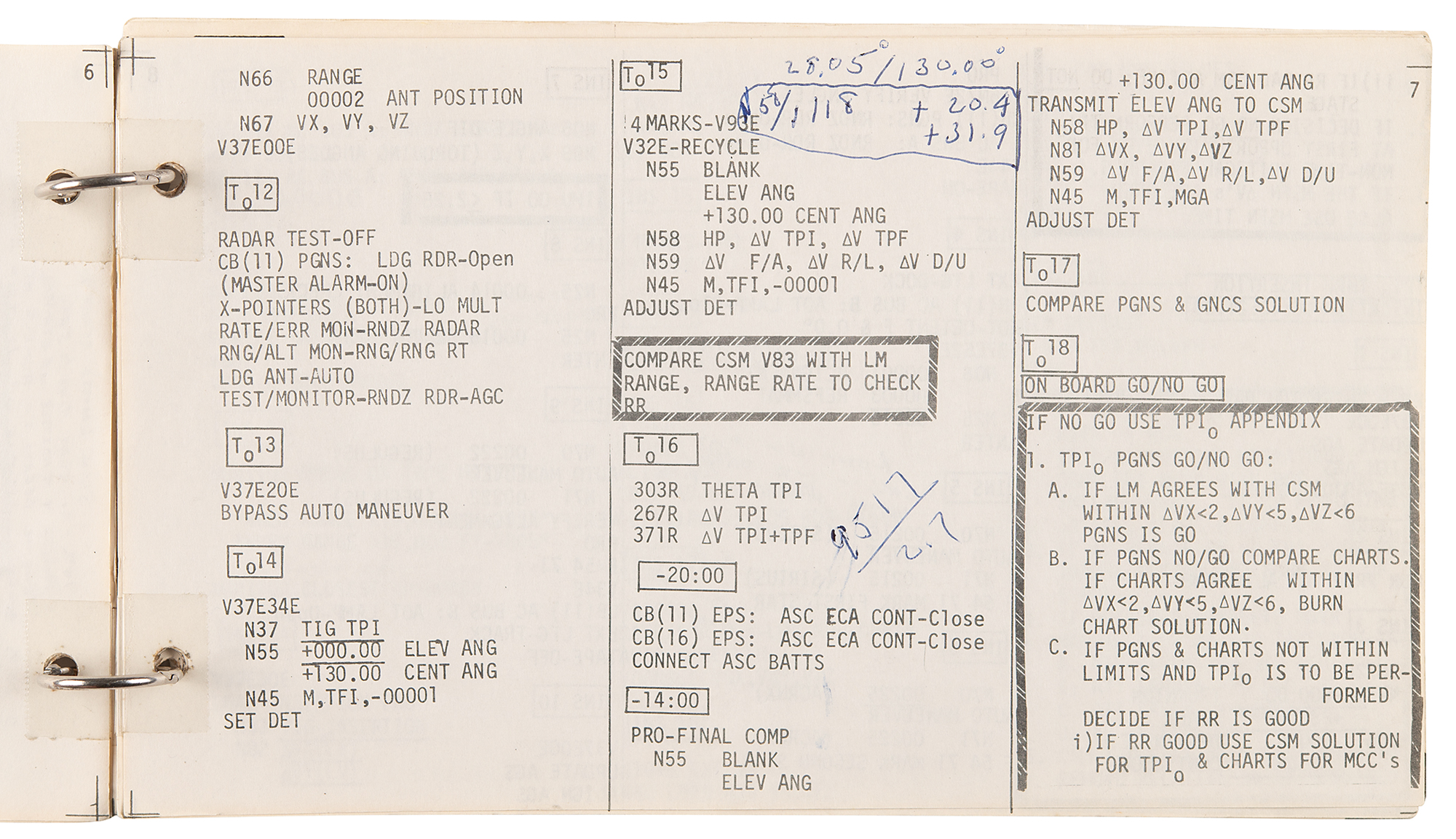
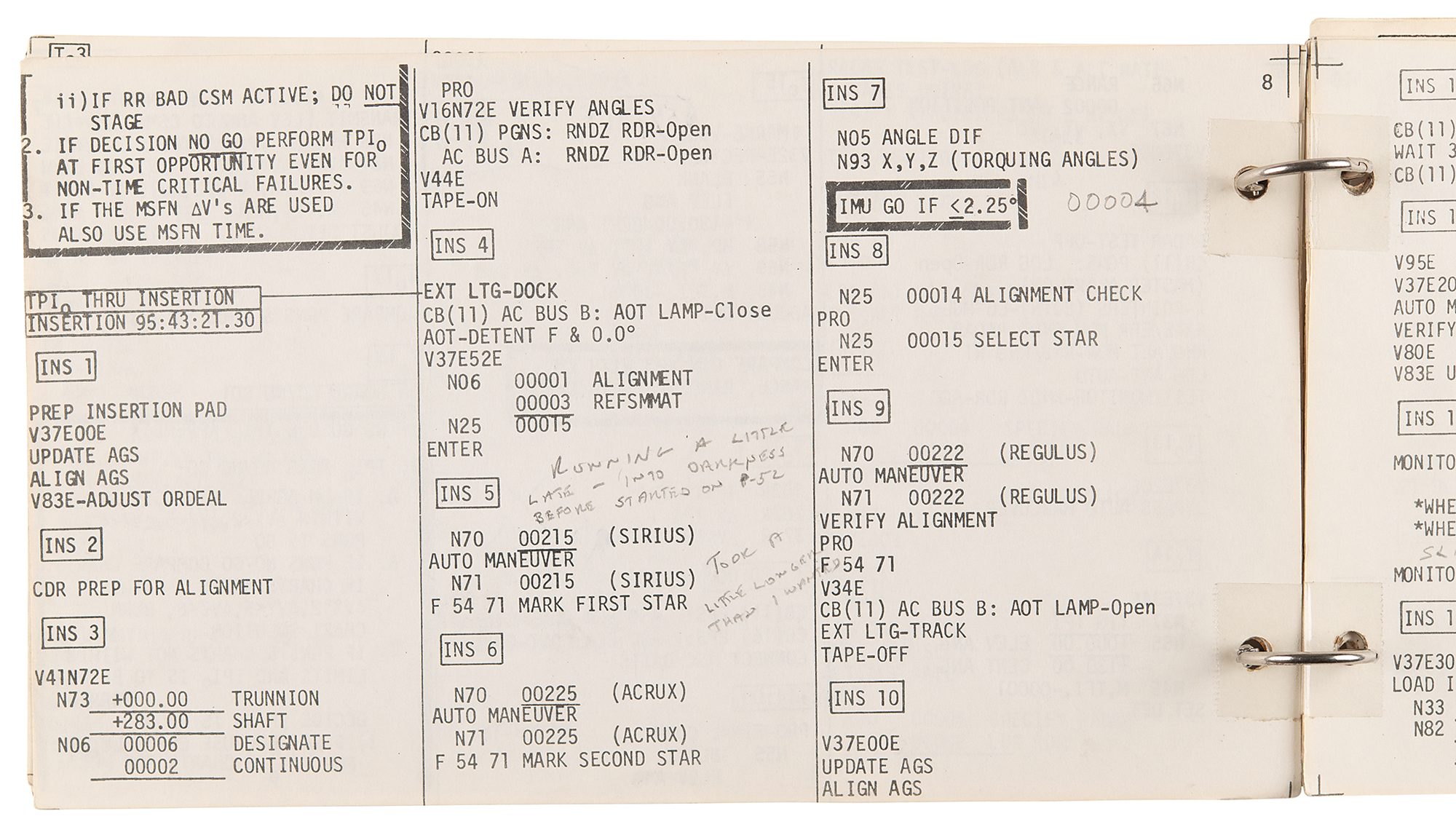
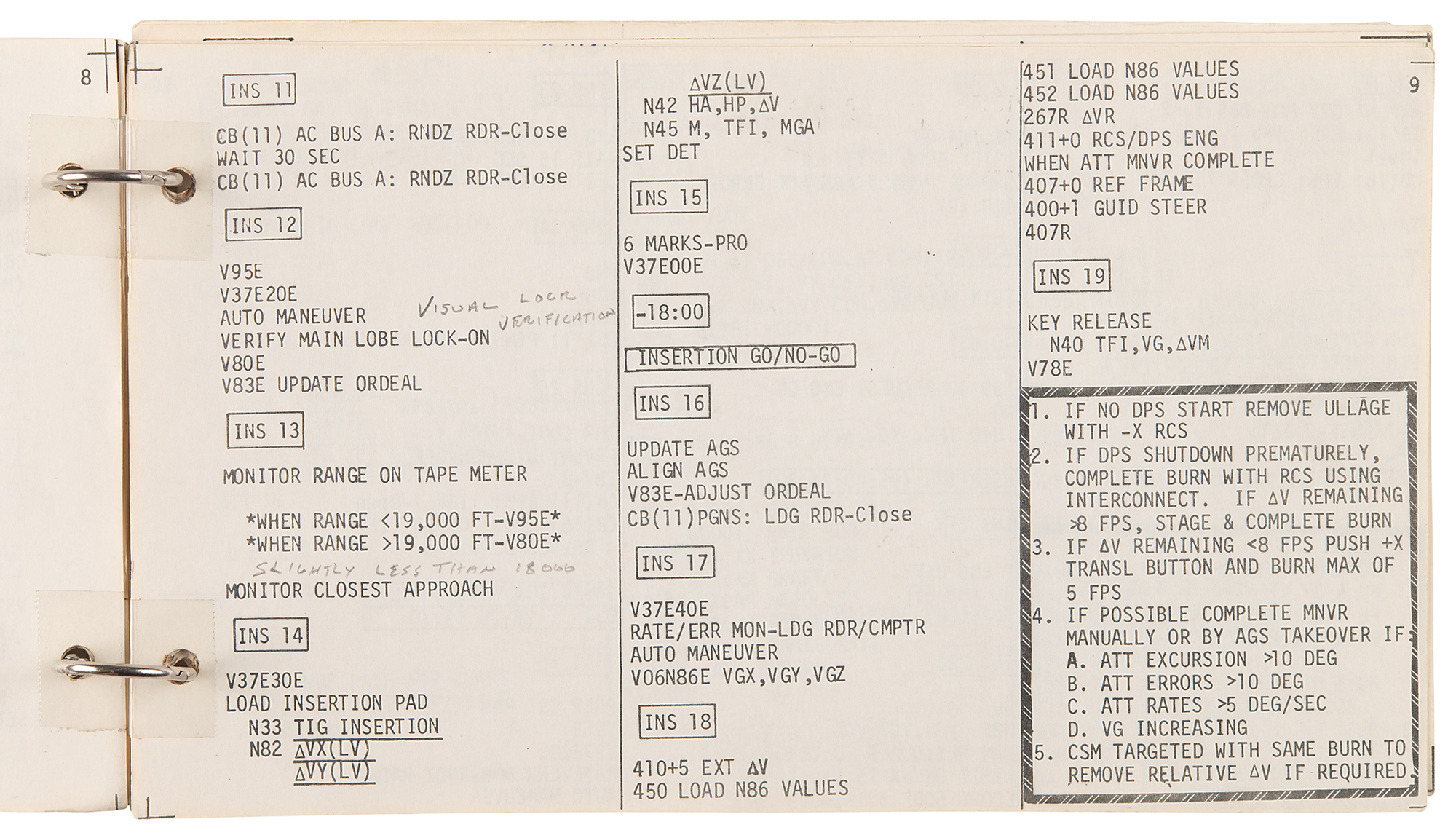
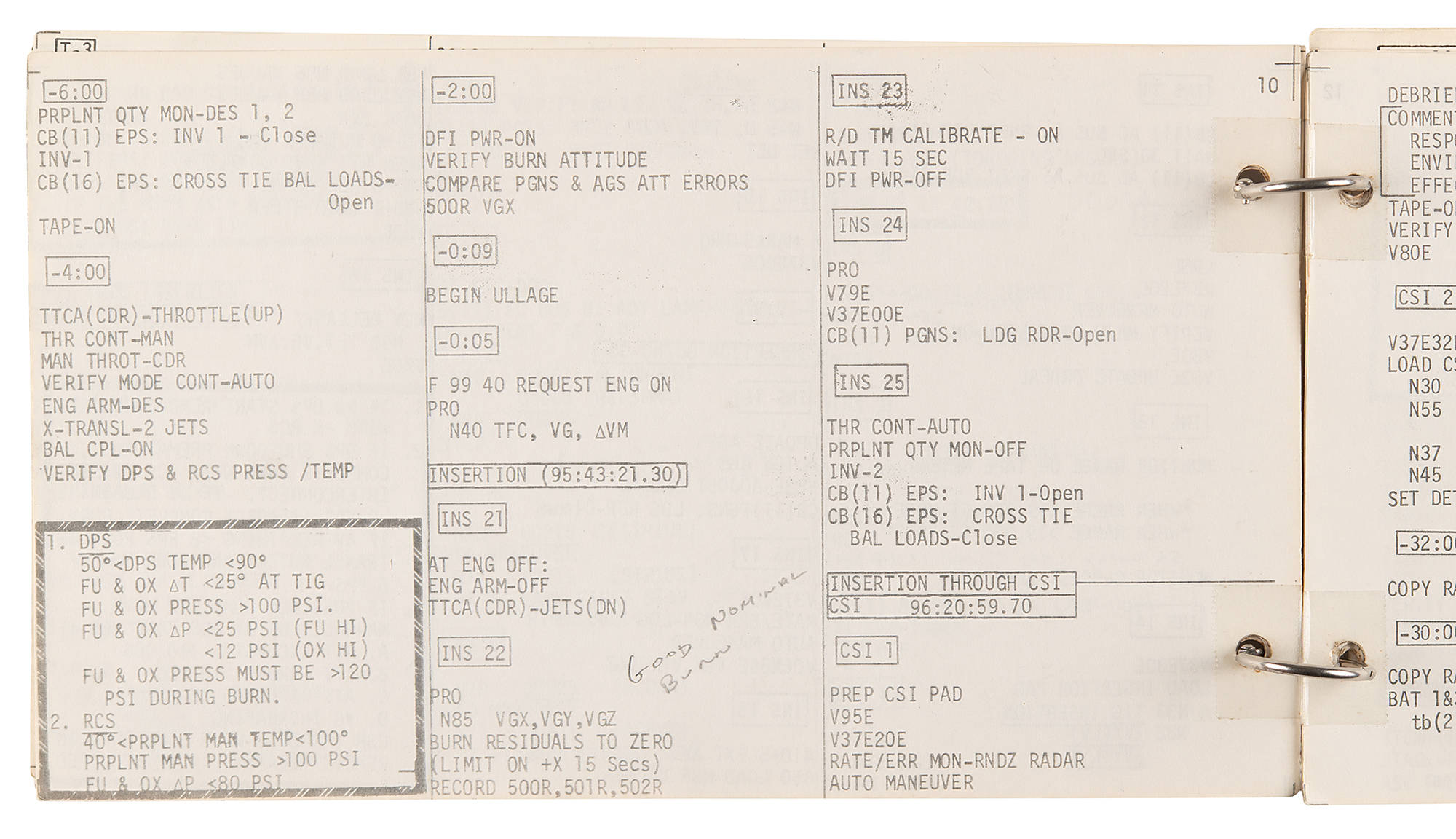
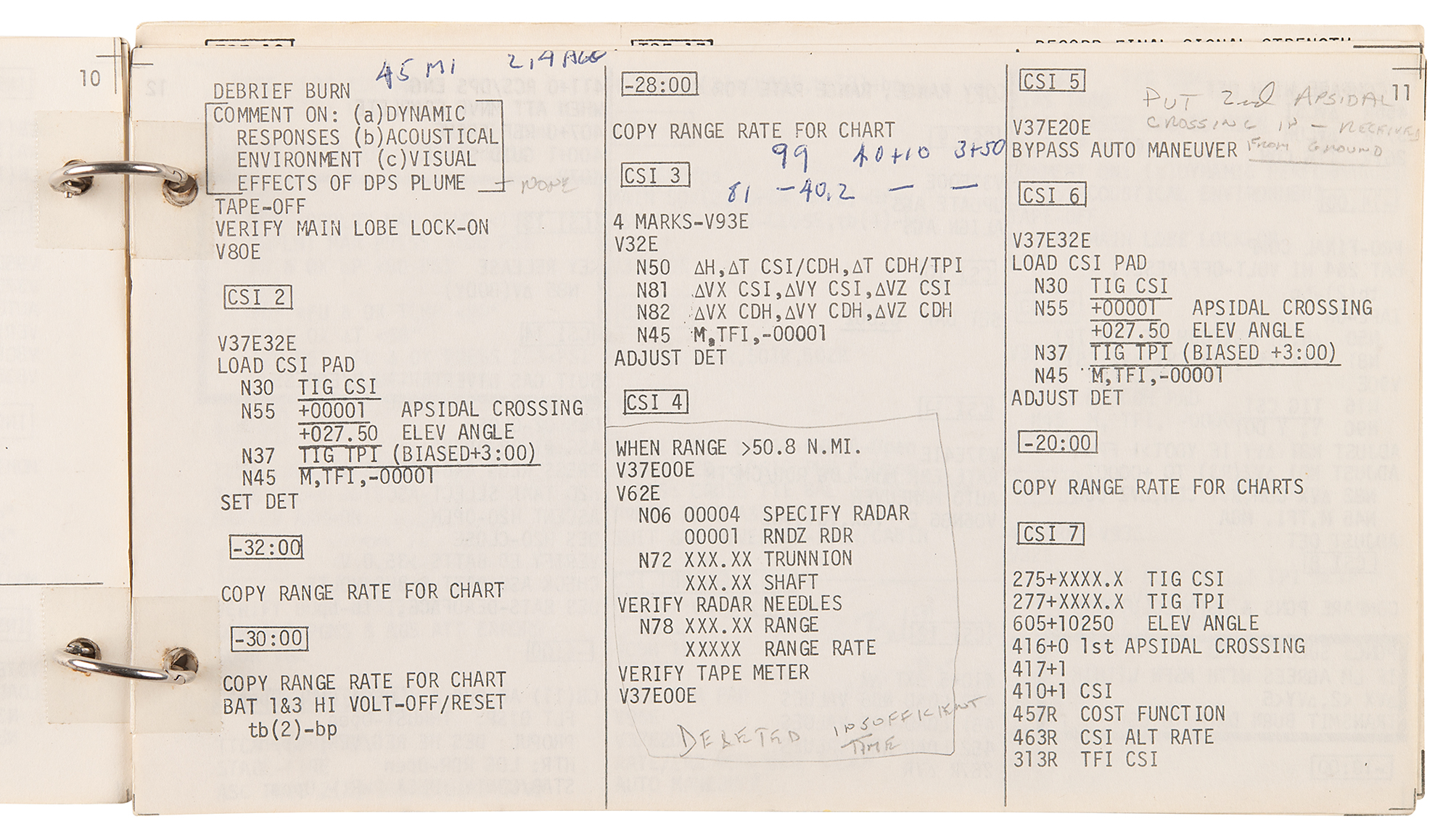
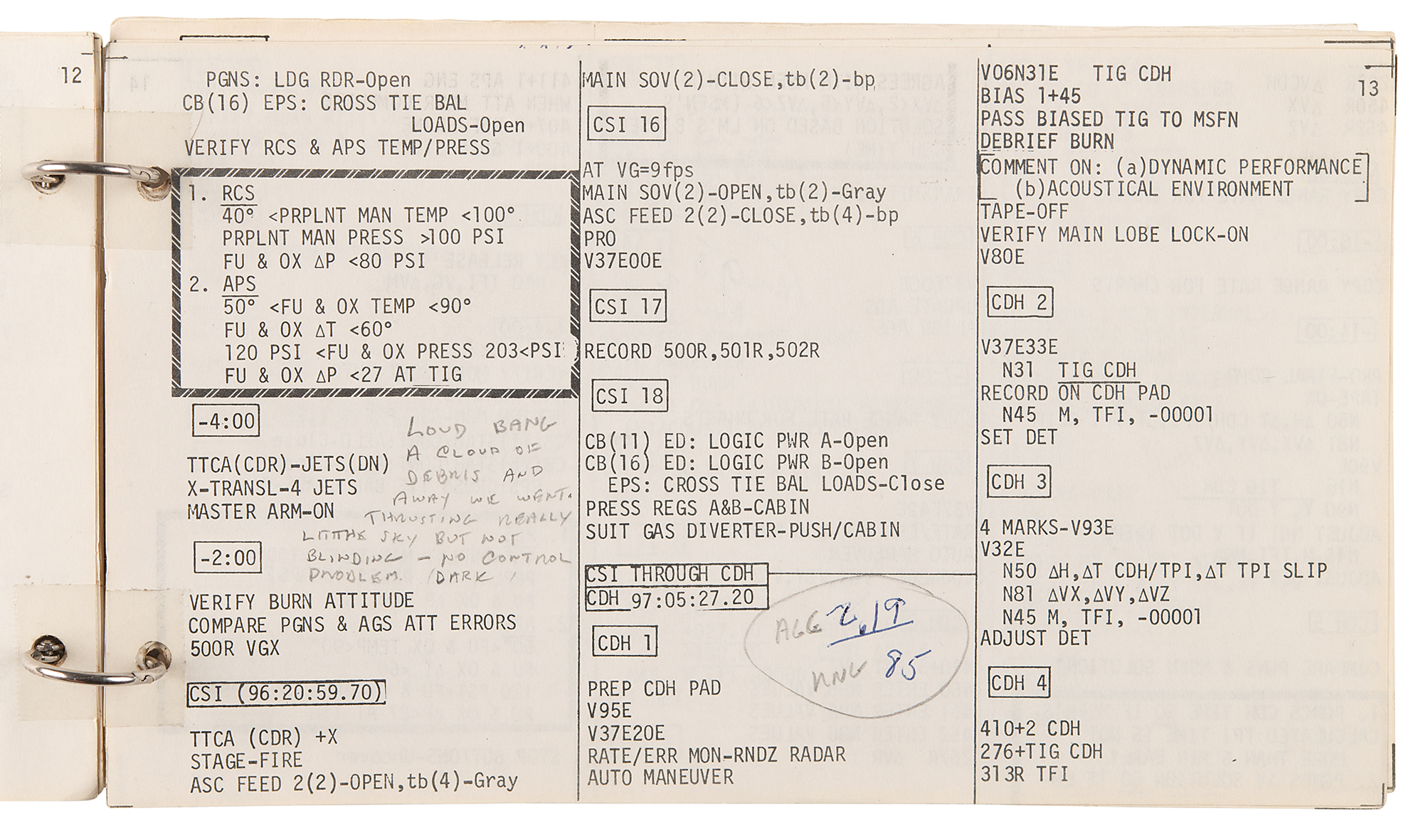
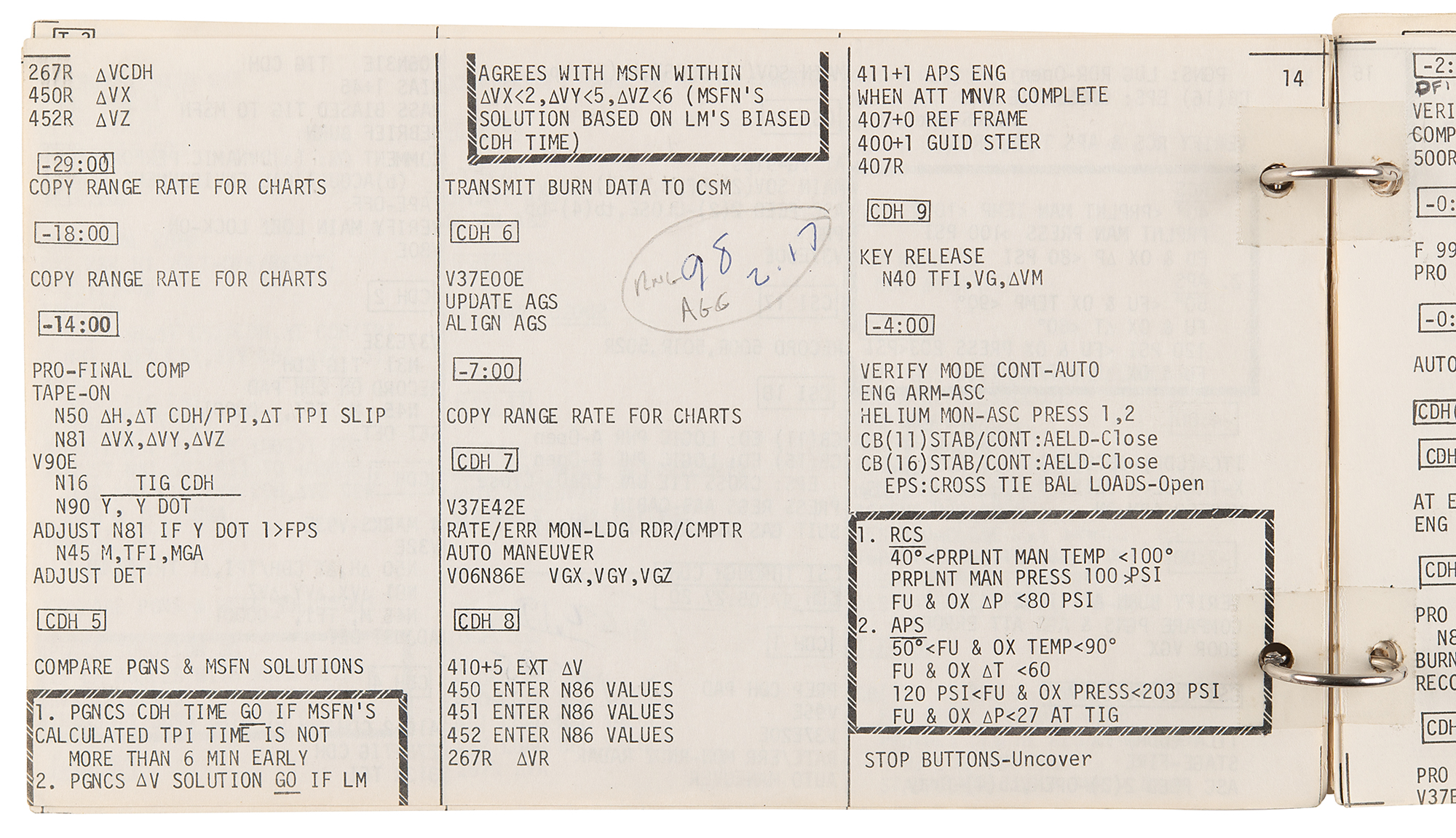
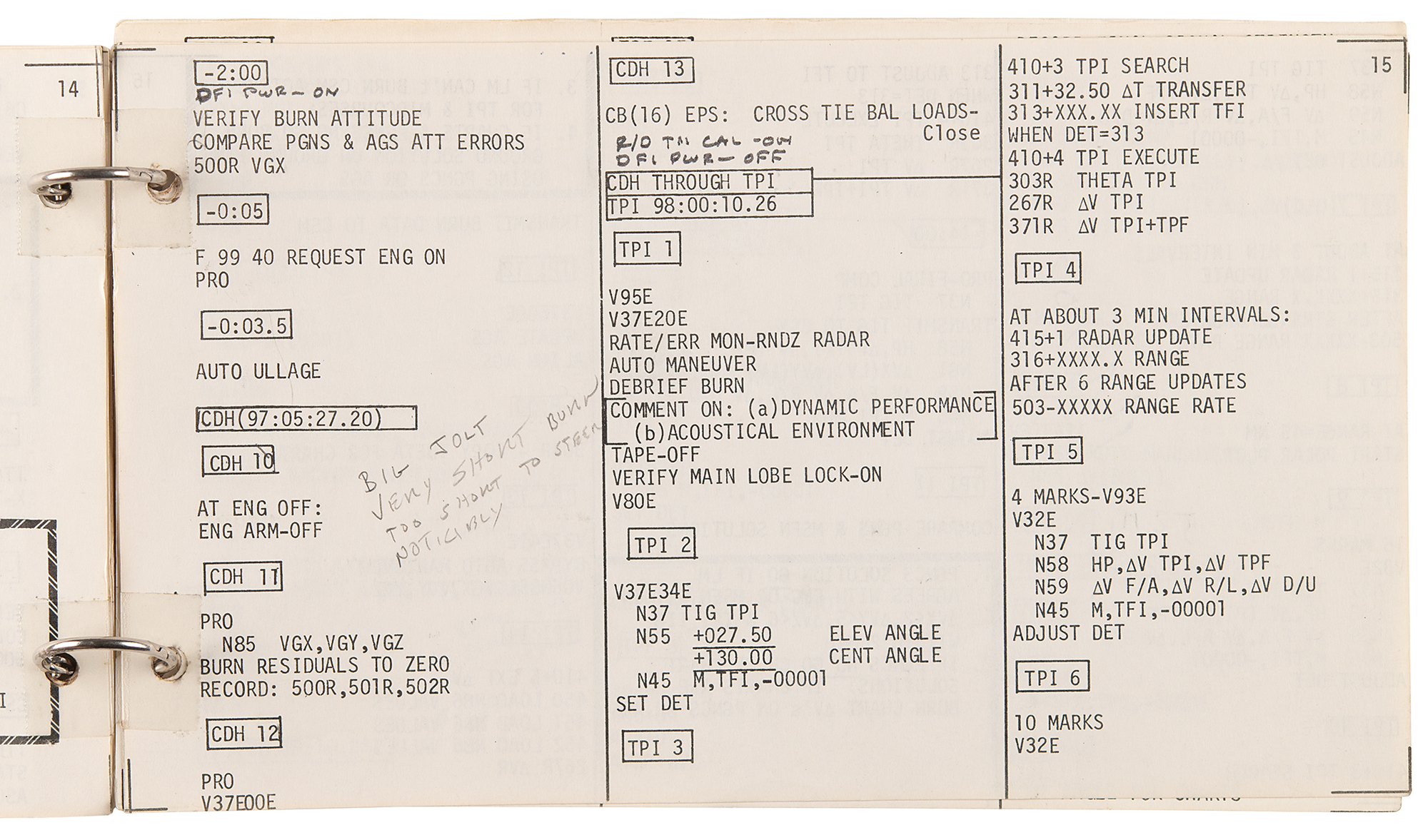
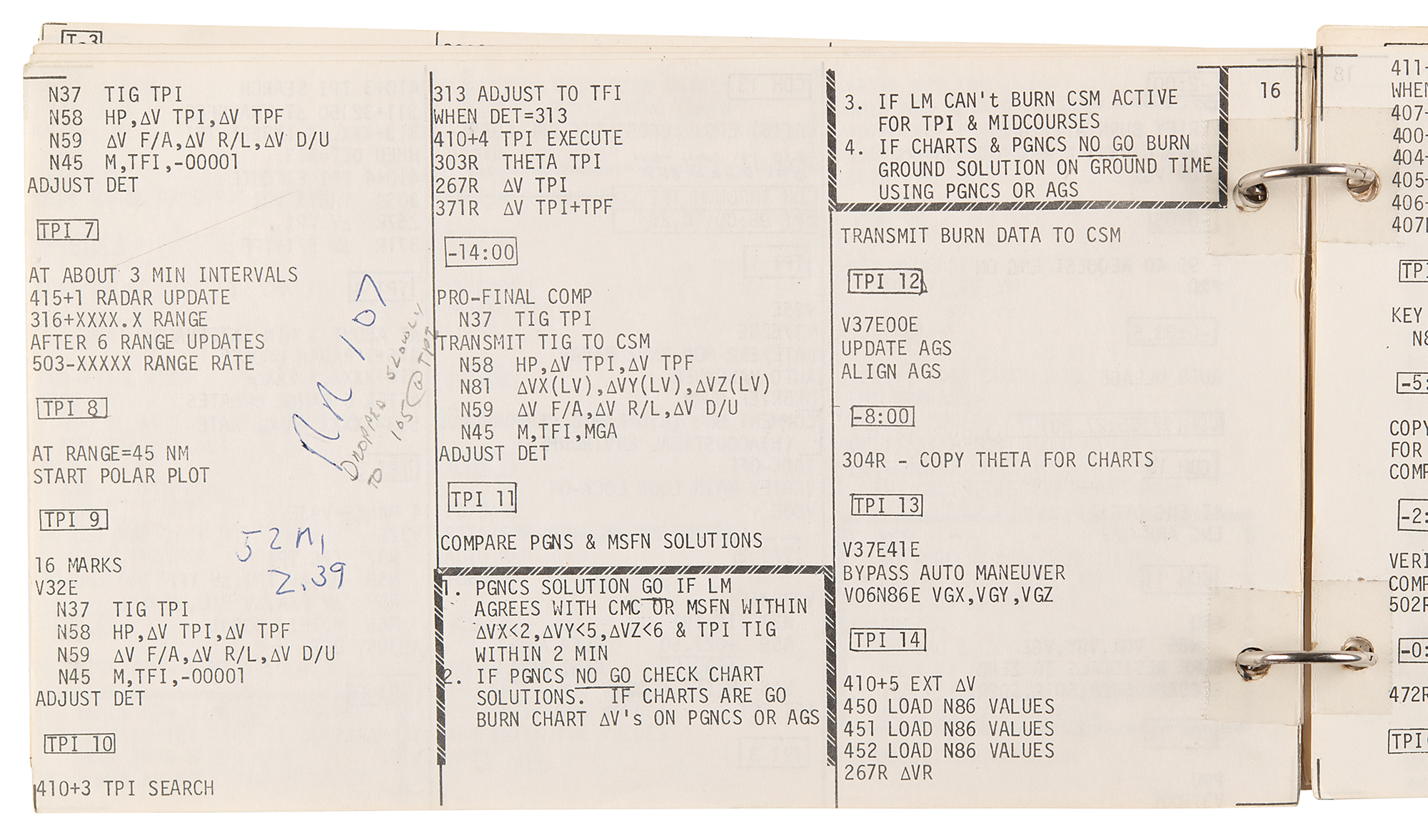
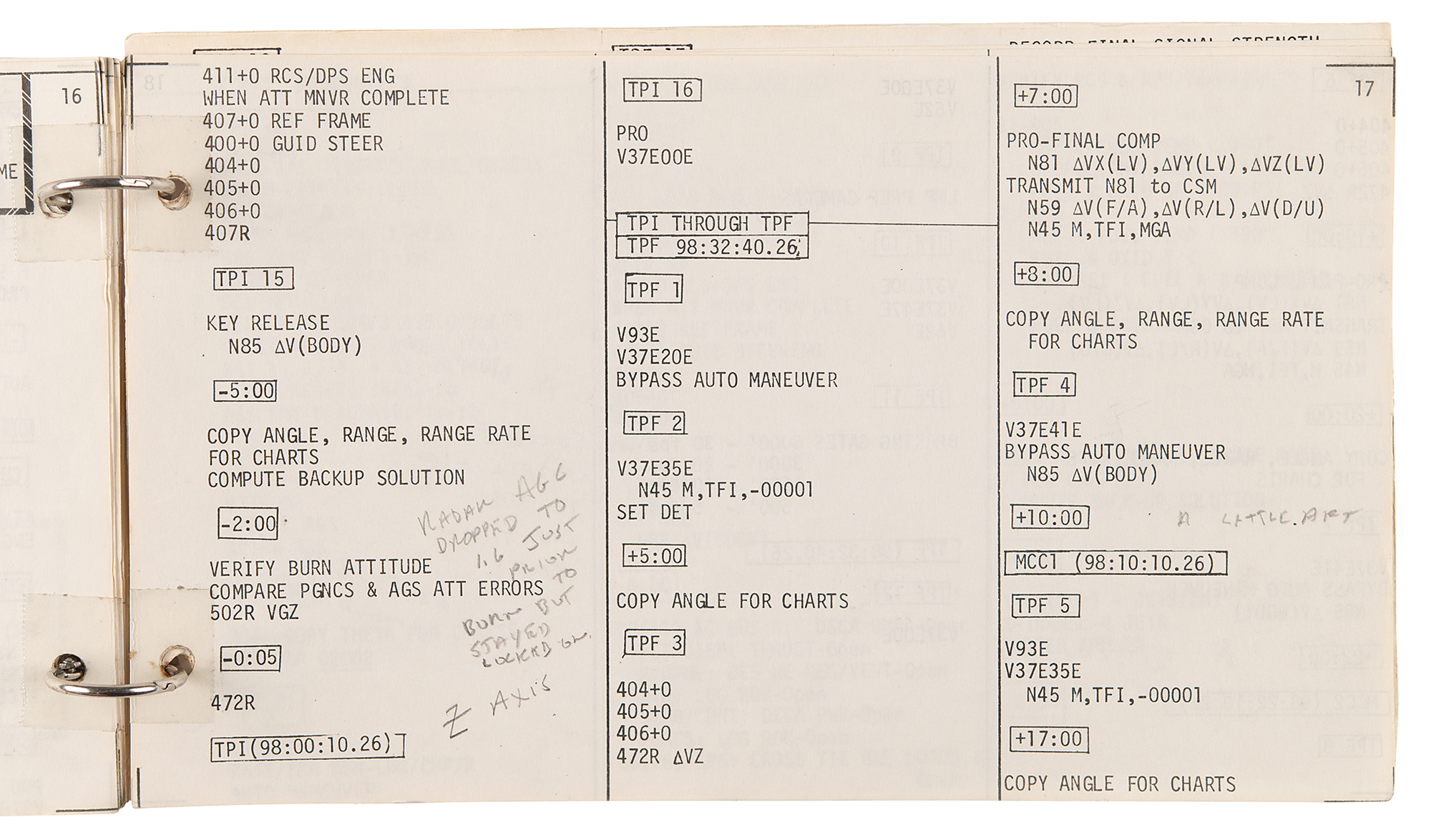
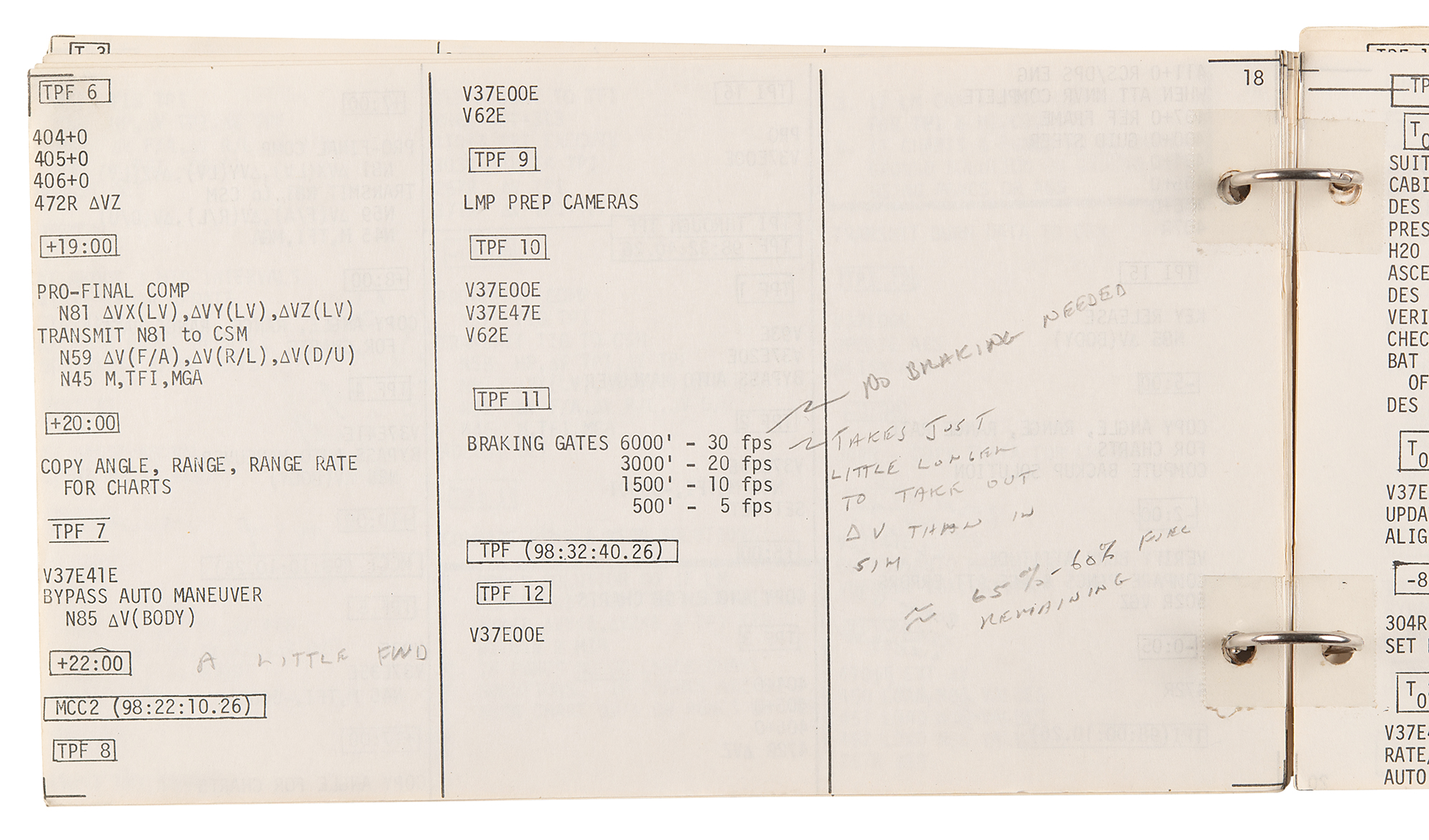
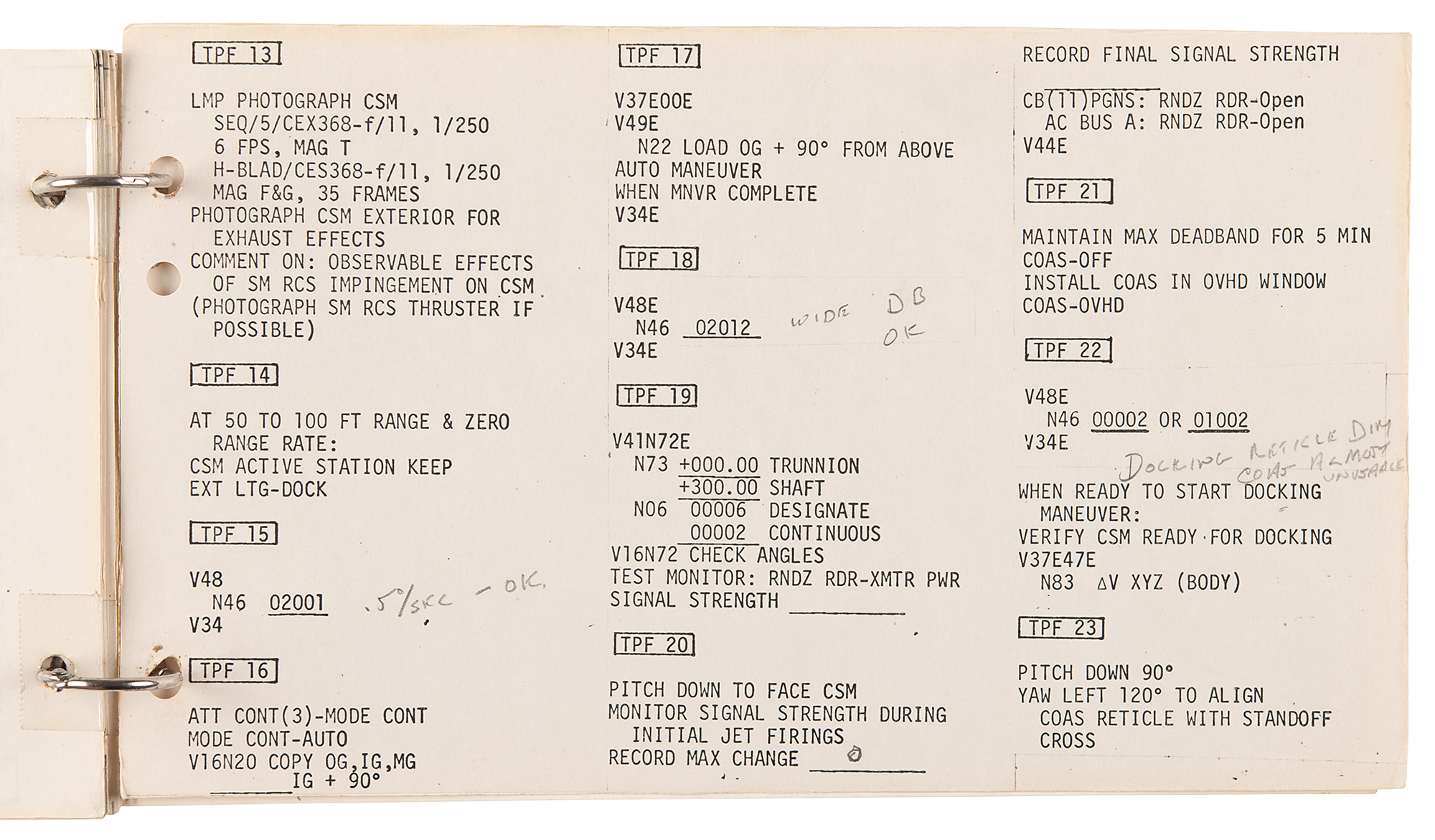
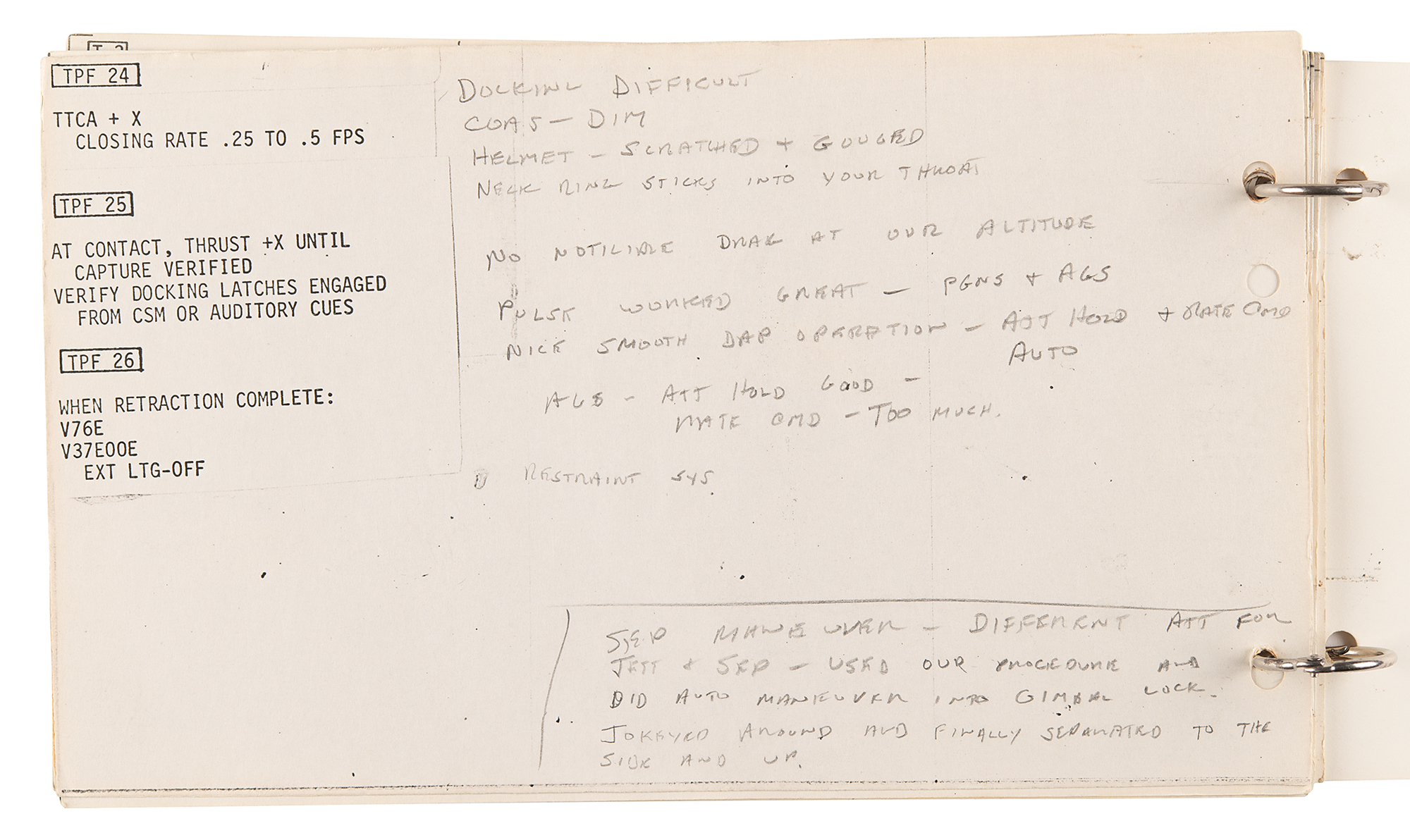
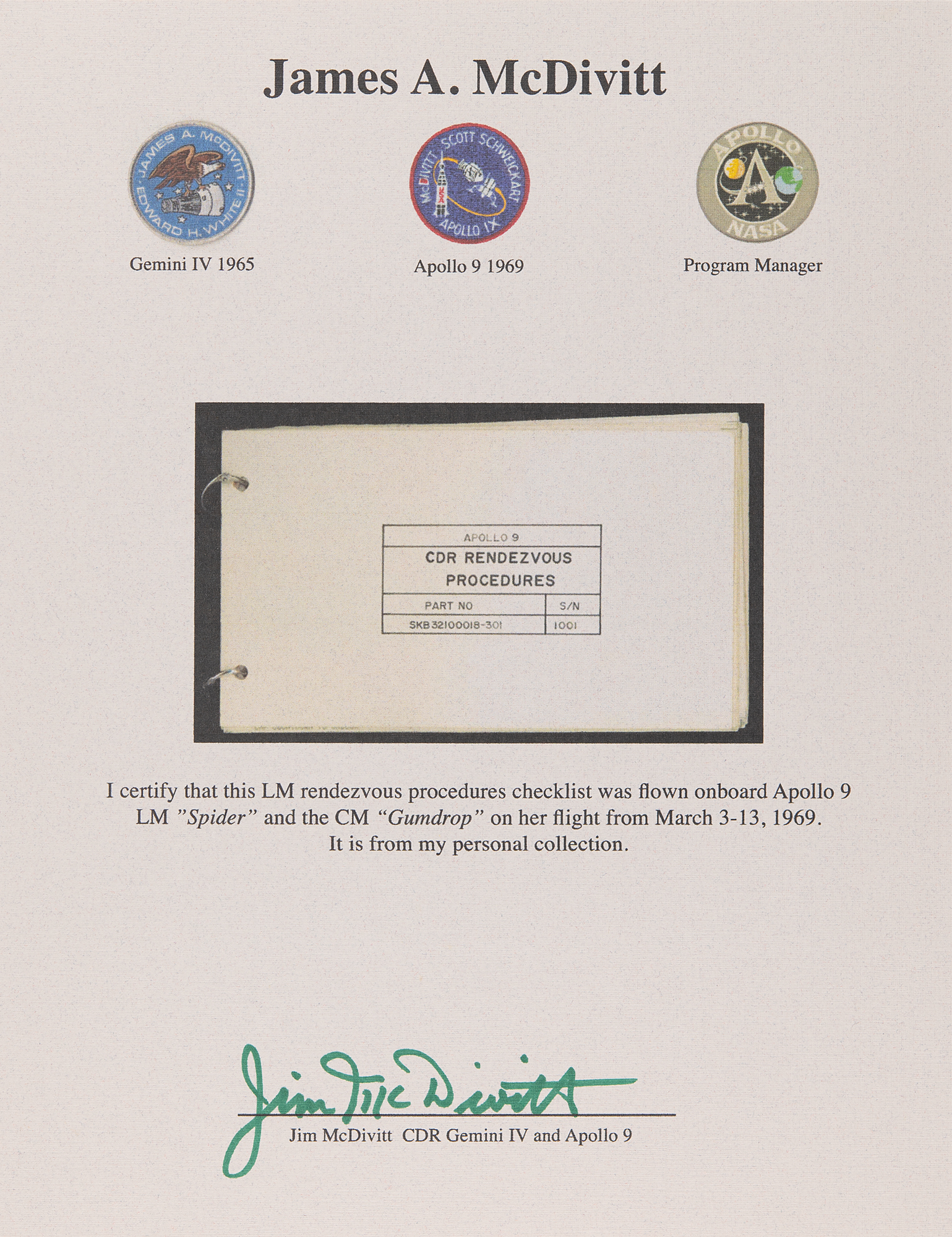
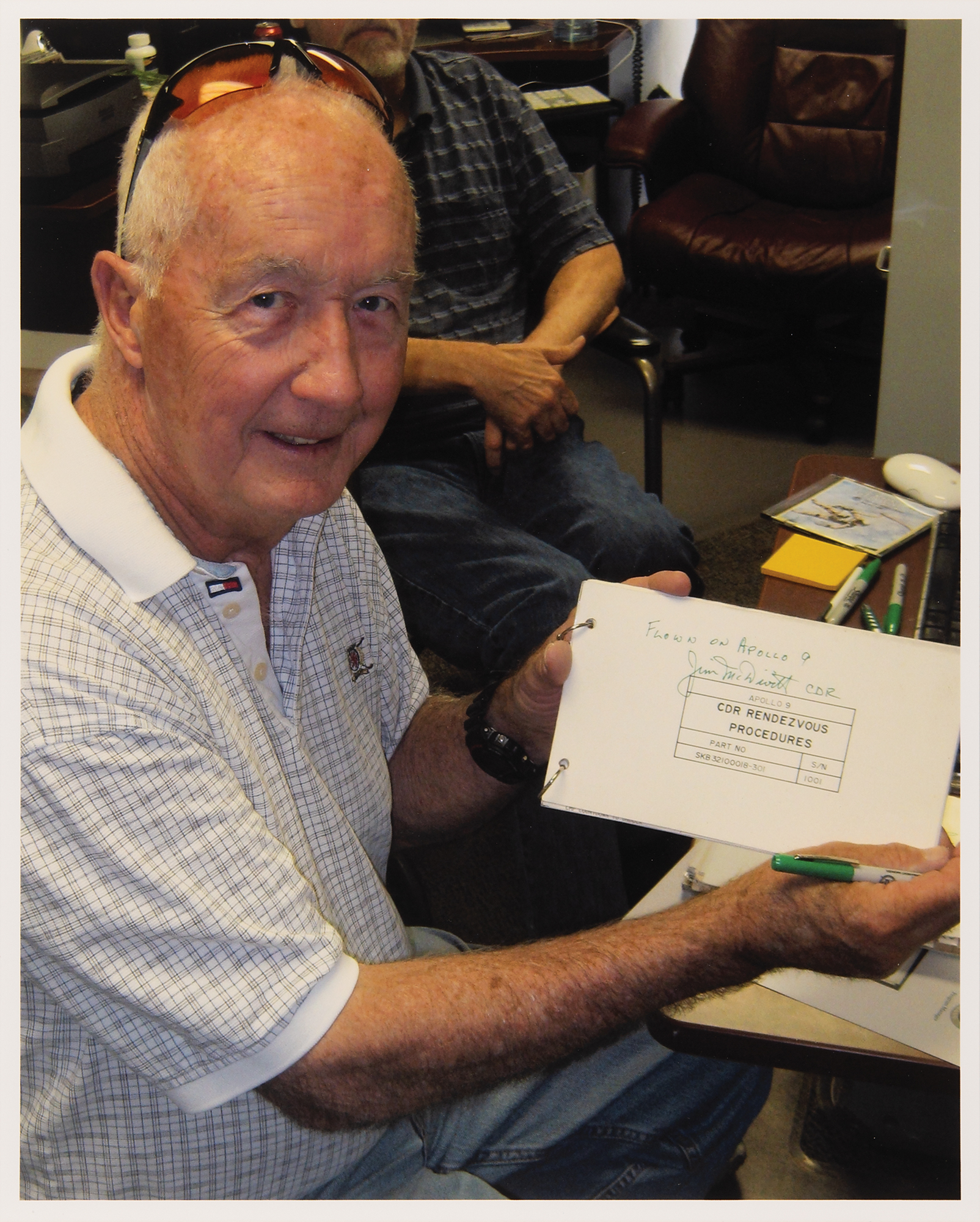
Jim McDivitt's complete "Apollo 9 CDR Rendezvous Procedures" carried into low Earth orbit on the Lunar Module 'Spider' during the mission, comprising twelve sheets between ring-bound cardstock covers, signed and flight-certified on the front cover in green felt tip, "Flown on Apollo 9, Jim McDivitt, CDR." The front cover also lists the part and serial numbers: "SKB32100018-301" and "1001." Inside are mission rules and procedures relating to the rendezvous of the Command and Service Module (CSM) and the Lunar Module (LM), boasting copious in-flight pencil notations pertaining to celestial navigation procedures ("Could do alignment in daylight—saw Sirius easily," "Very difficult to see, moon & planet confusing"), RCS burns ("Slow smooth start to 10%—at that time ~5 sec passed & throttle up started, engine began to rumble at ~20 throttle up. It then quieted down and continued to 40% OK. Good burn, good steer," "Good nominal burn"), and notable observations ("Loud bang, a cloud of debris and away we went. Thrusting really lit the sky but not blinding—no control problem"). On the last page are significant observations on the mission: "Docking difficult, COAS—dim, Helmet—scratched & gouged, Neck ring sticks into your throat, No noticeable drag at our altitude, Pule worked great—PGNS & AGS, Nice smooth DAP operation…Used our procedure and did auto maneuver into gimbal lock." In overall fine condition. Accompanied by a letter of provenance signed by Jim McDivitt, certifying that "this LM rendezvous procedures checklist was flown onboard Apollo 9 LM 'Spider' and the CM 'Gumdrop' on her flight from March 3–13, 1969." Also includes a photo of McDivitt posing with the checklist.
Apollo 9 marked the first successful rendezvous and docking of the Command Module (CM) and Lunar Module (LM) in Earth orbit, a crucial test for future lunar missions. After separating, the LM—nicknamed Spider—performed independent maneuvers before rejoining the CM, Gumdrop. This demonstrated that the spacecraft could operate separately and then link back together, proving the techniques essential for landing on and returning from the moon.

