
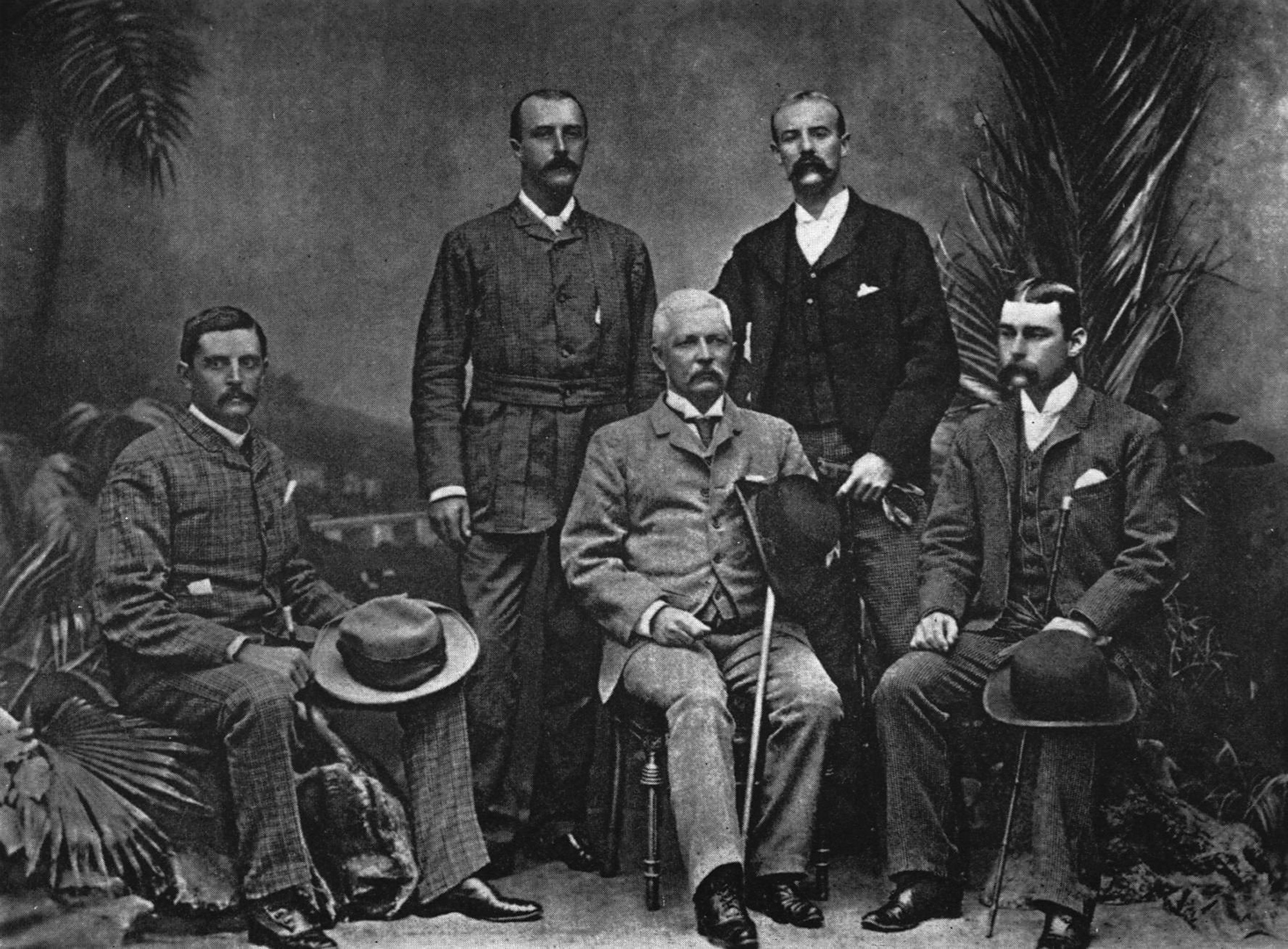
Archive of explorer Robert Henry Nelson and his role as a pivotal member of the Emin Pasha Relief Expedition led by Henry Morton Stanley between 1887 and 1889. An officer of the British Army, Nelson was brought on as one of Stanley’s trusted advance column, a lead group of nearly 700 men who traveled with Stanley to Equatoria (part of modern-day South Sudan) to rescue its besieged governor, Emin Pasha, from an onslaught of Mahdist forces. The men navigated up the Congo River and then through the Ituri rainforest to reach East Africa. The expedition was arduous, and in October 1887, Captain Nelson became ill and was left behind with 52 others in a camp near the Aruwimi River that was later coined ‘Starvation Fort.’ When the explorers finally returned to the camp, Nelson was one of only five men left alive. He recovered, resumed his part in the expedition, and returned to England in February 1890.
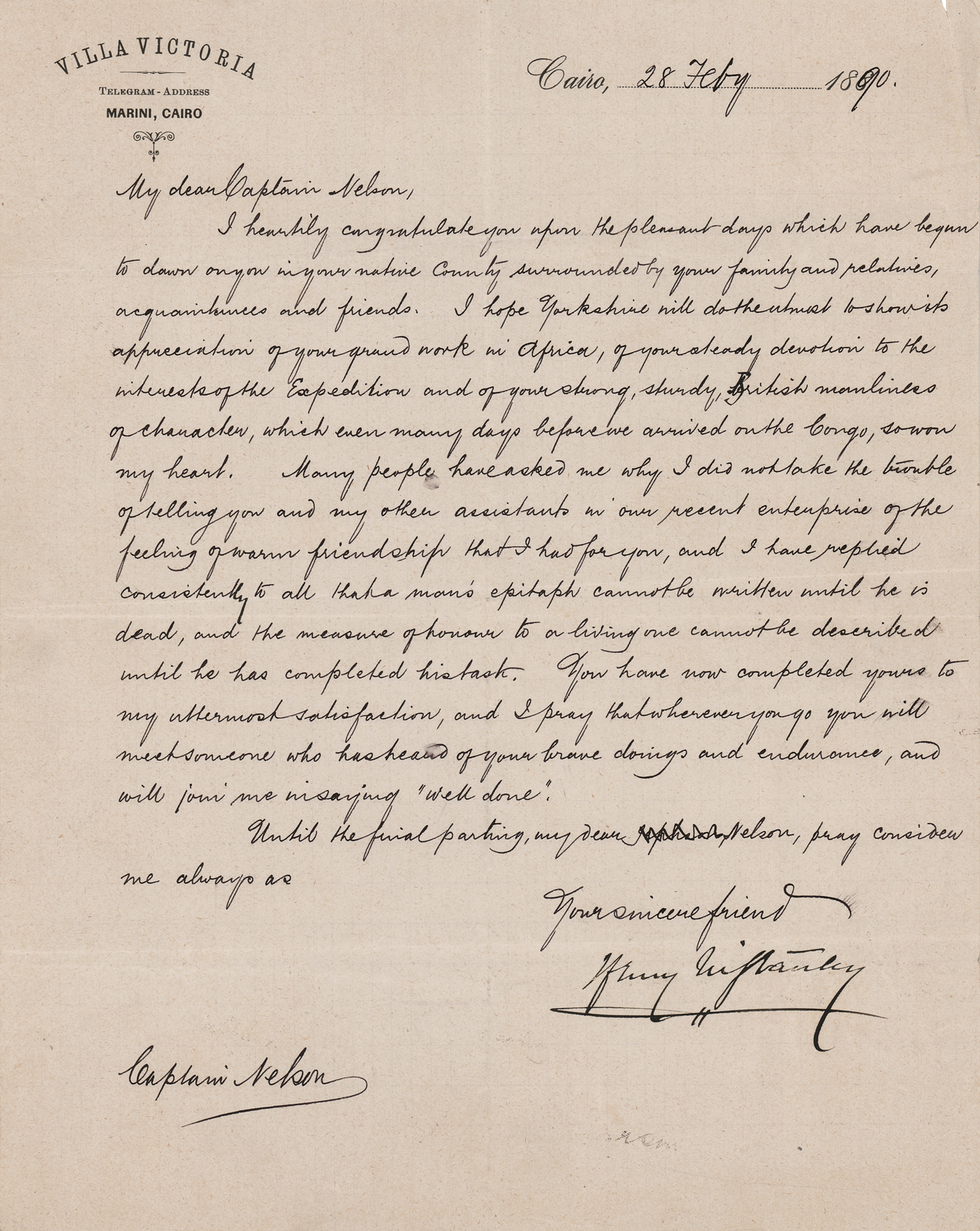
The archive, which details Nelson’s initial involvement and determination to join Stanley on his expedition, is highlighted by a one-page LS from Stanley to Nelson, signed “Henry M. Stanley,” dated February 28, 1890, penned on Villa Victoria (Marini, Cairo) letterhead, offering his gartutude and congratulations on a job well done: “I hope Yorkshire will do the utmost to show its appreciation of your grand work in Africa, of your steady devotion to the interests of the Expedition and of your strong, sturdy British manliness of character, which even many days before we arrived on the Congo, so won my heart.”
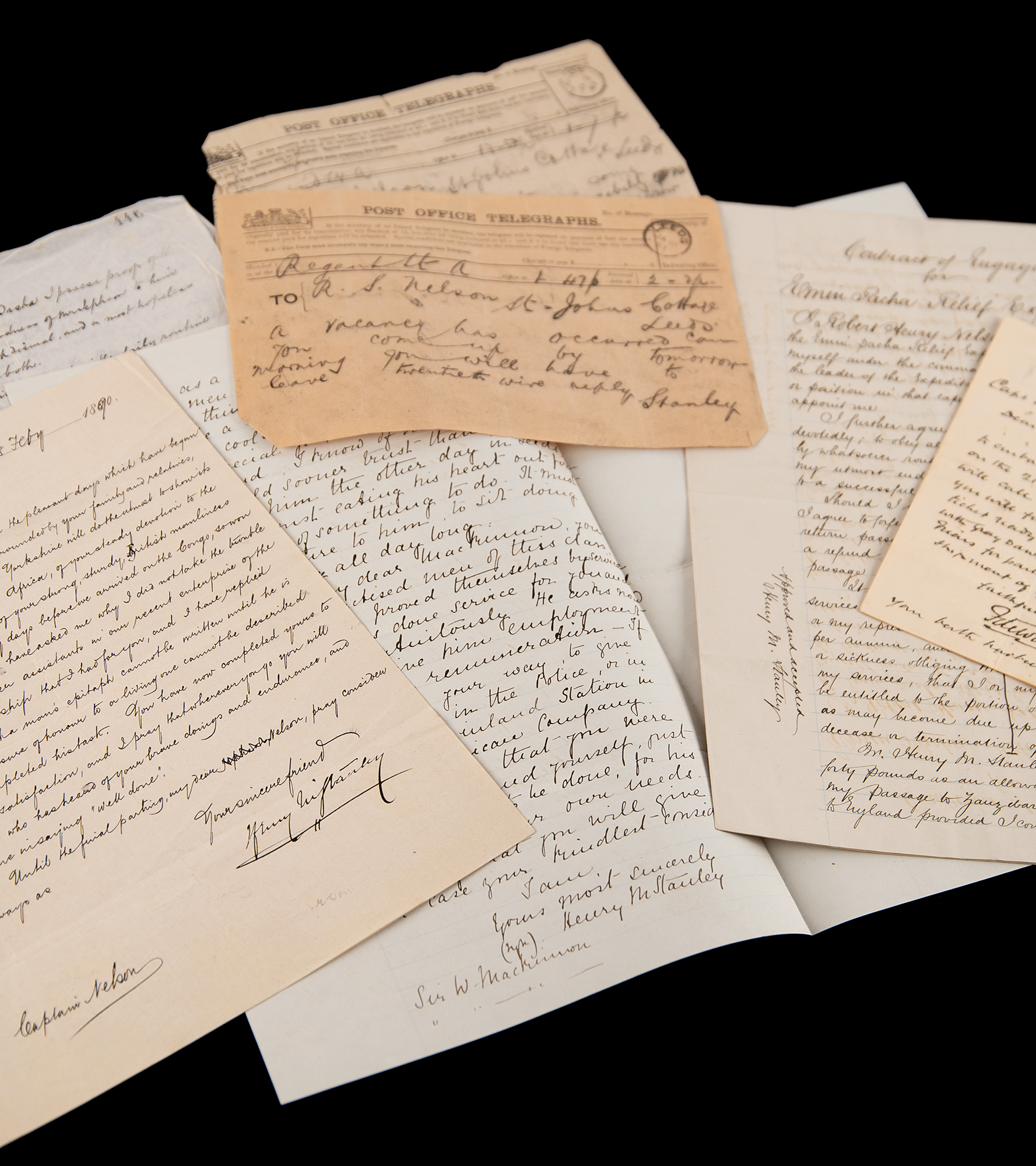
Other noteworthy pieces include:
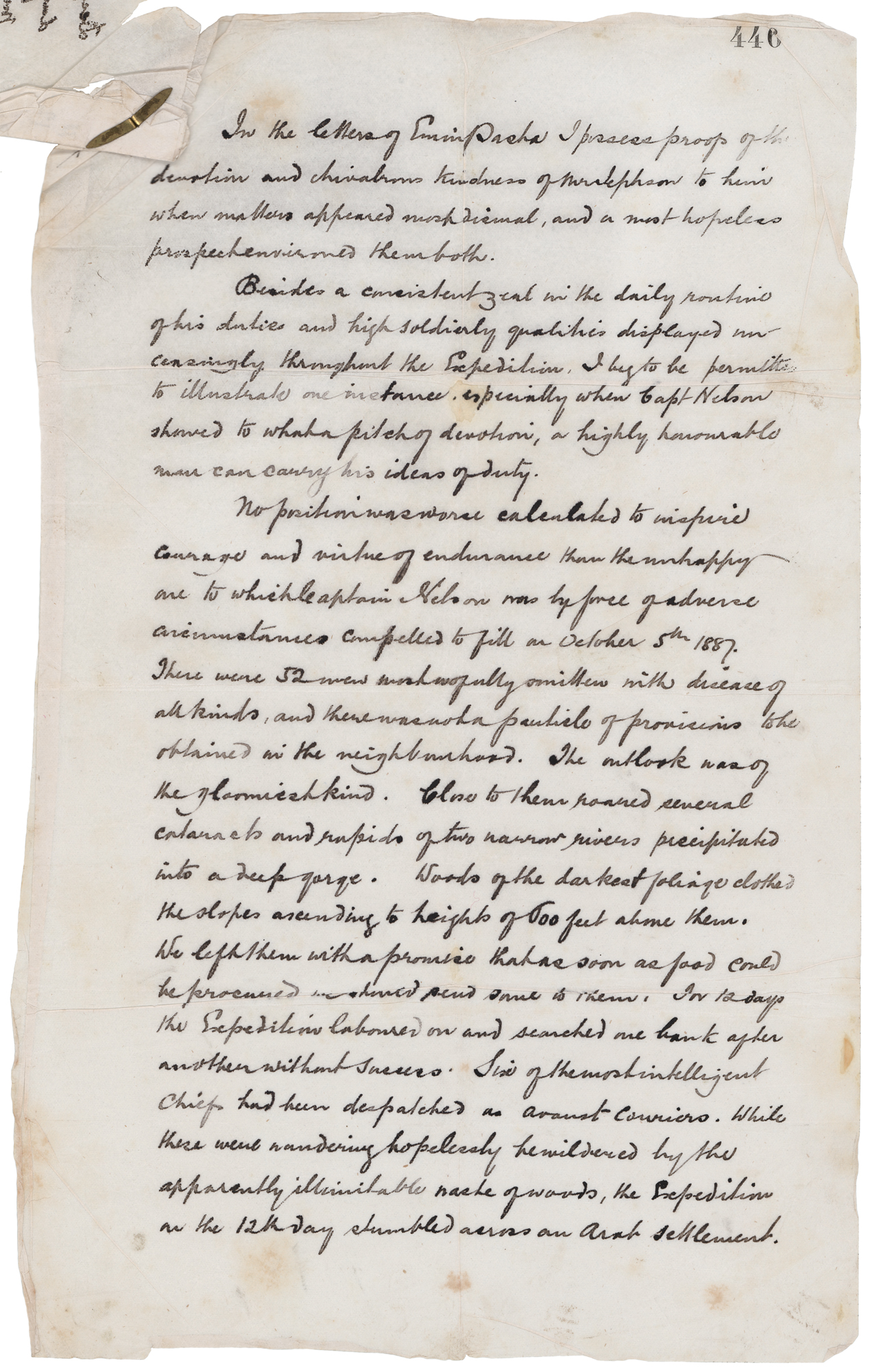
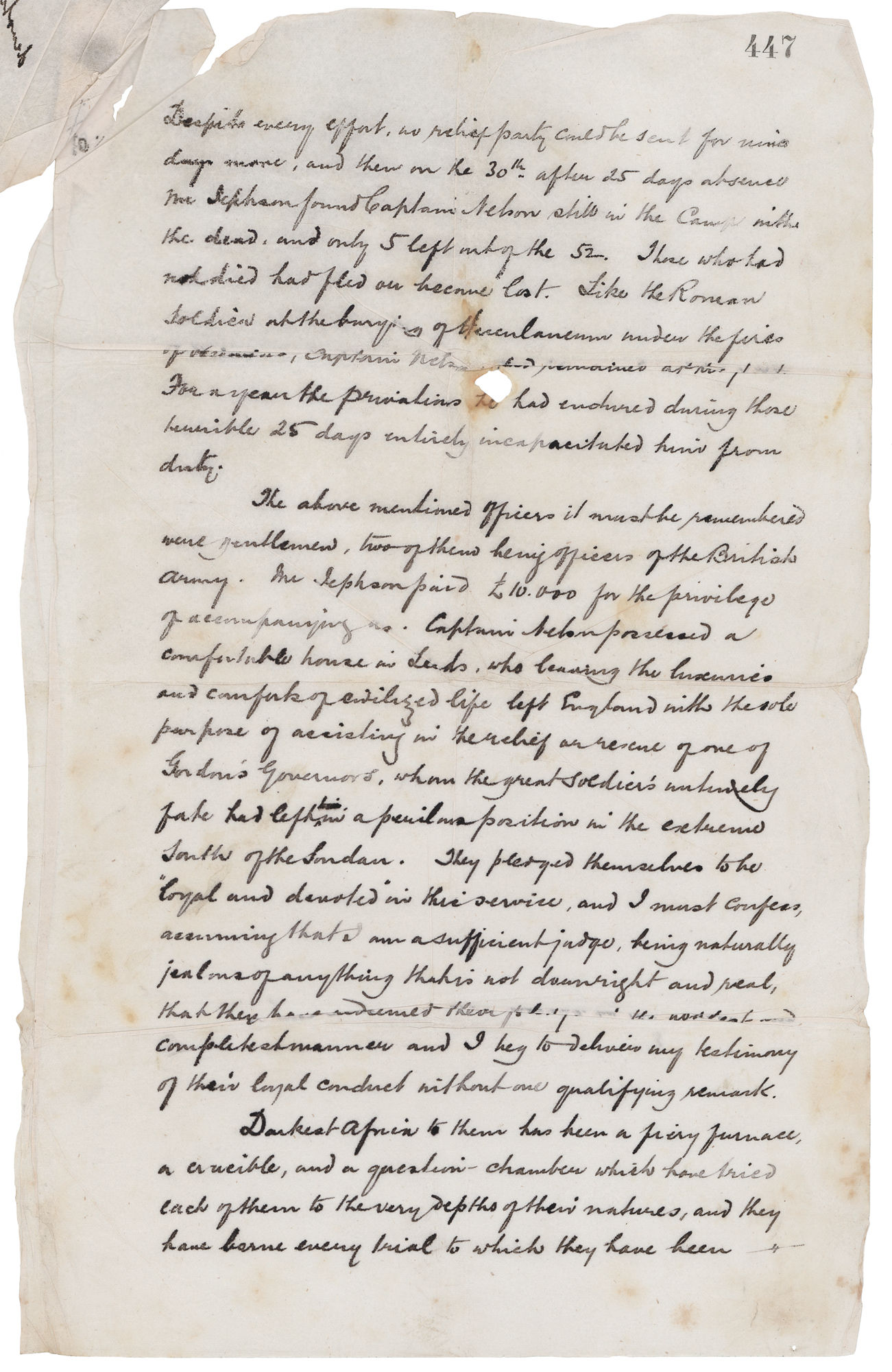
An undated partial letterpress copy of a Stanley’s handwritten letter of recommendation for Nelson, two pages, 8.25 x 13.25, no date (post 1889). In the letter, Stanley lauds the efforts and determination of Nelson during the Emin Pasha expedition before using an anecdote to illustrate “to what a pitch of devotion, a highly honourable man can carry his ideas of duty.” In part: “No position was worse calculated to inspire courage and virtue of endurance than the unhappy one to which Captain Nelson was by force of adverse circumstances compelled to fill on October 5th 1887. There were 52 men most woefully smitten with disease of all kinds, and there was not…provisions to be obtained in the neighborhood. The outlook was of the gloomiest kind. Close to them roared several cataracts and rapids of two narrow rivers precipitated into a deep gorge. Woods of the darkest foliage clothed the slopes ascending to heights of 100 feet above them. We left them with a promise that as soon as food could be procured, we should send some to them…the Expedition on the 12th day stumbled across an Arab settlement. Despite every effort, no relief party could be send for nine days more, and then on the 30th after 25 days absent…[we] found Captain Nelson still in the camp with the dead, and only 5 left out of the 52. Those who had not died fled or became lost…Captain Nelson had remained at his post. For a year the privations he had endured during those terrible 25 days entirely incapacitated him from duty.”
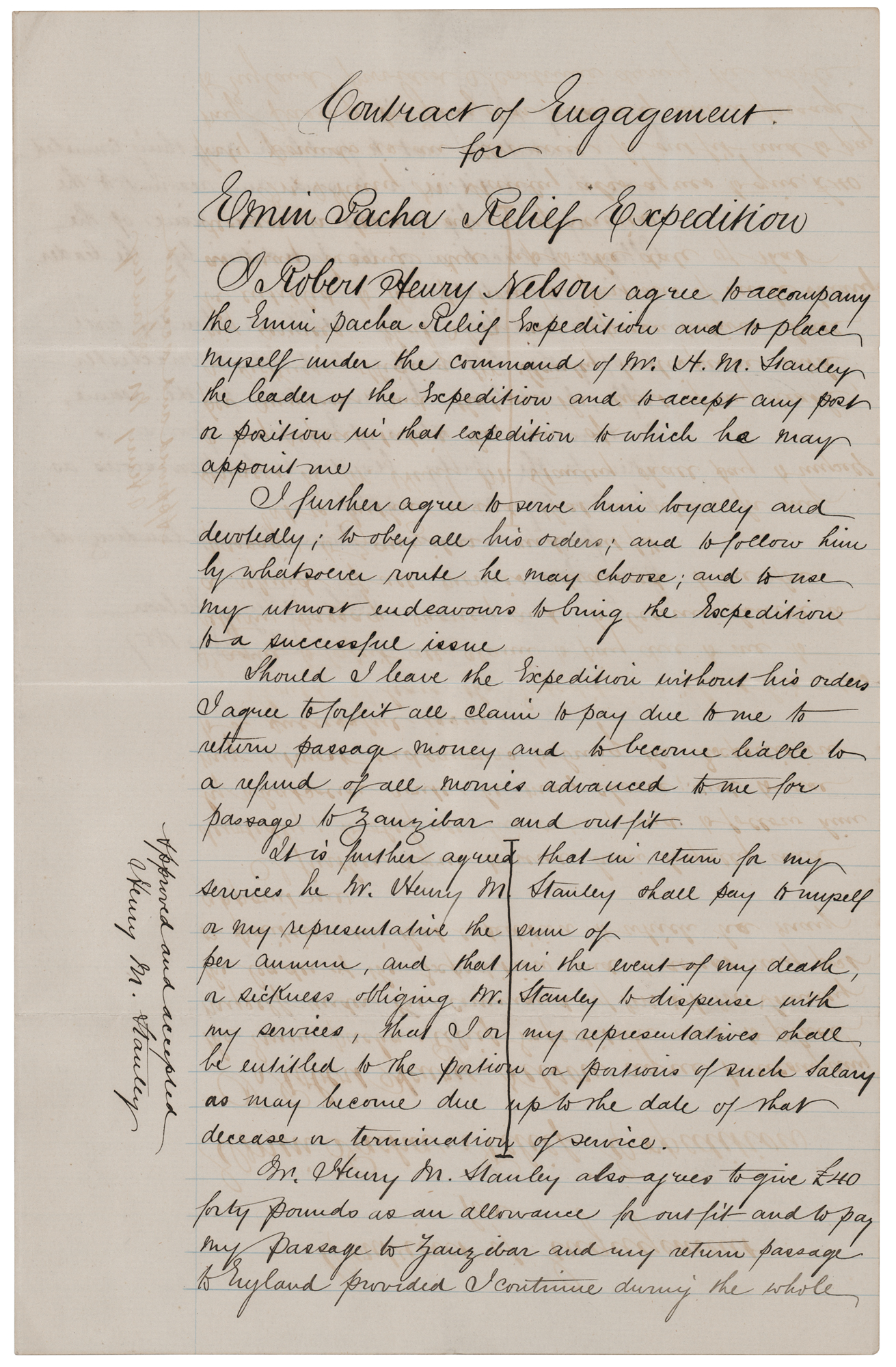
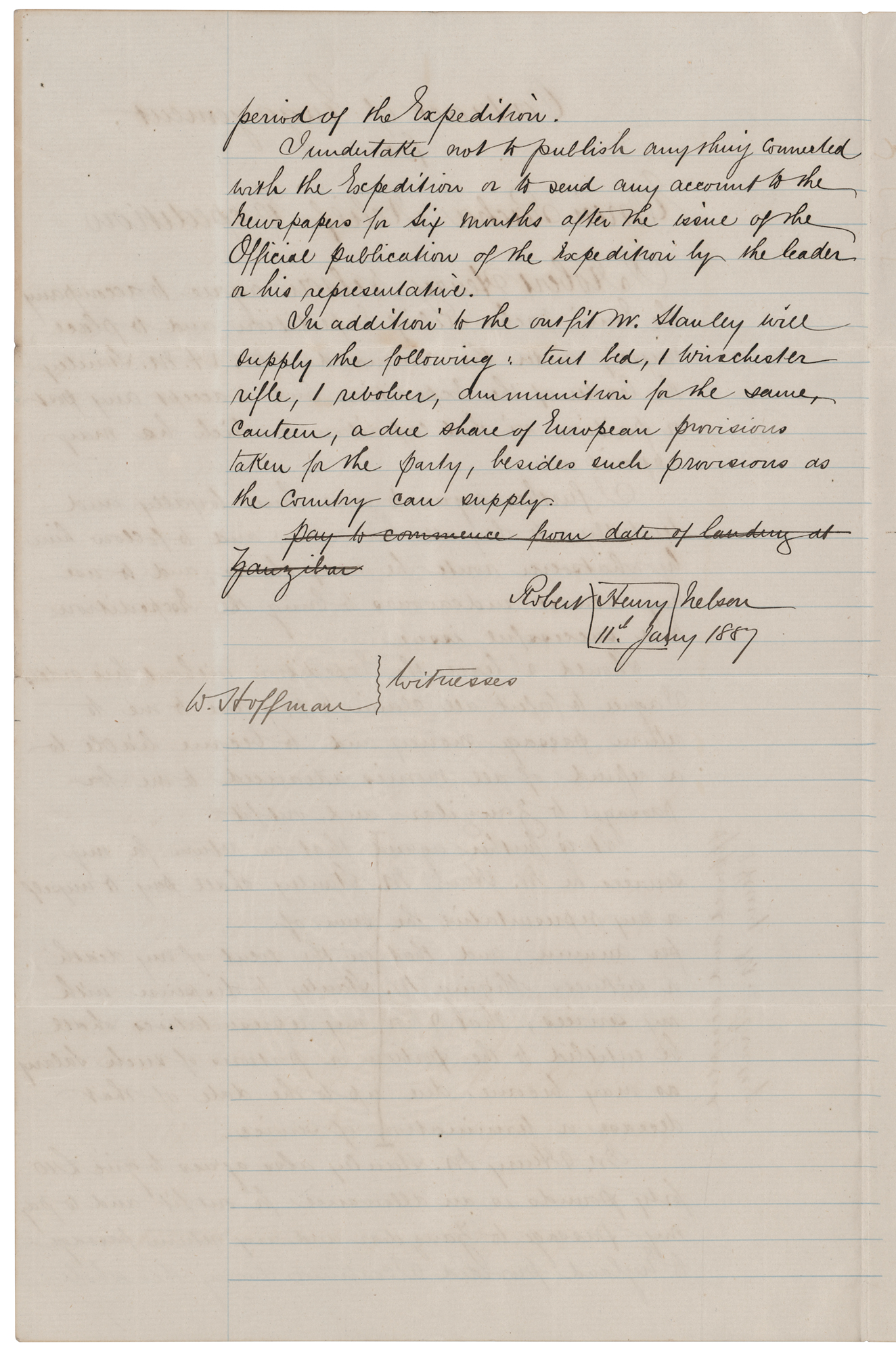
Nelson’s handwritten “Contract of Engagement for Emin Pacha Relief Expedition,” one page, both sides, 8.25 x 13, January 11, 1887, signed at the conclusion by Henry, who signs on behalf of Stanley on the first page. The contract reads, in part: “I, Robert Henry Nelso, agree to accompany the Emin Pacha Relief Expedition and to place myself under the command of Mr. H. M. Stanley, the leader of the expedition, and to accept any post or position in that expedition to which he may appoint me.”
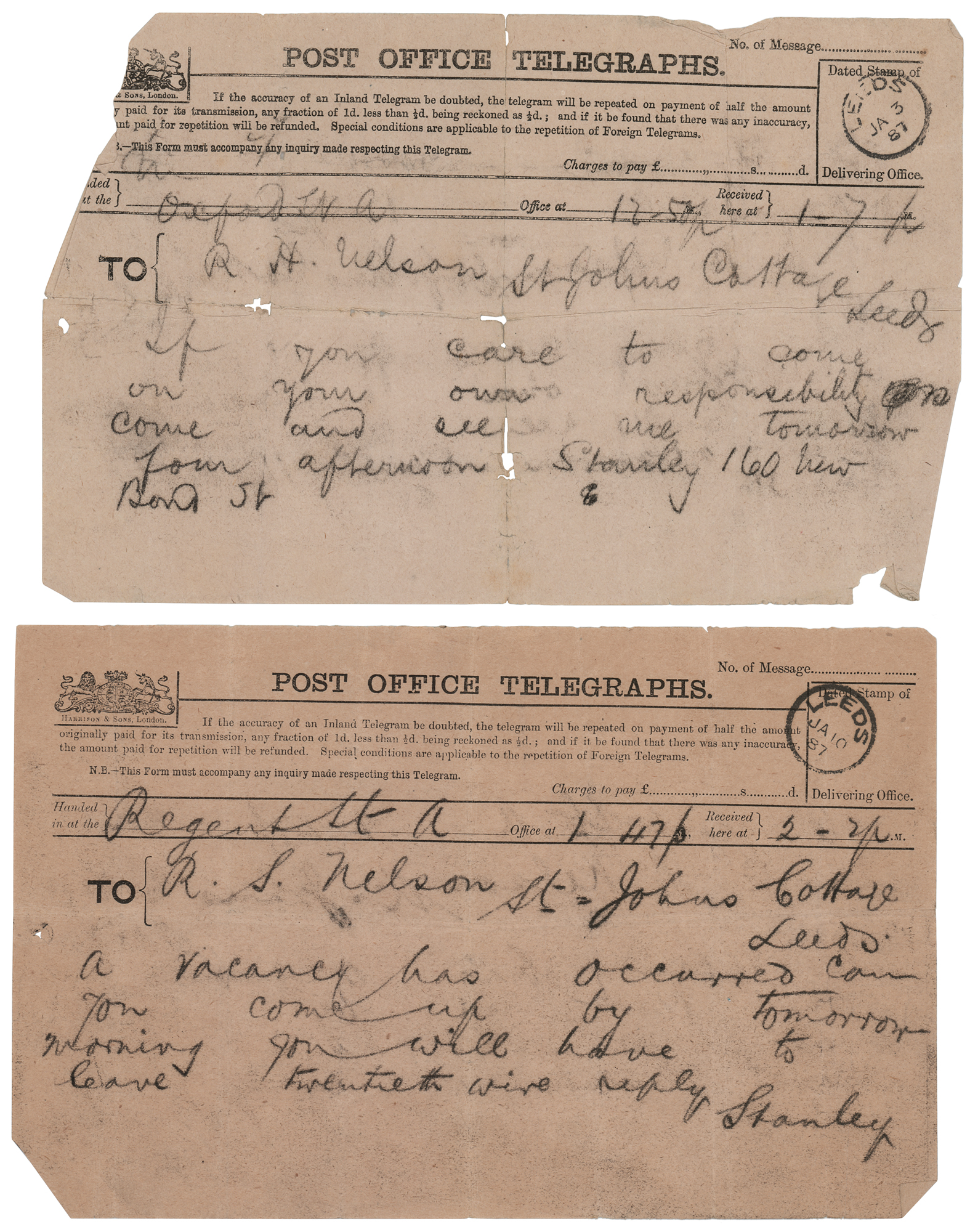
Two Post Office Telegraphs sent by Stanley to Nelson, dated January 3 and 10, 1887, both requesting that Nelson visit him at his earliest convenience.
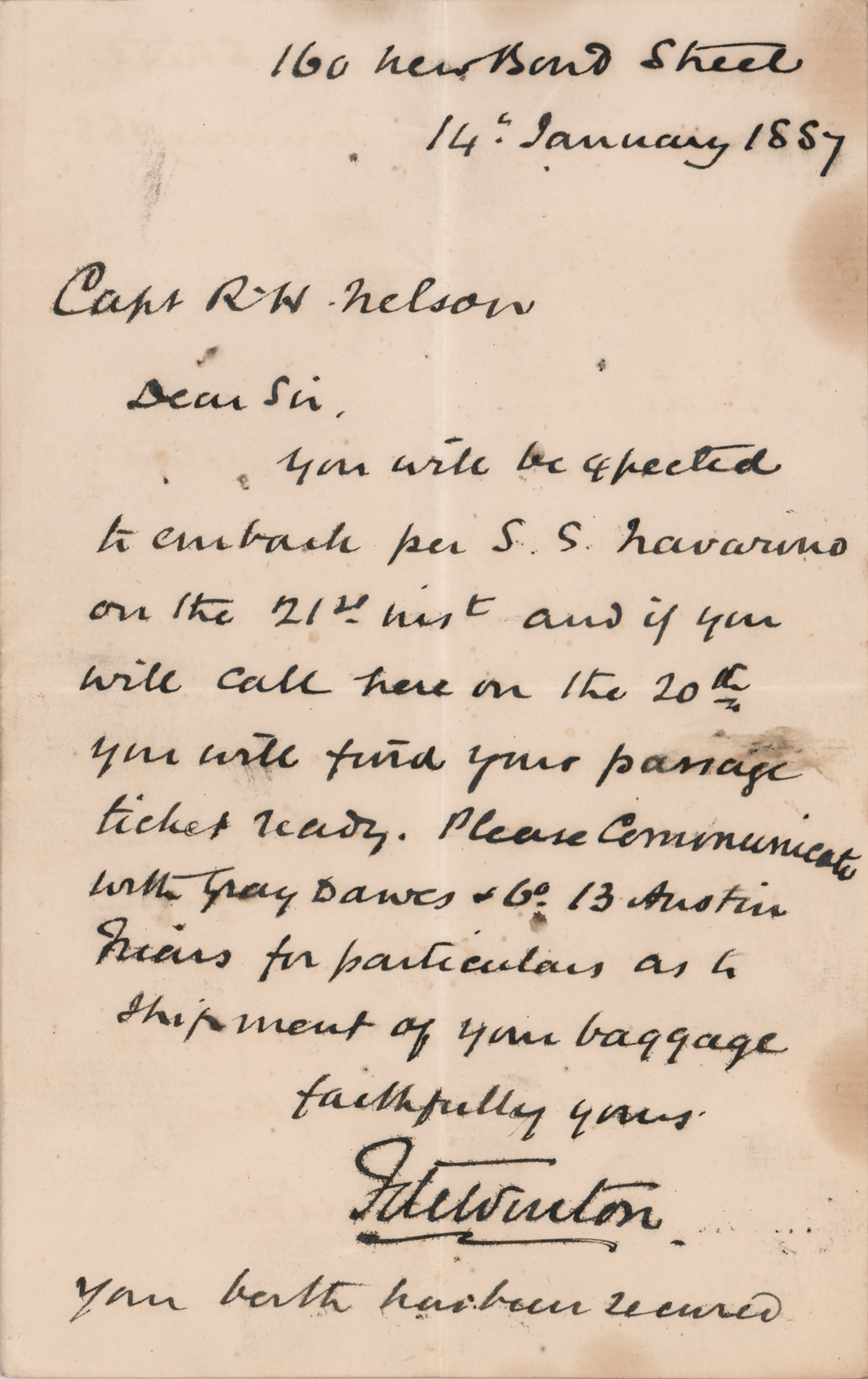
An ALS from Major-General Francis Walter de Winton, sent to Nelson on January 14, 1887, one week before the expedition departed London. It reads: “You will be expected to embark per S.S. Navarino on the 21st inst and if you will call here on the 20th you will find your passage ticket ready…your berth has been secured.”
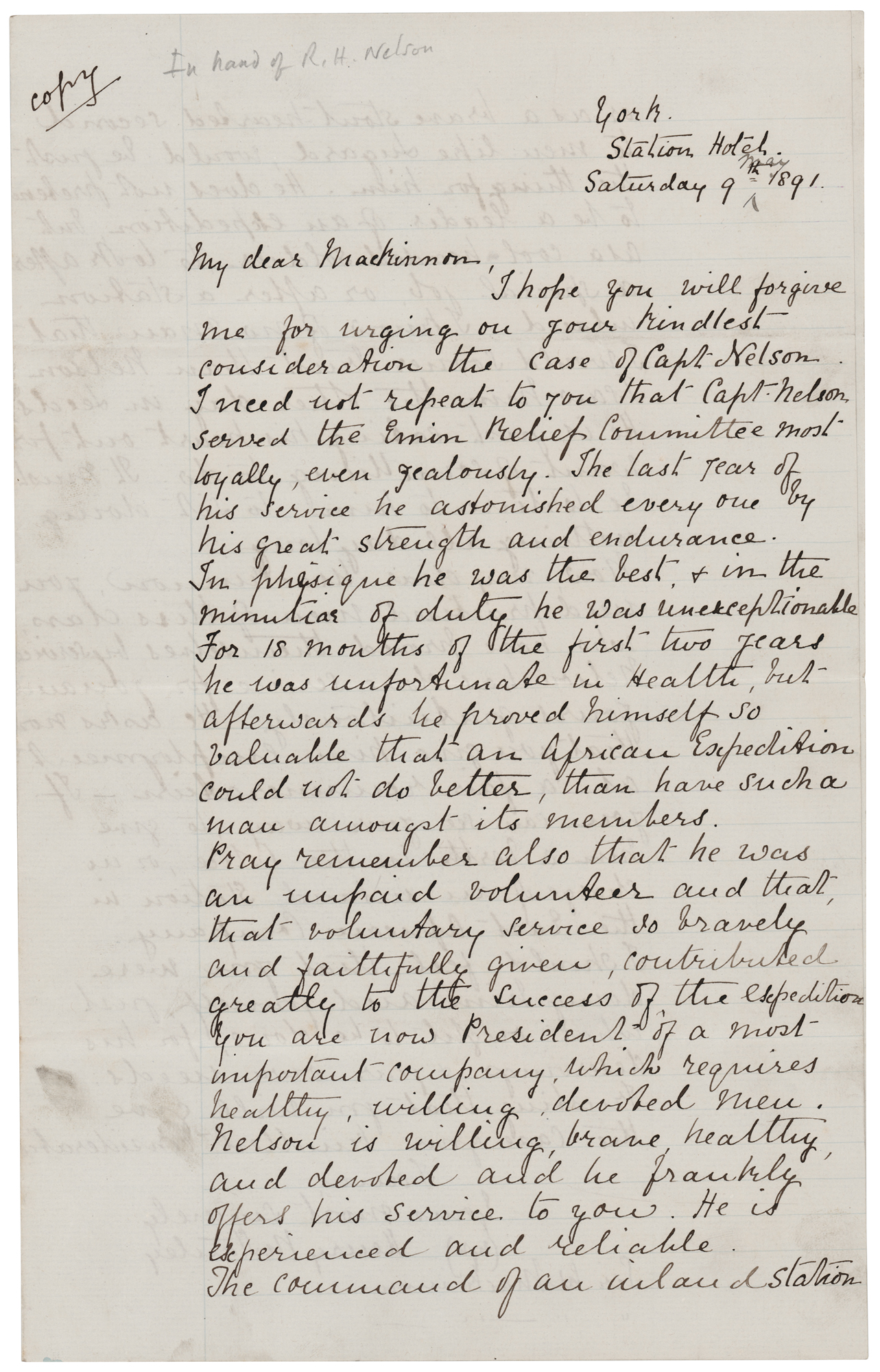
Two nearly identical letters of recommendation penned by Nelson on behalf of Stanley, both dated May 9, 1891, and directed to Sir William Mackinnon, 1st Baronet, the main financier of the relief expedition, imploring the latter to place Nelson in worthy employment, namely “a berth in the Police, or in charge of an inland Station in the East African Company.” Nelson signs for Stanley at the conclusion of both letters. Accompanying these letters is an employment acceptance letter sent to Nelson by the Imperial British East Africa Company on January 22, 1892. The balance of the archive contains additional letters of certification and recommendation written on behalf of Nelson and by Nelson. In overall fine condition.
While successful from the standpoint of Pasha’s retrieval, the Emin Pasha Relief Expedition ultimately dealt a devastating blow to the legacy of Henry Morton Stanley, who initially earned tremendous public praise following his return to Europe in May 1890. The acclaim, however, was short-lived. The cost of the journey (roughly two-thirds of the expedition did not return) and stories of cruelty and brutality soon emerged, including the horrific events of the expedition’s rear column led by Edmund Musgrave Barttelot and James Sligo Jameson. The former, whose deranged behavior resulted in a native shooting him dead, has often been identified as one of the sources for the character of Kurtz in Joseph Conrad's 1899 novel Heart of Darkness. A rare, firsthand record of one of the last large-scale expeditions from the ‘Scramble for Africa.’

