Sold For $6,250
*Includes Buyers Premium
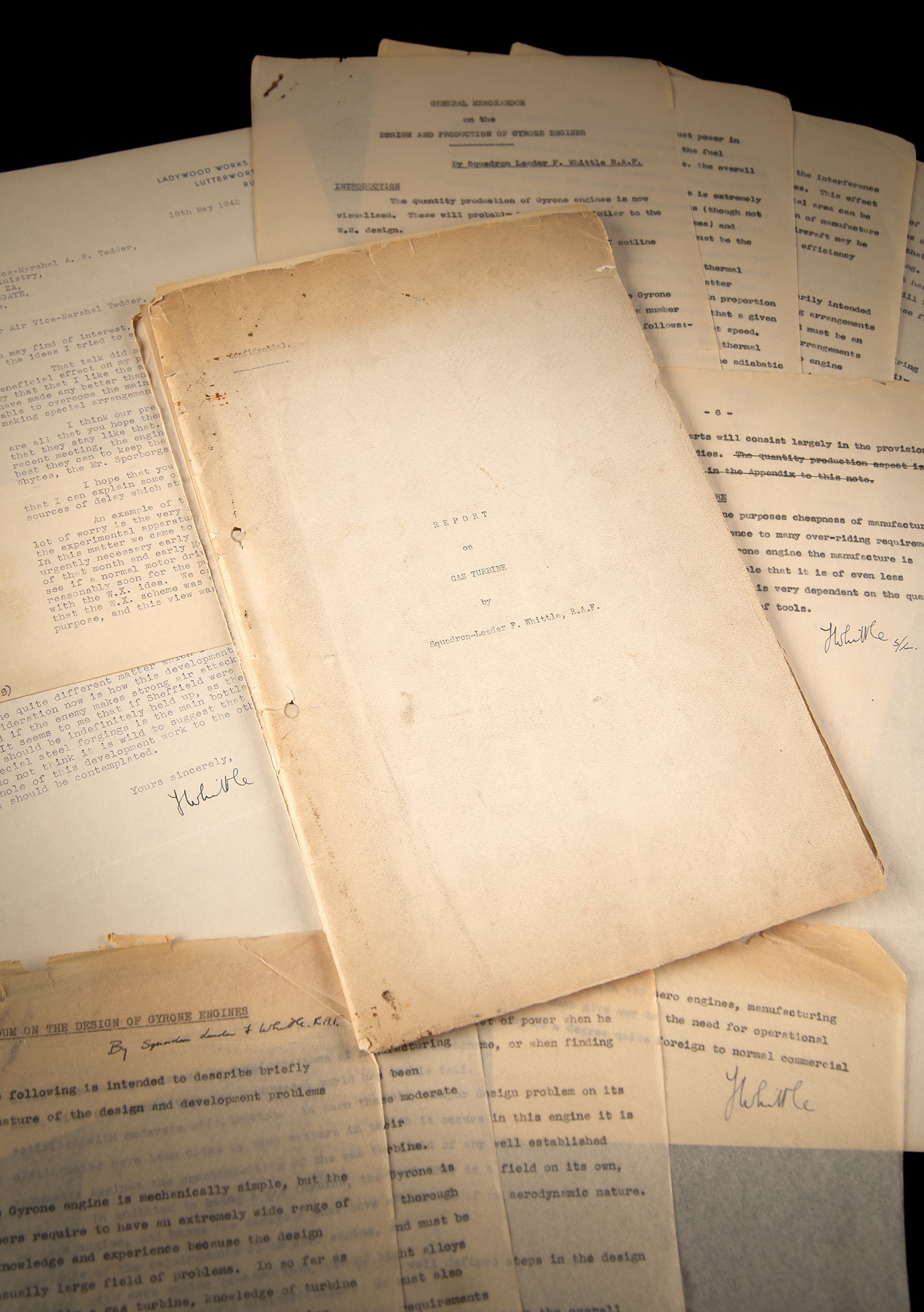
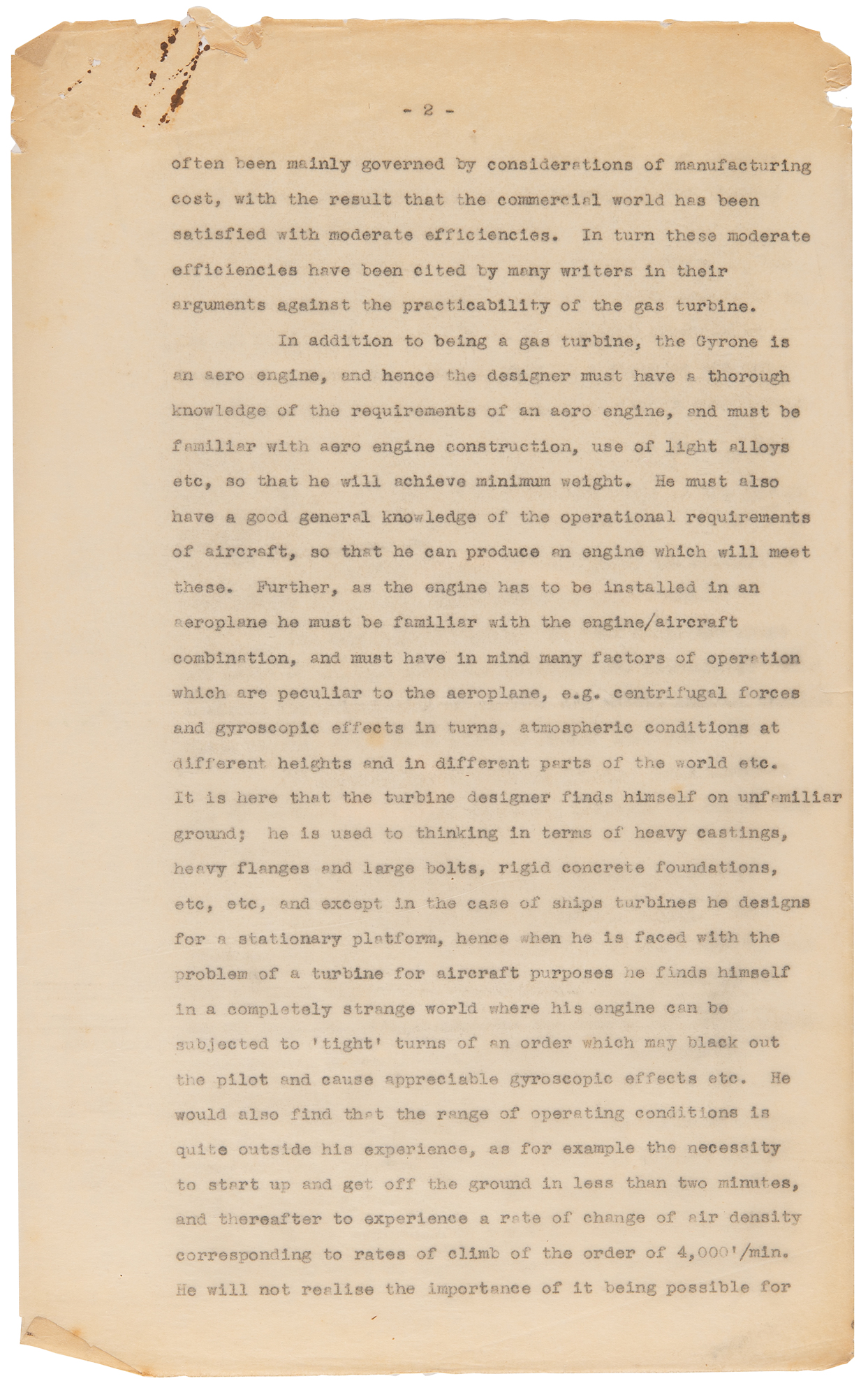
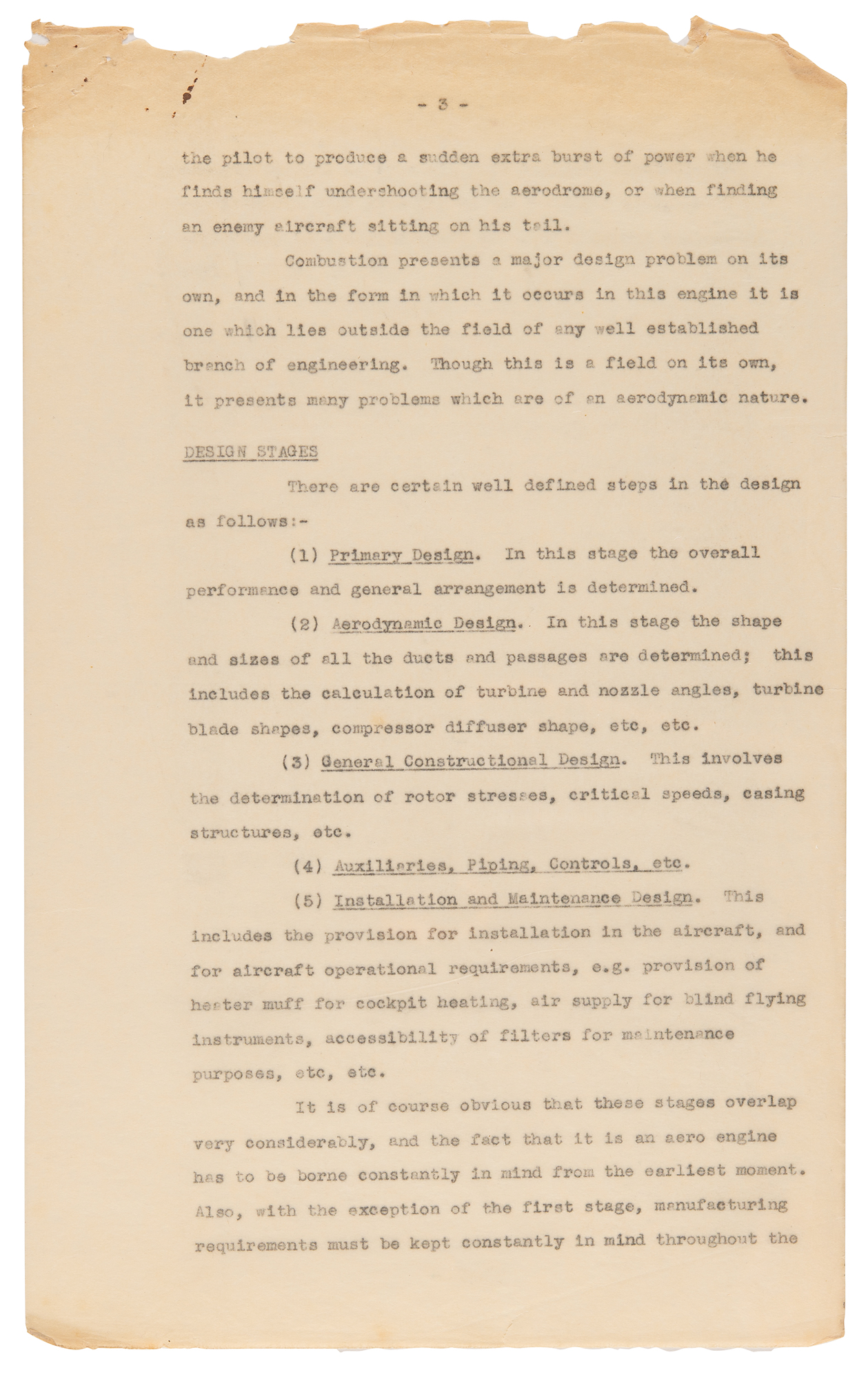
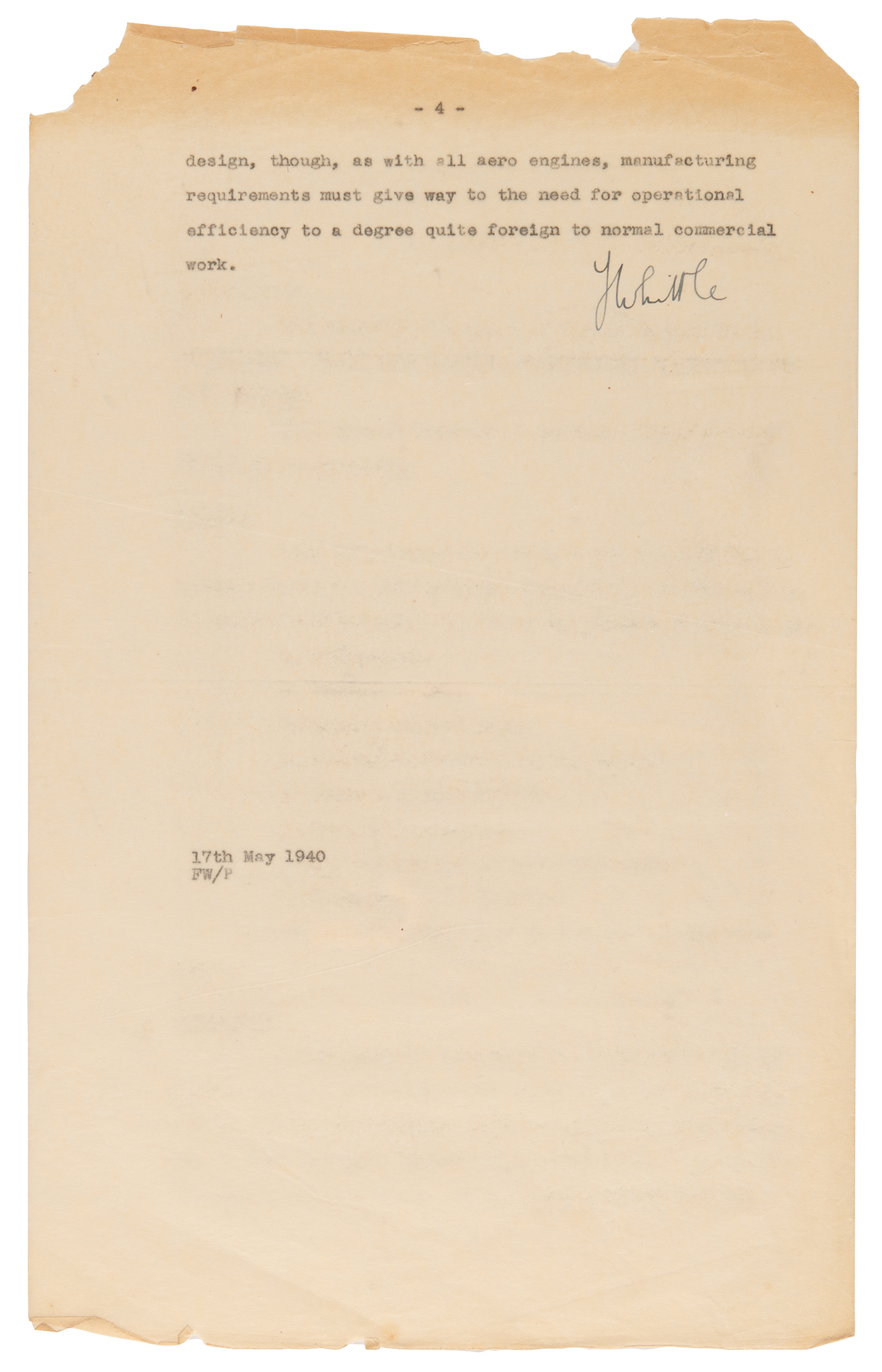
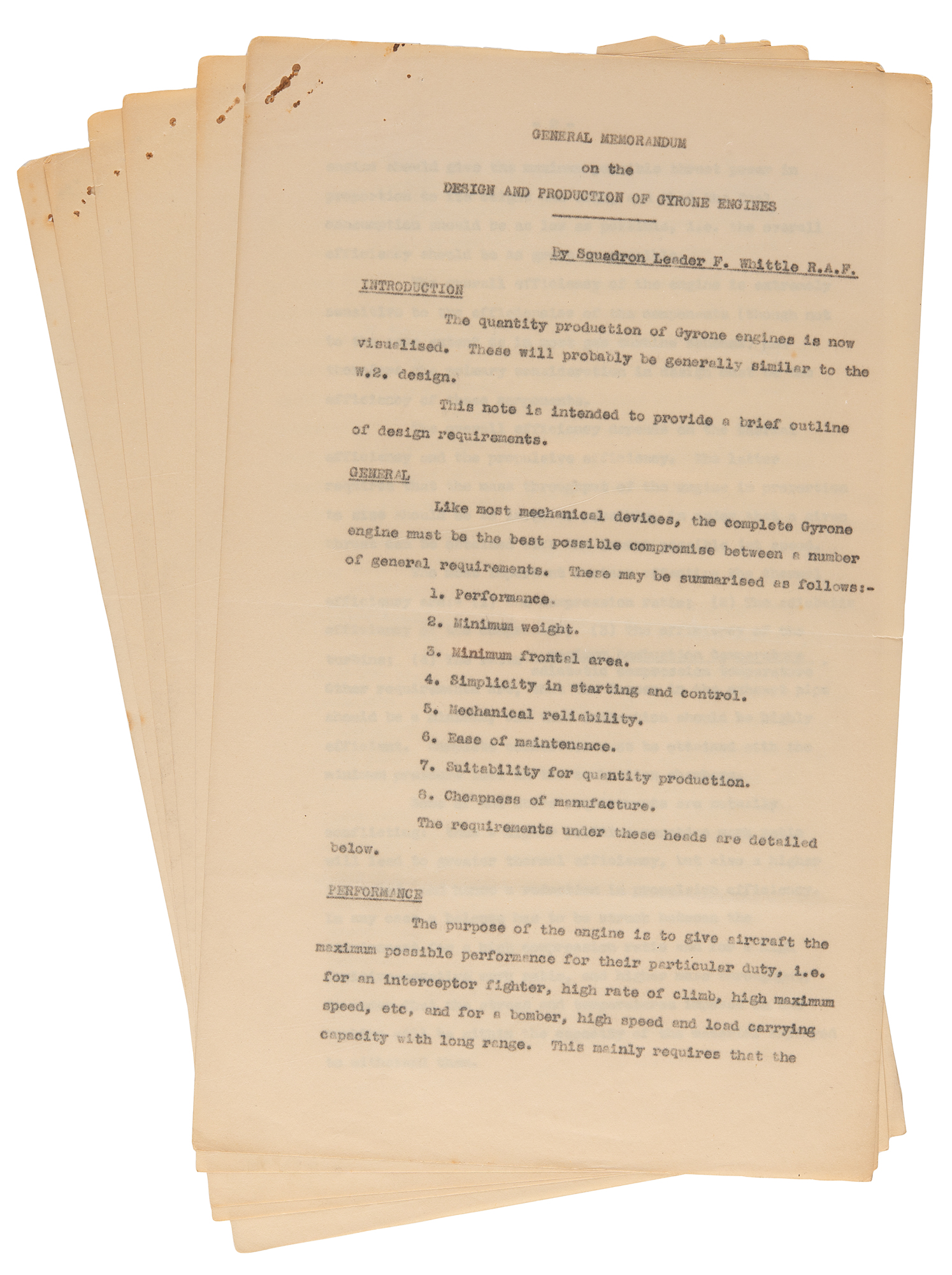
English Royal Air Force air officer (1907-1996) who is credited with single-handedly inventing the turbojet engine. Remarkable archive of documents tracing the earliest stages of Sir Frank Whittle’s revolutionary work on the turbojet engine, one of the defining inventions of the twentieth century. Whittle, a Royal Air Force officer and engineer, first outlined his concepts in the 1930s, when aviation was still dominated by piston-driven propellers. His 1938 confidential report to the Air Ministry, included here, records the first practical tests of a constant-pressure gas turbine for aircraft propulsion, marking the birth of the modern jet engine. Subsequent memoranda from 1940 reveal his ongoing efforts to refine jet design—addressing efficiency, reliability, production challenges, and the unique demands of aerial combat—while also highlighting the strategic pressures of wartime Britain, including fears of German bombing raids disrupting production.
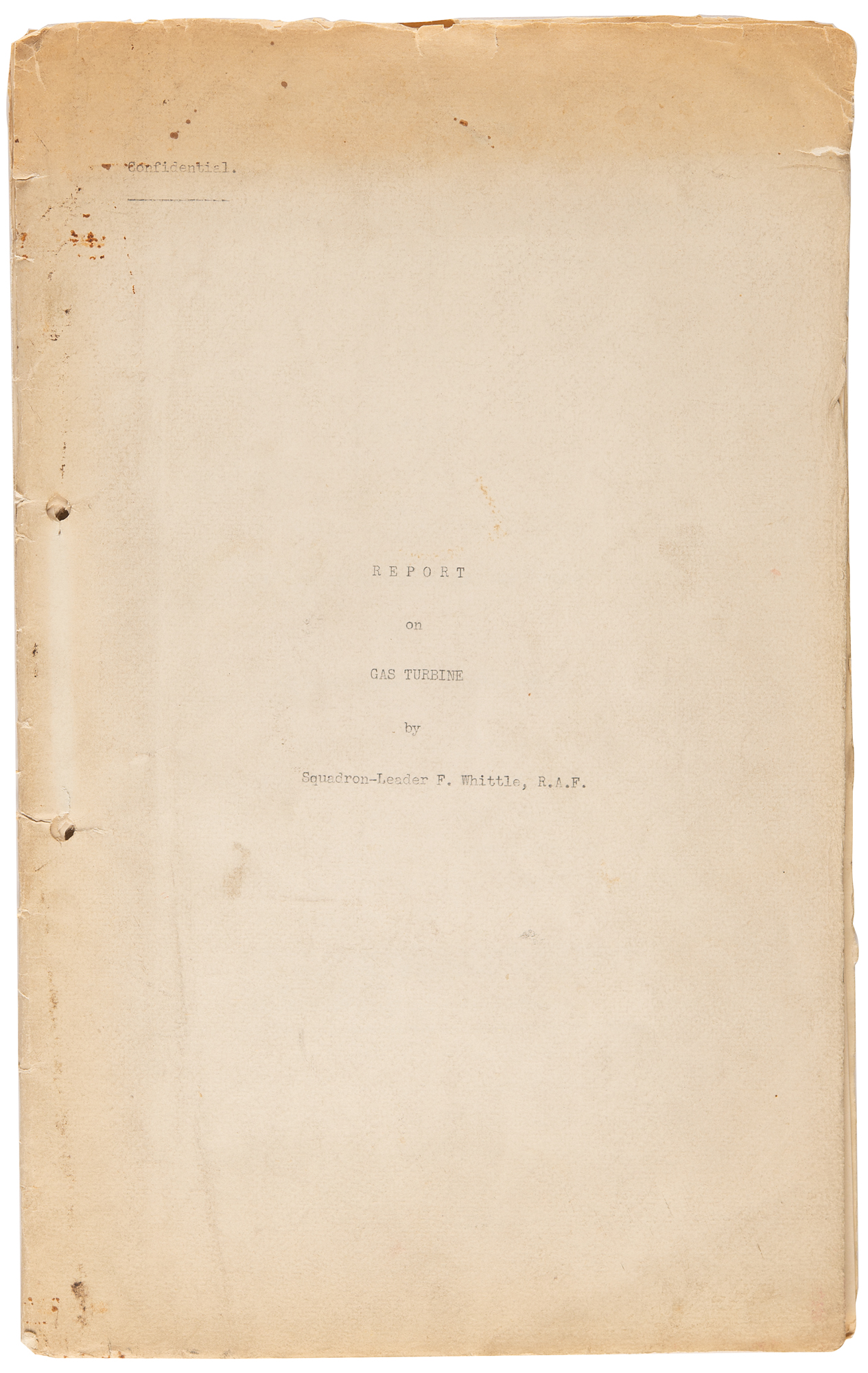
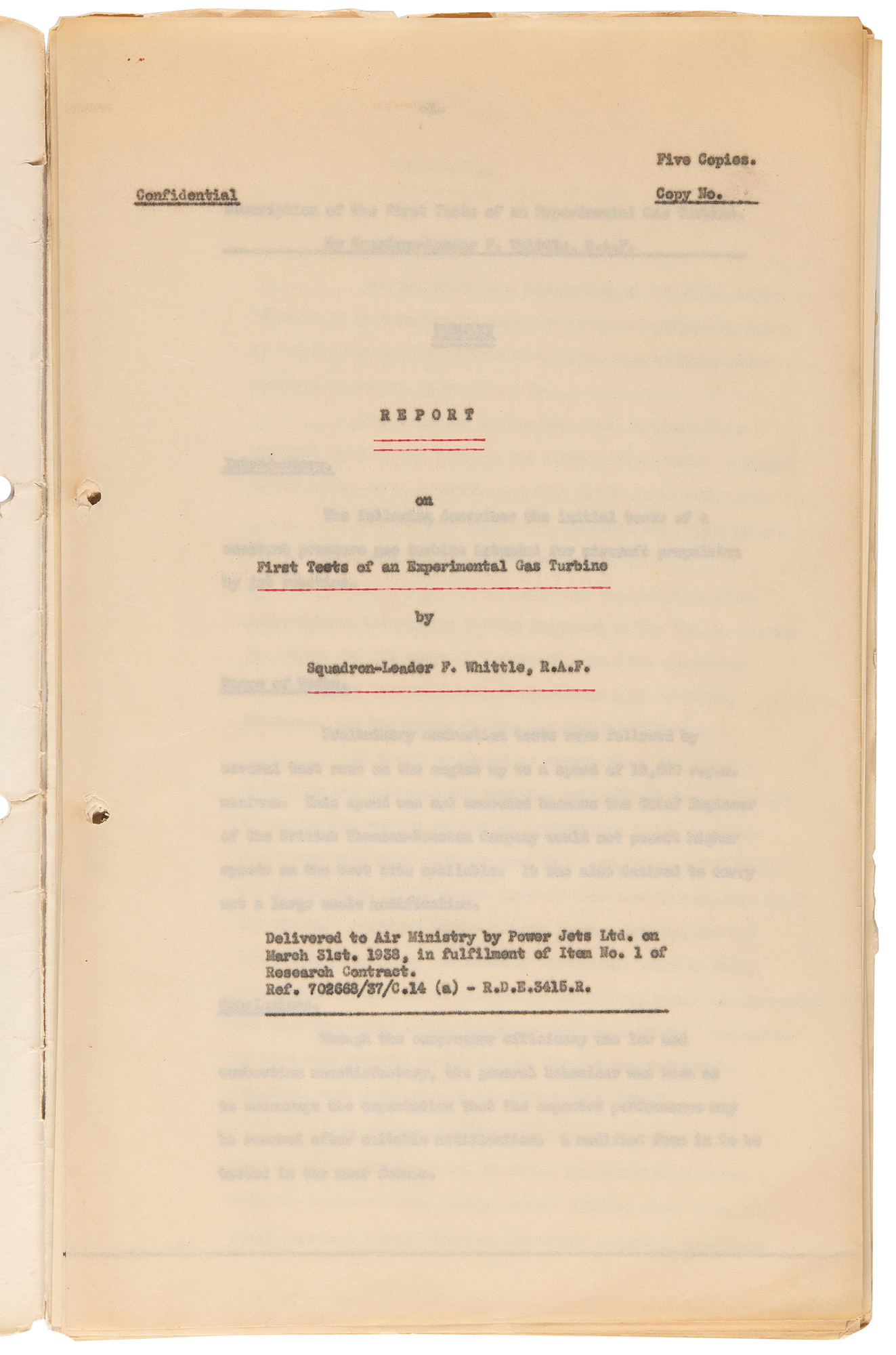
The group is highlighted by the historic report prepared by Frank Whittle under a research contract with the Air Ministry, unsigned, 36 carbon copy pages plus three fold-out appendix pages, 8 x 13, March 31, 1938. Marked "Confidential" and produced as one of just "Five Copies," the report describes in great detail the initial tests of a constant pressure gas turbine intended for aircraft propulsion by jet reaction and the experiments carried out under Whittle's supervision between April and August 1937, by Whittle's Power Jets Ltd. "in fulfilment of Item No. 1 of Research Contract," this being the earliest practical testing of what would become today's modern turbojet engine.
From Whittle's introduction: "The following is a description of the first series of tests on an experimental engine for aircraft propulsion built by Messrs. The British Thomson Houston Co. Ltd. of Rugby under contract to Messrs. Power Jets Ltd….At the time when the development of the propulsion unit was under consideration, there was no intention of making a complete engine at once, partly because definite ideas as to its final form were rather nebulous, but mainly because a sufficient knowledge of the performance of the different components for design purposes was lacking. It was therefore intended to adopt a step by step process, commencing with tests on a high speed single stage centrifugal compressor. It was decided that this should be of the size to be used in the engine…because it was believed that to make tests on a smaller scale would lead to misleading results." The report goes on to elaborate on design and construction, materials, the rotor assembly, the "very unorthodox feature" of the turbine nozzle, results of various experimental tests, and testing procedures.
According to the report, preliminary combustion tests "at least proved that the required combustion rates could be obtained, though for various reasons, they did not provide sufficient information for the avoidance of combustion trouble in the engine itself…Ignition of the atomising sprays by high tension spark proved to be easy at moderate air speeds, but as the electrodes were damaged early in the tests, ignition was mainly achieved by the insertion of burning oily waste through a flap…The quality of combustion was judged by the appearance of the flame, the presence or otherwise of visible smoke or fuel vapour, and the smell and the effect on the eyes of the exhaust." The report is loosely contained in its original paper wrappers, partially split along the hinge.
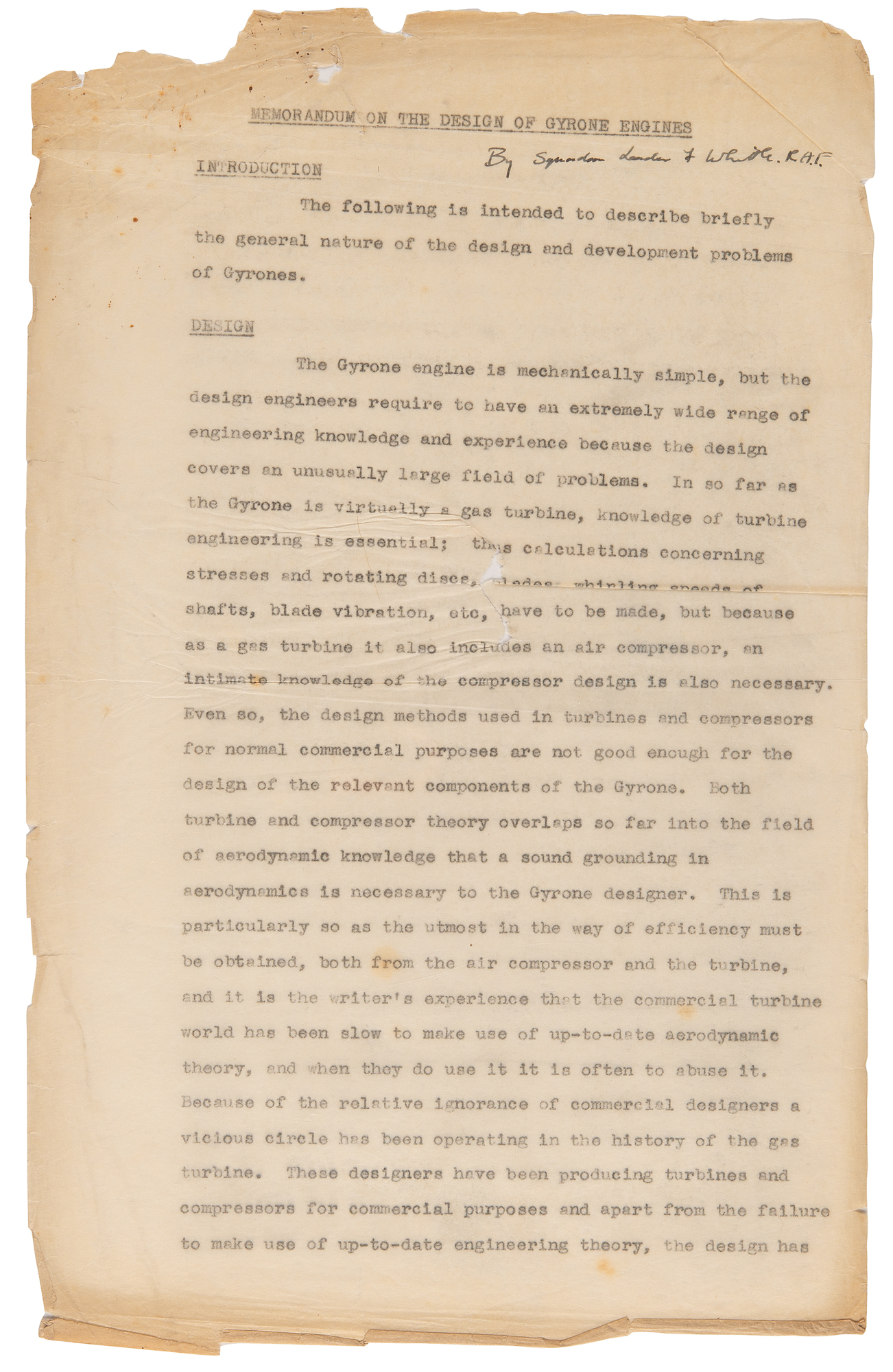
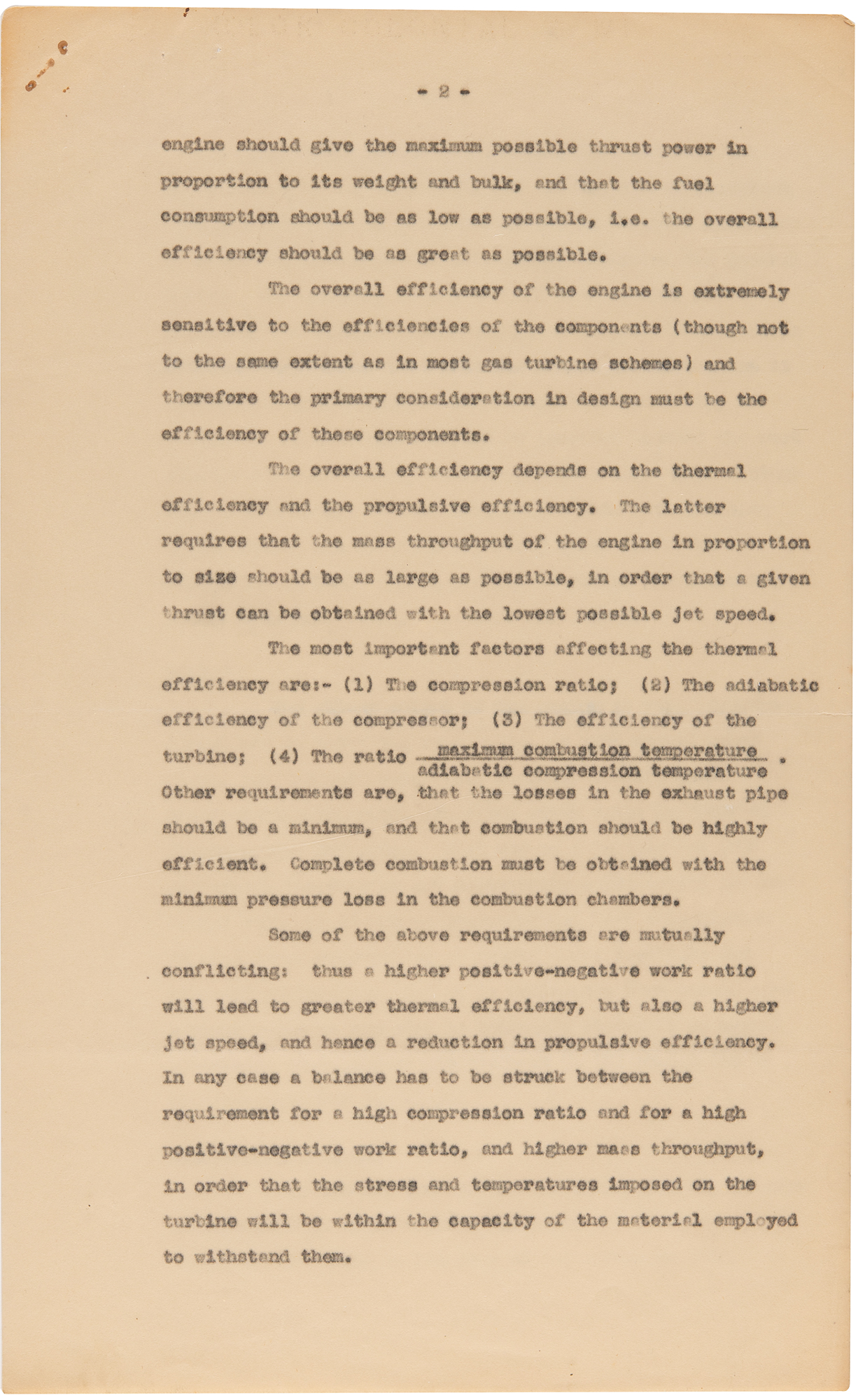
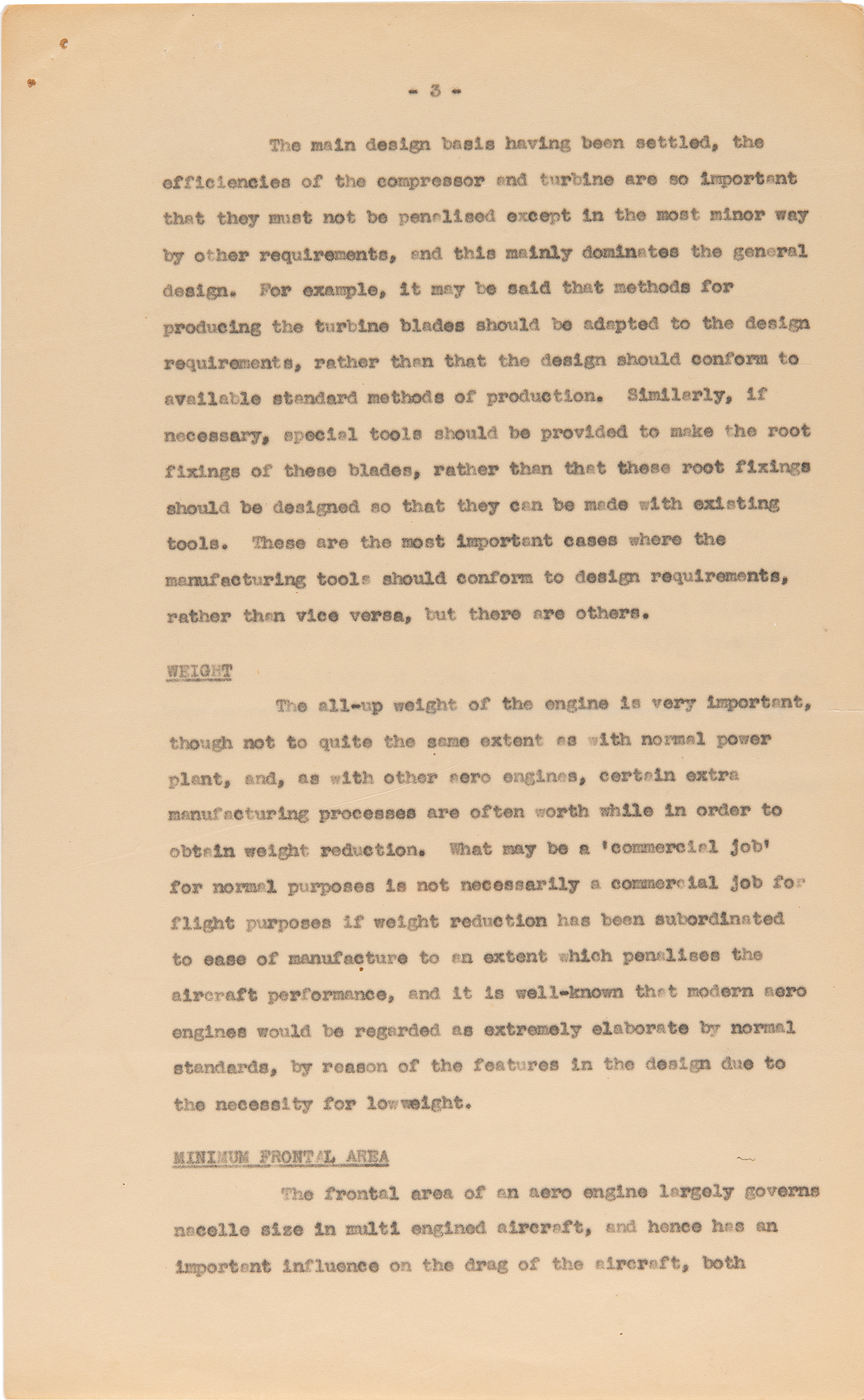
Additionally includes three pieces signed by Frank Whittle, including a "General Memorandum on the Design and Production of Gyrone Engines," a "Memorandum on the Design of Gyrone Engines," and a TLS to Air Vice-Marshal A. W. Tedder, May 18, 1940, enclosing said materials, in part: "I enclose two memoranda which you may find of interest, and which may help to amplify some of the ideas I tried to express at our talk on the 10th May. That talk did me a lot of good, and had a very beneficial effect on my peace of mind…An example of the sort of thing which causes me a lot of worry is the very serious delay which has occurred with the experimental apparatus for a pressure combustion test set…I sent a memorandum to Mr. Tweedie on March 27th after we had done a fair amount of drawing on the job…On the 15th April Mr. Tweedie told Mr. Whyte that the matter had been passed to the D.S.R. for a decision, and on the 15th April Mr. Tweedie asked the B.T.H. to give their opinion, and to assist them in this we sent the W.X. layout drawing to the B.T.H. on the 18th April, since when nothing has been settled…One quite different matter which I think needs urgent consideration now is how this development is going to be affected if the enemy makes strong air attacks on this Country. It seems to me that if Sheffield were intensively bombed we should be indefinitely held up, as the production of the special steel forgings is the main bottle neck of the job. I do not think it is wild to suggest that the removal of the whole of this development work to the other side of the Atlantic should be contemplated."
In overall very good to fine condition, with some edge wear, scattered small rust stains, and tears to the top of the memoranda.

