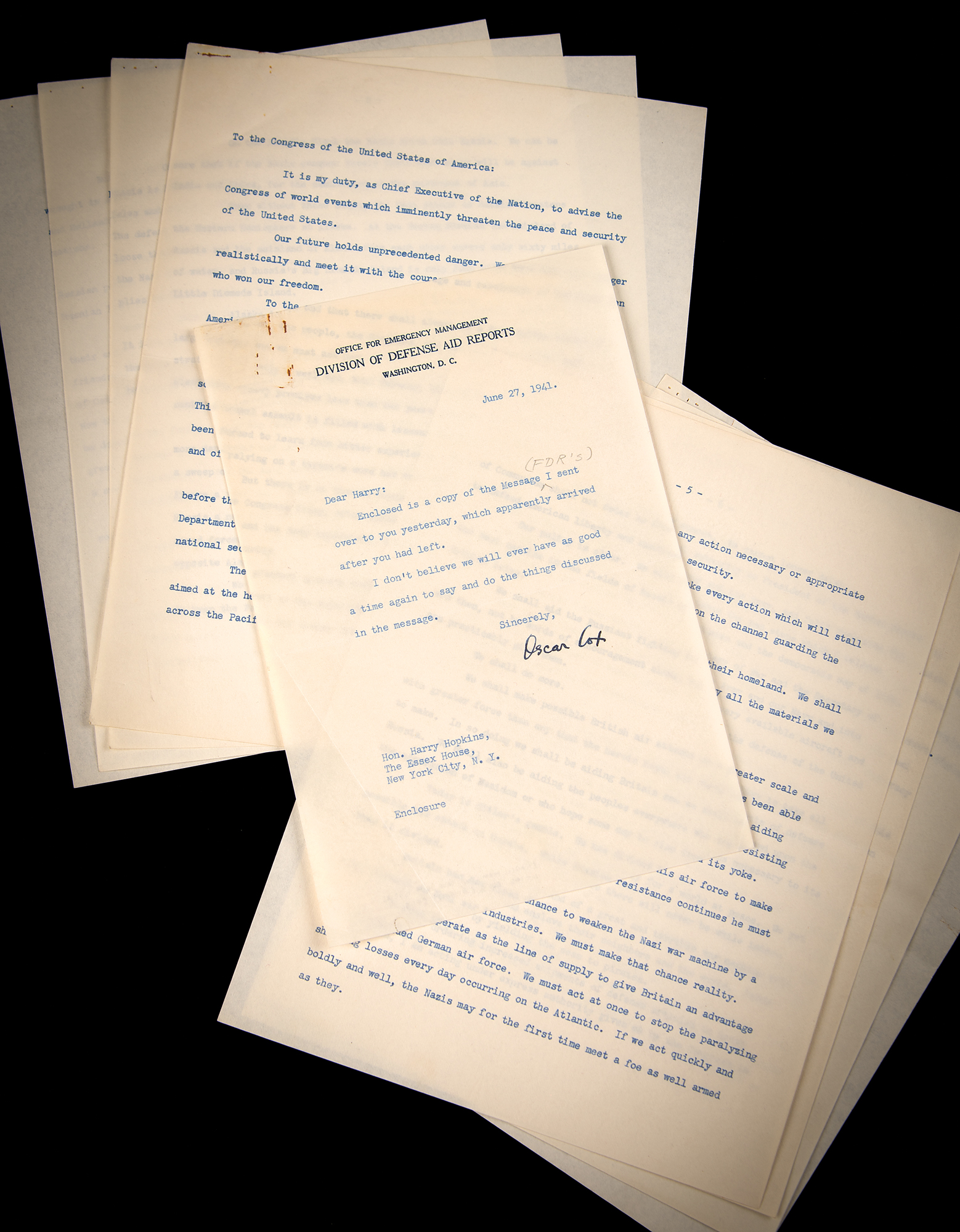
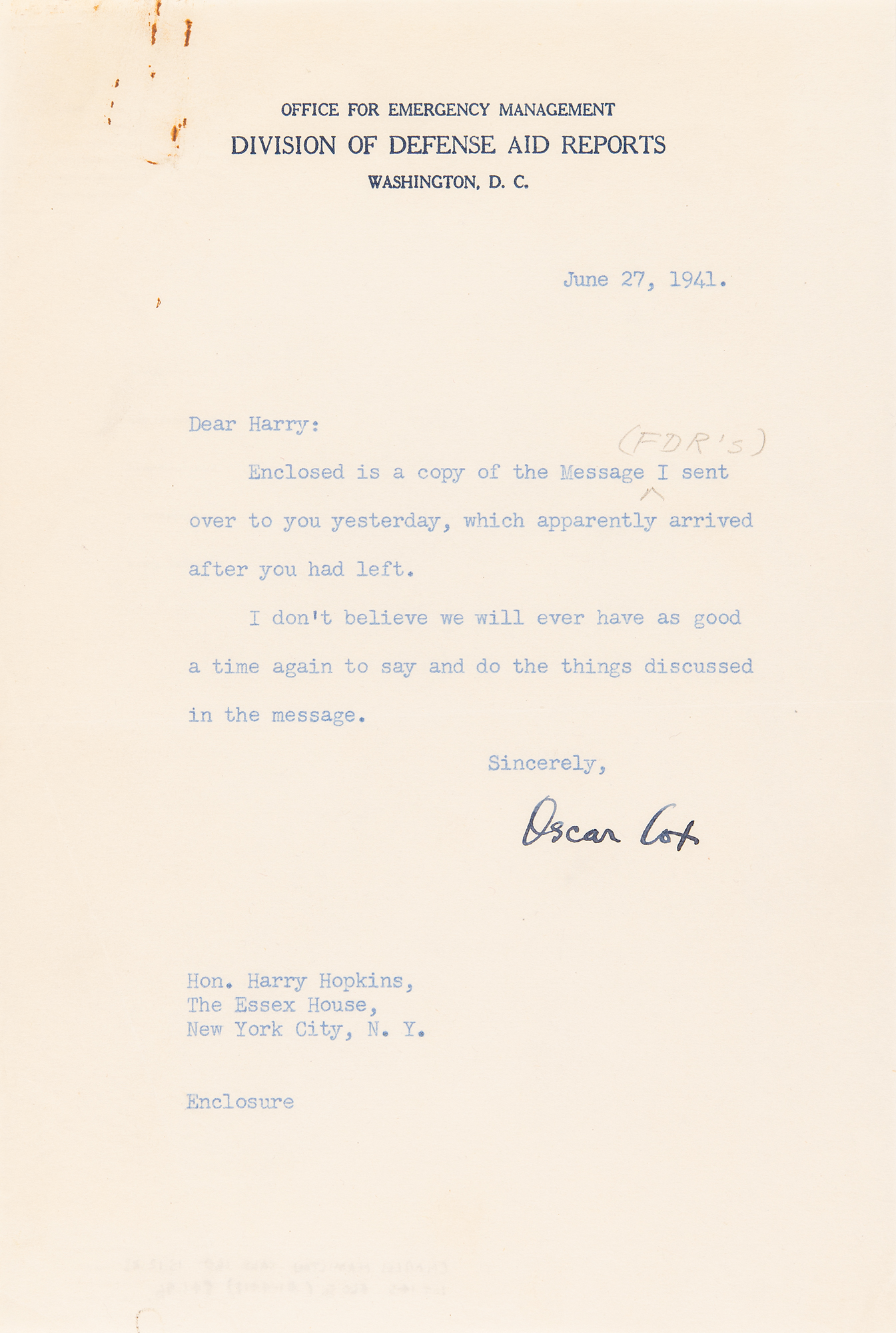
World War II-dated TLS signed "Oscar Cox," one page, 6.25 x 9.25, Office for Emergency Management, Division of Defense Aid Reports letterhead, June 27, 1941. Letter to FDR confidante, advisor, and emissary Harry Hopkins, in full: "Enclosed is a copy of the Message I sent over to you yesterday, which apparently arrived after you left. I don't believe we will ever have as good a time again to say and do the things discussed in the message."
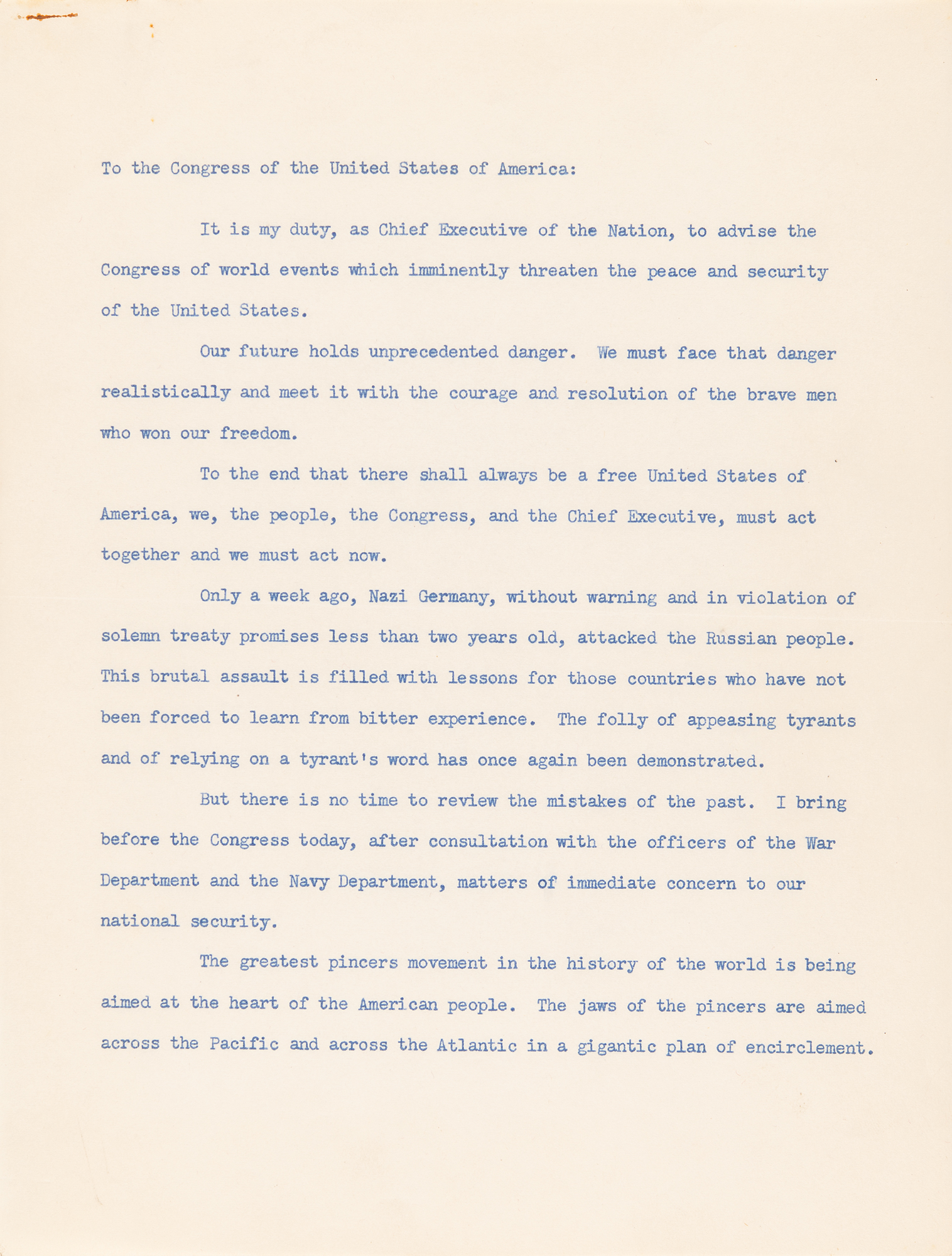
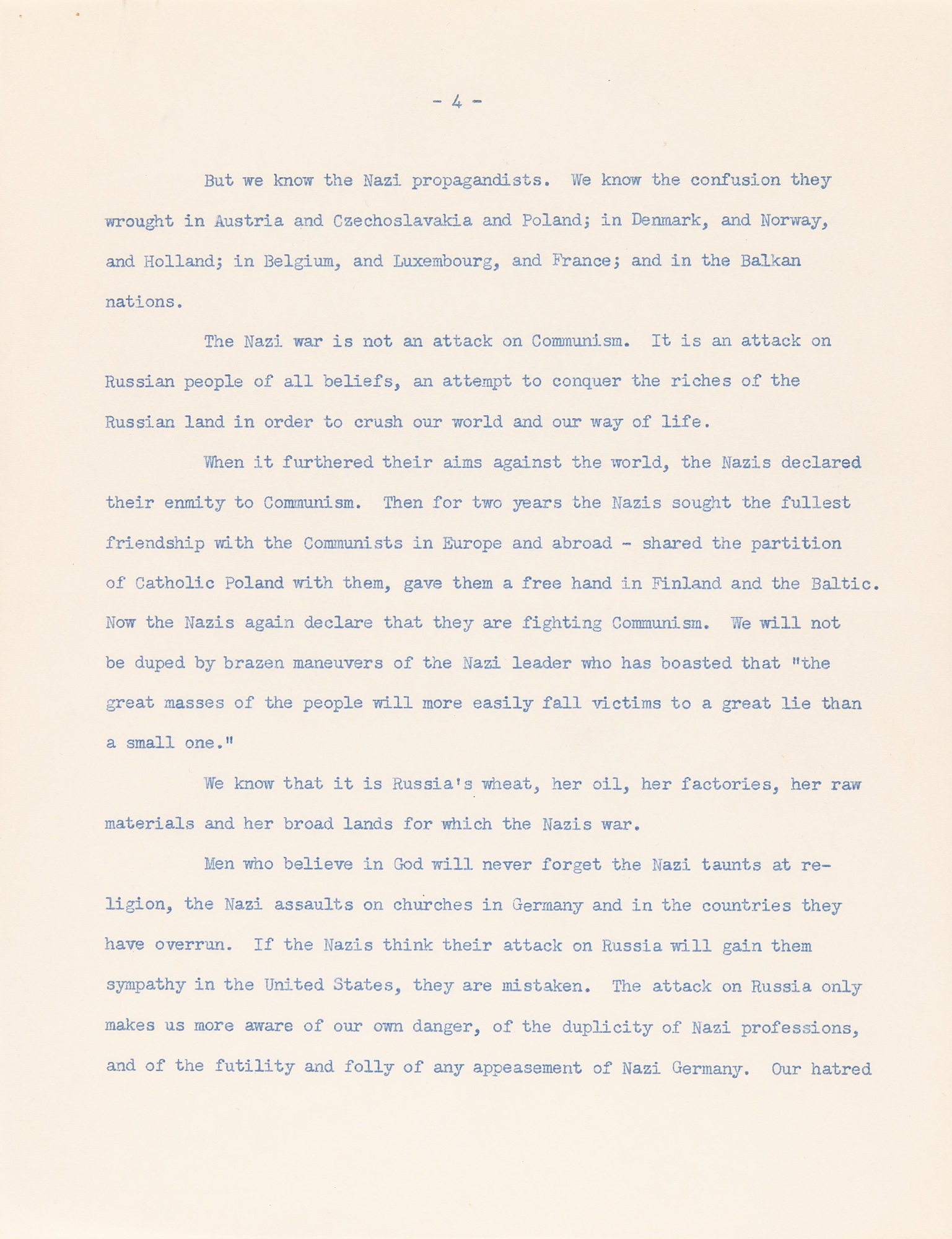
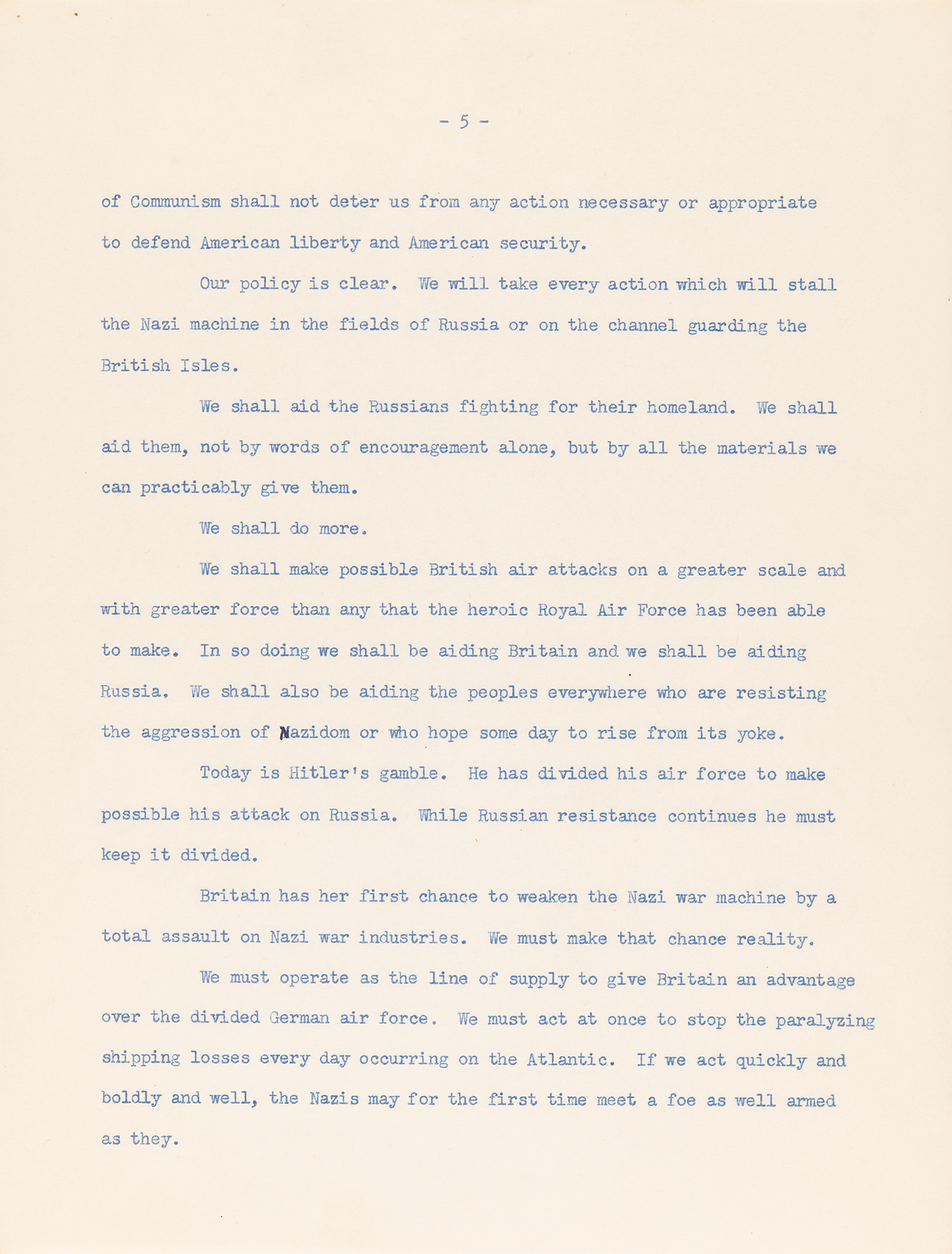
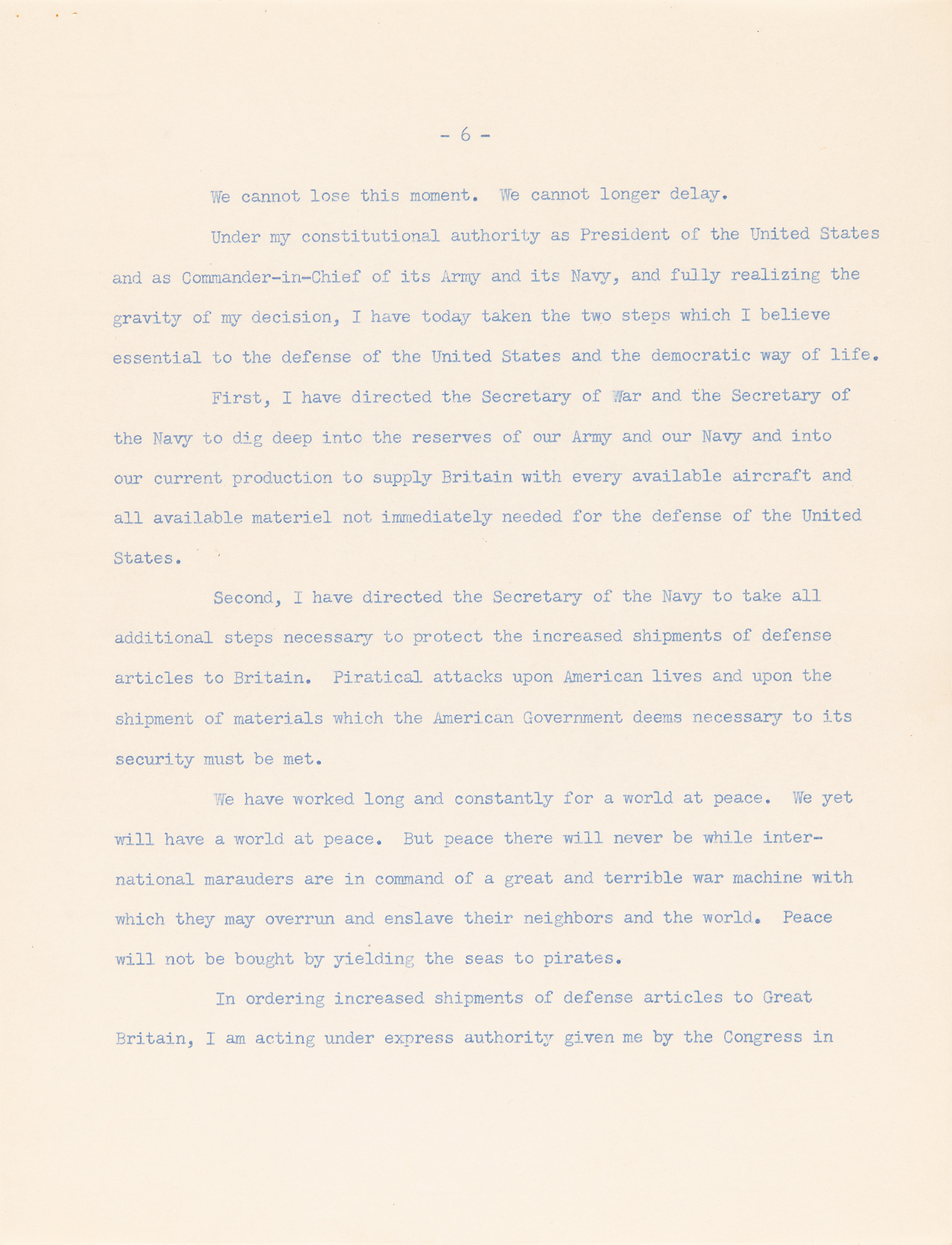
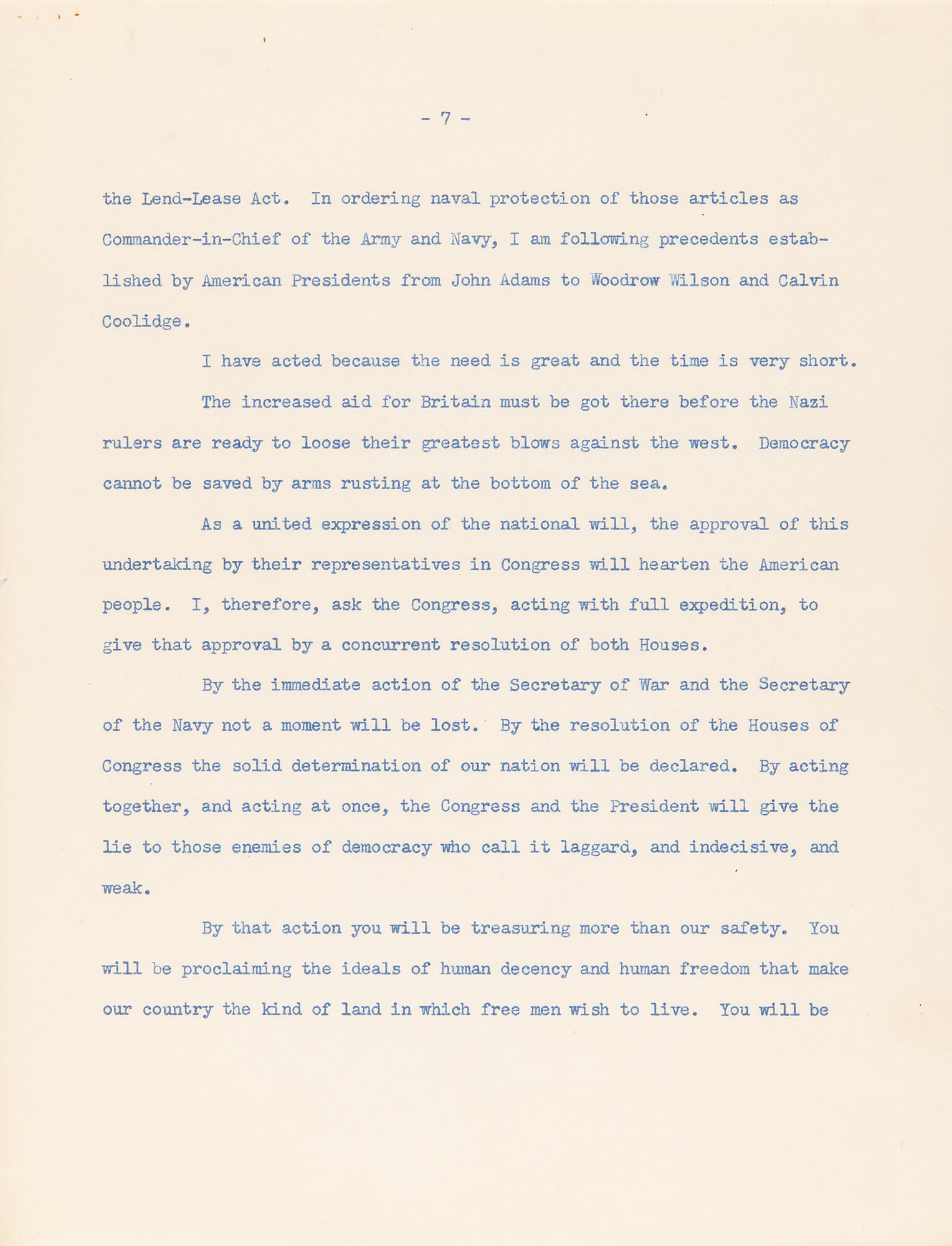
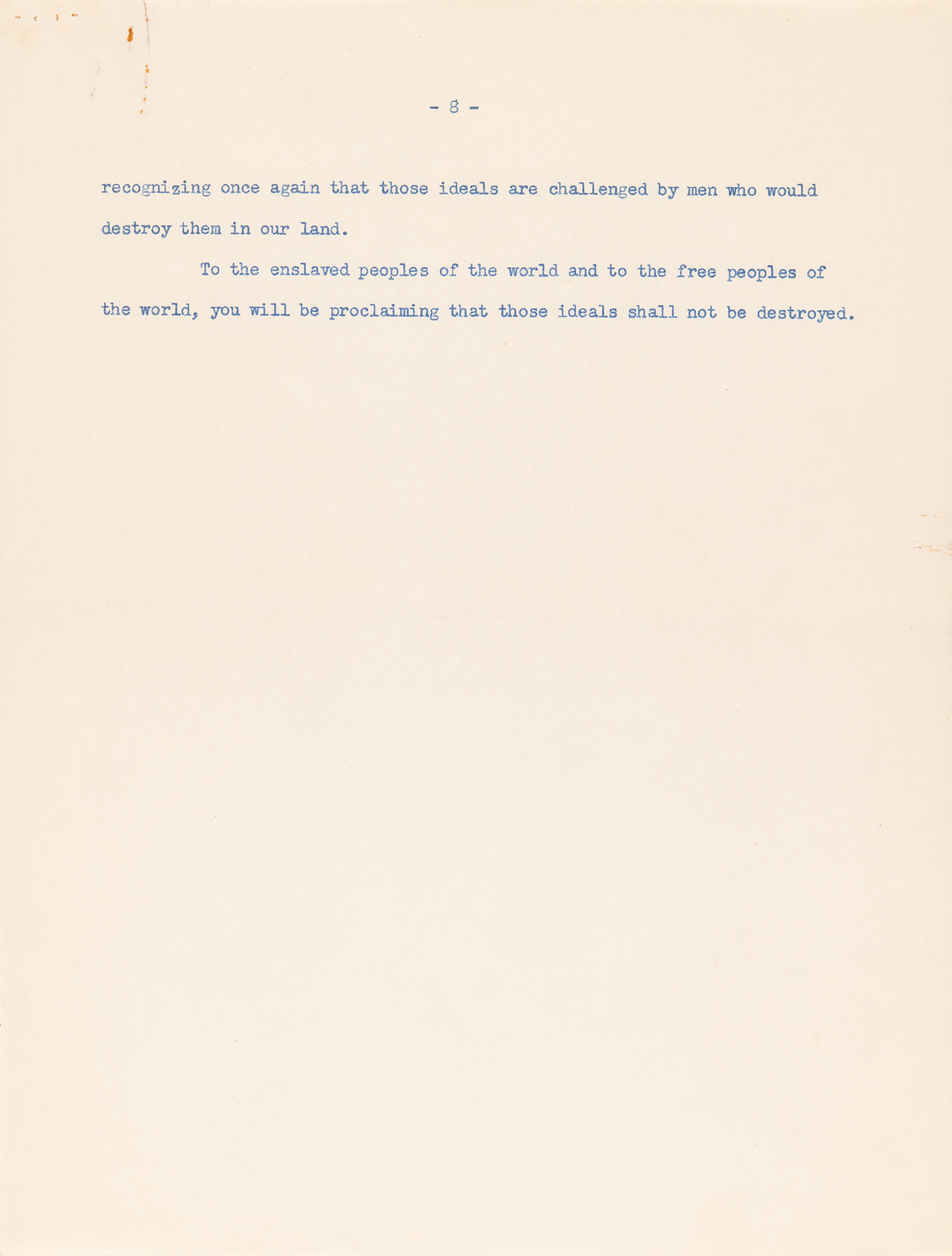
The accompanying enclosure, an eight-page typescript draft of a message to Congress prepared by President Franklin D. Roosevelt, on paper watermarked with the presidential seal, carries remarkable commentary on the dangerous world situation and the associated risks for the United States. Roosevelt ponders the fate of Alaska in the event of Russian surrender to Nazi Germany, justifying American aid to Russia and Great Britain—authorized by the Lend-Lease Act—and calling for further resolutions from Congress. Notably, we find no record of this message having ever been delivered.
The message, in small part: "Only a week ago, Nazi Germany, without warning and in violation of solemn treaty promises less than two years old, attacked the Russian people. This brutal assault is filled with lessons for those countries who have not been forced to learn from bitter experience. The folly of appeasing tyrants and of relying on a tyrant's word has once again been demonstrated.
But there is no time to review the mistakes of the past. I bring before the Congress today, after consultation with the officers of the War Department and the Navy Department, matters of immediate concern to our national security.
The greatest pincers movement in the history of the world is being aimed at the heart of the American people. The jaws of the pincers are aimed across the Pacific and across the Atlantic in a gigantic plan of encirclement.
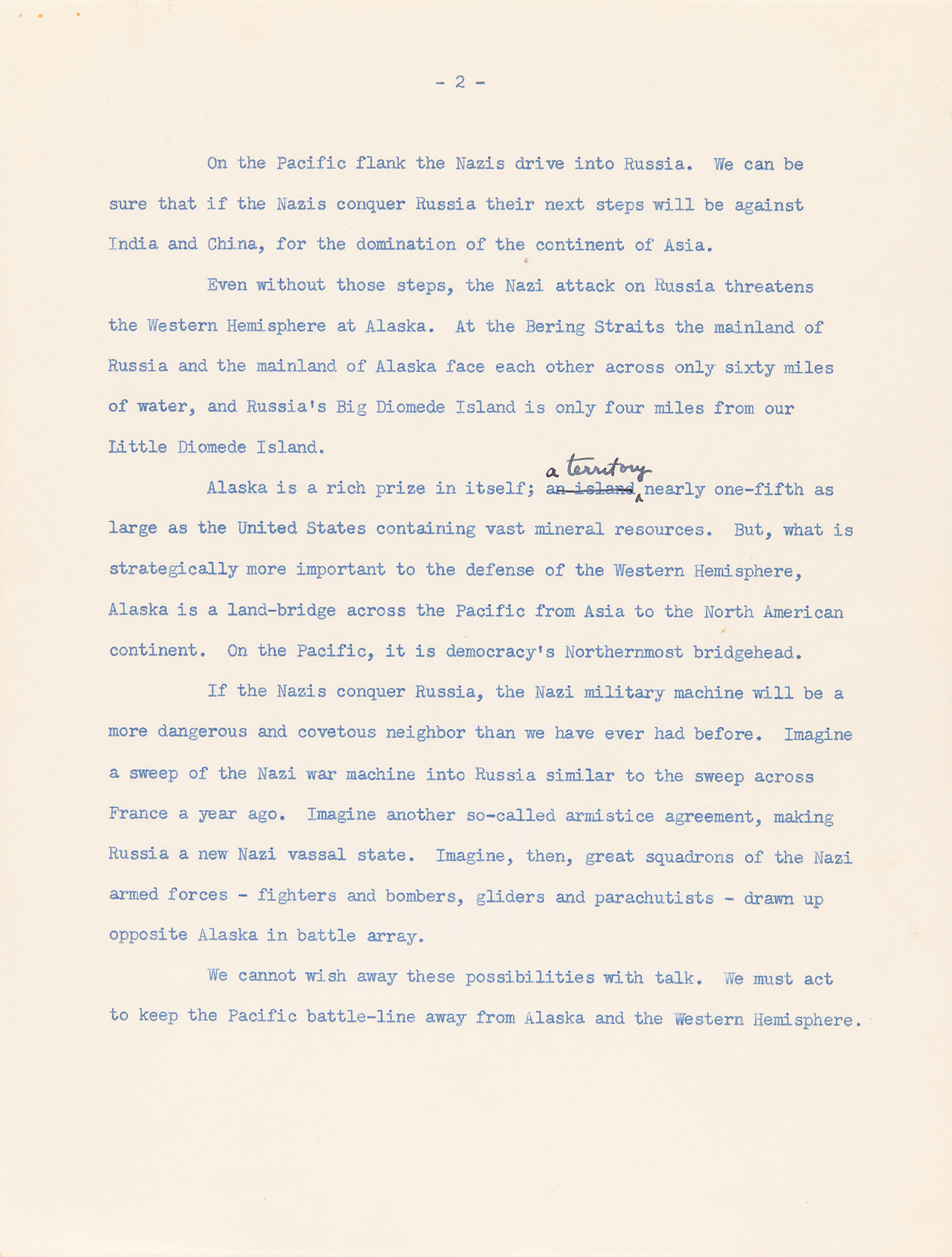
On the Pacific flank the Nazis drive into Russia. We can be sure that if the Nazis conquer Russia their next steps will be against India and China, for the domination of the continent of Asia.
Even without those steps, the Nazi attack on Russia threatens the Western Hemisphere at Alaska. At the Bering Straits the mainland of Russia and the mainland of Alaska face each other across only sixty miles of water, and Russia's Big Diomede Island is only four miles from our Little Diomede Island.
Alaska is a rich prize in itself; a territory nearly one-fifth as large as the United States containing vast mineral resources. But, what is strategically more important to the defense of the Western Hemisphere, Alaska is a land-bridge across the Pacific from Asia to the North American continent. On the Pacific, it is democracy's Northernmost bridgehead.
If the Nazis conquer Russia, the Nazi military machine will be a more dangerous and covetous neighbor than we have ever had before. Imagine a sweep of the Nazi war machine into Russia similar to the sweep across France a year ago. Imagine another so-called armistice agreement, making Russia a new Nazi vassal state. Imagine, then, great squadrons of the Nazi fighters and bombers, gliders and parachutists drawn up armed forces opposite Alaska in battle array.
We cannot wish away these possibilities with talk. We must act to keep the Pacific battle-line away from Alaska and the Western Hemisphere.
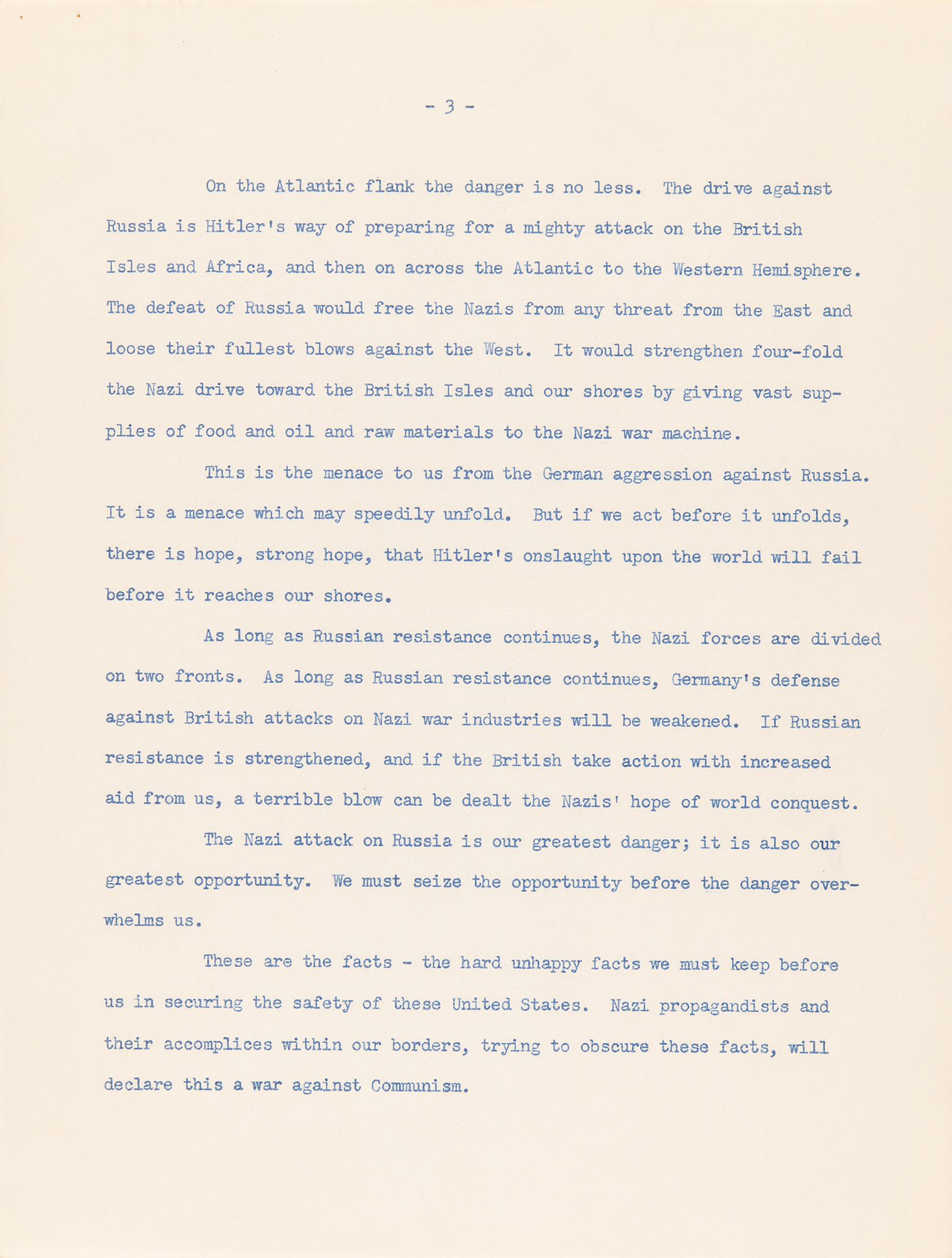
On the Atlantic flank the danger is no less. The drive against Russia is Hitler's way of preparing for a mighty attack on the British Isles and Africa, and then on across the Atlantic to the Western Hemisphere. The defeat of Russia would free the Nazis from any threat from the East and loose their fullest blows against the West. It would strengthen four-fold the Nazi drive toward the British Isles and our shores by giving vast supplies of food and oil and raw materials to the Nazi war machine.
This is the menace to us from the German aggression against Russia. It is a menace which may speedily unfold. But if we act before it unfolds, there is hope, strong hope, that Hitler's onslaught upon the world will fail before it reaches our shores.
As long as Russian resistance continues, the Nazi forces are divided on two fronts. As long as Russian resistance continues, Germany's defense against British attacks on Nazi war industries will be weakened. If Russian resistance is strengthened, and if the British take action with increased aid from us, a terrible blow can be dealt to the Nazis' hope of world conquest.
The Nazi attack on Russia is our greatest danger; it is also our greatest opportunity. We must seize the opportunity before the danger overwhelms us." The typescript has one minor handwritten correction, evidently in Cox's hand. In overall fine condition, with a rusty paperclip mark to the top of the letter.
Oscar Cox (1905–1966) served as general counsel of both the Lend-Lease Administration and the Office of Emergency Management during World War II.

