
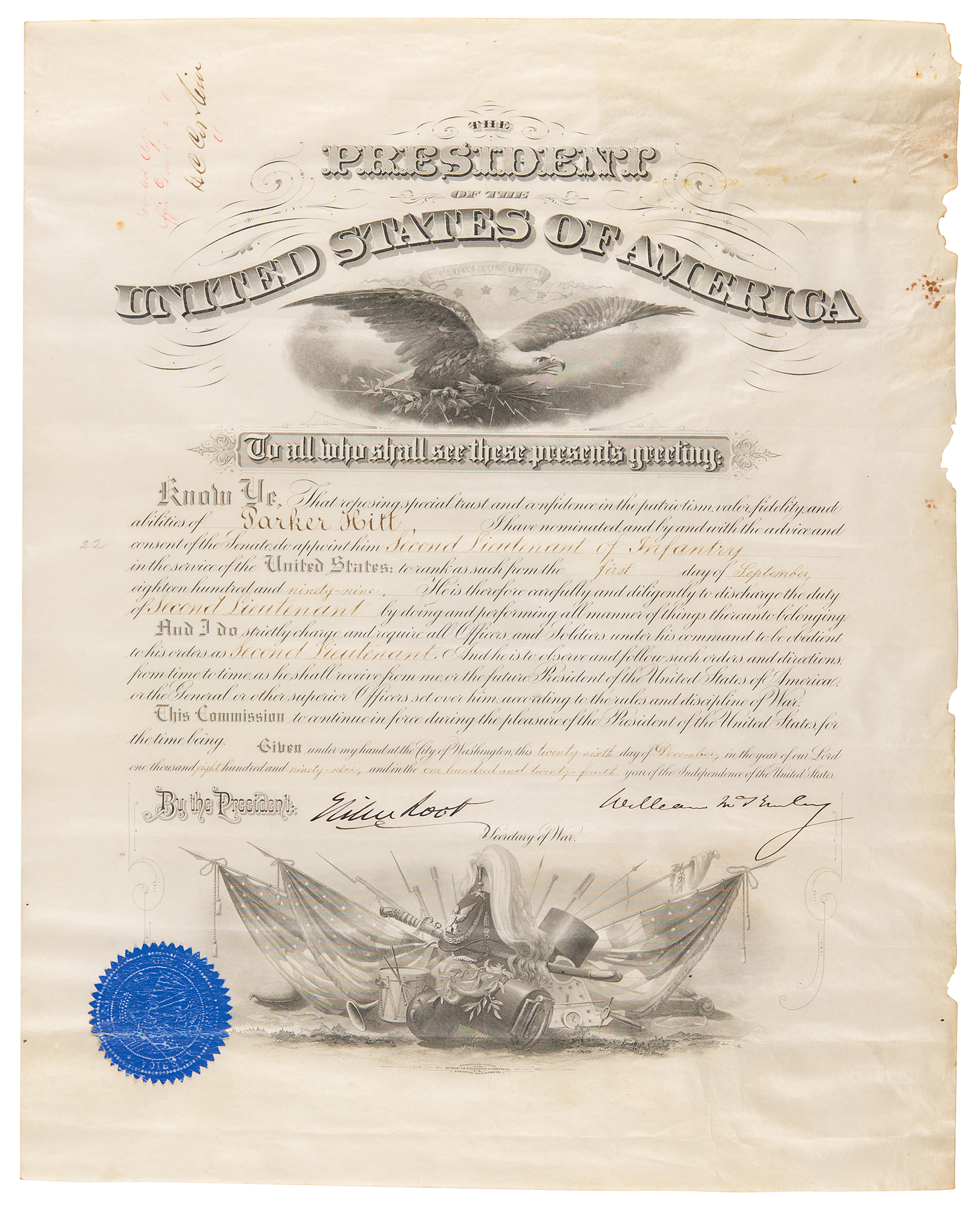
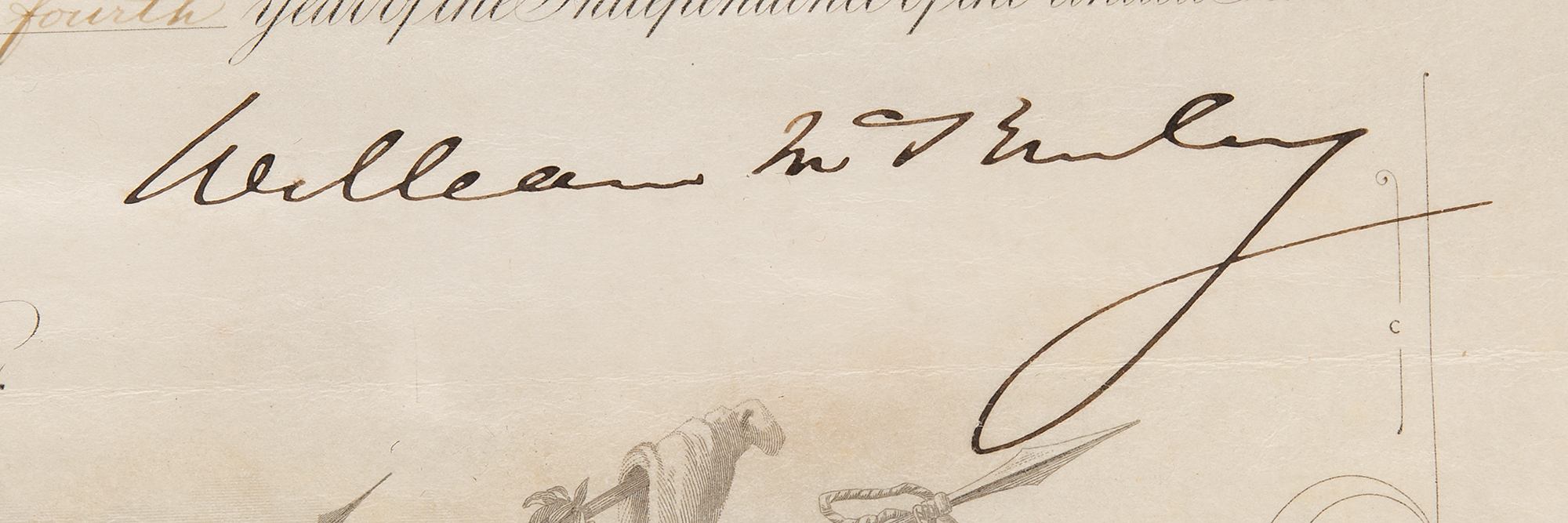
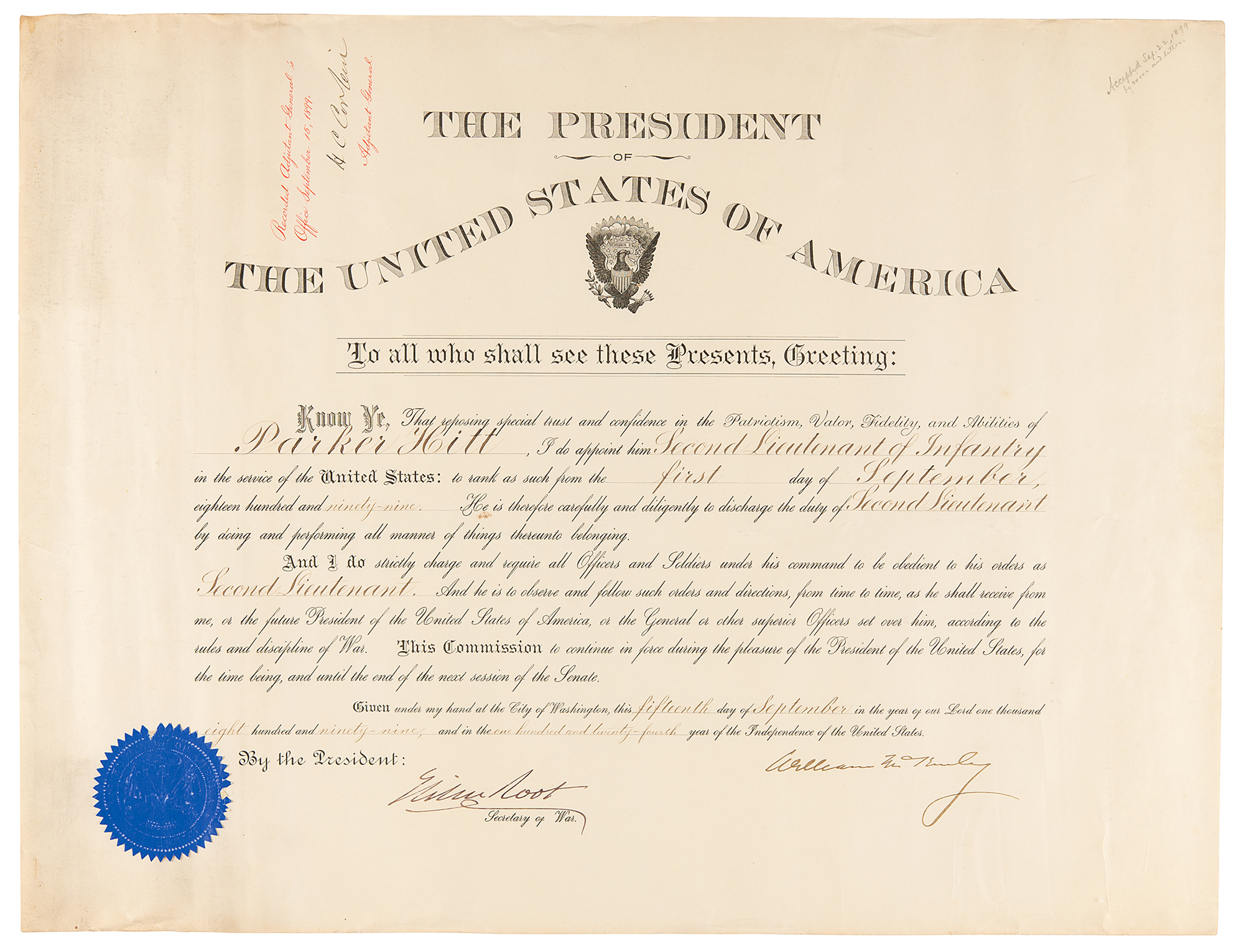
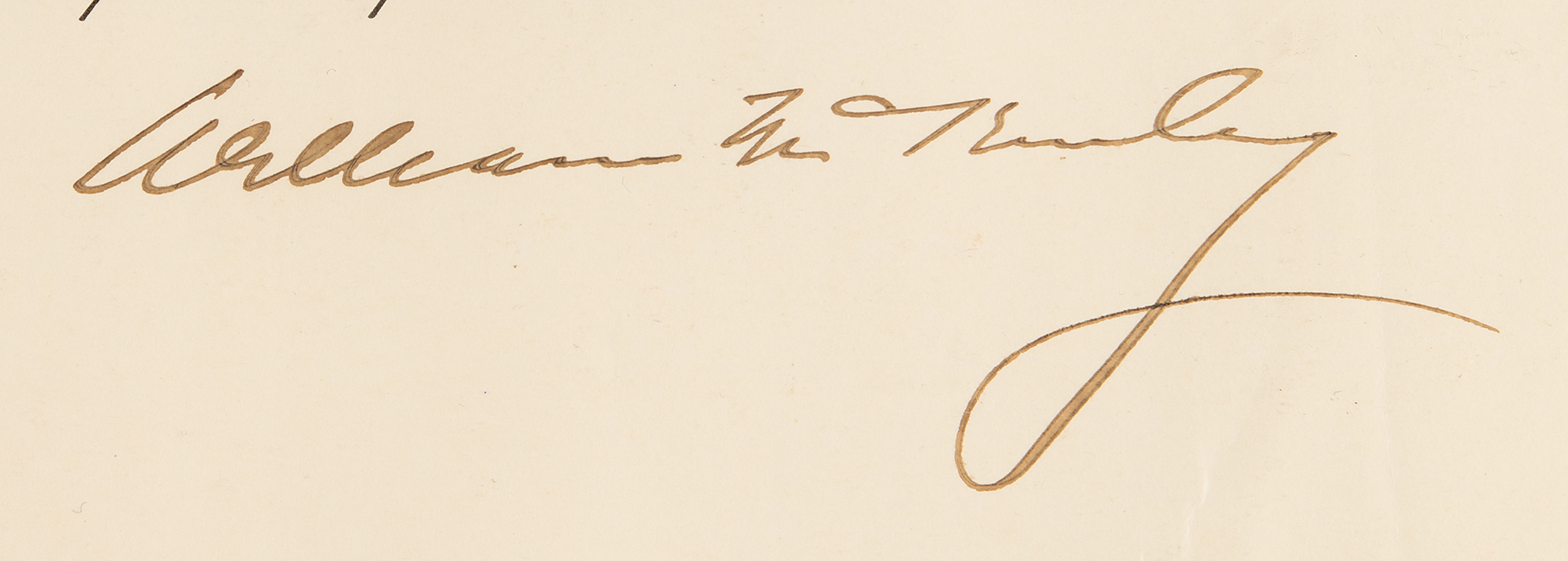


Impressive document archive of Colonel Parker Hitt, a career U.S. Army officer who is known as the ‘Father of American Military Cryptography,’ comprised of five military appointments dated from 1899 to 1911, each signed and approved by an American president: William McKinley (2), Theodore Roosevelt (2), and William H. Taft. The documents, in chronological order, are as follows:
Partly-printed DS as president, one page, 21 x 16, September 15, 1899. President William McKinley appoints Hitt as a “Second Lieutenant of Infantry in the service of the United States.” Signed at the conclusion by McKinley and countersigned by Secretary of War Elihu Root. The blue War Office seal remains affixed to the lower left. Rolled and in fine condition, with edgewear and some creasing.
Partly-printed vellum DS as president, one page, 15.75 x 19.25, December 26, 1899. President McKinley appoints Hitt as a “Second Lieutenant of Infantry in the service of the United States.” Signed at the conclusion by William McKinley and countersigned by Secretary of War Elihu Root. The blue War Office seal remains affixed to the lower left. Rolled and in very good to fine condition, with edgewear, including chipping to the right side, and some creasing.
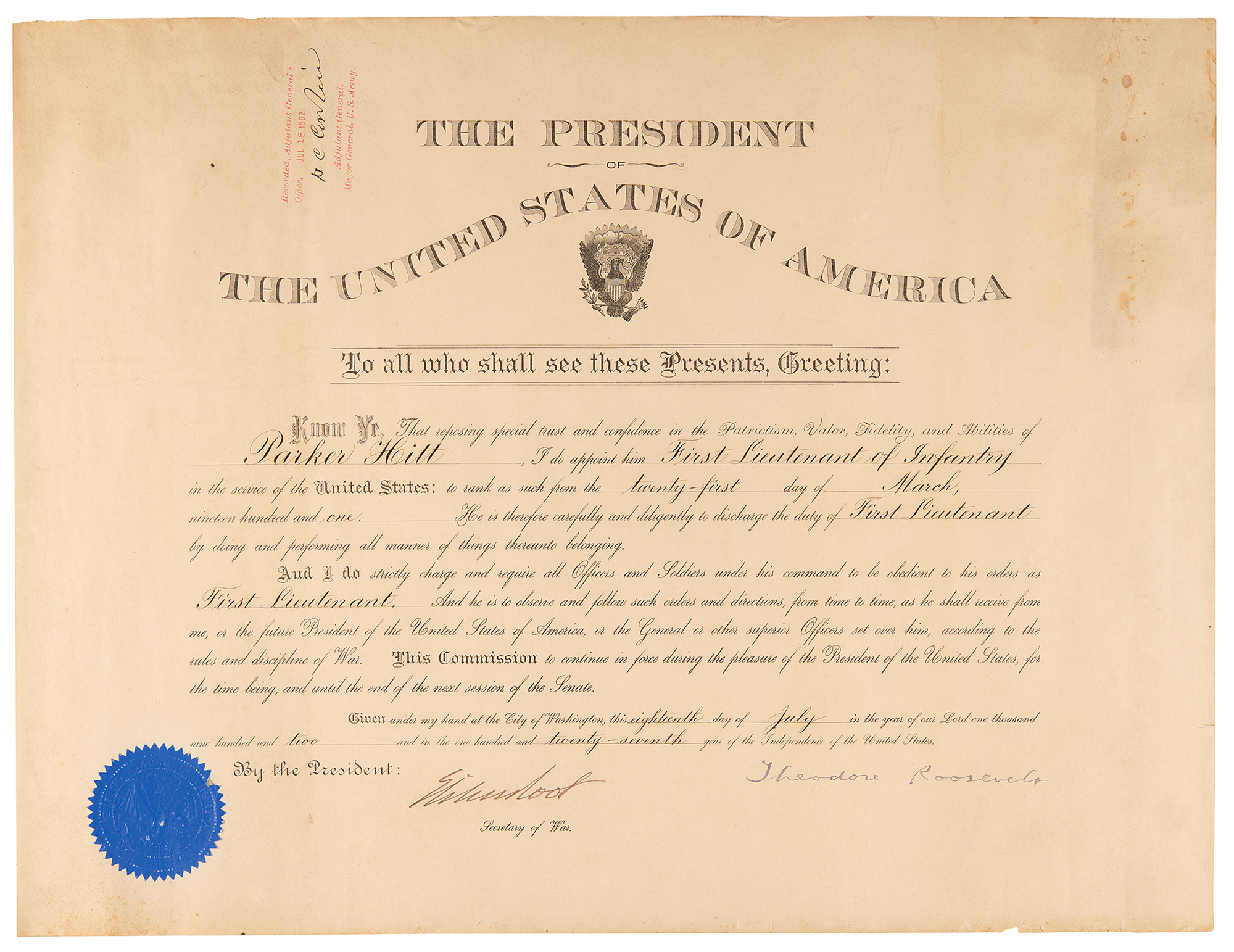
Partly-printed DS as president, one page, 21 x 16, July 18, 1902. President Theodore Roosevelt appoints Hitt as a “First Lieutenant of Infantry in the service of the United States.” Signed at the conclusion by Roosevelt and countersigned by Secretary of War Elihu Root. The embossed blue War Office seal remains affixed to the lower left. Rolled and in very good to fine condition, with edgewear, including chips and small tears, and some scattered stains.
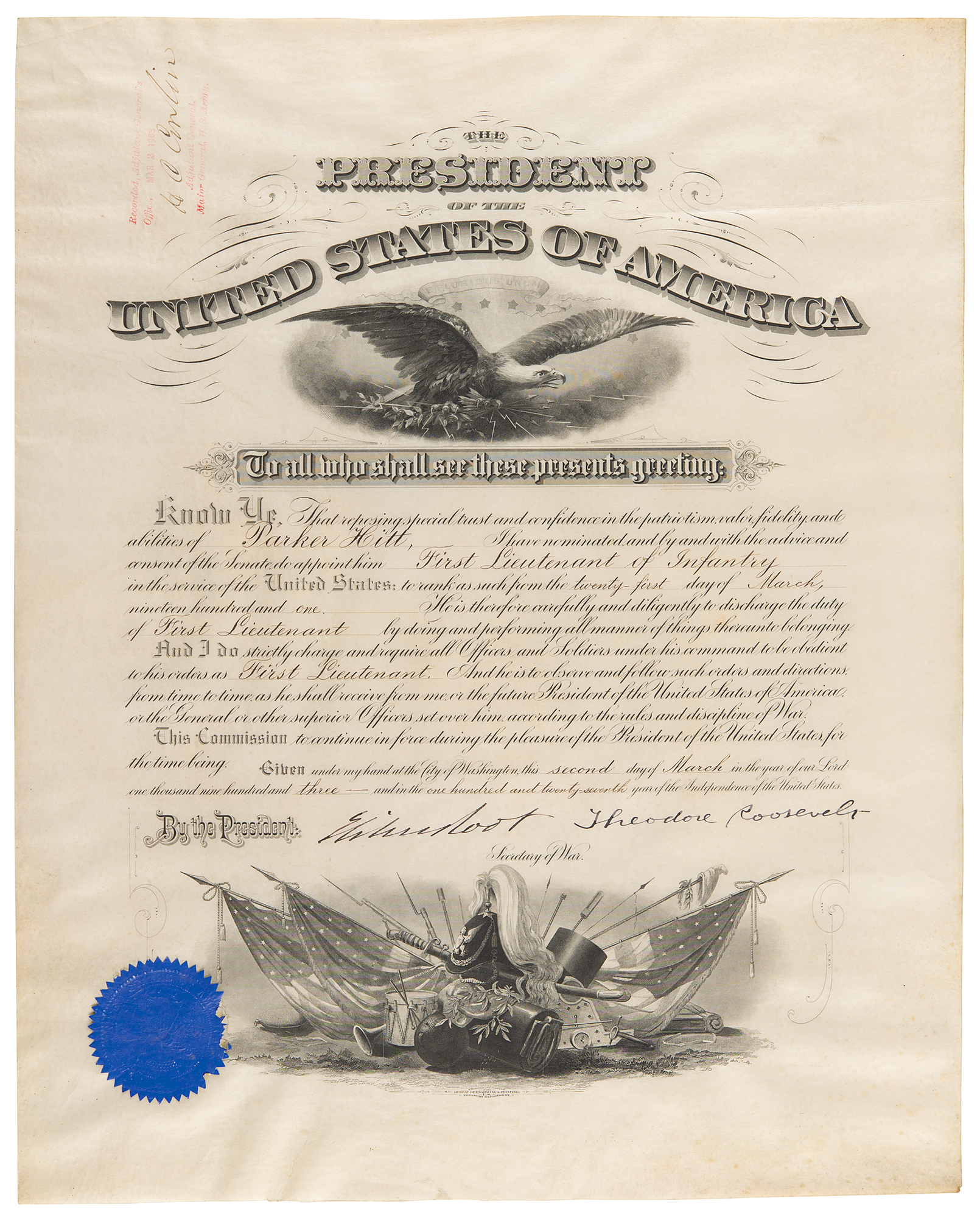
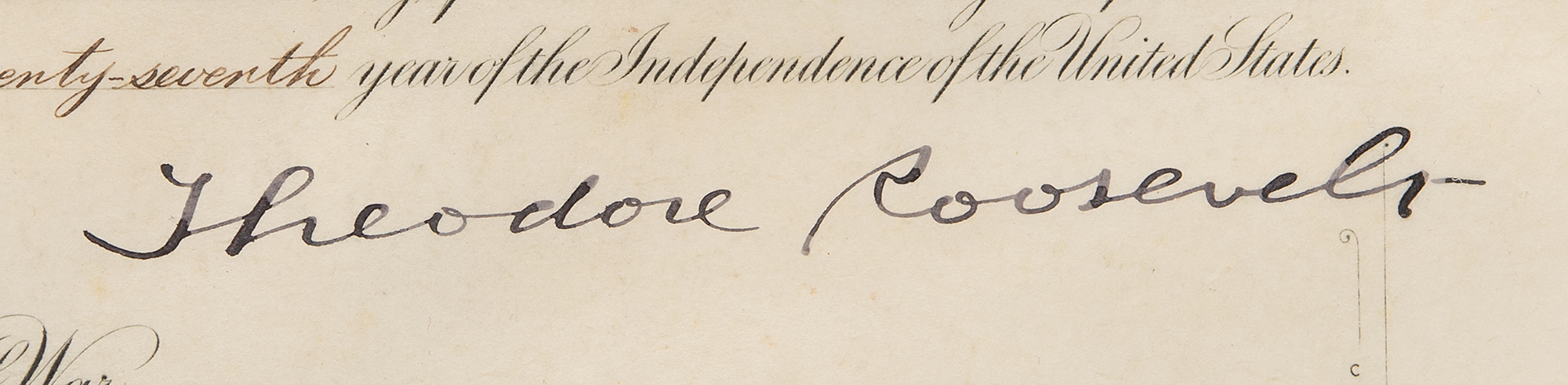
Partly-printed vellum DS as president, one page, 15.75 x 19.5, March 2, 1903. President Roosevelt appoints Hitt as a “First Lieutenant of Infantry in the service of the United States.” Signed at the conclusion by Theodore Roosevelt and countersigned by Secretary of War Elihu Root. The blue War Office seal remains affixed to the lower left. Rolled and in fine condition, with some scattered toning.
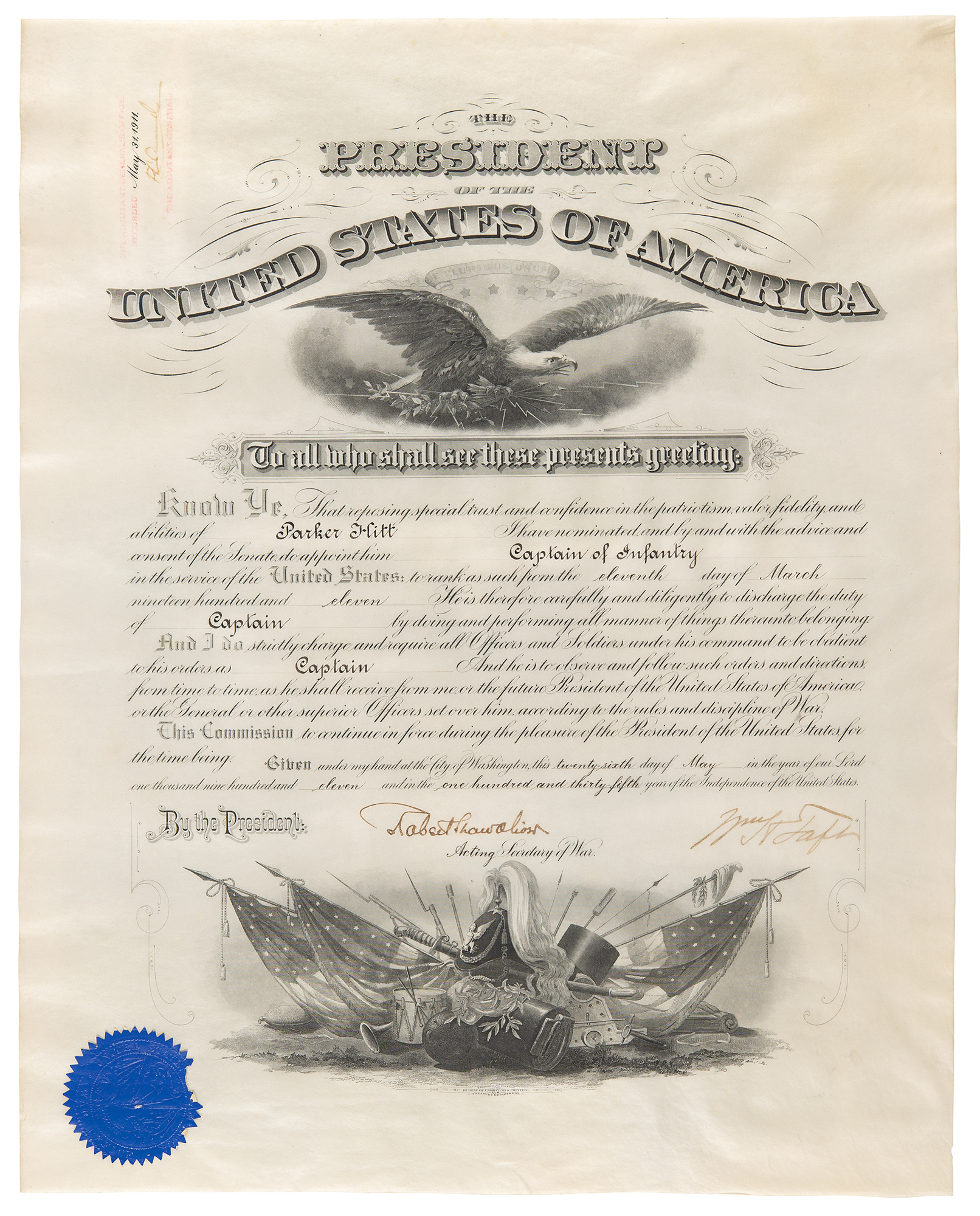
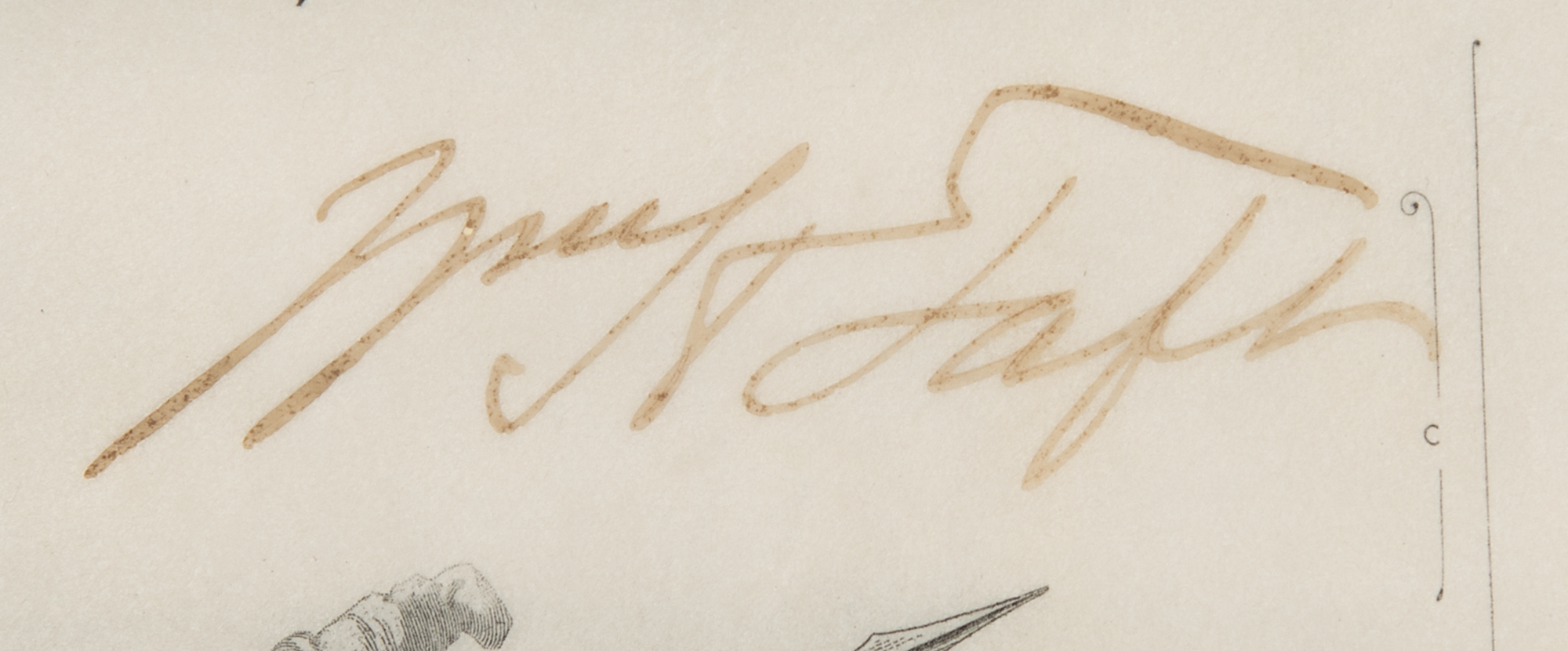
Partly-printed vellum DS as president, signed “Wm. H. Taft,” one page, 15.25 x 19, May 26, 1911. President William H. Taft appoints Hitt as “Captain of Infantry in the service of the United States.” Signed at the conclusion by Taft and countersigned by acting Secretary of War Robert Shaw Oliver. The blue War Office seal remains affixed to the lower left corner. Rolled and in fine condition.
Also included with the archive are twelve Christmas cards sent to Hitt from Dwight and Mamie Eisenhower, dated from 1953 to 1968, a 1961 Christmas card from Richard Nixon and family, three invitations to the White House sent to Hitt by President Calvin Coolidge and First Lady Grace Coolidge, a grouping of material sent to Hitt by the Inaugural Committee for the first inauguration of President Dwight D. Eisenhower, and a string-bound program for a Thanksgiving gathering of Company ‘H’ of the 19th Infantry. The Christmas cards bear facsimile handwriting and signatures. Accompanied by five full letters of authenticity from JSA for the signed documents.
Indiana native Parker Hitt (1878–1971) was a career U.S. Army officer who is best remembered as the ‘Father of American Military Cryptography.’ He served briefly in Cuba during the Spanish-American War with a volunteer engineer unit and was deployed twice to the Philippines as an infantry officer with the 22nd Regiment. While on Mindanao, Hitt organized the raising of two Spanish gunboats, which were refitted into service by the U.S. Army on Lake Lanao in the early 1900s.
Recognizing the importance of new communications methods, Colonel Hitt applied for a two-year detail to the Signal Corps. While instructing at the Army Signal School, he taught courses on codes and ciphers and researched and, recognizing the vulnerability of the U.S. Army field cipher, he designed a more secure system as a replacement in 1914. Two years later, he published his groundbreaking work, Manual for the Solution of Military Ciphers, to address the army's outmoded cipher practices. The Signal Corps widely adopted Colonel Hitt's cylindrical device, and it remained in service for the better part of three decades.
During the First World War, he served on General John Pershing's staff as Assistant to the Chief Signal Officer while in France, was regularly involved with coding/decoding operations, and was appointed as the Chief Signal Officer in July 1918. After the war, Hitt taught at the Army War College but then retired from the service in 1928, only to be recalled to active duty in 1940. During the Second World War, he served as the Signal Officer, Fifth Corps at Fort Hayes, Ohio, before retiring again in 1944. At a time when the nation had no formal cryptologic service, Parker Hitt's innovative work documented concepts and principles that would be used to protect U.S. military communications for decades.

