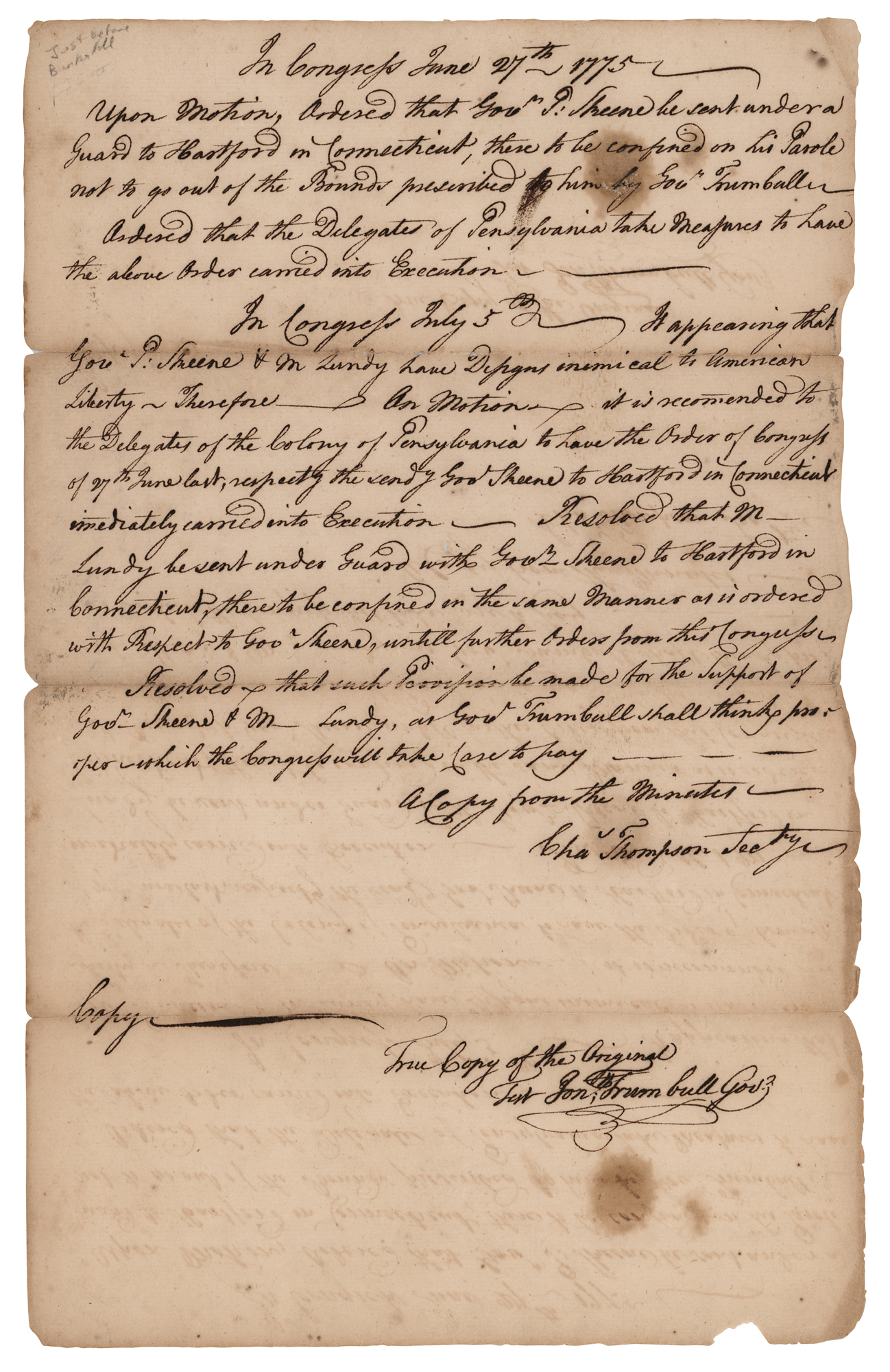
Governor of Connecticut who was the only colonial governor to side with the Americans during the Revolutionary War (1710-1785). ADS, signed “True Copy of the Original, Test. Jonth. Trumbull Gov'r,” one page, 8.25 x 13, June 27, 1775. Trumbull copies resolves of the Continental Congress, issued just days after the Battle of Bunker Hill. In part: "Upon Motion, Ordered that Gov'r P. Skeene be sent under a Guard to Hartford in Connecticut, there to be confined on his Parole not to go out of the Bounds presented to him by Gov'r Trumbull…In Congress July 3d—It appearing that Gov'r P. Skeene & M. Lundy have designs inimical to American liberty: Therefore, on Motion, It is recommended to the Delegates of the Colony of Pennsylvania to have the Order of Congress of 27th June last, respecting the send'g Gov. Skeene to Hartford in Connecticut immediately carried into Execution…Resolved—that such Provision be made for the Support of Gov'r Skeene & M. Lundy, as Gov'r Trumbull shall think proper, which the Congress will take care to pay." In fine condition, with small repairs to splitting along the folds.
Philip Skene, a British loyalist and former British army officer, played a notable role during the early stages of the American Revolution. As the founder and proprietor of Skenesborough (present-day Whitehall, New York), Skene supported British efforts to suppress the rebellion. His close ties to the British military and his strategic landholdings near Lake Champlain made him a figure of suspicion among American patriots. In 1775, while attempting to return to his estate from England—where he had been lobbying for the creation of a new royal colony—Skene was captured by American forces. Viewed as a potential threat due to his loyalist sympathies and connections with British officers, he was sent to West Hartford, Connecticut, where he was imprisoned. His confinement reflected the Continental Congress's broader efforts to neutralize loyalist influence during the volatile early years of the Revolution.

