Sold For $87,500
*Includes Buyers Premium
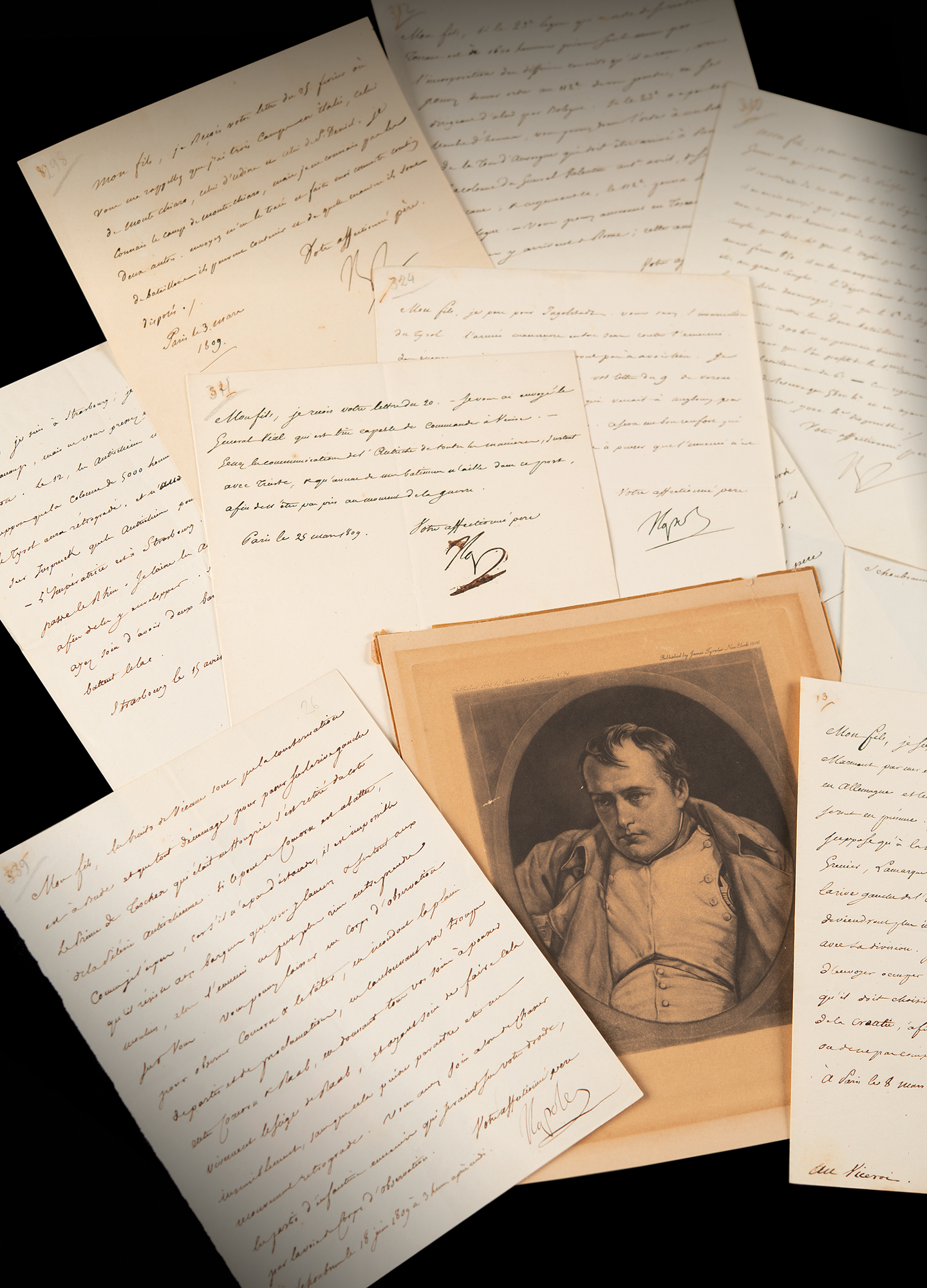
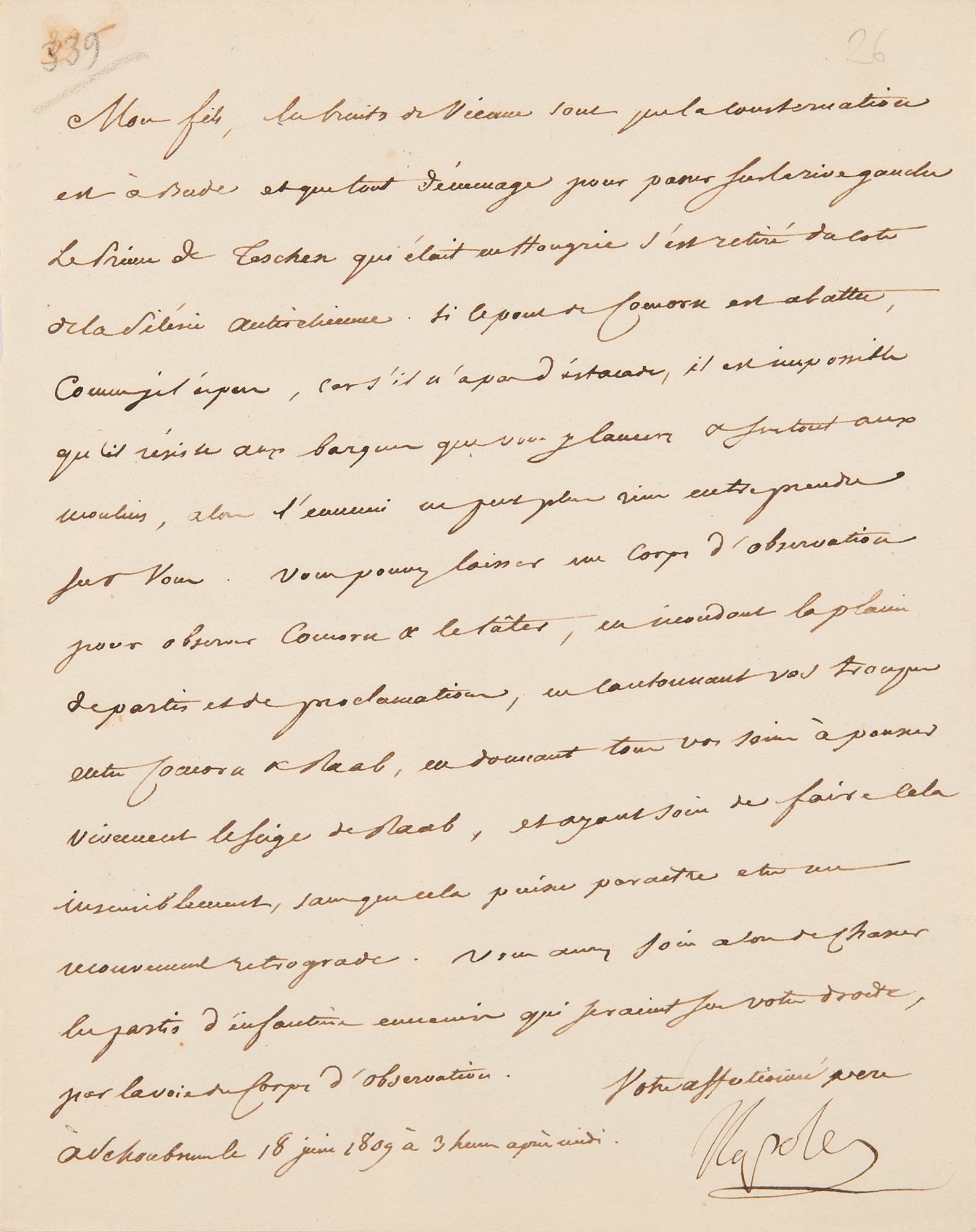
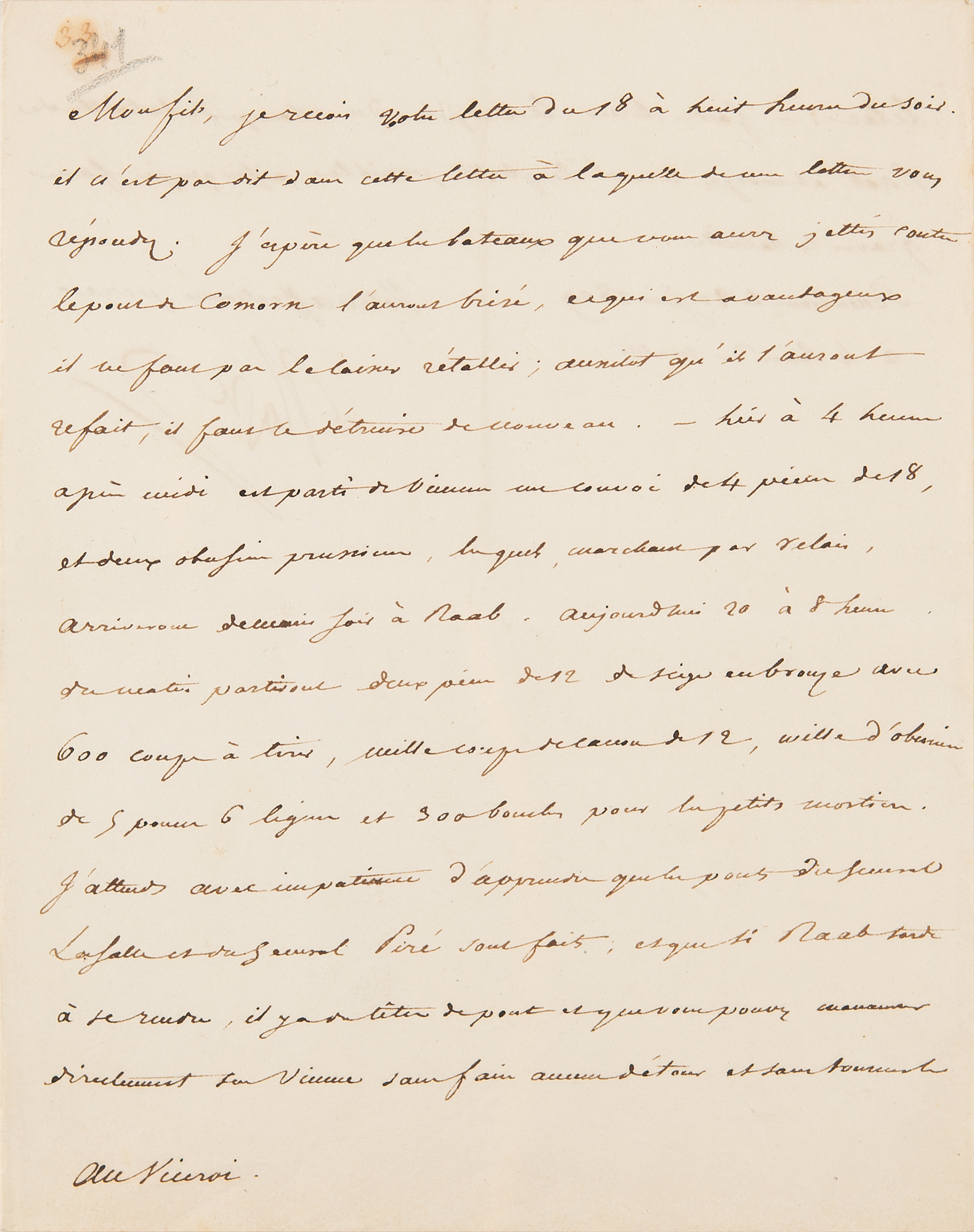
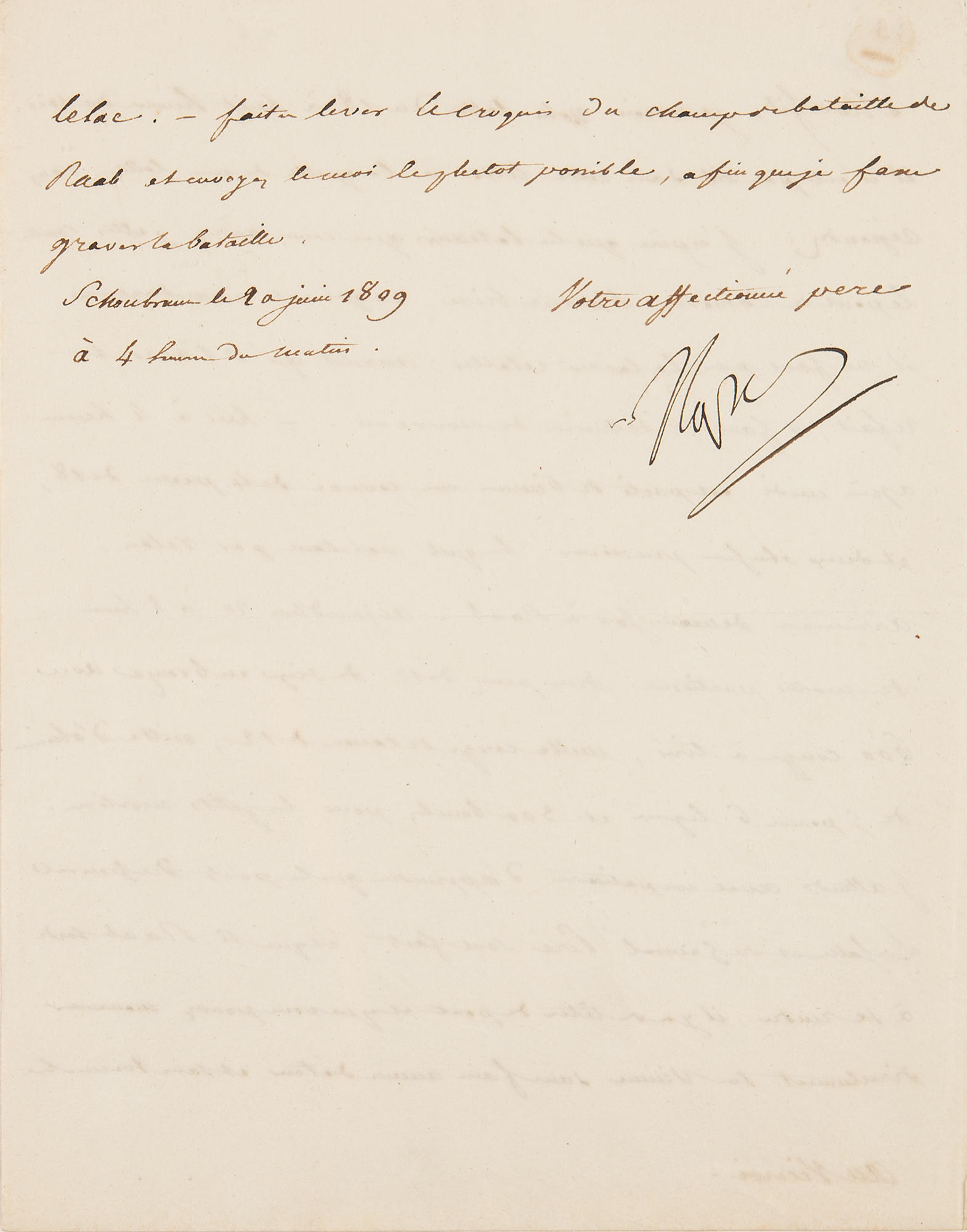
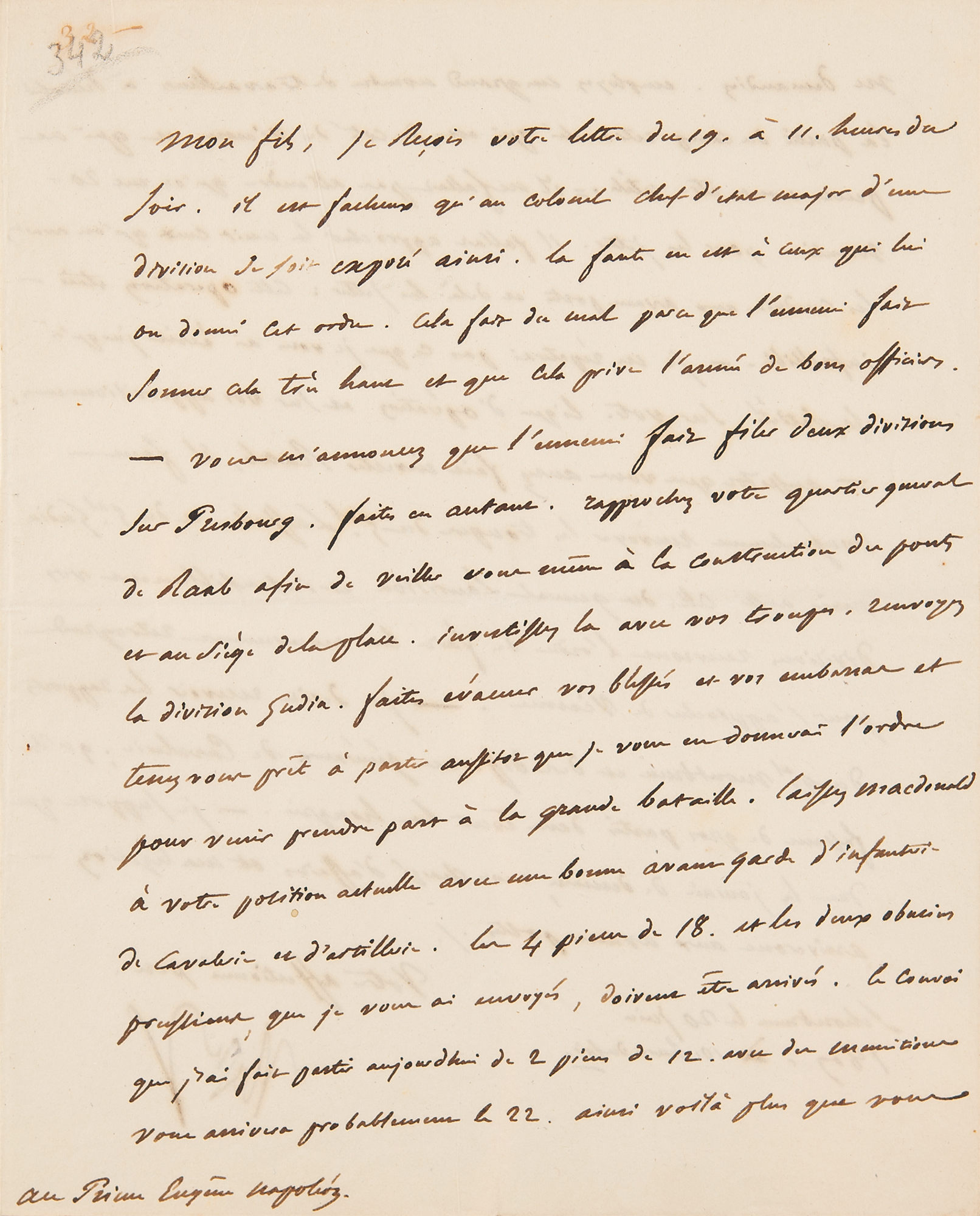
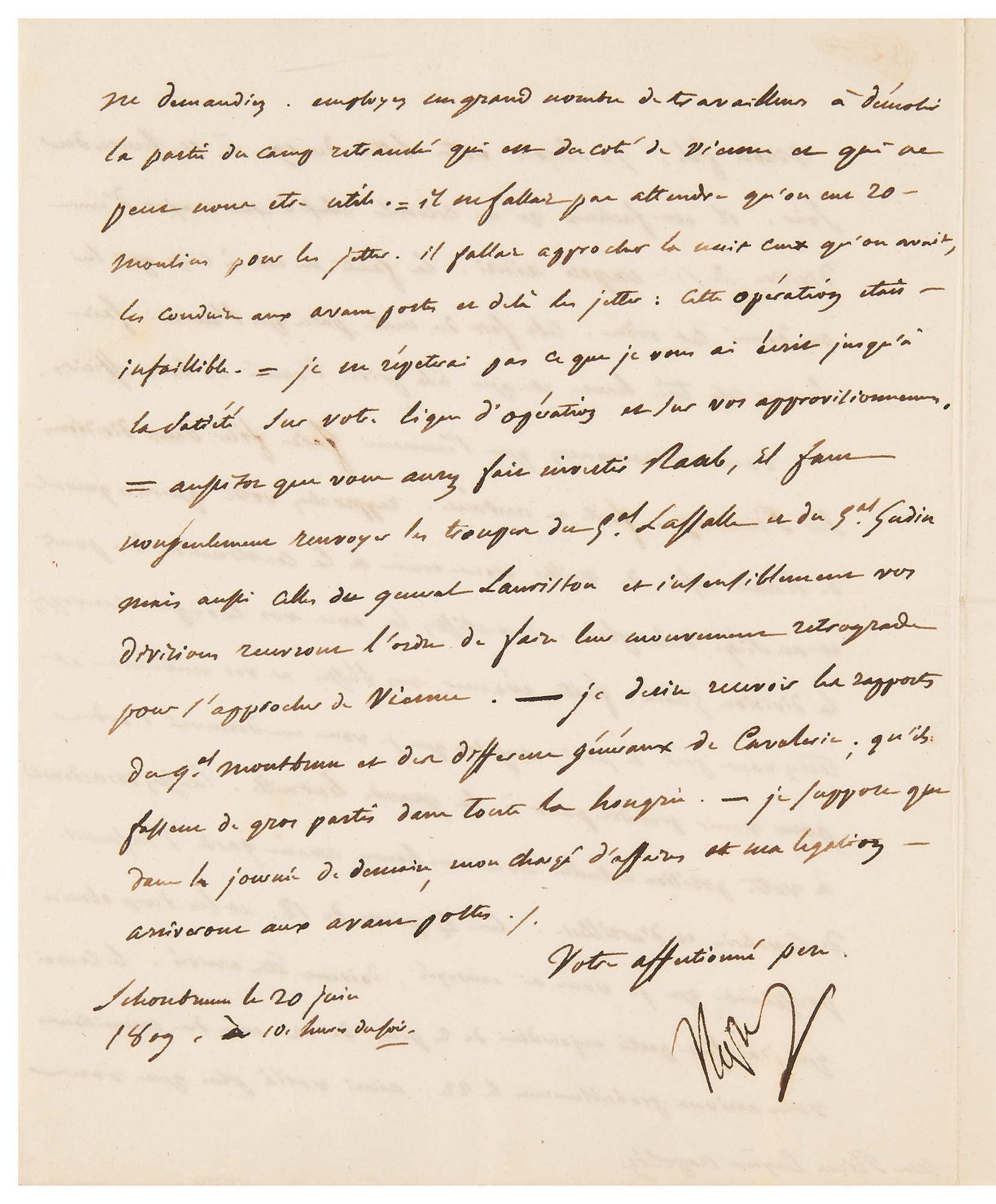
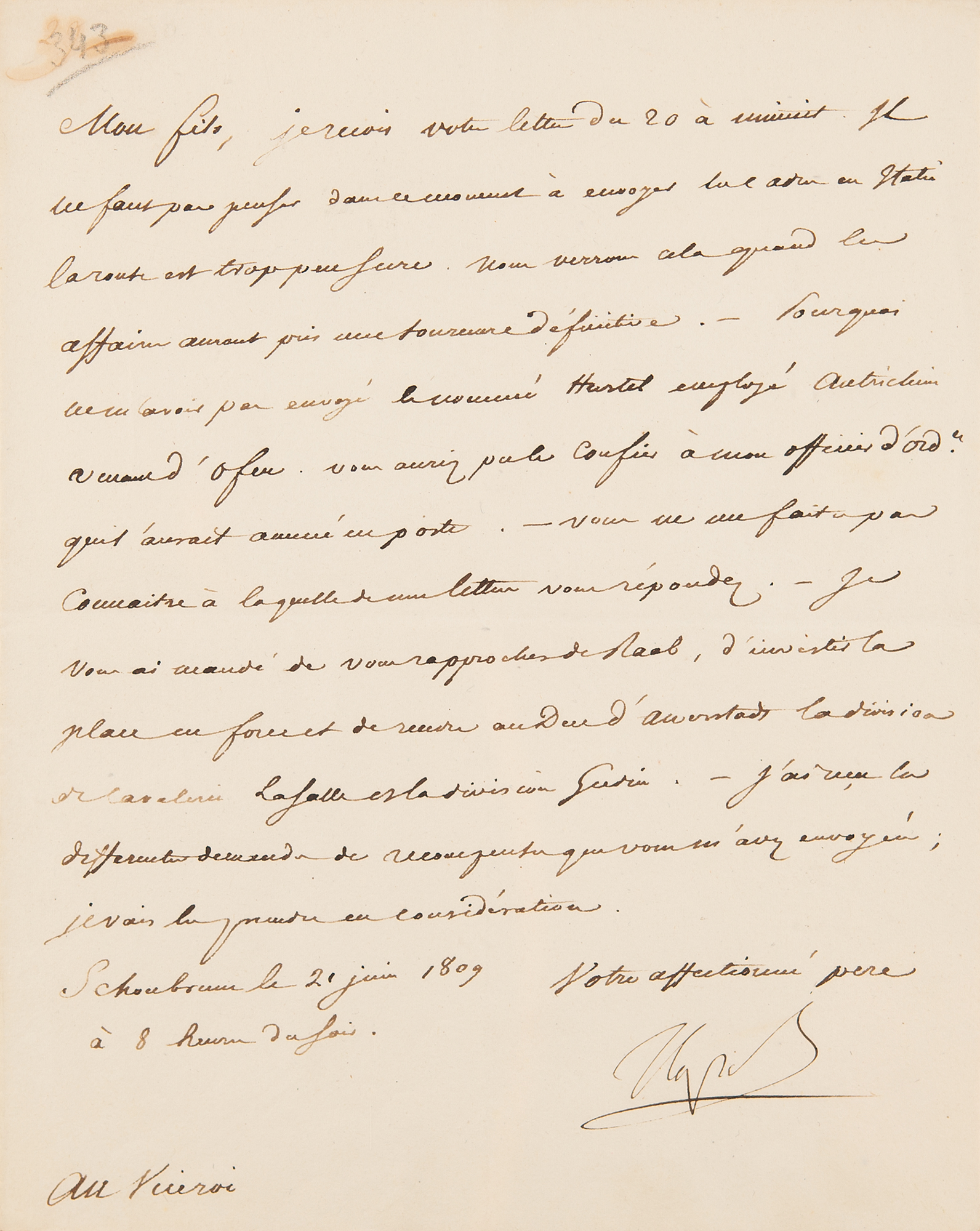
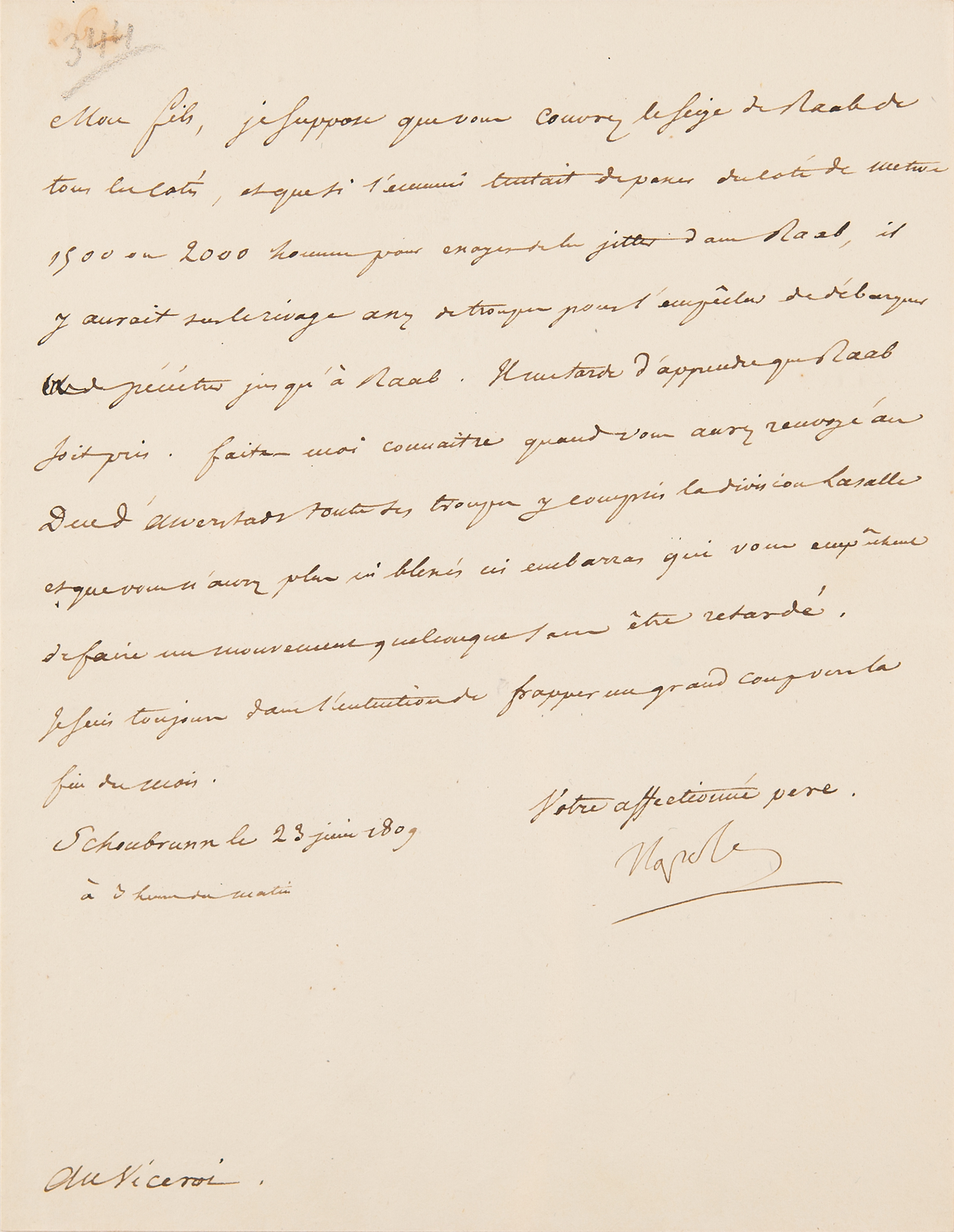
Extraordinary archive of 29 LSs by Napoleon Bonaparte, signed with various shortenings of his first name—including "Np," "Napole," and "Napo"—addressed to his adopted son, Prince Eugène de Beauharnais, Viceroy of Italy, totaling 46 pages, 7.25 x 9, dated from March 3, 1809, to June 23, 1809. These letters constitute an important series of military communications from Napoleon Bonaparte to his son (“Mon fils”) during the War of the Fifth Coalition, particularly concerning military operations around Raab (present-day Győr, Hungary) and Austria. Representing Napoleon's real-time war correspondence from his 1809 campaign, the letters illustrate his demanding and detail-oriented command style, his strategic vision, and the importance of Raab as a springboard to the conquest of Hungary.
In early 1809, Austria, encouraged by Napoleon’s preoccupation with Spain and sensing an opportunity after French setbacks in the Peninsular War, mobilized for war. Napoleon moved swiftly to consolidate his forces across central Europe, while ordering Eugène to strengthen and position the Army of Italy for an Austrian offensive across the Alps and into northern Italy. The letters from March detail meticulous orders for troop organization, recruitment, artillery deployment, and strategic positioning along the Adige, the Piave, and in Tyrol, emphasizing Napoleon’s preference for precise control over military logistics and his constant anticipation of enemy movements. His instructions reveal the Italian theater as both a defensive front to shield Napoleon’s flank and a potential launch point for offensive operations into Austria and Hungary.
By mid-1809, the correspondence reflects the shifting momentum of the campaign. Following the French capture of Vienna in May and the ongoing suppression of Tyrolean uprisings, Napoleon presses Eugène to coordinate with French marshals such as Marmont and MacDonald to pursue Austrian forces under Archduke John, secure key strongholds like Raab, and block Austrian retreat or reinforcement through Komárom and toward Budapest. The letters frequently reveal Napoleon’s frustration at delays, his insistence on speed and secrecy, and his determination to maintain offensive pressure, even in the face of logistical challenges and regional revolts. Together, they offer a remarkable, near-daily record of Napoleon’s wartime command—combining high-level grand strategy with minute operational detail—at a pivotal moment in the 1809 campaign that culminated in the decisive French victory at Wagram in July.
A few key excerpts, in translation:
March 5, 1809: "A new fourth battalion must be formed in Italy...It is of the utmost importance that my divisions be brought to full operational strength, as Austria's troop movements increasingly point to an attack."
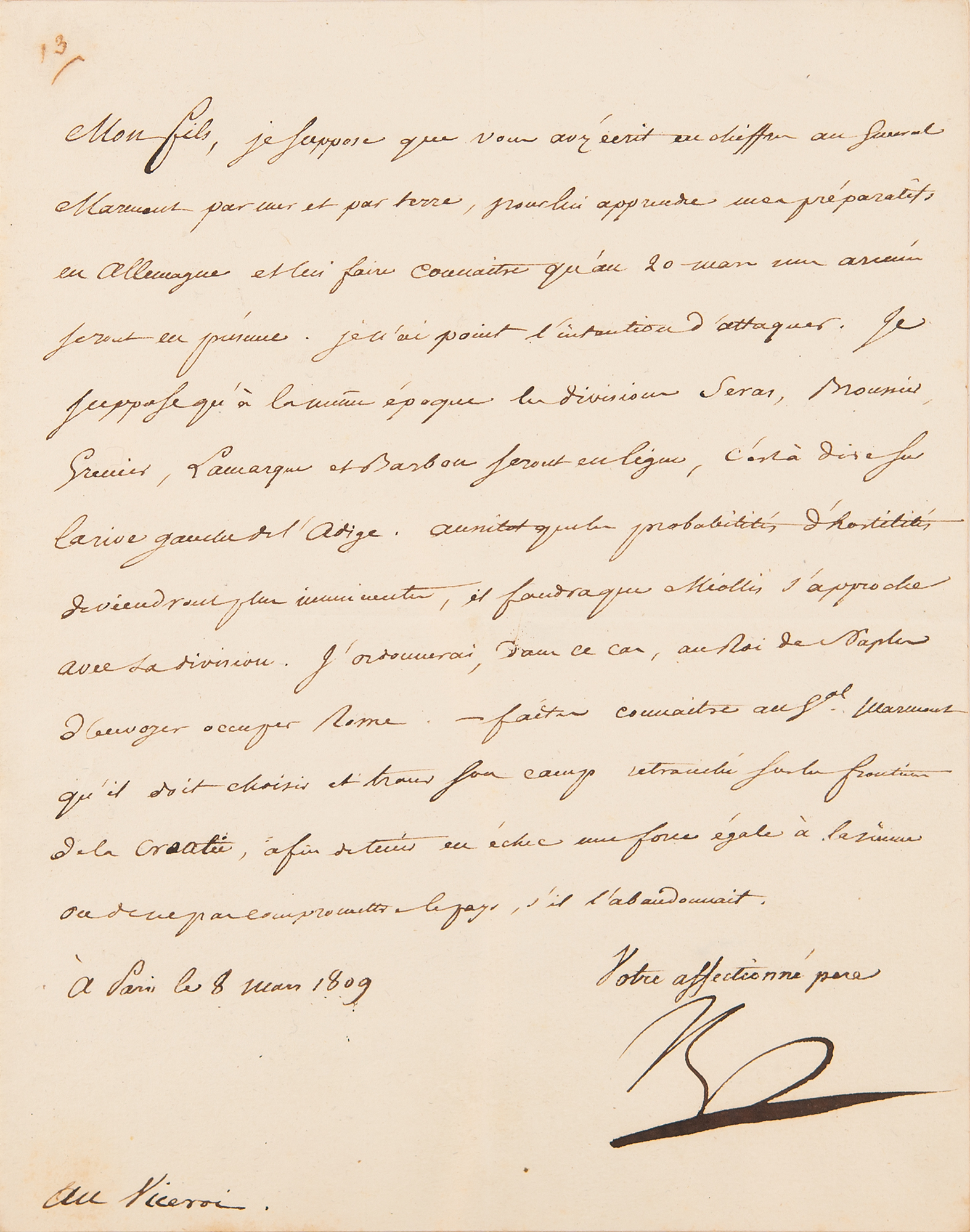
March 8, 1809: " As soon as the likelihood of hostilities increases, Miollis must advance closer with his division. In such a case, I will order the King of Naples to send troops to occupy Rome."
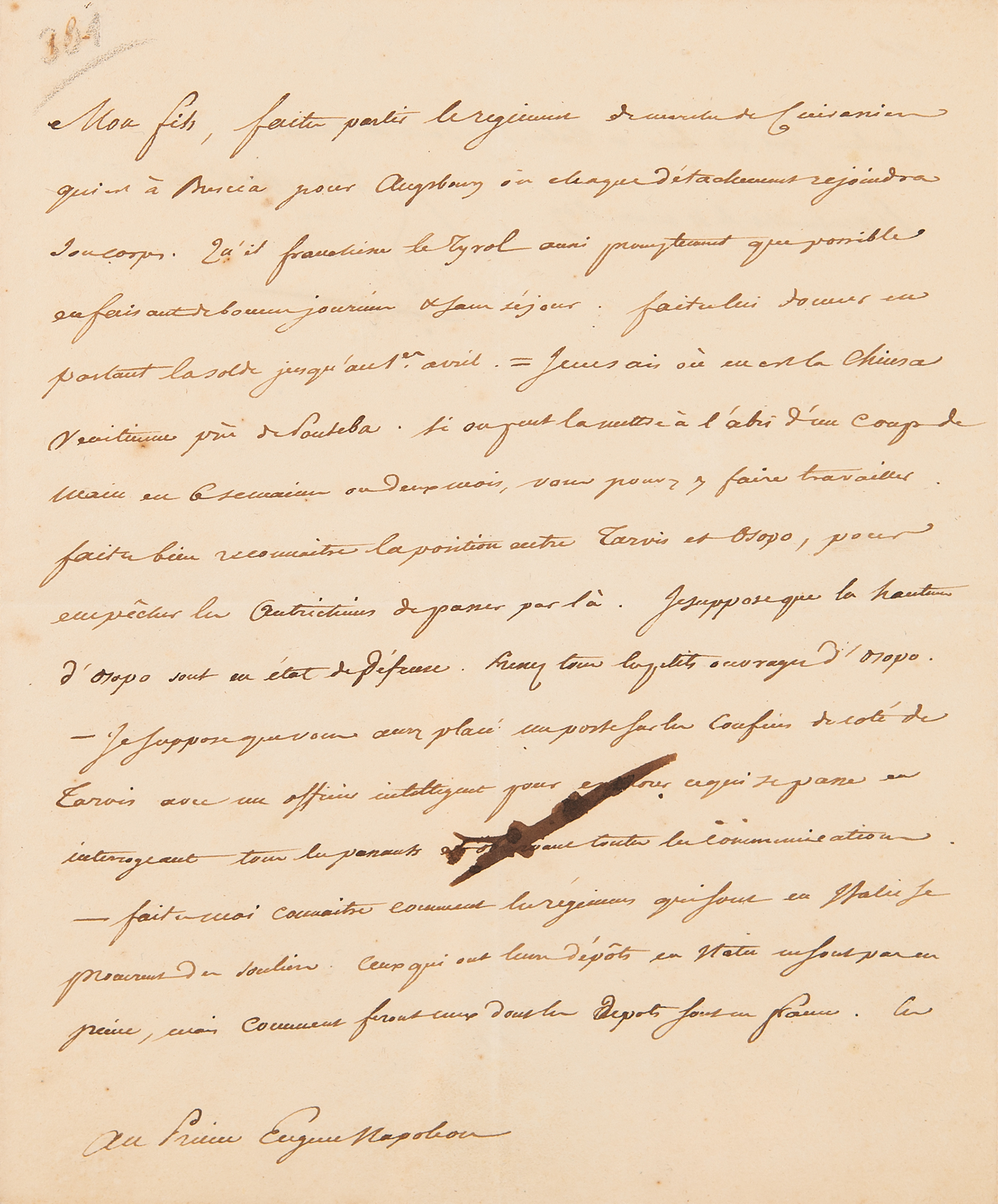
March 11, 1809: "Let Tyrol be crossed as quickly as possible by making long day marches without daily rests...I do not know exactly where Chiusa Venitienne near Pontebba is located. If it can be secured from an Austrian surprise attack within six weeks or two months, fortifications can be constructed there."
March 16, 1809: "Russia's movements against Austria are unclear, but significant. Russia is conducting suspicious activities, apparently arming itself."
March 22, 1809: "Since it is said that there is unrest in Tyrol, this column could, during its march, advantageously be used by the Bavarian occupiers, if necessary."
March 25, 1809: "Disrupt Austria’s lines of communication by all means, especially those with Trieste. Let none of my ships enter that port, so that they are not captured at the moment war breaks out."
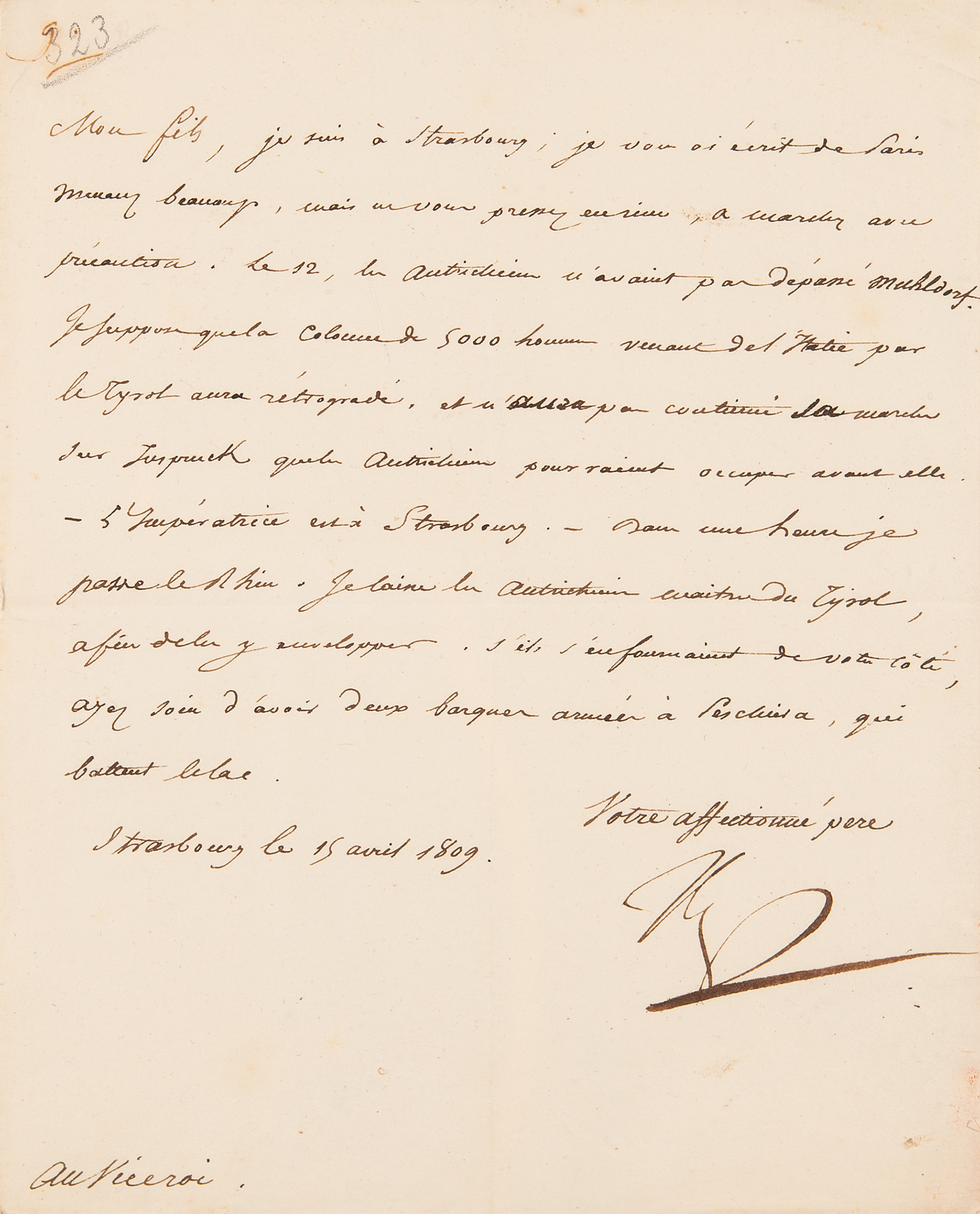
April 15, 1809: "The Empress is in Strasbourg. If, within an hour, I cross the Rhine, I will leave the control of Tyrol to the Austrians, to enclose them there; if they advance on your side, have two armed ships prepared in Peschiera (Lake Garda) to patrol the lake."
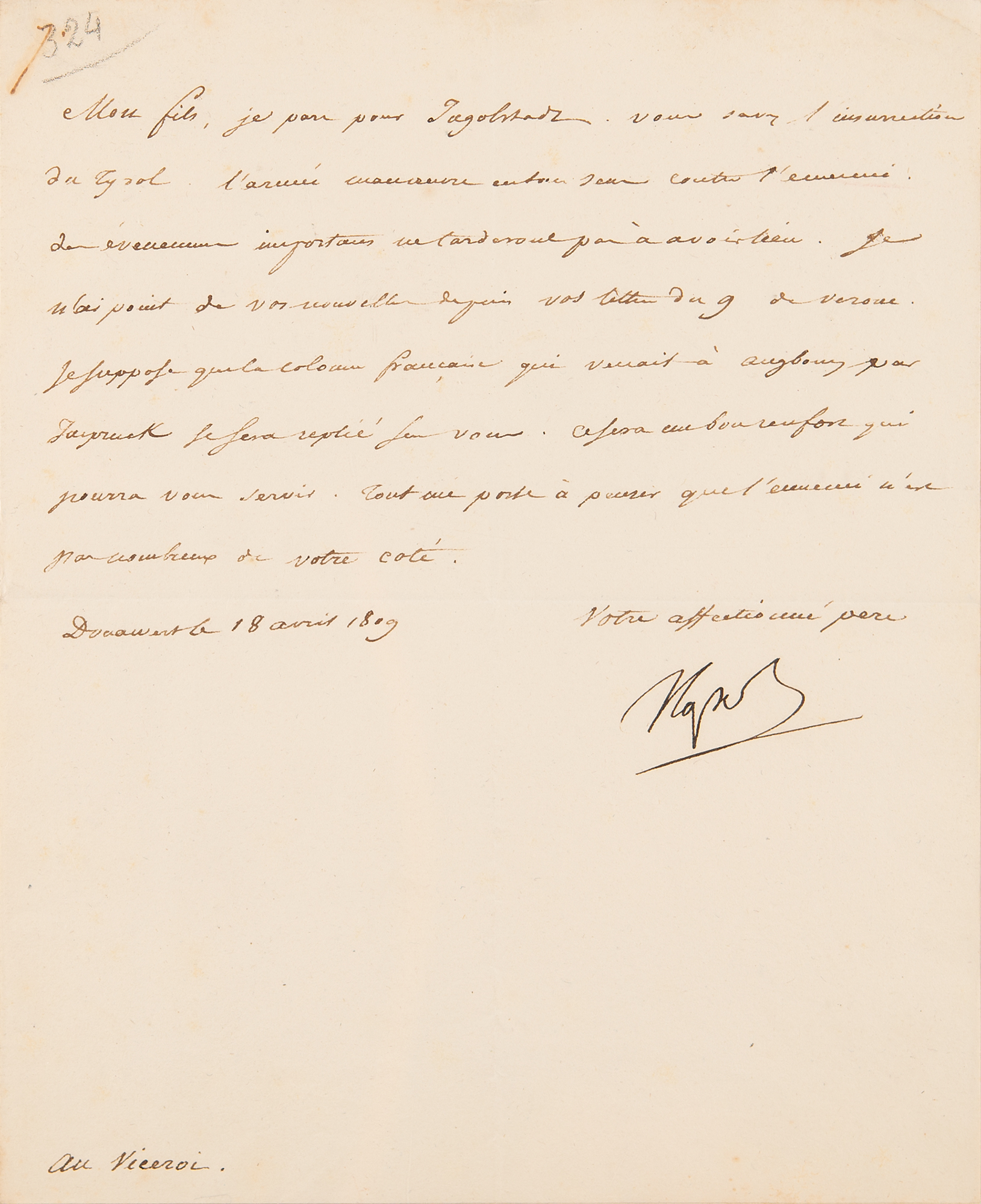
April 18, 1809: "You know about the uprising in Tyrol. The army is maneuvering in all directions against the enemy. Important decisions will soon be made...Everything suggests to me that the enemy on your side is not very numerous."
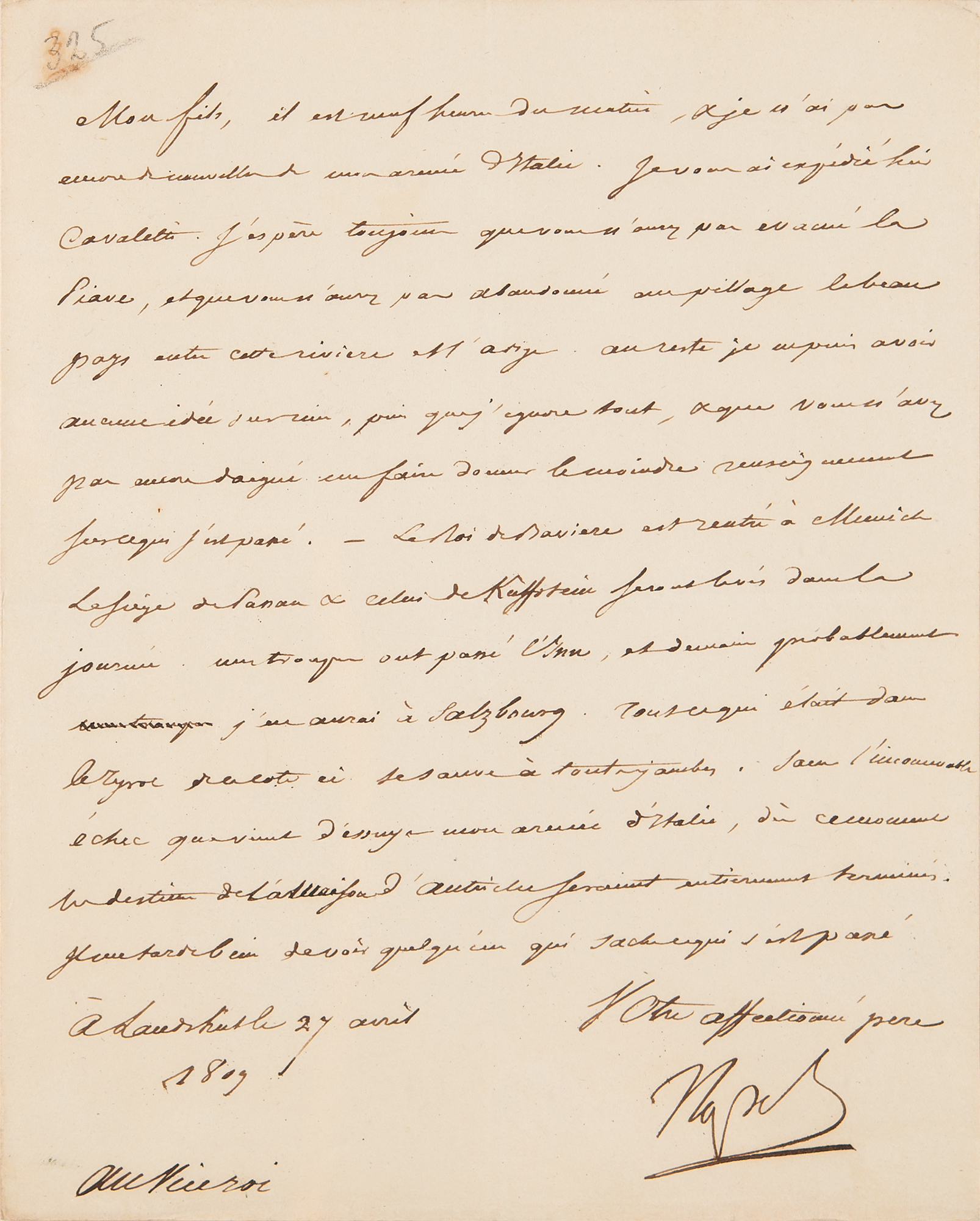
April 27, 1809: "Everything on our side that was in Tyrol has gone into hasty retreat. Had my army in Italy not suffered this unexpected setback, today would have been the end of the House of Austria. I am impatient to see someone who knows what has happened."
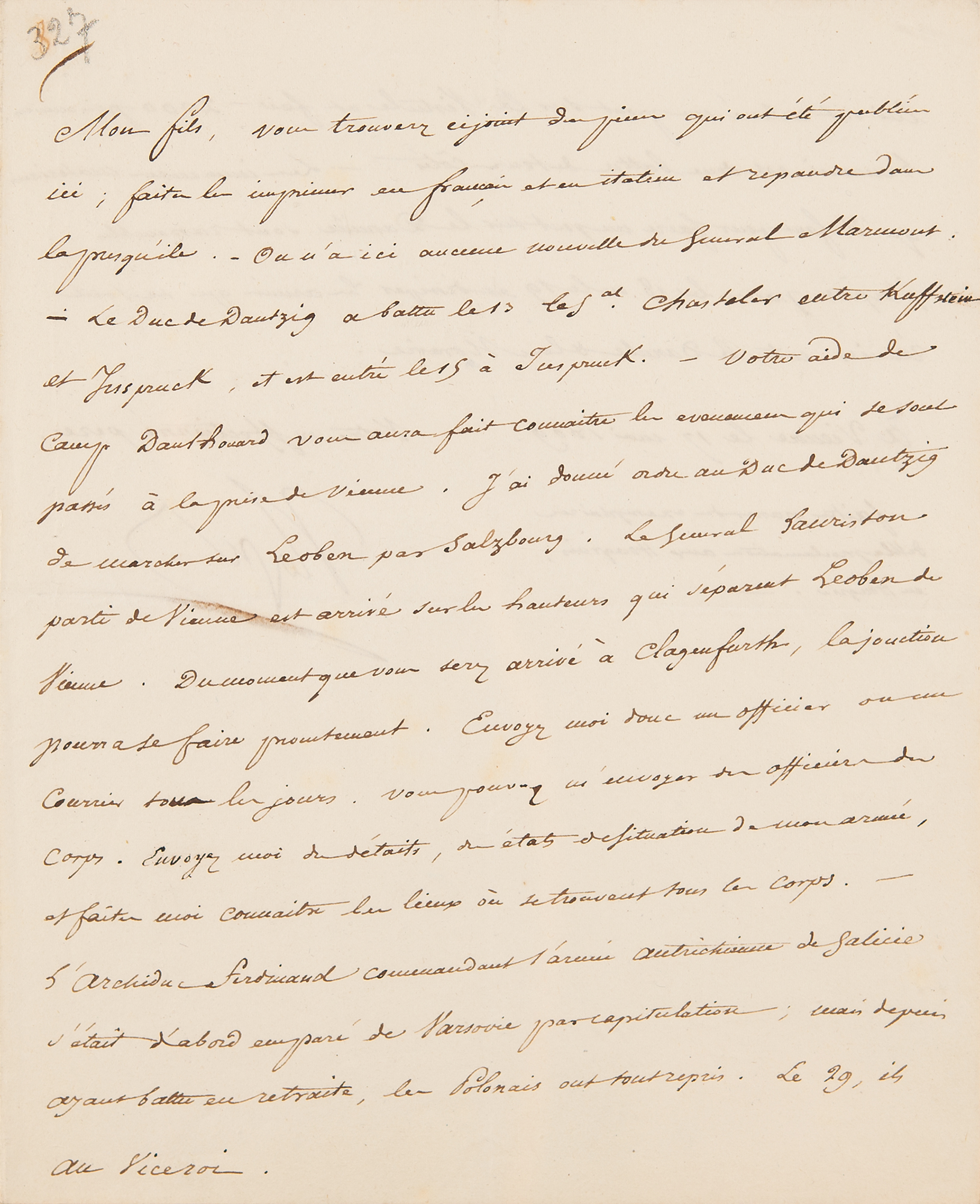
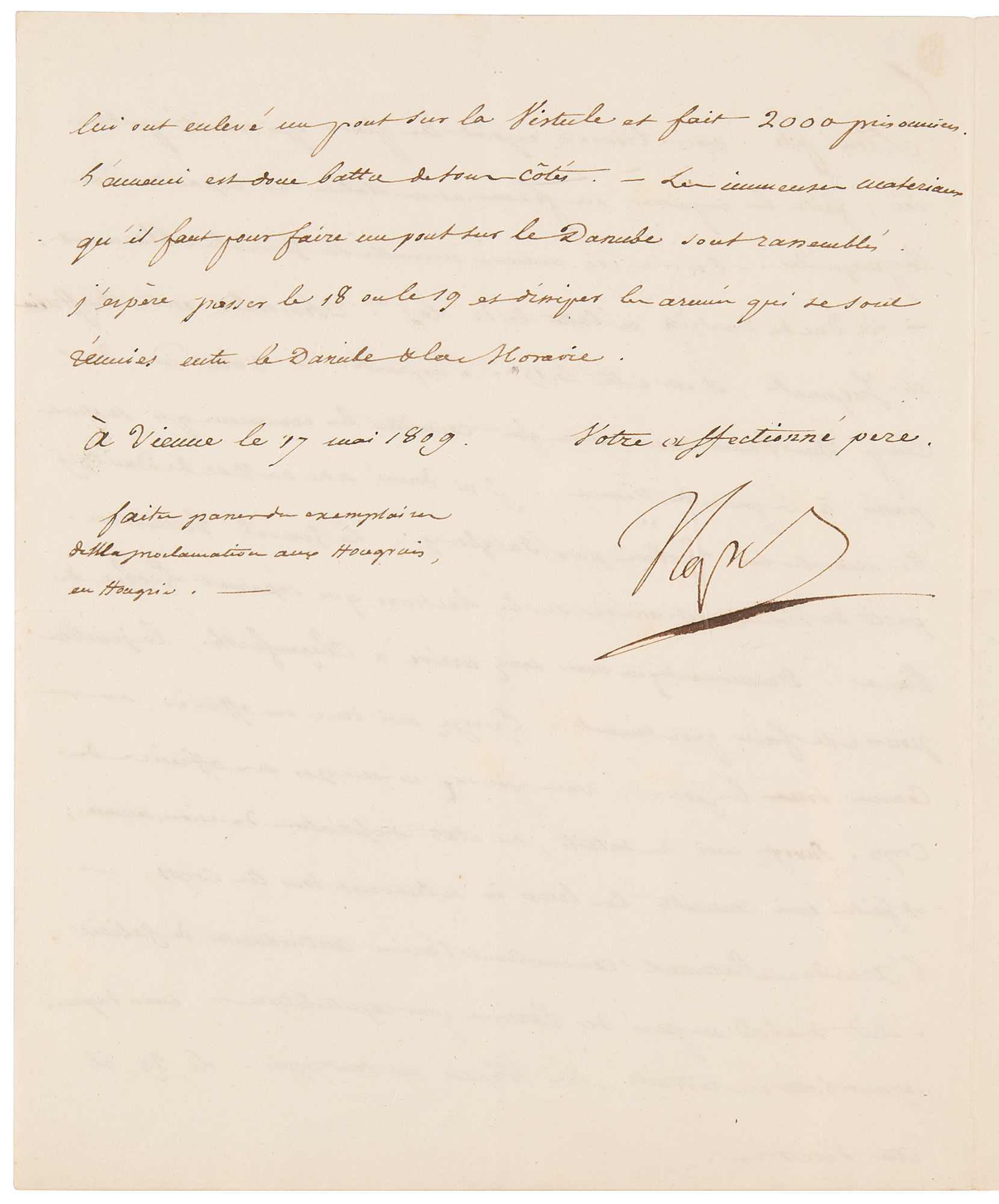
May 17, 1809, from occupied Vienna: "The enemy has been defeated on all fronts. The enormous quantities of building materials needed to construct a bridge across the Danube are almost ready. I hope to be able to cross on the 18th or 19th and to defeat the armies that have concentrated between the Danube and Moravia."
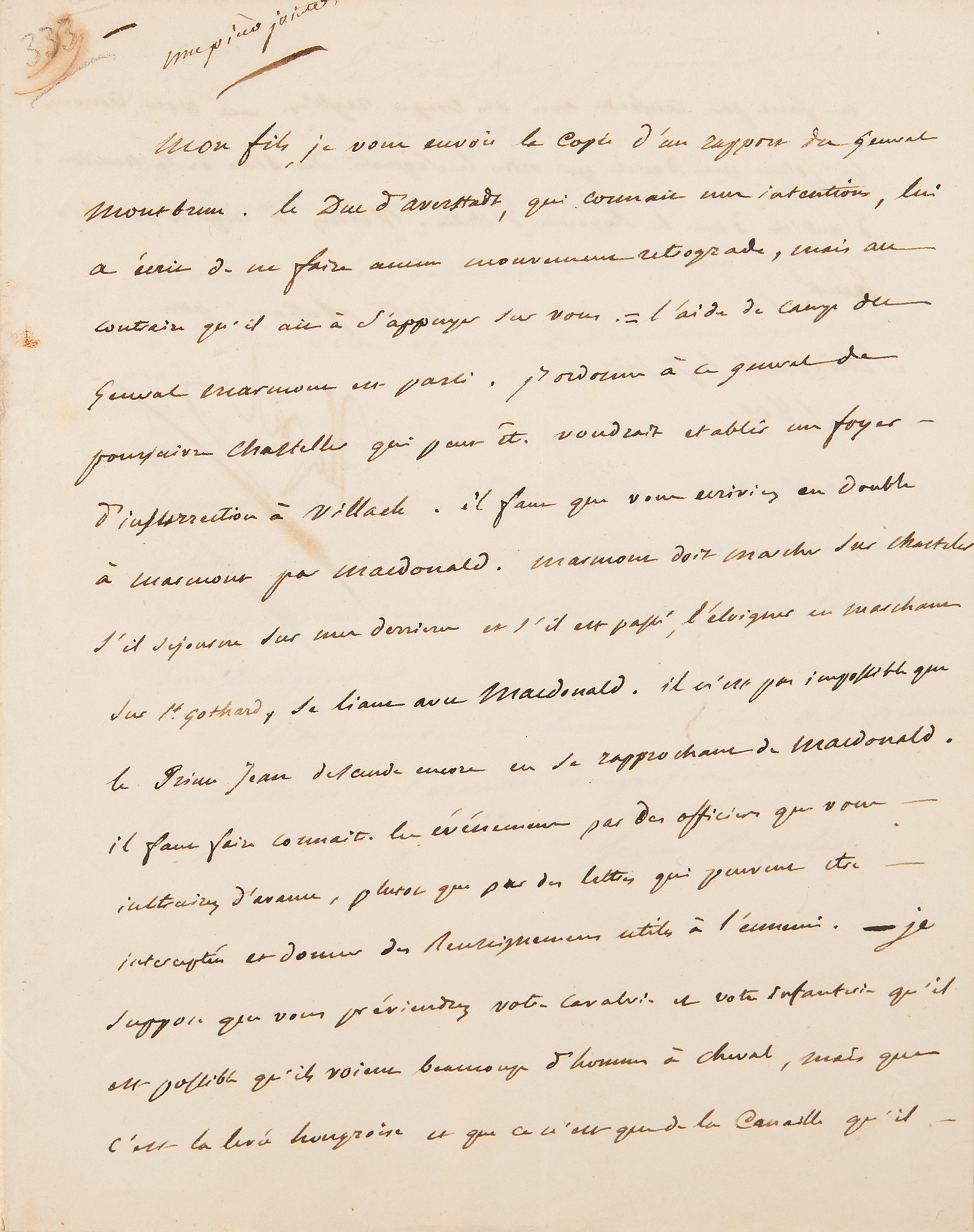
June 7, 1809: "The Duke of Auerstedt, who is familiar with my plans, wrote to me, requesting that no retreat movement be carried out, but instead to act offensively...It is not impossible that Prince John may once again try to give battle if he joins MacDonald. You must stay informed via officers already instructed for this purpose—not through letters, since they may be intercepted and fall into enemy hands."
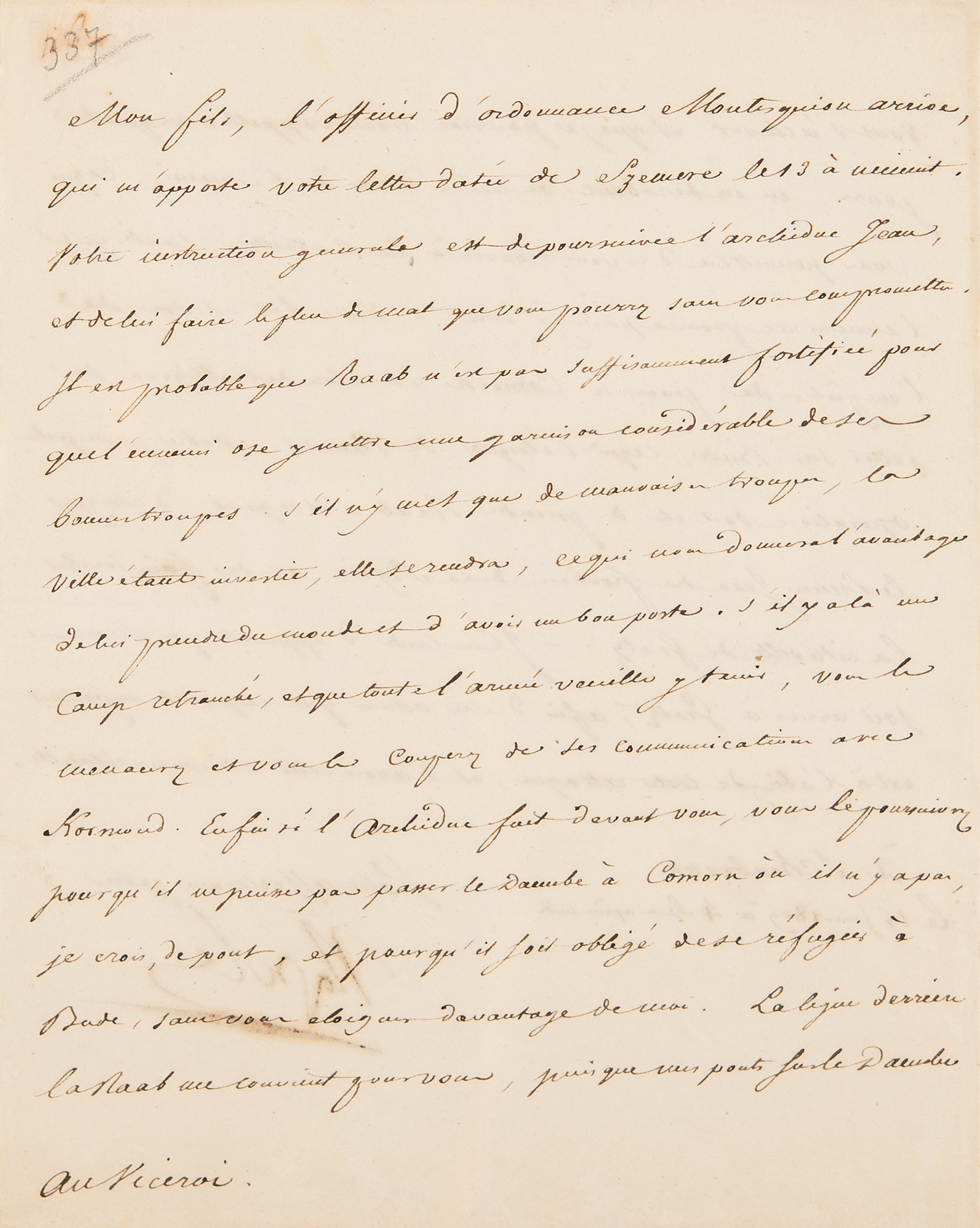
June 15, 1809: "In broad terms, you have the order to pursue Archduke Jean and to inflict as much damage as possible on him without taking undue risks. It is to be assumed that Raab is not sufficiently fortified, so it is unlikely that the enemy would dare to station a serious garrison of his best troops there. If he positions poor troops there, the city will surrender if it is surrounded, which benefits us by diverting forces and giving us a good base."
June 18, 1809: "The enemy’s movements seem to indicate a concentration in Buda...Since it is to your advantage to act fast, it is essential that you do not burden yourself with wagons or anything else that slows you down. The enemy must never perceive any backward movement from you...Put all your effort into keeping possession of Raab, and make sure this is done irrevocably, without anything that could be interpreted as a retreat."
June 20, 1809: "Leave MacDonald in your current position with a strong advance guard of infantry, cavalry, and artillery. The four 18-pounders and the two Prussian howitzers I sent you should already have arrived. The marching detachment with two 12-pounders and ammunition, which departed today, will likely arrive on the 22nd."
June 23, 1809: "I assume that you have secured the siege of Raab from all sides, and that, should the enemy attempt to send 1500 or 2000 men…there are enough troops on the bank to prevent them from landing and entering the city. I cannot wait to hear news of the capture of Raab...I still firmly intend to launch a decisive attack at the end of the month."
In overall fine to very fine condition.
A complete listing of the letters:
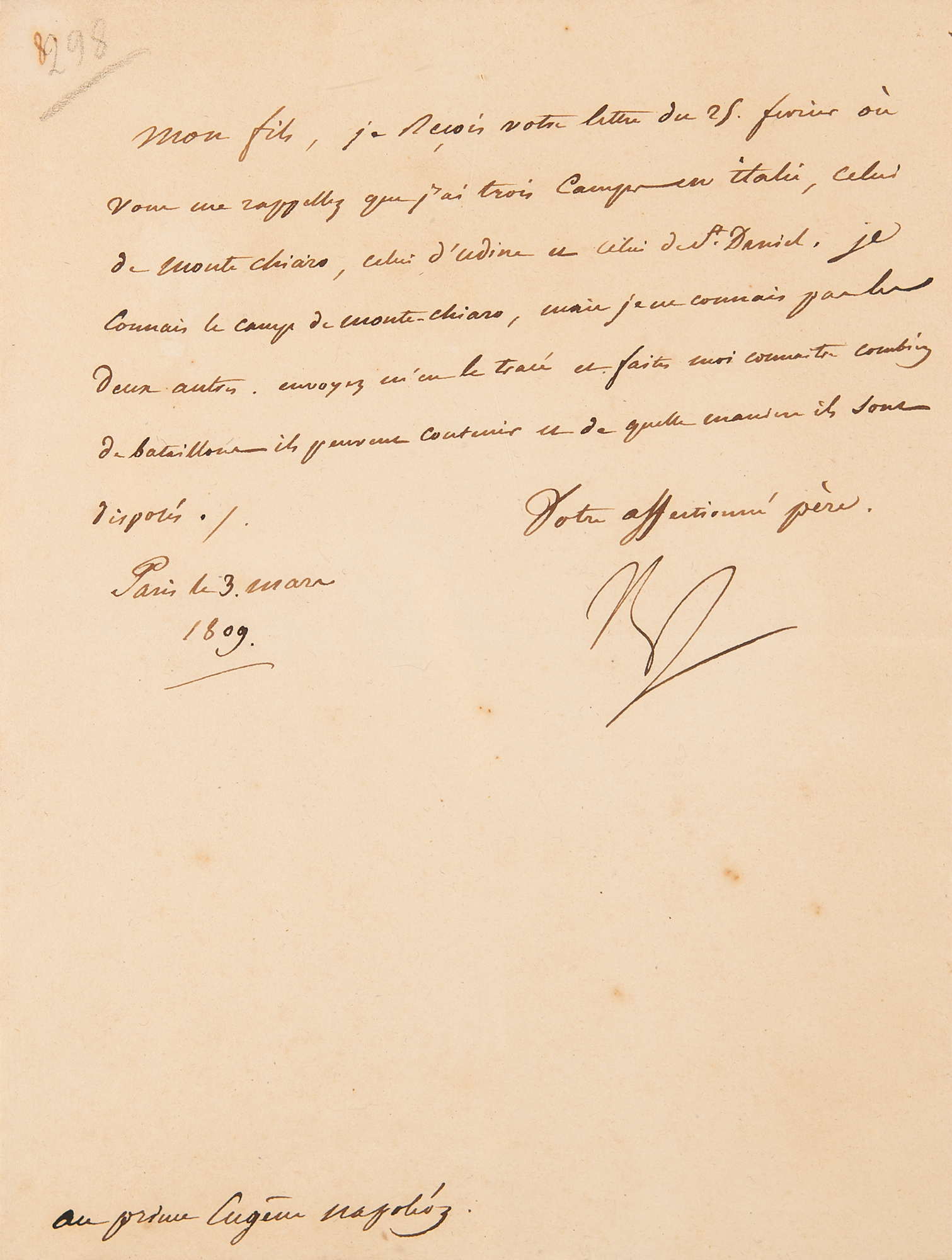
1. Paris, March 3, 1809
My son,
I have just received your letter dated February 25, in which you remind me that I have three military camps in Italy: the one at Monte Chiaro, the one at Udine, and the one at San Daniele.
I am familiar with the camp at Monte Chiaro, but I do not know the other two.
Send me a sketch of them, and let me know how many battalions they can accommodate and how they are laid out.
Your loving father,
Np
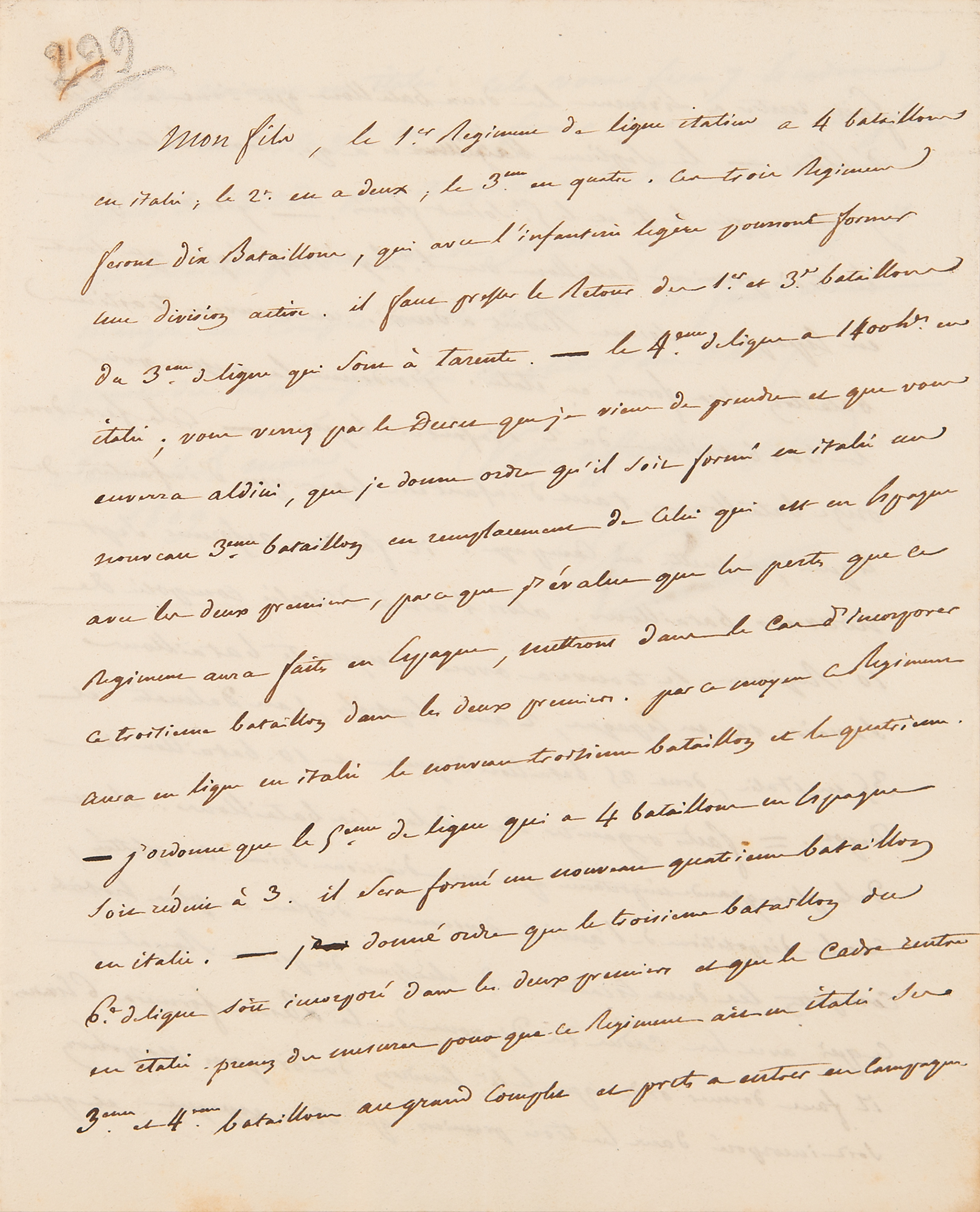
2. Paris, March 5, 1809
My son,
The 1st Italian Line Regiment has 4 battalions in Italy: the 2nd, 3rd, 4th. These three regiments form ten battalions, which together with the light infantry can form an entire division. The 1st and 3rd Battalions of the 3rd Line Regiment, which are in Tarent, must be mobilized quickly.—The 4th Line Regiment, currently at 1,400 men in Italy: you will tell the Duke accordingly, once he has taken command, and also send word to Aldini that I have ordered a new 3rd Battalion to be formed in Italy, as the first two are in Spain. Because of the losses the regiment has suffered in Spain, I estimate that this 3rd Battalion must be recruited again from scratch. This regiment will therefore only have two battalions in Italy, but with the new 3rd Battalion, it will again be three.
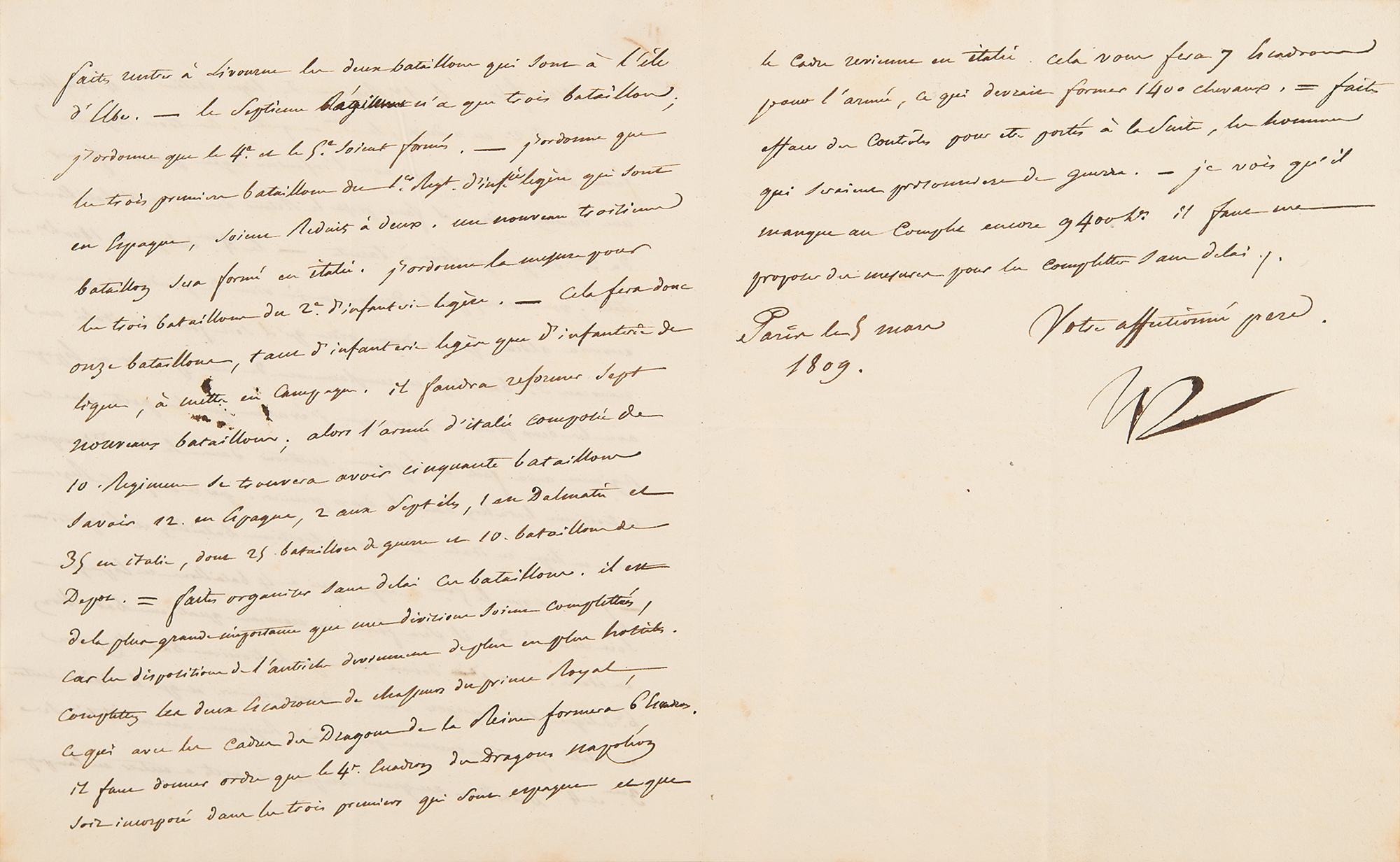
I order that the 5th Line Regiment, which has 4 battalions in Spain, be reduced to 3. A new fourth battalion must be formed in Italy.—I order that the third battalion of the 6th Line Regiment be incorporated with the first two and that the regimental staff return to Italy. Take steps to bring the 3rd and 4th battalions of this regiment up to full strength in Italy. Bring back the two battalions located on Elba, near Livorno.—The 7th Regiment has only 3 battalions; I order the 4th and 5th to be raised.—I order that the three first battalions of the 1st Light Infantry Regiment, currently in Spain, be reduced to two. A new 3rd battalion is to be raised in Italy.—I order the 4th battalion of the 2nd Light Infantry Regiment to be raised as well.
That means that we will have 12 battalions of Light Infantry, which, like Line Infantry, can be deployed for field operations. Seven battalions must still be raised: the Italian army, consisting of ten regiments, will then comprise fifty battalions—12 in Spain, 2 on the Seven Islands, 1 in Dalmatia, and 35 in Italy, of which 25 are field battalions and 10 are replacement battalions.—Raise these battalions without delay.
It is of the utmost importance that my divisions be brought to full operational strength, as Austria's troop movements increasingly point to an attack.
Add the two Jäger squadrons of the Crown Prince, along with the core troops of the Queen’s Dragoons, making 6 squadrons in total. Issue orders for the 4th Squadron of the Napoleon Dragoons to be merged with the first three that are currently in Spain, and for the core units to return to Italy. This will give the army seven squadrons, amounting to 1,400 cavalrymen.
I see that 9,400 men are still missing to complete the numbers. Propose measures to me in order to promptly reach full troop strength.
Your loving father,
Np
3. Paris, March 8, 1809
My son,
I assume that you have written to General Marmont by land and sea using the secret code, in order to inform him of my preparations in Germany and to notify him that my advance will begin on March 20.
I by no means intend to begin the war.
I assume that by that time the divisions of Sera, Broussier, Grenier, Lamarque, and Barbou will have taken up positions—namely, on the left bank of the Adige River. As soon as the likelihood of hostilities increases, Miollis must advance closer with his division.
In such a case, I will order the King of Naples to send troops to occupy Rome.
Inform General Marmont that he should establish his entrenched camp on the border with Croatia, so that he either keeps an opposing force in check, one that is equal to his own, or else does not risk losing the territory if he were to leave the camp.
Your loving father,
Np
4. Rambouillet, March 11, 1809
My son,
Let the field regiment of cuirassiers stationed in Brescia march to Augsburg, where a detachment will join your corps. Let Tyrol be crossed as quickly as possible by making long day marches without daily rests. Pay them until April 1 when they depart.
I do not know exactly where Chiusa Venitienne near Pontebba is located. If it can be secured from an Austrian surprise attack within six weeks or two months, fortifications can be constructed there. Have the area between Tarvis and Osopo thoroughly reconnoitered in order to prevent the Austrians from breaking through there. I assume the heights of Osopo are in a defensible condition. Take all the small defensive positions of Osopo.
I assume you have a post in the border region near Tarvis, with an intelligent officer, so we may learn what is happening by questioning all travelers and observing all lines of communication.
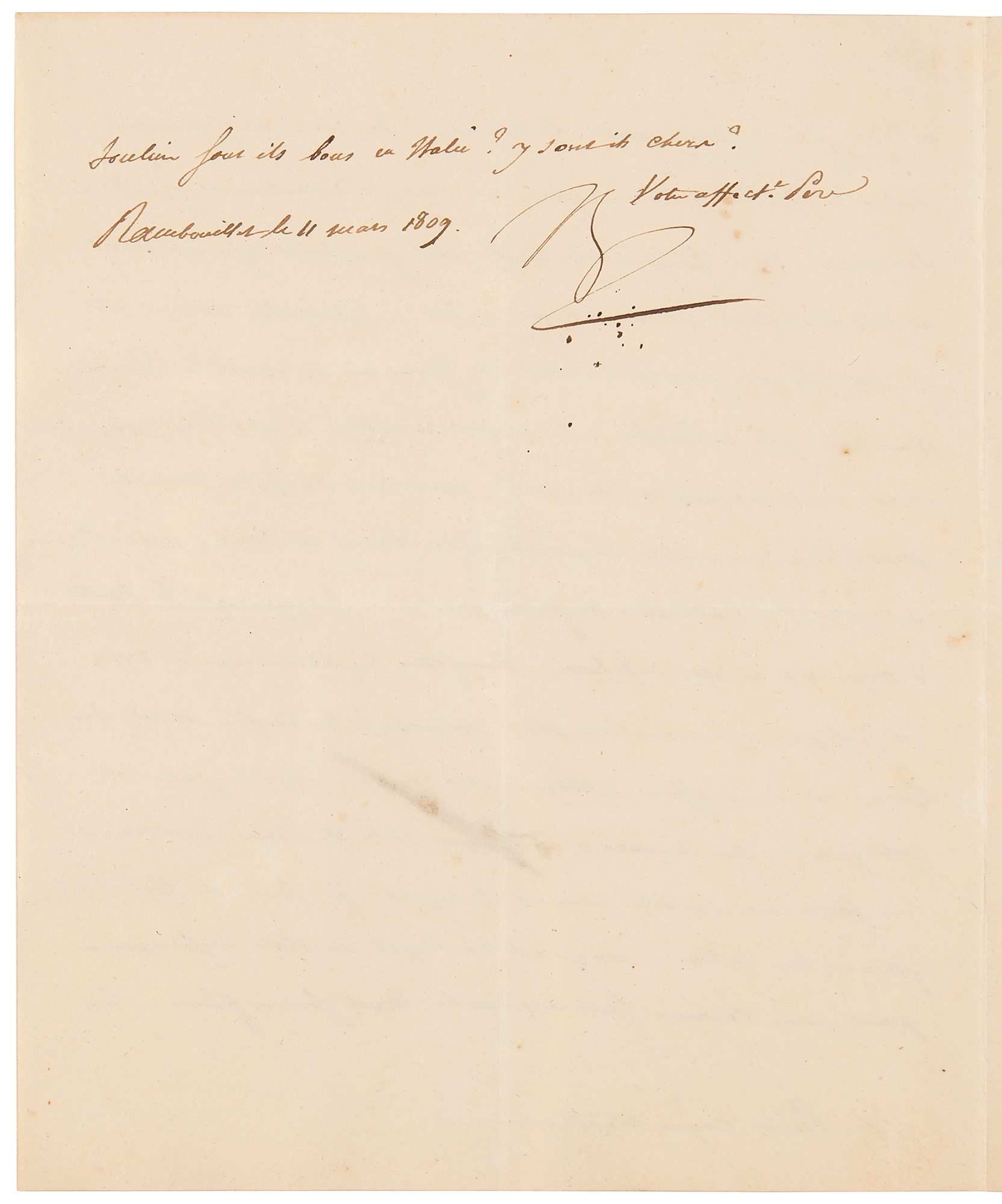
Let me know how the regiments in Italy are obtaining their footwear. Those who have their replacement depots in Italy are not in trouble—but what about those whose replacement depots are in France? Are the shoes in Italy good? Are they expensive?
Your loving father,
Np
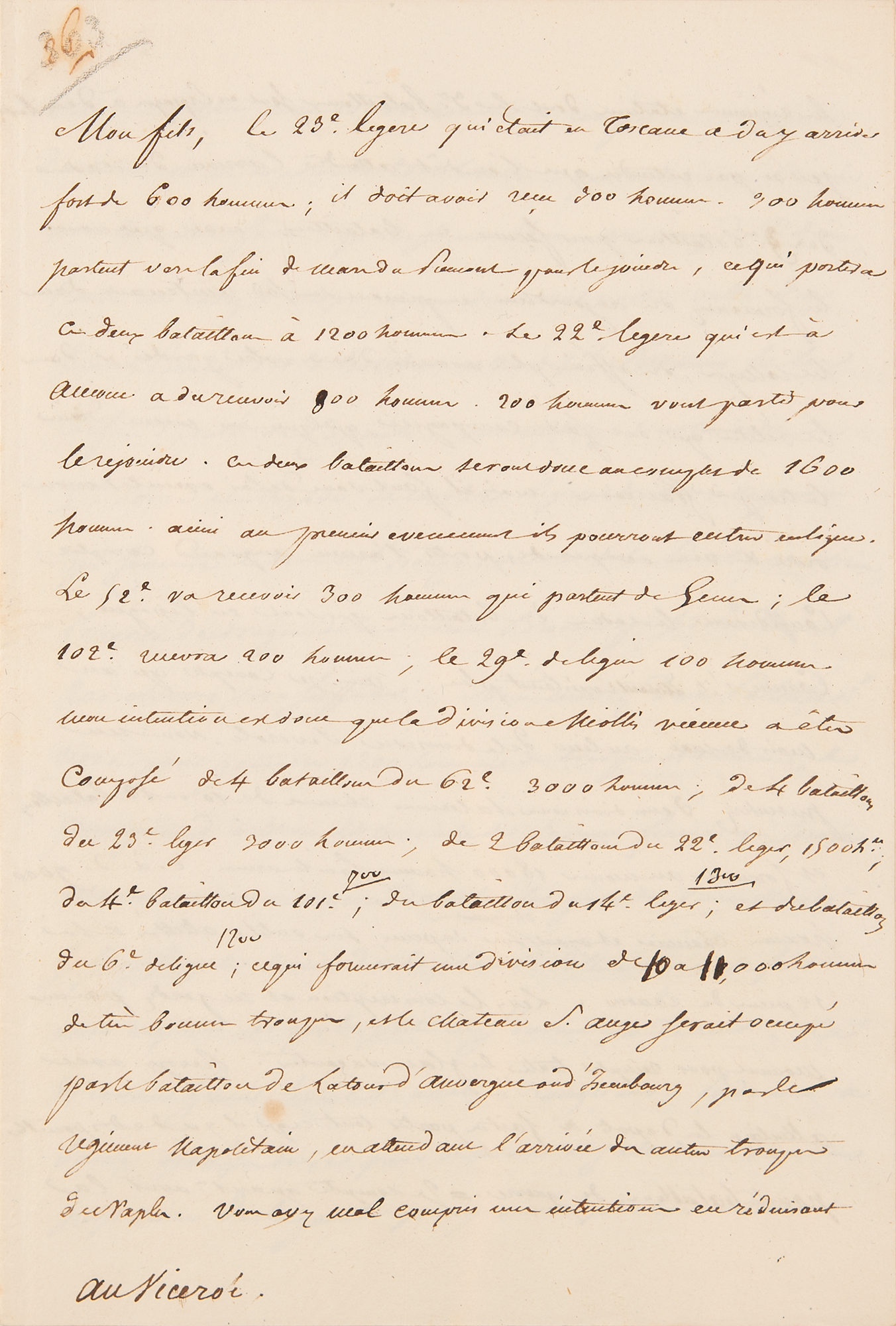
5. Paris, March 16, 1809
My son,
The 23rd Light Infantry Regiment from Tuscany, 600 men strong, must now have received reinforcements. It must receive 300 more men. 300 men will march toward the end of March to Piedmont to determine whether these 2 battalions will bring in a total of 1200 men. The 22nd Light Infantry Regiment in Ancona must receive 800 men; 200 more men will join it afterward. These two battalions will thus be brought up to a total strength of 1600 men. In such a case, they can take part in the first engagement.
The 52nd Regiment will receive 300 men, who will march from Genoa; the 102nd will receive 200 men; the 29th Light Infantry 200 men.
My intention is that Division Miollis will already be composed of 4 battalions of the 62nd Regiment – 3000 men; 4 battalions of the 23rd Light – 3000 men; 2 battalions of the 22nd Light – 1500 men; from the 4th battalion of the 101st – 700 men; from the battalion of the 14th Light – 1300 men; and from the battalion of the 6th Line Regiment – 1200 men.
This division of 10,000 men, with good troop material, will be formed. The English will be driven from the battalion of Latour or from the Auvergne, or from Isembourg, or from the Neapolitan Regiment, with other troops awaiting in Naples.
You misunderstood the detachment from the Italian regiment, whose 3rd battalion is in Spain, and whose 2 battalions have been reduced. I do not intend to wait for the arrival of the core troops of the 3rd battalion to form battalions, but rather that you should form them from the existing forces by taking the officers from your Guard – those who have already taken part in a campaign and whom some of the French troops already recognize.
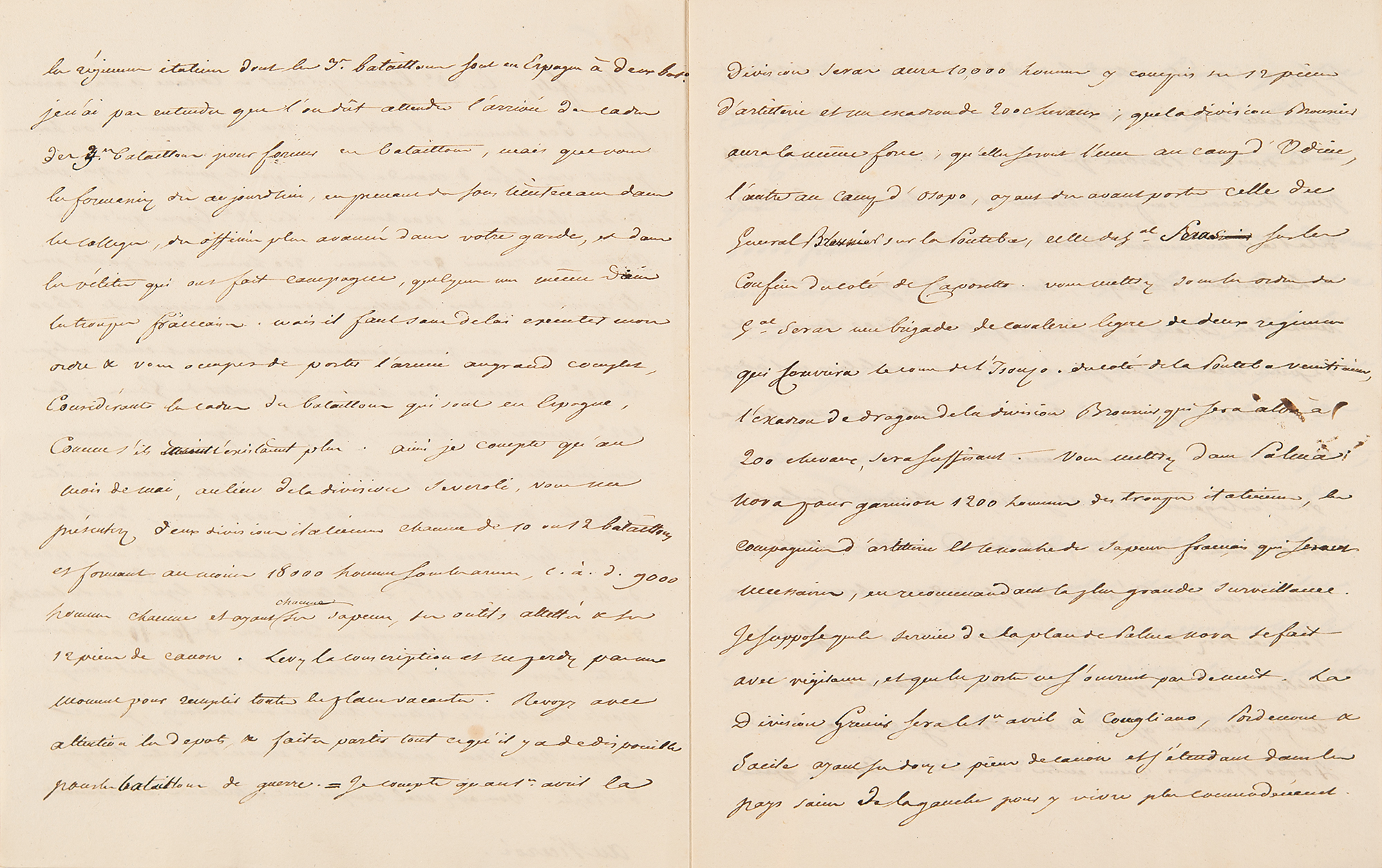
But carry out my orders immediately and bring the armies up to full strength, considering the cadre of the battalions stationed in Spain as if they did not exist. So I expect that by May, you will offer me two Italian divisions, each 10 or 12 battalions strong, which means at least 18,000 men, plus some special units, i.e., 9000 men each, and each having its own engineers, equipment, and 12 artillery pieces.
Carry out recruitment without losing a moment to fill the vacancies. Inspect the depot battalions with rigor and send everything available to the active battalions.
I expect that the Division Seras will have 10,000 men by April 1, including the 12 artillery pieces and a squadron of 200 cavalry; that the Broussier Division has the same strength; that one is in the field camp near Udine, and the other in the field camp near Osopo, where General Broussier is closest to Pontebba, while General Seras is at the border near Caporetto. You will provide a brigade of light infantry under General Seras consisting of two regiments to cover the advance of the army.
In the Venetian area near Pontebba, the dragoon squadron of General Broussier, which will then count 200 riders, will be sufficient.
You will station the 1200-man garrison from Italian troops in Palma Nova, including the artillery component, and the number of French engineers required, where you will assign the utmost vigilance. I assume that the commander of the location of Palma Nova can man the watchtower well.
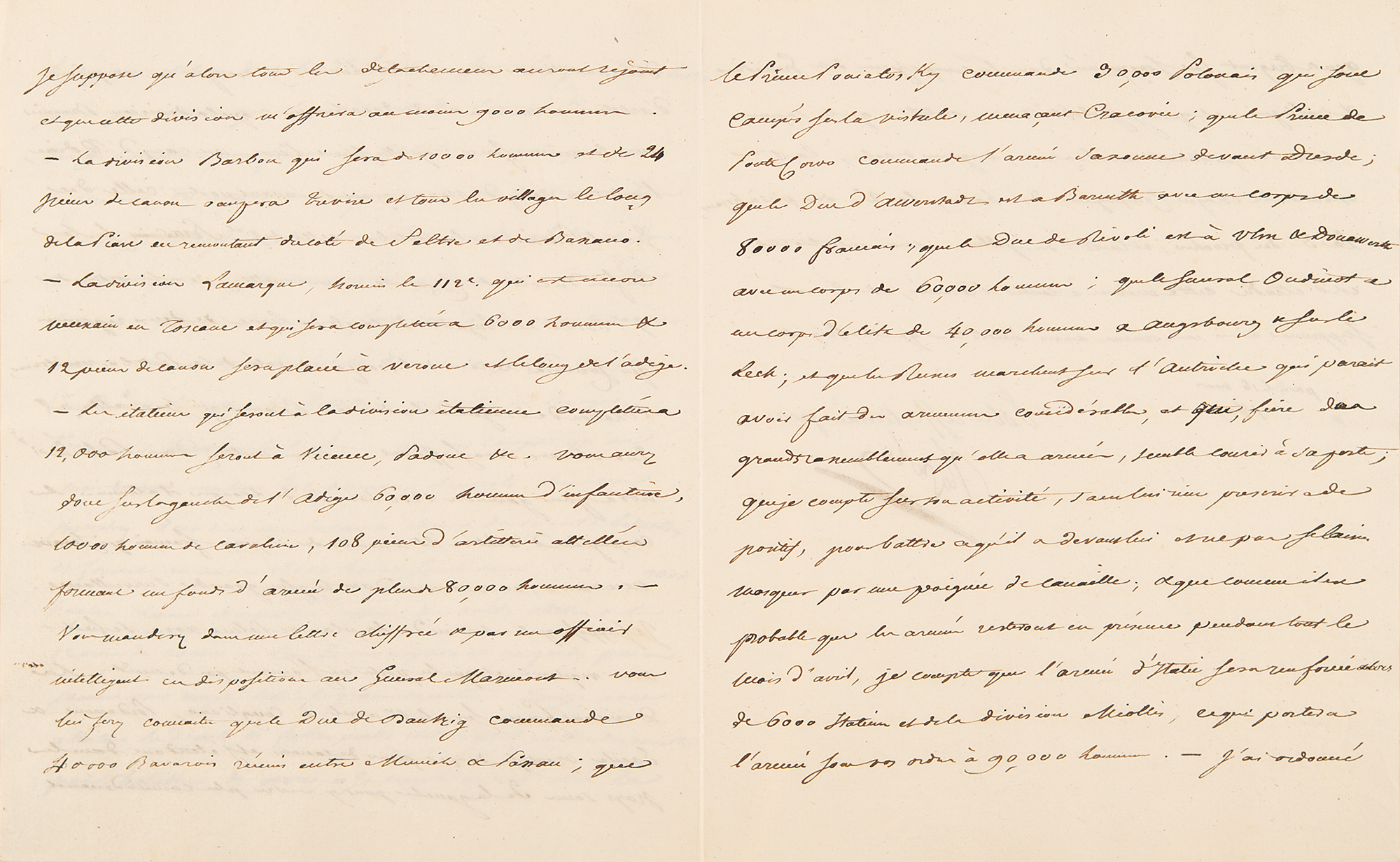
The Grenier Division will also be in Pordenone and Sacile by April 1 with 12 cannons, while it will extend its left flank to the fruit-growing plain, where it is easier to live. I assume that by then all units will have assembled and that this division will have at least 9000 men.—The Barbou Division, which will consist of 10,000 men and 24 cannons, will take over the city of Treviso and all the villages along the Piave River as far as Feltre and Bassano.—The Lamarque Division, which is still in Tuscany and will be reinforced to 6,000 men and 12 cannons, will be stationed in Verona and deployed along the Adige River.—The Italians who are in the Italian Division will number 12,000 men and will be in Vicenza, Padua, etc.
You also have, on the left of the Adige, 60,000 infantry, 10,000 cavalry, 108 pieces of mounted artillery, which gives a total force of more than 80,000 men.—You will inform General Marmont of this in a ciphered letter and send him a position map through an intelligent officer.
You will inform him that: The Duke of Danzig commands 40,000 Bavarians concentrated between Munich and Passau.—Prince Poniatowski commands 30,000 Poles stationed on the Weichsel River near Krakow.—The Prince of Ponte Corvo commands the Saxon army near Dresden.—The Prince of Auersperg is in Bayreuth with a corps of 80,000.—The Duke of Rivoli with the French is in Ulm and Donauwörth with 60,000 men.—General Oudinot has a corps of 40,000 men in Augsburg and on the Lech River.
Russia's movements against Austria are unclear, but significant. Russia is conducting suspicious activities, apparently arming itself. I am waiting to see what direction things are going, and I am obviously counting on Severoli to command a strong force, to whom I will assign specific orders — any man who has nothing to fight for but would allow himself to be corrupted by a handful of villains.
Also, it is likely that the armies will remain in position throughout April, so I am relying on the Italian army having 6,000 men from Division Miollis, which will bring the army under your command to 90,000 men.
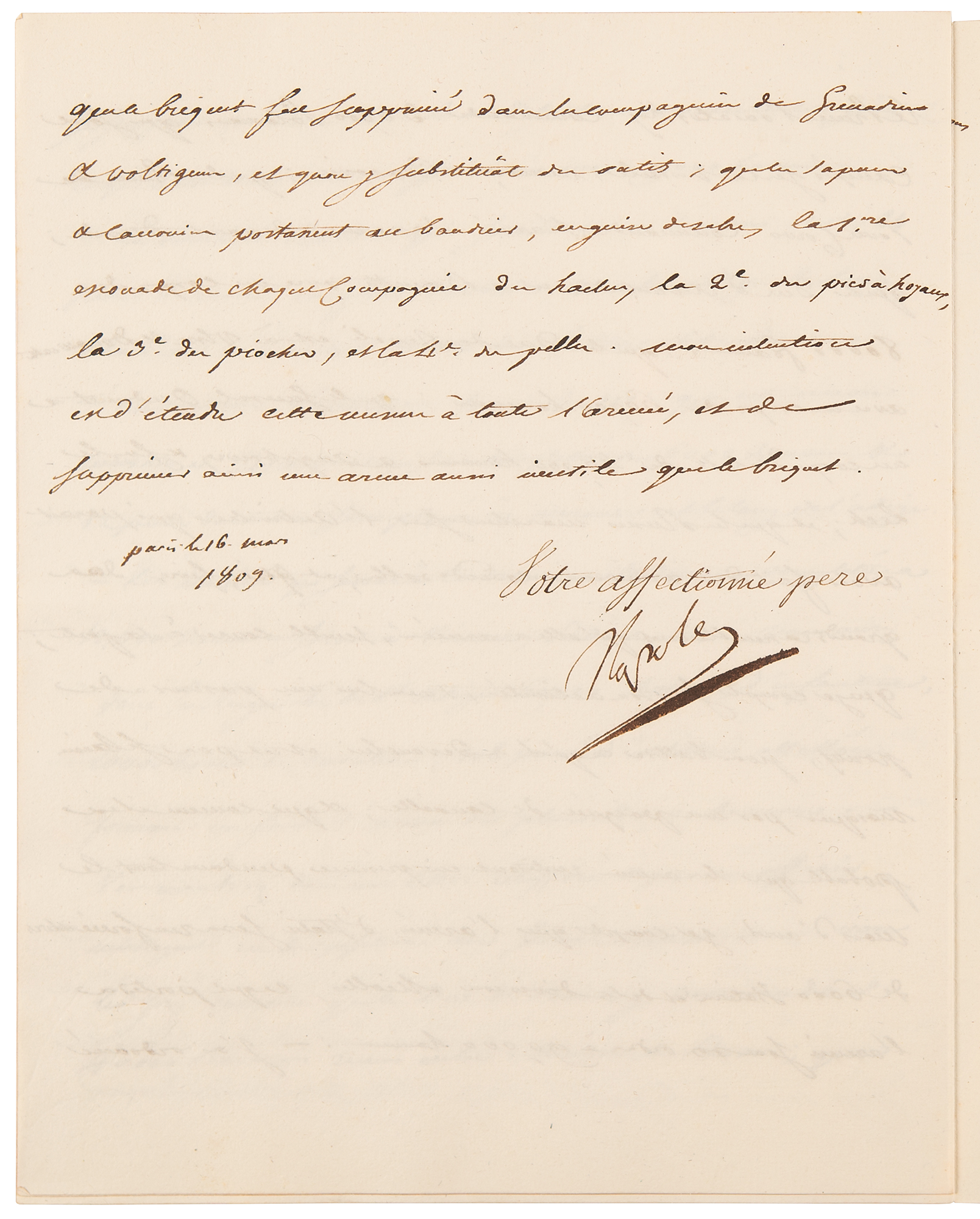
I have ordered that the briquet (sabre) of the grenadiers and assault troops be abolished and replaced with tools. The pioneers and gunners will carry tools on shoulder straps instead of sabres: the first corporal unit of each company: axes; the second: pickaxes; the third: spades; the fourth: shovels. My intention is to extend this measure to the entire army and eliminate such a useless weapon as the briquet.
Your affectionate father,
Napole
6. Paris, March 22, 1809
My son,
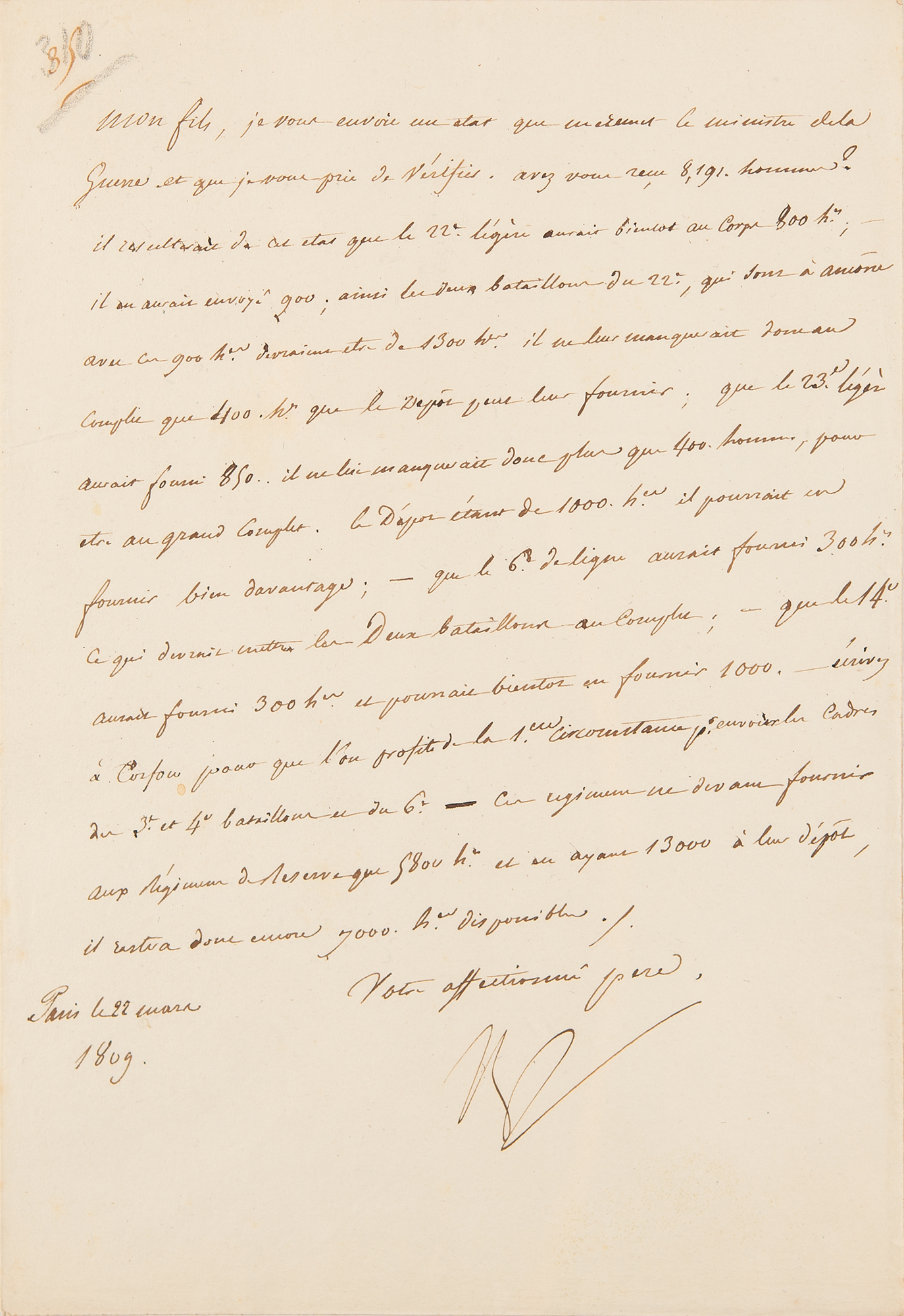
I am sending you a report that summarizes the review of the young recruits which I had taken from the depots. Have you received 8,191 men?
It results from this that the 22nd Line had sent to the Corps 800 men; it would have sent 900, as well as the two battalions of the 72nd, which are in another army corps, which would have sent 1,800 men. Another regiment has sent 400, which the depot had to supply; the 23rd Line had supplied 850…
I have written to the Corps so that the general inspector of cadet battalions of the Guard would proceed with the inspection of the 3rd and 4th battalions of the 6th.—That the regiment must supply, along with the regiment of the 1st, about 800 men, and having 1,800 at their depots, there would remain at least 7,000 men available.
Your affectionate father,
Np
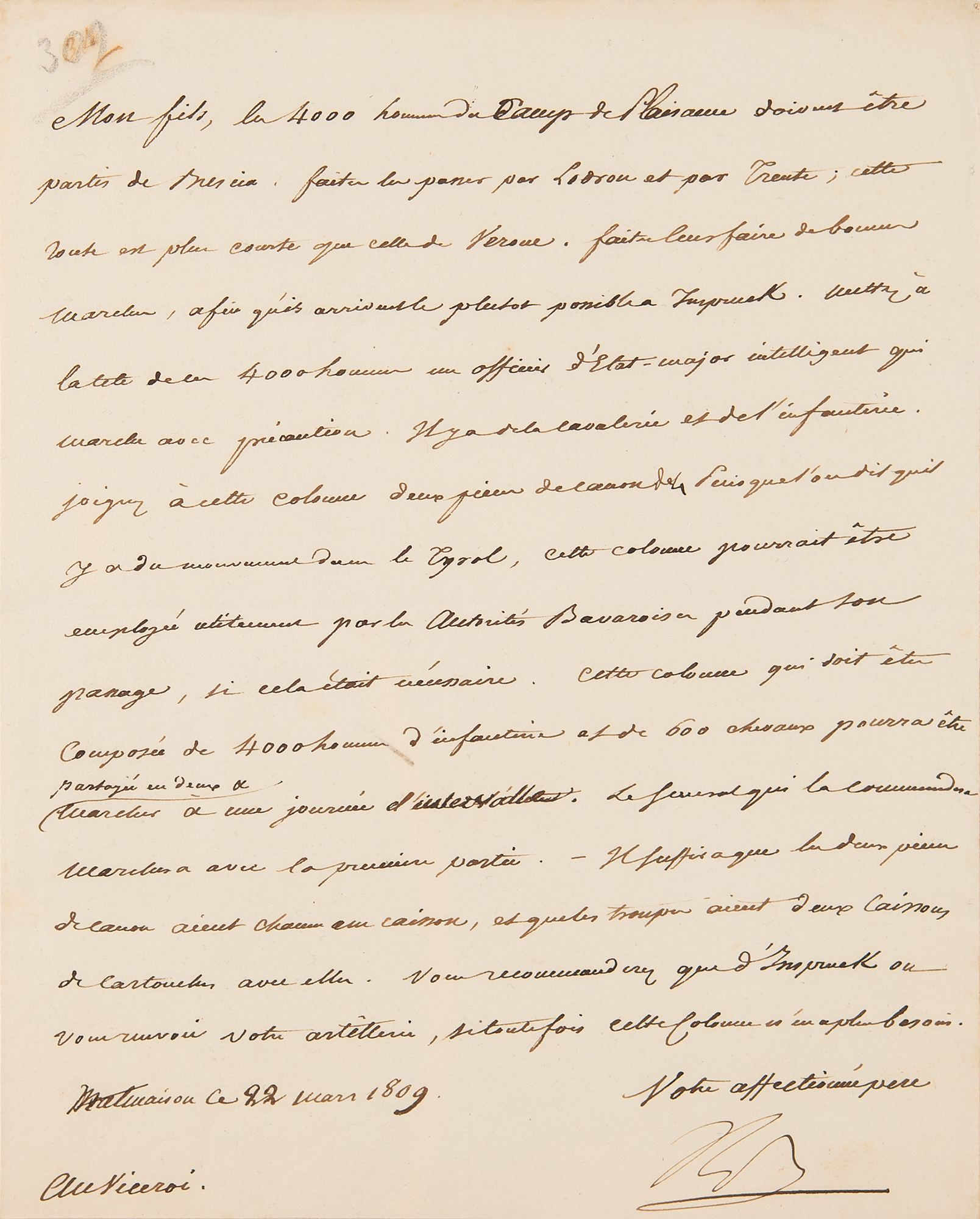
7. Malmaison, March 22, 1809
My son,
The 4,000 men from the camp at Laissance must have already set out from Brescia. Have them march through Lodron and Trento. This route is shorter than the one from Verona. Make sure they march vigorously so that they arrive in Innsbruck as soon as possible. Appoint an intelligent officer from the General Staff to the head of these 4,000 men, who should lead them cautiously. It is cavalry and infantry. Add two pieces of artillery to this column. Since it is said that there is unrest in Tyrol, this column could, during its march, advantageously be used by the Bavarian occupiers, if necessary.
This column, which should consist of 4,000 infantry and 600 cavalry, can be divided into two groups and march one day's distance apart.
The general who commands them will march with the first detachment. It will suffice for the two guns to each have a supply wagon, and for the troops to carry two wagons with ammunition.
You will order that your artillery be sent back from Innsbruck once the column definitely no longer needs it.
Your loving father,
Np
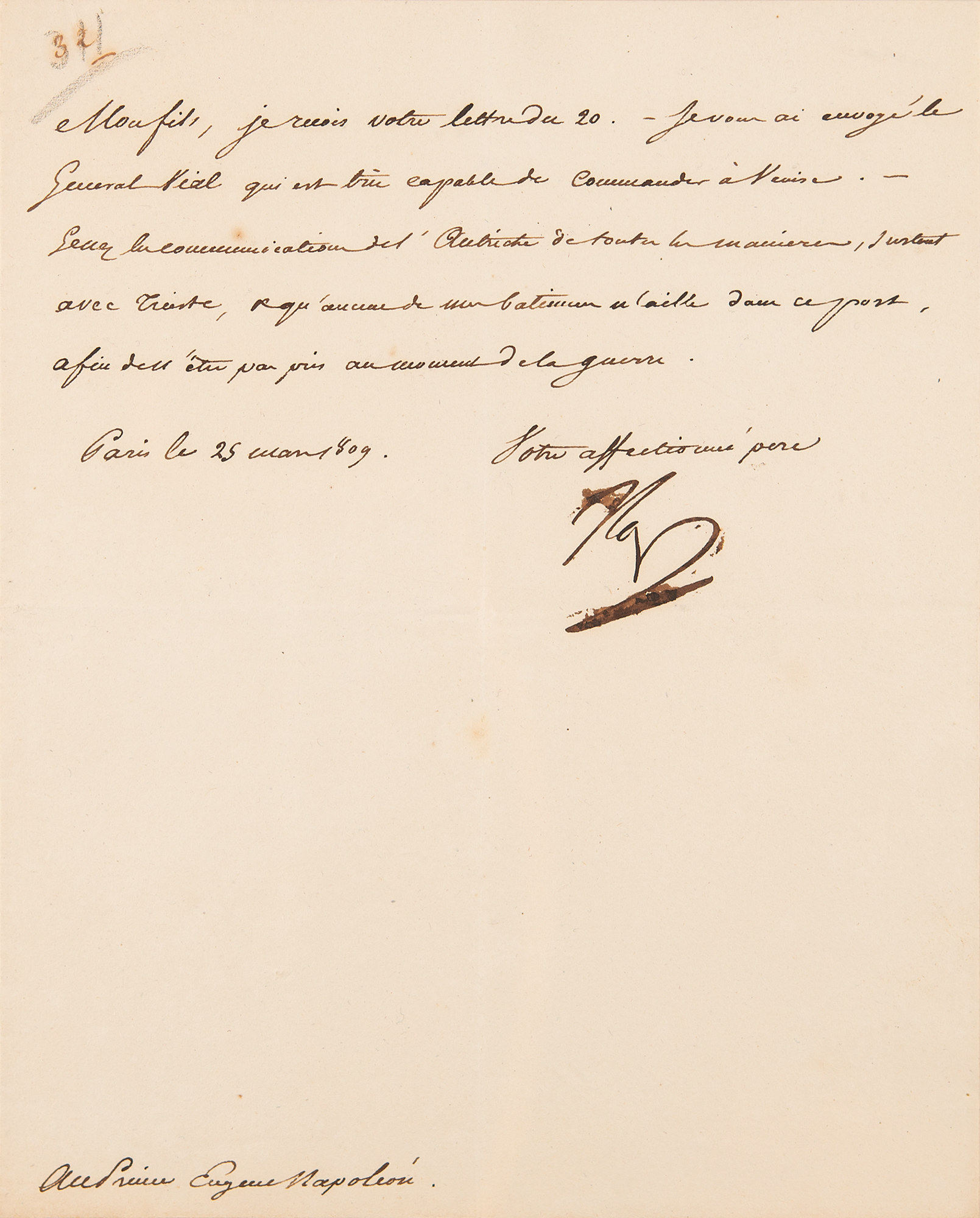
8. Paris, March 25, 1809
My son,
I have just received your letter from the 20th.—I am sending you General Vial, who is very well suited to command in Venice.
Disrupt Austria’s lines of communication by all means, especially those with Trieste. Let none of my ships enter that port, so that they are not captured at the moment war breaks out.
Your loving father,
Nap
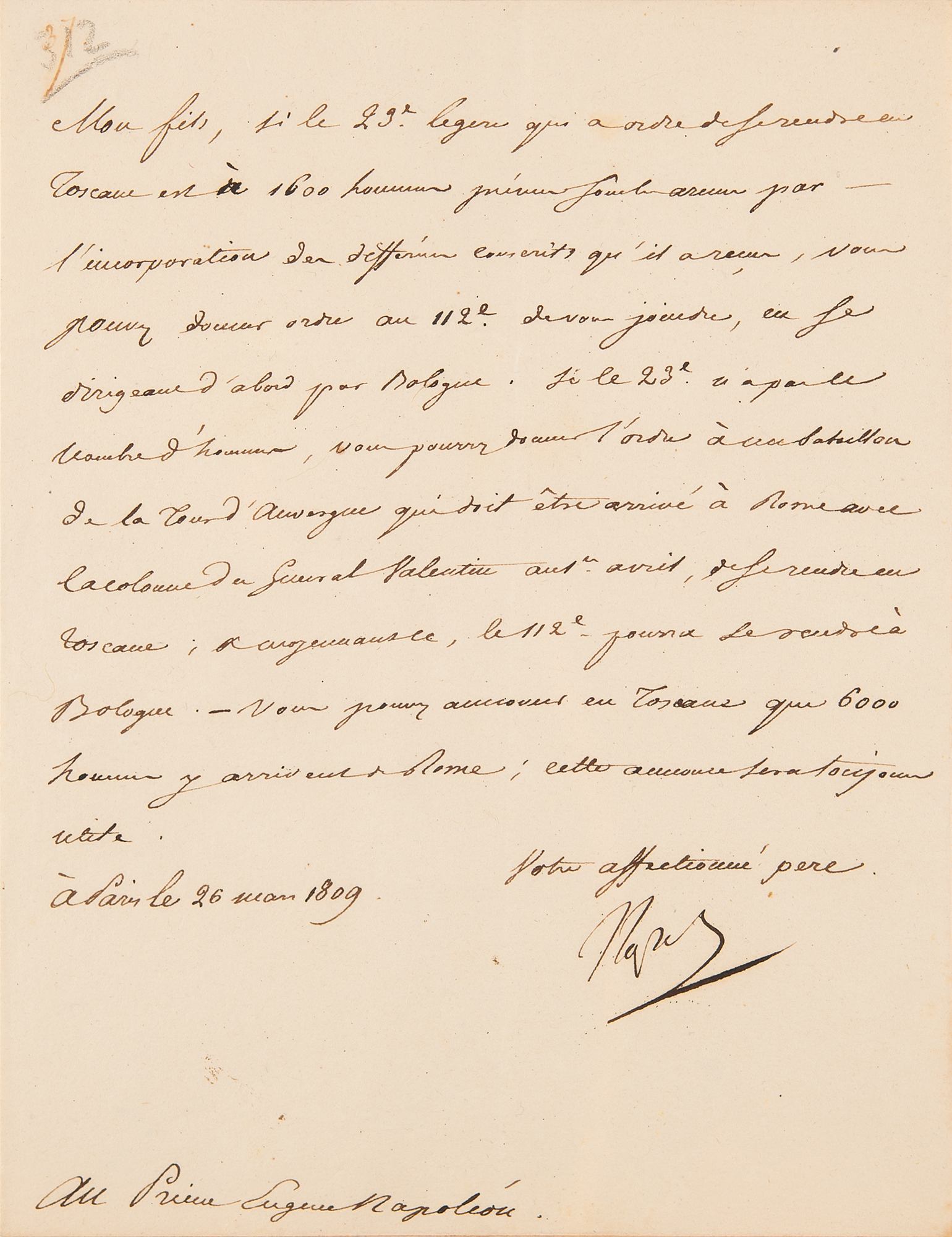
9. Paris, March 26, 1809
My son,
If the light infantry regiment which was ordered to proceed to Tuscany has reached 1600 men, you may give the 112th Regiment the order to join you and first march to Bologna. If the 23rd does not have this strength, you may give a battalion of Latour's from Auvergne, which is to join General Valentin's column in Rome on April 1st, the order to proceed to Tuscany; after that, the 112th can then proceed to Bologna. You may let it be known in Tuscany that 6000 men are coming from Rome; such an announcement will be useful in any case.
Your loving father,
Napol
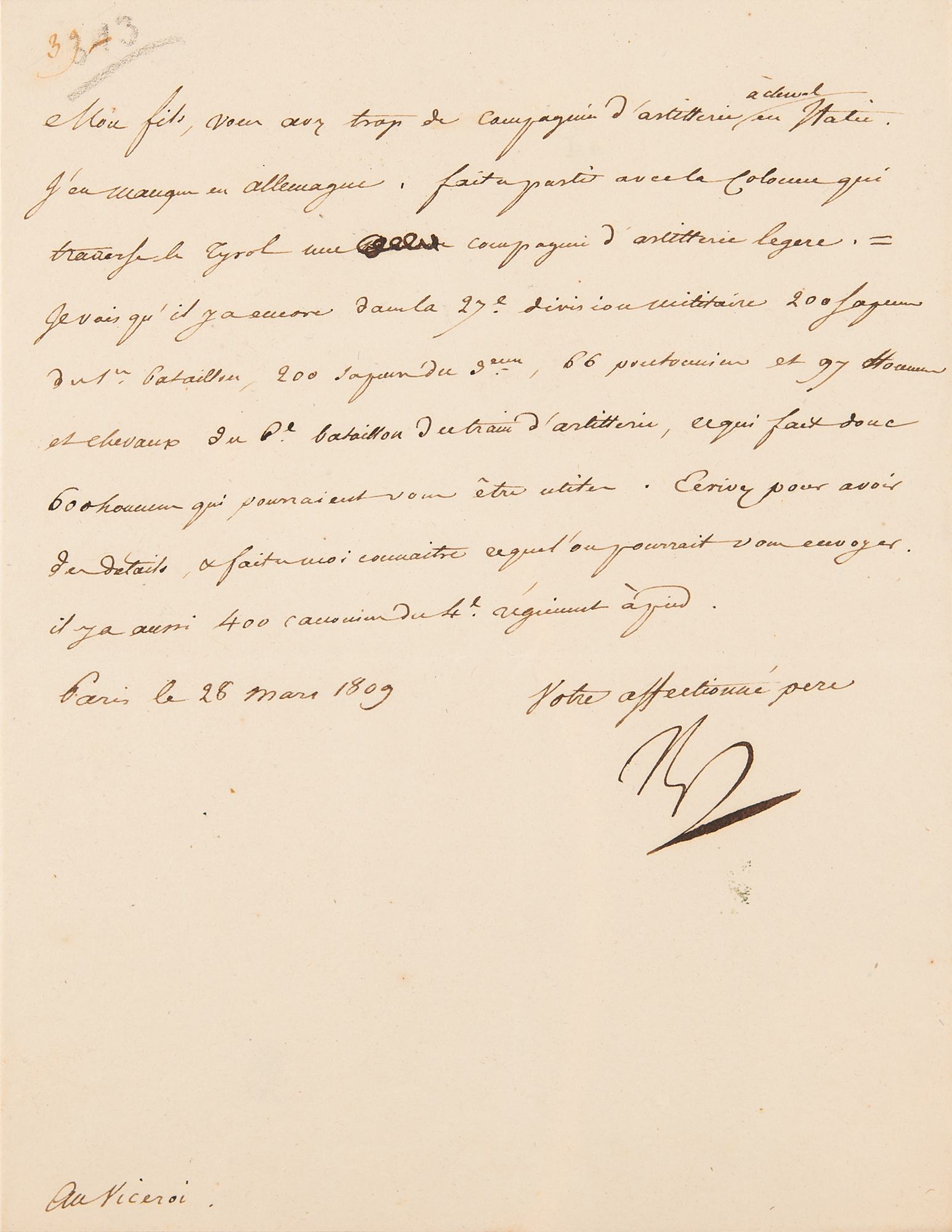
10. Paris, March 28, 1809
My son,
You have too much mounted artillery in Italy, while I am lacking it in Germany. Have a light artillery unit accompany the column marching through Tyrol.
I see that in the 27th Division there are 200 engineers of the 1st Battalion, further 200 engineers of the 3rd, 66 bridge builders, and 97 mounted men of the 6th Battalion from the artillery unit — totaling 600 men, who could be useful to you.
Write me the details and let me know what can be sent to you. There are also 400 gunners of the 4th Regiment on foot.
Your loving father,
Np
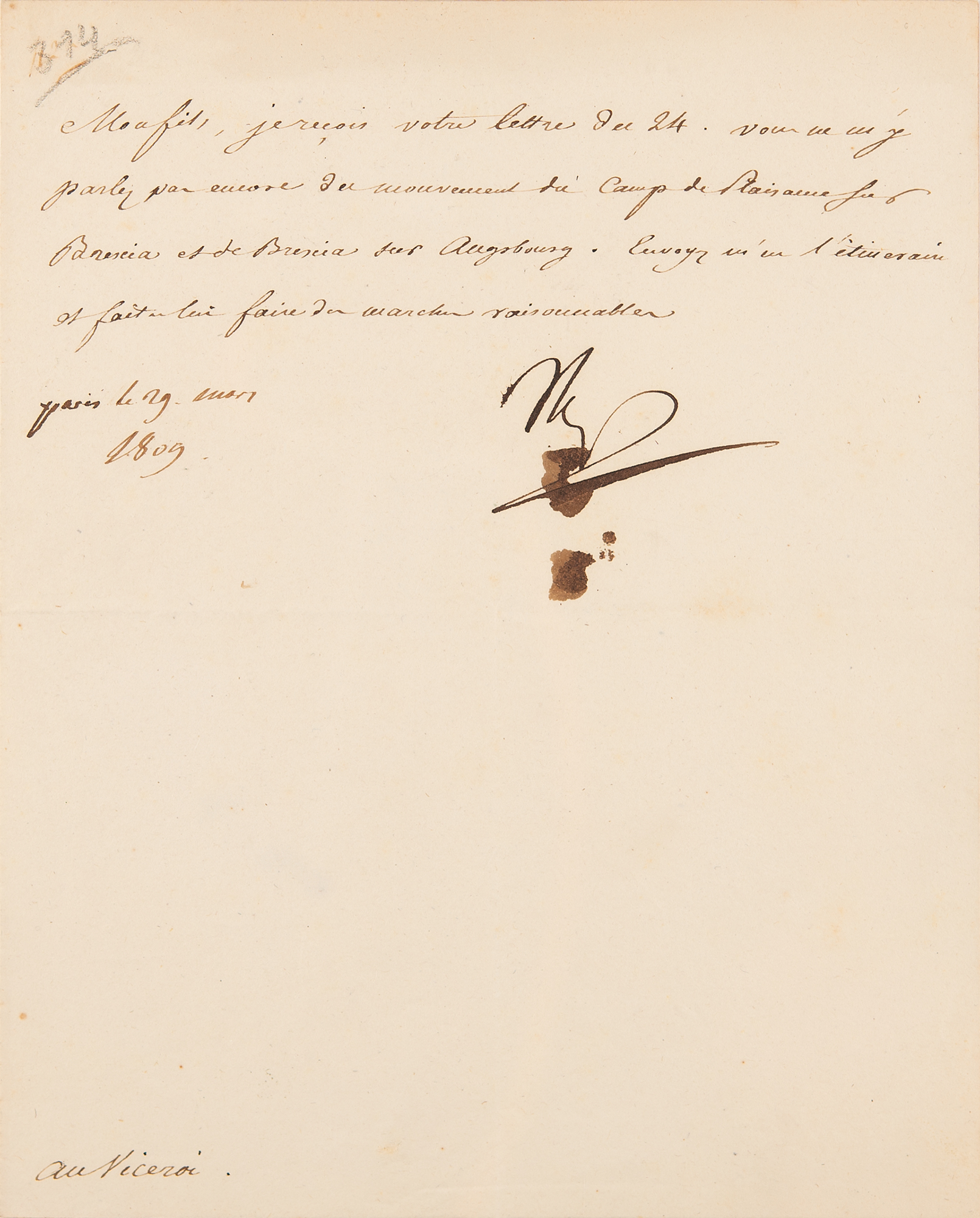
11. Paris, March 29, 1809
My son,
I have just received your letter of the 24th. You still do not mention the departure of the camp from Laisance to Brescia and from Brescia to Augsburg. Send me the marching orders for that and let them march in a reasonable manner.
Your loving father,
Np
12. Strasbourg, April 15, 1809
My son,
I am in Strasbourg; I wrote to you from Paris. Put yourselves in a safe position, but do not be hasty and march with caution.
On the 12th, the Austrians had not yet passed Mühldorf. I assume that the column of 5,000 men advancing from Italy through Tyrol began a retreat and did not continue the march to Innsbruck, which the Austrians could have occupied before them.—The Empress is in Strasbourg. If, within an hour, I cross the Rhine, I will leave the control of Tyrol to the Austrians, to enclose them there; if they advance on your side, have two armed ships prepared in Peschiera (Lake Garda) to patrol the lake.
Your loving father,
Np
13. Donauwörth, April 18, 1809
My son,
I am departing for Ingolstadt. You know about the uprising in Tyrol. The army is maneuvering in all directions against the enemy. Important decisions will soon be made. I have received no message from you since your letter of the 9th from Verona.
I assume that the French column, which was advancing through Innsbruck toward Augsburg, has withdrawn to you. That will be a good reinforcement, which will benefit you greatly. Everything suggests to me that the enemy on your side is not very numerous.
Your loving father,
Napol
14. Landshut, April 27, 1809
My son,
It is nine o’clock in the morning and I still have no news from the Italian army. I sent you Cavaletti yesterday. I still hope that you have not given up the Piave line and not exposed that beautiful plain between this river and the Adige to looting.
Besides that, I have no detailed plan because I know nothing and you apparently haven’t considered it necessary to send me even the slightest information about what has happened.—The King of Bavaria has returned to Munich. The camps at Passau and Kufstein have been dissolved during the course of the day. My troops have crossed the Inn River and I will probably be in Salzburg tomorrow.
Everything on our side that was in Tyrol has gone into hasty retreat. Had my army in Italy not suffered this unexpected setback, today would have been the end of the House of Austria. I am impatient to see someone who knows what has happened.
Your loving father,
Napol
15. Vienna, May 17, 1809
My son,
You will find enclosed the official documents that have been published; have them printed in French and Italian and distributed throughout the entire peninsula.—There is still no news from General Marmont.—The Duke of Danzig defeated General Chasteler between Kufstein and Innsbruck on the 13th and entered Innsbruck on the 15th.
Your adjutant Dathouard will inform you of the previous events surrounding the capture of Salzburg. I have given the Duke of Danzig the order to march from Salzburg against Leoben. General Lauriston has marched from Vienna and reached the mountain passes separating Leoben from Vienna. Once you arrive in Klagenfurt, the union of the troops can immediately take place.
Send me a courier every day. You can also send an officer or a troop officer. Report to me in detail the condition of each part of my army and inform me of the locations where each unit is positioned.
Archduke Ferdinand, who commands the Austrian army in Galicia, initially attempted to seize the city of Warsaw by means of capitulation, but has since retreated, and the Poles have regained everything. On the 29th, they took a bridge over the Vistula and captured 2000 prisoners.
The enemy has been defeated on all fronts. The enormous quantities of building materials needed to construct a bridge across the Danube are almost ready. I hope to be able to cross on the 18th or 19th and to defeat the armies that have concentrated between the Danube and Moravia.
Your loving father,
Napol
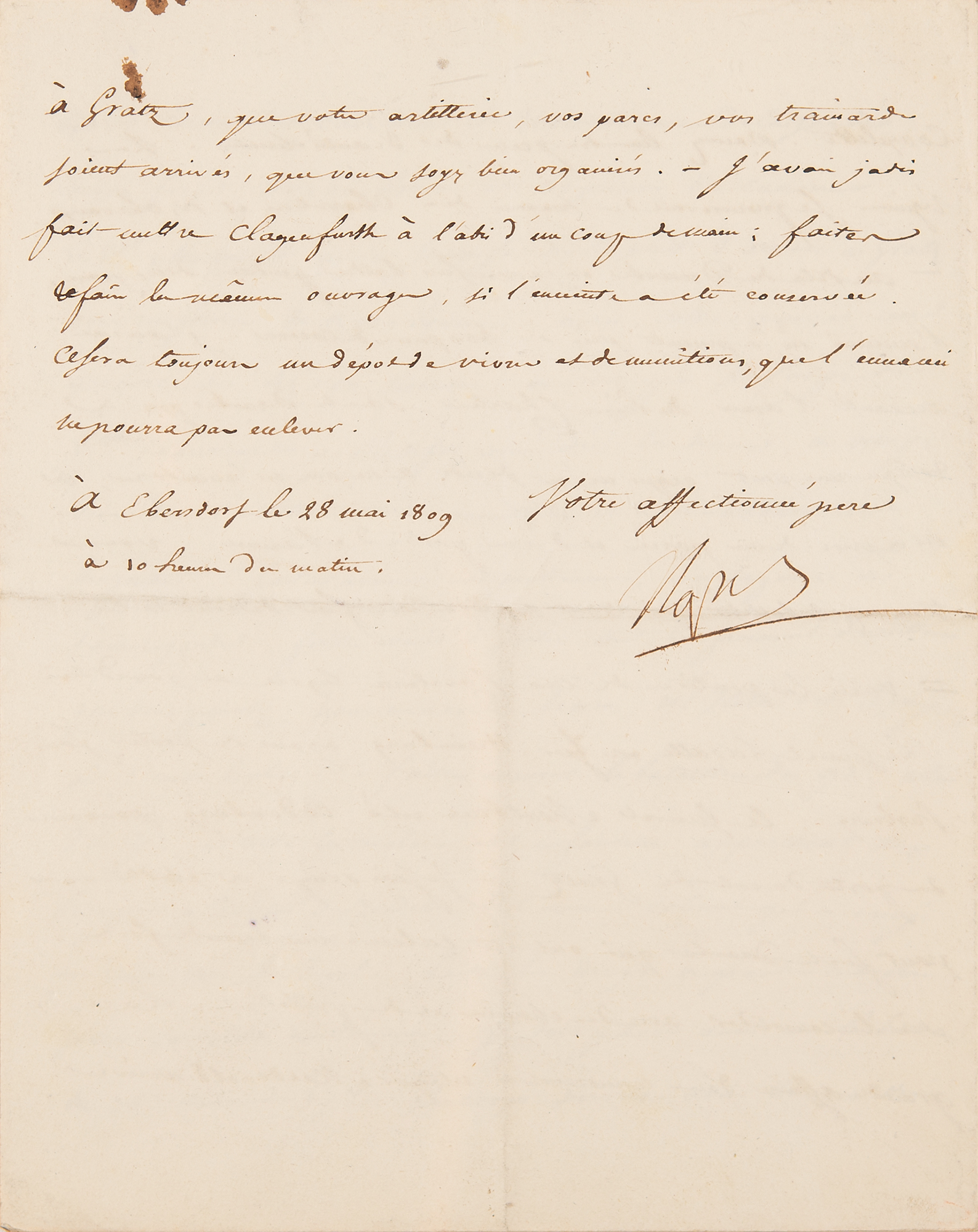
16. Ebersdorf, May 28, 1809
My son,
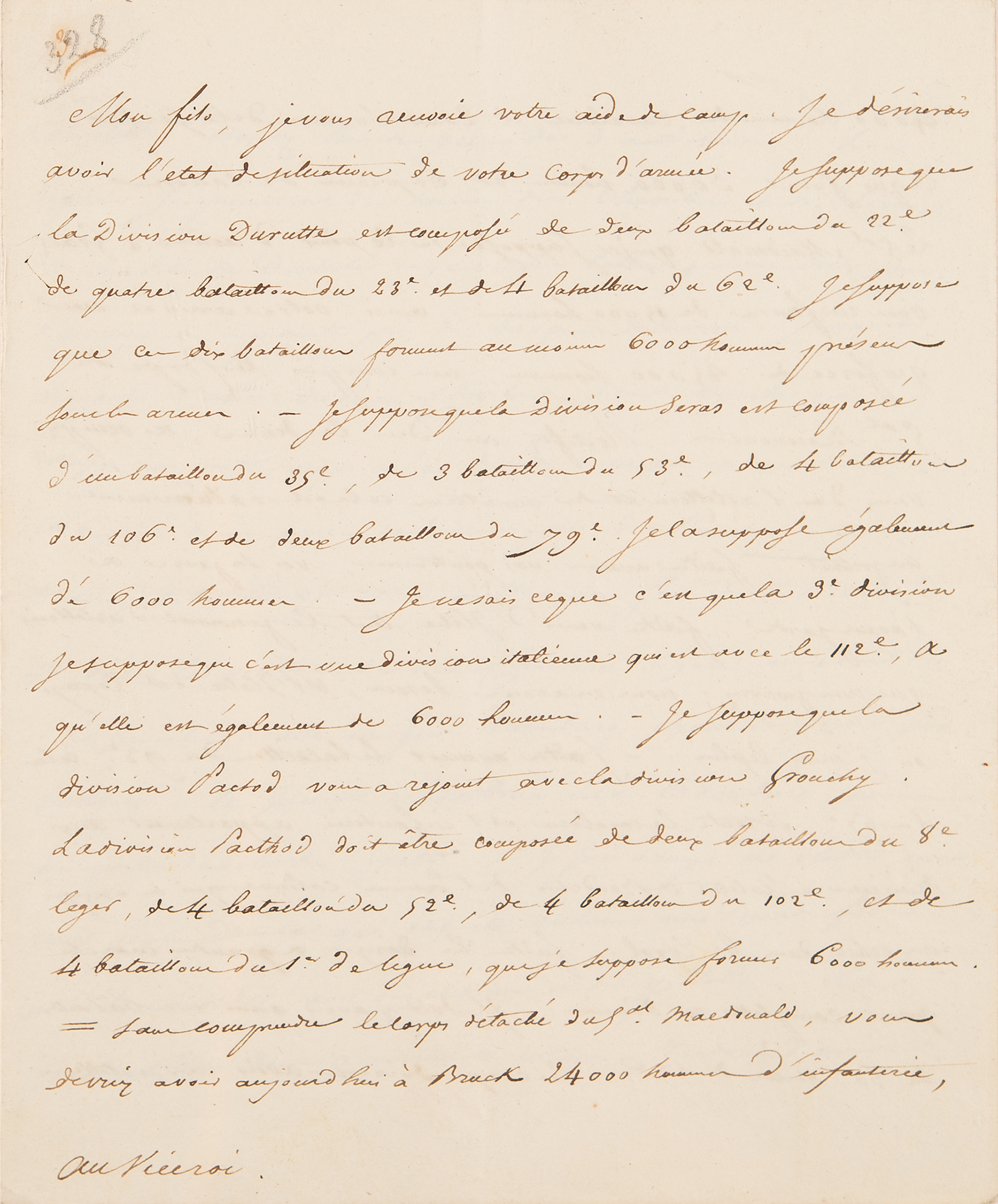
I am sending your adjutant back to you. I would like to have a situation report from your army corps. I assume that the Durutte Division is composed of two battalions of the 22nd Regiment, two battalions of the 23rd, and two battalions of the 62nd. I assume that this division has at least 6000 men under arms. I also assume that the Seras Division is composed of one battalion of the 35th, three battalions of the 53rd, four battalions of the 106th, and two battalions of the 79th Regiment. I assume it also has more than 6000 men.
I do not know what the 3rd Division consists of. I assume it is an Italian division, the 112th Regiment being part of it, which should also have more than 6000 men.
I assume that the Pactod Division, together with Grouchy’s Division, is united with you. The Pactod Division should consist of two battalions of the 8th Light Infantry Regiment, two battalions of the 52nd Line, four battalions of the 102nd, and four battalions of the 1st Line Regiment—altogether 6000 men.
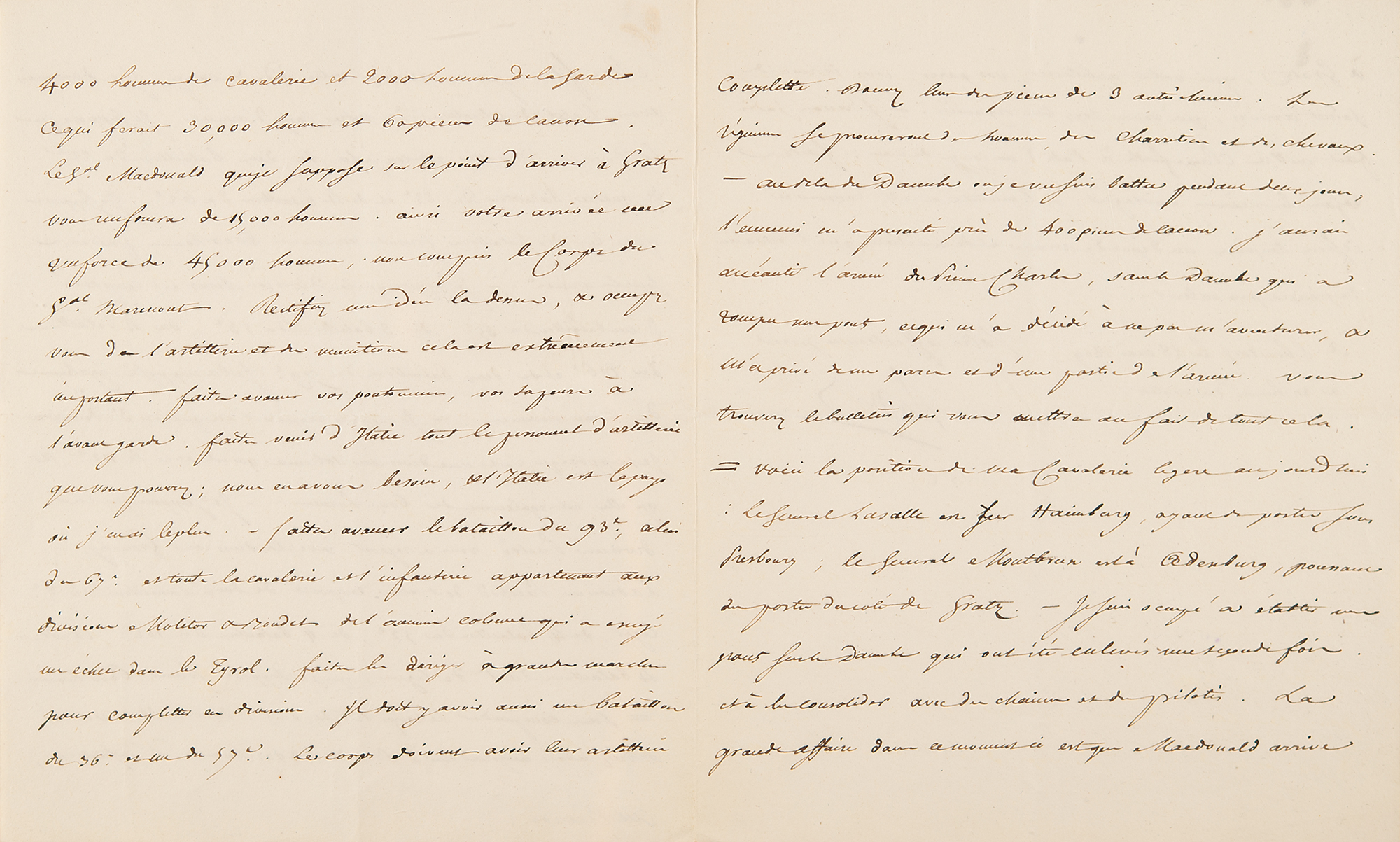
If we include the freely operating corps of General MacDonald, there should be in Bruck about 24,000 infantry, 4000 cavalry, and 2000 guardsmen. That would be 30,000 men and 60 artillery pieces.
General MacDonald, as I assume, will immediately reinforce you with 15,000 men upon the arrival of his corps in Graz. That would make 45,000 men available. Reports from General Marulaz confirm this. Keep a close eye on the artillery and ammunition; they are of utmost importance. Send your pontoon specialists and engineers ahead. Also send artillerymen from Italy as we need them urgently, and Italy has the largest numbers of them.
Let the 93rd Battalion advance, as well as the 67th and the entire cavalry and infantry that belong to the Molitor Division and suffered a setback in Tyrol as part of the former army detachment. They should march in forced marches and join your division. They should also bring a battalion of the 36th and one of the 57th with them. The corps must have their artillery fully operational.
Provide them with three cannons. The regiments will secure carts and horses themselves. Beyond the Danube, which I fought hard for two days to cross, I have captured nearly 400 artillery pieces. I would have annihilated Archduke Charles’s army if the Danube had not taken away my bridges and forced me to decide not to go too far forward, which would have deprived me of part of my transport and army. You will find a report on all this, which you must become familiar with.
From today’s report by my light cavalry:
General Lasalle is stationed in Hainburg and has outposts in front of Pressburg. General Montbrun is located in Odenburg and extends his outposts to the outskirts of Graz.—I am busy building my bridges over the Danube, which have been torn down a second time, using piles and chains to secure them. The most important thing at the moment is that MacDonald reaches Graz, that your artillery, your baggage train, your troops arrive, and that order is restored in your army. I have ordered Klagenfurt to be secured. Let the adjacent buildings be searched again in case the city wall is still standing. The city can serve as a base for supplies and ammunition, which the enemy must not be allowed to take.
Your loving father,
Napol
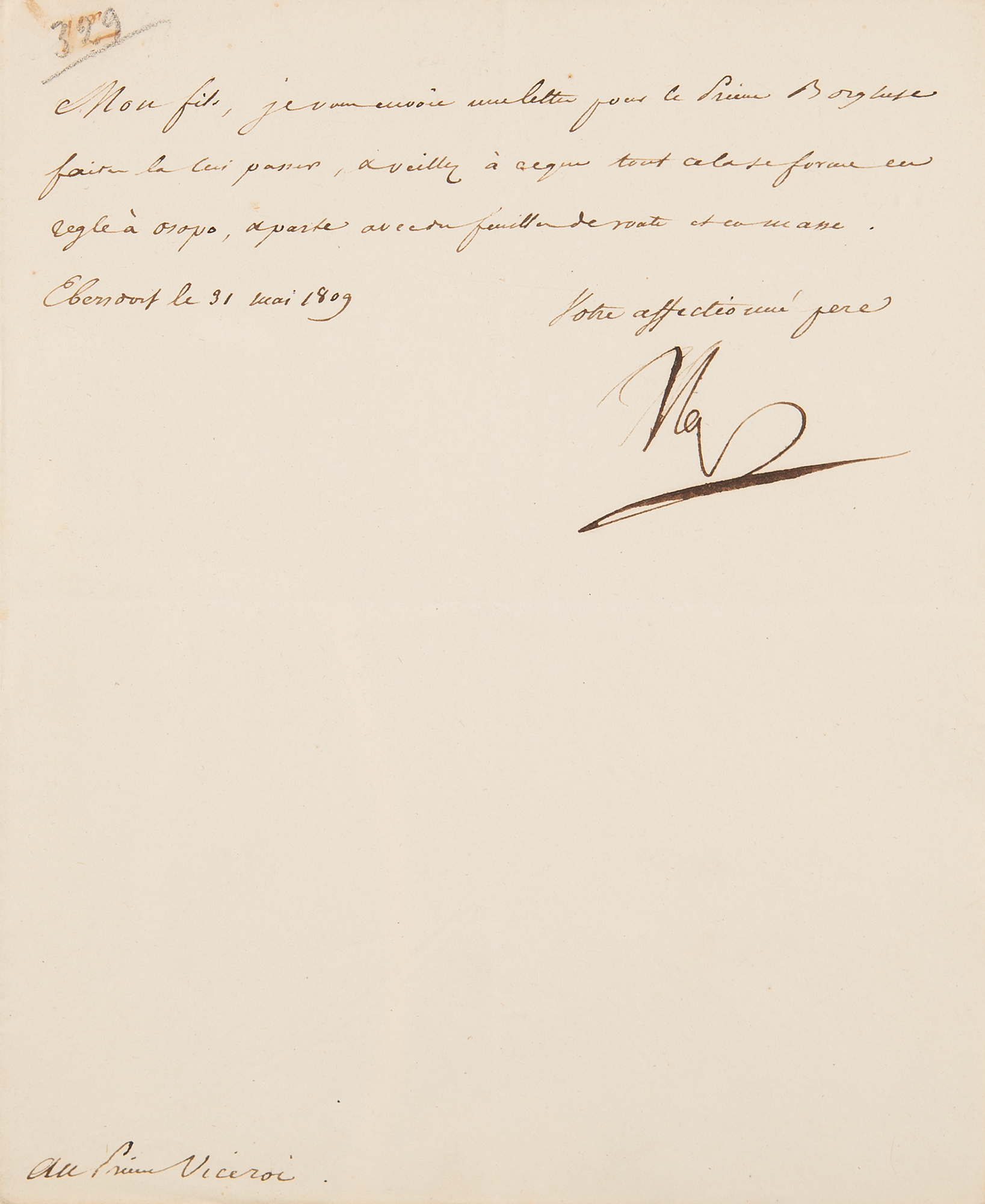
17. Ebersdorf, May 31, 1809
My son,
I am sending you a letter for Prince Borghese; let it be delivered to him, and ensure that everything is properly formed at Osopo, and that they set out according to a marching plan and at full strength.
Your loving father,
Np
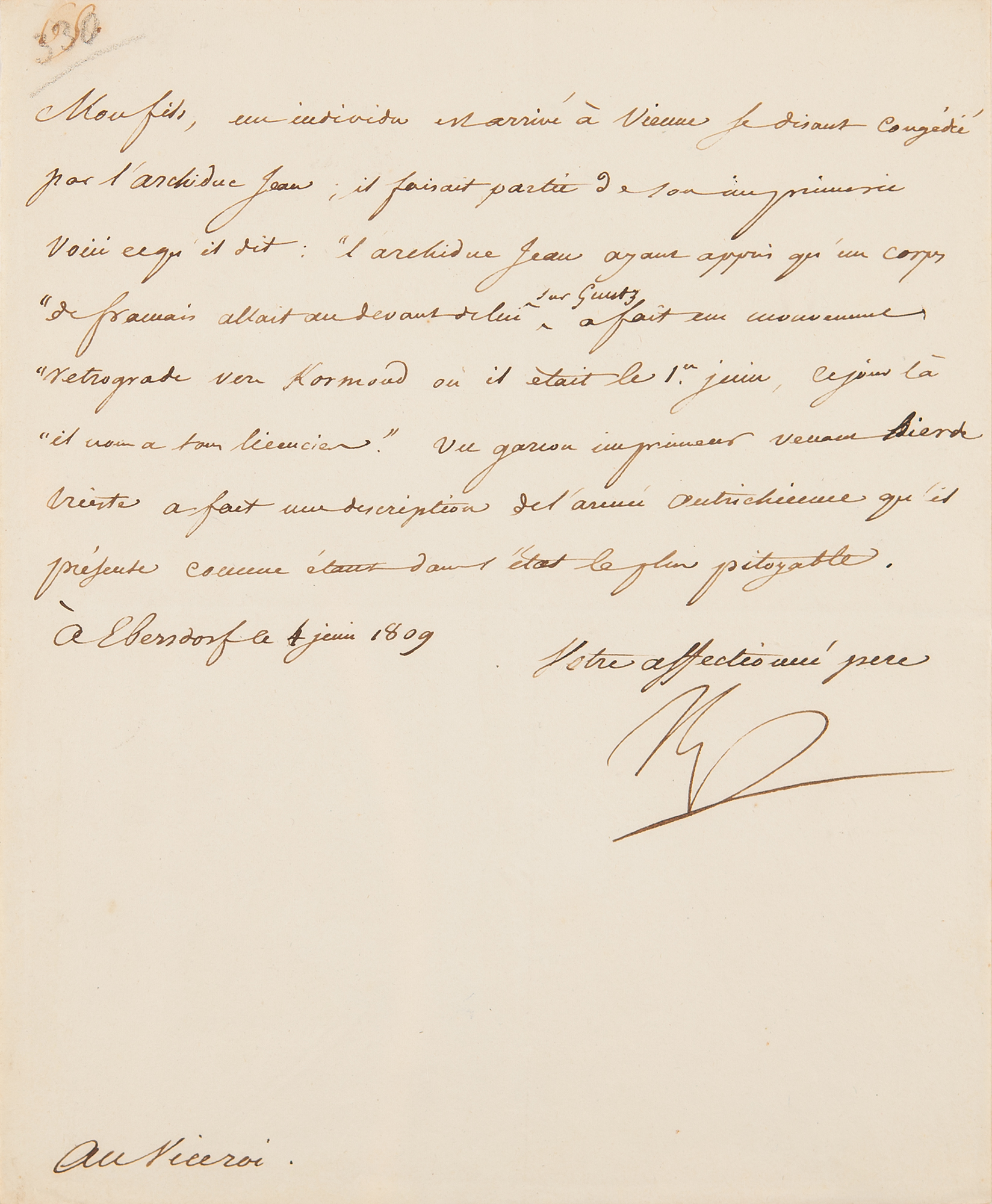
18. Ebersdorf, June 4, 1809
My son, a man has arrived in Vienna who claims he was released from service by Archduke Johann; he worked in his printing shop. He reports the following: ‘After Archduke Johann learned that a French corps was advancing toward Graz, he began a retreat in the direction of Komorn, where he was located on June 1; on that day, he dismissed us all from service.’
A printer who arrived yesterday from Trieste has given a description of the Austrian army, portraying it as being in an extremely pitiful condition.
Your loving father,
Np
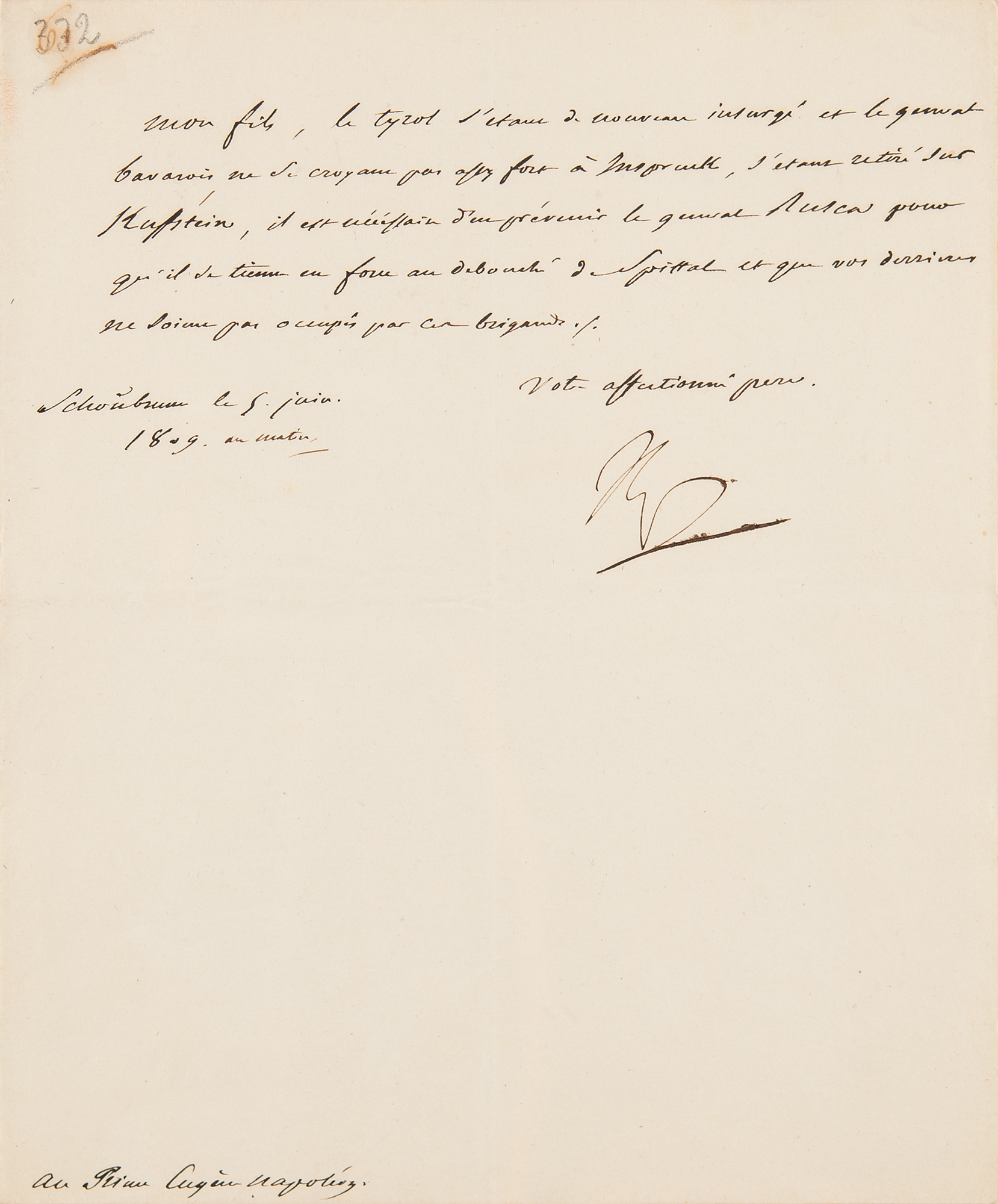
19. Schönbrunn, June 5, 1809
My son,
Since Tyrol has risen again, and the Bavarian general who was stationed in Innsbruck did not consider himself strong enough and has begun a retreat toward Kufstein, it is necessary to issue an order to General Rusca that he move into position in full strength at the entrance to the valley near Spittal, and that your rear area not be occupied by these bandits.
Your loving father,
Np
20. Schönbrunn, June 7, 1809
My son,
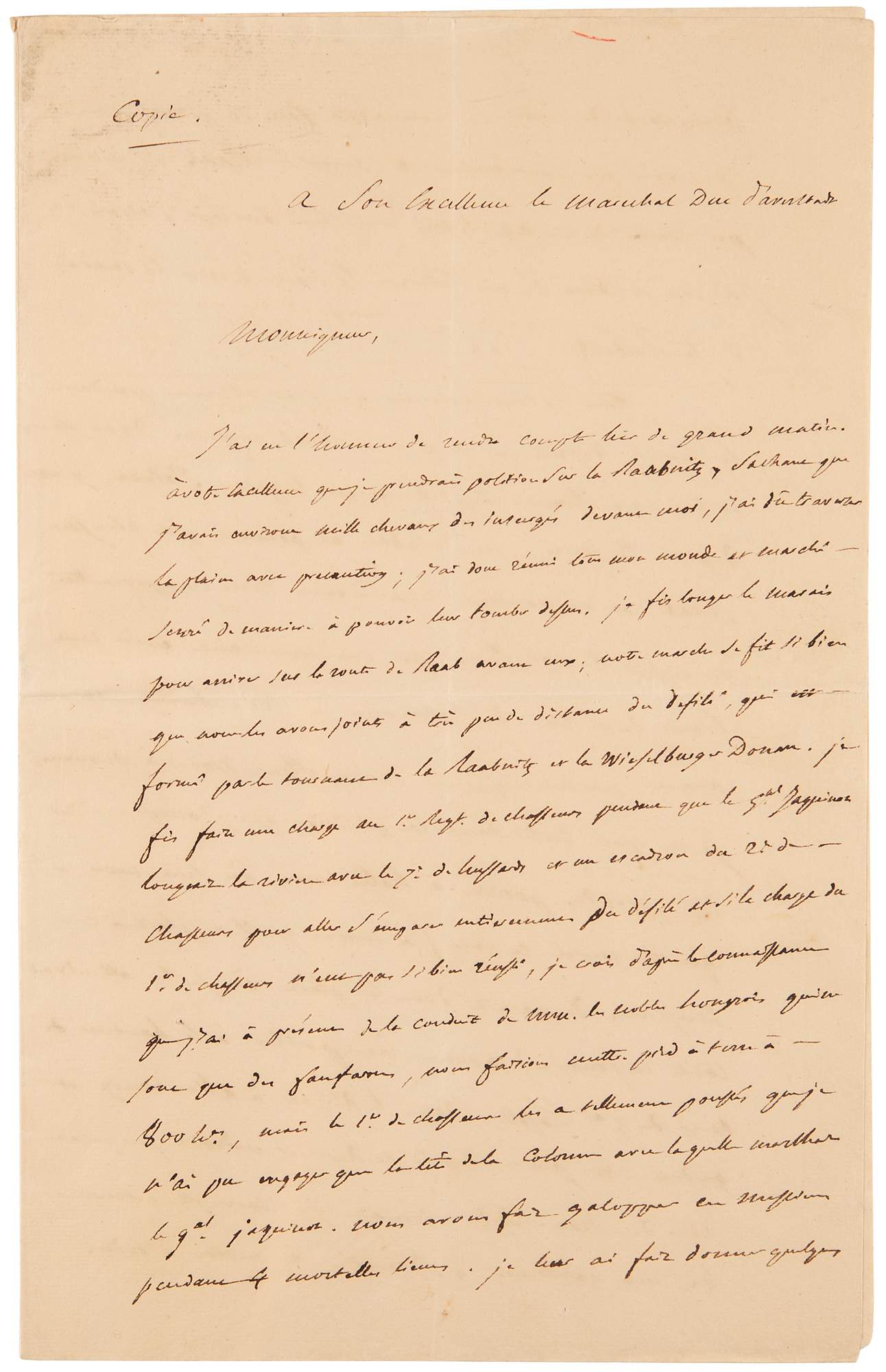
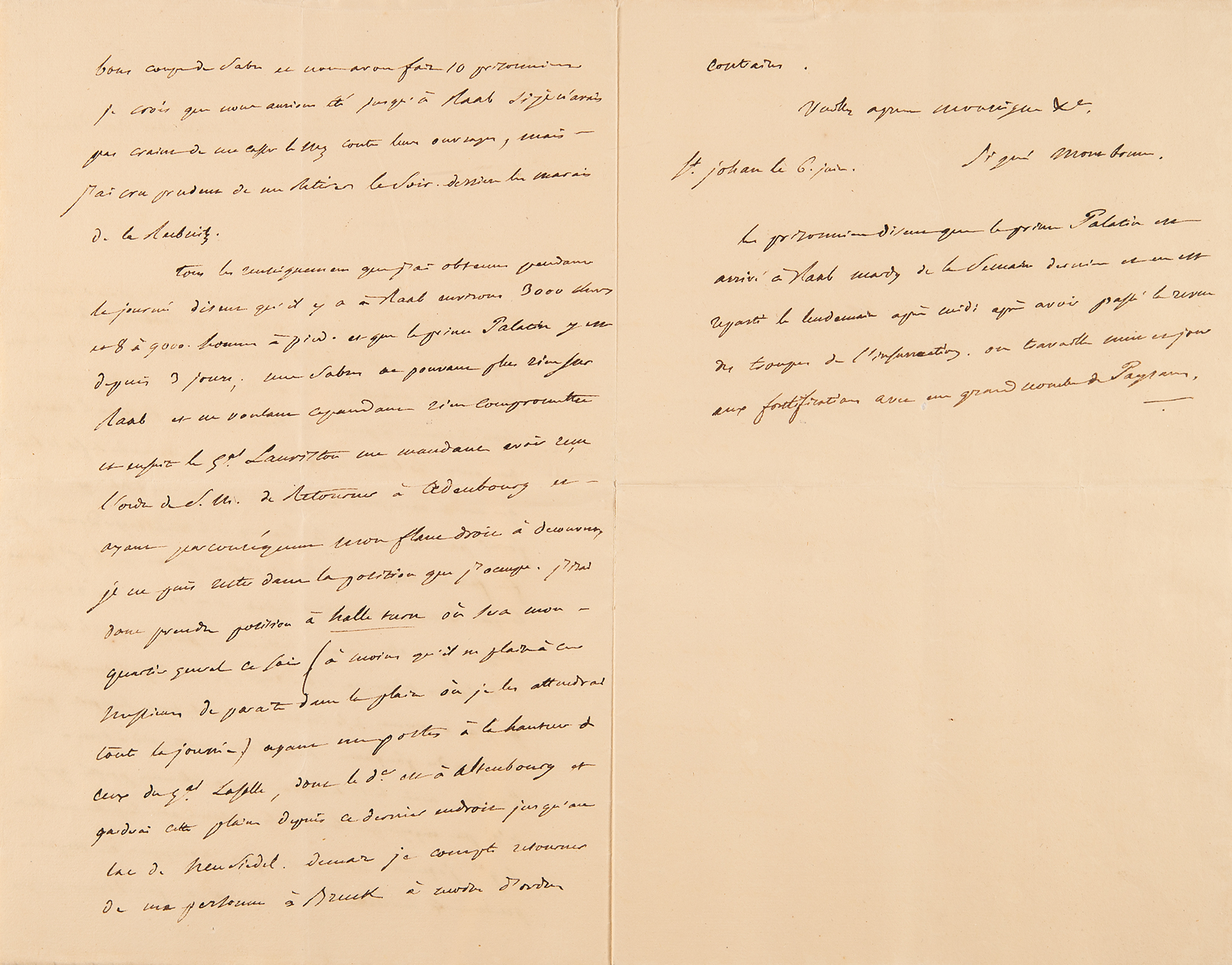
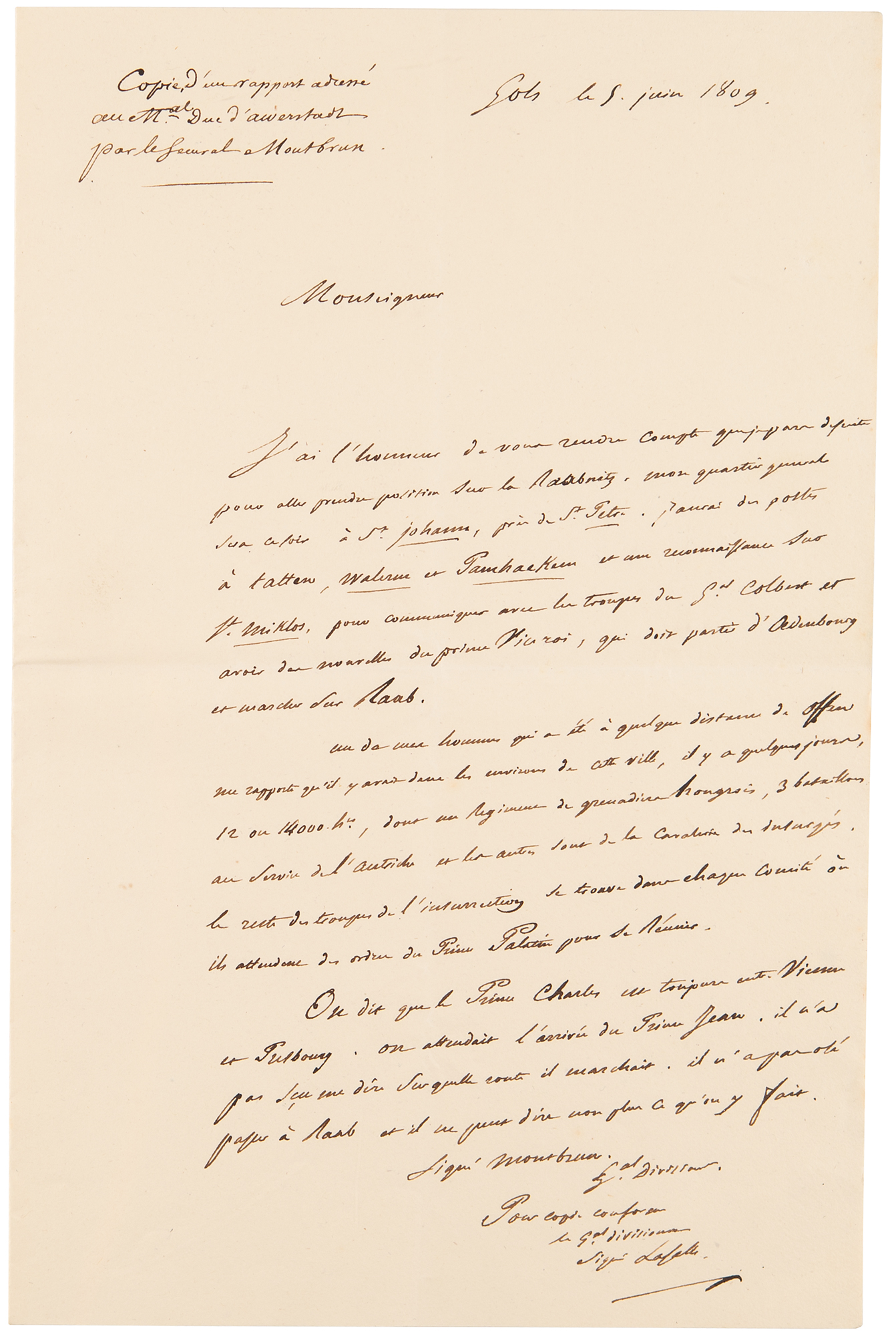
I am sending you the copy of a report from General Montbrun. The Duke of Auerstedt, who is familiar with my plans, wrote to me, requesting that no retreat movement be carried out, but instead to act offensively.
The adjutant of General Marmont has departed. I have given this general the order to pursue Chasteler, who perhaps wants to form the center of the uprising in Villach. In case of doubt, Marmont must be reinforced via MacDonald. Chasteler should be followed if he remains in the rear, and if he has been overtaken, he should be confronted as he marches toward St. Gotthard, forcing a battle with MacDonald.
It is not impossible that Prince John may once again try to give battle if he joins MacDonald. You must stay informed via officers already instructed for this purpose—not through letters, since they may be intercepted and fall into enemy hands.
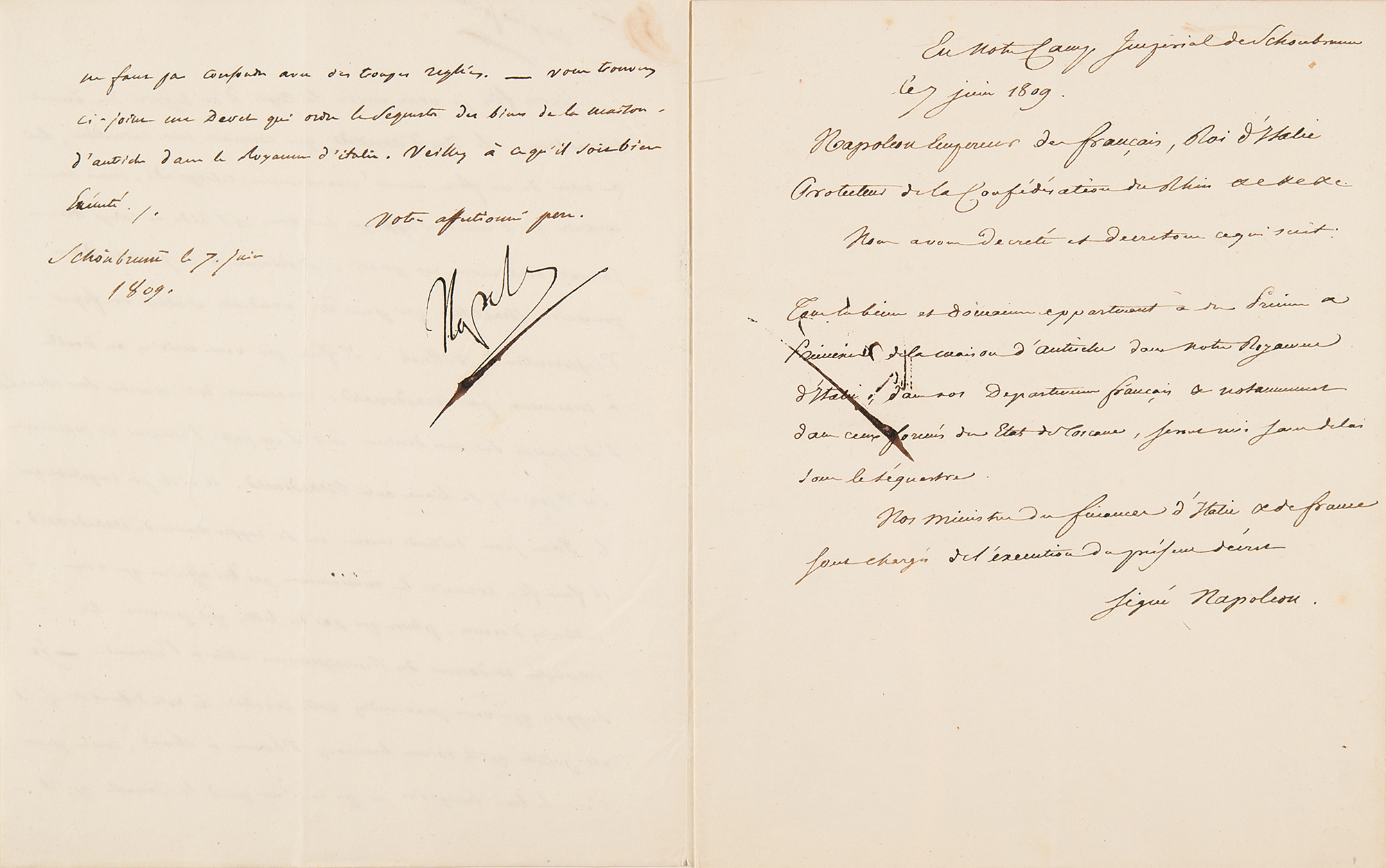
I expect you to alert your cavalry and infantry that many horsemen may be seen—but that it is the Hungarian Landsturm (militia), and not regular troops. This rabble should not be mistaken for trained soldiers.
Enclosed you will find a decree that orders the confiscation of the estates of the House of Austria in the Kingdom of Italy. Make sure that this is properly enforced.
Your loving father,
Napole
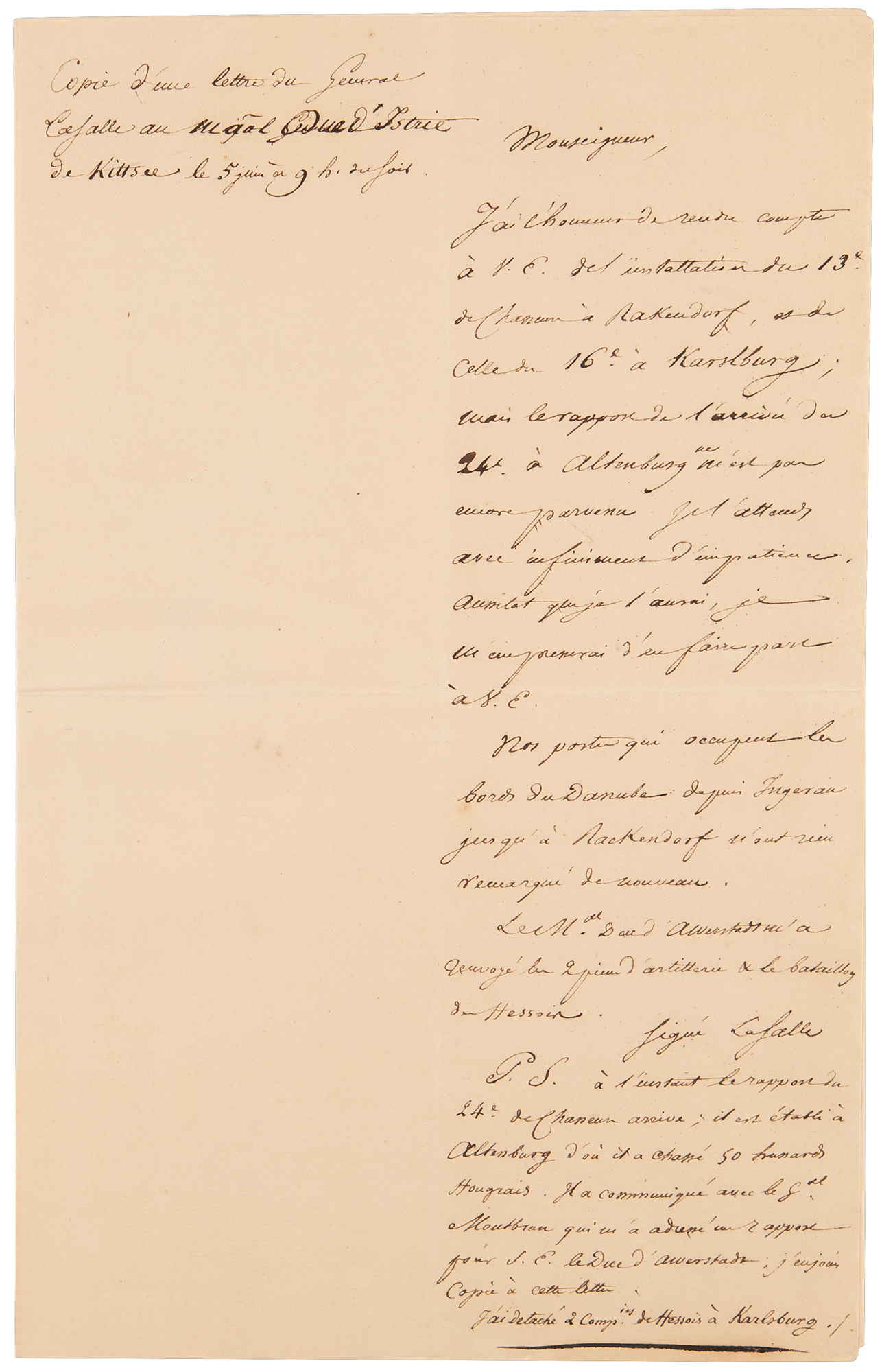
[with:] enclosed manuscript featuring a secretarial signature, by which Napoleon decrees that “all property and possessions of the princes and princesses of the House of Austria in our Kingdom of Italy, in our French departments—particularly in those formed from the states of Tuscany—are immediately seized”; and the manuscript copy of Montbrun’s report.
21. Schönbrunn, June 7, 1809
My son,
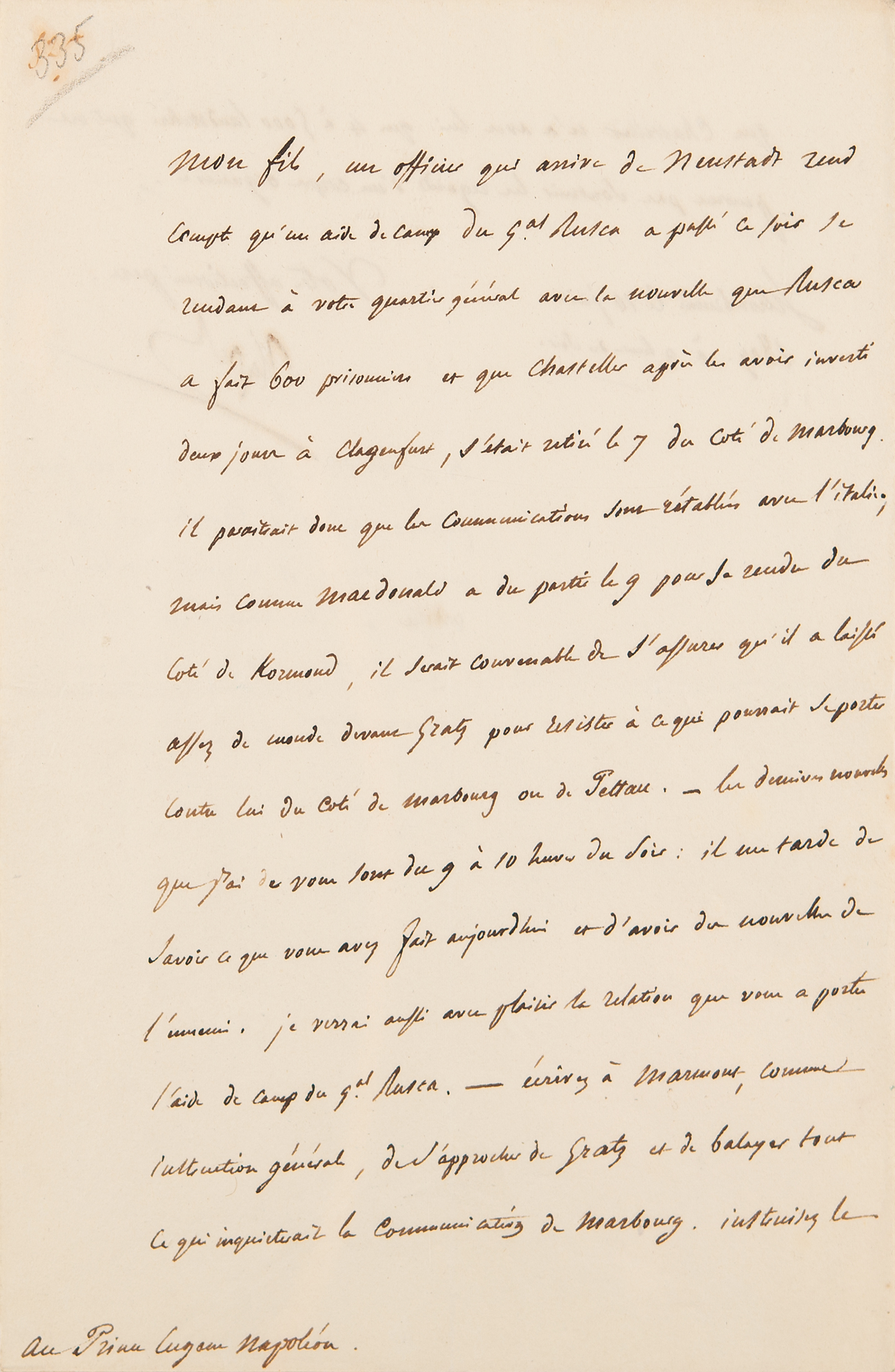
An officer coming from Neustadt reports that an adjutant of General Rusca passed through your headquarters this evening with the message that Rusca has taken 600 prisoners and that Chasteller, after besieging Klagenfurt for two days, has retreated toward Marburg on the 7th.
So it seems that our lines of communication with Italy are open again. Since MacDonald had to break off on the 9th to march toward Komorn, it would have been sensible to ensure that enough men were left behind in Gratz to be able to offer resistance against anything that might come at him from the direction of Marburg or Pettau.
The latest news I have from you is from 9 to 10 in the evening. I am impatient to learn what you did today and any news about the enemy. I would very much like to see the report brought by General Rusca’s adjutant.
Write to Marmont, as a general instruction, that he should advance toward Gratz and avoid anything that could harm us concerning the line of communication to Marburg.
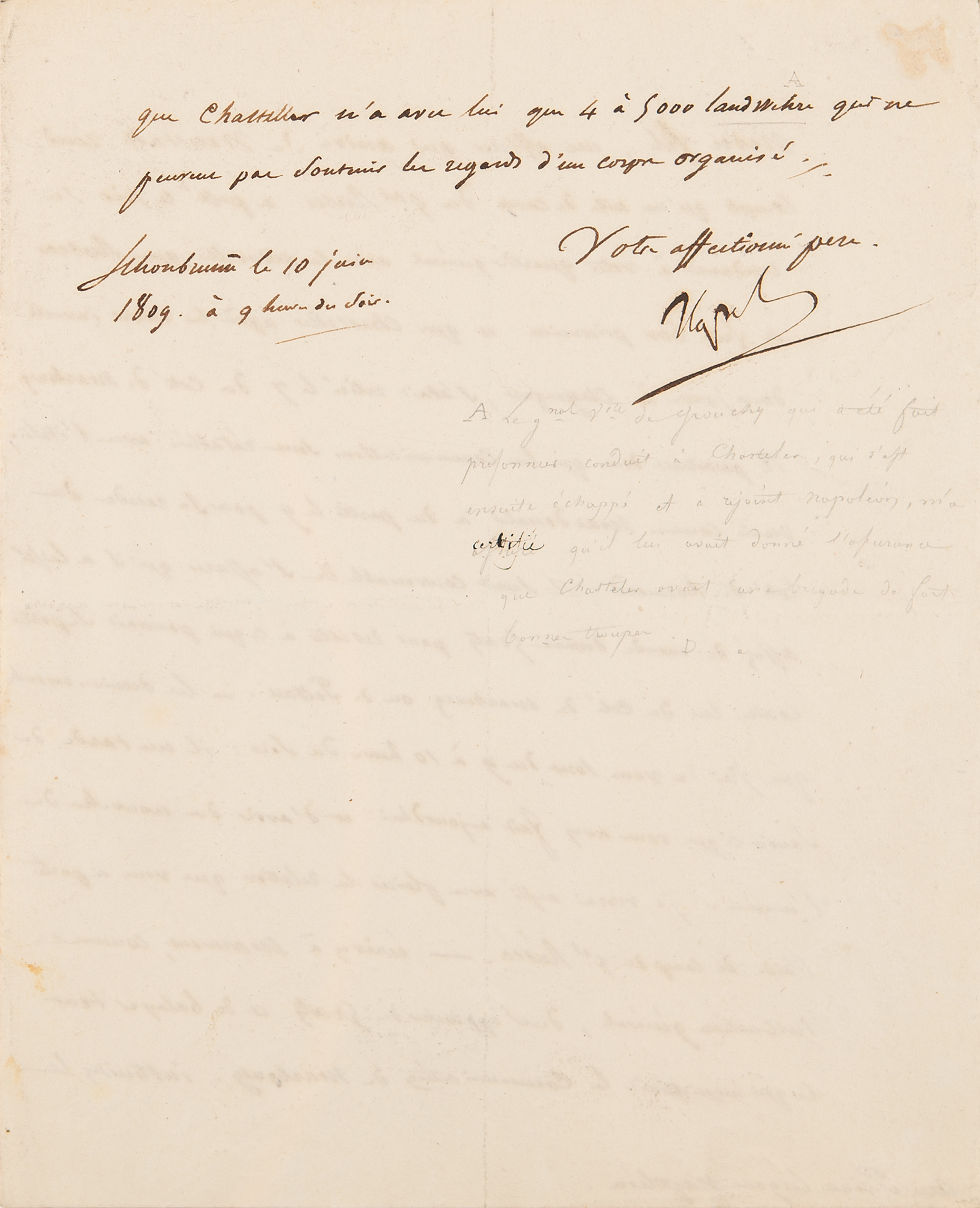
Let him know that Chasteller has only 4,000–5,000 Landwehr (militia), who would not be able to withstand the assault of a regular army corps.
Your loving father,
Napol
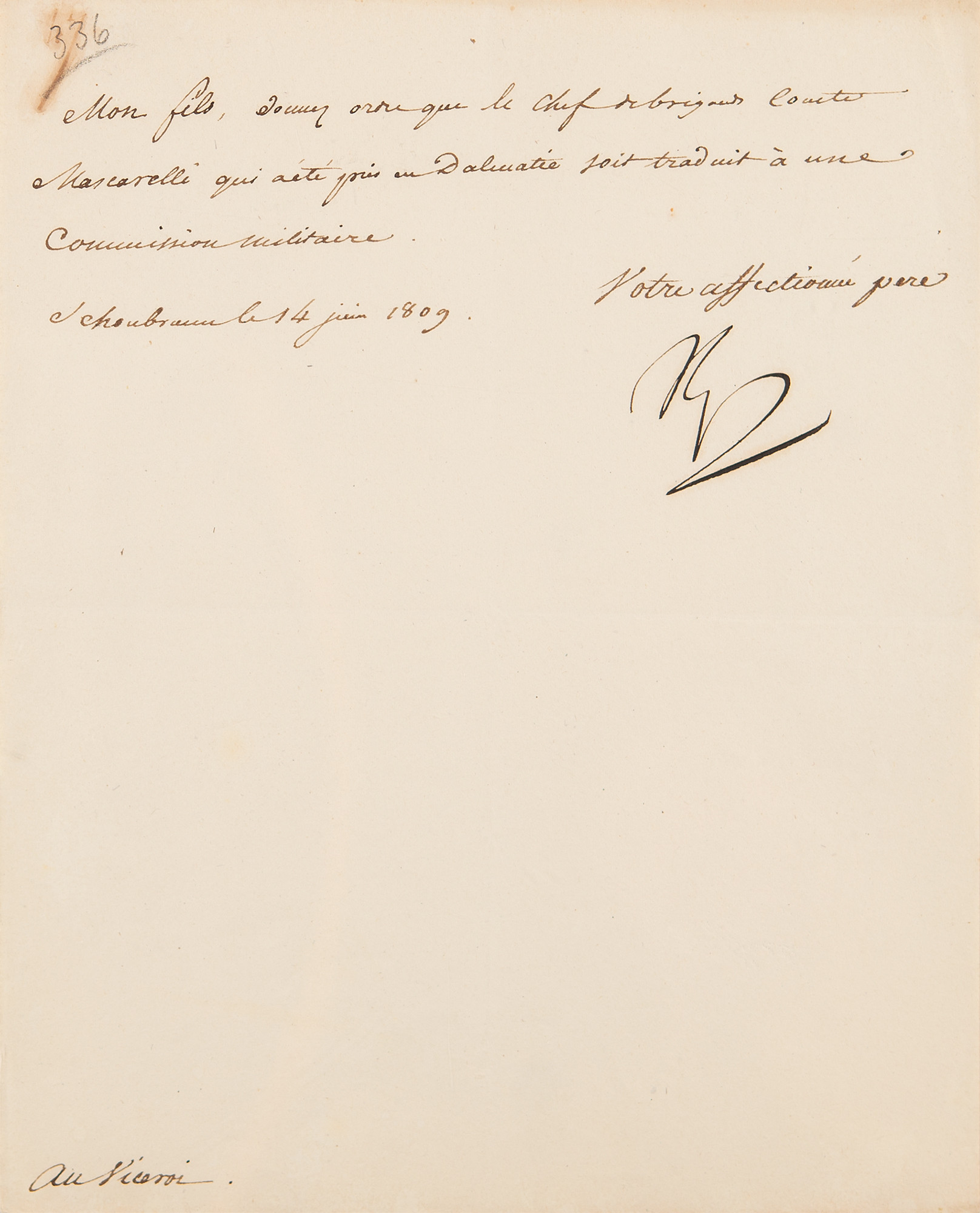
22. Schönbrunn, June 14, 1809
My son,
Give the order that the bandit leader Count Mascarelli, who was captured in Dalmatia, be handed over to a military commission.
Your loving father,
Np
23. Schönbrunn, June 15, 1809
My son,
The orderly officer Montesquieu has just arrived and brings me your letter dated the 31st of this month, 3 o'clock in the morning. In broad terms, you have the order to pursue Archduke Jean and to inflict as much damage as possible on him without taking undue risks. It is to be assumed that Raab is not sufficiently fortified, so it is unlikely that the enemy would dare to station a serious garrison of his best troops there. If he positions poor troops there, the city will surrender if it is surrounded, which benefits us by diverting forces and giving us a good base.
However, if he tries to hold the position there with his entire army, then you are to threaten him and cut off his lines of communication with Komorn. Should the Archduke eventually attempt to escape from you, you are to pursue him so that he cannot cross the Danube at Komorn, where, I believe, there is no bridge, and thus force him to flee toward Buda.
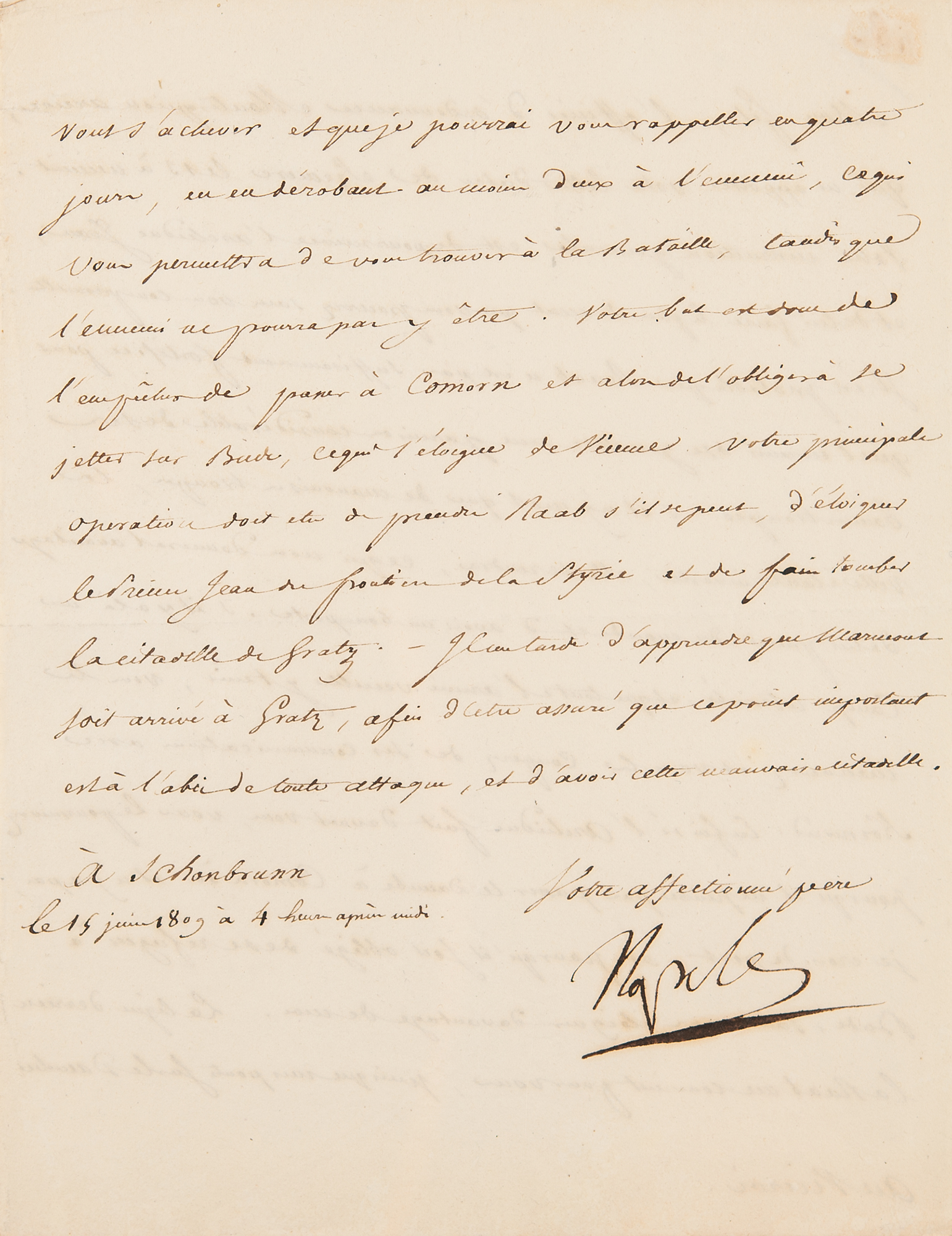
Since the line behind the Raab is too far from me, the bridge over the Danube is very convenient for you, and it is almost finished, and can be brought up to you within four days—at least 2 days in secret, so that you can take part in the decisive battle, while the enemy is not aware of it.
Your goal is therefore to prevent the enemy from crossing at Komorn, and to force him to retreat toward Buda, thereby drawing him further away from Vienna...
Your loving father,
Napole
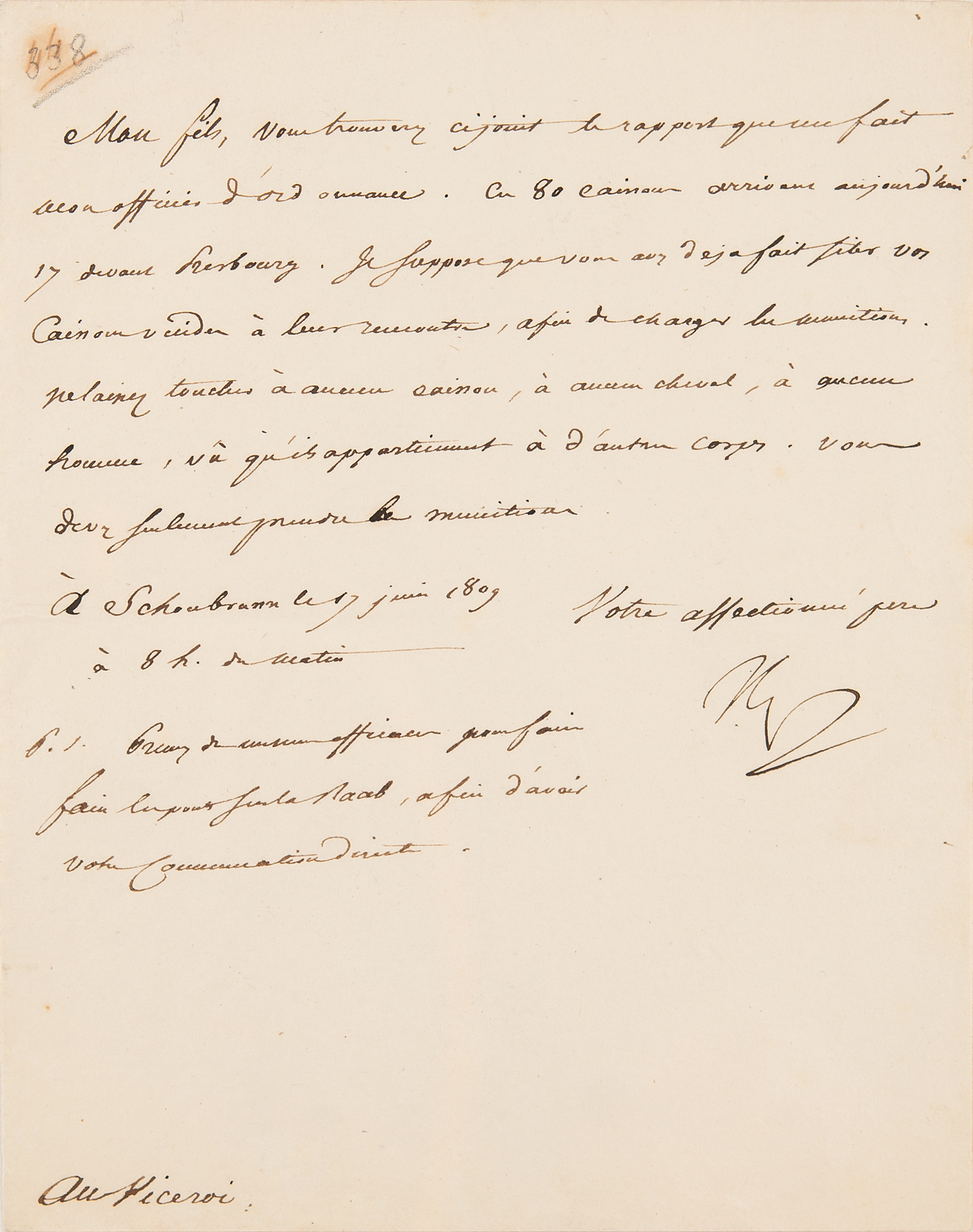
24. Schönbrunn, June 17, 1809
My son,
You will find enclosed the report written to me by my ordnance officer. These 80 ammunition wagons are arriving today, the 17th, in front of Pressburg. I assume you had your box wagons sent off...to load the ammunition.
Do not touch any wagon, any horse, or any man so that they are not possibly taken from another corps. You may only take the ammunition.
Your loving father,
Np
P.S. Have bridges built over the Raab, so that you have a direct connection.
25. Schönbrunn, June 18, 1809
My son,
The enemy’s movements seem to indicate a concentration in Buda...Since it is to your advantage to act fast, it is essential that you do not burden yourself with wagons or anything else that slows you down. The enemy must never perceive any backward movement from you. You must organize a corps of observation to hold Komorn and Raab, and give strict orders to this effect.
When your troops leave their positions, you must cover their departure skillfully and make it appear as if you are advancing toward Raab. Put all your effort into keeping possession of Raab, and make sure this is done irrevocably, without anything that could be interpreted as a retreat.
Take care to remove all enemy reports that could reveal your withdrawal, by using the observation corps.
Your affectionate father,
Napole
26. Schönbrunn, June 20, 1809
My son,
I received your letter from the 18th at 8 in the evening. This letter does not state which of my letters you are responding to. I hope that the ships you had driven against the bridge at Komorn have blown it up; once a decision is made to do so, one must not allow it to be rebuilt. As soon as they rebuild it, it must be destroyed again.—Yesterday at 4 in the afternoon, a marching detachment of four 18-pounder cannons and two Prussian howitzers departed from Vienna. They will arrive before Raab tomorrow evening, since they are marching in relays.
Today, the 20th, at 8 in the morning, two 12-pound siege cannons made of bronze will depart, along with 600 rounds of canister shot, 1000 rounds for the 12-pounders, 1000 howitzer shells, and 300 bombs for the small mortars.
I am impatiently awaiting word that the bridges of General Lasalle and General Pire are completed, and that, if Raab continues to hold out, there are bridgeheads and you can move directly toward Vienna without making a detour or crossing the lake.—Have a sketch of the battlefield at Raab made and send it to me as soon as possible so that I can have an etching of the battle made.
Your loving father,
Napo
27. Schönbrunn, June 20, 1809
My son,
I received your letter of the 19th, at eleven o’clock at night. It is annoying that a colonel of the staff of one of your divisions would expose himself to danger in such a manner. The fault lies with those who gave him the order. Such things are unfortunate because the enemy exploits them, and because they deprive an army of good officers.
You were right to let the enemy know that two divisions are moving toward Pressburg. Do the same. Move your headquarters closer to Raab and personally oversee the construction of the bridges and the siege of the city. Encircle it with your troops. Send General Gudin’s division back. Evacuate your wounded and all non-combatants, and prepare your baggage to move out as soon as you are ordered to join the major battle.
Leave MacDonald in your current position with a strong advance guard of infantry, cavalry, and artillery. The four 18-pounders and the two Prussian howitzers I sent you should already have arrived. The marching detachment with two 12-pounders and ammunition, which departed today, will likely arrive on the 22nd. So you’ve demanded a lot. Deploy a large number of laborers to demolish the part of the entrenchments that face you and are useless.
It was unnecessary to wait until 20 grain mills were brought in to grind—they should have been driven in immediately. One should have used what was available, brought them to the front, and driven them until more arrived. This operation has definitely failed due to lack of energy.—I don’t want to repeat what I’ve already written to you to the point of overkill, especially regarding your area of operations and its orientation.—Once you have Raab encircled, you must not only send back the troops of Generals Lasalle and Gudin, but also those of General Lauriston.
Your divisions will gradually receive orders to carry out their retreat maneuvers for the approach to Vienna.—I wish to receive reports from General Montbrun and various cavalry commanders; they should undertake long-ranging raids throughout all of Hungary.—I hope that tomorrow my envoy and my delegation will arrive at the outposts.
Your loving father,
Napol
28. Schönbrunn, June 21, 1809
My son,
I received your letter of the 20th, at midnight. At this point, one must not even consider sending [someone] to Italy; the road is not secure enough. We will decide on that when things have taken a decisive turn.—Why didn’t you send me Herstel, who is in Austrian service and comes from Ofen [Buda]? You could have entrusted him to my orderly officer, who could have brought him along. You do not let me know which of my letters you are replying to.
I instructed you to move closer to Raab, to encircle the town with a strong force, and to hand over to the Duke of Auerstedt the cavalry division of Lasalle and the division of Gudin.—I have received the various demands for redress that you sent me; I will take them into consideration.
Your loving father,
Napol
29. Schönbrunn, June 23, 1809
My son,
I assume that you have secured the siege of Raab from all sides, and that, should the enemy attempt to send 1500 or 2000 men…there are enough troops on the bank to prevent them from landing and entering the city.
I cannot wait to hear news of the capture of Raab. Let me know when you have sent the Duke of Auerstedt back with all his troops, including Lasalle’s division, and that you yourself have neither wounded men nor any other obstacles that could prevent you from carrying out a planned movement without delay.
I still firmly intend to launch a decisive attack at the end of the month.
Your loving father,
Napole

