Sold For $24,994
*Includes Buyers Premium
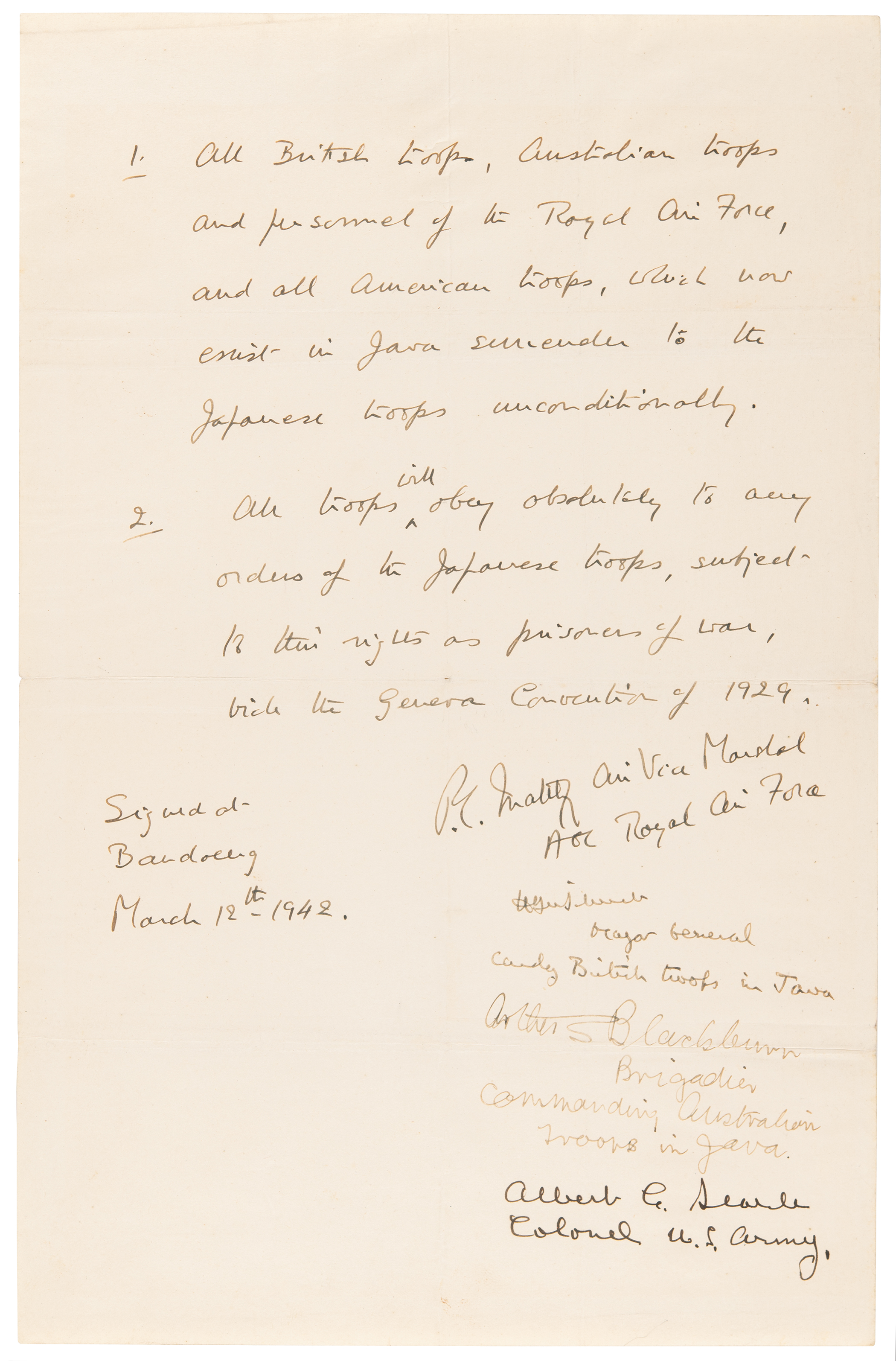
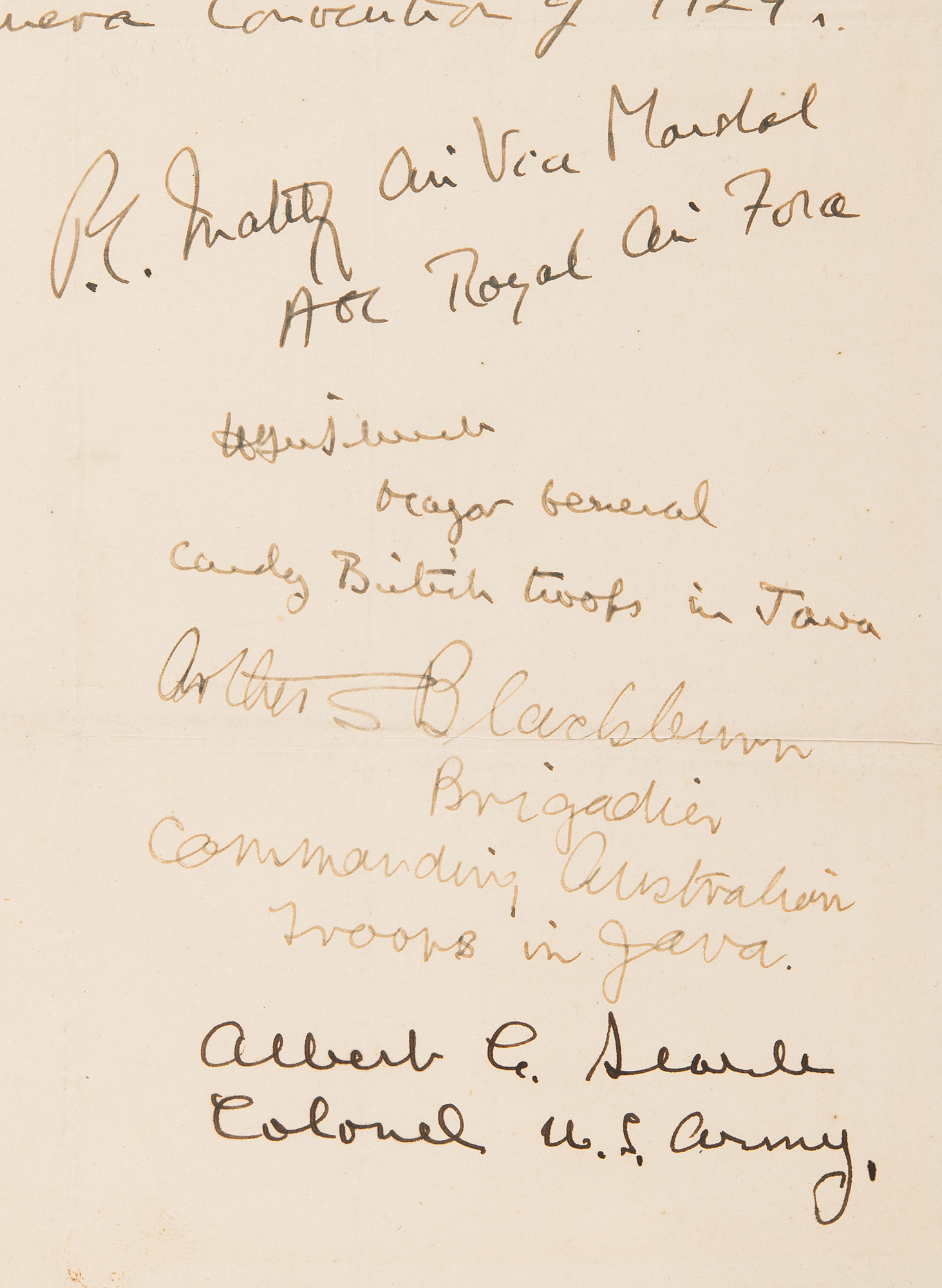
Manuscript DS, one page, 8.5 x 13.5, March 12, 1942. Col. Albert Searle's retained copy of the Allied surrender document signed at Bandoeng, West Java, Indonesia, in March 1942. In full: "1. All British troops, Australian troops and personnel of the Royal Air Force, and all American troops, which now exist in Java surrender to the Japanese troops unconditionally. 2. All troops will obey absolutely to any orders of the Japanese troops, subject to their rights as prisoners of war, vide the Geneva Convention of 1929." Signed at the conclusion by four Allied commanding officers: "P. C. Maltby, AOC Royal Air Force," "H. D. W. Sitwell, Major General, Comd'g British Troops in Java," "Arthur S. Blackburn, Brigadier Commanding Australian Troops in Java," and "Albert C. Searle, Colonel U.S. Army." In fine condition.
The Battle of Java, fought in early 1942 during World War II, was a major conflict between Allied forces and the Japanese Empire for control of the Dutch East Indies. After suffering heavy losses in the preceding Battle of the Java Sea, the Allies were unable to repel the Japanese invasion of the island despite a stubborn resistance. Japanese forces quickly overwhelmed the island's Allied defenders—comprised mostly of Dutch, British, American, and Australian forces—through superior numbers and tactics. By early March 1942, Java fell to Japan, marking a decisive victory that secured vital resources for the Japanese war effort.
As conditions on Java deteriorated, Col. Albert Searle had arranged for the evacuation of most American forces from the island. However, he chose to stay behind in an effort to support the 2nd Battalion, 131st Field Artillery, 36th Infantry Division (Texas National Guard) of the U.S. Army, still stationed there. The men of the battalion, plus the survivors of the sunken cruiser USS Houston, were soon captured by the Japanese and taken as prisoners of war.
On March 12, 1942, the senior British, Australian, and American commanders were summoned to Bandung where a formal instrument of surrender was signed in the presence of the Japanese commander, Lt. Gen. Masao Maruyama, who promised them the rights of the Geneva Convention for the protection of prisoners of war—a compact that had been signed, but not ratified, by Japan. Despite that promise, the prisoners' rights were immediately and flagrantly violated—they were subjected to harsh interrogation, rigorous imprisonment, and inhumane treatment.
Searle and the 2nd Battalion—which would come to be known as the 'Lost Battalion'—spent the duration of the war in horrific conditions, used as slave laborers building the Burma Railway. Authorities in the United States had no information about the fate of the men until September 16, 1944, when American submarines sank two Japanese freighters transporting more than 2,000 British and Australian POWs to Japan. The surviving POWs reported that American soldiers from the 2nd Battalion had worked with them on the Burma railroad.

