Sold For $166,333
*Includes Buyers Premium
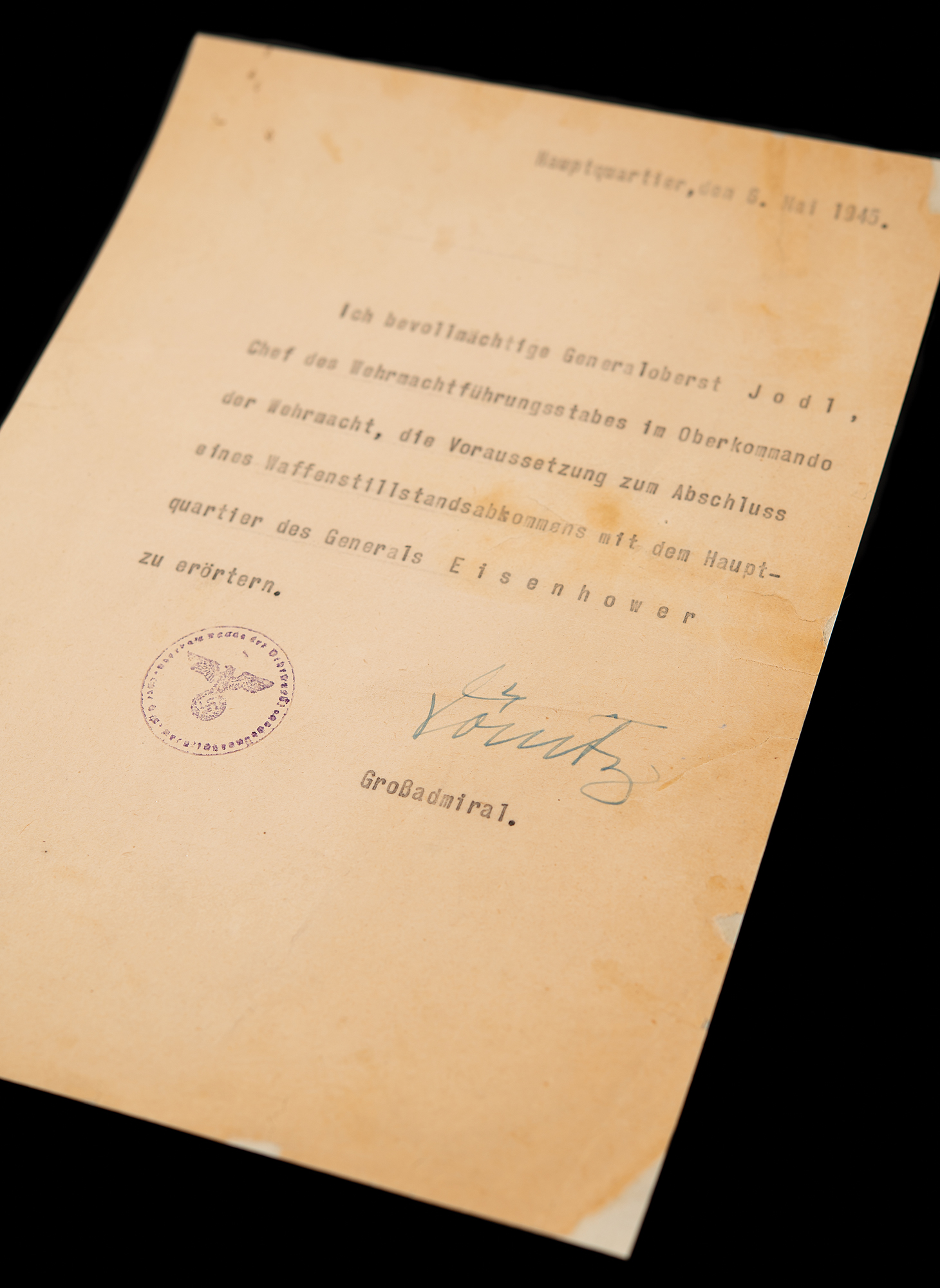
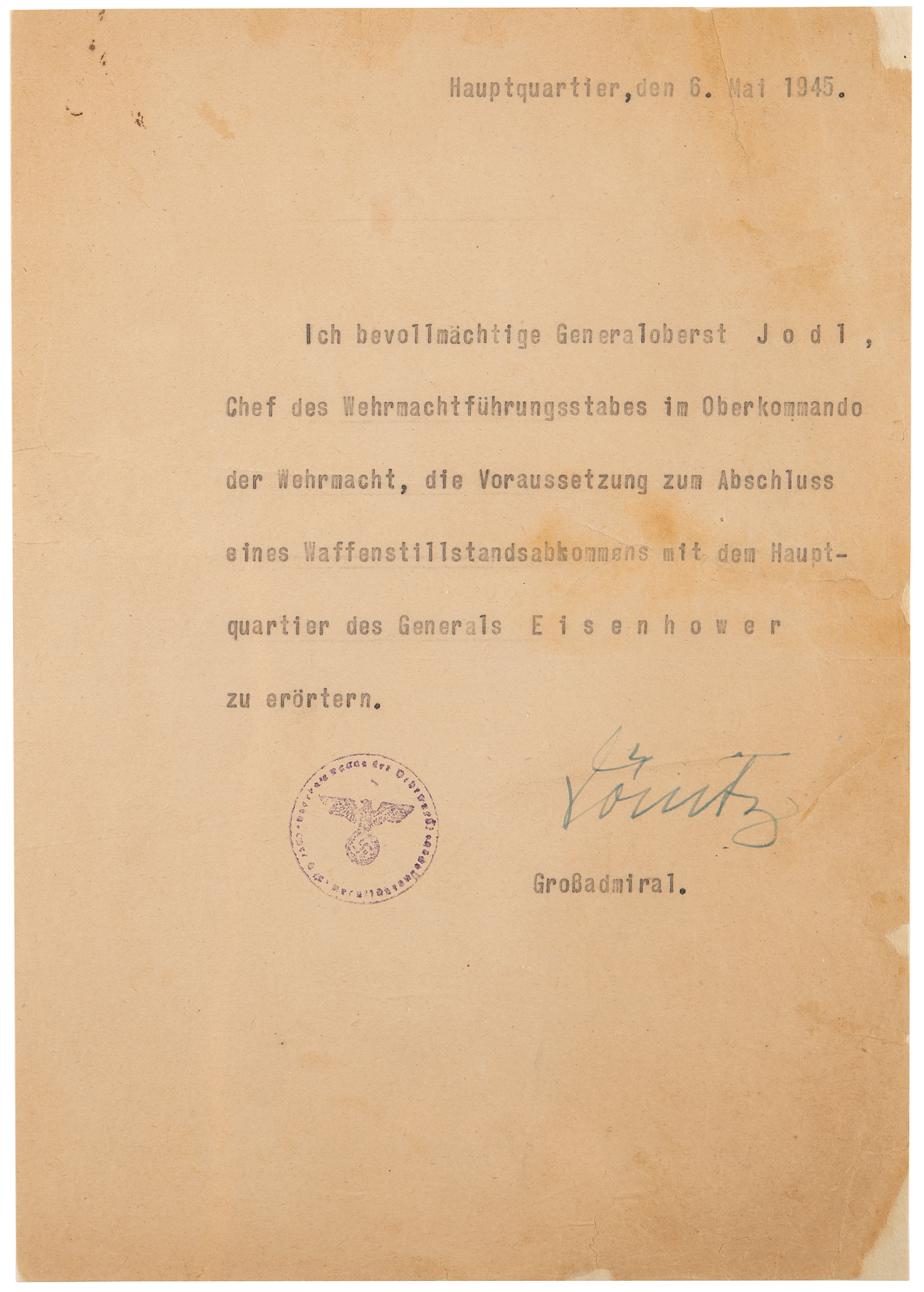
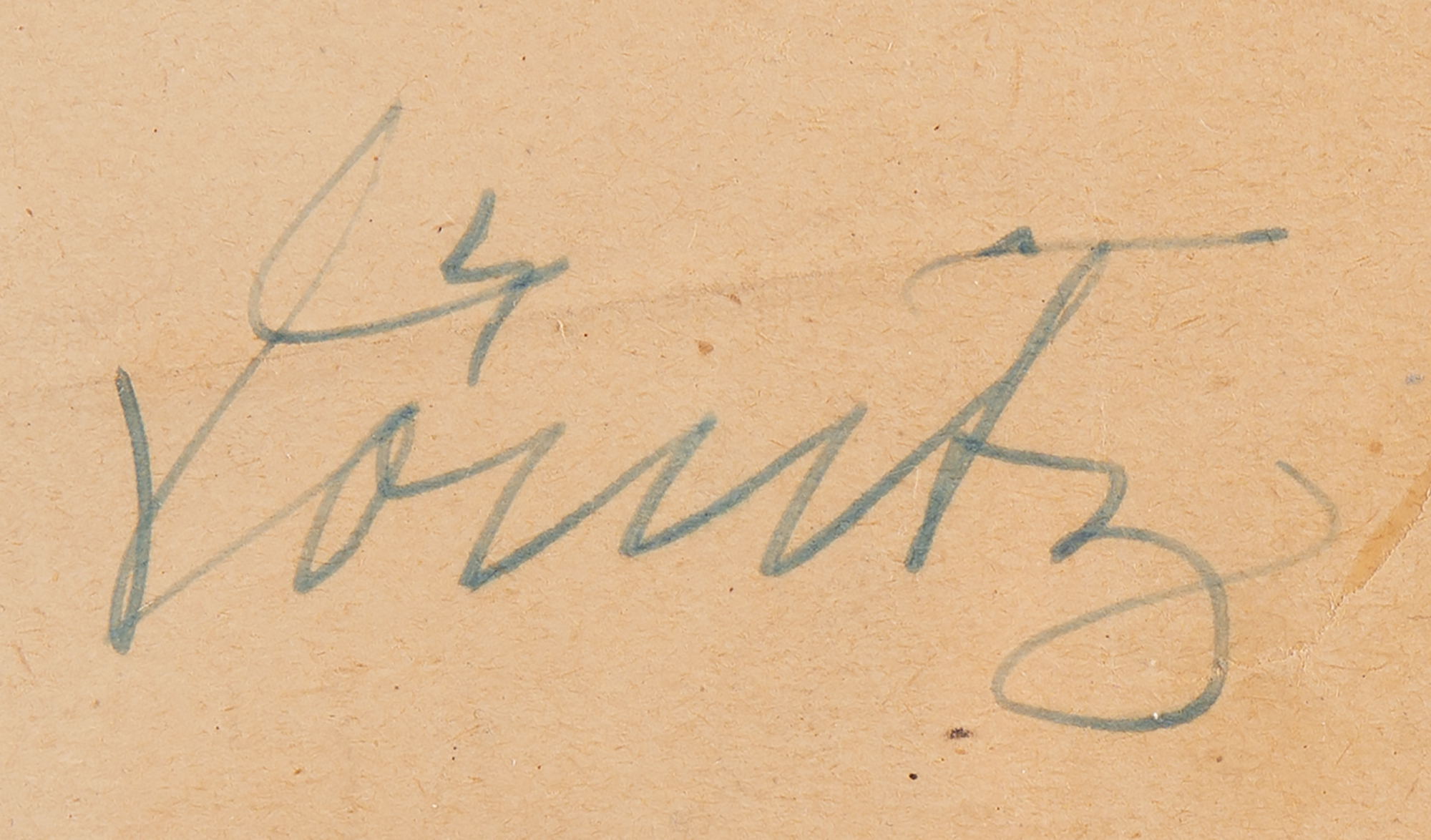
Historically significant DS in German, signed “Dönitz,” one page, 8.25 x 11.75, May 6, 1945. Official document by which Karl Dönitz authorizes Alfred Jodl to negotiate terms of surrender with General Dwight D. Eisenhower, in full: "Ich bevollmächtige Generaloberst Jodl, Chef des Wehrmachtführungsstabes im Oberkommando der Wehrmacht, die Voraussetzung zum Abschluss eines Waffenstillstandsakommens mit dem Hauptquartier des Generals Eisenhower zu erörtern [I authorize Colonel General Jodl, Chief of the Wehrmacht Operations Staff in the High Command of the Wehrmacht, to discuss the conditions for concluding an armistice agreement with General Eisenhower's headquarters]." Signed at the conclusion in fountain pen by Dönitz, and stamped with the round seal of the Nazi Party at lower left. Professionally backed and deacidified, and in very good to fine condition, with scattered light staining and creasing, and restorations to small edge tears and losses.
With Adolf Hitler's suicide on April 30, 1945, Karl Dönitz became head of Germany and its armed forces. It was clear that Germany had lost the war, and on May 6, 1945, following receipt of Eisenhower's ultimatum of 'unconditional surrender,' Dönitz sent a representative of the government, Alfred Jodl, to negotiate a comprehensive military surrender with the Allied command, then headquartered at Reims, France. Jodl was dispatched with two nearly identical documents: this one, authorizing him to "discuss the conditions for concluding an armistice," and another, authorizing him to actually 'conclude an armistice agreement.' The second document is today preserved in the collection of the National Archives. Writing in 1975, James B. Rhoads, Archivist of the United States, observed: 'The passage of more than 30 years…only heightens the importance of the surrender documents, which remain among the most significant records of the 20th century.'
Armed with documents granting plenipotentiary powers, Jodl was instructed to try to negotiate a separate peace with the Americans and British in an effort to continue the fight on the Eastern Front and avoid the Soviet occupation of Germany. If a separate peace was impossible, Jodl was to ask for a delay 'as long as possible' between the signing of a surrender document and the fixing in place of German forces, buying time for 2,000,000 Germans in the east to flee to 'salvation in the west,' as Dönitz described it. Ultimately, Jodl had to settle for the second option, successfully negotiating a 48-hour delay. The time spent negotiating, transmitting terms back-and-forth with Dönitz—plus the delay of two days—became crucial hours that allowed even more soldiers and refugees to flee across the lines into the west.
This document, allowing only negotiations of an armistice (rather than the conclusion of one), was deemed 'unacceptable' by the Allies and retained by Major-General Sir Kenneth William Dobson Strong (1900-1982), a senior officer of the British Army who served as Eisenhower's chief of intelligence at SHAEF. Strong played a leading part in the negotiations of the unconditional German surrender, acting as a translator.
By empowering Jodl to negotiate and sign the surrender at Allied headquarters in Reims, Dönitz effectively acknowledged total military defeat, leading to the formal end of hostilities in Europe and the beginning of Germany's occupation and reconstruction. Few documents of such great importance exist in private hands.

