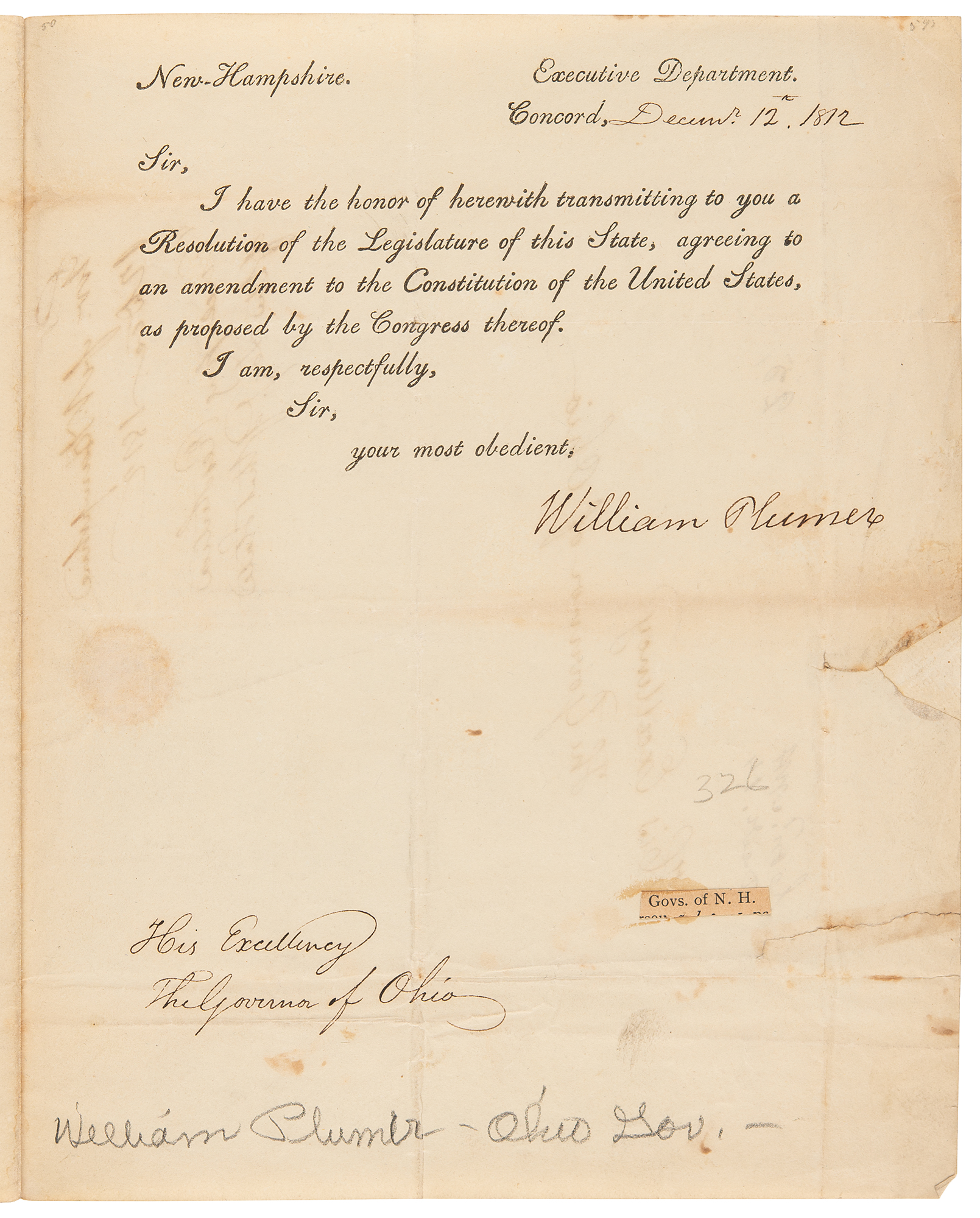
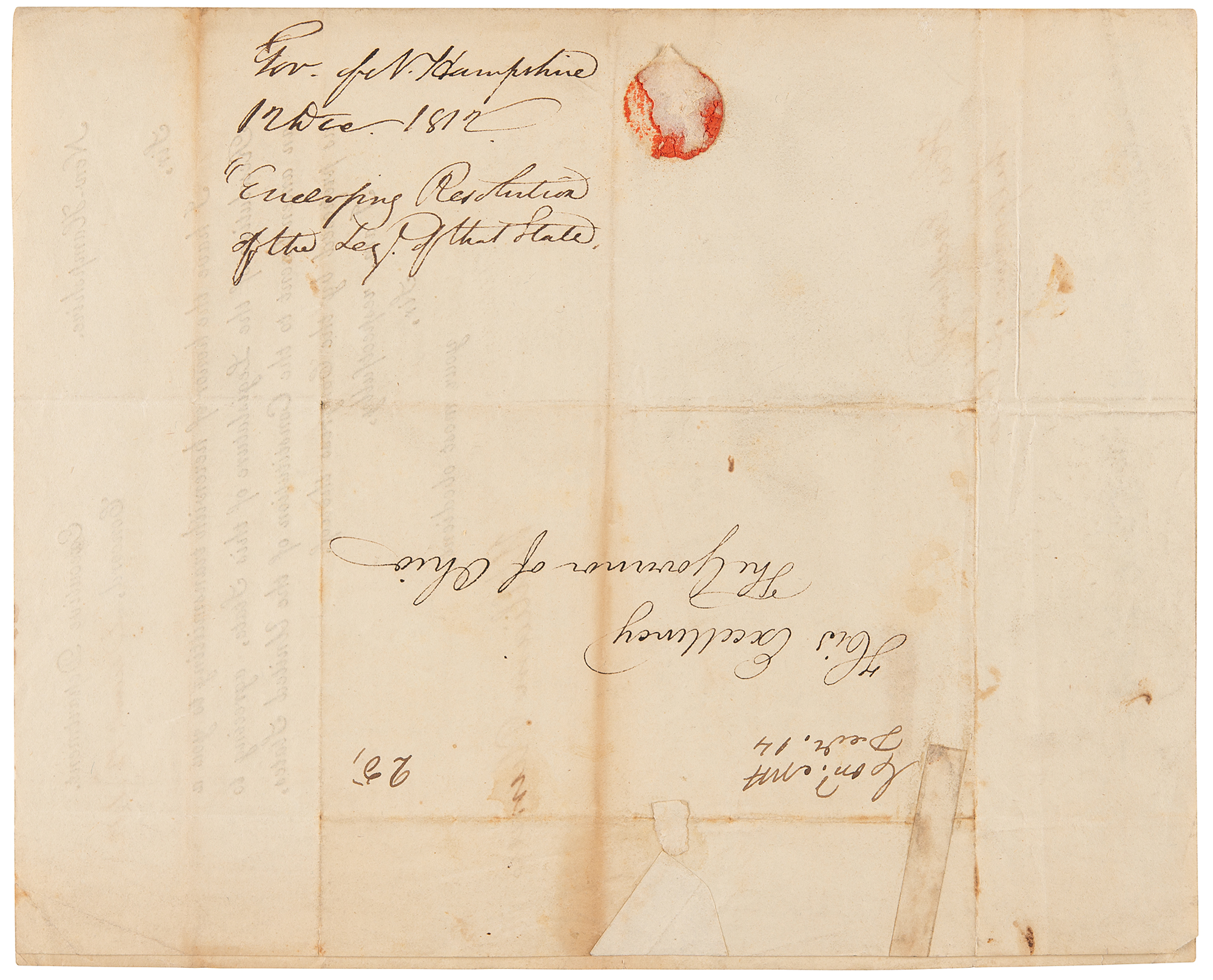
Fascinating war-dated 1812 transmittal letter and printed resolution related to the ‘original’ Thirteenth Amendment, the Titles of Nobility Amendment, a proposed and still-pending amendment to the United States Constitution, that would strip United States citizenship from any citizen who accepted a title of nobility from an ‘emperor, king, prince or foreign power.’ The letter, one page, 7.5 x 9.5, Executive Department letterhead, was sent by New Hampshire Governor William Plumer to Ohio Governor Return J. Meigs, Jr., on December 12, 1872, three days after New Hampshire ratified the amendment. It reads: “I have the honor of herewith transmitting to you a Resolution of the Legislature of this State, agreeing to an amendment to the Constitution of the United States, as proposed by the Congress thereof.” Signed below in ink by Governor Plumer.
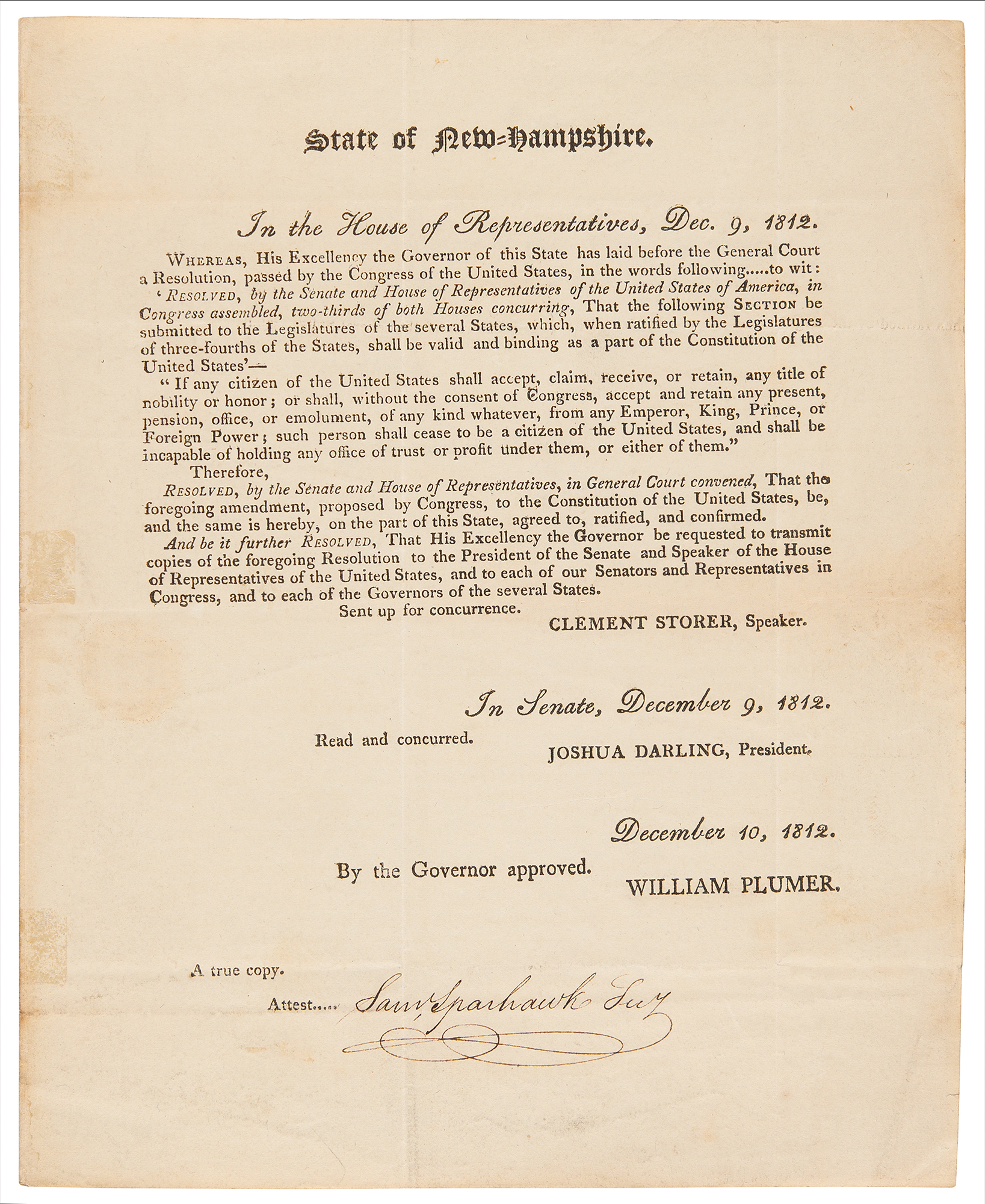
Printed on the reverse of the inherent second page is the referenced “Resolution,” issued by the “State of New-Hampshire. In the House of Representatives,” on December 9, 1812, which reads, in part: “Whereas, His Excellency the Governor of this State has laid before the General Court a Resolution, passed by the Congress of the United States, in the words following….to wit: ‘ Resolved, by the Senate and House of Representatives of the United States of America, in Congress assembled, two-thirds of both Houses concurring, That the following SECTION be submitted to the Legislatures of the several States, which, when ratified by the Legislatures of three-fourths of the States, shall be valid and binding as a part of the Constitution of the United States'—‘If any citizen of the United States shall accept, claim, receive, or retain, any title of nobility or honor; or shall, without the consent of Congress, accept and retain any present, pension, office, or emolument, of any kind whatever, from any Emperor, King, Prince, or Foreign Power; such person shall cease to be a citizen of the United States, and shall be incapable of holding any office of trust or profit under the, or either of them.” Signed and attested by Secretary Samuel Sparhawk. In fine condition, with light soiling, and a small repair to seal-related paper loss.
The ‘original’ Thirteenth Amendment, the Titles of Nobility Constitutional Amendment, is one of only a handful of proposed amendments to the Constitution that were passed by Congress, but then not ratified by a sufficient number of states. As described, the amendment would strip United States citizenship from any citizen who accepted a title of nobility from a foreign country. The Constitution already banned any member of Congress from holding another office in the government, and this amendment would have expanded this provision to prohibit any citizen from receiving any present, office, or title from a foreign nation, and would punish them by stripping them of their citizenship.
The Senate voted 19-5 to pass the amendment on April 26, 1810. Just a few days later, it was approved by the 11th Congress on May 1, 1810, and submitted to the state legislatures for ratification. As the amendment had been passed by both houses of Congress, it could move on to the next step of the process – ratification by three-quarters of the states, 13 of the 17 at the time. It is here that historical interpretations diverge.
Everyone agrees that it was ratified by 12 states – Maryland, Kentucky, Ohio, Delaware, Pennsylvania, New Jersey, Vermont, Tennessee, North Carolina, Georgia, Massachusetts, and New Hampshire. It is also clear that it was rejected by three states – New York, Connecticut, and Rhode Island. The debate is over whether the amendment was ratified by Virginia and South Carolina.
If it were approved by either of them, that would make 13 states for ratification. Both of these states took action on the amendment. The South Carolina Senate voted to ratify it on November 28, 1811, but the House of Representatives rejected it years later, on December 21, 1814. Virginia’s House of Delegates voted for it on February 2, 1811, but the Senate rejected it on February 14.
Although there are no records today of these states passing the amendment in both houses, rumors began to spread at the time that the necessary 13 states had ratified it. Some records that may have clarified the issue were lost when, in 1814, the British captured Washington, D.C., burning the White House, the Library of Congress, and other government buildings. Documents relating to the status of the amendment were lost forever. The government itself became confused.
In 1817, the U.S. House of Representatives asked President James Monroe to inquire into the status of the amendment’s ratification. Secretary of State John Quincy Adams investigated the matter and reported that 12 states had voted for the amendment and two against it. Letters were sent to the governors of Virginia, Connecticut, and South Carolina asking about the status of the amendment in their states. In 1818, Adams reported that he received a letter from the governor of South Carolina stating that his state had rejected the amendment.
Despite its failure during the ratification process, the Amendment was printed in the 1815 version of the Statutes at Large as the Thirteenth Amendment, and the Amendment was widely believed to be part of the Constitution well into the late nineteenth century.
Congress did not set a time limit for its ratification, so the amendment is still pending before the states. Now, since the number of states has increased, ratification by an additional 26 states would be needed for this amendment to be adopted.

