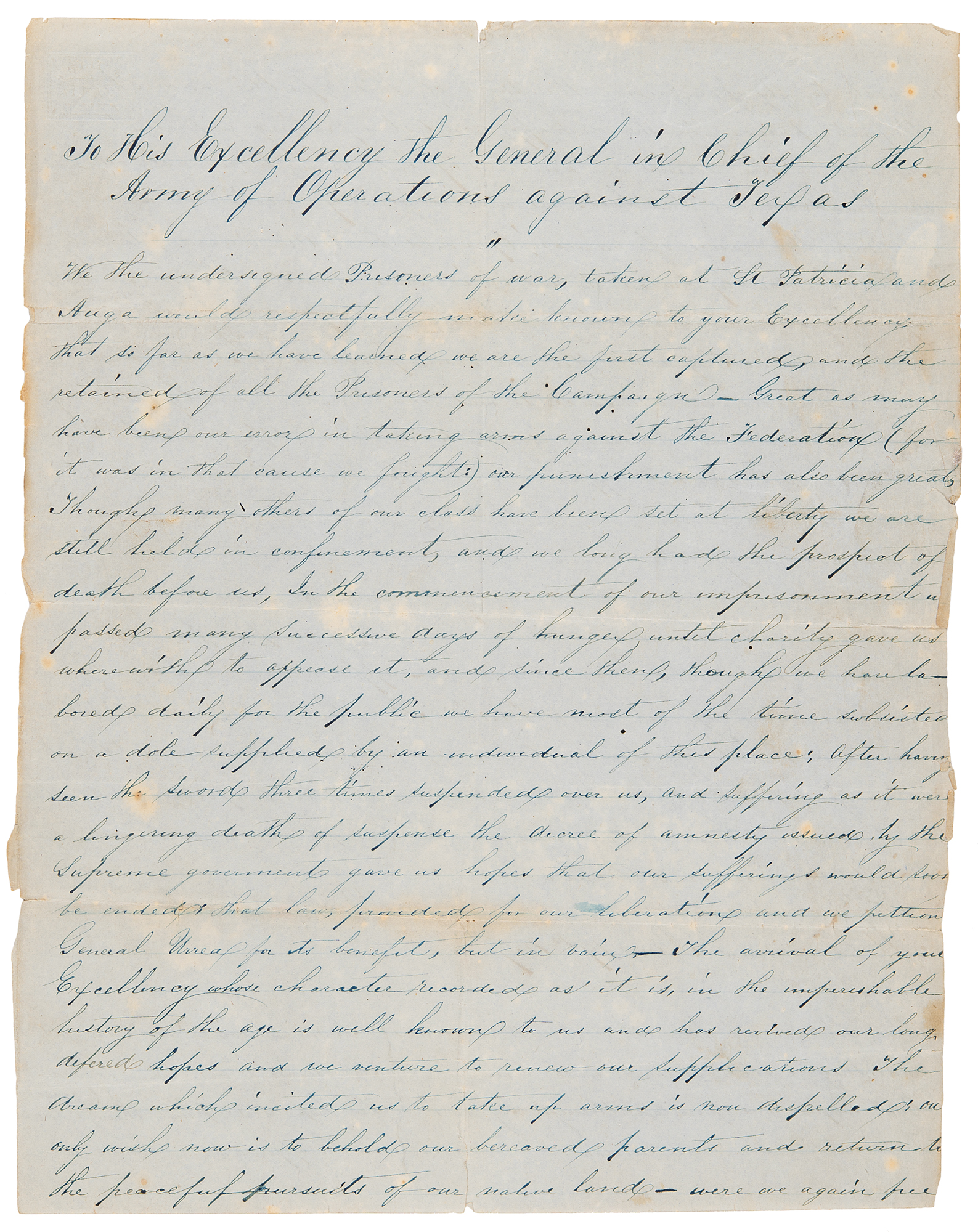
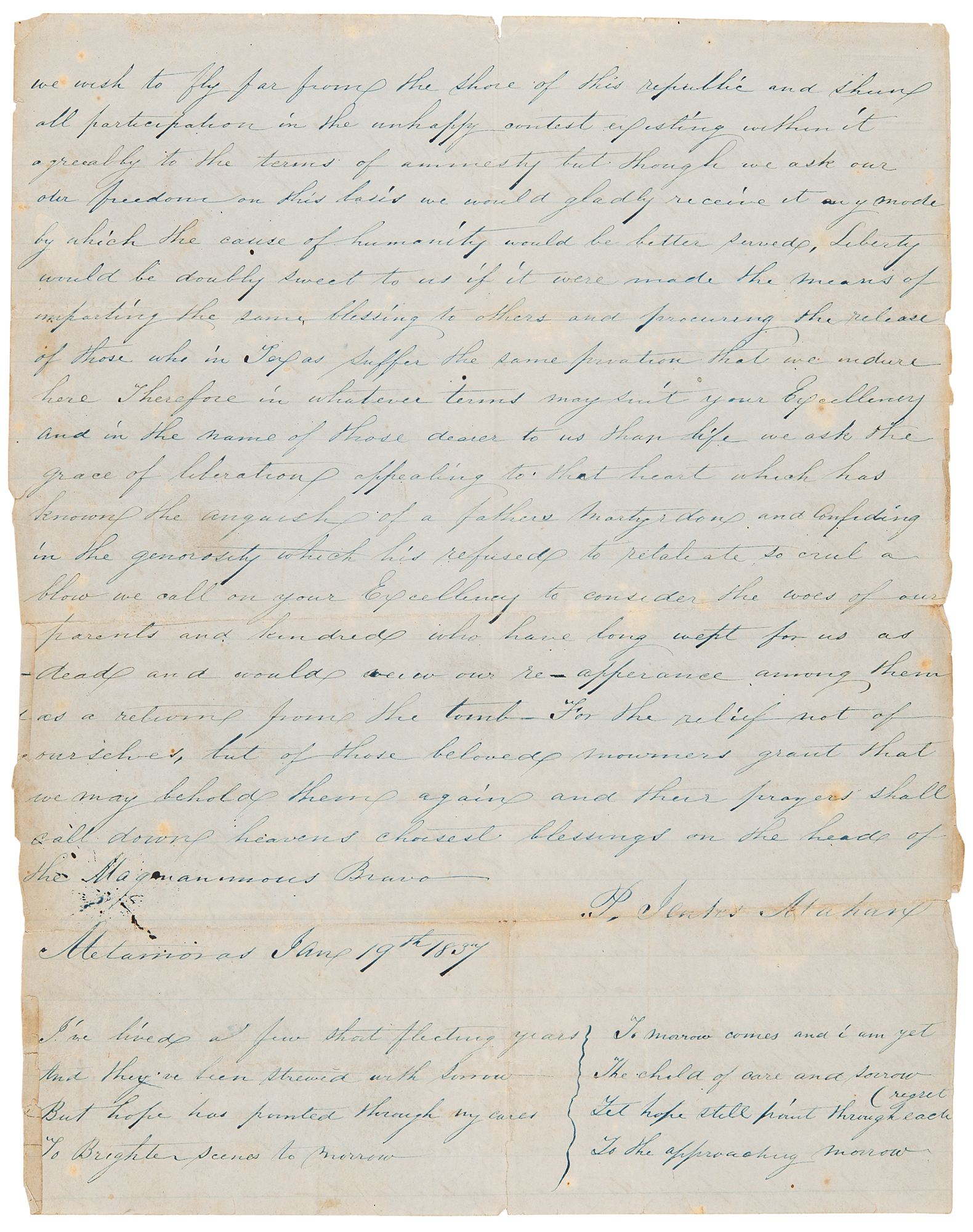
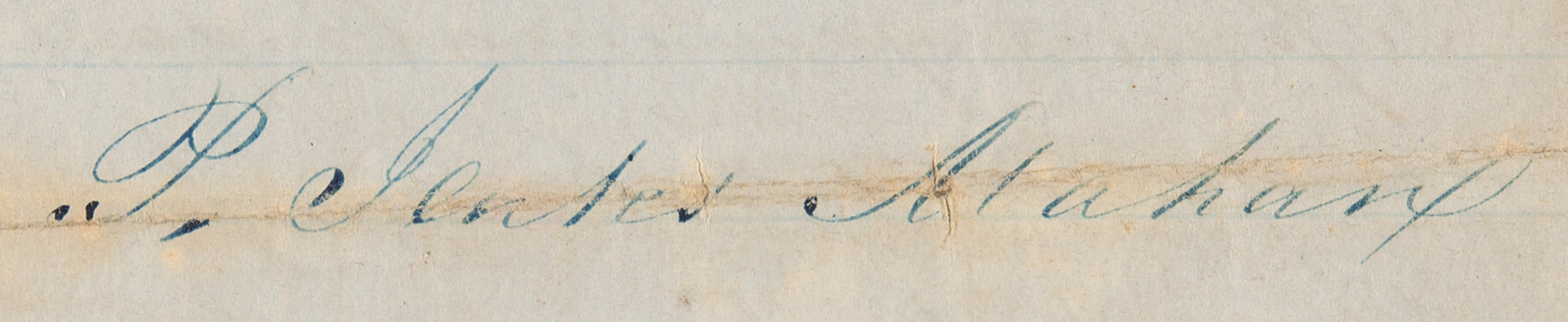
ALS from Phineas Jenks Mahan, a former prisoner of war following the Battle of San Patricio, which was fought on February 27, 1836, between Texian rebels and the Mexican army, during the Texas Revolution. The letter, signed “P. Jenks Mahan,” one page both sides, 7.75 x 10, January 19, 1837, is a handwritten duplicate of the petition that was composed by Captain Reuben M. Potter, transcribed by Mahan, then sent to General Nicholas Bravo on behalf of the surviving soldiers held captive in Matamoros, Mexico.
In the closing months of 1835, as Texian forces secured early victories against Mexico, some leaders turned their eyes southward. They launched what became known as the Matamoros Expedition—a plan to extend the revolution into Mexican territory and rally Federalist sympathizers. The expedition collapsed almost before it began.
In February and March of 1836, Texian forces were ambushed and defeated at San Patricio (February 27) and Agua Dulce Creek (March 2). Survivors were captured or killed. Others, scattered or retreating, were picked up piecemeal by Mexican forces. What had begun as an ambitious plan ended in disaster, leaving scores of Texians imprisoned.
As the Revolution surged forward—the fall of the Alamo, the Goliad massacre, the Runaway Scrape, and finally the victory at San Jacinto—thoughts of the Matamoros prisoners fell by the wayside. Their loved ones, having no word, mourned the men as dead.
The prisoners had been sent to Matamoros at the order of General Urrea, who refused to carry out the Dictator Santa Anna's command that all prisoners be shot. For many, perhaps, a bullet or a bayonet would have been more merciful.
Abused and tortured for the amusement of their captors, knowing nothing but deprivation and disease, and suffering the constant torment of an unknown fate—as if the Sword of Perseus lingered above their heads—Death at Matamoros did a fine business. Of however many that entered that pest-ridden gaol—the number is in dispute—by January 1837, only twenty-one souls remained.
In early 1837, a change came: General Nicolás Bravo arrived in Matamoros. Known even to his enemies as a man of clemency, Bravo’s presence offered the prisoners a hope long buried. It was then that Captain Reuben M. Potter, recognizing the moment, composed the petition appealing for their lives.
The letter—written on both sides of a single sheet—bears the signature of one prisoner, Phineas Jenks Mahan. Beneath Mahan’s signature, a short poem in another hand reflects the prisoners’ plight and the desperate hope that animated their appeal.
This document stands today as a rare and poignant window into the uncertainty, suffering, and fragile hope that marked the final, forgotten chapter of the Texas Revolution.
The letter, in full: “We, the undersigned prisoners of war, taken at St. Patricio and Agua Dulce would respectfully make known to your Excellency, that as far as we have learned, we are the first captured, and the last retained, of all the prisoners of the campaign. Great as may have been our error in taking arms against the Federation, (for it was in that cause we fought) our punishment has been great. Through many others of our class have been set at liberty, we are still held in confinement, and we long had the prospect of death before us.
In the commencement of our imprisonment we passed many successive days of hunger, until charity gave us the wherewith to appease it, and since then, though we have labored daily for the public, we have most of the time subsisted on a dole, supplied by an individual of this place. After having the sword five times suspended over us, and suffering as it were a lingering death of suspense, the decree of amnesty issued by the Supreme Government, gave us hopes that our sufferings would soon be ended that law provided for our liberation, and we petitioned Gen. Urrea for its benefit, but in vain.
The arrival of your Excellency, whose character recorded as it is, in the imperishable history of the age, is well known to us and has revived our long deferred hopes, and we venture to renew our supplications. The dream which incited us to take up arms is now dispelled. Our only wish now is to behold our bereaved parents and return to the peaceful pursuits of our native land.
Were we again free we would wish to fly far from the shore of this Republic, and shun all participation in the unhappy contest existing within it, agreeably to the terms of amnesty; but though we ask our freedom on this basis, we would also gladly receive it in any other mode, by which the cause of humanity would be better served.
Liberty would be doubly sweet to us if it were made the means of imparting the same blessings to others, and procuring the release of those who in Texas [this referring to Santa Anna and the Mexican prisoners taken at San Jacinto] suffer the same privation that we endure here. Therefore on whatever terms may suit your Excellency, and in the name of whose dearer to us than life, we ask the grace of liberation, appealing to that heart which has known the anguish of a father's martyrdom, and confiding in the generosity which has refused to retaliate so cruel a blow. We call on your Excellency to consider the woes of our parents and kindred, who have long wept for us as dead and would view our reappearance among them as a return from the tomb. For the relief not of ourselves, but of those beloved mourners, grant that we may behold them again, and their prayers shall call down Heaven's choicest blessings on the head of the Magnanimous Bravo.”
The lower portion bears several lines of poetry not included in the original petition: “I've lived a few short fleeting years / And they've been strewed with sorrow / But hope has pointed through my cares / To brighter scenes tomorrow / Tomorrow comes and I am yet / The child of care and sorrow / Yet hope still points through each regret / To the approaching morrow.” In very good to fine condition, with edgewear, and areas of toning and spotting. Accompanied by printed transcriptions of the letter, ample research related to Mahan and his captivity, and a printed copy of Mahan’s ‘Reminiscences of the War for Texas Independence: A Narrative,’ which recounts his harrowing experience during the Texas Revolution.
In November of 1835, Phineas Jenks Mahan (1814-1875) enlisted at New Orleans and, under the command of Captain Thomas Pearson, his company assisted with the transport, to San Antonio, of the eighteen-pounder cannon from the San Felipe, but arrived too late for the siege at the Alamo. Mahan was one of the soldiers under the command of Colonel Frank W. Johnson when they were surprised in a cold, driving rain by Centralista Forces led by General José de Urrea at the abandoned Irish settlement at San Patricio on February 27, 1836.
The document remains in fine condition. It is accompanied by printed transcriptions of the letter, ample research related to Mahan and his captivity, and a printed copy of Mahan’s 'Reminiscences of the War for Texas Independence: A Narrative,' which recounts his harrowing experience during the Texas Revolution.

