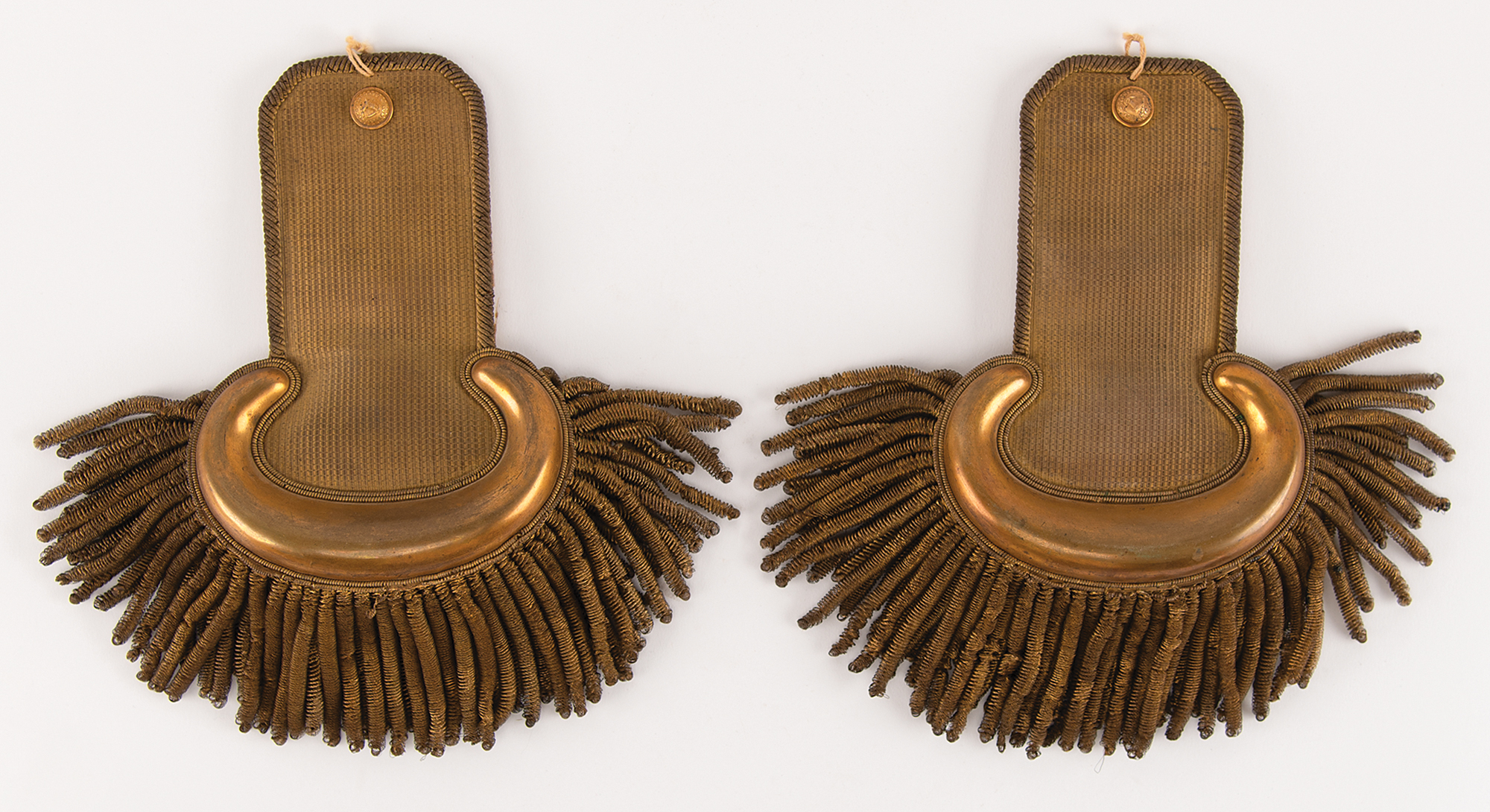
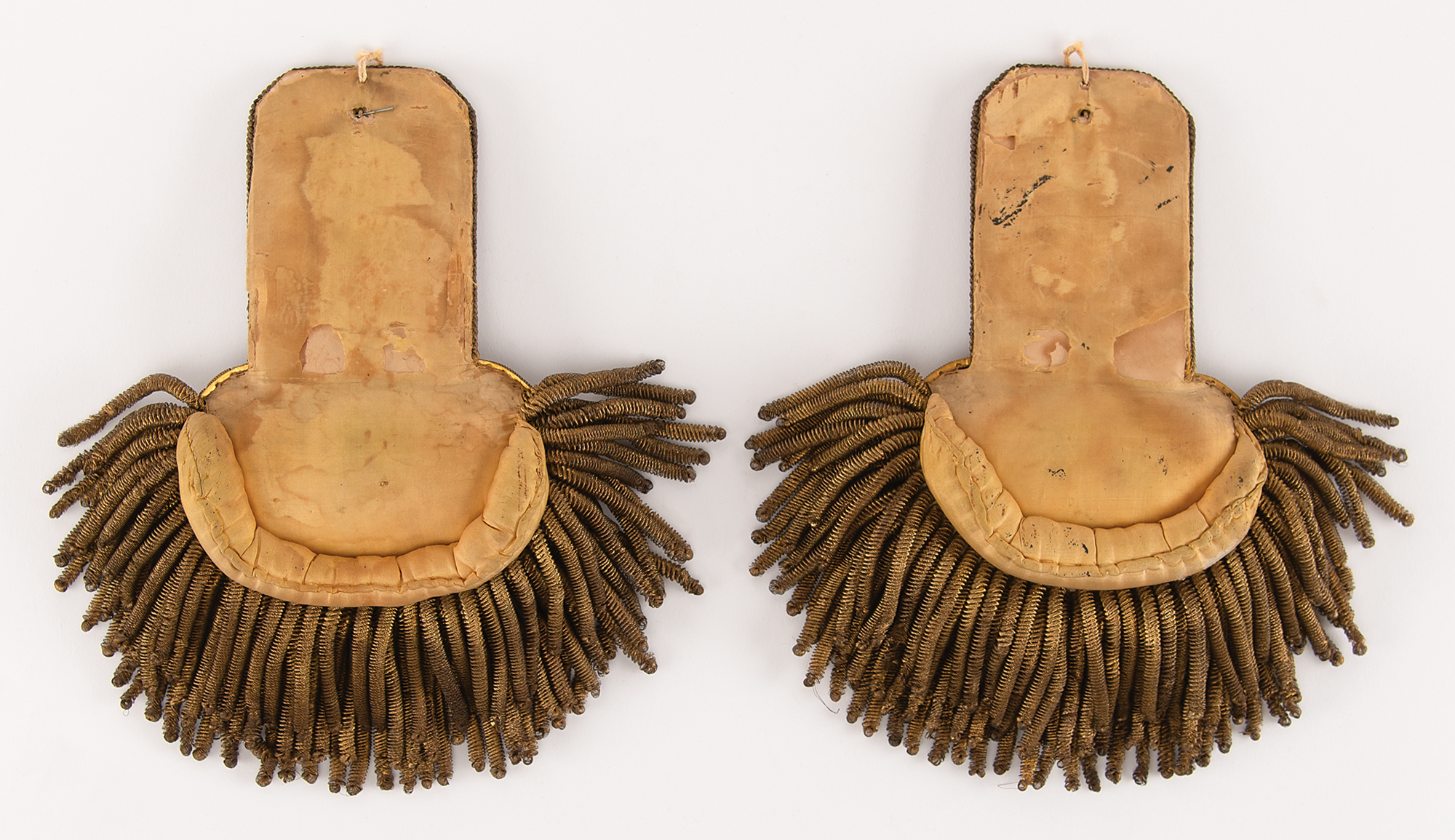
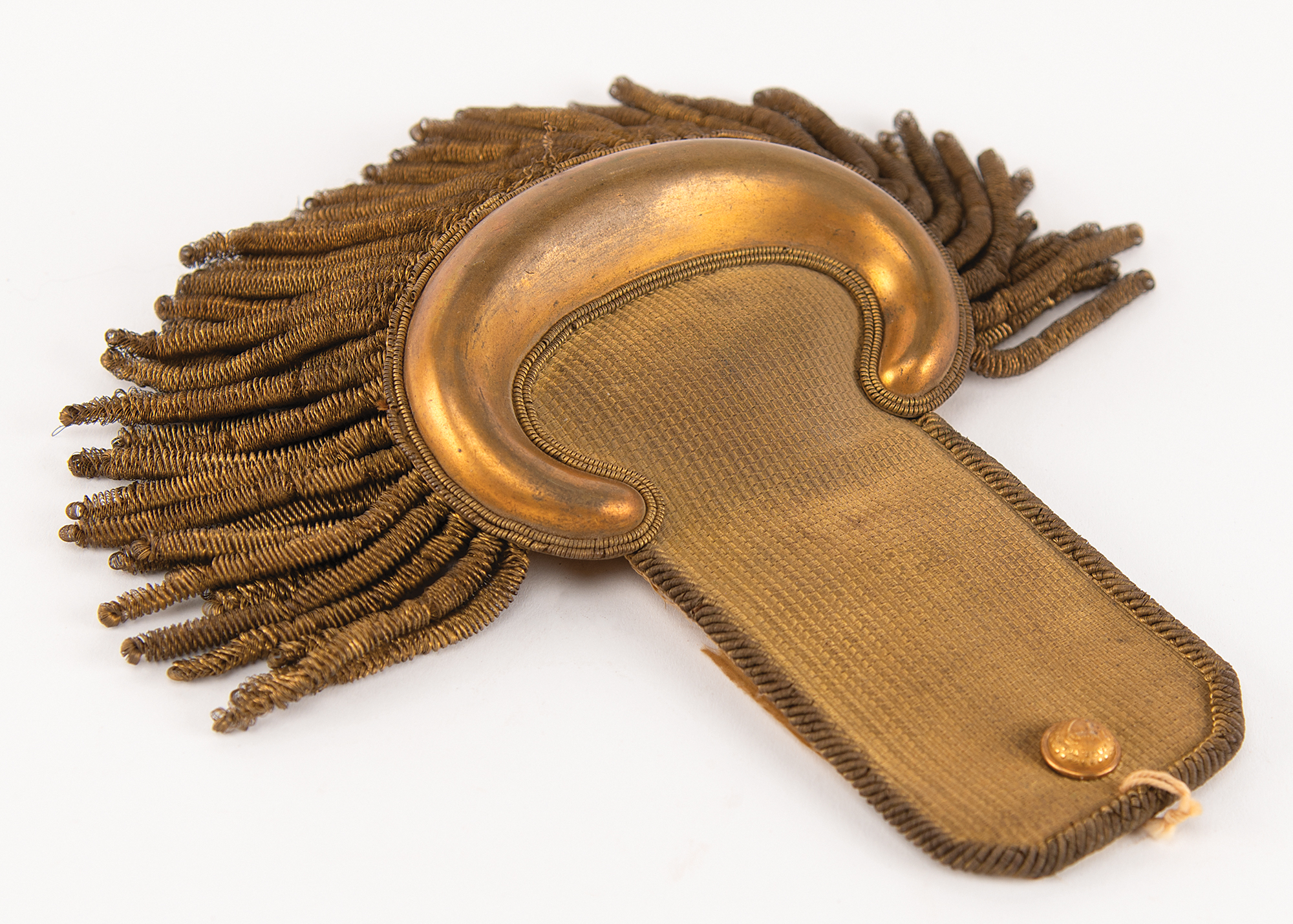
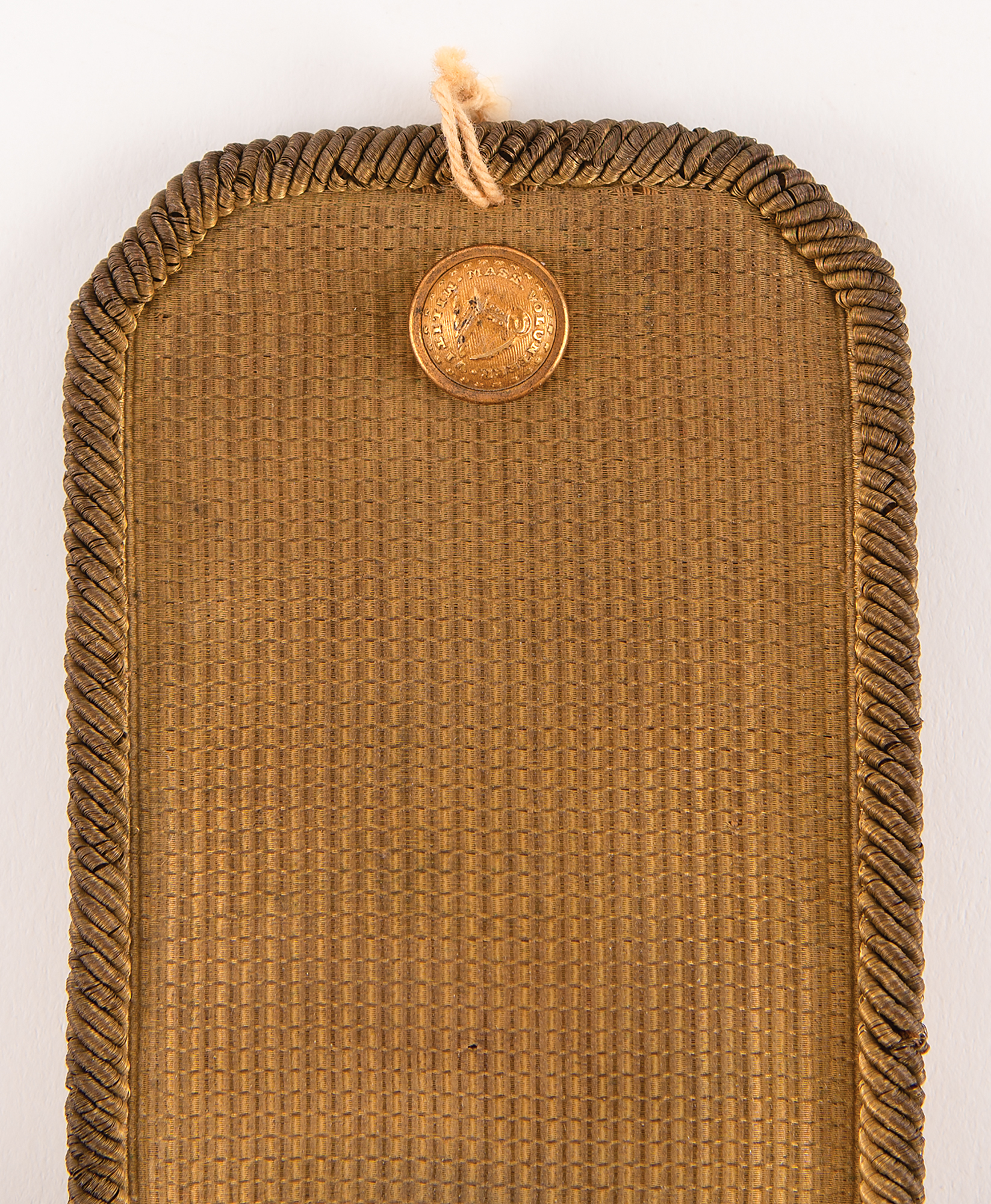
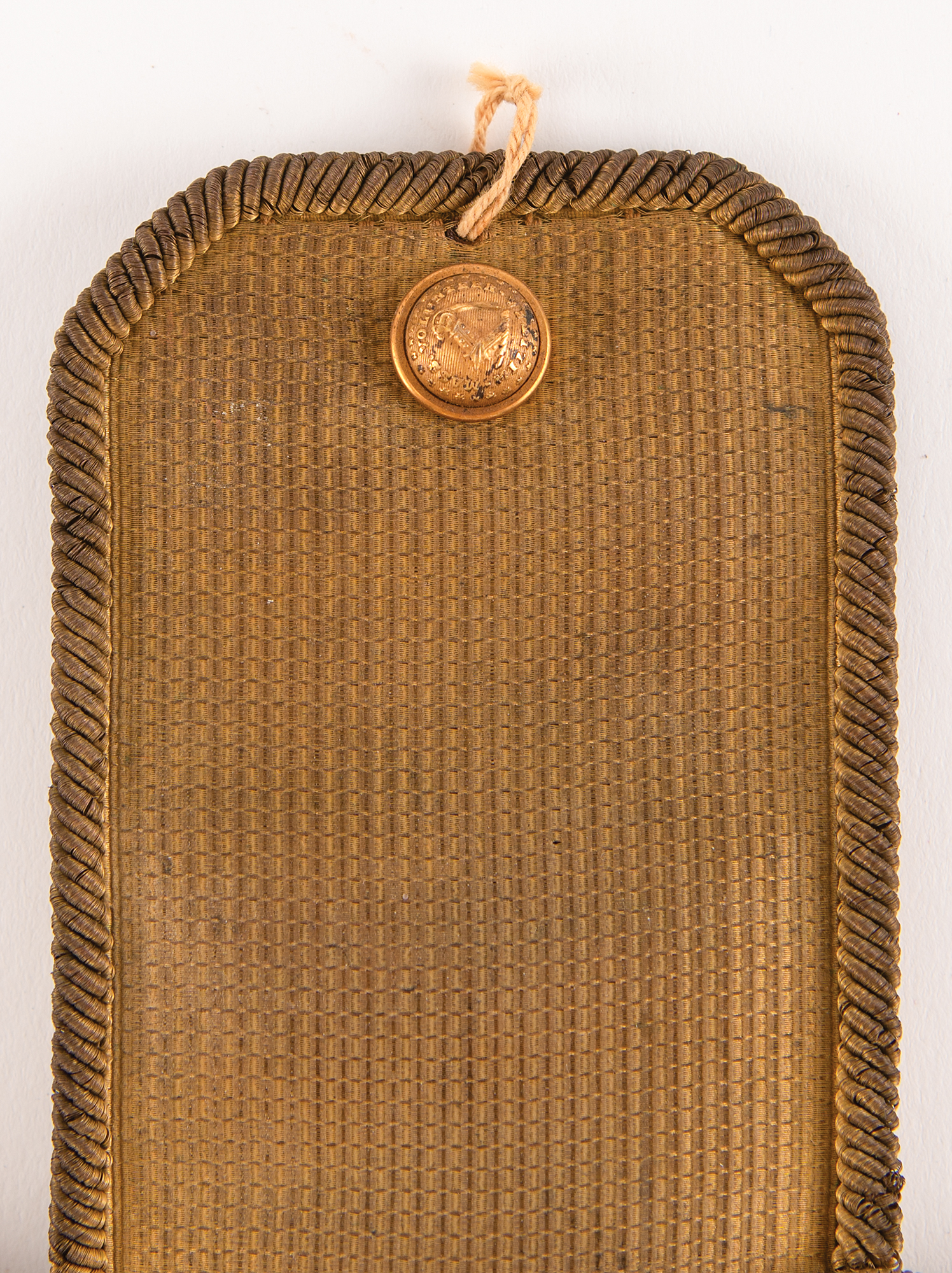
Pair of Civil War-era ‘Captain of Infantry’ epaulettes belonging to Captain John A. Hawes of Company E, Third Regiment, Massachusetts Volunteer Militia. The gilt dress epaulettes feature gilded brass crescents, bullion borders, and a double strand of bullion tassels and padded yellow silk lining. The buttons are Massachusetts Volunteer Militia buttons and bear “Robinsons Makers” backmarks. According to Ridgeway, the Robinson companies of Attleborough, Massachusetts operated in various forms and names from 1813 to 1848, when it was taken over by D. Evans. In overall very good condition, with minor staining, tarnish, and missing shoulder hooks.
Provenance: From the descendants of John Hawes
John Alexander Hawes (September 23, 1823 – March 10, 1883) was born in Fairhaven, Massachusetts, into a wealthy family. A Harvard graduate of the class of 1845, he established himself as a prominent lawyer in his town, serving as a selectman from 1857 to 1860 and as an active member of the school committee. Following the Civil War, Mr. Hawes served two terms as a state senator. Among his other positions, he held the role of president of the Bristol County Agricultural Society and was elected as the first commodore of the New Bedford Yacht Club. His marriage to Amelia Hallett, daughter of the renowned Captain Bangs Hallett, further solidified his standing in the community. They resided on a large estate in Fairhaven, inherited from his grandfather, Captain Samuel Borden.
At the onset of the Civil War, Hawes volunteered immediately in support of the Union. In 1861, he joined a committee responsible for securing arms and equipment from the Commonwealth for harbor and coastal defense. When the Third Regiment was organized at Lakeville, he was chosen to lead Company E, despite it being largely composed of former members of the New Bedford City Guard. On September 4, 1862, Hawes was commissioned as an officer in Company E, 3rd Massachusetts Volunteers, later known as the 43rd Infantry. He participated in the battles of White Hall and Kingston, serving from September 23, 1862, until his mustering out on June 26, 1863.
The Massachusetts Volunteer Militia traces its origins back to the early days of the Massachusetts Bay Colony when colonists formed local militias to defend against various threats. Officially mustered in 1636, it is one of the oldest military organizations in North America. During the colonial period, the militia played a significant role in conflicts such as King Philip's War and the French and Indian War. As tensions with Great Britain escalated in the 1770s, the militia became a crucial force in the fight for independence, particularly during the Battles of Lexington and Concord. The creation of the elite Minutemen, who were ready for combat at a minute's notice, was a notable aspect of the Revolution, contributing to early American successes.
After the American Revolution, the Massachusetts Militia continued to serve during the War of 1812 and in the suppression of Shays' Rebellion. The outbreak of the Civil War in 1861 saw the Massachusetts Volunteer Militia once again called into action. Massachusetts was the first state to respond to President Abraham Lincoln's call for troops and its militia units were among the first to reach Washington, D.C. The militia was reorganized into regiments that served with distinction throughout the war, participating in major battles such as Bull Run, Antietam, and Gettysburg.

