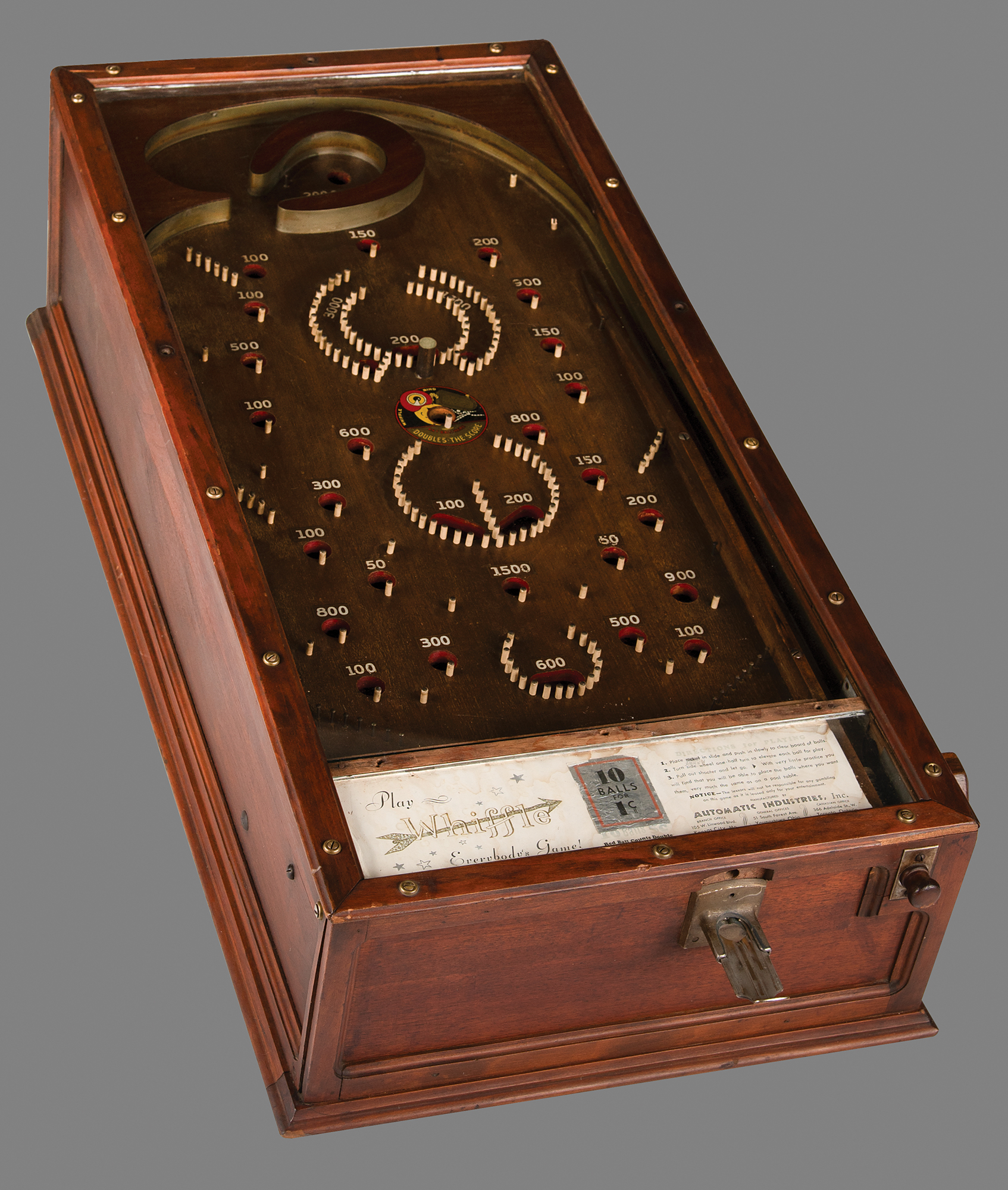
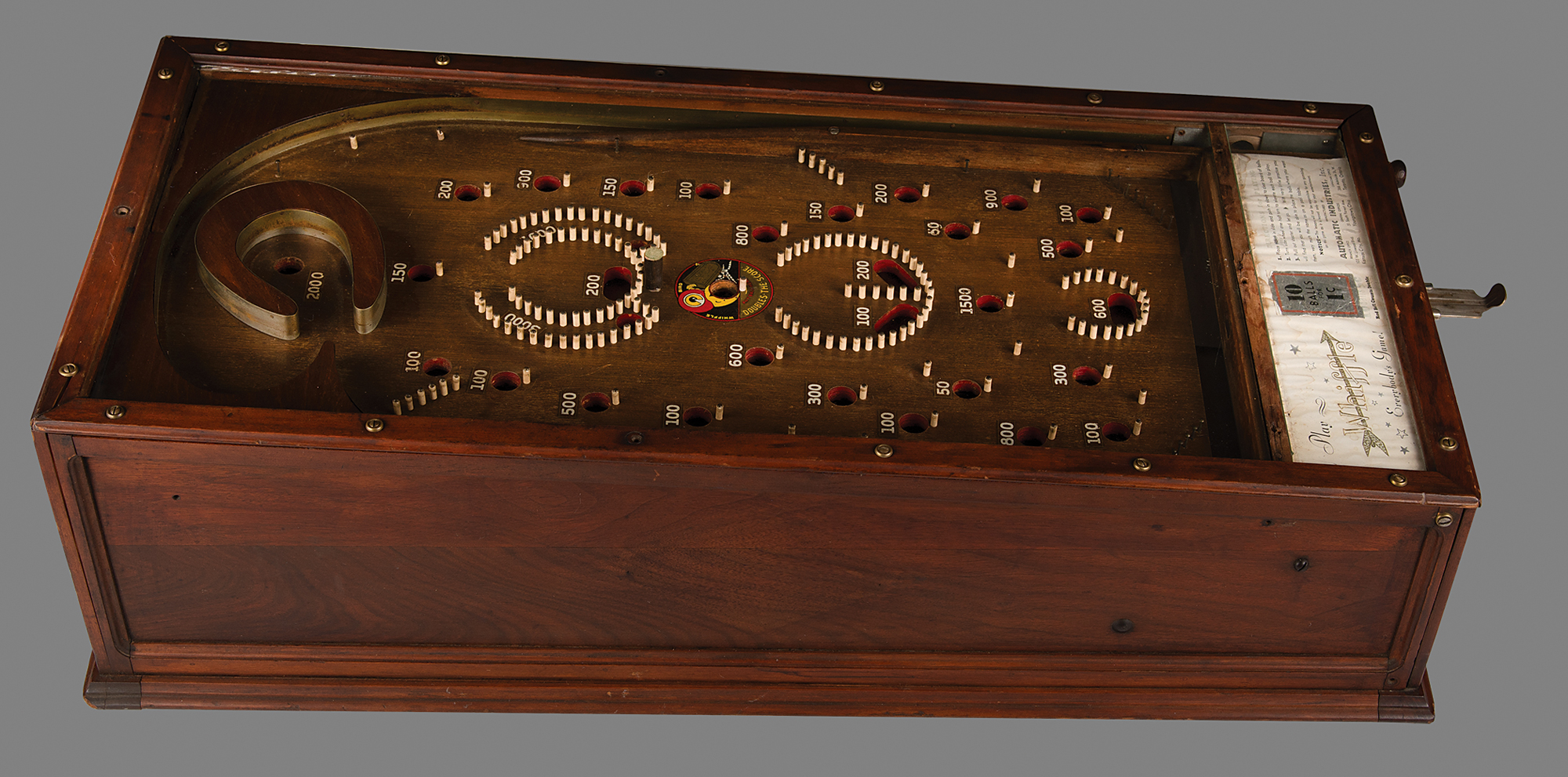

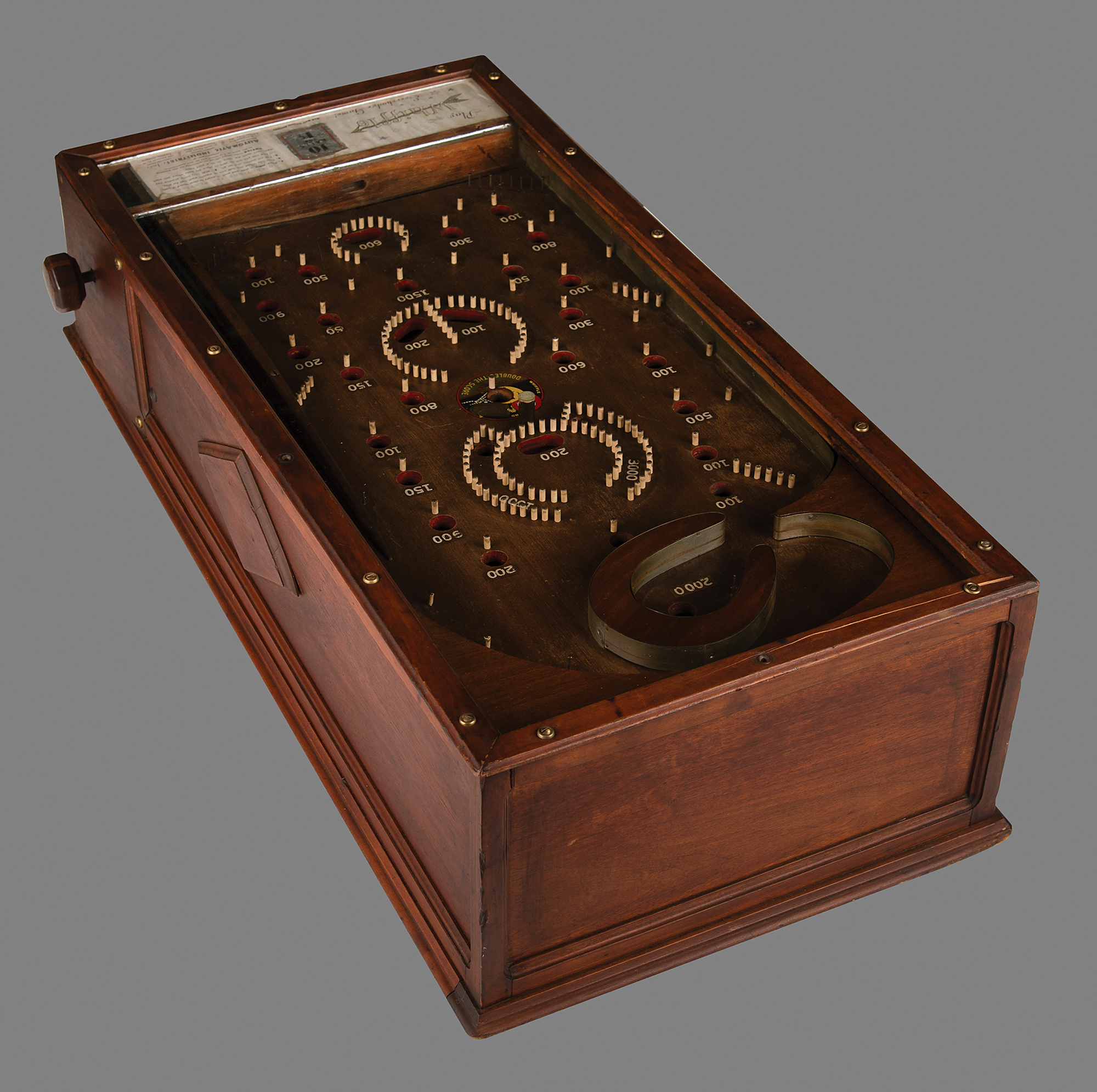

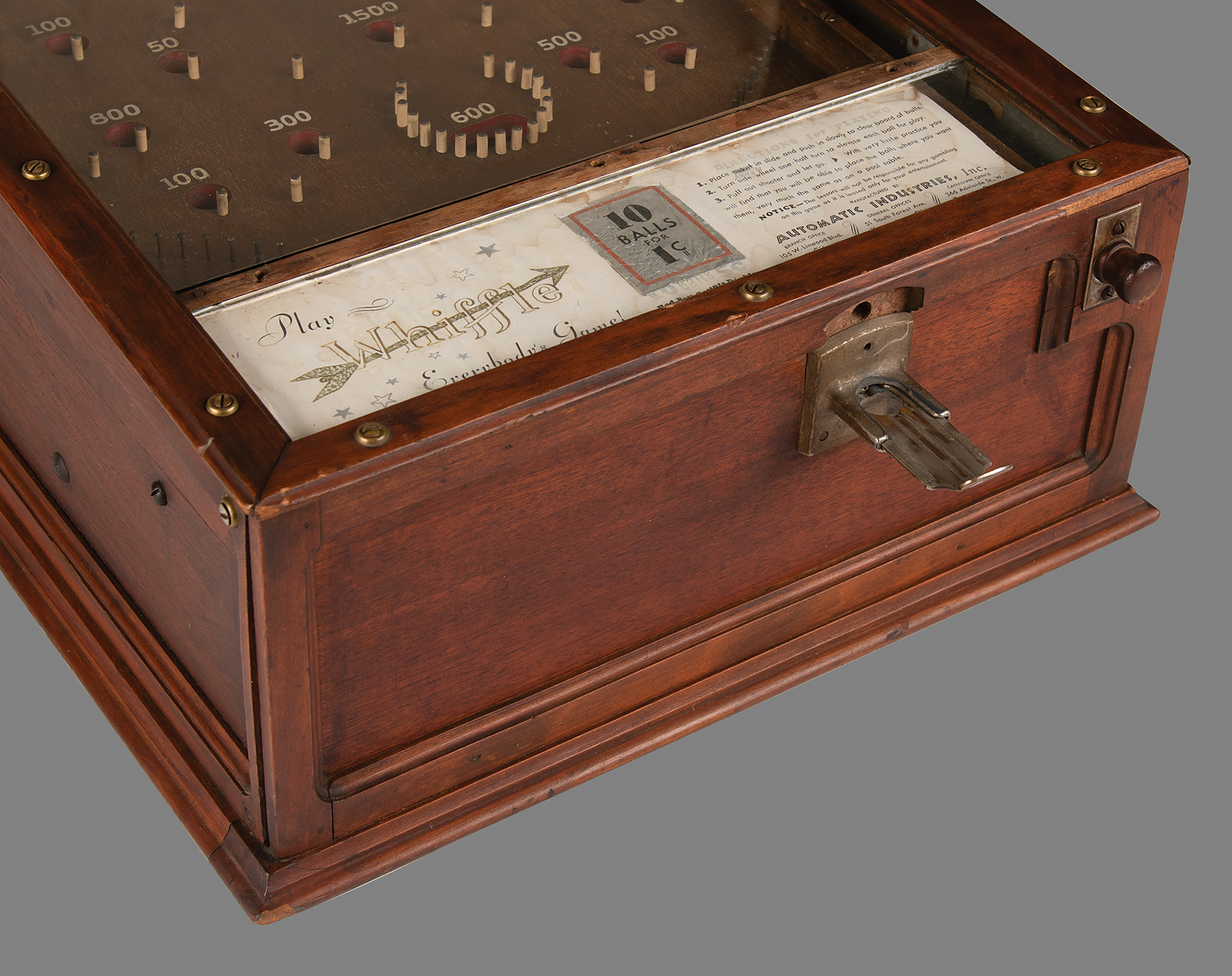
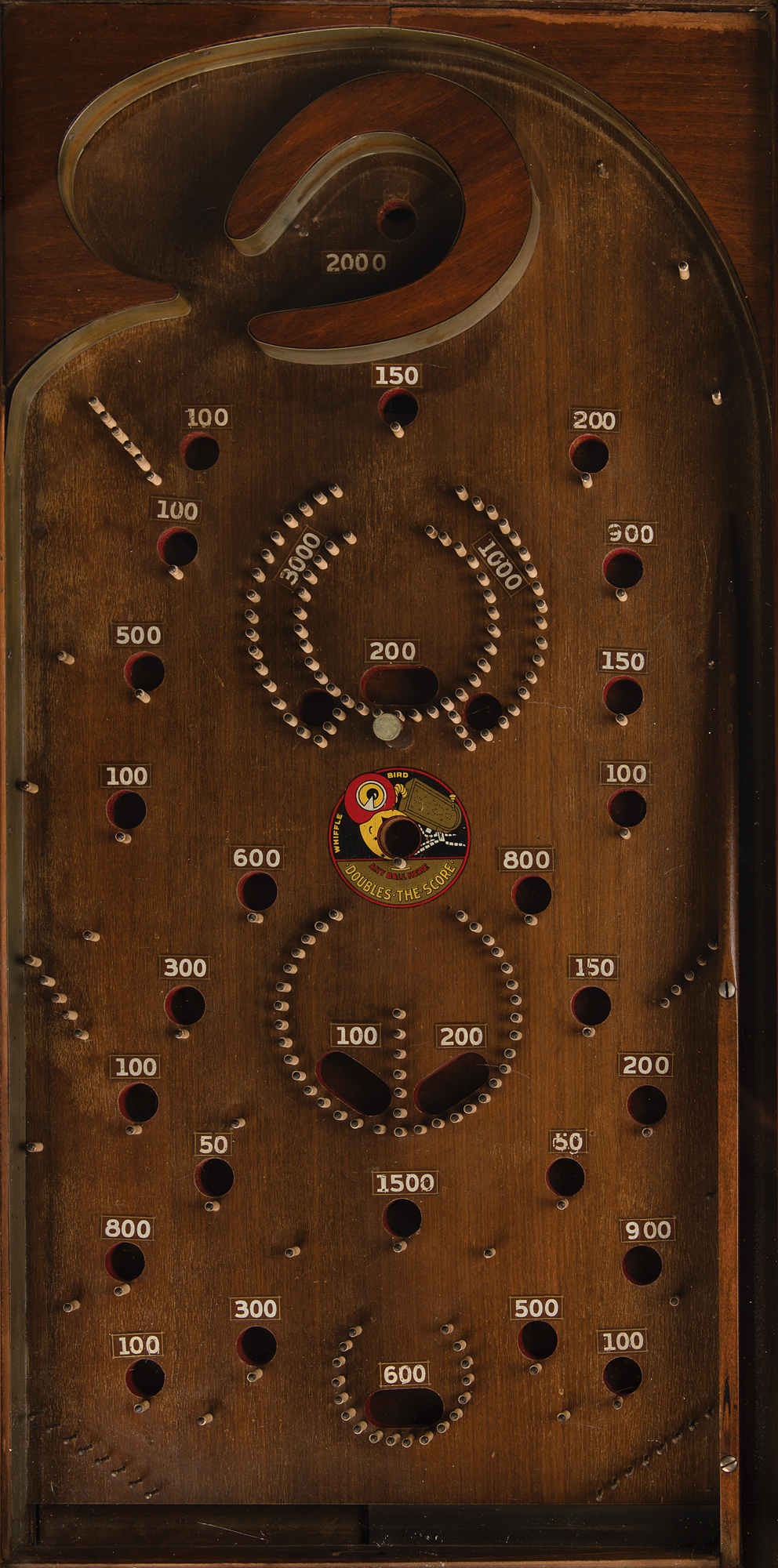
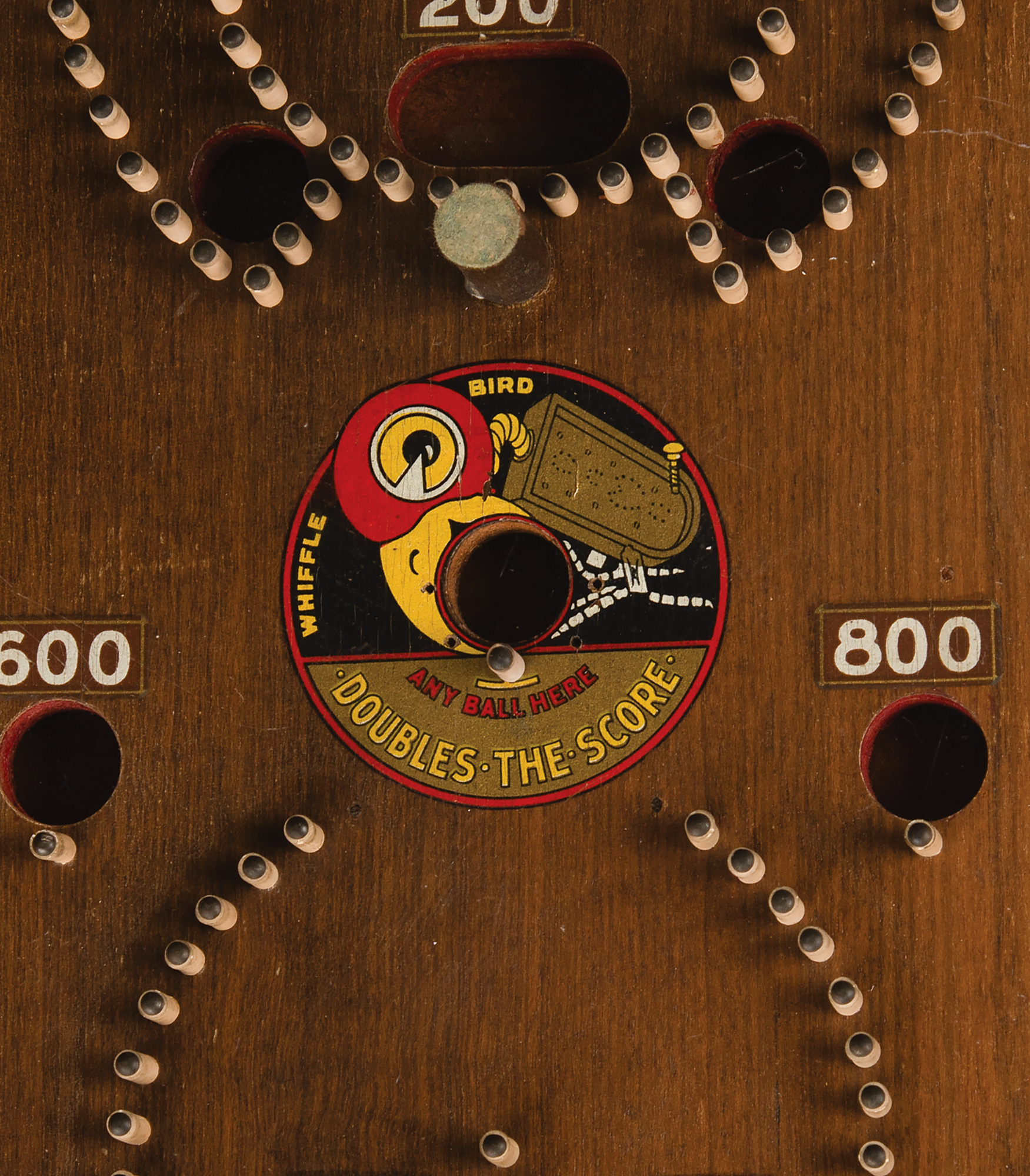
Incredible, historic original Whiffle ‘pure mechanical’ pinball machine released by Automatic Industries, Inc., circa June 1931. Conceived by Arthur L. Paulin, a carpenter from Youngstown, Ohio, and designed by Paulin and his friend, Earl Froom, an electrical salesman, the Whiffle has long been touted as the first American coin-operated pinball machine. The tabletop machine, 18˝ x 38˝ x 10.25˝, is comprised of its original wooden cabinet with a glass top, through which the player can observe the playfield layout with upper horseshoe design, a multitude of bumper pegs, and a total of 32 scoring options ranging from 50 points to 3000 points, which includes a central ‘Double the Score’ hole with colorful ‘Whiffle Bird’ emblem. The game’s title sheet reads: “Play Whiffle, Everybody’s Game! Directions for Playing: 1. Place nickel [“penny” in an unknown hand] in slide and push in slowly to clear board of balls. 2. Turn side-wheel one-half turn to elevate each ball for play. 3. Pull out shooter and let go. With very little practice you will find that you will be able to place the balls where you want them, very much the same as on a pool table. NOTICE – The lessors will not be responsible for any gambling on this game as it is leased only for your entertainment.” The sheet bears an affixed “10 Balls for 1¢” label and the lower portion lists manufacturing and office locations in Kansas City, Missouri, Youngstown, Ohio, and Toronto, Ontario, Canada. In fine condition, with some dampstaining to the game sheet, a few missing cabinet screws, and several pins without their white rubber guards, with one or two cracked. Bidder notice: the game should not be played unless the fragile rubber pin guards are replaced.
According to the Internet Pinball Database: ‘In converting Arthur L. Paulin's bagatelle design to an automatic coin-operated device, salesman Earl Froom solved a number of issues, including how to separate the player from the playfield (glass), how to recirculate the balls after play (playfield baffle/shuttle and ball elevator), and how to collect money (coin mechanism). What resulted was a game of such wild popularity in the United States that it caught the coin-op world by surprise and caused innumerable imitations by other companies, leading to the pinball patent wars.
We don't know how many of these games were made, but The Encyclopedia of Pinball, Volume 1, page 29 quotes Earl Froom as saying, ‘We built 27,000 Whiffle games the first year’ in his lament that his game became, as author Dick Bueschel put it, ‘instantly obsolete’ in the face of competition from the very successful Bally's 1932 'Ballyhoo' of which approximately 50,000 units were produced.
Whiffle is the game most often associated with the birth of pinball, but according to the Encyclopedia of Pinball Vol 1, the first true pinball was Charles P. Young's ‘Coin Game Board’ trade stimulator of 1892, which was also glass-covered and coin-operated. The idea to add coin mechanisms to machines came even earlier, from British inventor Percival Everett, but it was Londoner Henry John Gerrard Pessers who was first to put a coin slot on a marble game, which was patented on September 29, 1889.’

