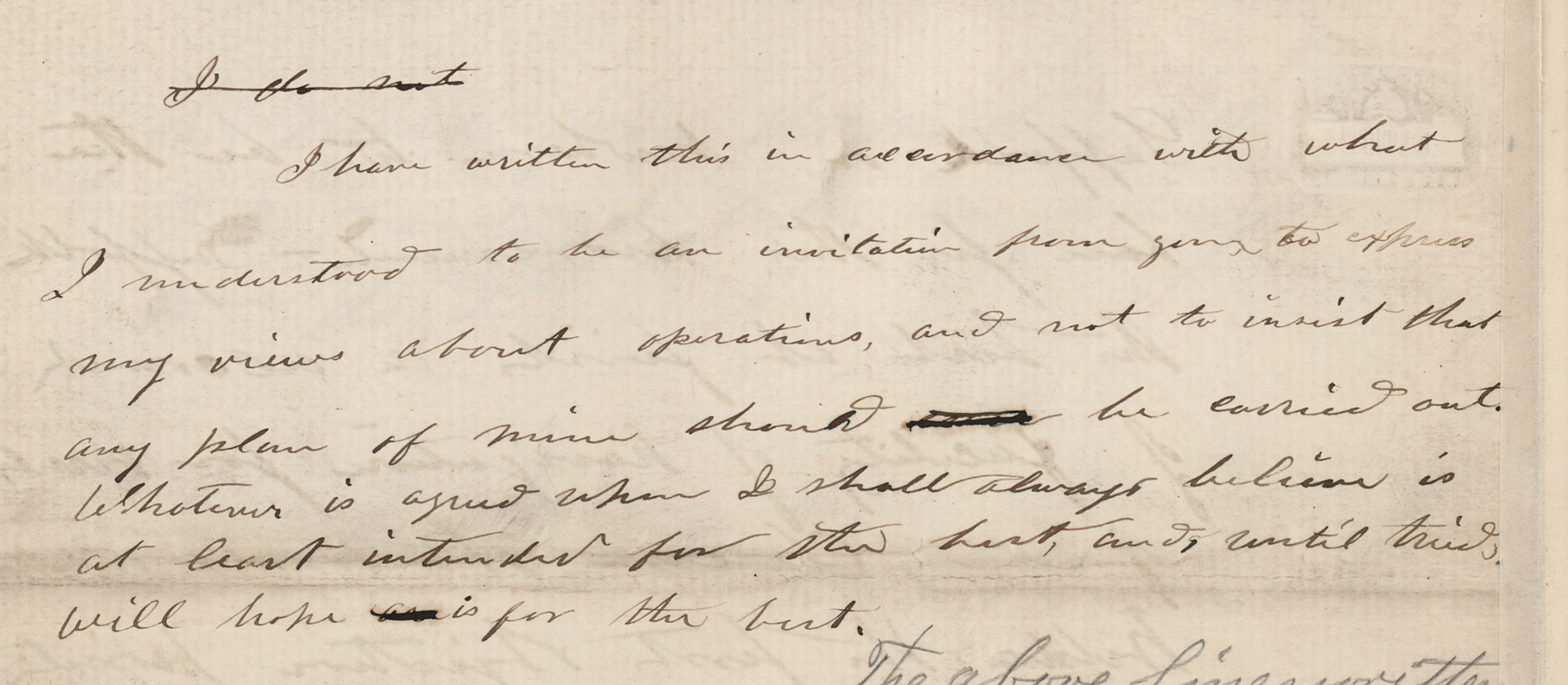
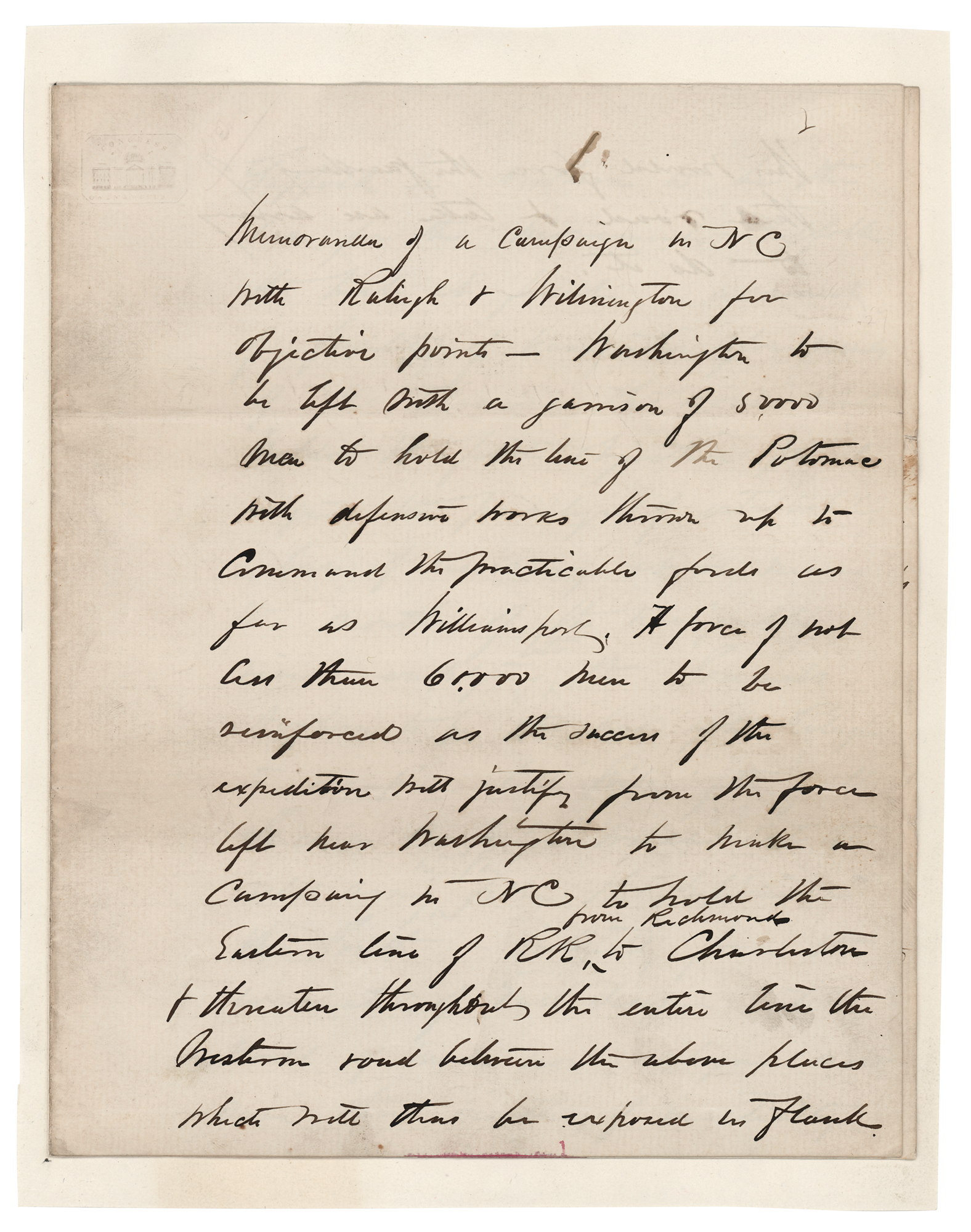
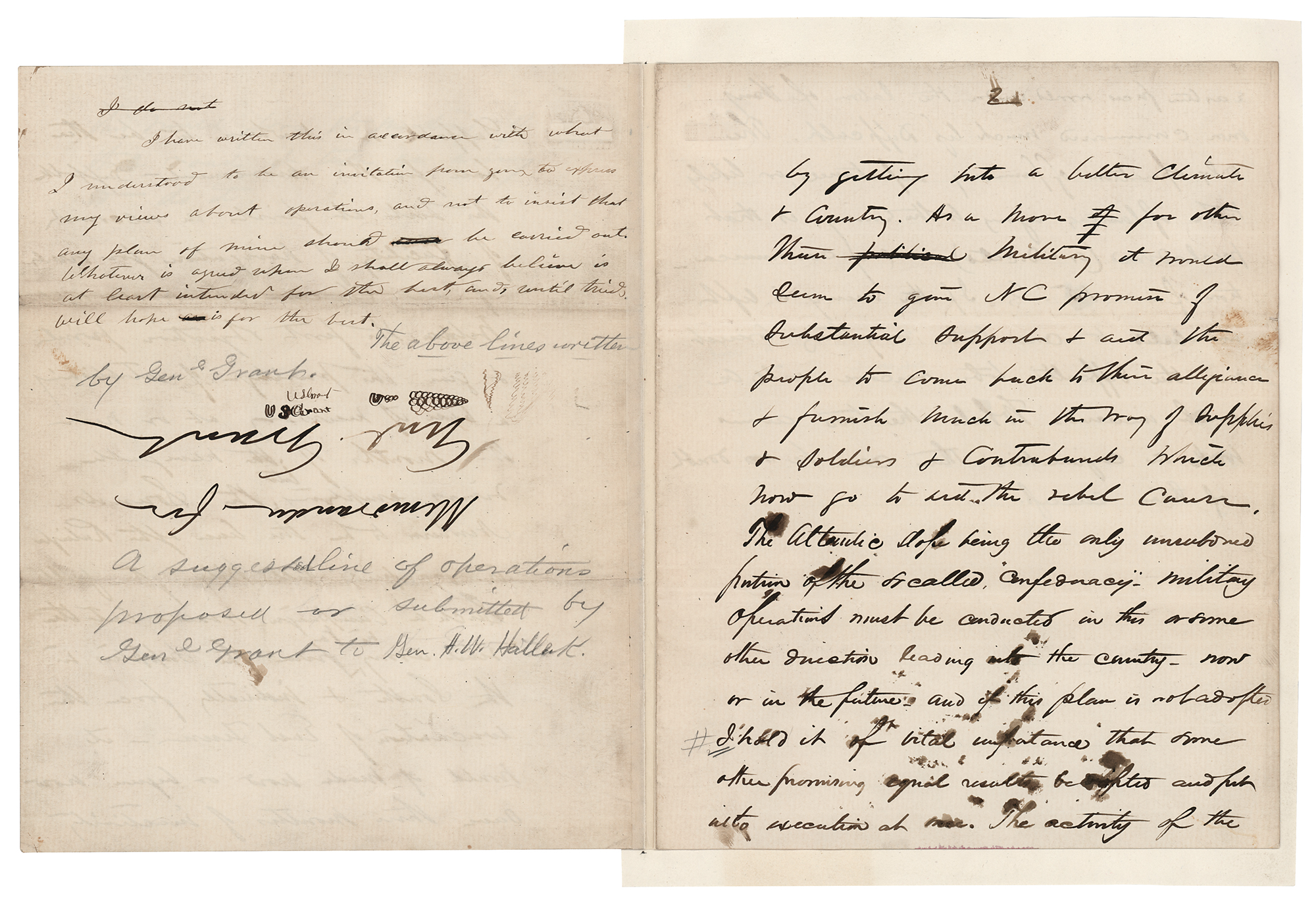
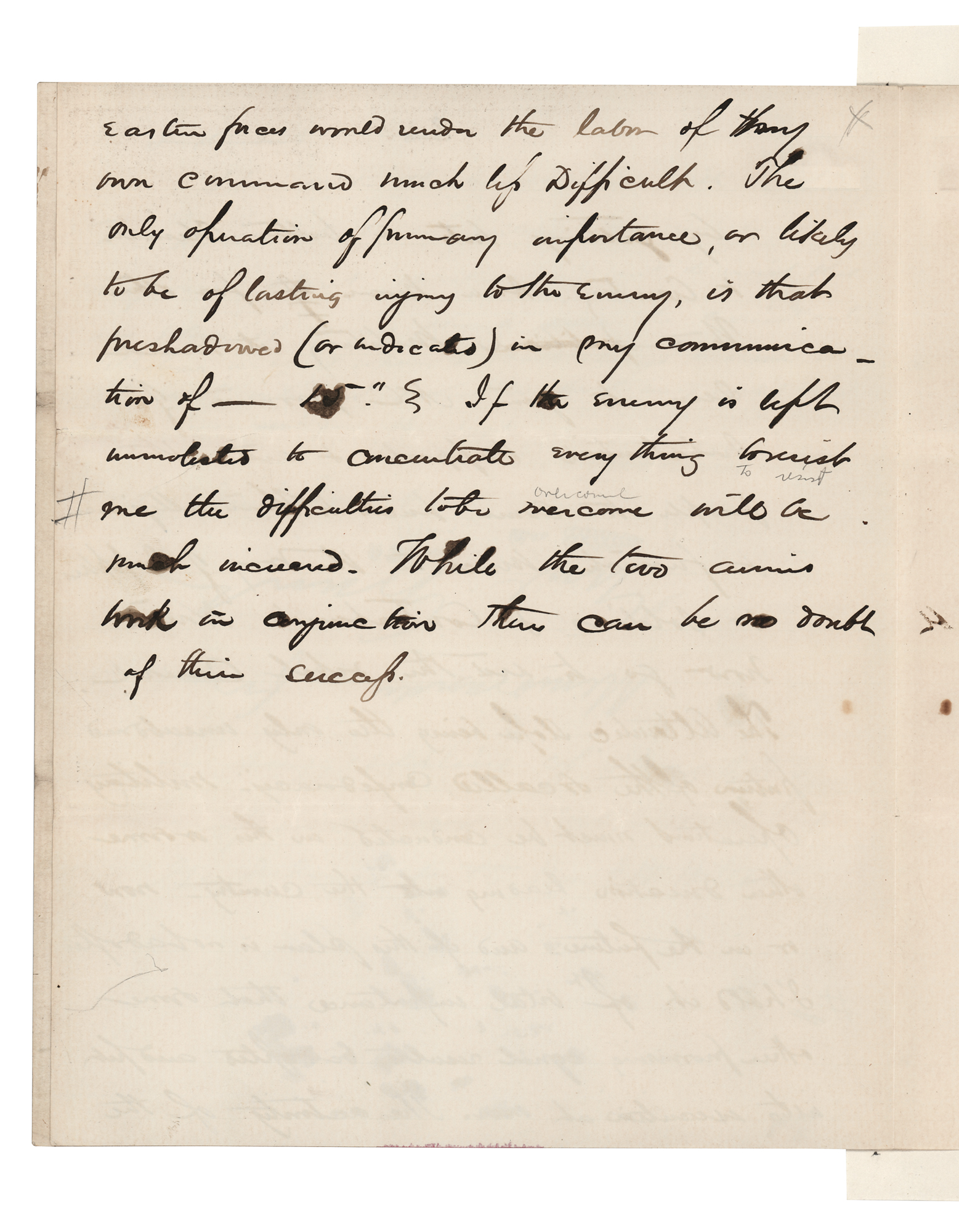
Civil War-dated manuscript document headed “Memorandum of a Campaign in NC with Raleigh & Wilmington for objective points,” containing a seven-line handwritten statement from General U. S. Grant, six pages, 8 x 9.75, no date [January, 1864]. Penned in a secretarial hand and addressed to General Henry Halleck, then Grant's superior, this memorandum comprises an authentic rough draft of an ambitious proposal about the taking of North Carolina that would eventually be sent to Halleck on January 19, 1864. Grant’s response, penned on the reverse of the third page, reads: “I have written this in accordance with what I understood to be an invitation from you to express my views about operations, and not to insist that any plan of mine should be carried out. Whatever is agreed upon I shall always believe is at least intended for the best, and, until tried will hope for the best.” A secretarial hand has added Grant's name below.
In a letter penned on January 8, 1864, Henry Halleck invited Grant to share his views for the upcoming campaign in the Military Division of the Mississippi. Halleck, a military scholar and theoretician, desired to hear suggestions from his generals, but often left them to the actual decision-making on the field of battle. It comes as no surprise, then, that he would ask of Grant a strategy for the upcoming campaign. Grant initially demurred, stating that he heretofore had abstained from offering suggestions about what might be done in campaigns other than his own, but agreed to write Halleck again in a few days. In his work, ‘The Rise of U.S. Grant,’ A. L. Conger states on p. 310: ‘On January 19, 1864, Grant presented his first proposal to Halleck, in response to Halleck's invitation.’ A comparison with the subsequent printed text of the letter shows our manuscript herein to be the true rough draft.
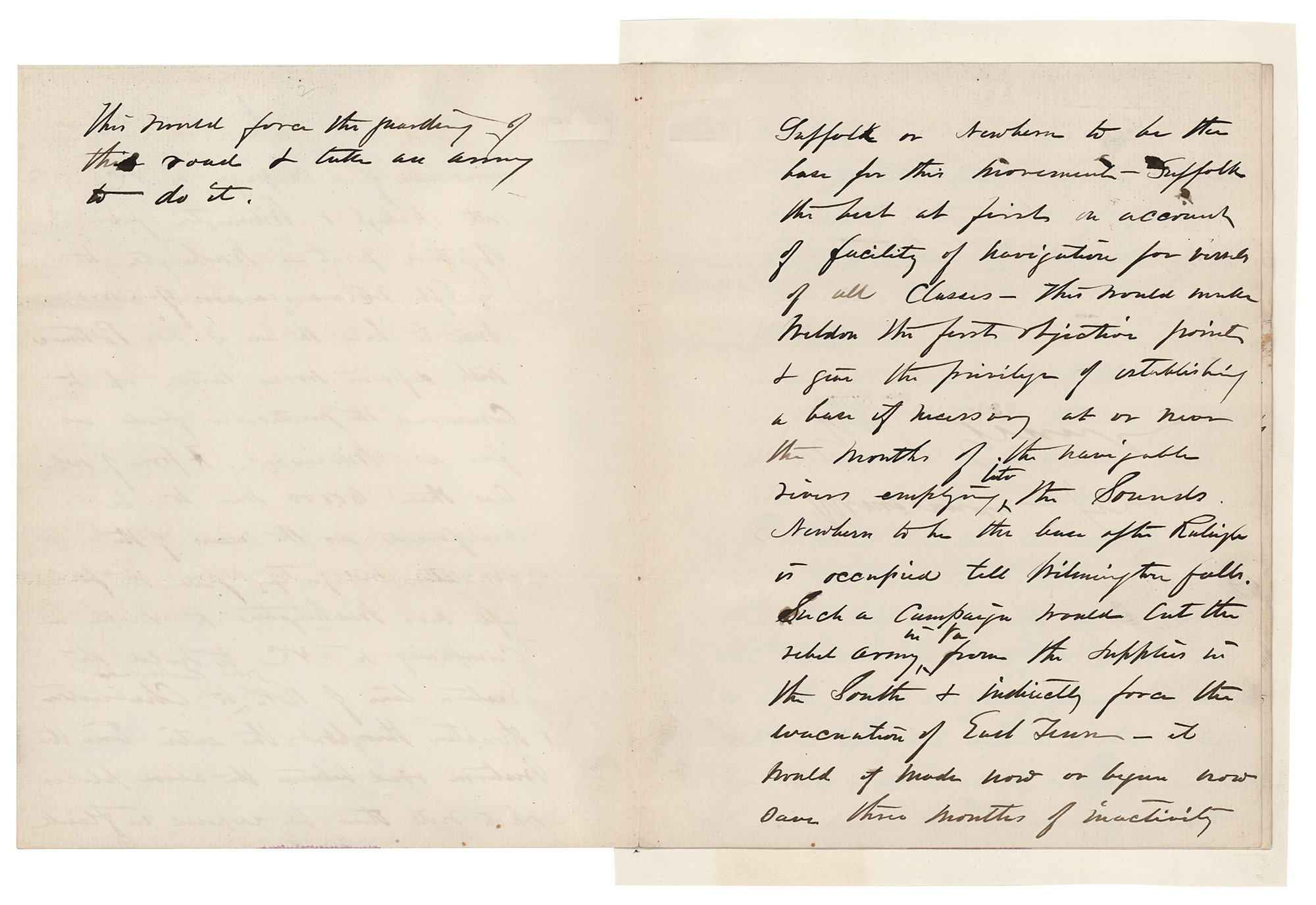
Ten days before our document, on January 9, 1864, Grant instructed General George Meade, commanding the Army of the Potomac, to take out the rail lines in the area of Norfolk, Virginia, including those as far west as Greensboro, North Carolina. Meade was then to move towards New Bern or Wilmington, capturing the port at Wilmington along with the Weldon railroad, before invading and capturing the city of Raleigh, North Carolina. As a follow-up to that plan, our “Memorandum” reads, in part: “Washington to be left with a garrison of 50,000 men to hold the line of the Potomac with defensive works thrown up to command the practicable forces as far as Williamsburg. A force of not less than 60,000 men to be reinforced as the success of the expedition will justify from the force left near Washington to link…a company in NC to hold the Eastern line of the RR from Richmond to Charleston & threaten throughout the entire line the Western road between the above places which will thus be exposed in flank. This would force the guarding of the road & take an army to do it.
Suffolk or Newburn to be the base for this movement. Suffolk the best at first on account of facility of navigation for vessels of all classes. This would make Weldon the first objective point & give the privilege of establishing a base if necessary at or near the mouth of the navigable river emptying into the Sounds. Newburn [sic, New Bern] to be the base after Raleigh is occupied till Wilmington falls. Such a campaign would cut the rebel army in V[irgini]a from the supplies in the South & indirectly force the evacuation of East Tenn. It would if made now or begun now over three…months of inactivity by getting into a better climate & country. As a move for other than military, it would seem to give NC promise of substantial support & aid the people to come back to their allegiance & furnish much in the way of supplies & soldiers & contrabands which now go to aid the Rebel cause. The Atlantic slope…being the only unenforced portion of the so-called ‘Confederacy' military operations must be conducted in this or some other direction leading into the country now or in the future, and if this plan is not adopted I hold it of vital importance that some other promising equal results be adopted and put into execution at once. The activity of the Eastern forces would render the labor of my own command much less difficult. The only operation of primary importance, or likely to be of lasting injury to the enemy, is that preshadowed (or indicated) in my communication of 15˝. If the enemy is left unmolested to concentrate every thing to resist me, the difficulties to be overcome will be much increased. While the two armies work in conjunction there can be no doubt of their success.” Affixed to a backing sheet and in fine condition.
Some scholarship suggests that the views expressed in the memorandum were not Grant's, but actually those of his chief engineer W. F. Smith, who had served in the east. Grant would abandon the plans outlined herein after he visited the eastern theater and saw for himself the situation there. Regardless, Grant would abandon all plans outlaid in both the memorandum and subsequent letter, and began planning for the Overland Campaign instead.

