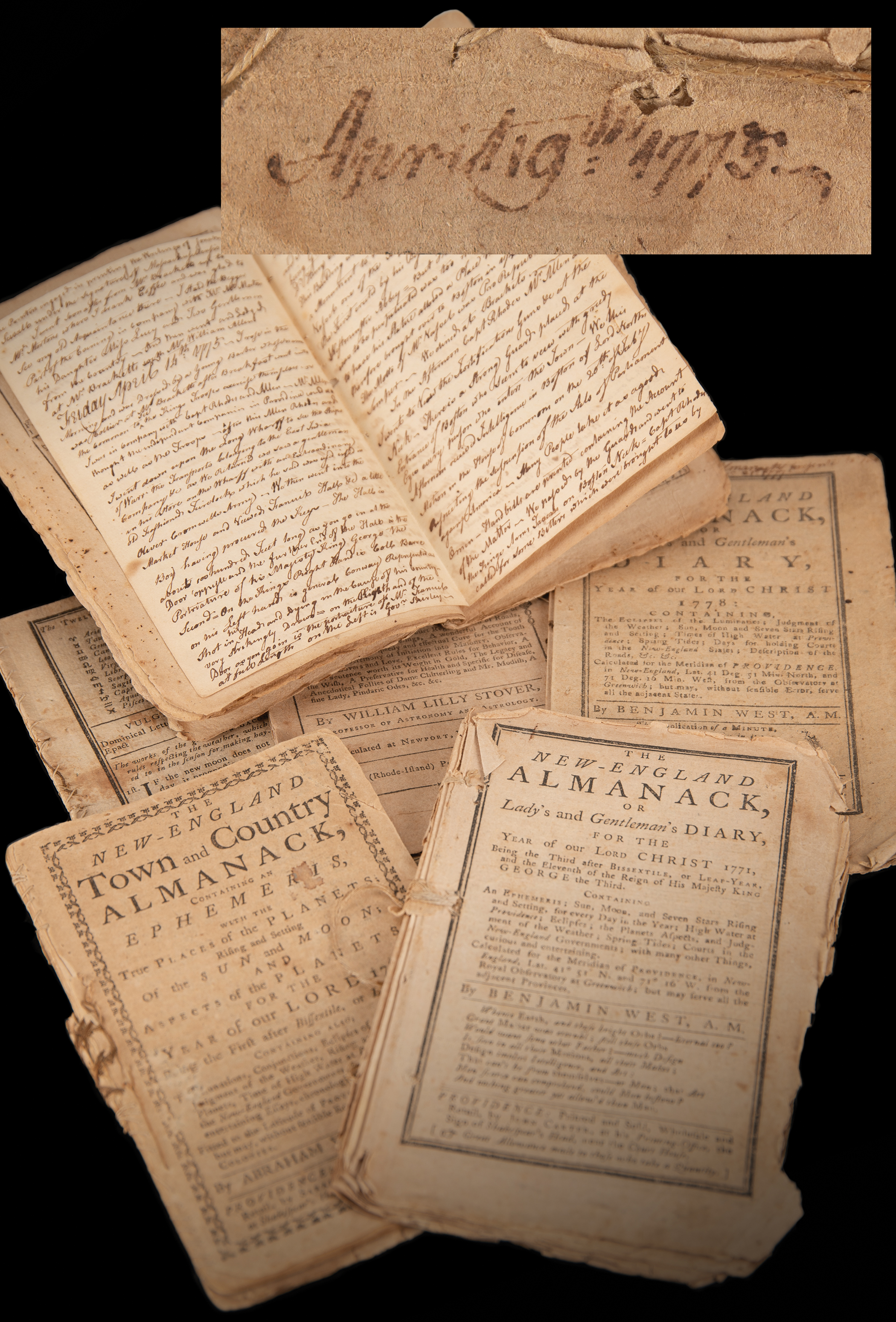
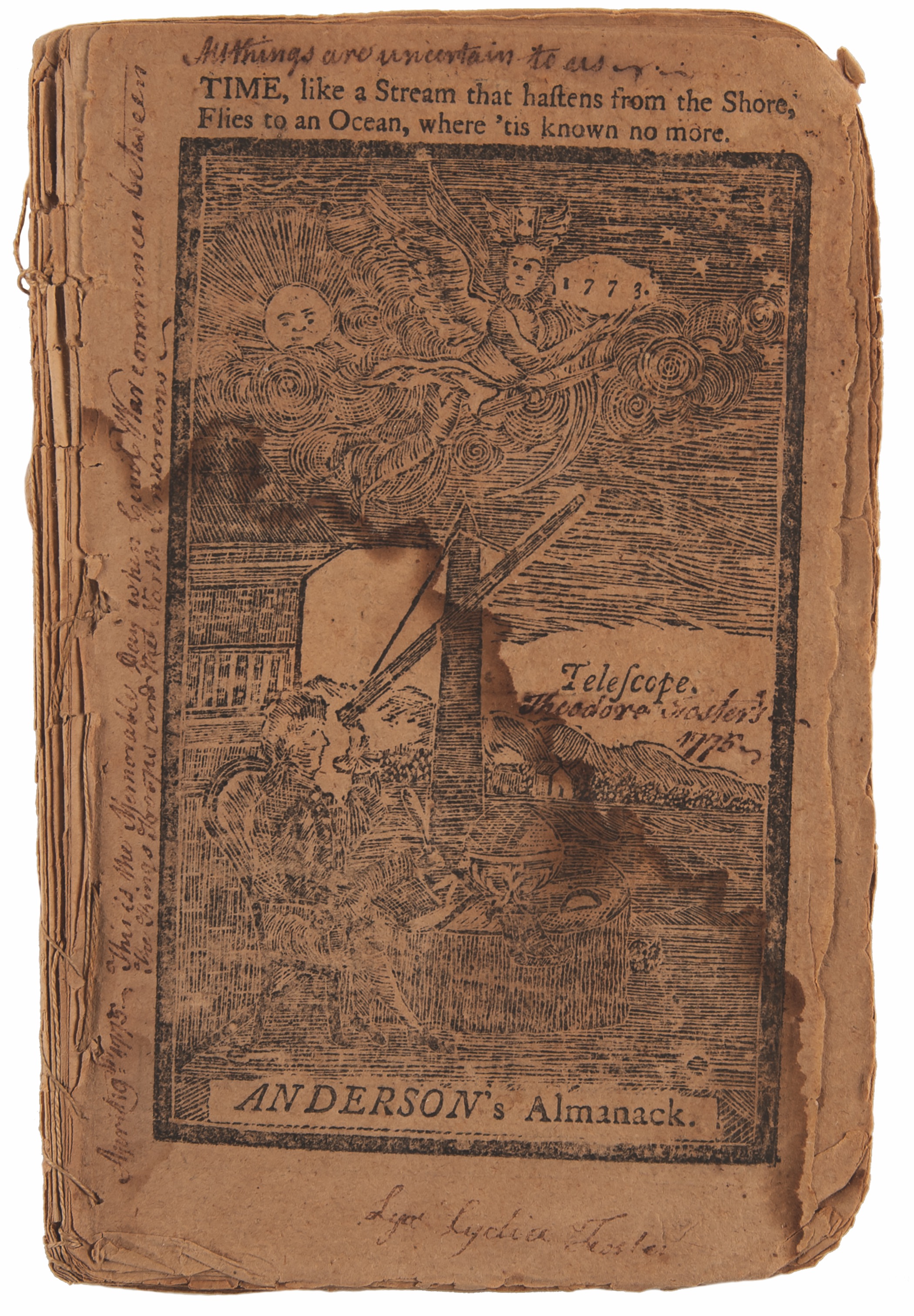

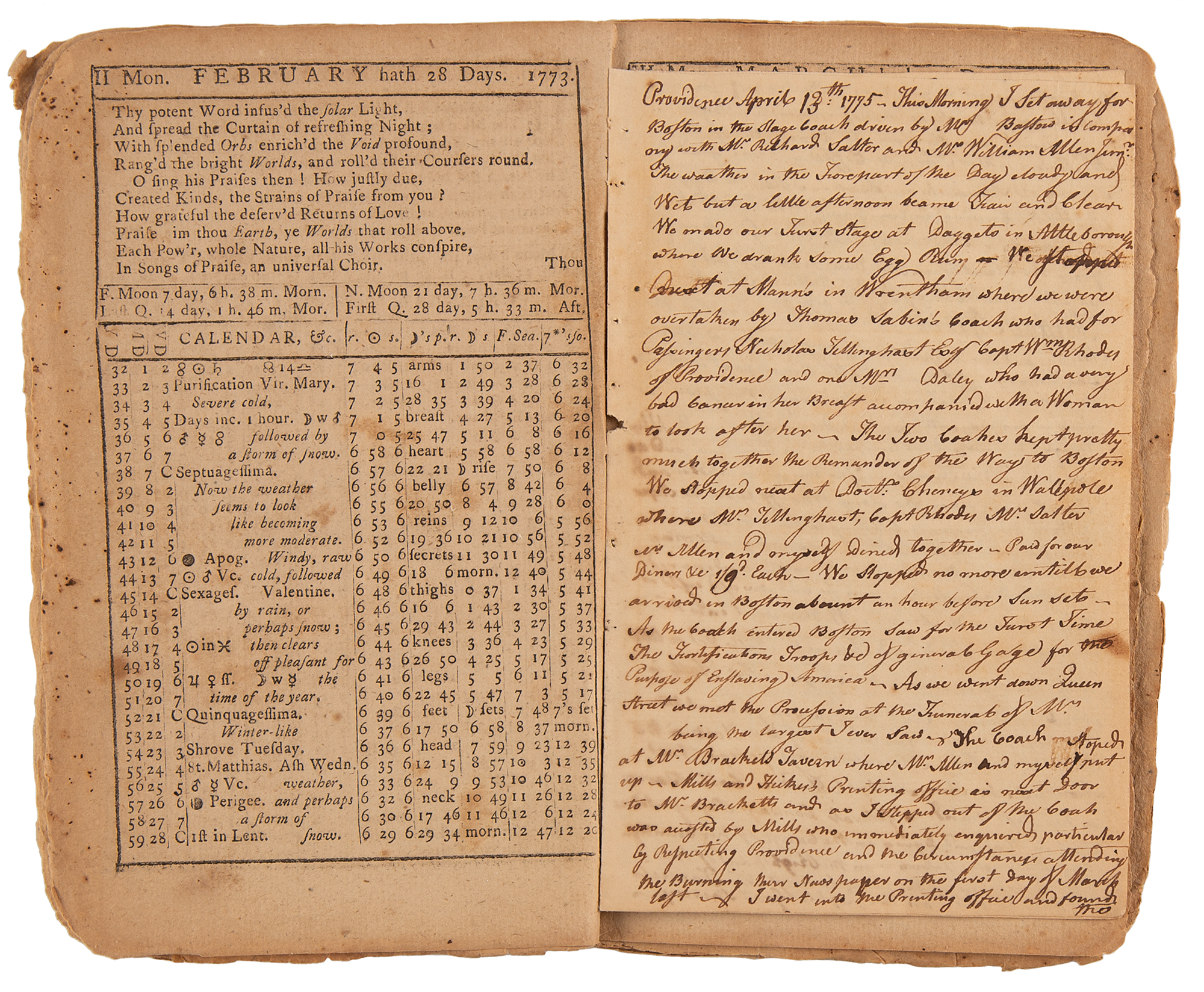
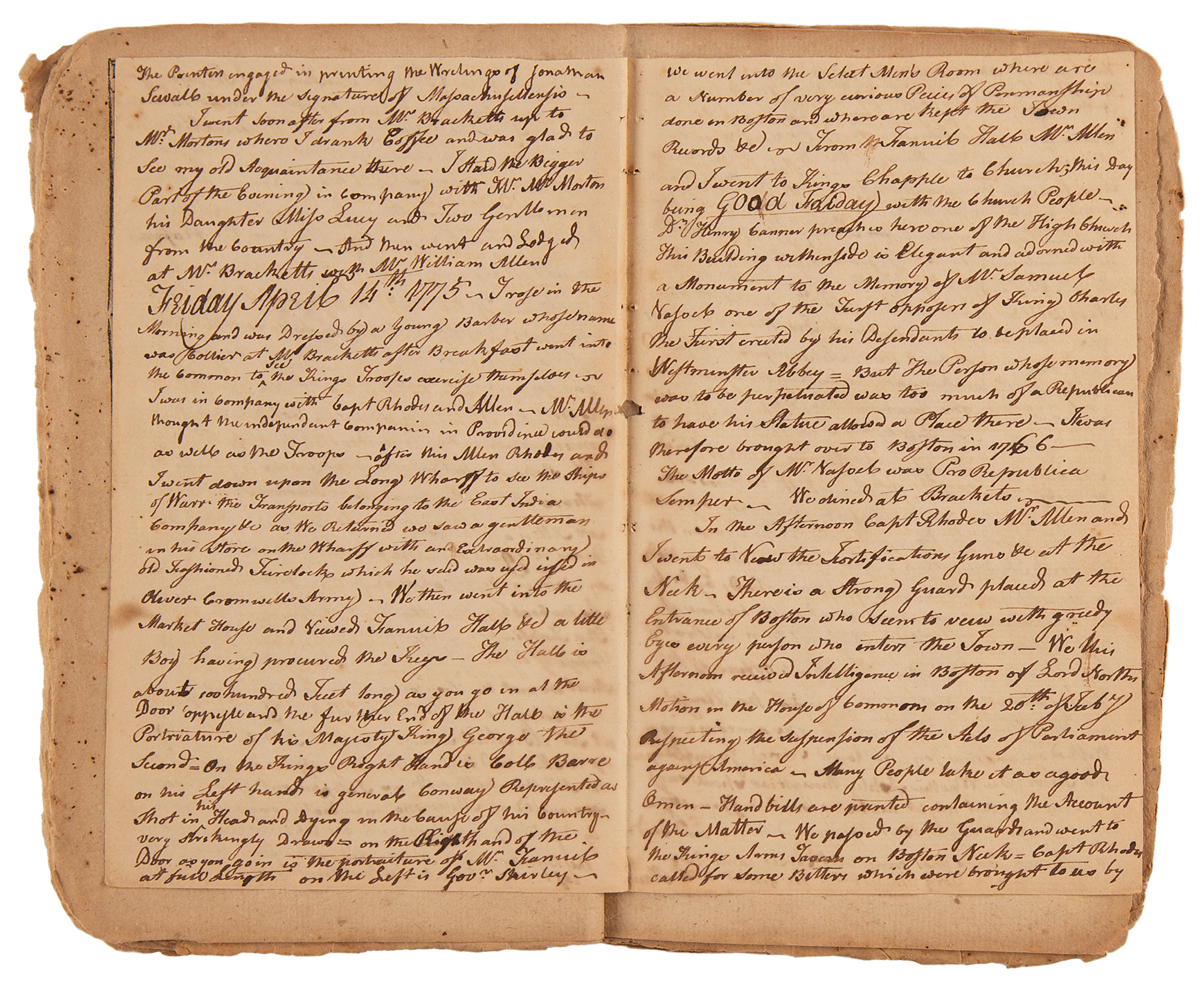
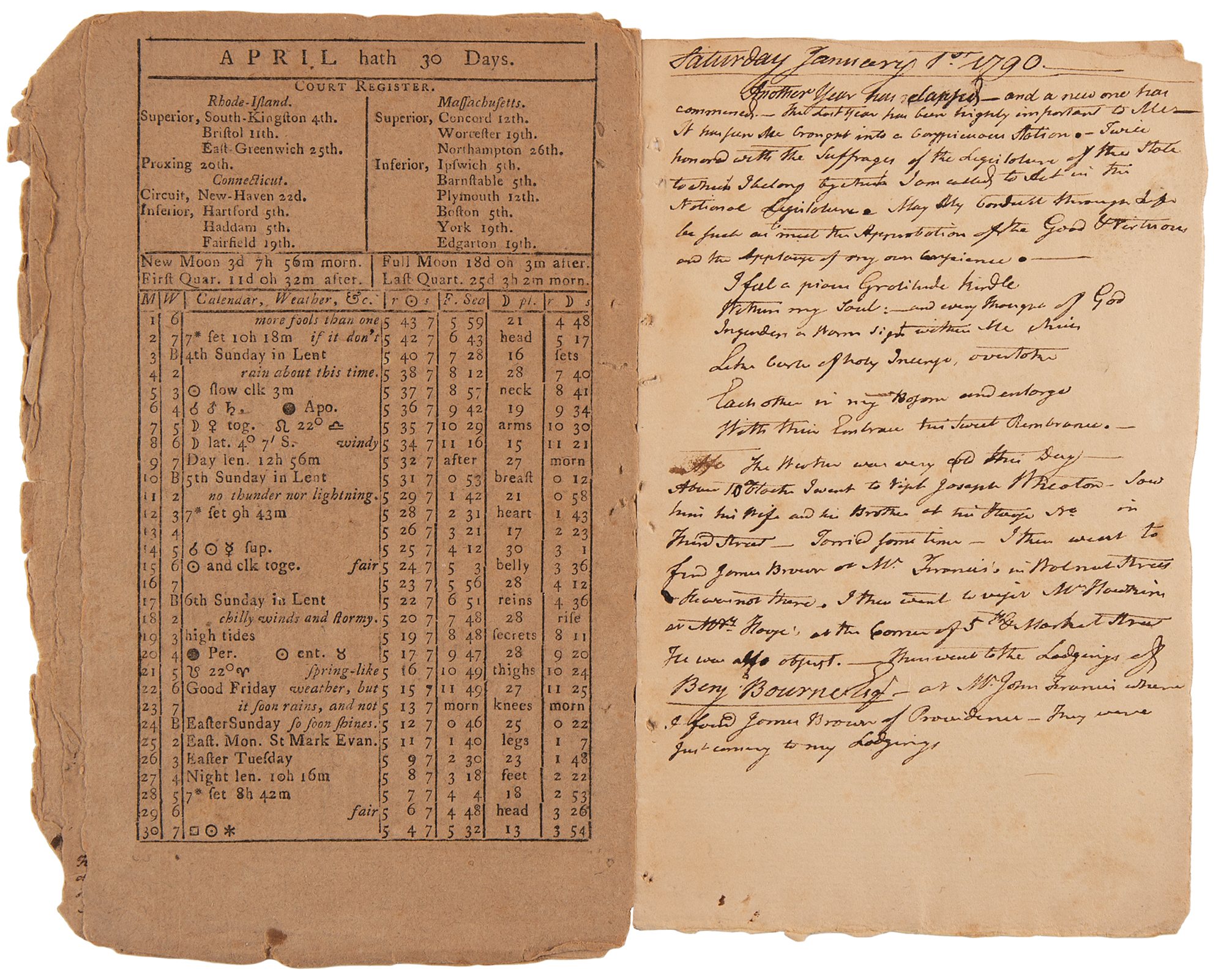
Historical collection of six Revolution-era almanacs published in Newport and Providence, Rhode Island between 1769 and 1791, originating from the personal collection of Theodore Foster, who, in a rare 1773 printing of John Anderson’s ‘Anderson Improved: Being an Almanack, and Ephemeris,’ offers a firsthand account of a trip to Boston, Massachusetts, on the eve of the Battle of Lexington and Concord. On the front leaf, Foster has written vertically in the left margin and then along the top: “April 19th 1775. This is the Memorable Day when Civil War commences between The Kings Troops and the North Americans” and “All things are uncertain to us.” Bound within these early publications are Foster’s secret diary entries, containing roughly 40 handwritten pages discussing daily events both quotidian and consequential to the political climate of the New England Colonies.
Foster, an educator, lawyer, and politician who served as one of the two original state senators of Rhode Island, describes British fortifications in the town and preparations for the advance to Lexington and Concord and the ‘shot heard round the world’ that began the American Revolutionary War. Highlights from this particular almanac are as follows (by date):
April 13, 1775: “We arrived in Boston about an hour before Sunset. As the Coach entered Boston saw for the First Time the Fortifications Troops &c of general Gage for the Purpose of Enslaving America. As we went down Queen Street we met the Procession at the funeral of Mrs being the largest I ever Saw."
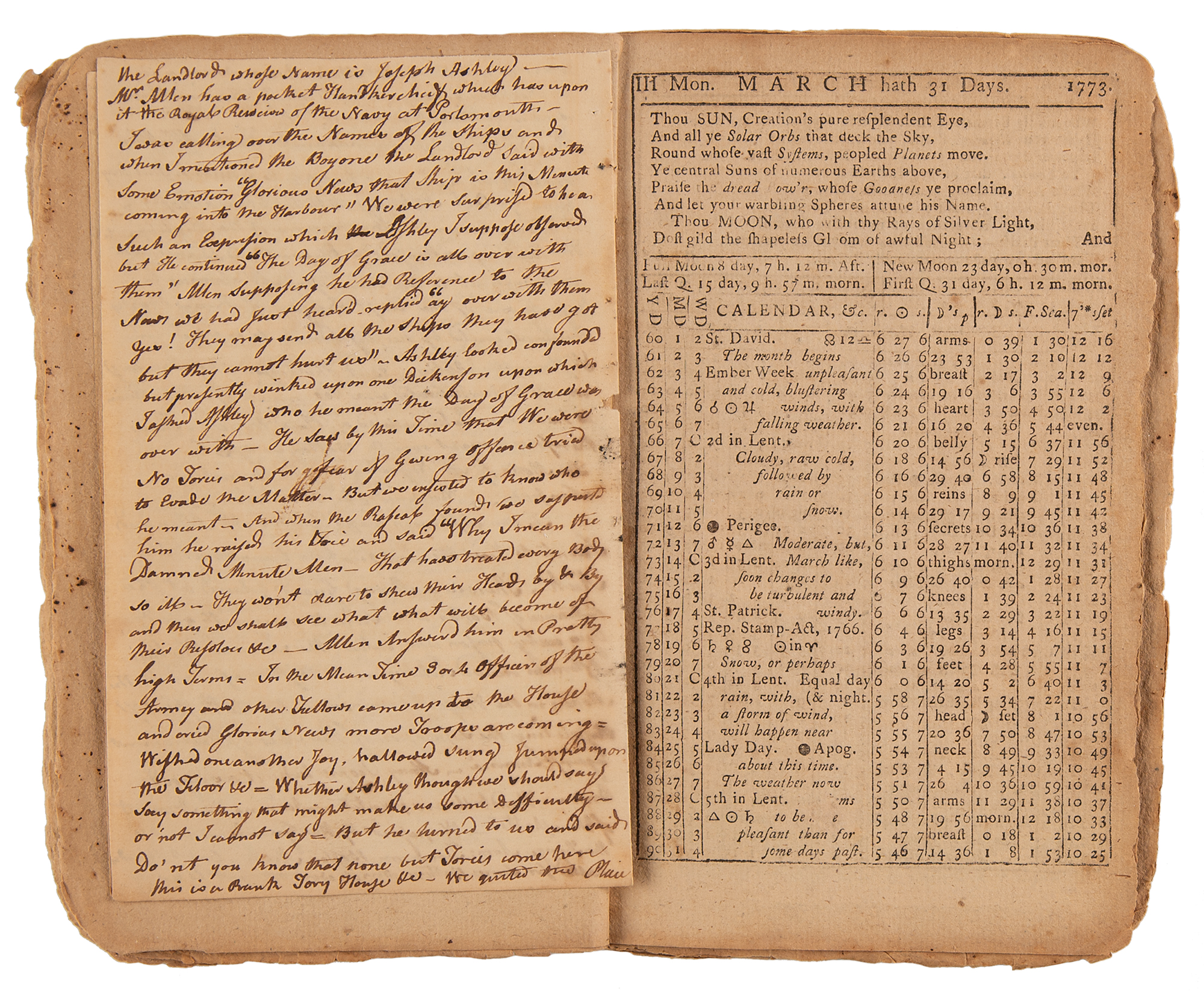
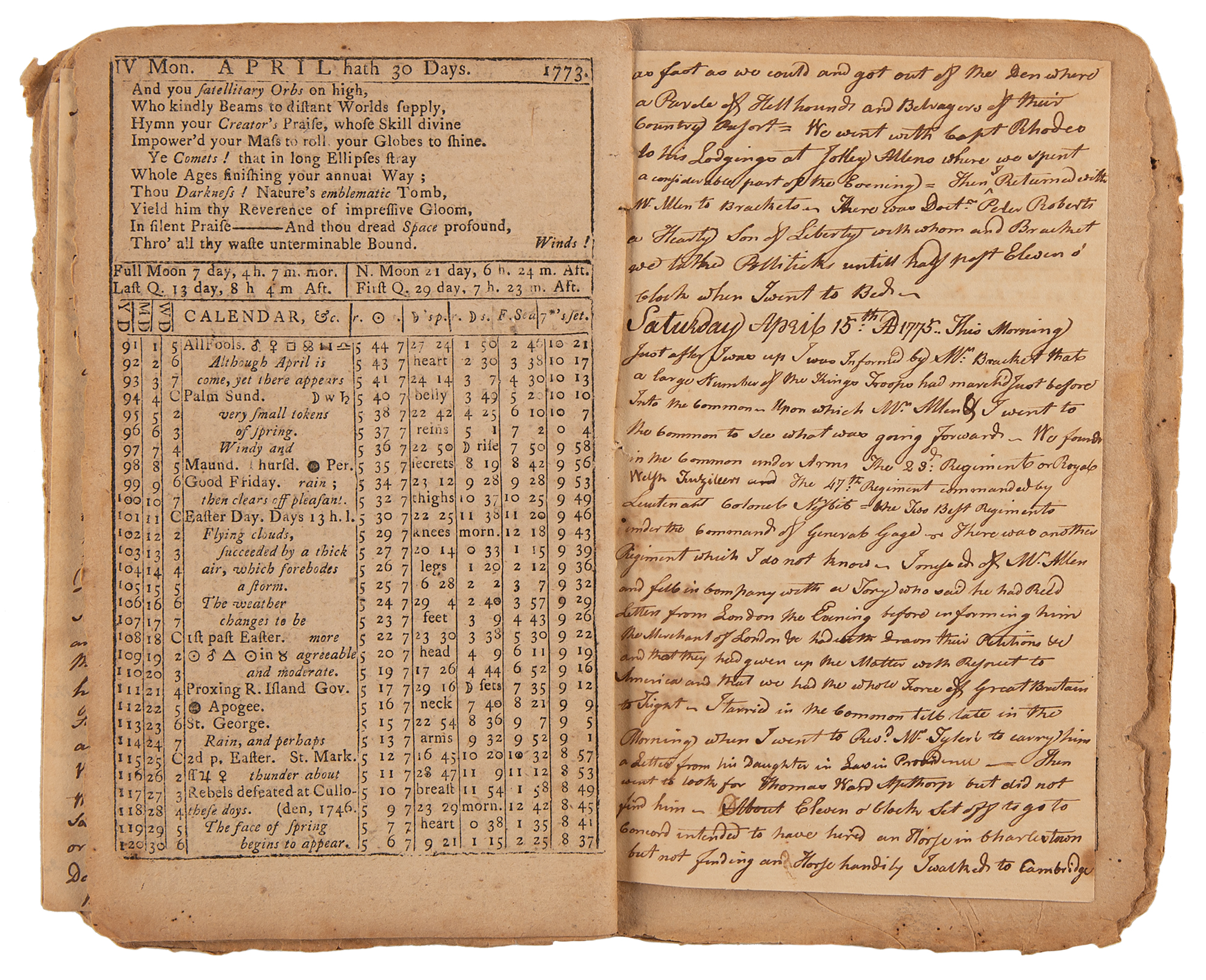
April 14, 1775: “I rose in the Morning and…went into the Common to see the Kings Troops exercise themselves. I was in Company with Capt Rhodes and Allen…After this Allen Rhodes and I went down upon the Long Wharff to see the Ships of Warr the Transports belonging to the East India Company &c…We then went into the Market House and Viewed Fanuil Hall…[whic] is about 100 hundred Feet long as you go in at the Door opposite and the further End of the Hall is the Portraiture of his Majesty King George the Second. On the Kings Right Hand is Coll Barre on his Left hand is general Conway Represented as Shot in his Head and Dying in the Cause of his country…In the Afternoon Capt Rhodes Mr Allen and I went to View the Fortifications Guns &c at the Neck. There is a Strong Guard placed at the Entrance of Boston who seem to view with greedy Eyes every person who enters the Town. We this Afternoon received Intelligence in Boston of Lord Norths Motion in the House of Commons on the 20th of Feby Respecting the suspension of the Acts of Parliament against America. Many people take it as a good Omen. Hand bills are printed containing the Account of the Matter. We passed by the Guards and went to the Kings Arms Tavern on Boston Neck. Capt Rhodes called for some Bitters which were brought to us by the Landlord whose Name is Joseph Ashley…I was calling over the Names of the ships and when I mentioned the Boyone the Landlord said with Some Emotion 'Glorious News that Ship is this Minute coming into the Harbour.' We were surprised to hear such an Expression which Ashley I suppose observed but He continued 'The Day of Grace is all over with them.' Allen supposing he had Reference to the News we had just heard replied 'ay over with them yes! They may send all the ships they have got but they cannot hurt us.' Ashley looked confounded but presently winked upon one Dickenson…He saw by this Time that we were No Tories and for fear of giving offence tried to Evade the Matter but we insisted to know who he meant. And when the Rascal found we suspected him he raised his voice and said 'Why I mean the Damned Minute Men, That have treated every Body so ill. They won't dare to shew their Heads by & By and then we shall see what will become of their Resolves…For the Mean Time 3 or 4 Officers of the Army and other Fellows come up to the House and cried Glorious News more Troops are coming…[Ashley] turned to us and said Do'nt you know that none but Tories come here this is a Rank Tory House &c. We quited the Place as fast as we could and got out of the Den where a Parade of Hell hounds and Betrayers of their Country Resort.”
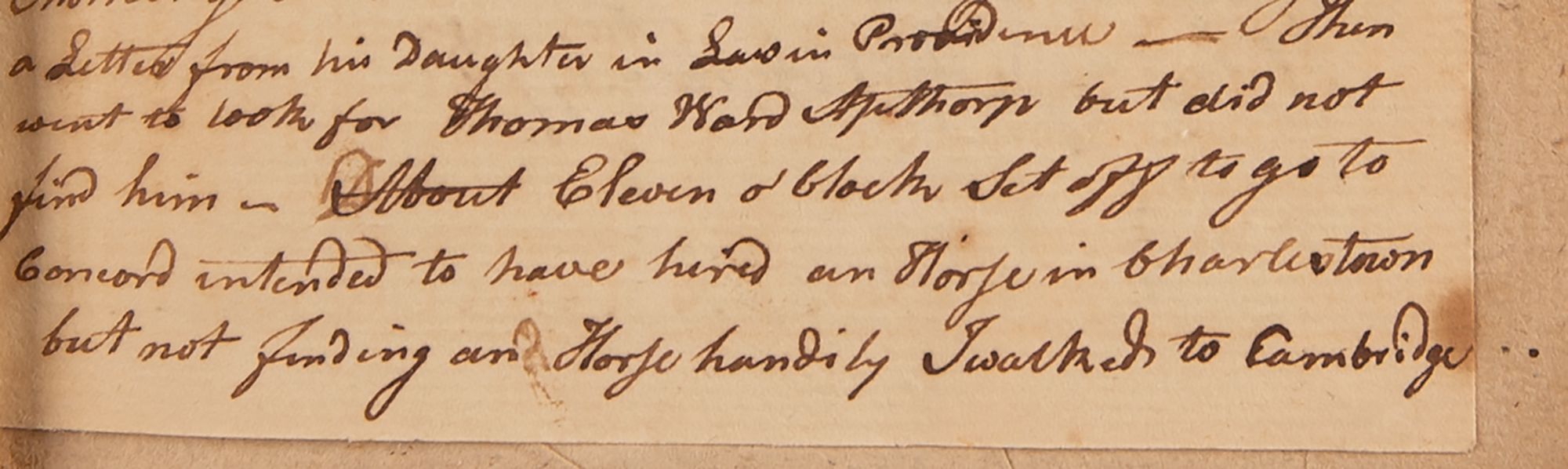
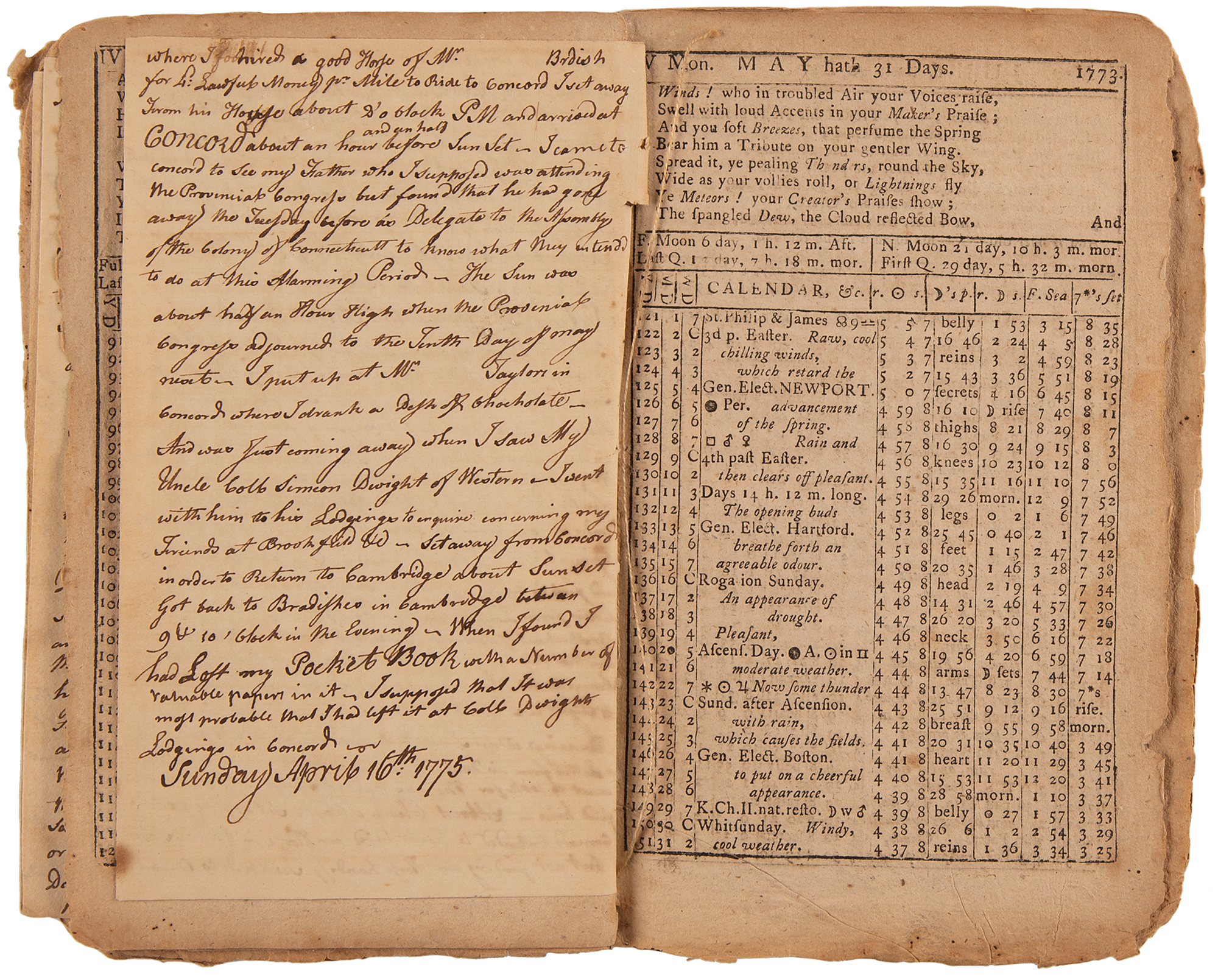
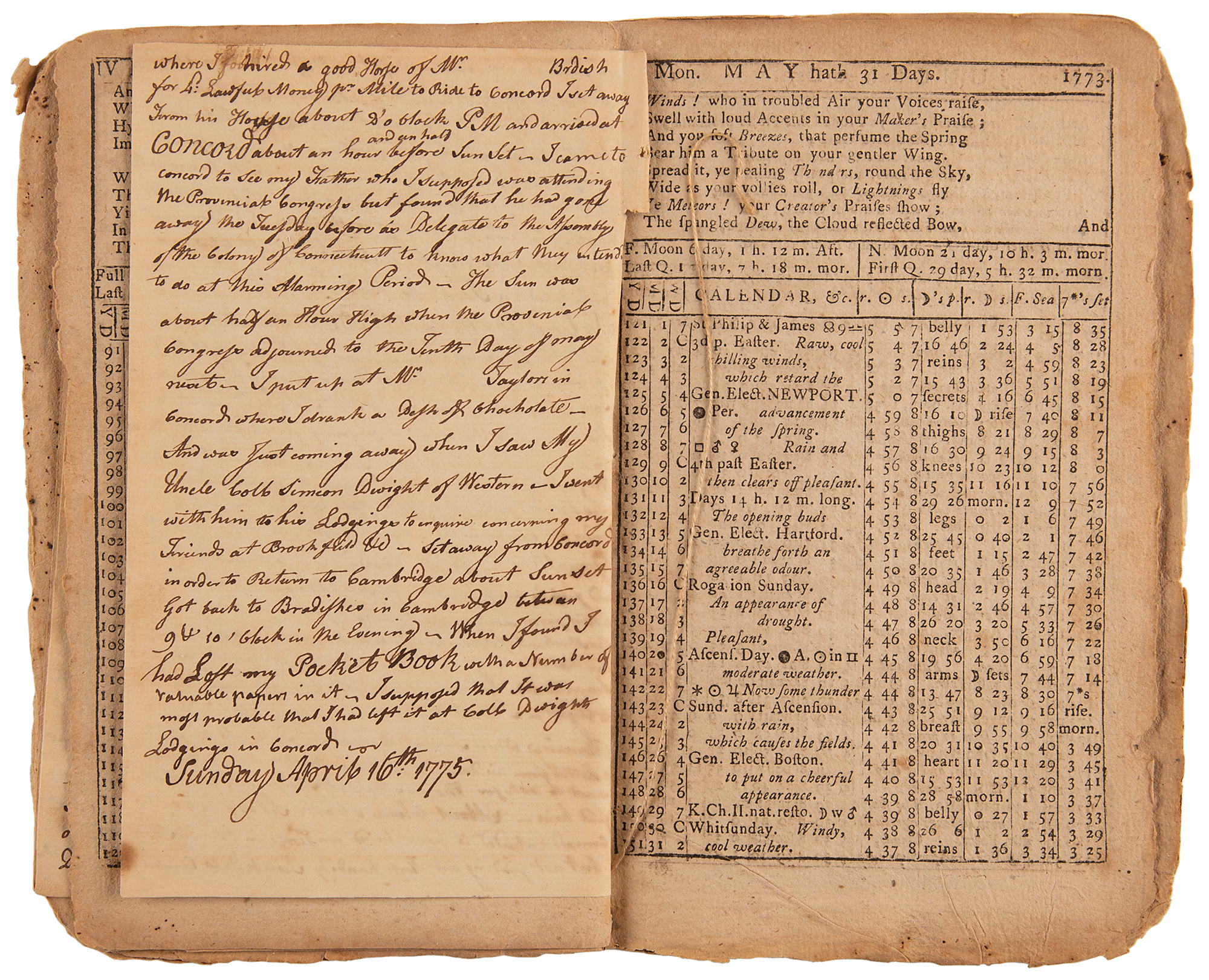
April 15, 1775: “This Morning Just after I was up I was informed by Mr Bracket that a large number of the Kings Troops had march'd Just before Into the Common Upon which Mr Allen & I went to the Common to see what was going forward. We found the Common under Arms. The 23d Regiment or Royal Welsh Futzileers and the 47th Regiment commanded by Lieutenant Colonel Nesbit - the Two Best Regiments under the Command of General Gage…About Eleven o'Clock Set off to go to Concord intended to have hired an Horse in Charlestown but not finding a Horse handily I walked to Cambridge where I hired a good Horse…I set away From his House about 2'o clock PM and arrived at Concord about an hour and an half before sunset. I came to Concord to see my Father who I supposed was attending the Provincial Congress but found that he had gone away the Tuesday before as a Delegate to the Assembly of the Colony of Connecticutt to know what they intend to do at this Alarming Period.”
The Battles of Lexington and Concord occurred on April 19, 1775, when British troops from Boston attempted to capture and destroy colonial military supplies in nearby Concord. The first shots were fired near sunrise at Lexington, where eight American militiamen were killed. The British continued to Concord, where 400 colonial militiamen engaged 100 British soldiers at 11:00 am. at the North Bridge, with casualties on both sides. After searching for military supplies, the British forces began their return march to Boston, but militiamen continued to arrive from surrounding towns and attacked the returning British forces with heavy fire, inflicting approximately 300 casualties on the British while suffering fewer than 100 casualties. The American militia then blockaded the narrow land accesses to Charlestown and Boston, beginning the siege of Boston.
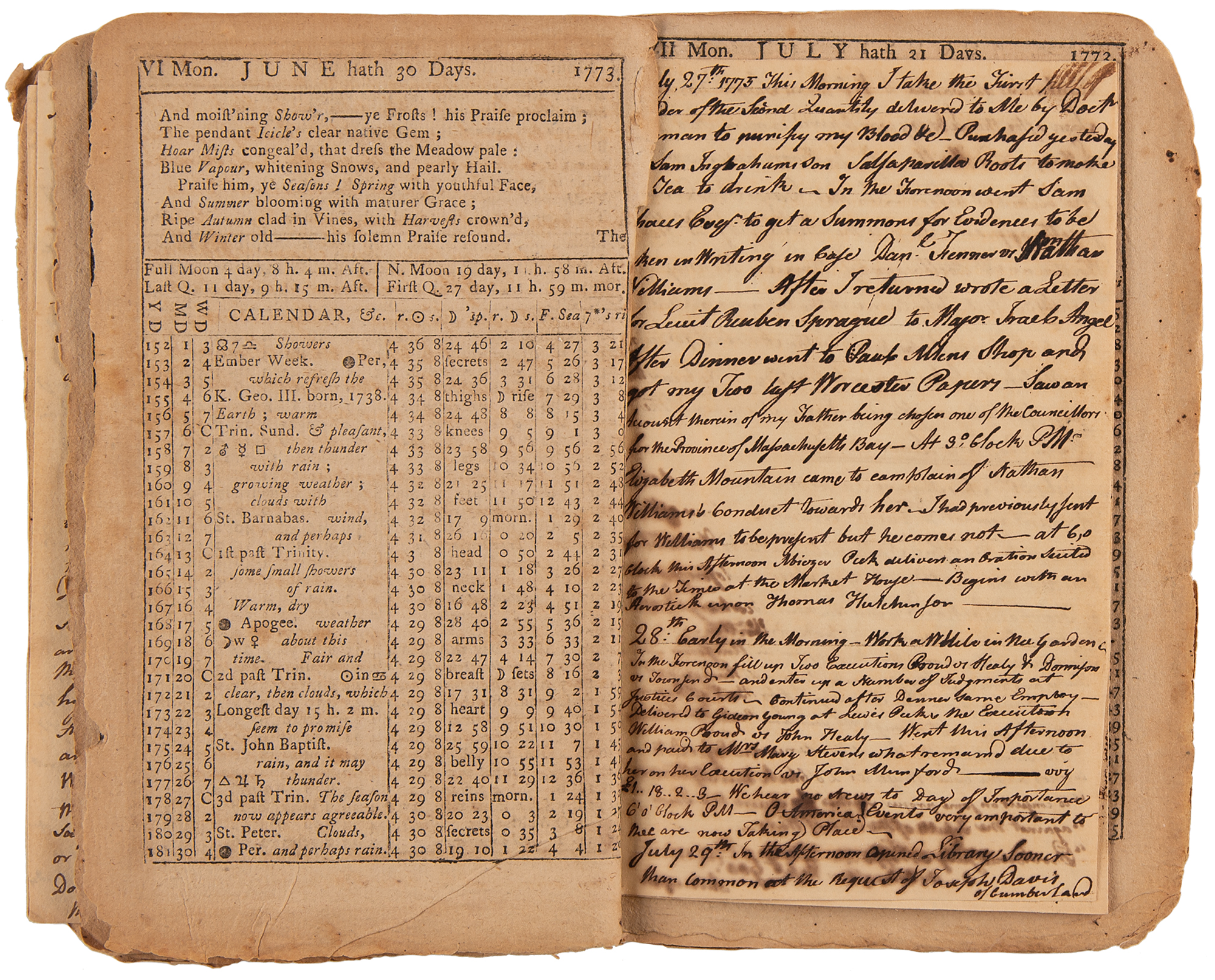
July 28, 1775: “O America! Events very important to thee are now Taking Place.”
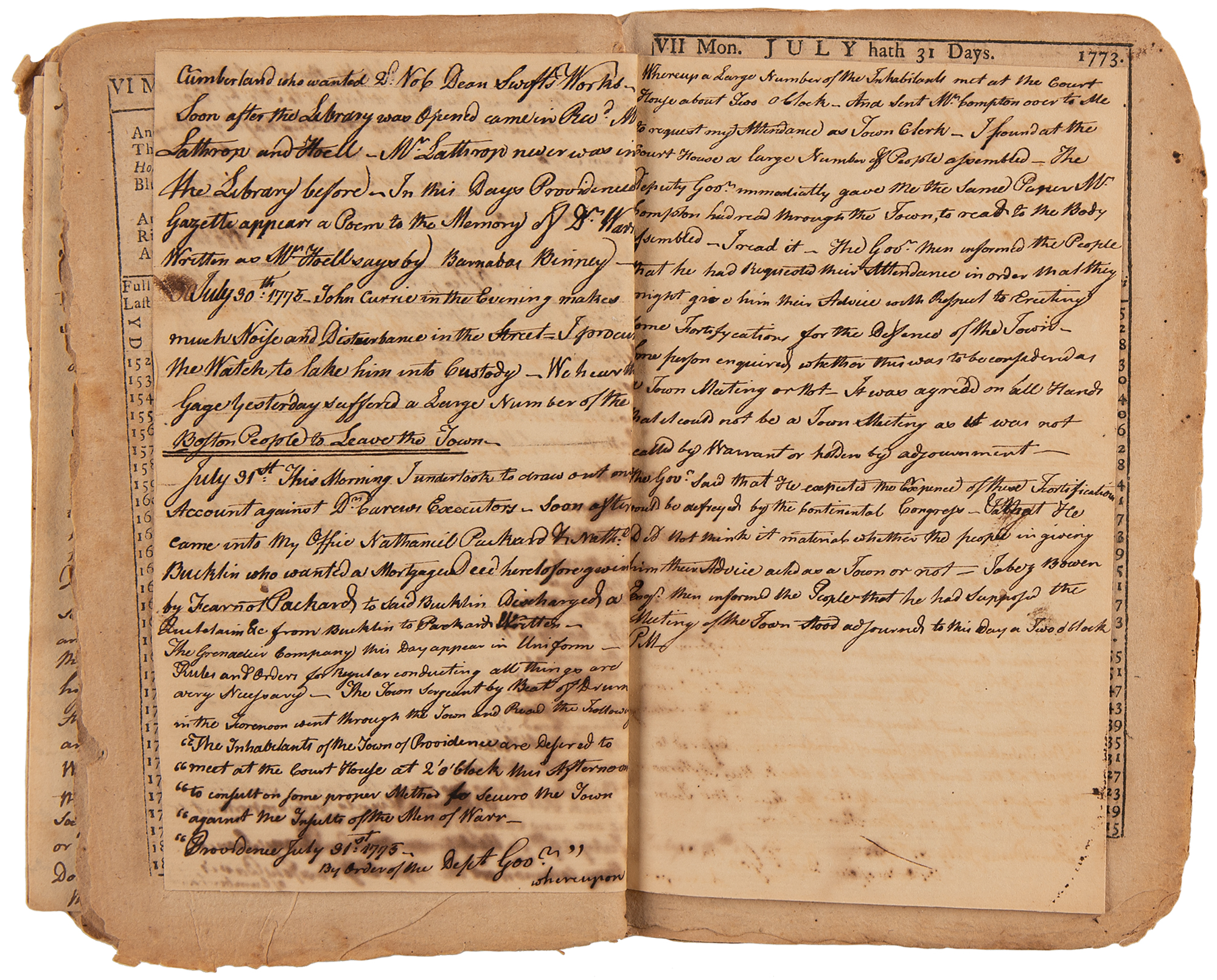
July 30, 1775: “We hear that Gage Yesterday suffered a Large Number of the Boston People to Leave the Town.”
July 31, 1775: “The Grenadier company this Day appear in Uniform. Rules and Orders for Regular conducting all things are very Necessary…The Govt then informed the People that he had Requested their Attendance in order that they might give him their Advice with Respect to Erecting some Fortifications for the Defence of the Town…The Govt said that He expected the Expence of these so called Fortifications would be defrayed by the Continental Congress.”
Almanacs produced an important revenue stream for colonial and Revolution-era printers. They also provided readers with essential information, including calendars, weather forecasts, planting dates for farmers, and information on tides. They often included additional reading material, local court sessions, travel distances, currency conversions, and other useful information, such as recipes and medical remedies. After the Bible, almanacs were the most widely purchased books in America, found in American households throughout the colonies and young nation in the eighteenth century.
The almanacs included with this collection are as follows (chronological):
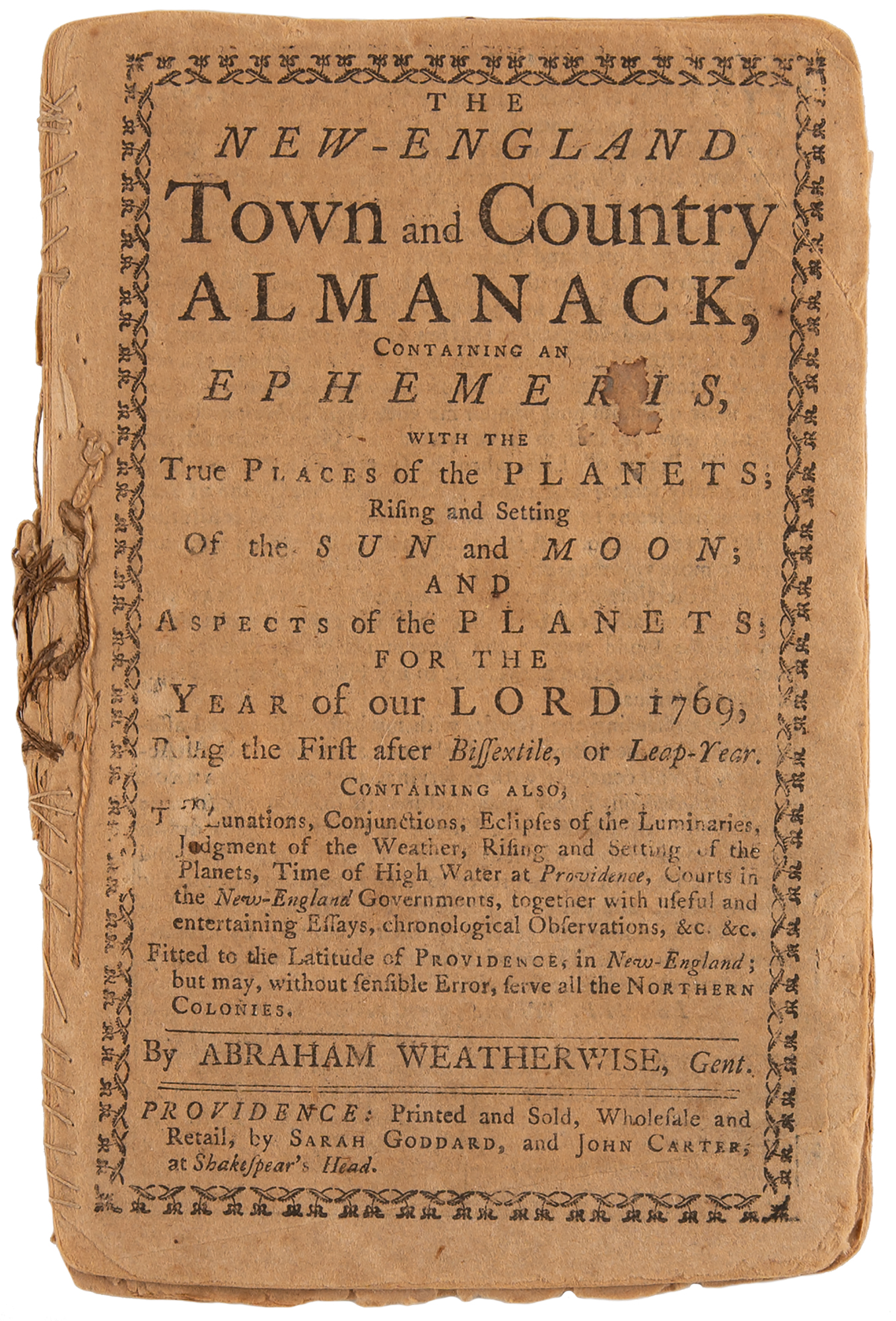
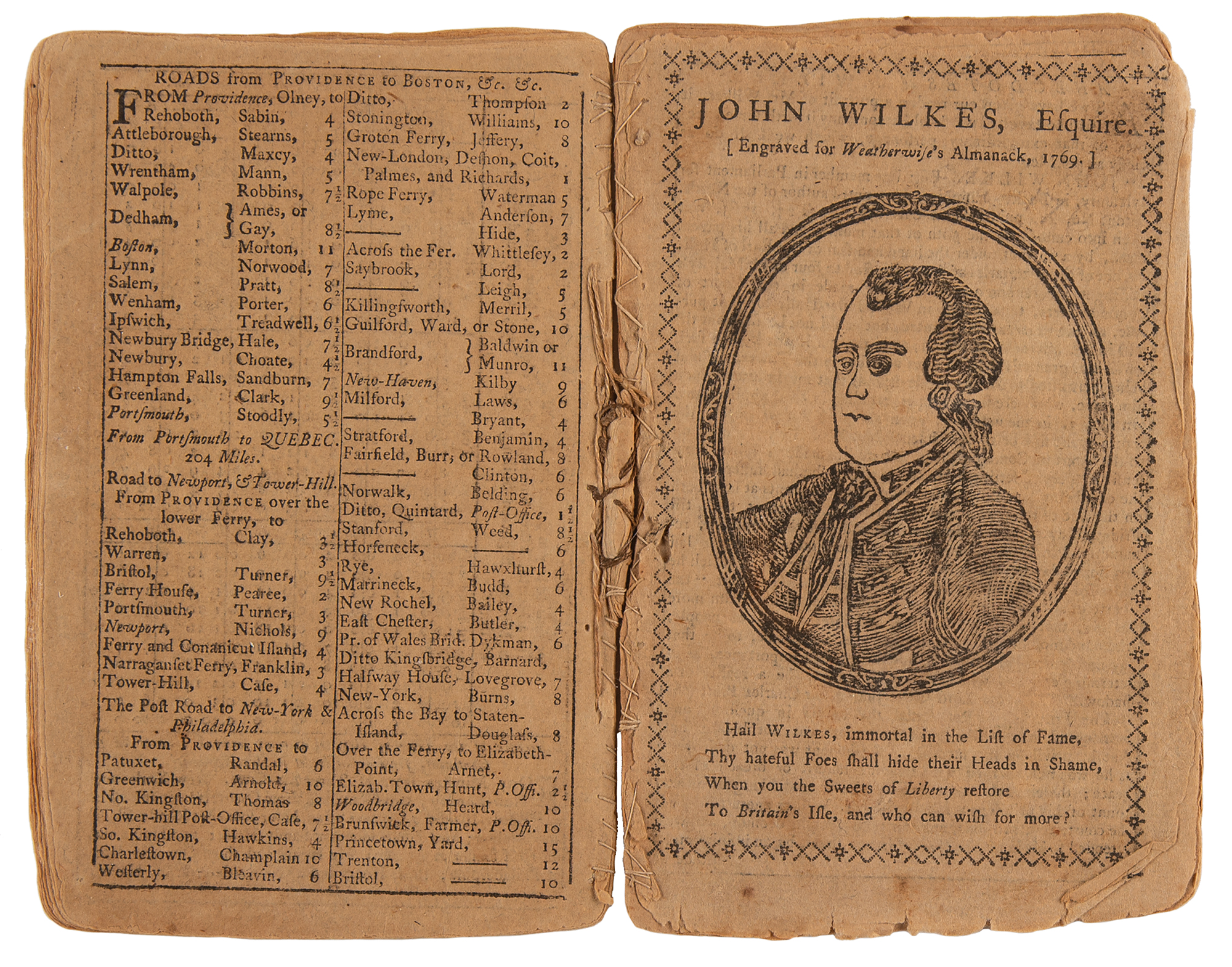
1769 – Abraham Weatherwise’s [Benjamin West] The New-England Town and Country Almanack, Containing an Ephemeris, with the True Places of the Planets; Rising and Setting of the Sun and Moon; and Aspects of the Planets; for the Year of our Lord 1769, Being the First after Bissextile, or Leap-Year. Providence, Rhode Island: Sarah Goddard and John Carter, [1768], 44 pages, 4.25 x 6.5, also contains almanac pages for 1768. Sewn on left side in two parts; general toning and some staining. Includes a woodcut engraving of British radical journalist and defender of American liberties John Wilkes and a three-page anecdote about Wilkes, as well as "a beautiful poetical Essay on Public Spirit, wrote by an American Patriot.”
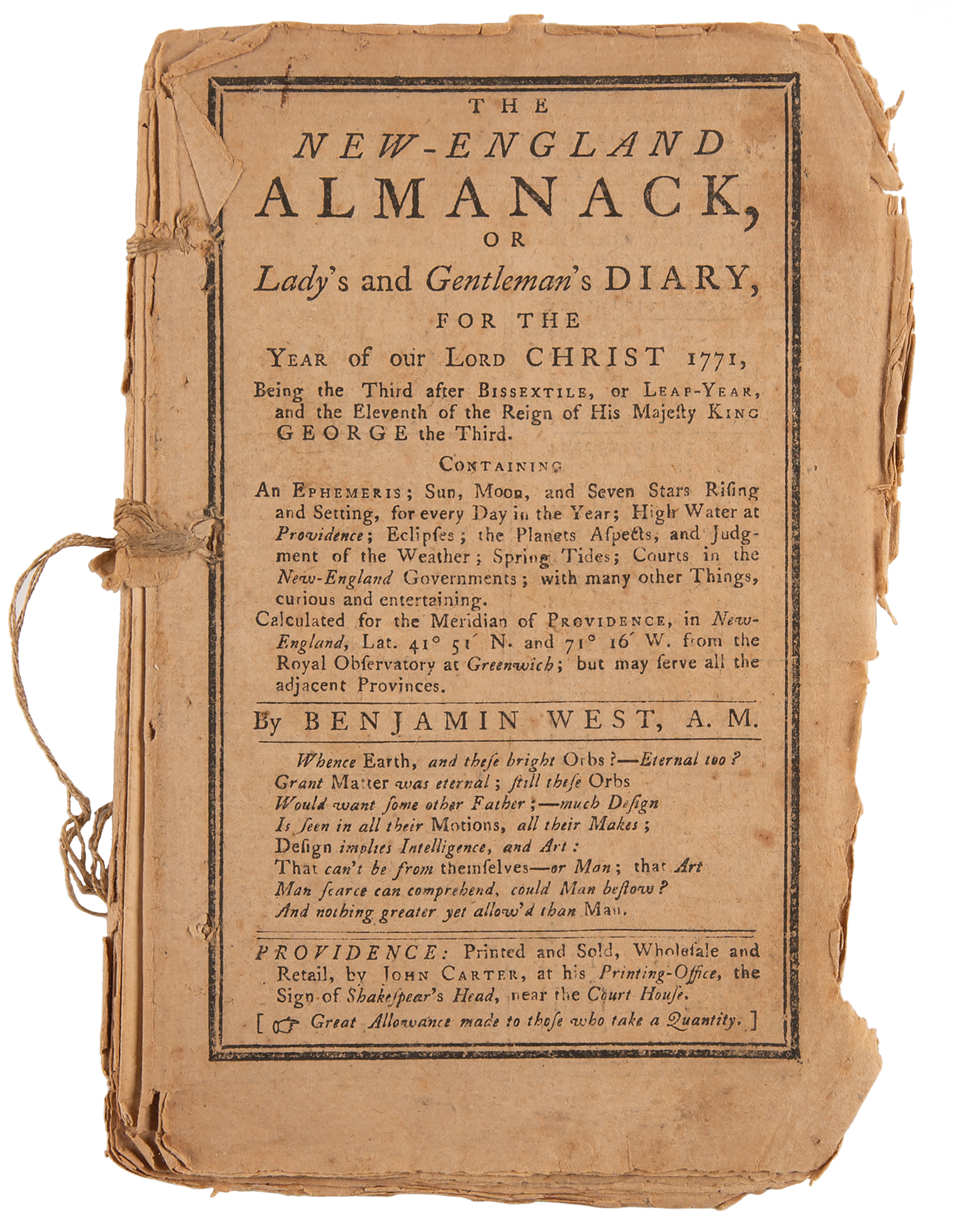
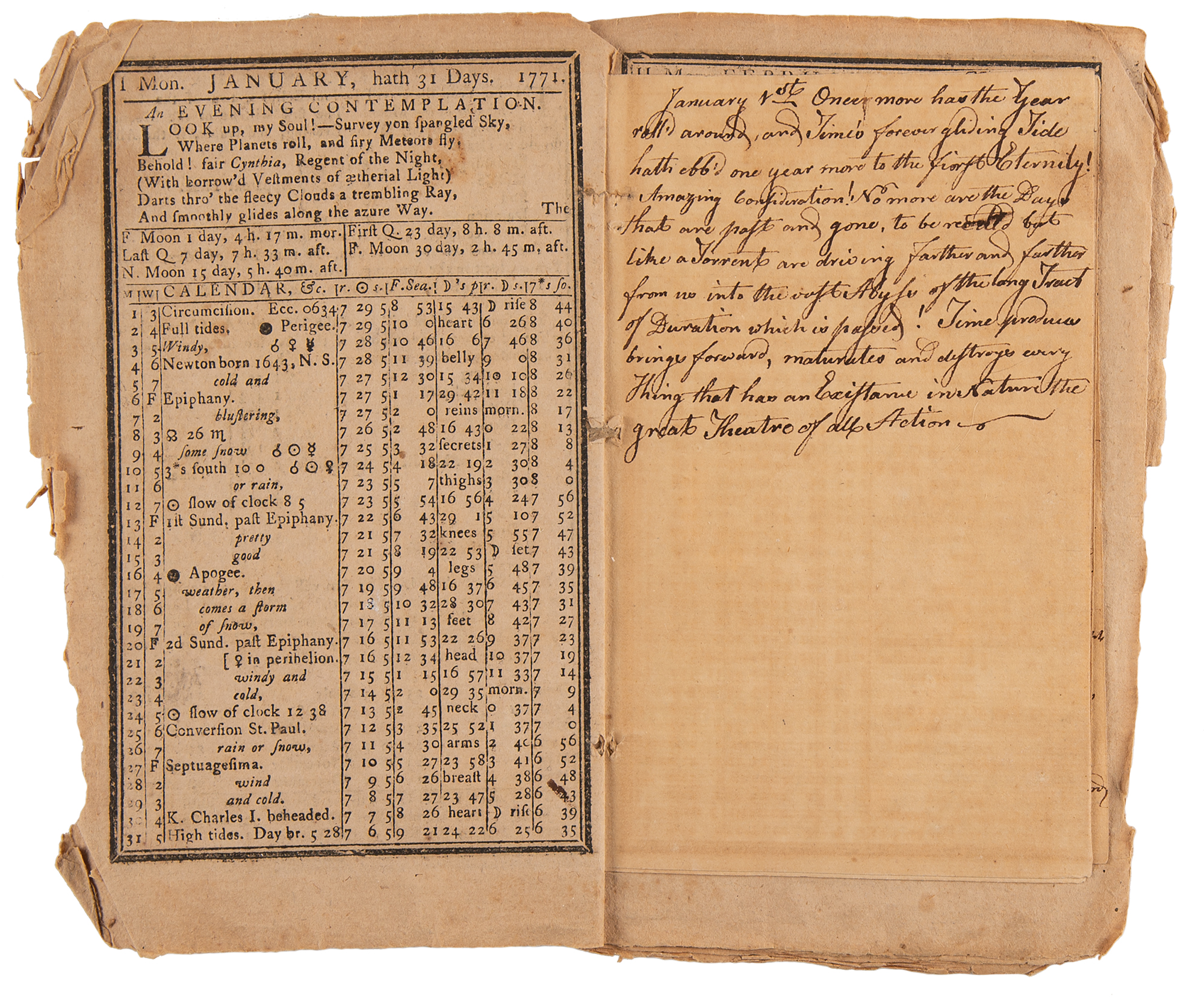
1771 – Benjamin West’s The New-England Almanack, or Lady's and Gentleman's Diary, for the Year of our Lord Christ 1771, Being the Third after Bissextile, or Leap-Year, and the Eleventh of the Reign of his Majesty King George the Third. Providence, Rhode Island. John Carter, 1770, 16 pages, 4.75 x 7, with 46 interleaved manuscript pages, 20 of which are blank.
1773 – John Anderson’s Anderson Improved: Being an Almanack, and Ephemeris, For the Year of Our Lord 1773: Being the First after Bissextile, or Leap Year: Calculated for Newport, Rhode Island. Newport, Rhode Island: Solomon Southwick, 1772, 38 pages, 4.75 x 7, with 10 interleaved manuscript pages discussing historical events of 1775. Sewn on left margin; scattered staining, general toning.
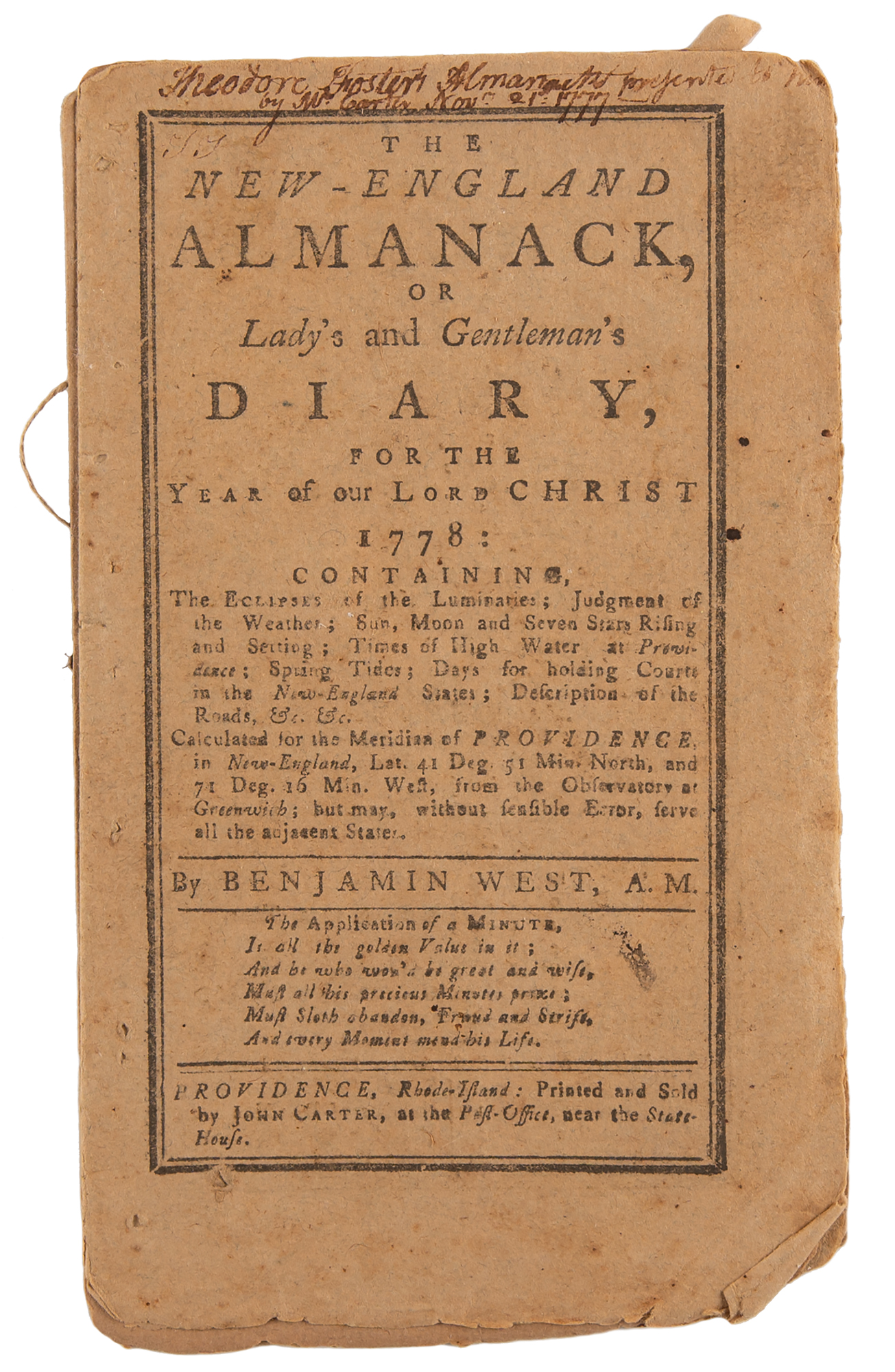
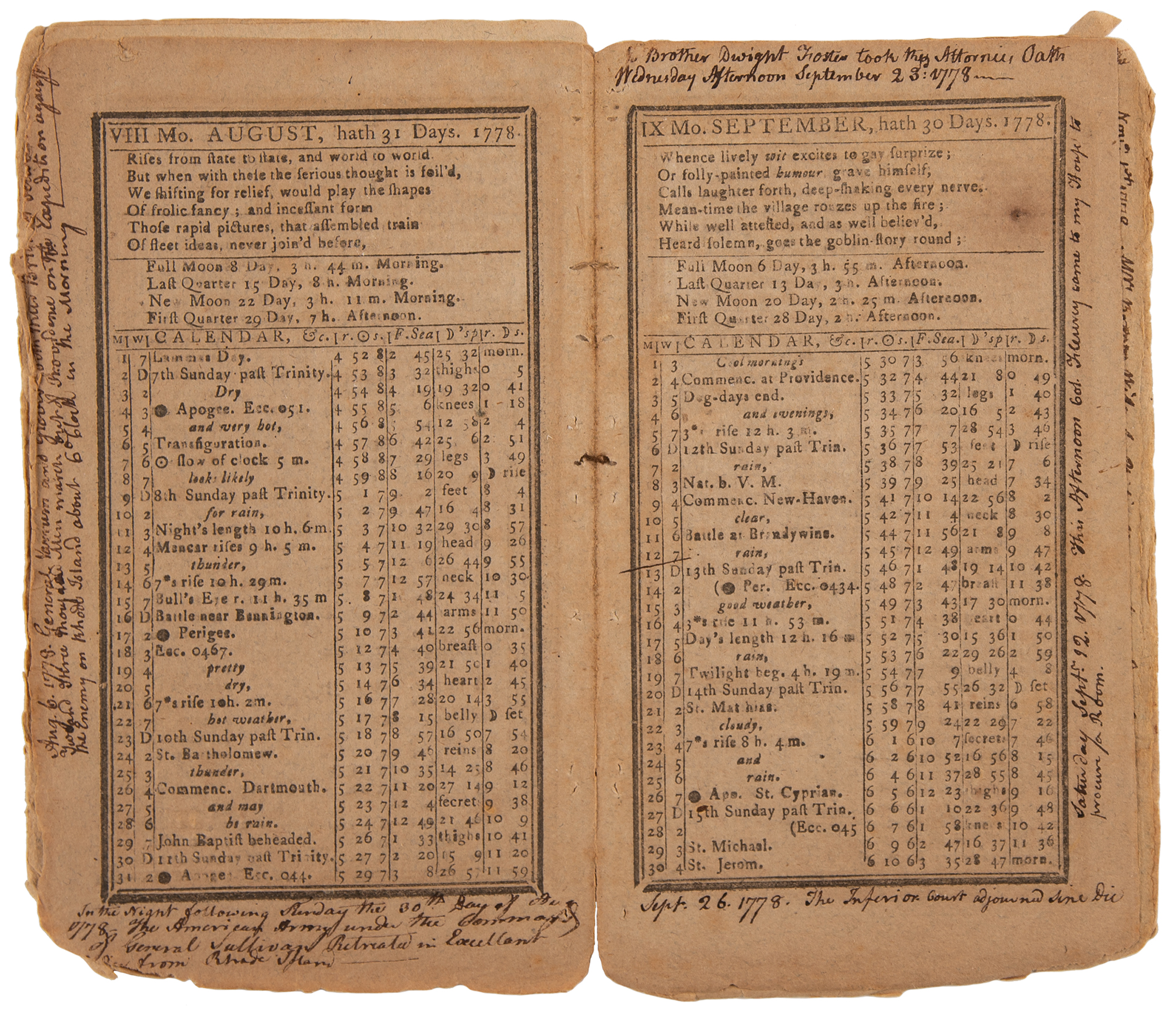
1778 – Benjamin West’s The New-England Almanack, or Lady's and Gentleman's Diary, for the Year of our Lord Christ 1778. Providence, Rhode Island: John Carter, 1777, 12 pages, 4.25 x 7.25, with Foster’s handwritten notes inner margins, which read, in part: “Aug. 6. 1778 General Varnum and Glover with their Brigade…Two and Three thousand Men march out of Providence on the Expedition against the Enemy on Rhode Island about 6 o'Clock in the Morning." Some edge tears; general toning, and scattered staining.
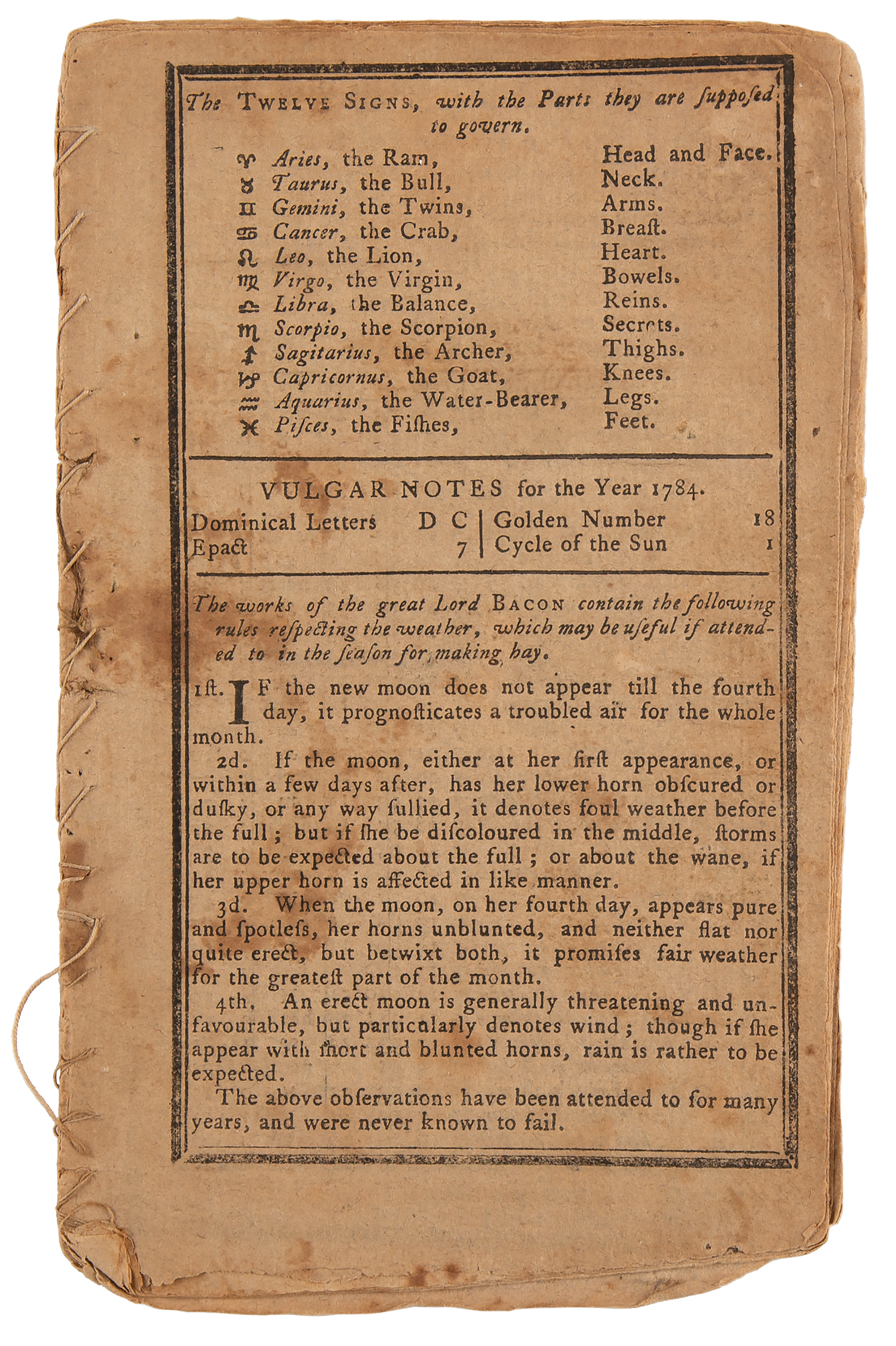
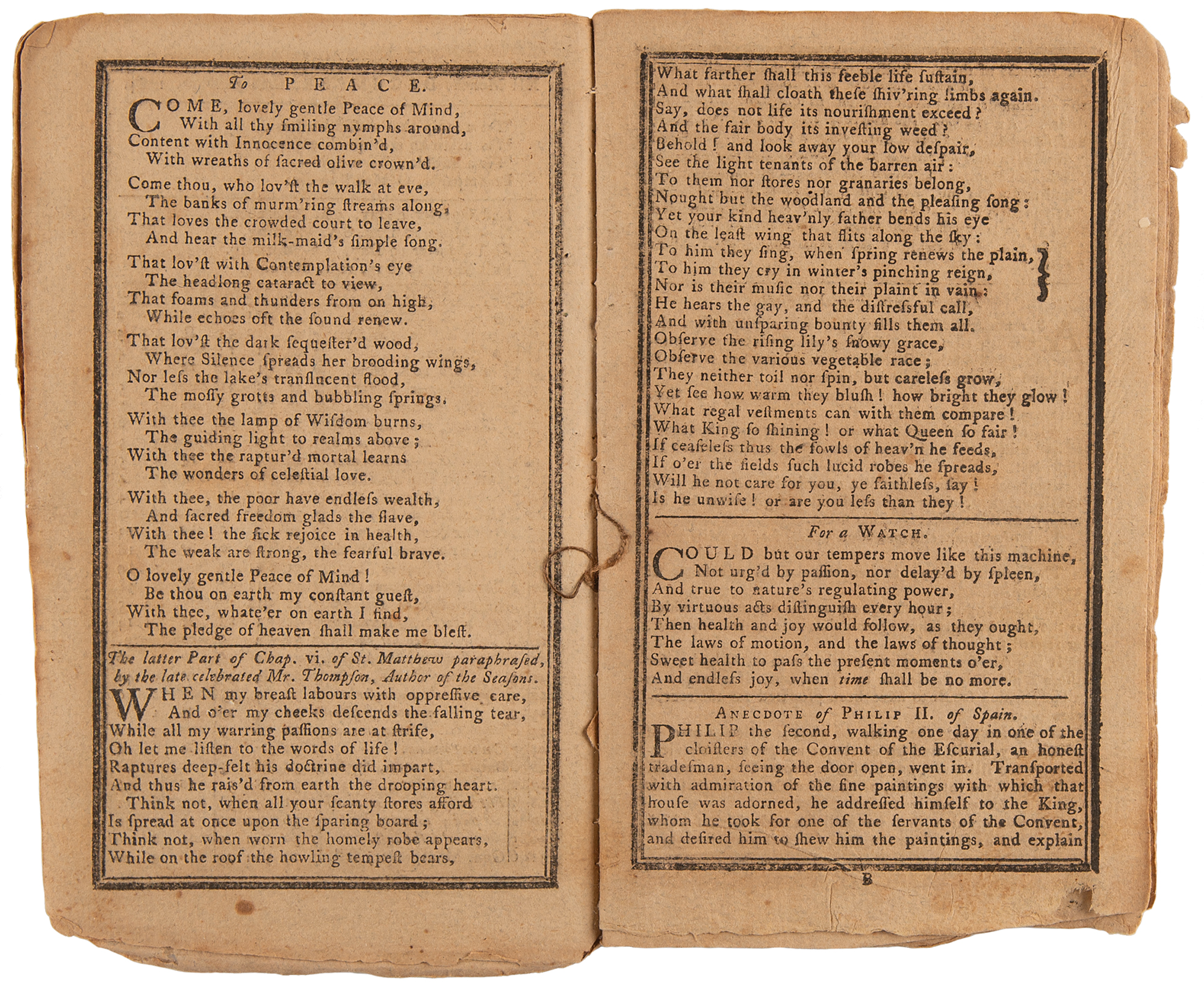
1784 - Unidentified almanac sans covers, [Rhode Island] 24 pages, 4.25 x 7, which includes the poems, ‘On Happiness,’ ‘The Curse of Avarice,’ and ‘On Time,’ above monthly calendars. Also includes ‘To Peace,’ ‘For a Watch,’ ‘Anecdote of Philip II of Spain,’ ‘Thoughts on Several Subjects,’ and other pieces. Sewn on left margin; general toning; scattered staining.
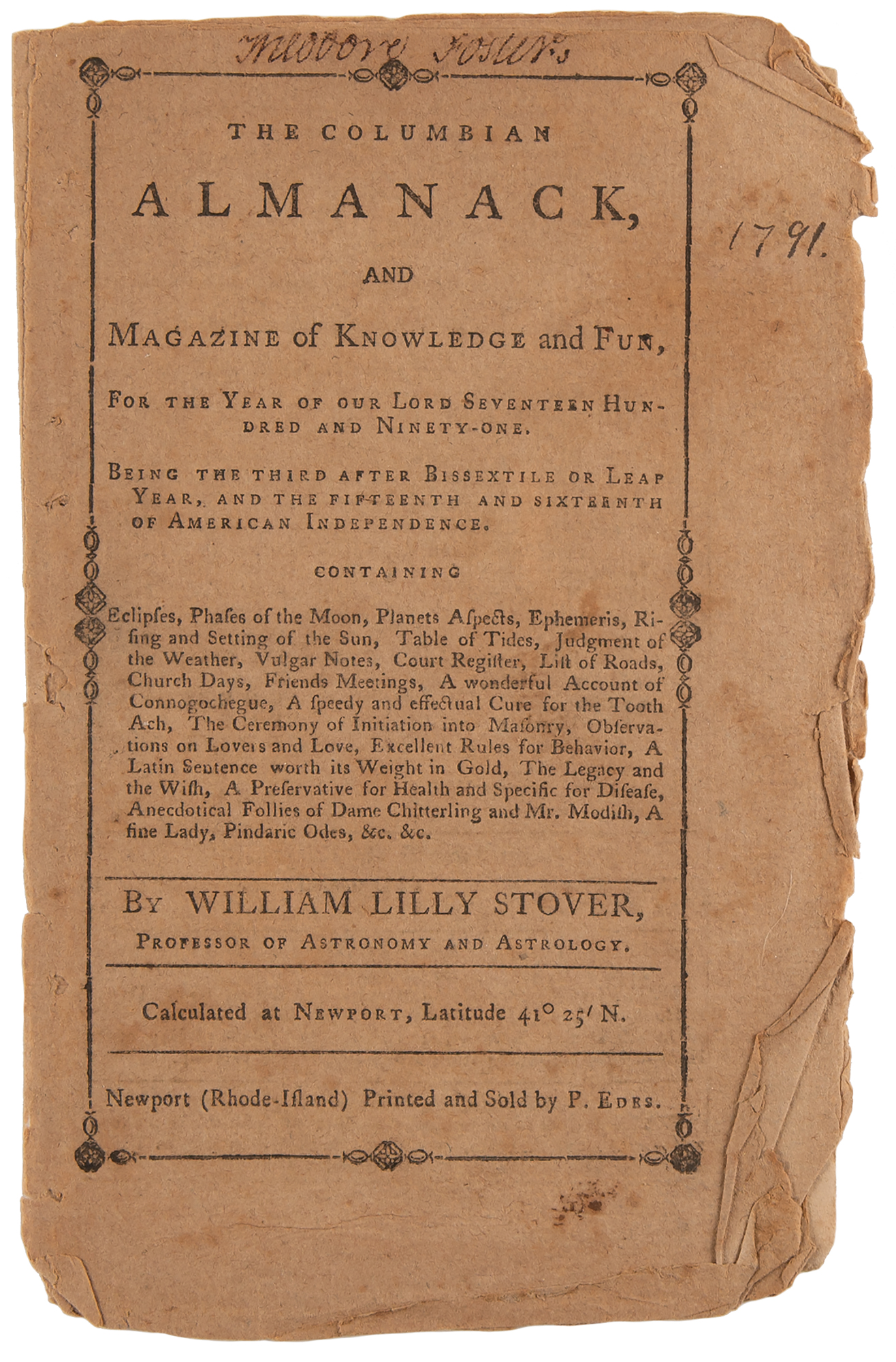
1791 – William Lilly Stover’s The Columbian Almanack, and Magazine of Knowledge and Fun, For the Year of Our Lord Seventeen Hundred and Ninety-One. Being the Third after Bissextile or Leap Year, and the Fifteenth and Sixteenth of American Independence. Newport, Rhode Island: P. Edes, 1790, eight pages (incomplete, February to April only), 4.5 x 7, with four interleaved manuscript pages (now loose), which read: "Saturday, January 1st 1790. Another year has elapsed-and a new one has commenced. The last year has been highly important to me. It has seen me brought into a conspicuous Station. Twice honored with the Suffrages of the Legislature of the State to which I belong by them I am called to Act in the National Legislature. May My Conduct through Life be such as to meet the Approbation of the Good & Virtuous and the Applause of my own conscience." Edge tears; general toning.
Theodore Foster (1752-1828) was born in Brookfield, Massachusetts, as the son of Judge Jedediah Foster and Dorothy Dwight. He graduated from Rhode Island College in 1770, studied law, and settled in Providence, entering into practice with his brothers Dwight and Peregrine Foster. He was elected town clerk of Providence in 1775 and served through 1787. Though he did not serve in the Army during the Revolution, he did serve as Secretary on the Rhode Island Council of War. He also became a close associate of former governor Stephen Hopkins, who taught the younger man about the early history of the colony and gave him a considerable collection of original manuscripts.
In 1788, Foster became notable as a leading advocate of ratification of the U.S. Constitution. Upon its ratification in 1790, one of the new state's first acts was the election of Foster as Senator. An active Federalist and supporter of George Washington, he served in the senate until retiring in 1803 to his estate in Foster, R.I., which had been named in his honor in 1781. There he and his college classmate Dr. Solomon Drowne found, in the words of Foster's biographer, ‘abundant scope for the gratification of their literary and classical predilections.’ He devoted much of his time to collecting source material on the history of Rhode Island, either in the original or through his own transcriptions. In 1822, he was instrumental in the founding of the Rhode Island Historical Society. Though his extensive notes were never published in his lifetime, his efforts still had an enormous impact on the historiography of the state.

