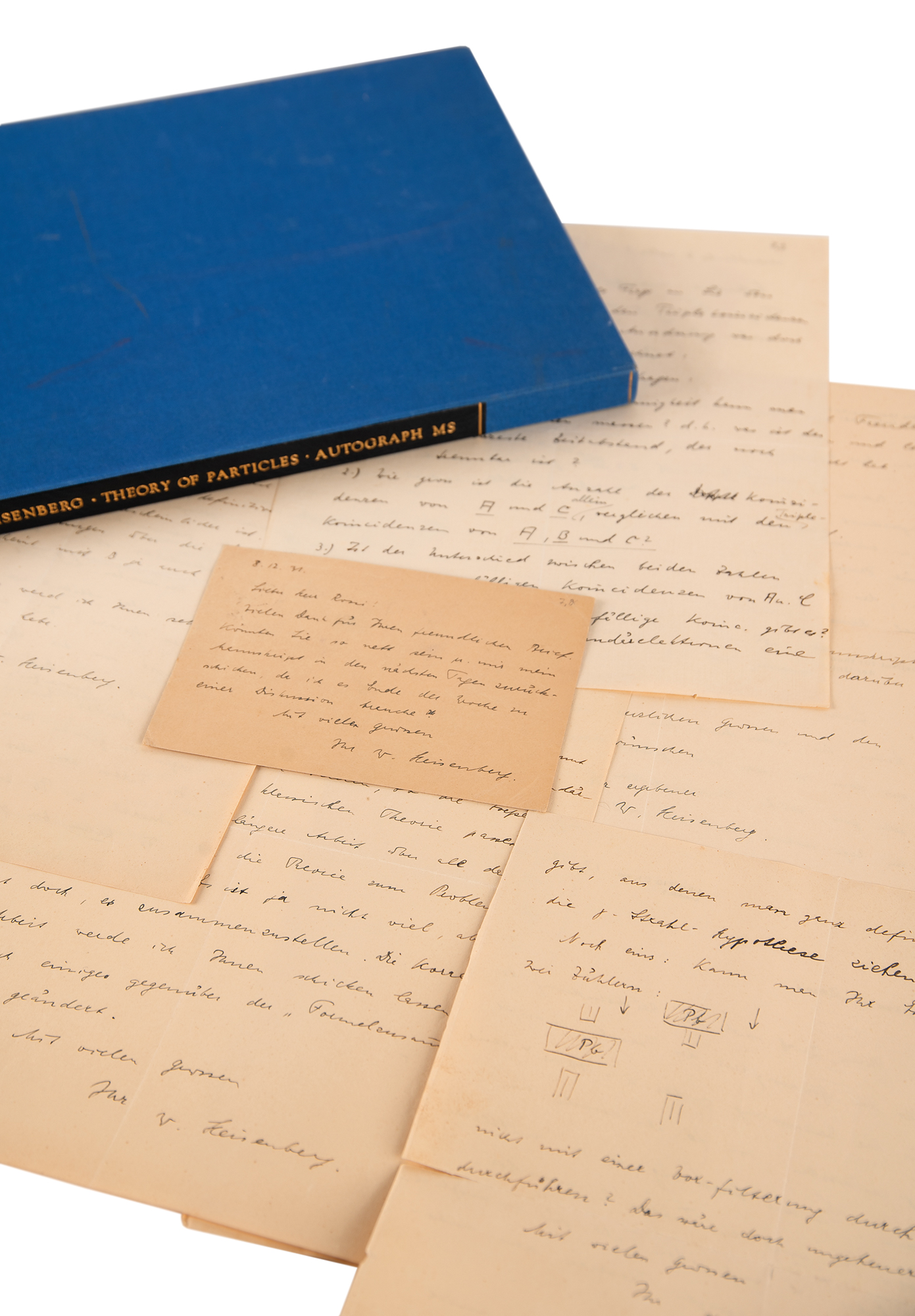
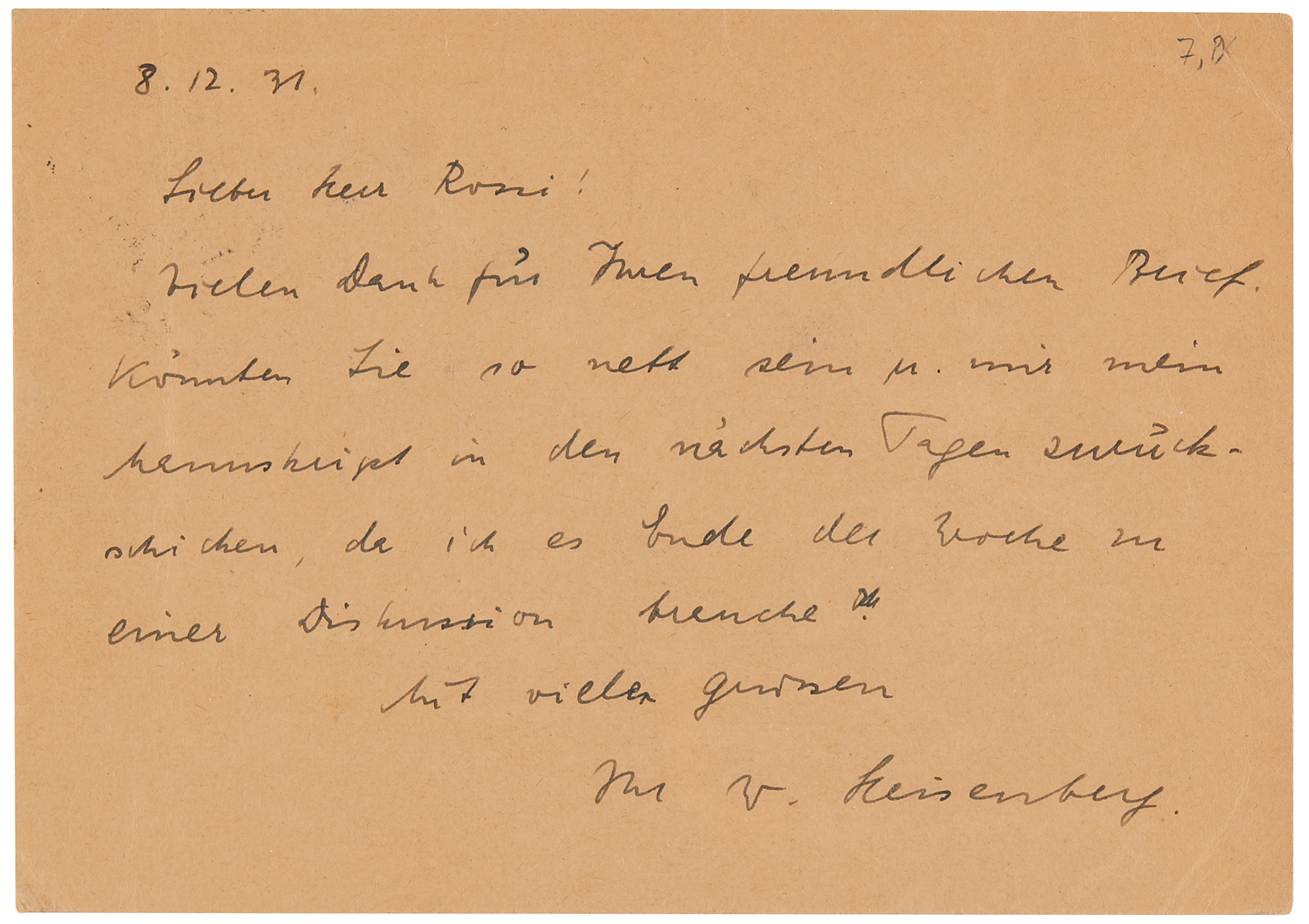
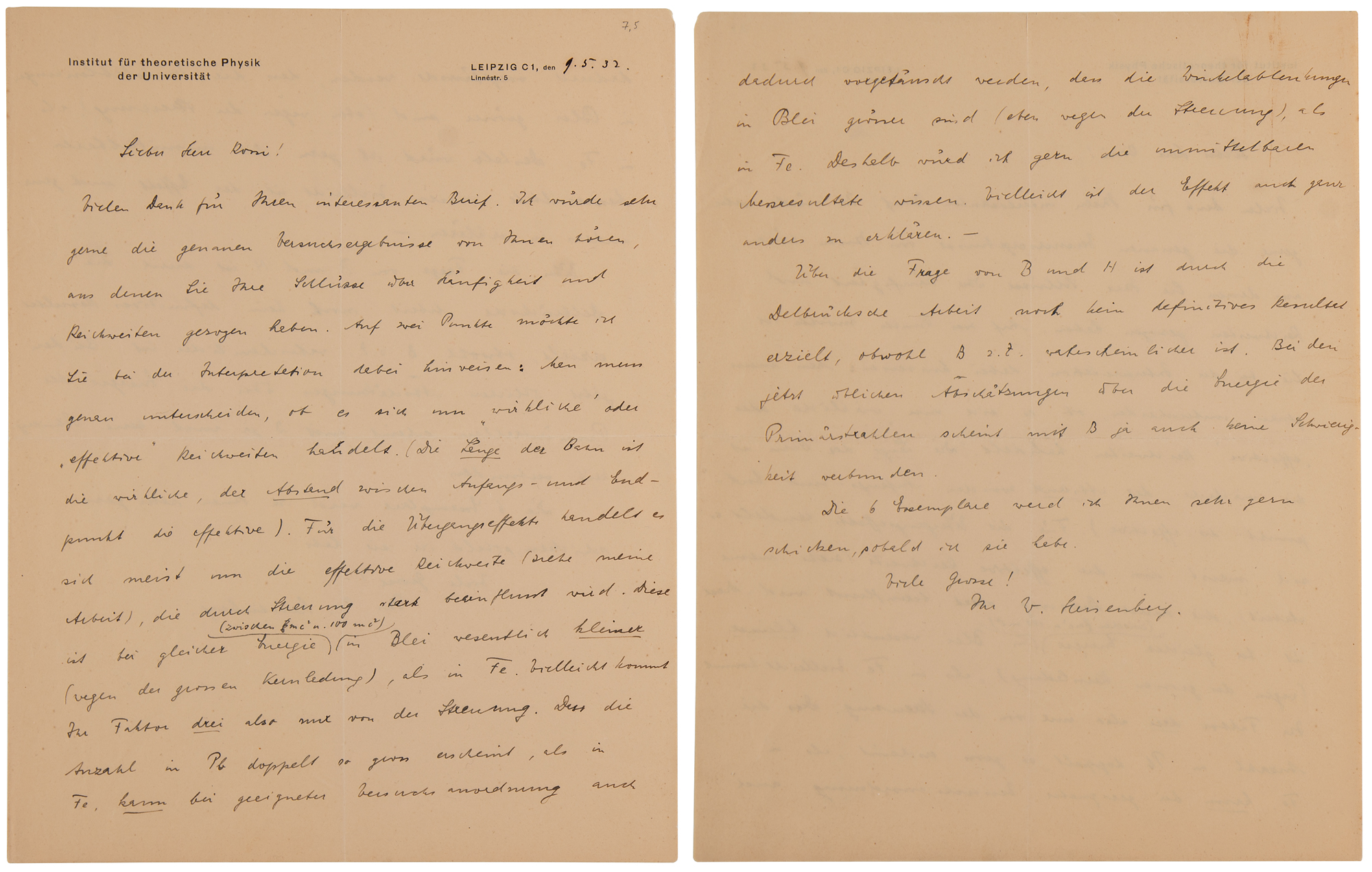
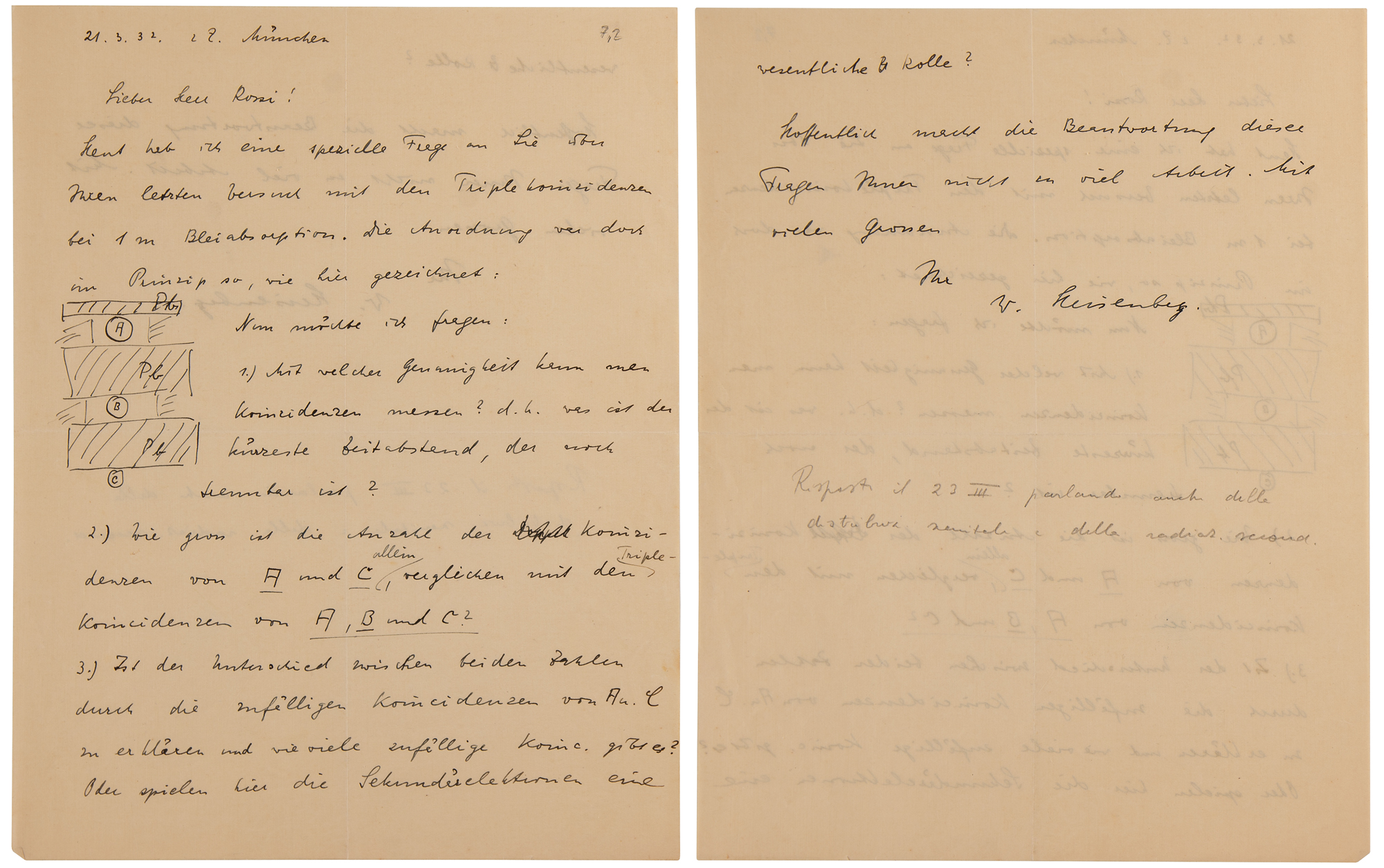
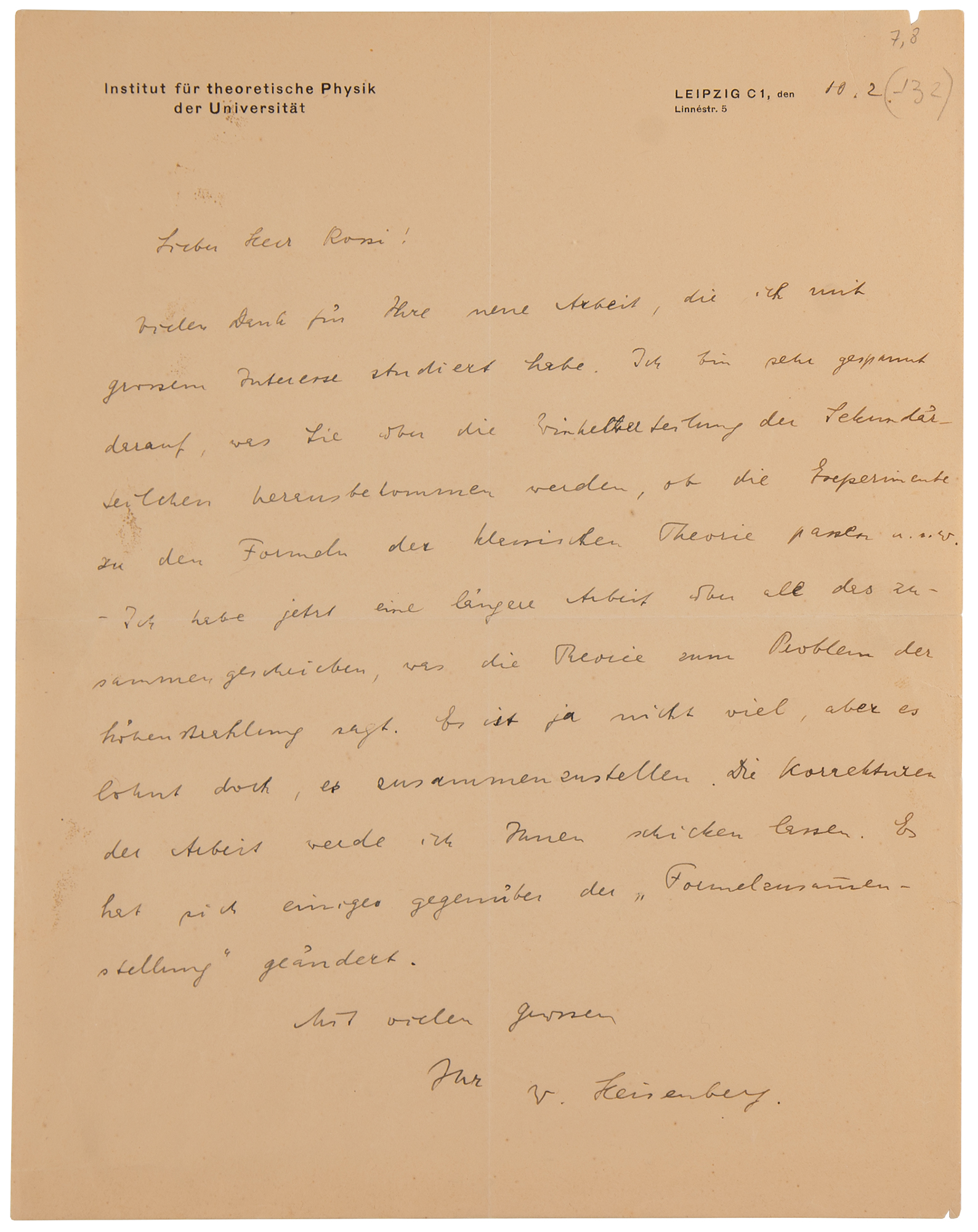
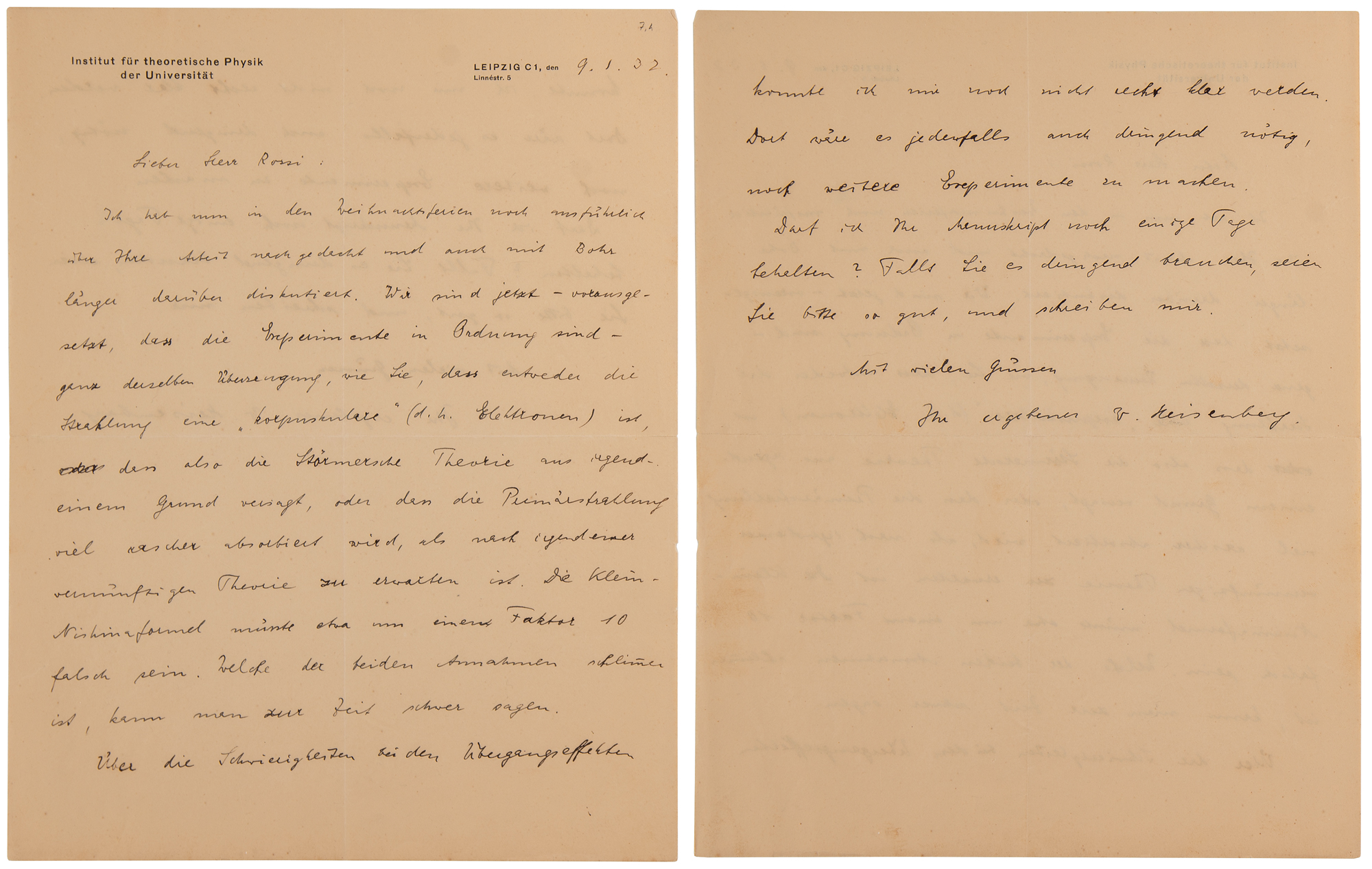
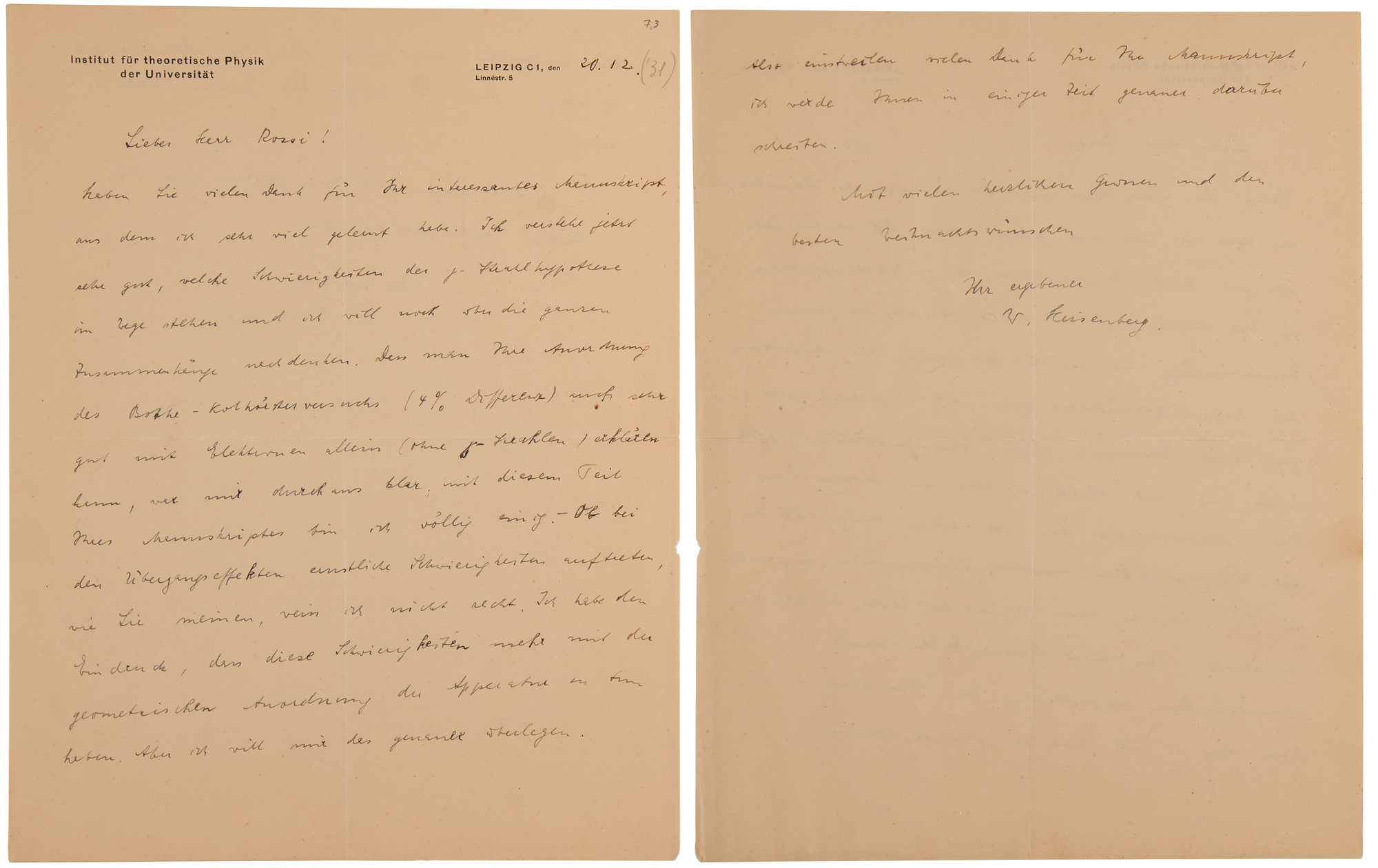
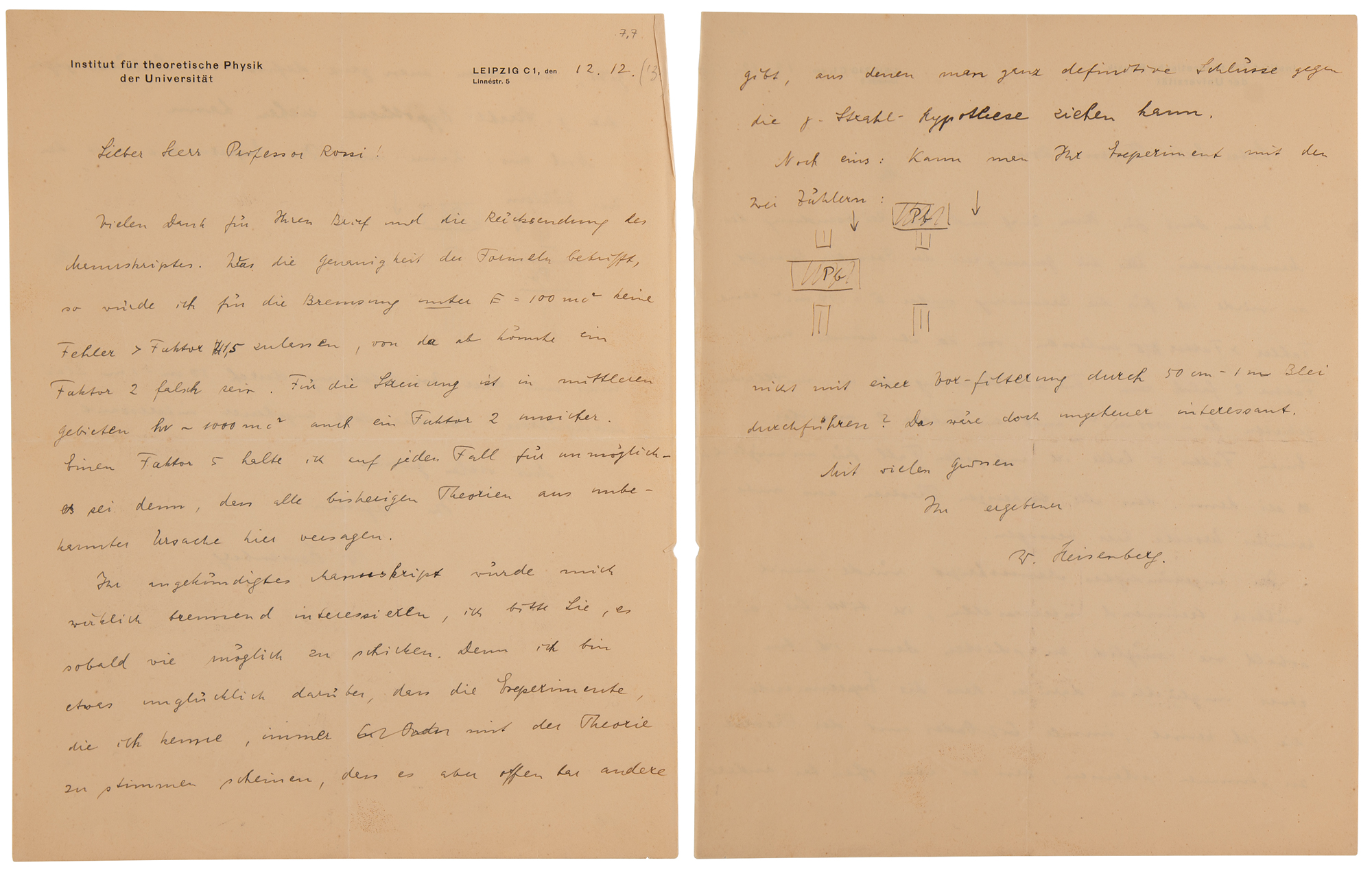
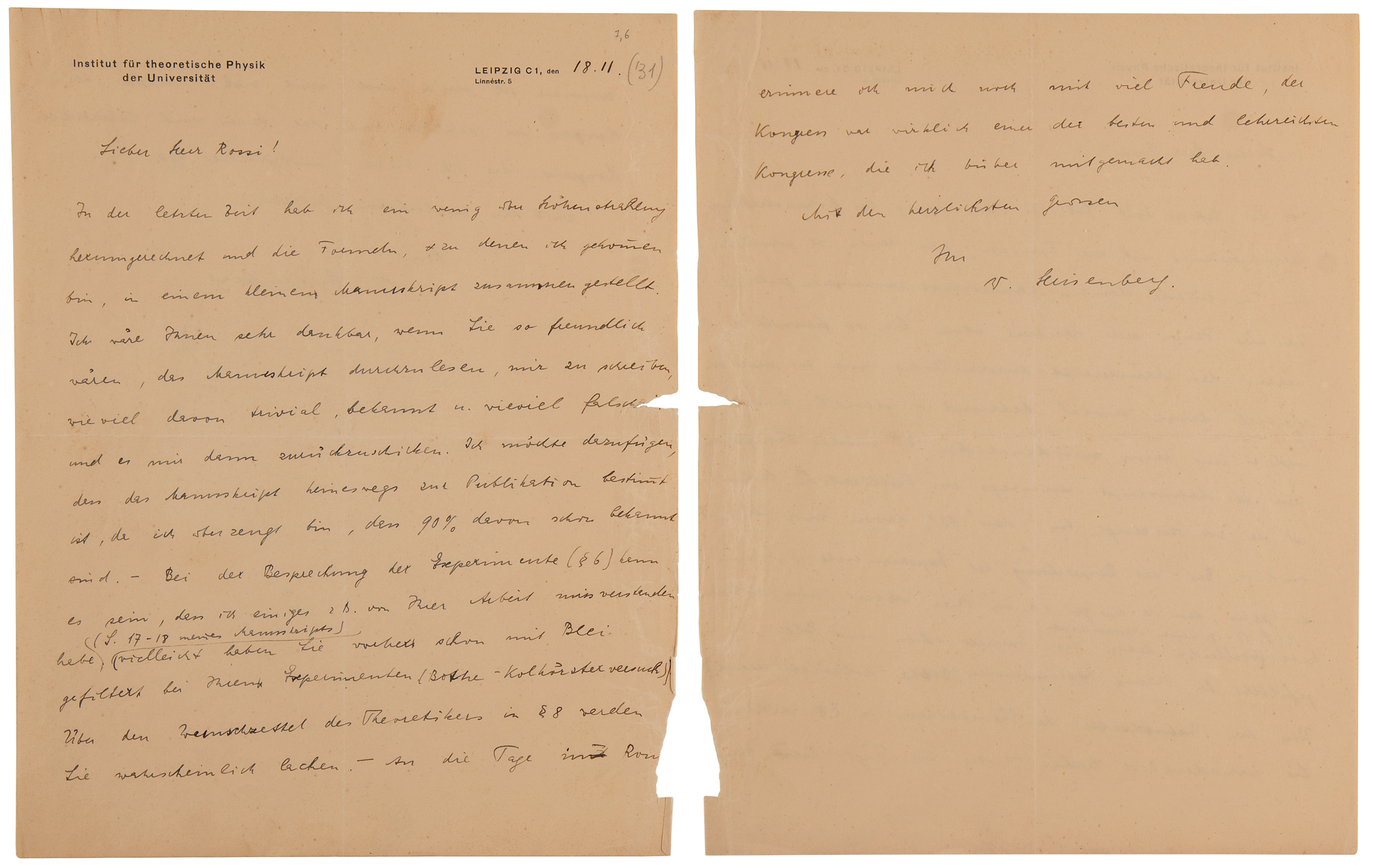
Archive of nine ALSs in German, all signed "W. Heisenberg," totaling sixteen pages on nine sheets (including eight on letterhead of the Institut fur theoretische Physik, Leipzig, and one on a postcard), dated from November 18, 1931 to May 9, 1932. Heisenberg writes to fellow physicist Bruno Rossi concerning Rossi's experimental work on cosmic rays. This important suite of scientific letters evidences Heisenberg in the process of conceiving a new science of cosmic radiation, and his contributions to Rossi's work; notably, two letters feature sketched diagrams of Rossi's experimental devices. Additionally includes three ALSs from Rossi to Heisenberg, dated 1930 and 1932.
Written while Bruno Rossi was performing his pioneering research into cosmic rays, these highly technical letters offer a contemporaneous reporting—and high-level running commentary—on the emerging results and implications of Rossi’s experiment. Prior to Rossi’s experiment almost nothing was known about cosmic radiation; but using a new mode of tracking device (“coincidence detector”) of his own invention, Rossi was able to determine the velocity, strength, and composition of cosmic rays for the first time. And very significantly and unexpectedly, Rossi discovered that the collision of high-energy cosmic rays could trigger a cascade (“shower”) of subatomic particles when they collided with matter in earth’s atmosphere—a discovery of the greatest import for the development of modern physics.
Heisenberg opens the correspondence by saying that he has been “doing some calculations concerning cosmic radiation recently” and asking Rossi if he would look at his “little manuscript.” Soon thereafter, Heisenberg indicates interest in seeing Rossi’s own manuscript about the experiment; and a number of subsequent letters communicate Heisenberg’s critique of Rossi’s document, with Heisenberg writing: "Many thanks for your interesting manuscript; I learned a lot from it. I now understand very well, what difficulties stand in the way of the j-ray hypothesis. I still want to think over all the implications of the fact, that adjustment of the Bothe-Kolhörster experiment (4% difference) can explain [its results] very well with electrons alone (without j-rays); this was quite clear to me, and I’m in complete agreement with this part of your manuscript."
In the critical central letter of the series (January 9, 1932), Heisenberg indicates that he has discussed cosmic rays with Neils Bohr and states that “we’re both now completely convinced, like you, either that the radiation is “corpuscular” (i.e. electron) and that Störmer’s theory fails for some reason, or that the primary radiation is absorbed much more quickly than one would expect from a reasonable theory. The Klein-Nishina formula would have to be wrong by a factor of about 10.”
In one of the final letters, Heisenberg indicates that he has just completed “a longish piece on all the theory about the problem of cosmic radiation”—undoubtedly a reference to his own field-defining 1932 article “Theoretical Reflections on Cosmic Rays,” the foundational work for the new science of cosmic radiation.
Heisenberg was actively involved in cosmic ray research throughout the 1930s, and he approached the field from a wide range of perspectives over the decade. At this early date of his work with cosmic rays, Heisenberg’s interest in the subject was strongly motivated by recent developments in relativistic quantum theory; and most specifically, by Dirac’s theoretical prediction of the reality of antimatter. Insofar as cosmic rays afforded the only then-available means to observe and test the behavior of high-energy quanta, Heisenberg thought that the study of high-energy cosmic rays could materially aid the discovery of antimatter’s existence. And indeed it was only a few short months after these letters were written that the existence of antimatter (in the form of a 'positive electron,' i.e. positron) was empirically discovered in the cascading particle showers caused by cosmic ray collisions.
Heisenberg’s work with cosmic rays essentially defined the future direction of his scientific efforts. Rossi’s discovery of collision-based particle showers ushered in a 'golden age' of particle discovery and prompted the necessity to unify the diverse 'particle zoo' revealed by collision techniques. Rising to the challenge, Heisenberg formulated S-Matrix theory, a critical tool for constructing a unified theory of matter. Somewhat similar in concept to the revolutionary matrix techniques Heisenberg introduced into Quantum Mechanics in 1925 (for which he was awarded the Nobel Prize), S-Matrix theory provides a mathematical framework for characterizing the quantum states of particles and for describing the probability of their interaction and scattering. Extensively used to test hypotheses about the nature of matter and to study the properties of subatomic particles (including mass, spin, and charge), S-Matrix theory has found widespread application throughout physics, ranging from the study of condensed matter to quantum gravity.
This exceptional suite of letters chronicles one of the most significant experiments of the 20th century. Heisenberg’s letters evidence the significant—and apparently little-known—role Heisenberg played in both the theoretical and practical aspects of the experiment (including his diagrammatic suggestions for modifying Rossi’s coincidence detector). Heisenberg’s work with Rossi and cosmic rays ultimately paid big dividends for physics: Heisenberg’s S-Matrix theory was designed to replace local quantum field theory as a basis for elementary particle physics; and the theory was highly influential in the 1960s, aiding the development of an organized view of the structure of matter and laying the foundation for String Theory. In overall fine condition, with some light creasing and short edge tears.

