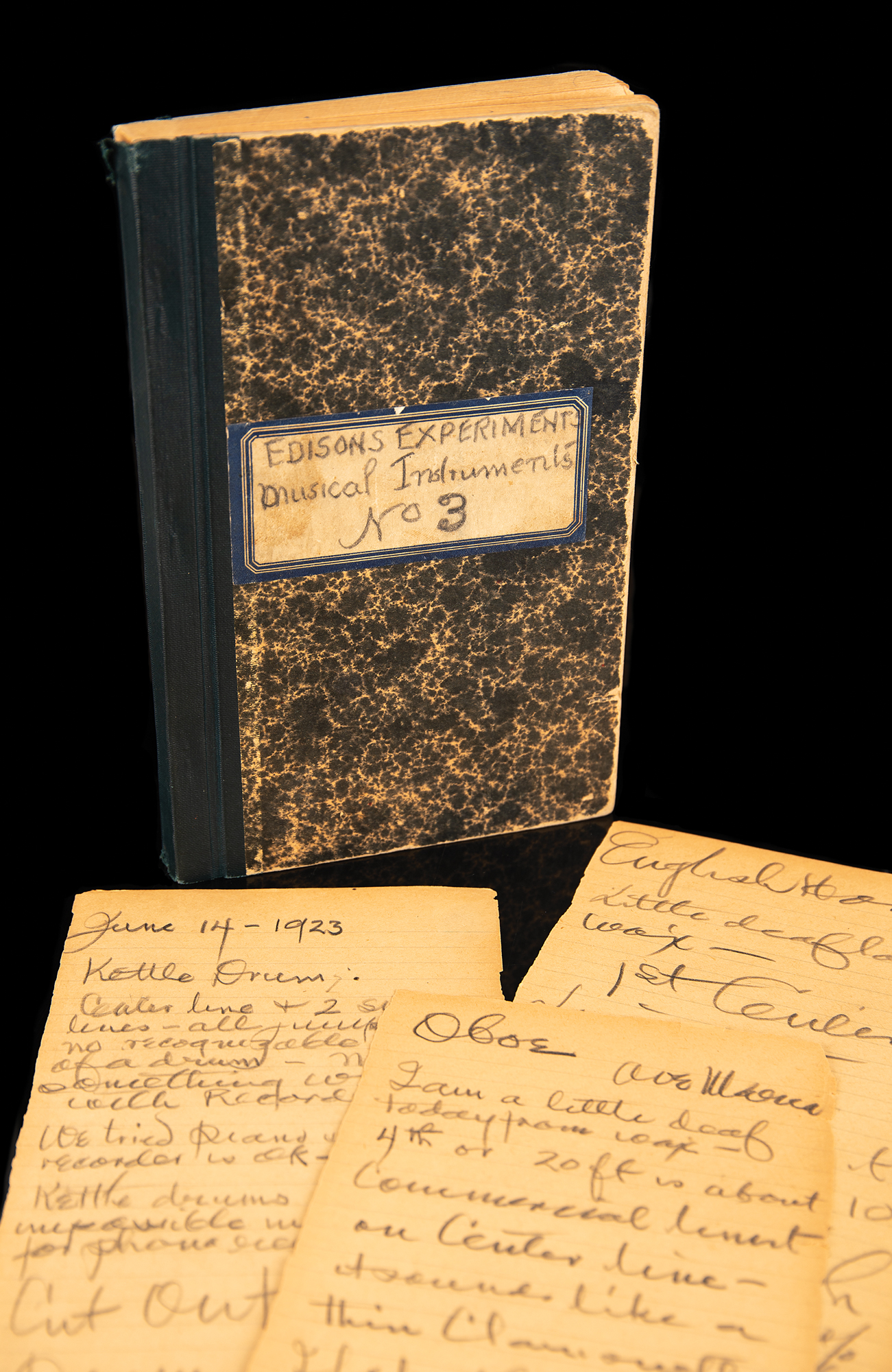
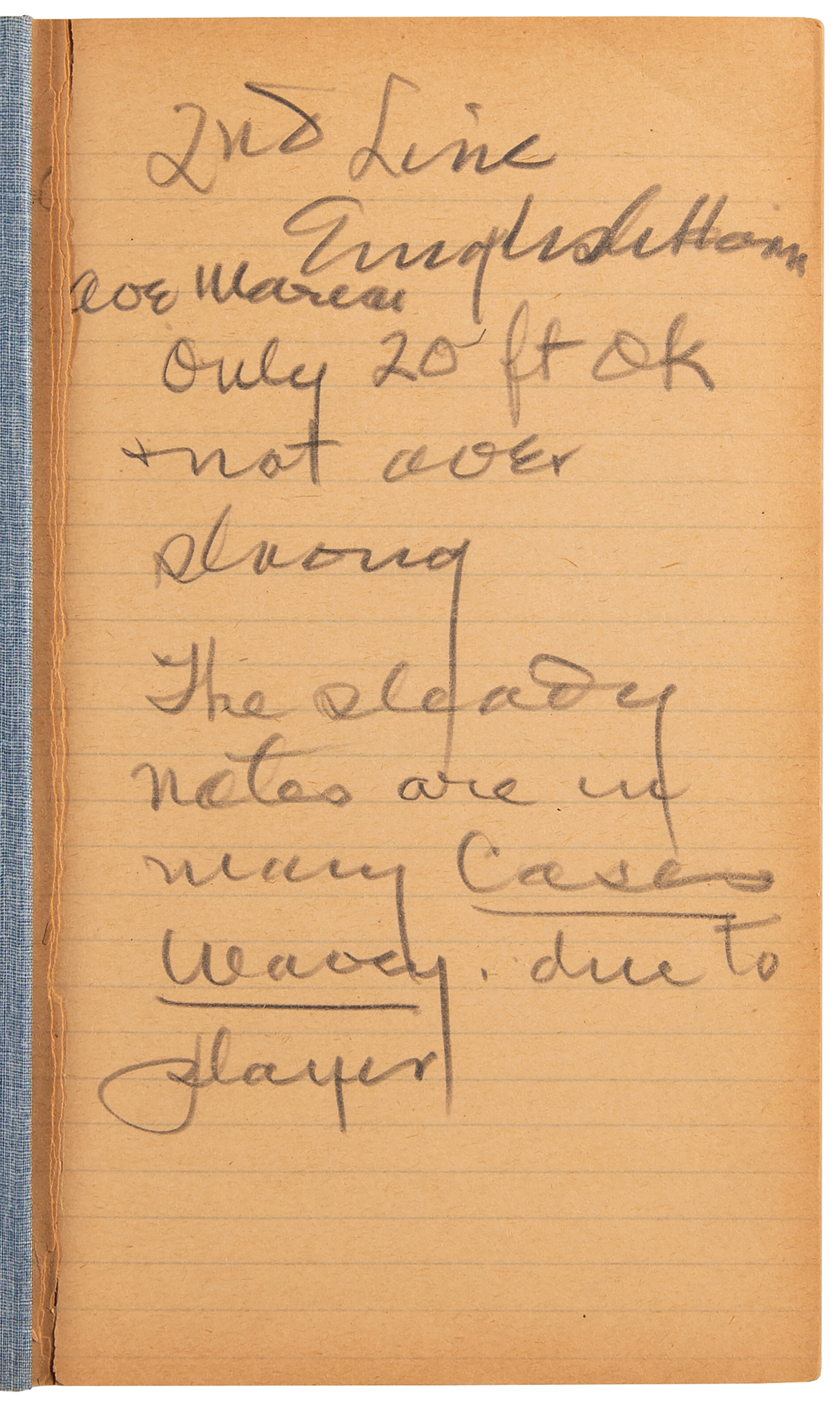
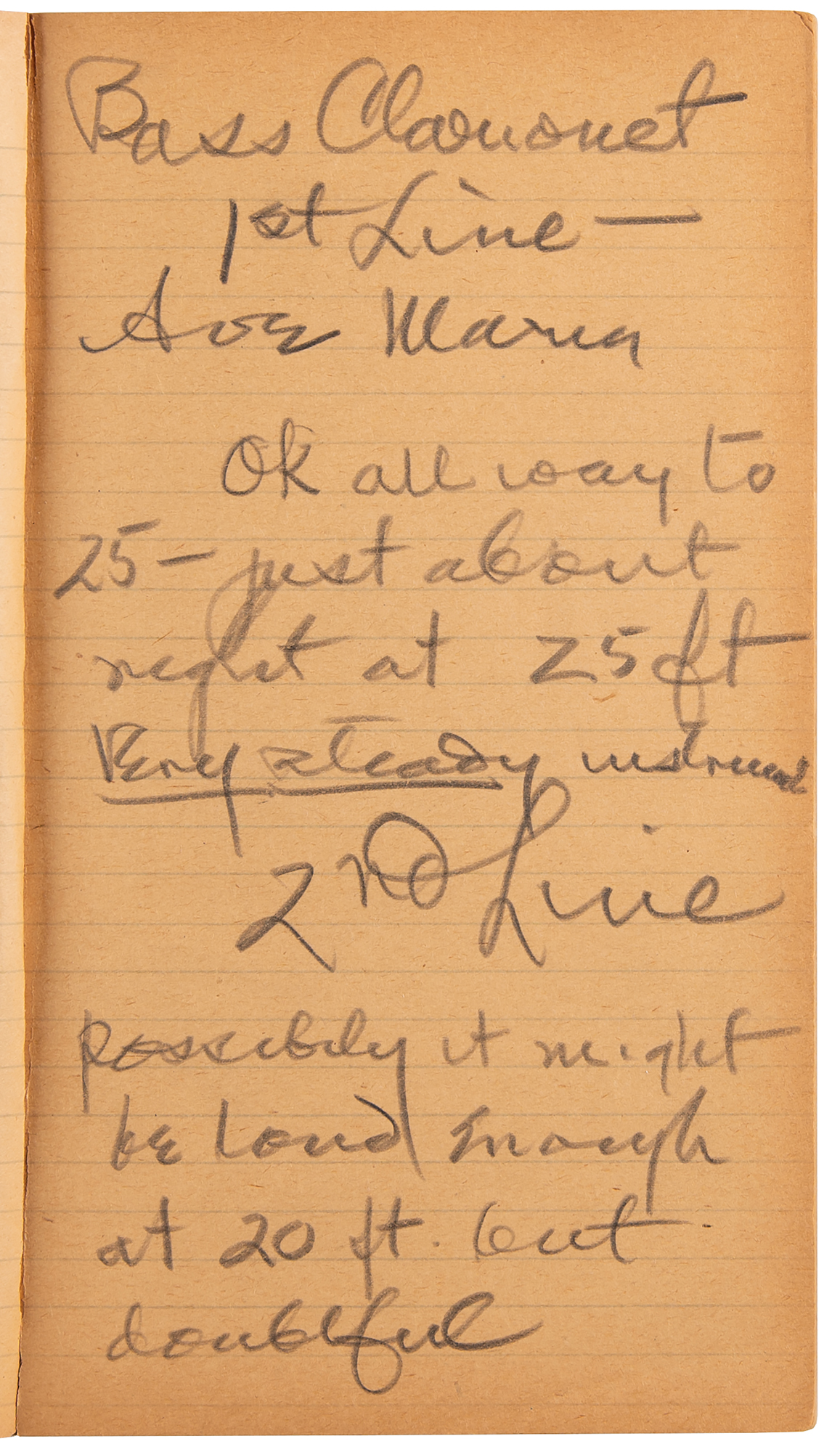
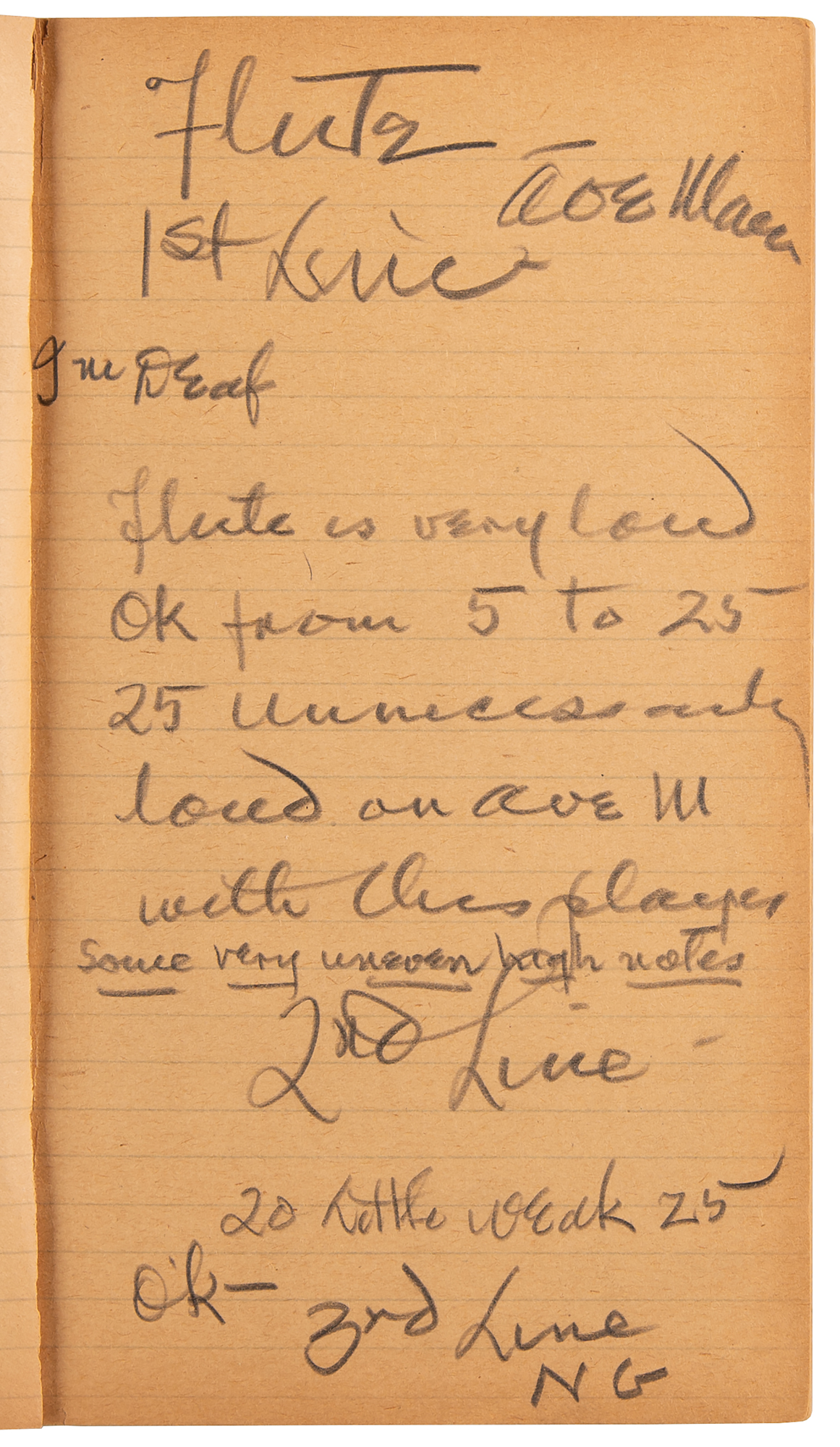
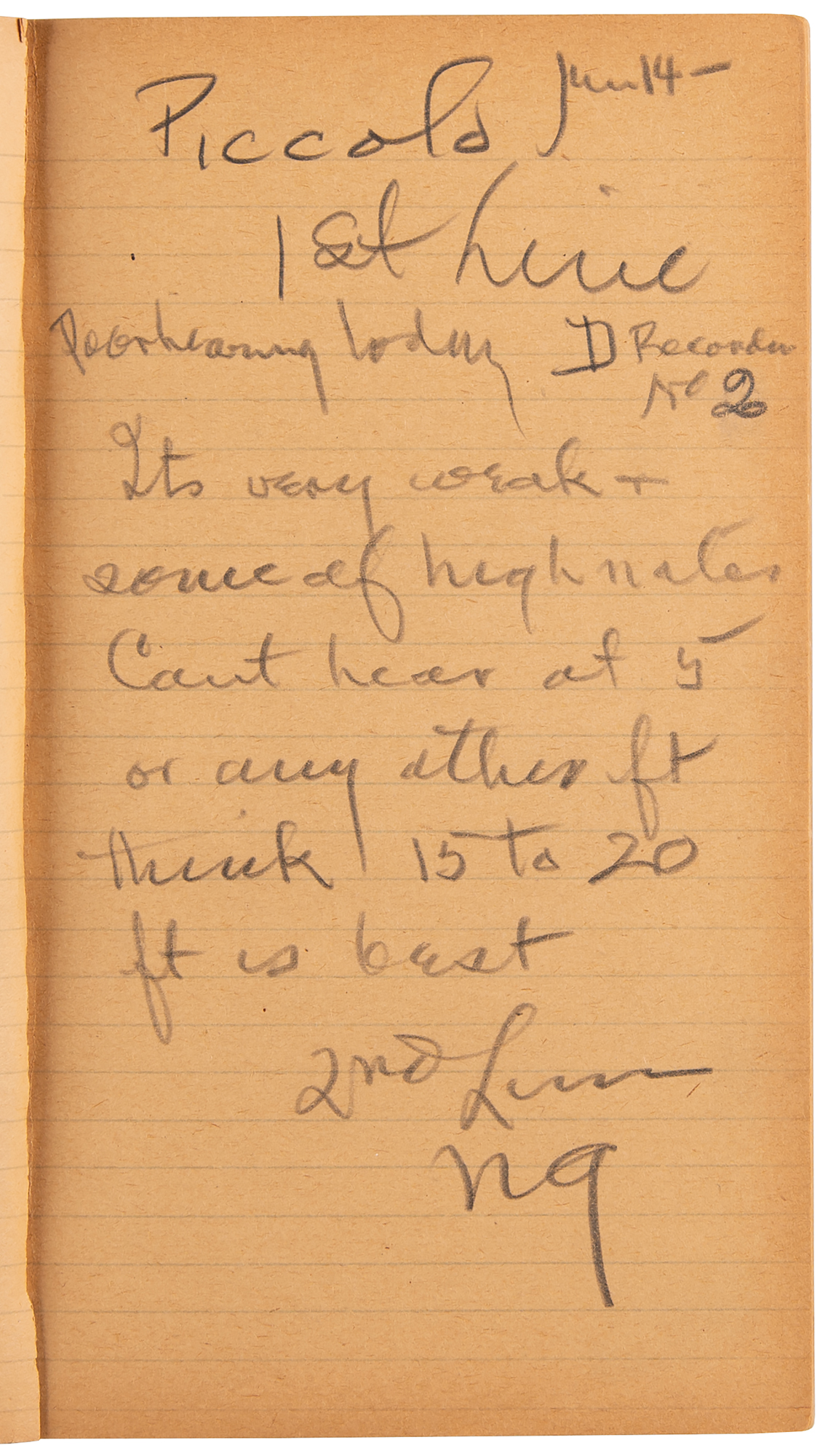
Extraordinary original handwritten laboratory notebook by Thomas Edison, containing 22 handwritten pages in pencil on phonograph experiments (entirely in Edison's hand, a few with additional notes on the reverse), 5.5 x 8.75, circa June 1923, documenting various experiments related to the recording of musical instruments. Labeled on the front cover in pencil, "Edison's Experiments, Musical Instruments, No. 3"; with the possible exception of “Edison's Experiments,” the front cover label also matches Edison’s handwriting of the period.
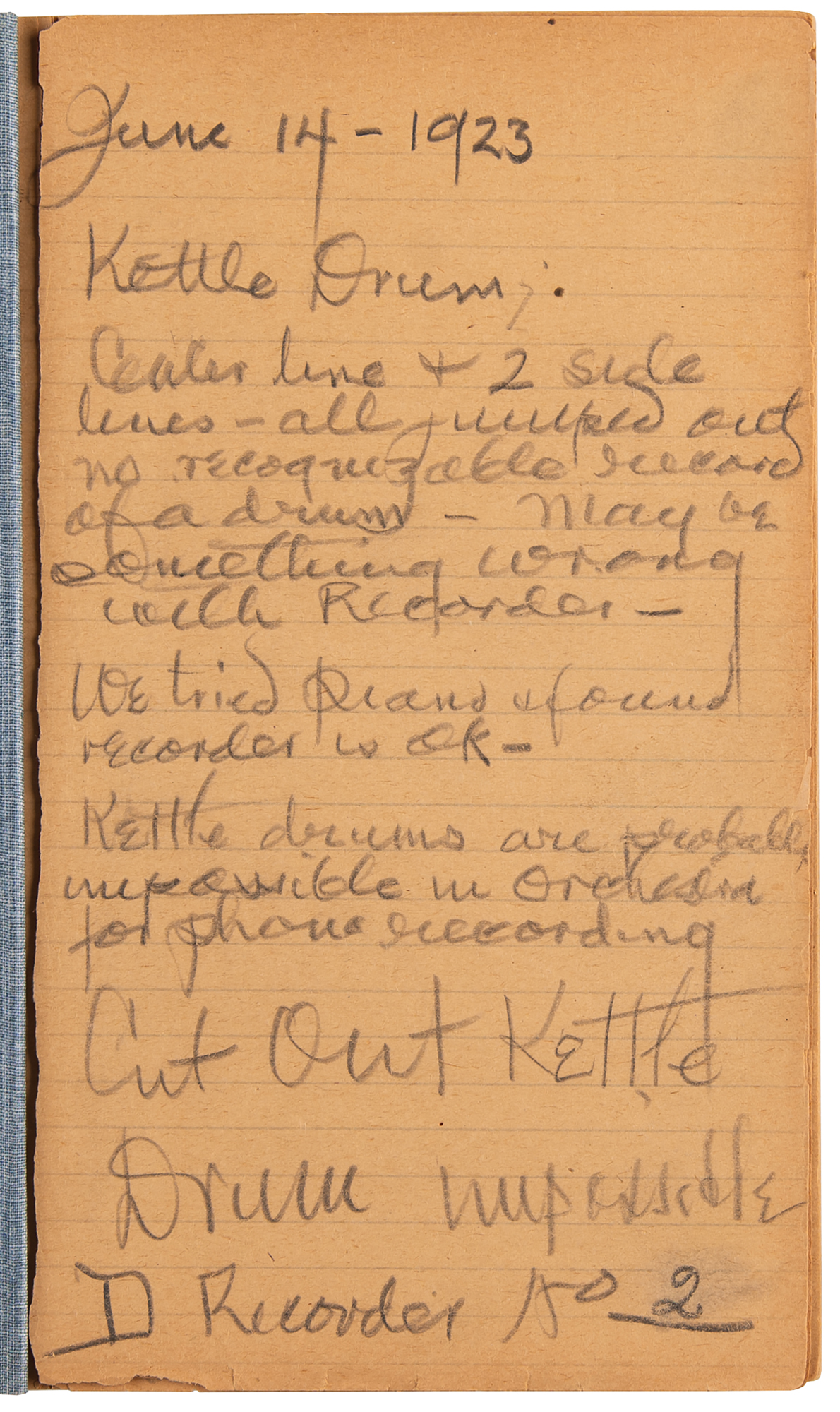
The first page, dated June 14, 1923, begins: "Kettle Drum: Center line & 2 side line—all jumped out, no recognizable record of a drum—may be something wrong with recorder—We tried piano & found recorder is OK—Kettle drums are probably impossible in orchestra for phono recording."
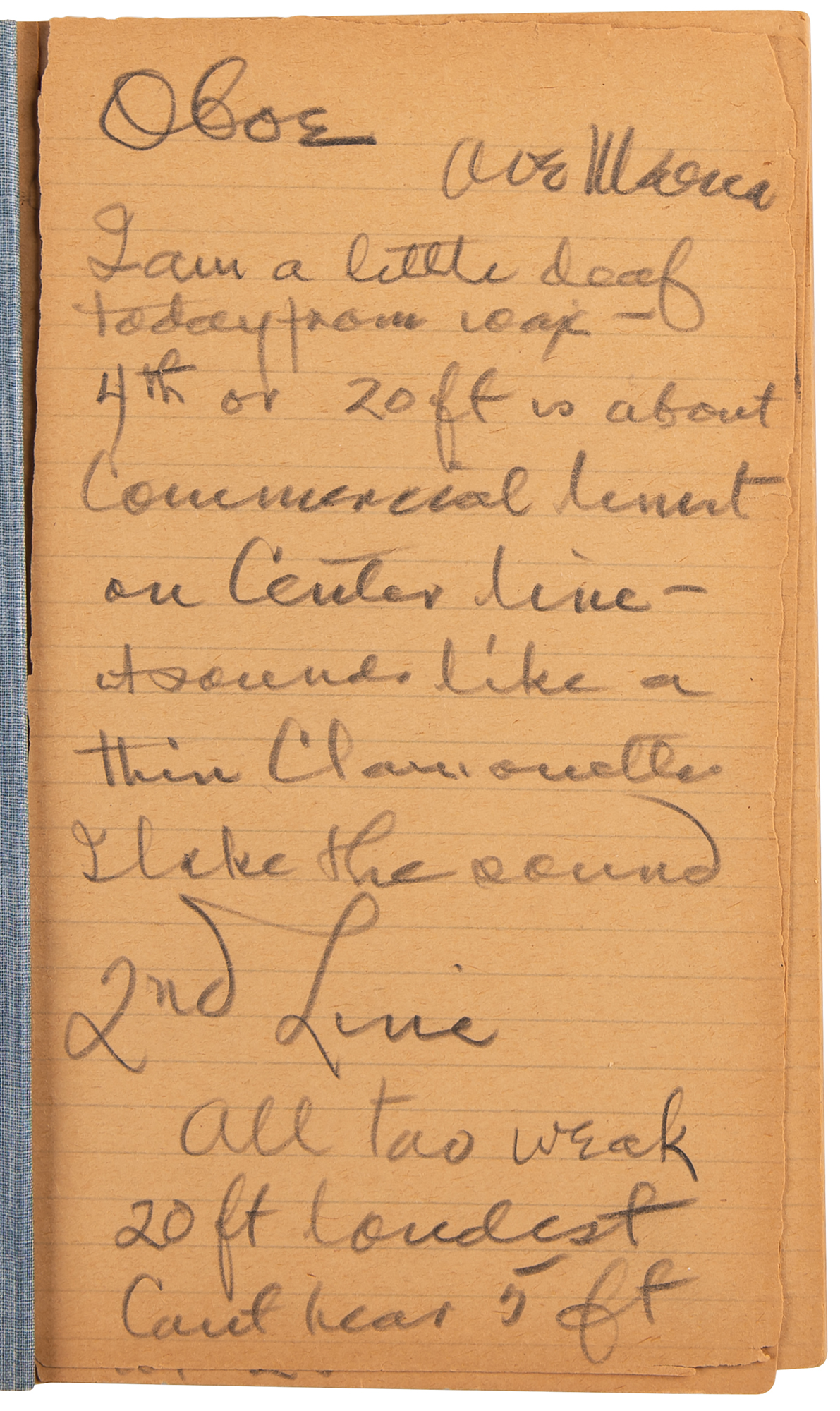
The second page, headed "Oboe, Ave Maria," begins with a comment on his hearing that day: "I am a little deaf today from wax—4th or 20ft is about commercial limit on center line—it sounds like a thin clarionette. I like the sound."
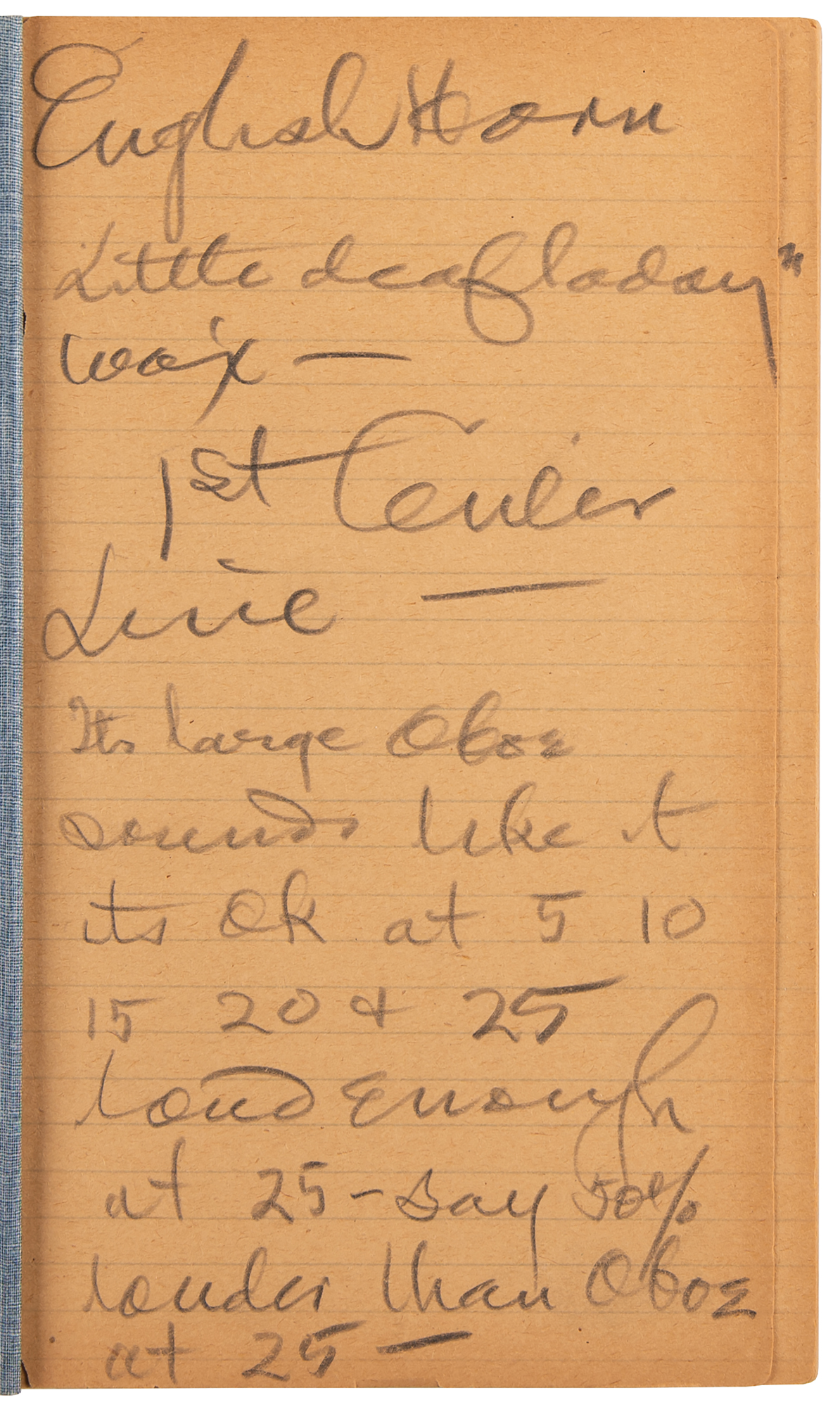
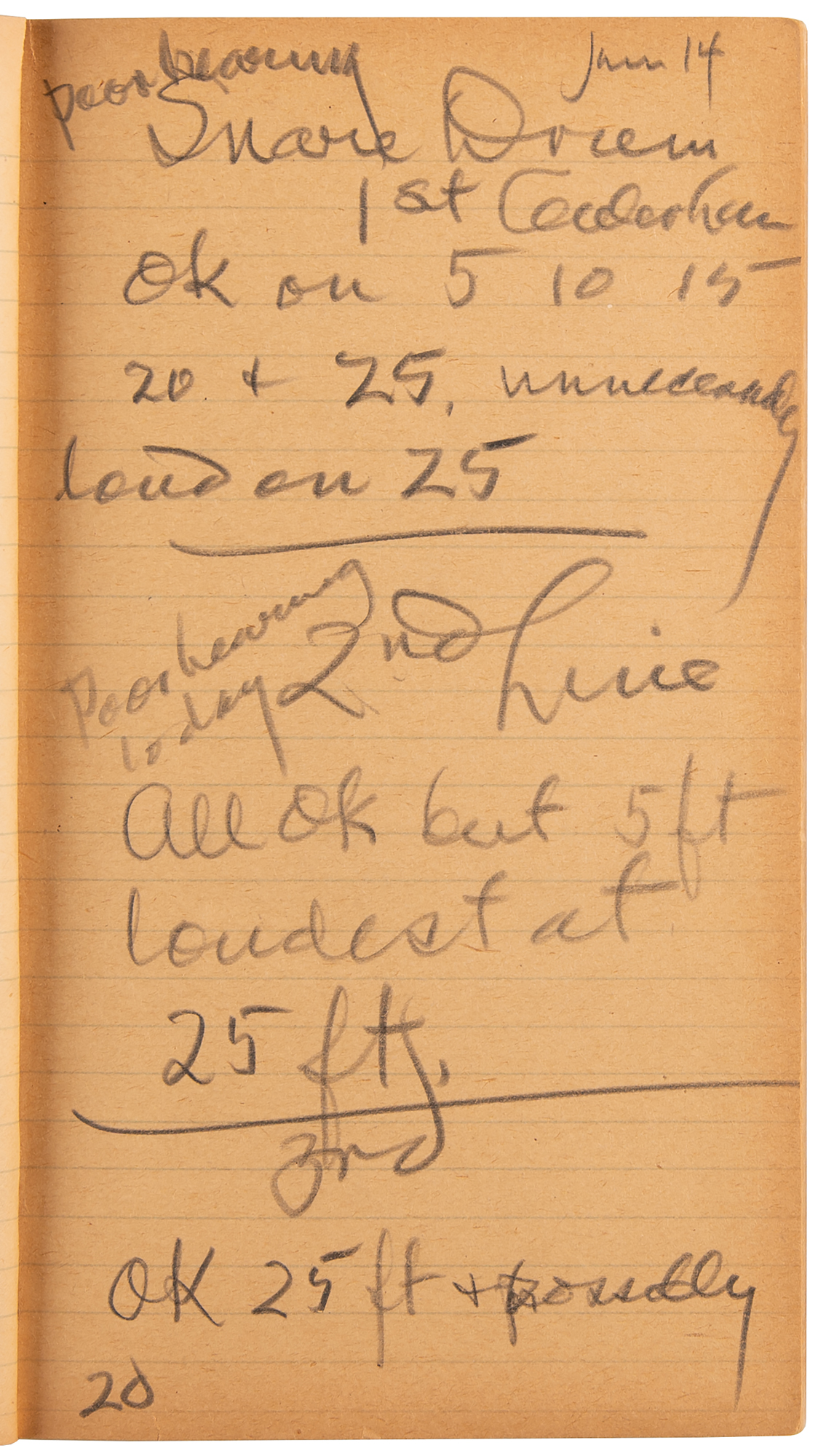
The third page, headed "English Horn," provides similar remarks: "Little deaf today, wax—1st Center Line—Its large oboe sounds like it, it's OK at 5 10 15 20 & 25, loud enough at 25—say 50% louder than oboe at 25."
Edison continues to make similar observations, often prefacing his notes with remarks on his hearing with lines like "I'm deaf" and "Poor hearing today." Throughout his life, Edison suffered from hearing loss. While theories on Edison’s hearing loss from different events in his younger years abound, the most likely cause was hereditary. The irony that the record industry was launched by a person who was hard of hearing is clearly portrayed in this surviving notebook of Edison's experiments, in which he makes notes concerning the recording of various instruments at different distances.
Edison’s hearing loss was progressive, and by the time of these experiments in 1923, Edison was 76 years old. In spite of his progressively severe deafness, Edison’s unstoppable work ethic and persistent drive for improvement—a trait that many associate with his immense success—is clearly shown in this notebook, in Edison’s words and hand.
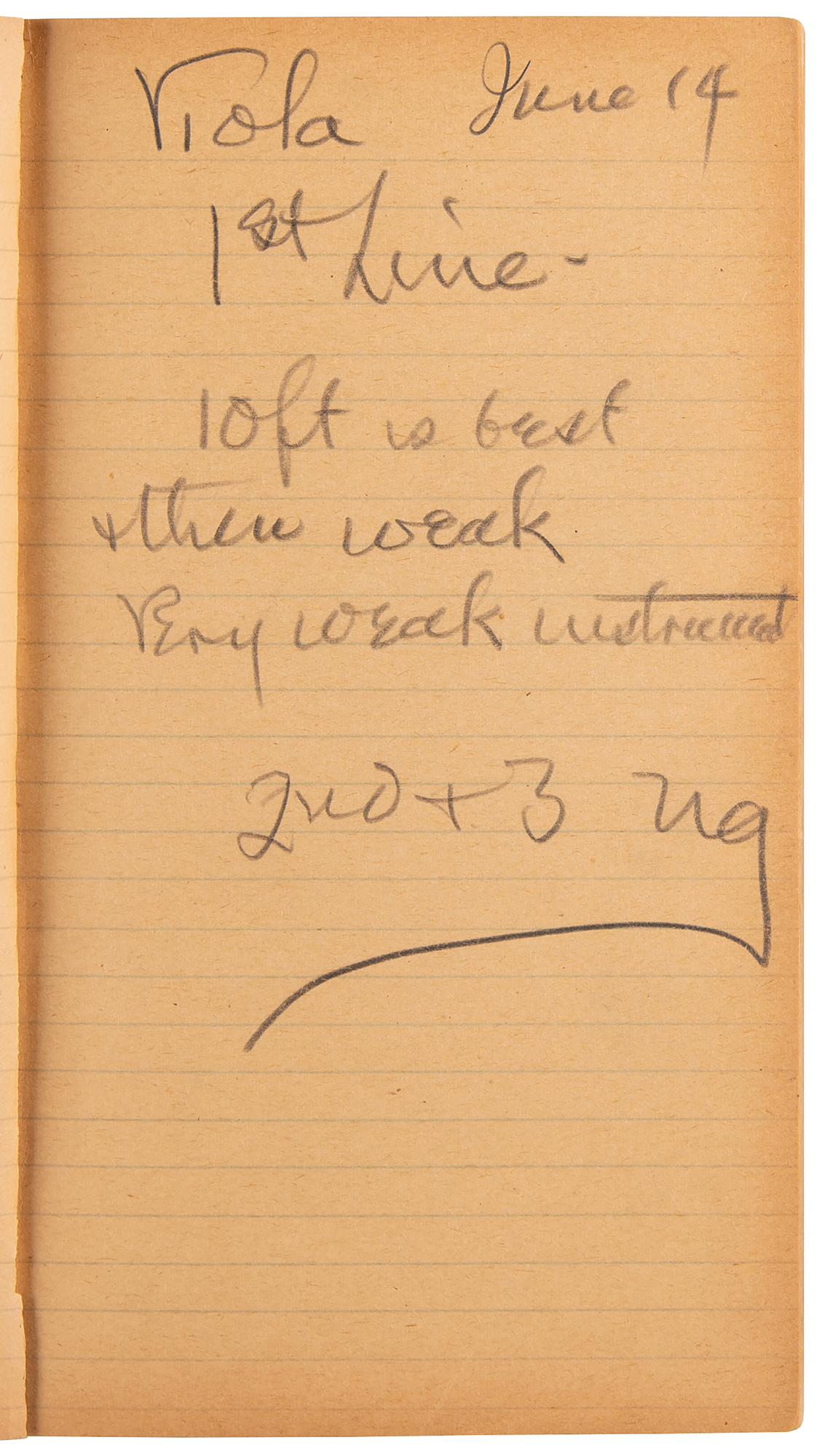
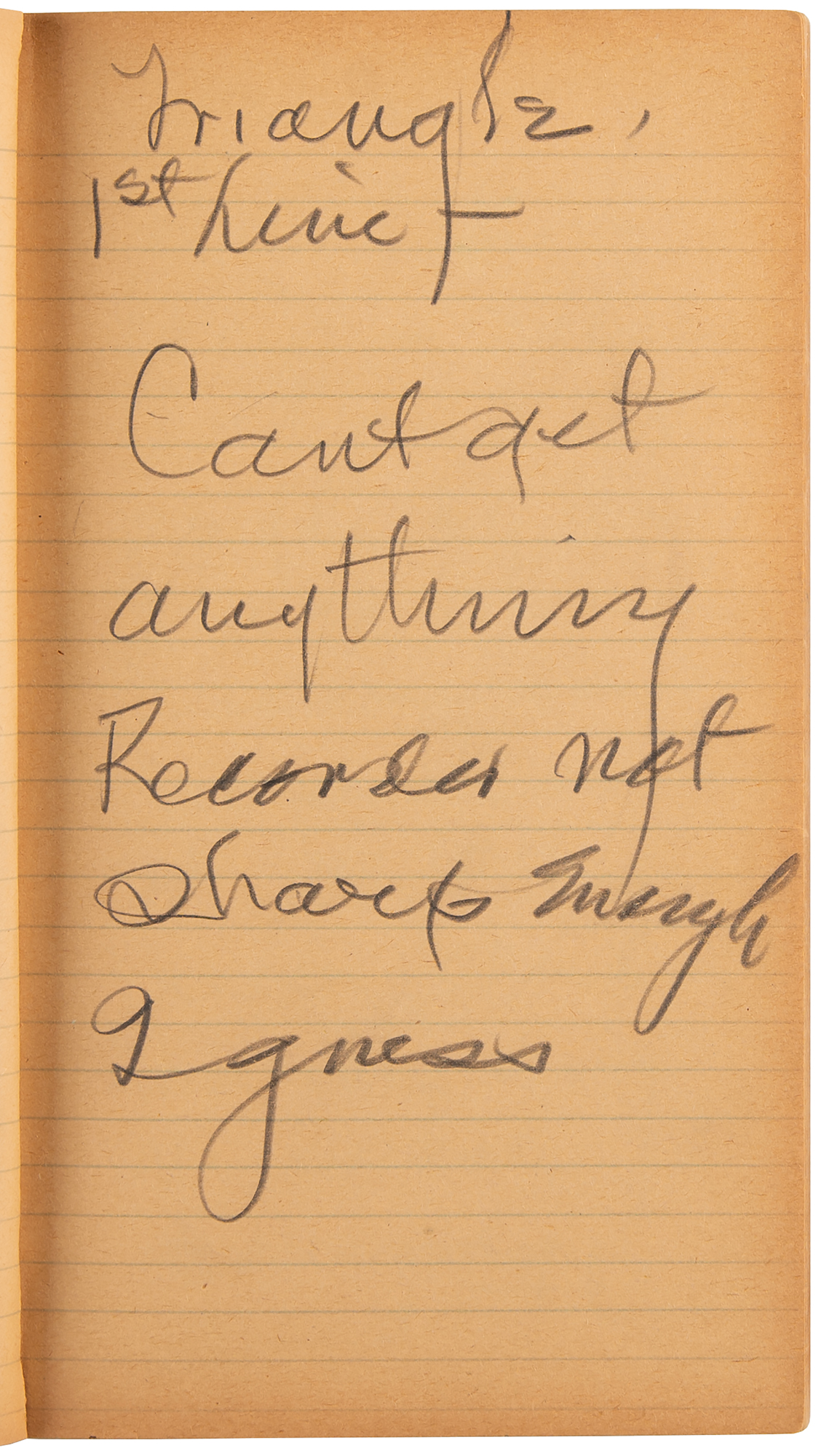
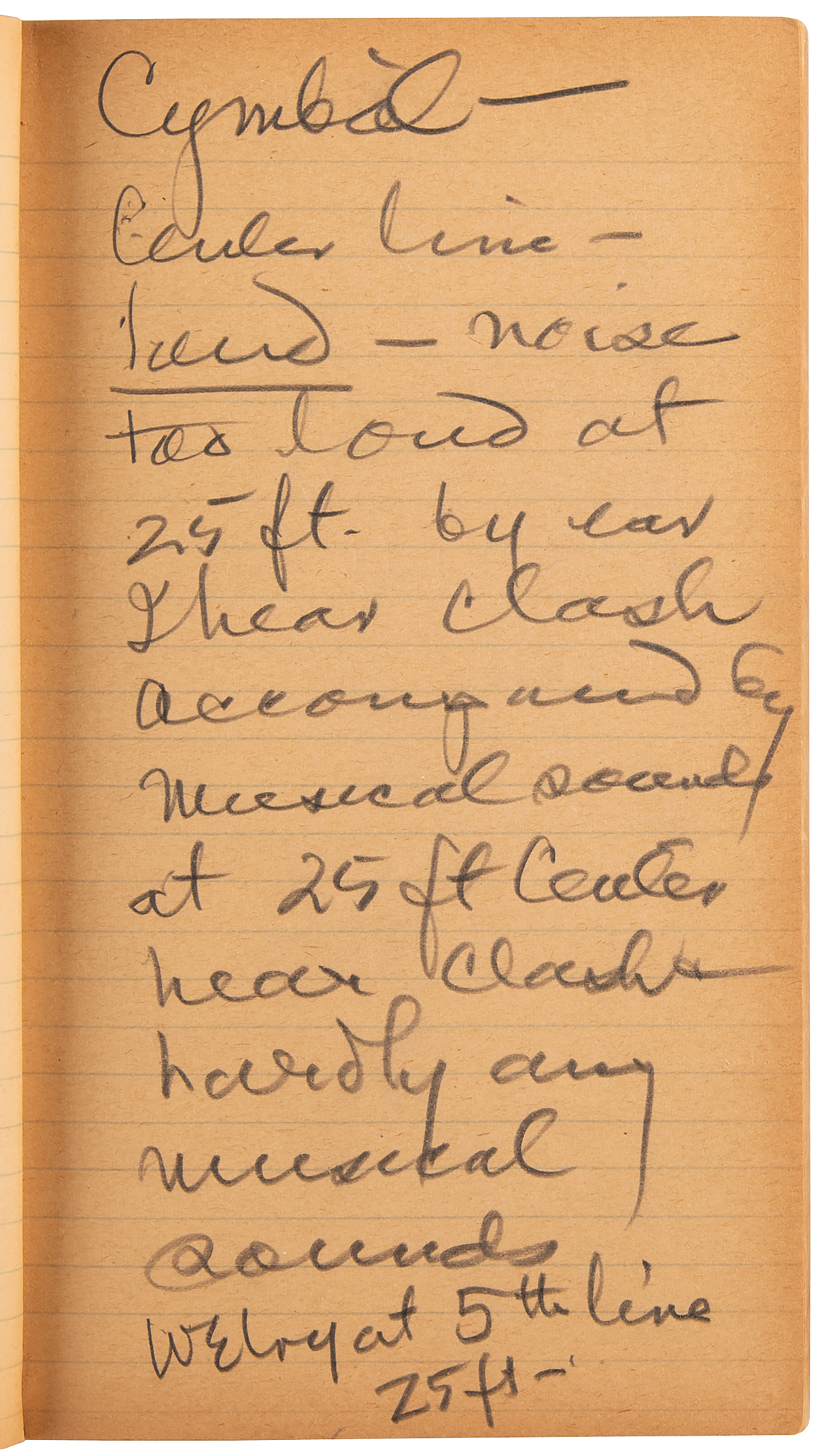
In addition to the above instruments, Edison documents recordings of a bass clarinet ("very steady instrument…possibly it might be loud enough at 20 ft. but doubtful"), flute ("very loud…some very uneven high notes"), piccolo ("very weak & some of high notes can't hear at 5 or any other ft"), viola ("10 ft is best…very weak instrument"), snare drum ("unnecessarily loud on 25"), triangle ("Can't get anything recorded, not sharp enough I guess"), and cymbal ("noise too loud at 25 ft. by ear I hear clash followed by musical sounds").
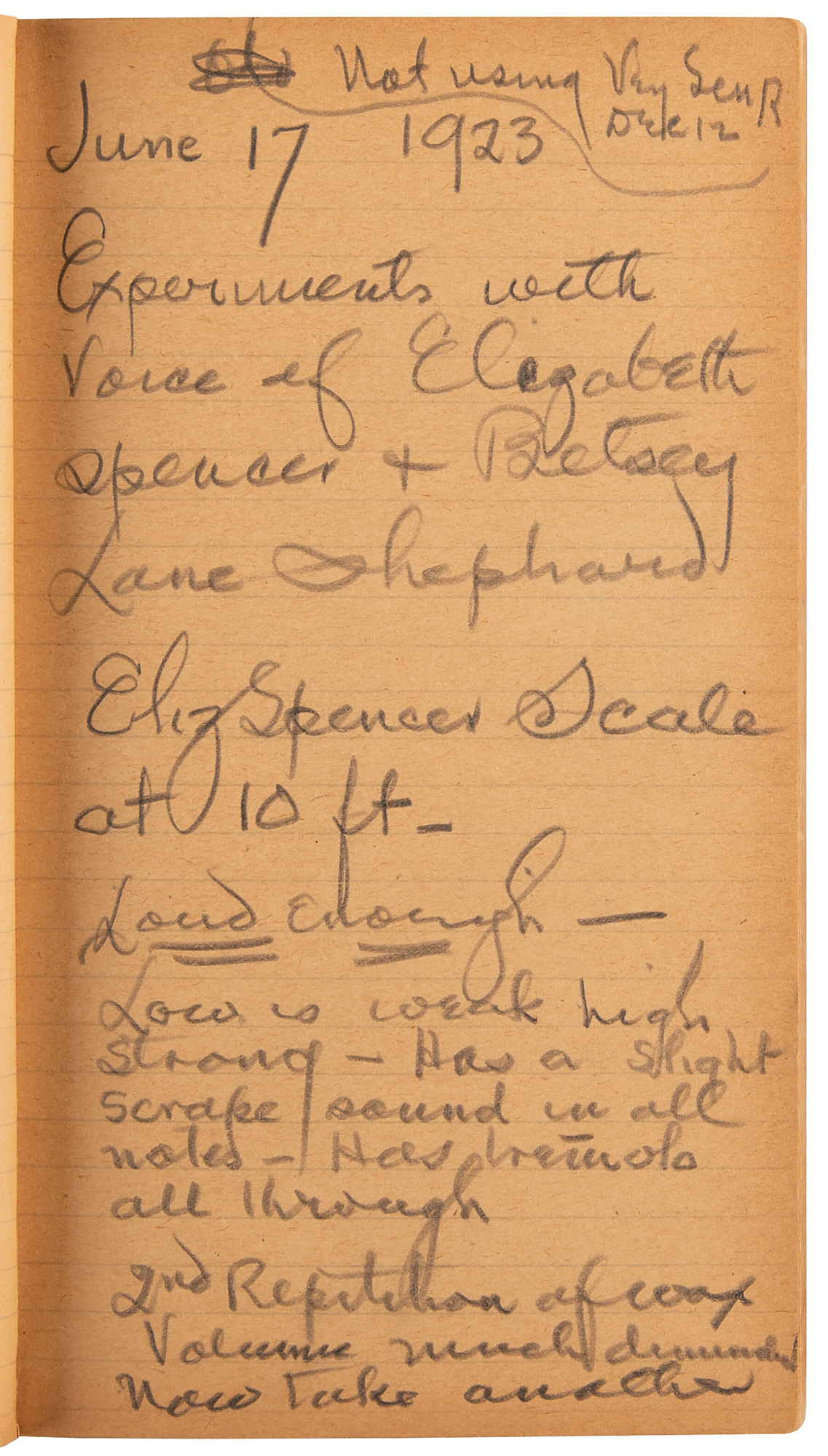
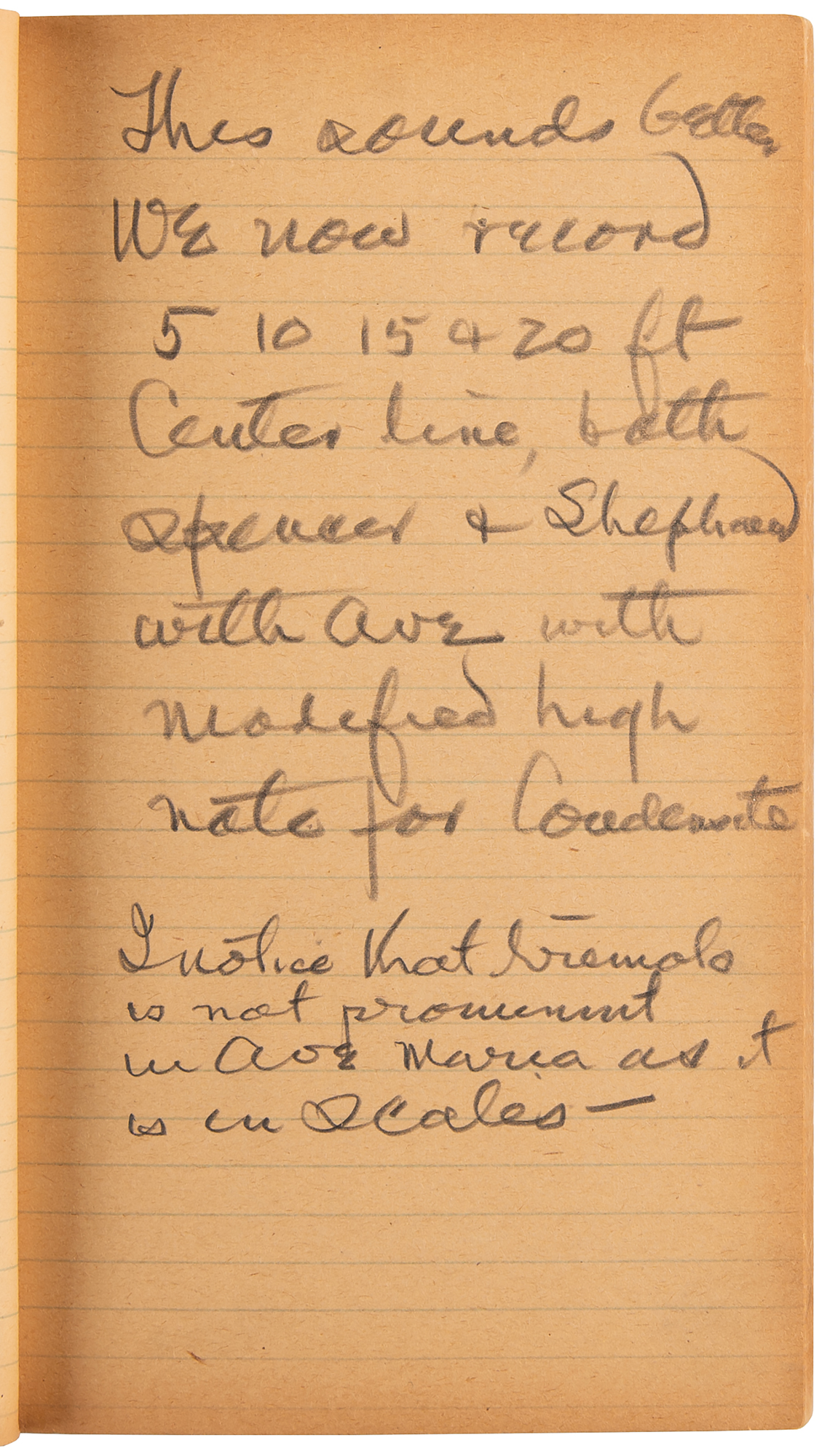
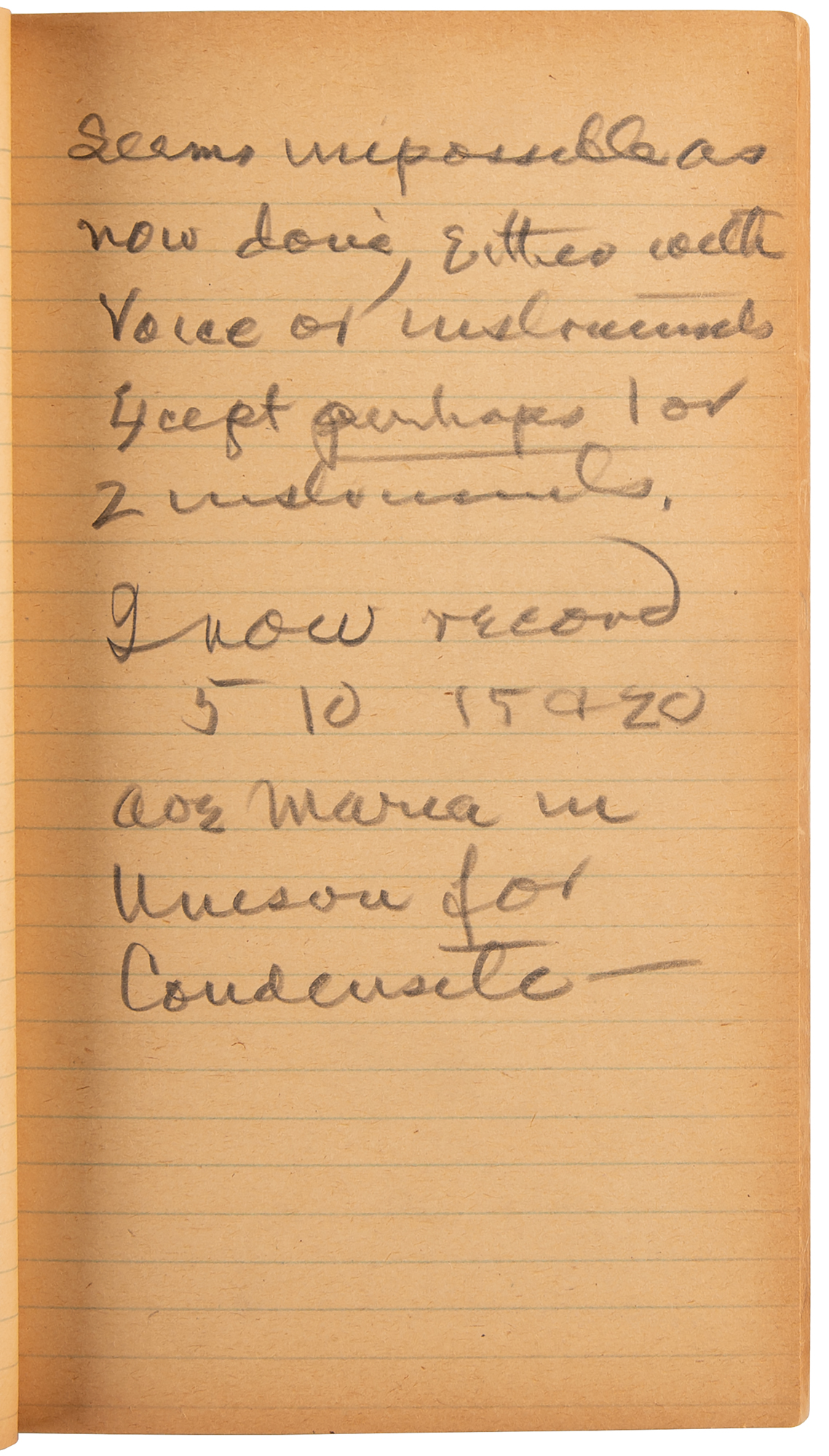
On June 17th, he makes observations of a recording session with soprano Elizabeth Spencer: "Experiments with voice of Elizabeth Spencer & Betsey Lane Shepard. Eliz. Spencer scale at 10 ft—loud enough—Low is weak high strong—has a slight scrape sound in all notes—has tremolo all through…B. L. Shepard…scale at 10 ft on same record, very little tremolo, some scrape—more powerful than Spencer…will make further trials on position…I notice that tremolo is not prominent in Ave Maria as it is in scales." In fine condition, with expected handling wear, and the first three pages detached but present. Accompanied by a tag that once identified a studio recording horn, marked: “Original Recording Horn used by Mr. Edison at Edison Laboratory, Orange, N.J.”
In 1877, when Edison invented the phonograph, the first device for recording and playing back sound, he thought that its main use would be to record speech in business settings, which could then be played back and transcribed. Edison moved on from the phonograph in 1878 to conquer electric lighting but quickly returned to it less than a decade later, the second time making efforts to bring affordable music to the homes of all. In the 1880s, Edison pioneered the use of wax cylinders as a means of sound recording and reproduction and his phonograph would be adopted primarily for entertainment purposes, bringing music into millions of American households. A holder of over 1,000 patents, Edison considered the phonograph to be his favorite invention.
As was true with many of Thomas Edison’s inventions, he continually experimented with improving the quality and performance of the records and phonographs produced at the Edison Phonograph Works. Rival companies would find greater success in hiring famous and desirable talent to record for their labels. At the same time, Edison focused on achieving the best recording quality while ignoring the demand from the public for top-name performers. Edison’s short-sightedness for the business side of inventing is evinced here—he focuses on making meticulous, minute improvements in quality, while failing to grasp the big picture of the matured record industry that he founded.
This notebook is one of the few official laboratory notebooks outside the few institutions with such holdings. Few objects of Edisonia connect the reader so intimately with Edison’s day-to-day work on such an important and groundbreaking invention.

