Sold For $11,731
*Includes Buyers Premium
UPDATE: Click here to read Camp and field. Papers from the portfolio of an army chaplain.
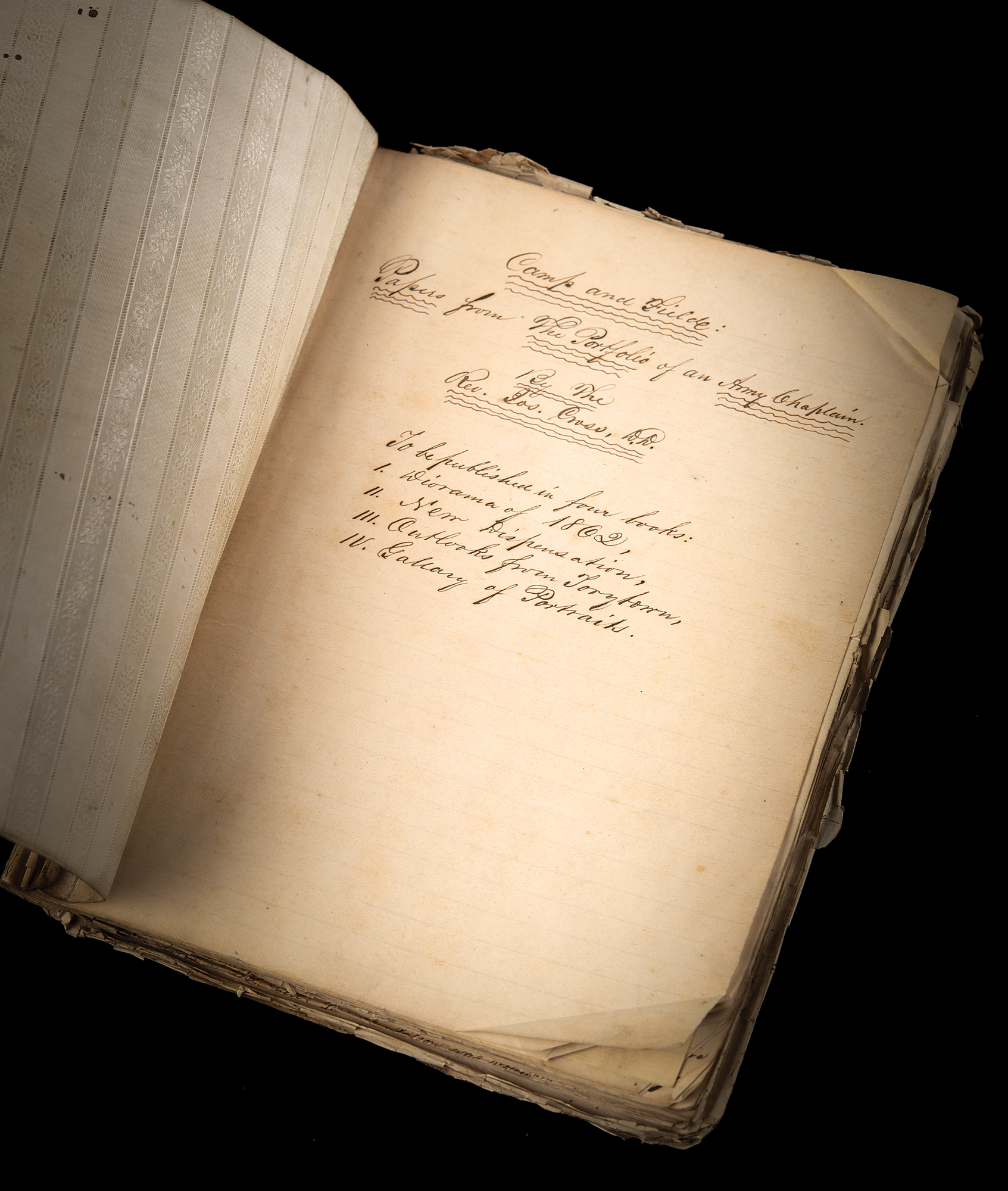
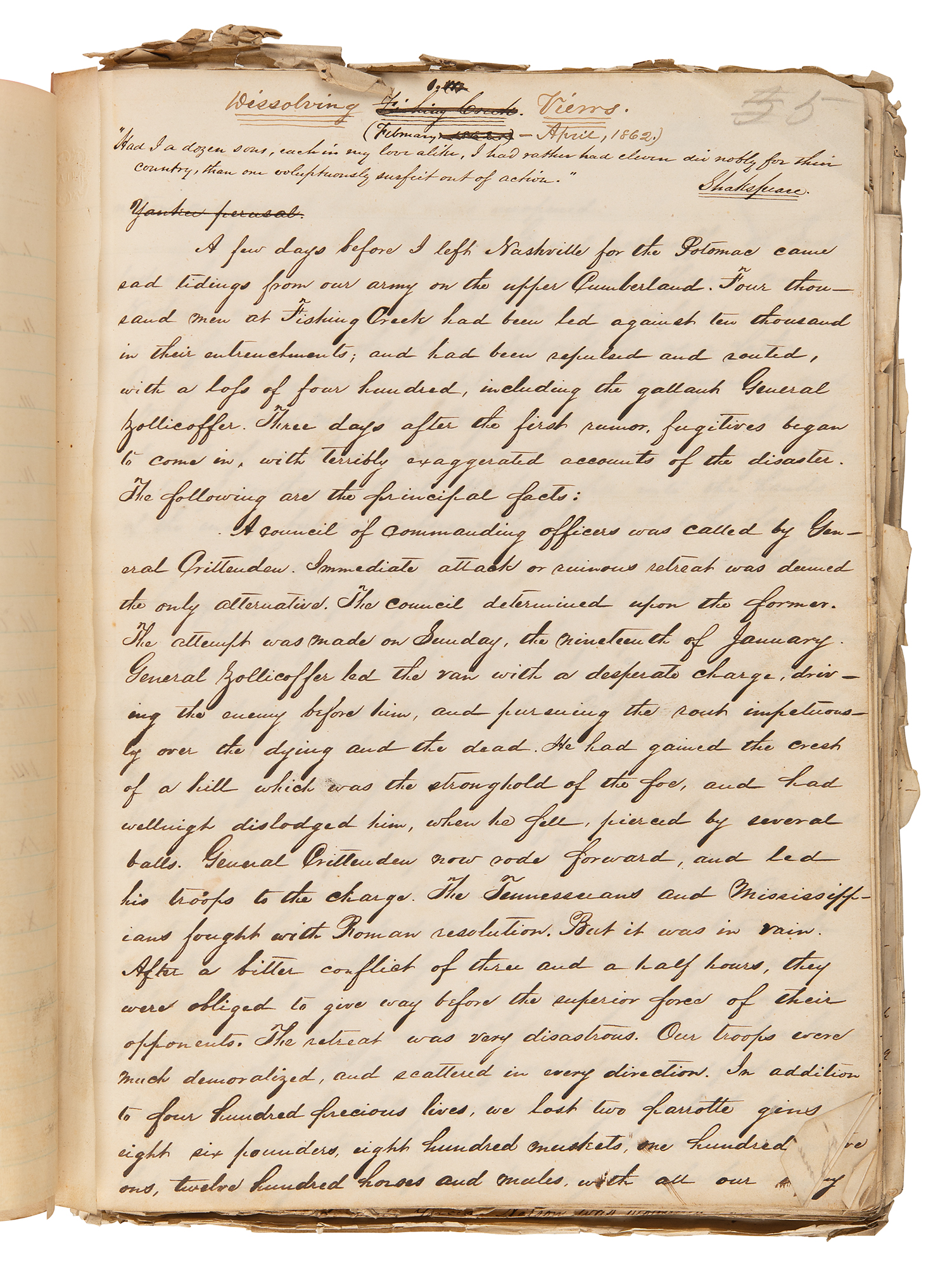
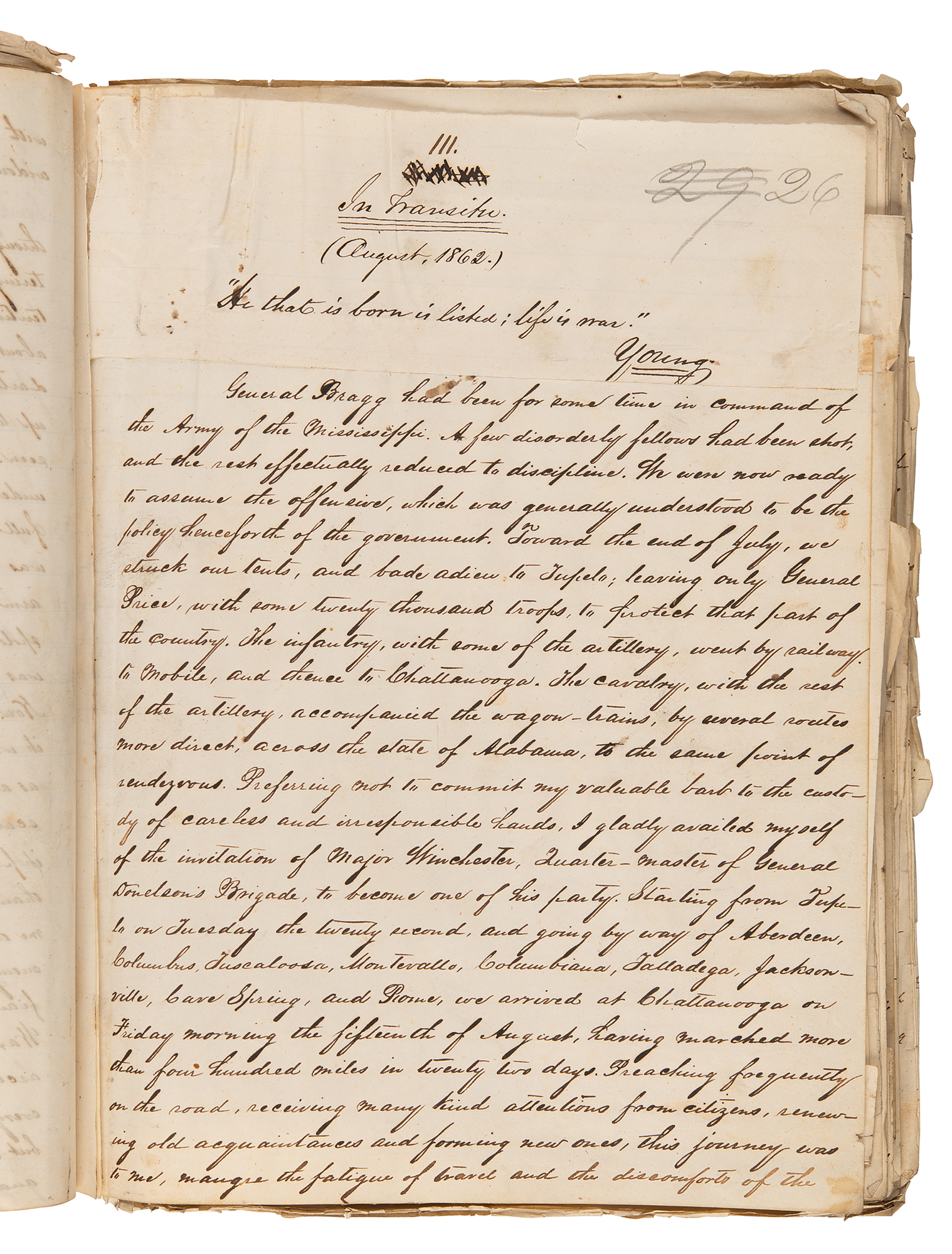
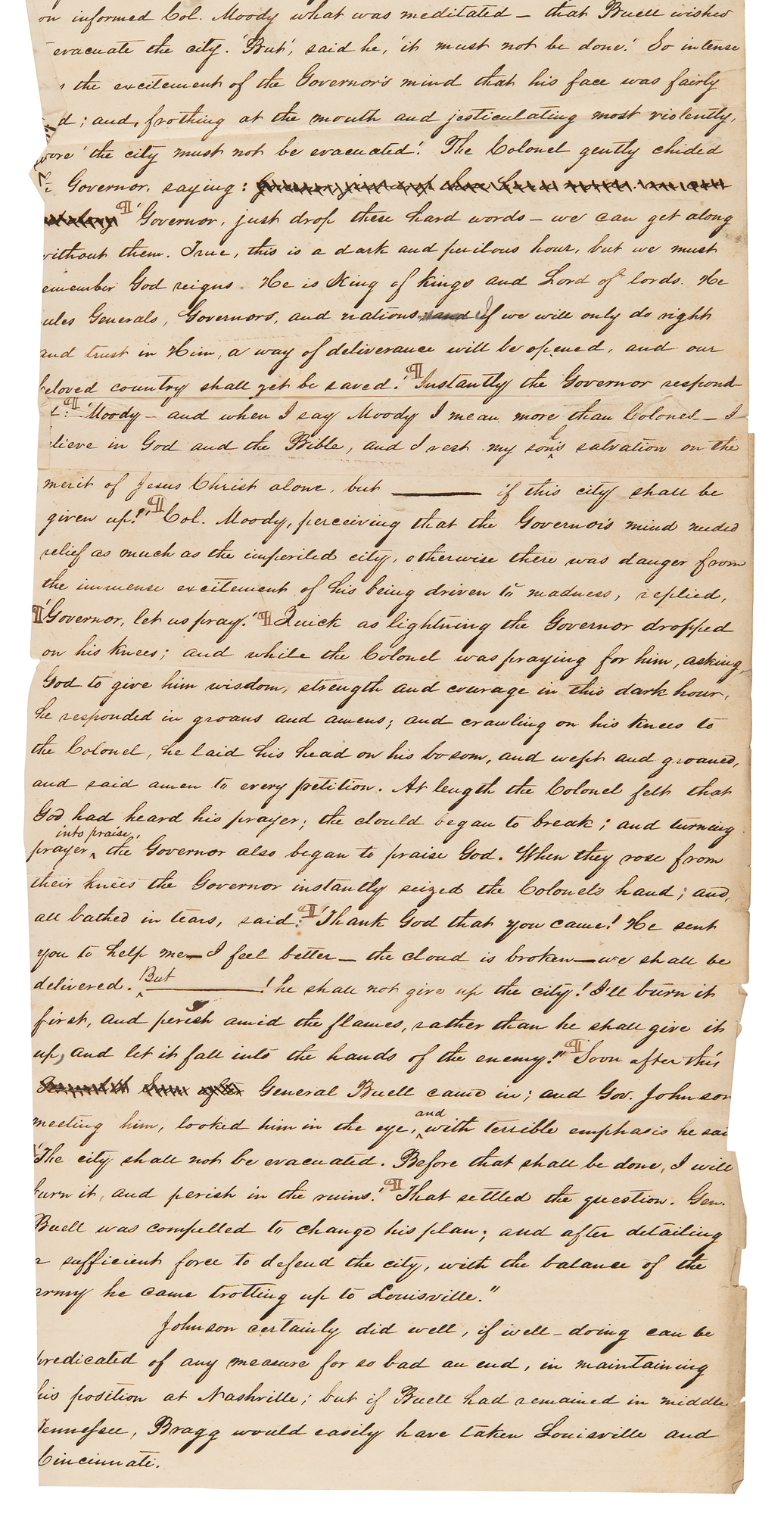
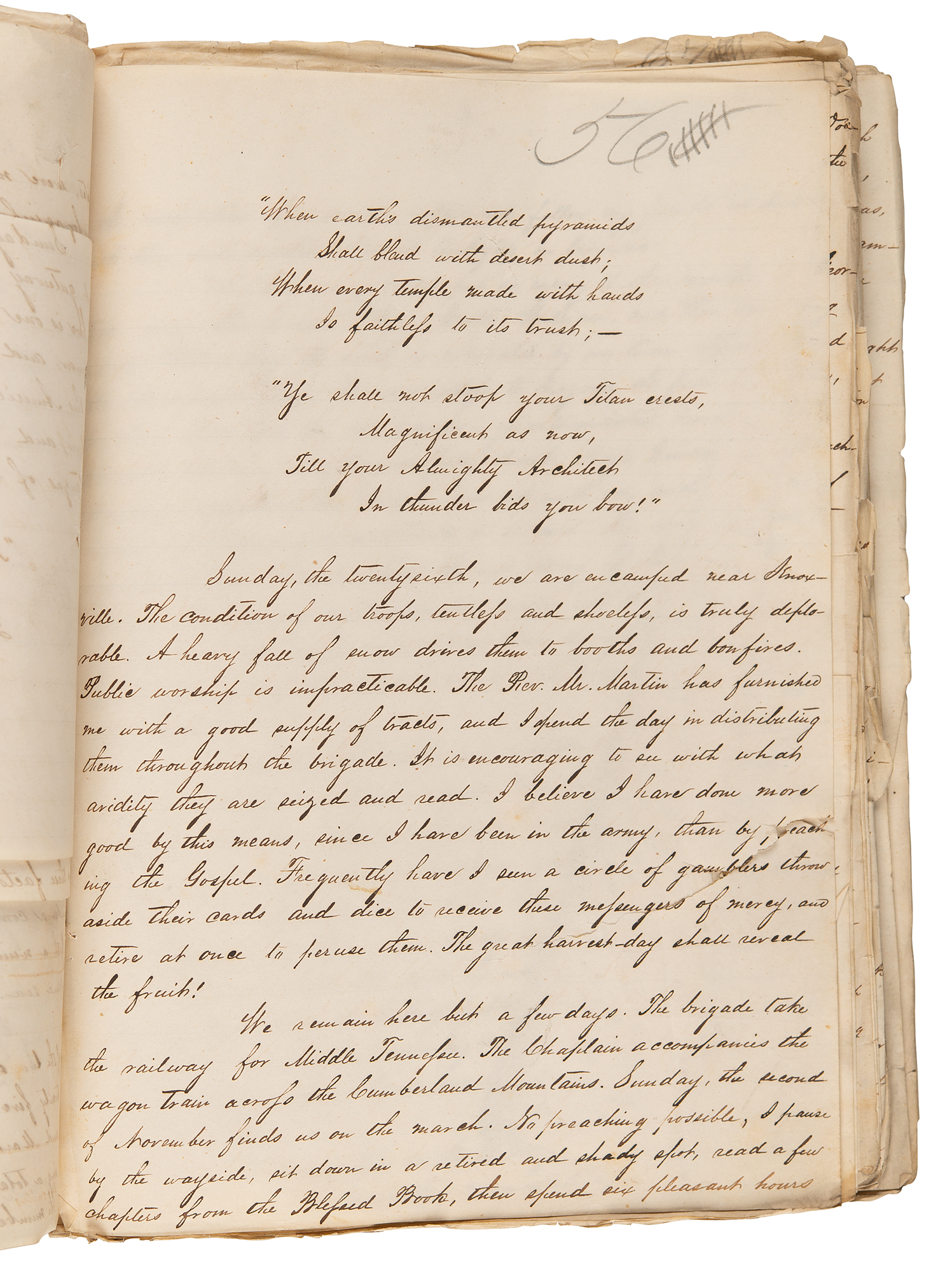
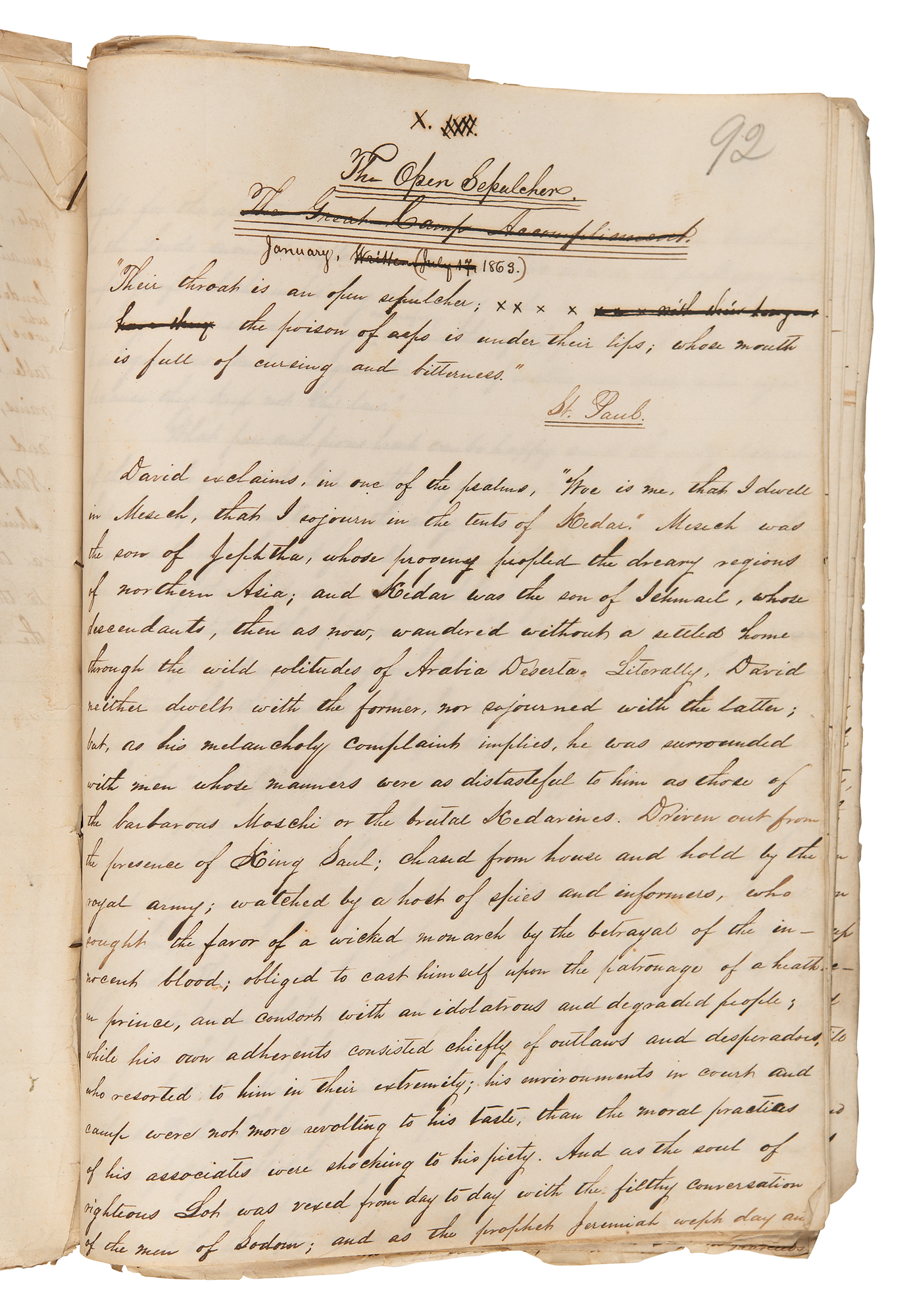
Original handwritten working manuscript by Dr. Joseph Cross, a Methodist Chaplain of the 2nd Tennessee Infantry Regiment, for the first book of his remarkable Civil War memoir ‘Camp and Field: Papers from the Portfolio of an Army Chaplain,’ which was published as four books in 1864 by Burke, Boykin & Co. of Macon, Georgia (Books 1 and 2), and Evans & Cogswell of Columbia, South Carolina (Books 3 and 4). The string-bound manuscript, approximately 110 pages, 8.25 x 10.25, entitled “Book First, Diorama of 1862,” offers a series of detailed essays and narratives from the unique perspective of a Confederate Army chaplain during 1862, which chronicles the hardship of soldiers, military engagements, and the spiritual and moral aspects of camp life.
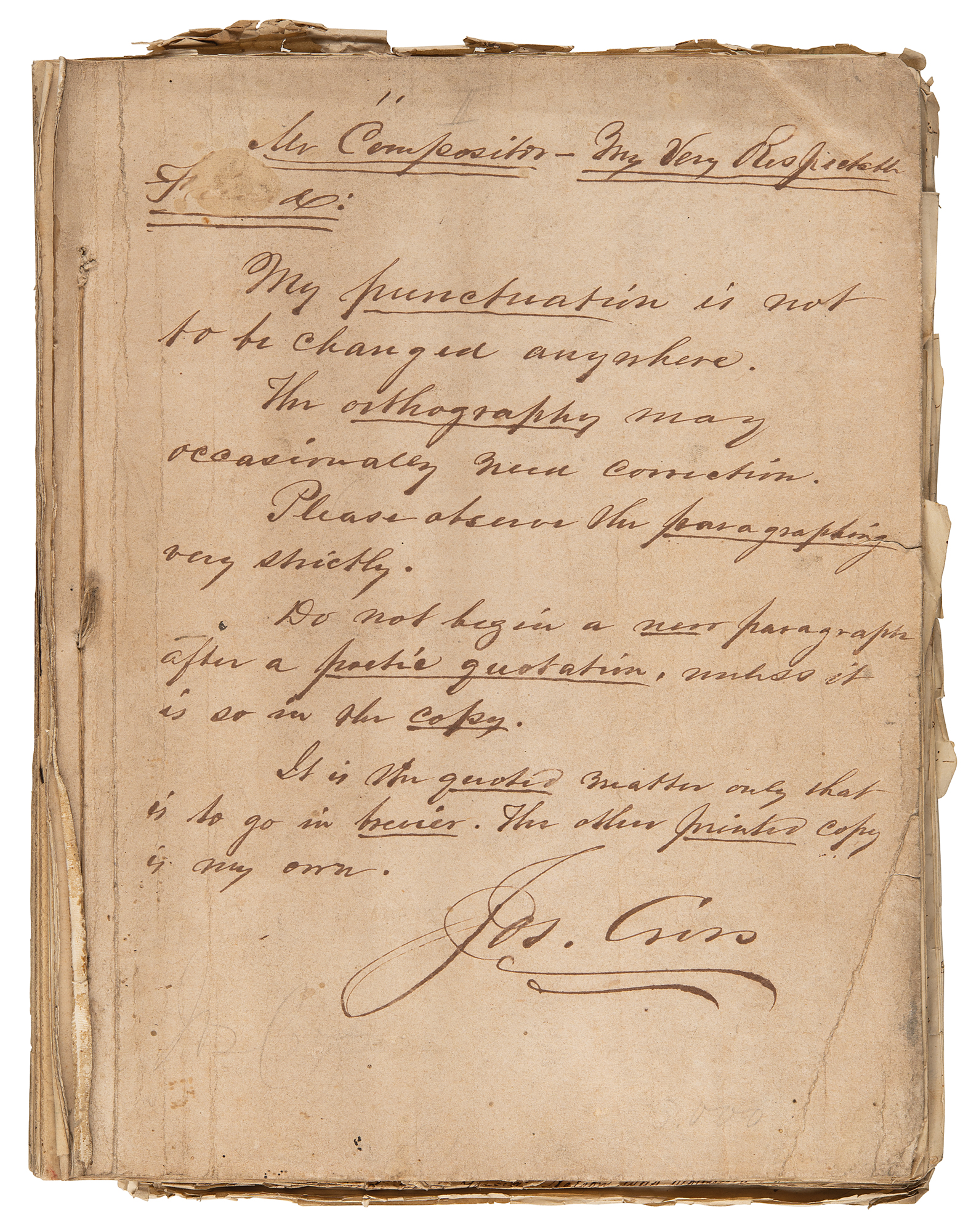
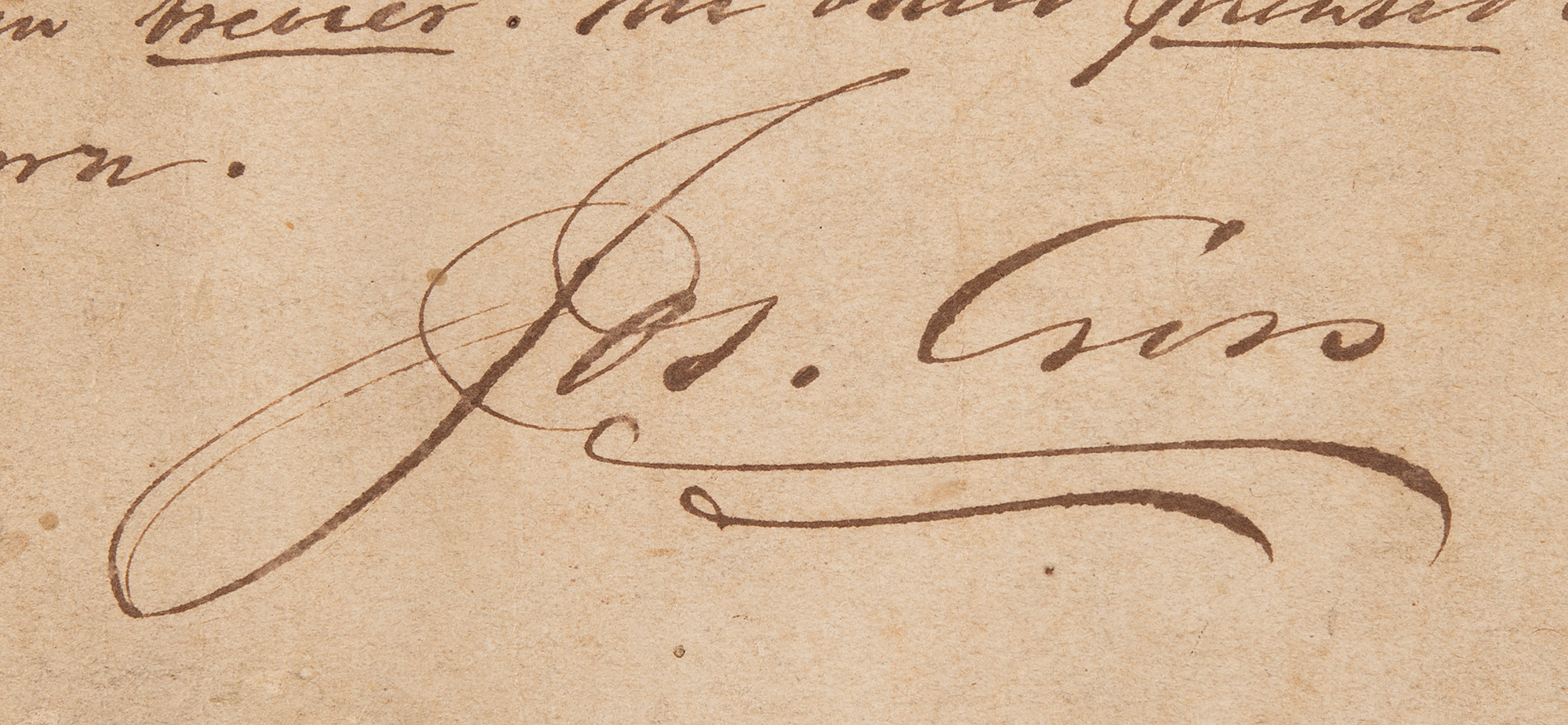
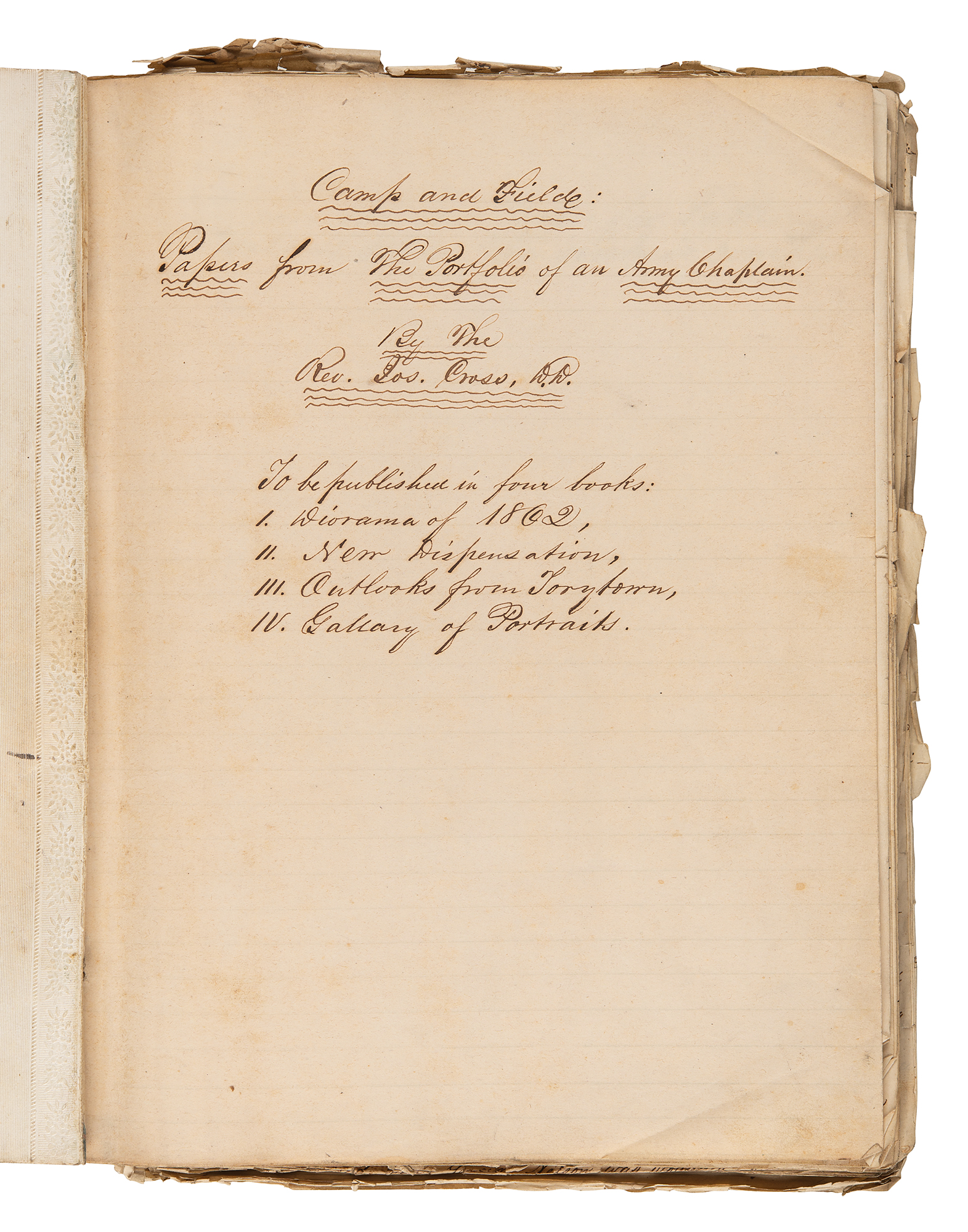
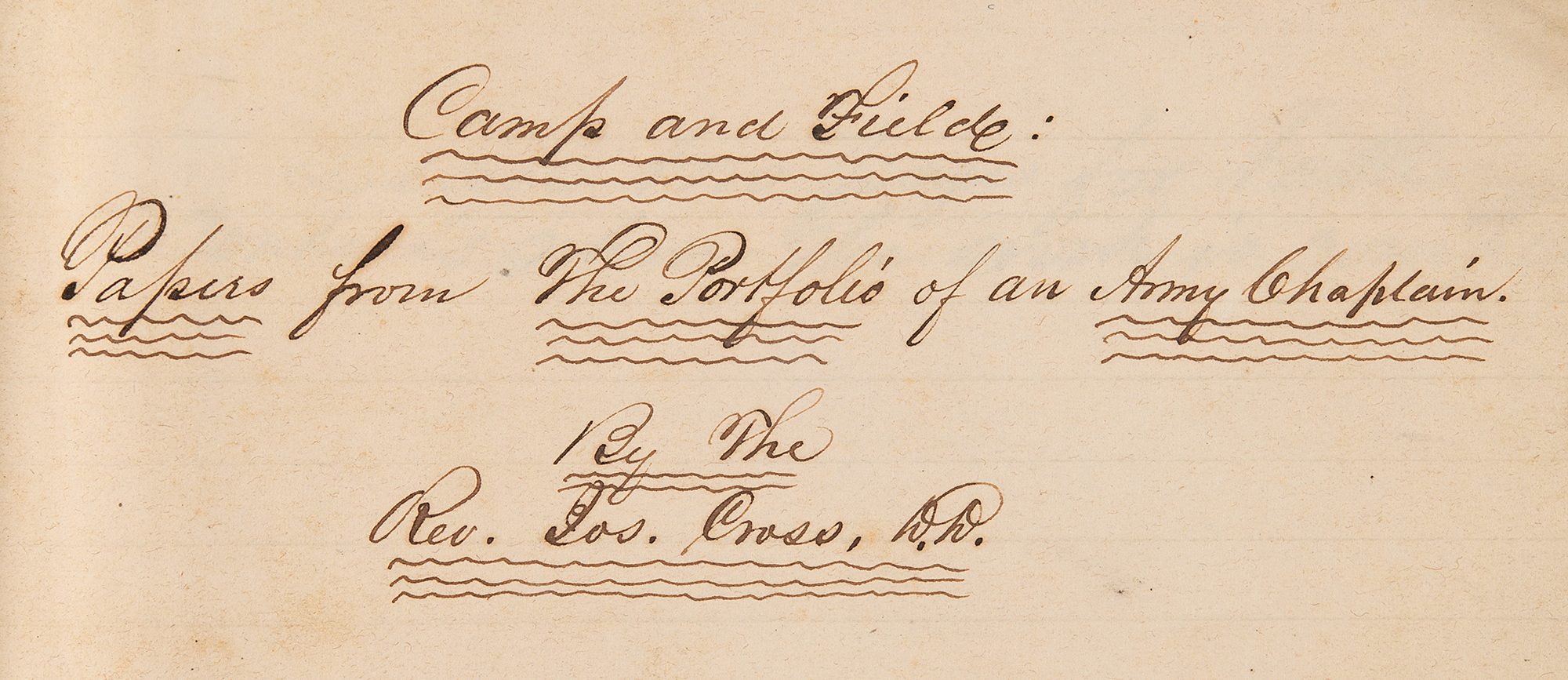
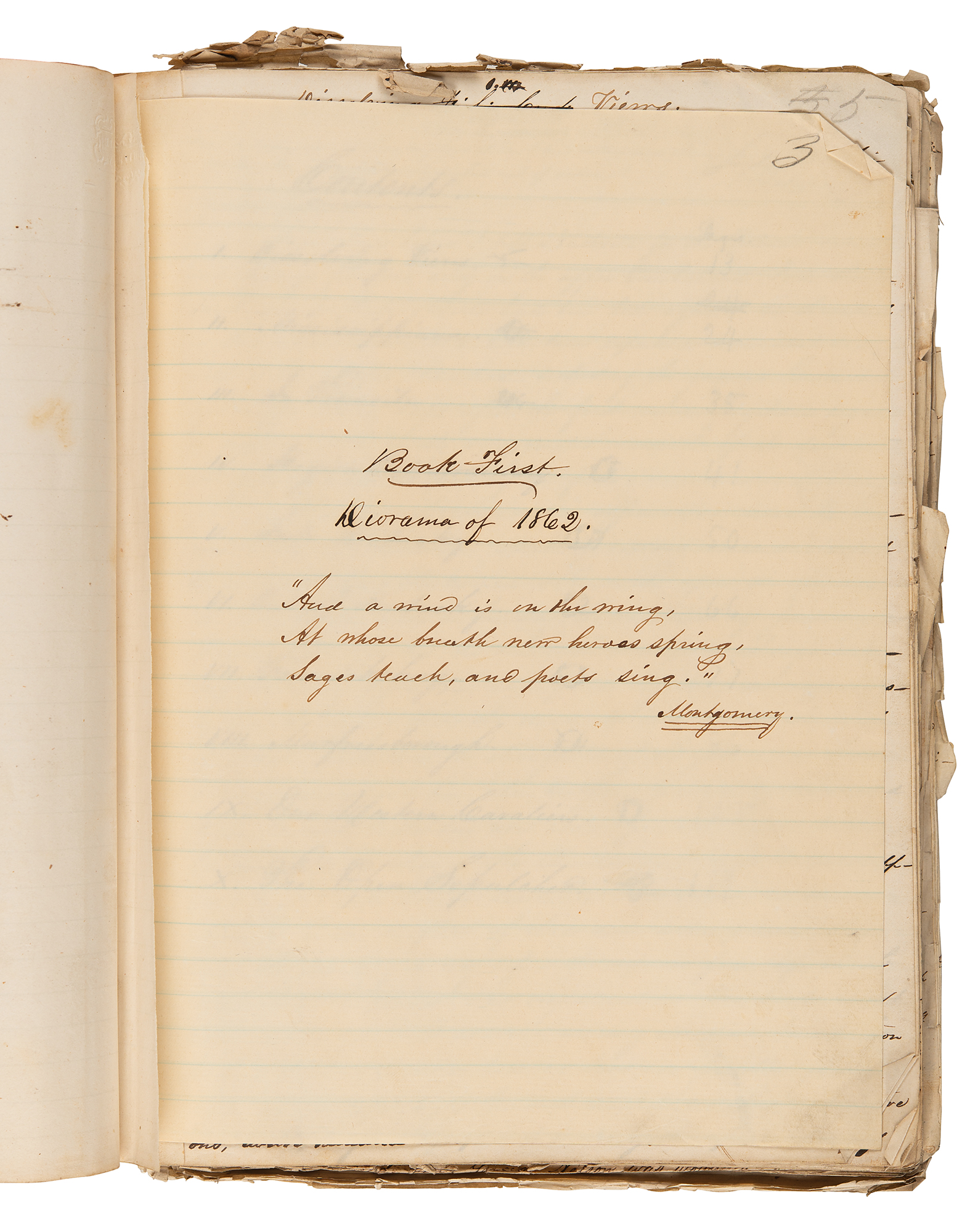
Cross’s cover sheet, which he has signed below as “Jos. Cross,” features annotated directions to “Mr. Compositor,” in part: “My punctuation is not to be changed anywhere. The orthography may occasionally need correction. Please observe the paragraphing very strictly.” The opening page, which served as the book's front cover, reads: “Camp and Field: Papers from the Portfolio of an Army Chaplain, By the Rev. Jos. Cross, D.D., To be published in four books: I. Diorama of 1862 / II. New Dispensation / III. Outlooks from Torytown / IV. Gallery of Portraits.” The ensuing title page for “Book First” features a stanza from James Montgomery’s poem A Voyage Round the World, which reads: “And a wind is on the wing / At whose breath new heroes spring / Sages teach and poets sing”; Cross routinely begins chapters with quotes from famous poets, which includes William Shakespeare, William Cullen Bryant, Edward Young (“He that is born is listed; life is war”), and more. The book’s contents page contains 10 chapters: “I. Dissolving Views, II. Mississippiana. III. In Transitu, IV. Hegira Extraordinary, V. Into Kentucky, VI. Out of Kentucky, VII. Fredericksburg, VIII. Murfreesborough, IX. Our Western Cavaliers, X. The Open Sepulcher.”
Highlighted passages are as follows:
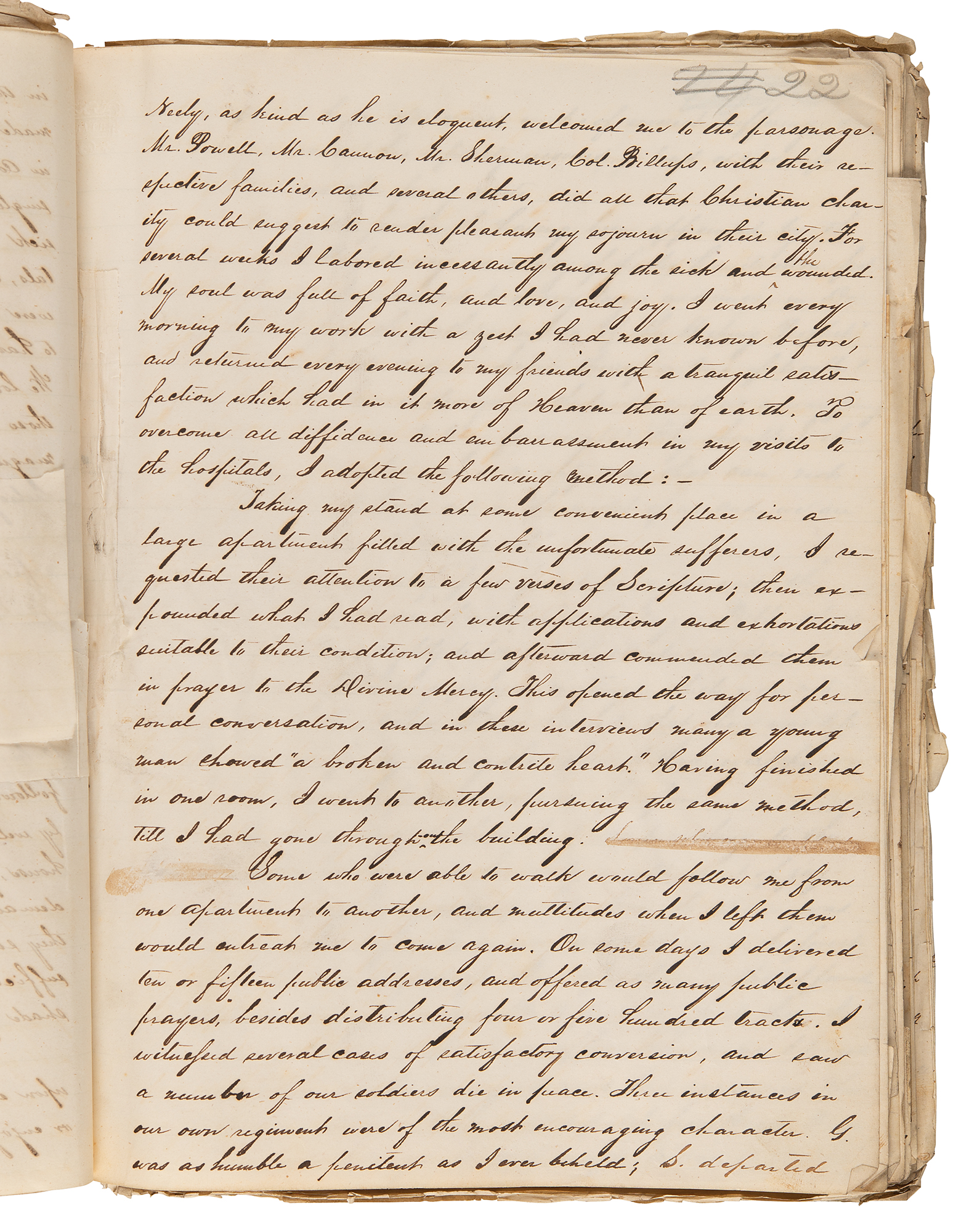
Page 22: “Taking my stand at some convenient place in a large apartment filled with the unfortunate sufferers, I requested their attention to a few verses of Scripture; then expounded what I had read, with applications and exhortations suitable to their condition; and afterward commended them in prayer to the Divine Mercy. This opened the way for personal conversation, and in these interviews many a young man showed ‘a broken and contrite heart.’”
Page 38: “On the self-same day was fought the second great battle of Manassas, in which Lee put the gasconading invader to an inglorious rout; took thirty pieces of artillery and eight thousand stand of small arms; destroyed and carried away an immense amount of Federal army stores; captured a large number of prisoners, seven thousand of whom were paroled upon the field; strewed the ground for three or four miles with the wounded, the dying, and the dead; and left the enemy full thirty-eight thousand less than he found him at the opening of the conflict.”
Page 42: “Among the prisoners were three chaplains; one of them a Methodist preacher of the Indiana Conference. He said he was ‘sick of the war,’ and if released he should ‘quit the army.’ He seemed to be uneasy, however, and anxious to know what was to be done with him. I told him that we did not imprison ministers of the Gospel, and that he would certainly be set at liberty. He desired me to speak with Gen. Bragg about it, and bring him word in the afternoon. I represented the case, through Colonel Johnston, to the General; and was authorized to ‘say to the gentlemen,’ that he and his two colleagues would ‘be free, to go where they pleased, only not in advance of our army.’”
Pages 47 and 48: “As soon as the wounded begin to arrive at the hospital I am summoned to assist the surgeons. The first sight I see there makes me sick at heart; a poor fellow from one of the batteries, with both legs crushed by a cannon-ball. Another has a hole through his body, which would admit a man's arm; yet, strange to say, he lives a full hour. A third, smeared with blood and brains, presents no semblance of the "human face divine." Some are shot through the breast, through the lungs; others through the arm, the hand, the shoulder. One has lost a little finger or a big toe; another is minus a nose, or has had one of his ears cut away; while a third will need a new set of teeth, and has parted perhaps with a piece of his tongue. They are wounded in almost every manner possible, only none of them seem to have been shot in the back.”
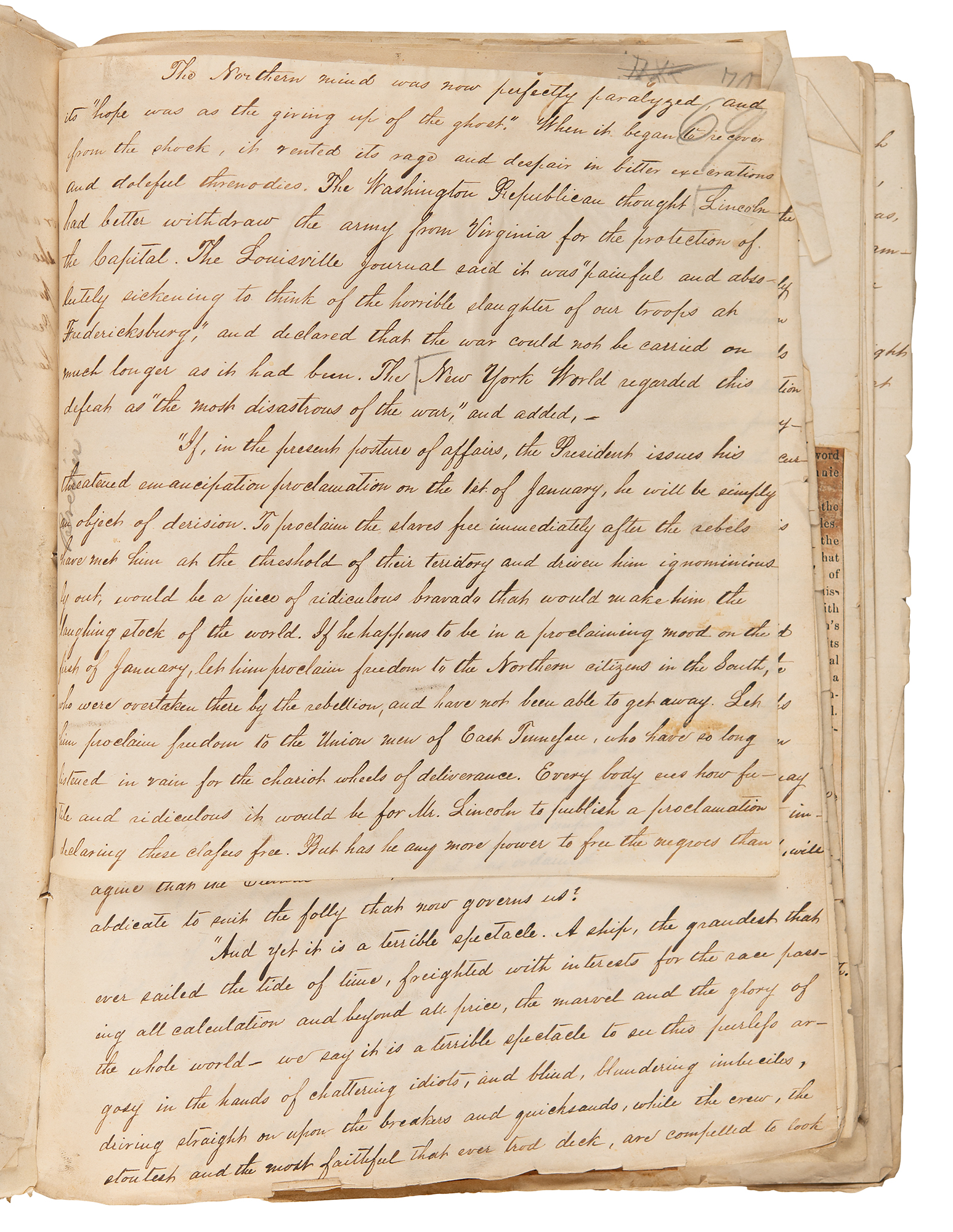
Page 69, quoting a passage from The New York World: “If, in the present posture of affairs, the President issues his threatened emancipation proclamation on the 1st of January, he will be simply an object of derision. To proclaim the slaves free immediately after the rebels have met him at the threshold of their territory and driven him ignominiously out, would be a piece of ridiculous bravado that would make him the laughing stock of the world. If he happens to be in a proclaiming mood on the first of January, let him proclaim freedom to the Northern citizens in the South, who were overtaken there by the rebellion, and have not been able to get away. Let him proclaim freedom to the Union men of East Tennessee, who have so long listened in vain for the chariot wheels of deliverance. Everybody sees how futile and ridiculous it would be for Mr. Lincoln to publish a proclamation declaring these classes free. But has he any more power to free the negroes than to free them? Have not they at least as strong a claim on the government as the slaves?”
Pages 74 and 75: “The Rev. Doctor Sehon also has recently been enlarged. Andy Johnson had kept him a long time in the Nashville penitentiary, plying him frequently with the infamous Federal oath. The Doctor spurned it with indignation, would not even give his parole of honor, nor any pledge whatever that might be construed into an acknowledgment of the right of Mr. Lincoln to arrest and imprison an unarmed and peaceable citizen. He has displayed a noble firmness and independence, and has won his freedom without cringing at the feet of the tyrant.”
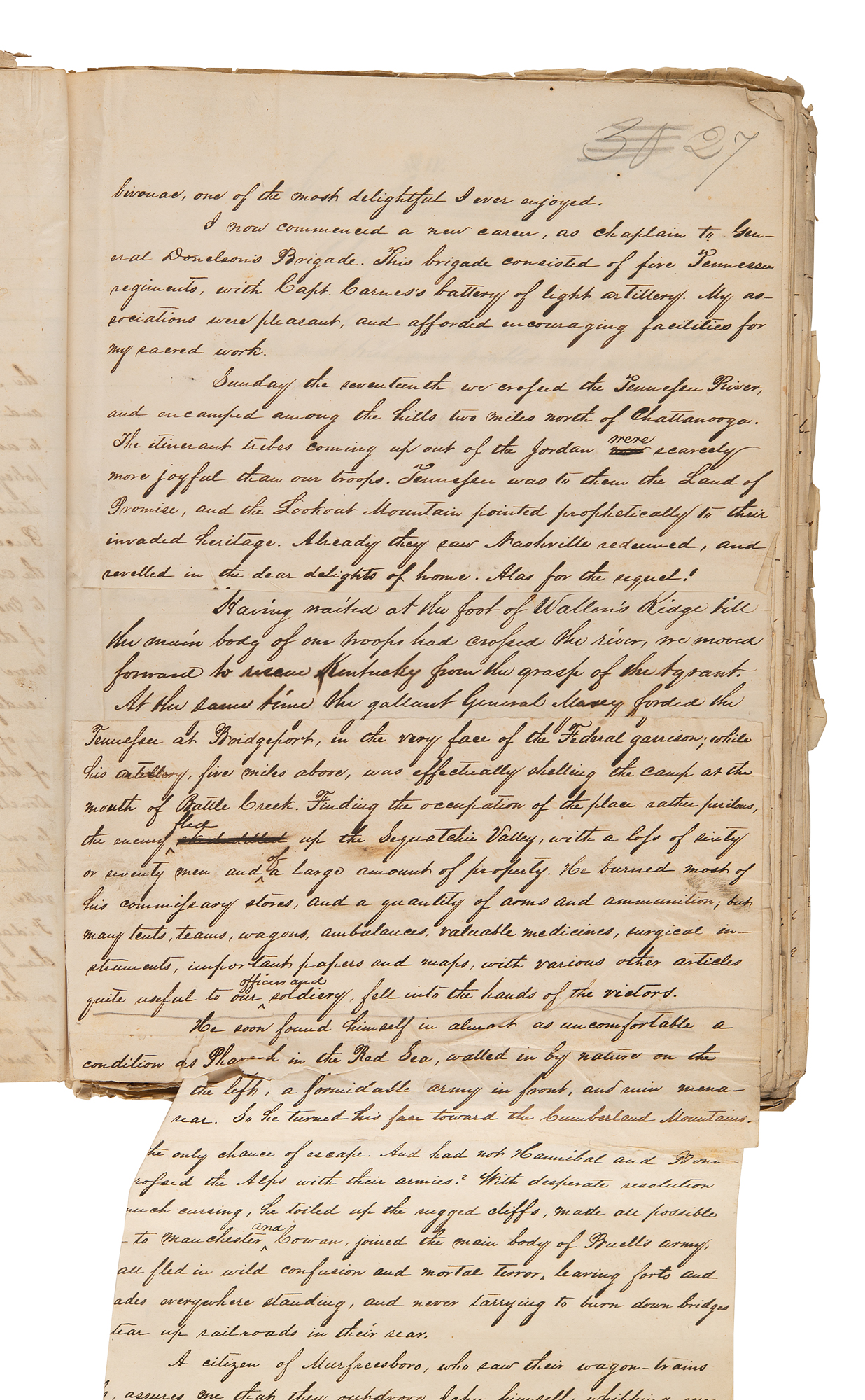
Cross’s wife was Jane T. H. Cross (1817-1870), an eminent Southern author of children’s literature and a noted contributor of prose and poetry to the religious journals of the South. During the Civil War, she sympathized strongly with the South. Her Southern sentiments were so intense in favor of the Confederacy that she and her daughters were imprisoned at Camp Chase for six months for waving their handkerchiefs to John Hunt Morgan's troops. This episode is documented within this book beginning on page 28: “On Sunday evening, the seventeenth of August, while we were in bivouac near Chattanooga, I preached to the Eighth Regiment. After the service Colonel Moore showed me the Louisville Journal of the sixth instant, containing a notice of my wife's arrest, trial and imprisonment, with her two daughters, on a charge of disloyalty to Lincoln…Mrs. Cross, with her daughters, was on a visit to her native home in Harrodsburg. While there, John H. Morgan made his advent in the town. The ladies waved their handkerchiefs: this was indubitable disloyalty. They welcomed the liberators of their friends: this was abominable rebellion. They furnished them some refreshments from Judge Chirm's larder: this was intolerable treason. It would never do to let such proceedings pass unpunished. Probably, too, these ladies knew how to shoot. Who could give assurance that they were not here for the purpose of organizing a guerilla party?”
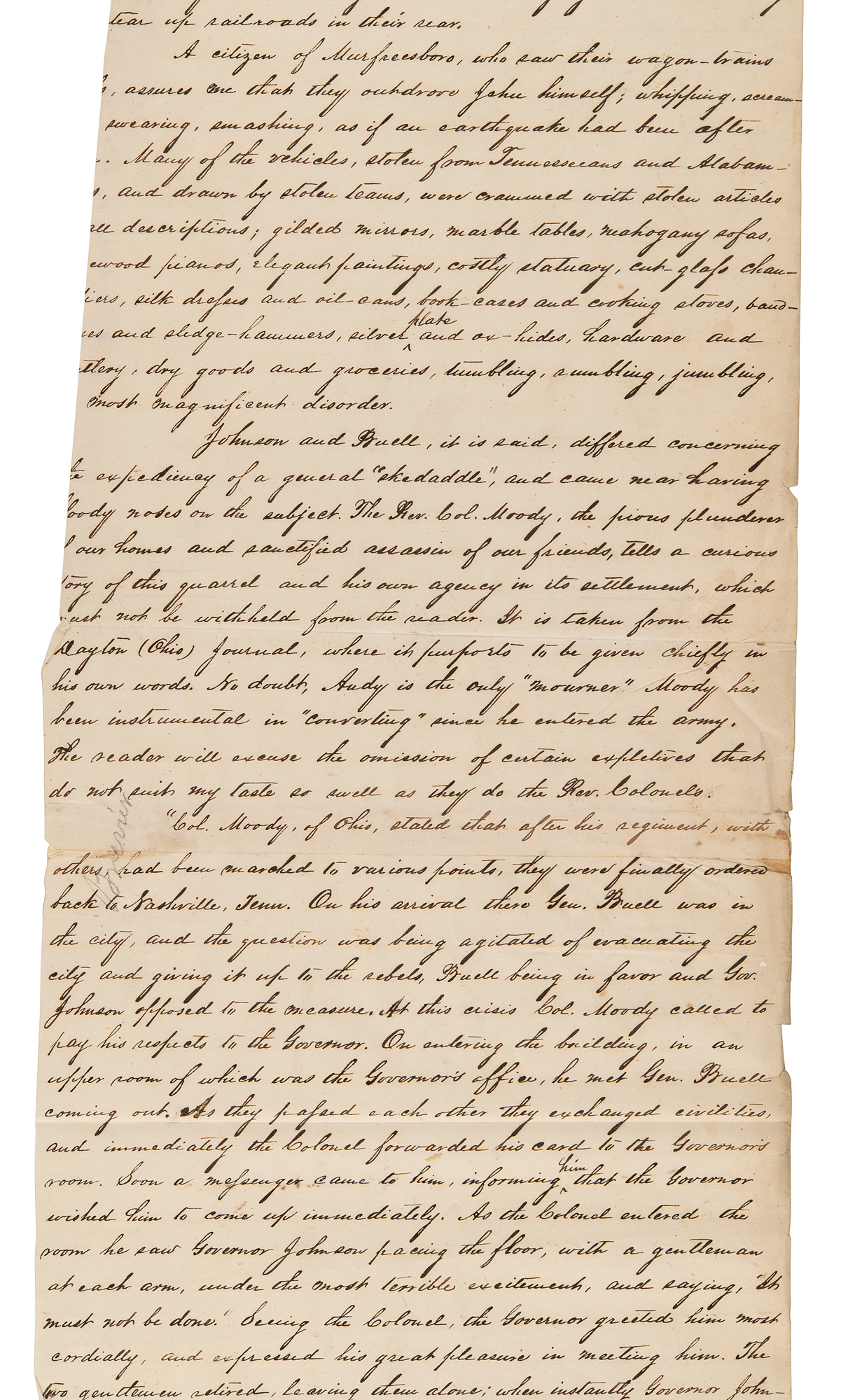
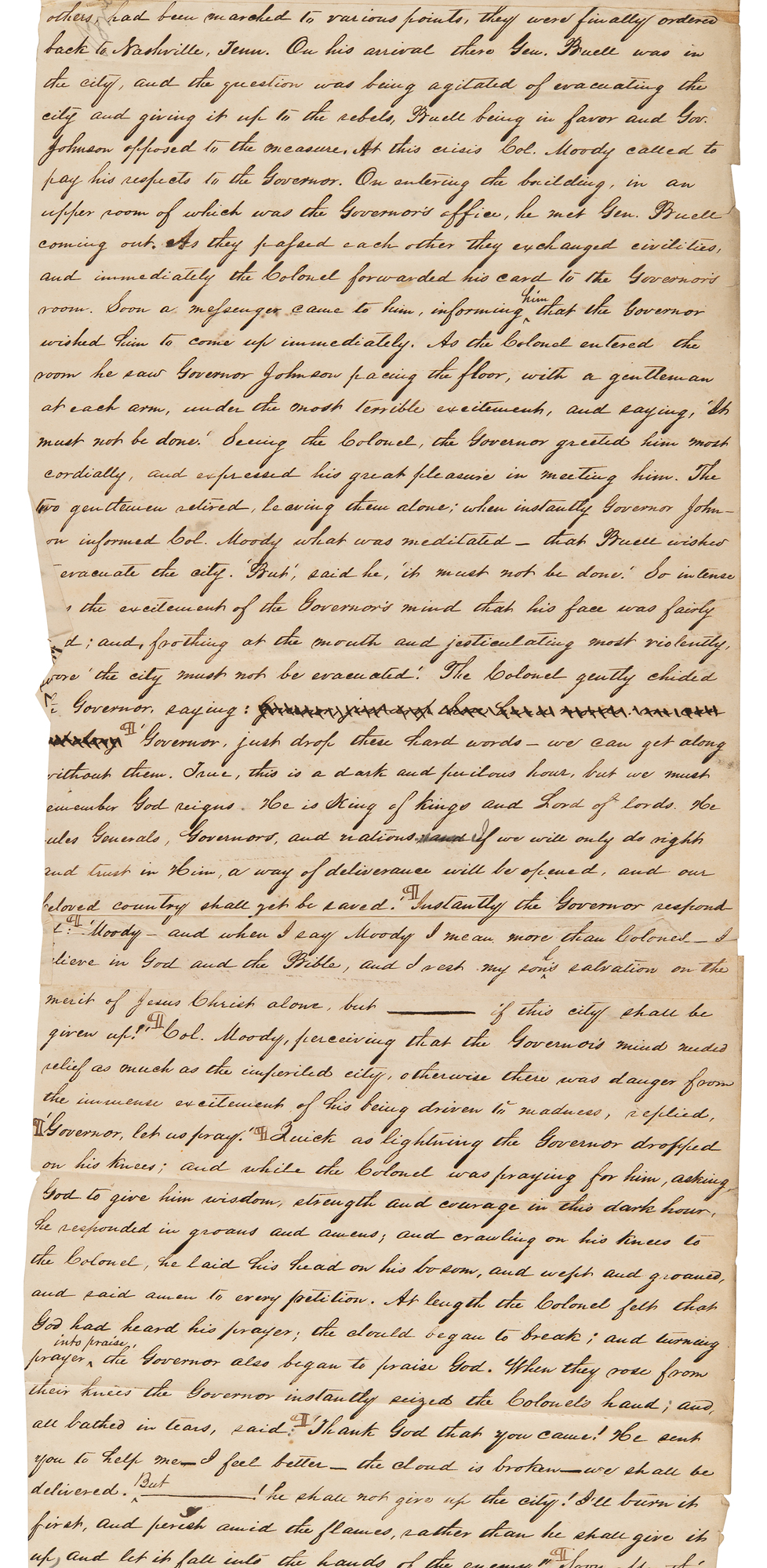
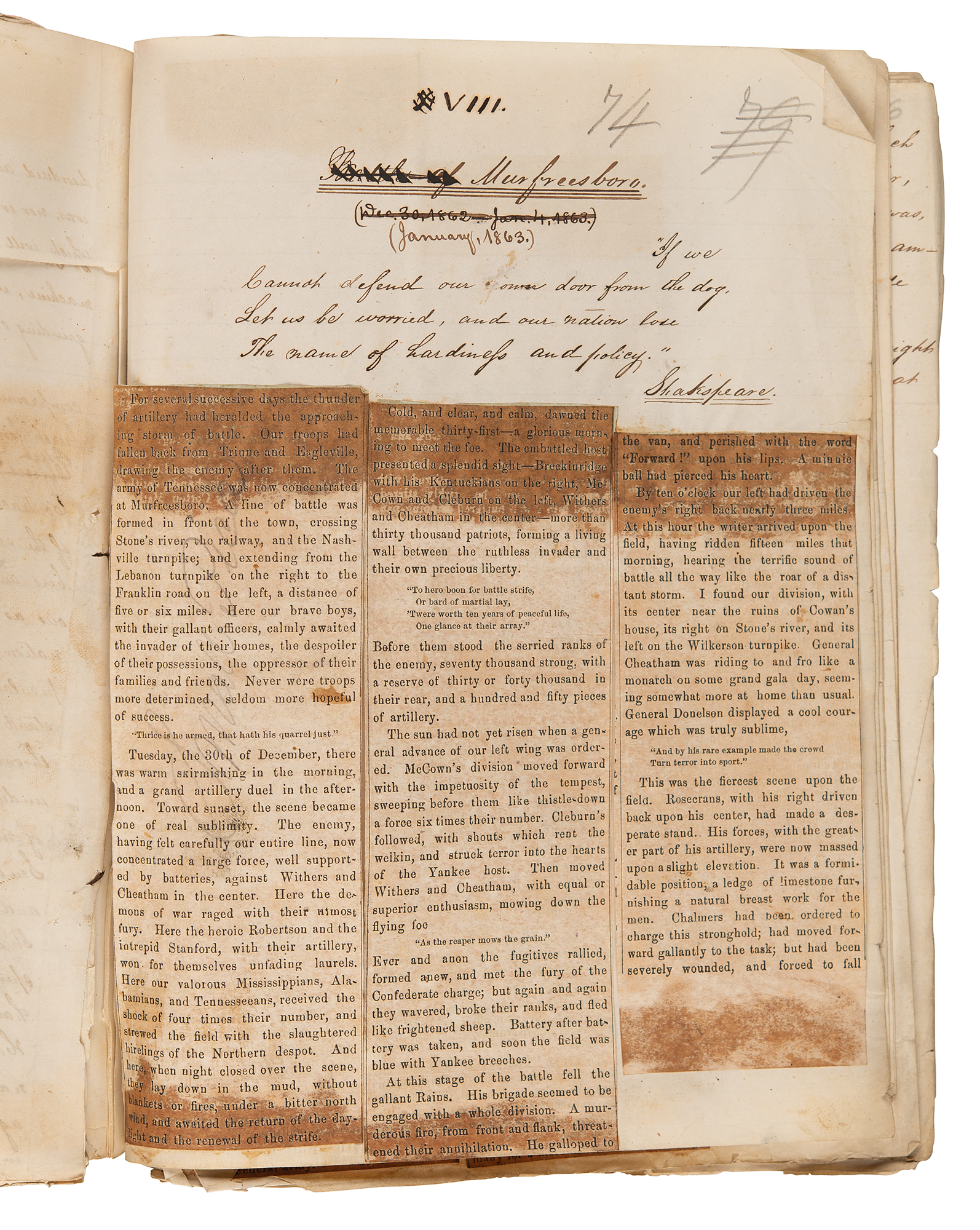
The section designated as “Murfreesboro” contains several affixed newspaper articles, some with annotations, and a handful of pages have been excised and reordered within the booklet. In overall very good to fine condition, with scattered overall wear, with the backs of numerous pages professionally repaired with tape. A staggering, museum-quality work of immense historical interest that glows with Cross’s lyrical prose and vivid remembrances, qualities perhaps only overshadowed by the manuscript’s remarkable condition and strikingly crisp penmanship.
Joseph Cross (1813-1893) departed from his home in East Brent, Somersetshire, England, and arrived in the United States in 1825. In 1829 he entered the ministry of the Methodist Episcopal Church in Genesee, New York, and later served as a professor of English literature at Transylvania University in Lexington, Kentucky, where he became a prominent member in the southern branch of the Church. It was also where Cross was named a commissioner and utilized the Transylvania campus to recruit Methodist pastors to serve as Confederate chaplains. It’s believed that he entered the Confederate service as Chaplain to the Second Regiment of Tennessee Volunteers on July 4, 1861.
The 2nd Infantry Regiment Provisional Army was organized in May 1861, at Nashville, Tennessee, and mustered into Confederate service at Lynchburg, Virginia. The unit was assigned to John George Walker's and French's Brigade, fought at Aquia Creek and First Manassas, then in February 1862, returned to Tennessee. After fighting at Shiloh, Richmond, and Perryville, the regiment participated in the campaigns of the Army of Tennessee from Murfreesboro to Atlanta, then was involved in Hood's Tennessee operations and the Battle of Bentonville. It lost thirty-seven percent of the 300 at Richmond, had four killed and 59 wounded at Murfreesboro, and of the 264 engaged at Chickamauga, more than sixty percent were disabled. The unit totaled 262 men and 146 arms in December 1863, had 133 in action at Ringgold Gap, but could muster only 65 after the Battle of Nashville.

