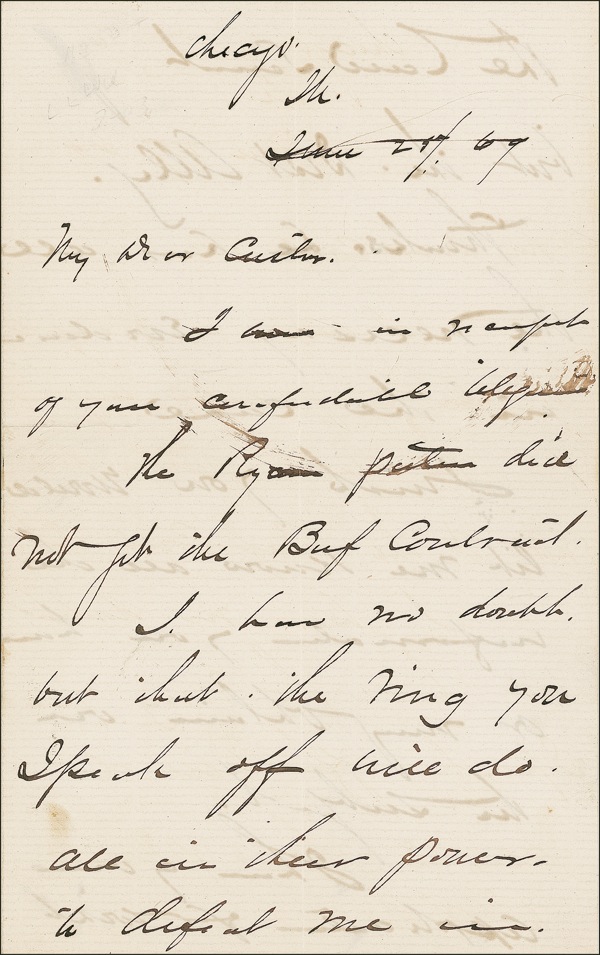
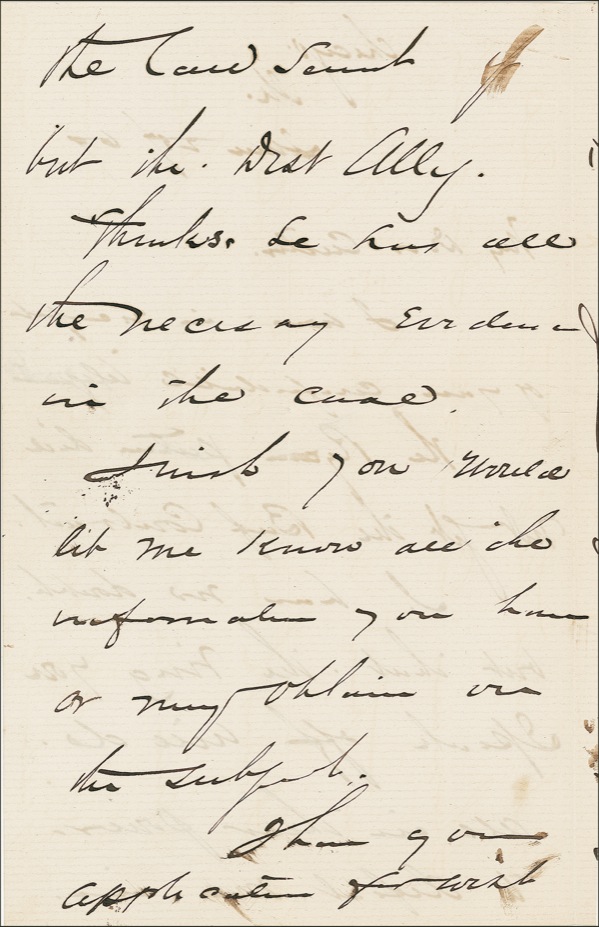
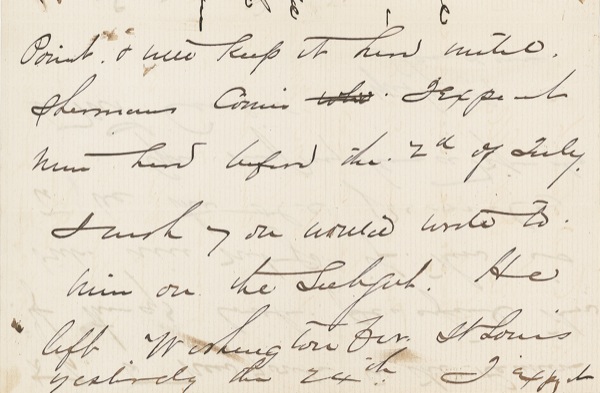
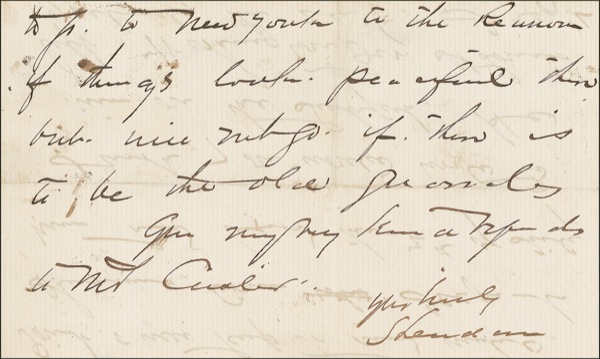
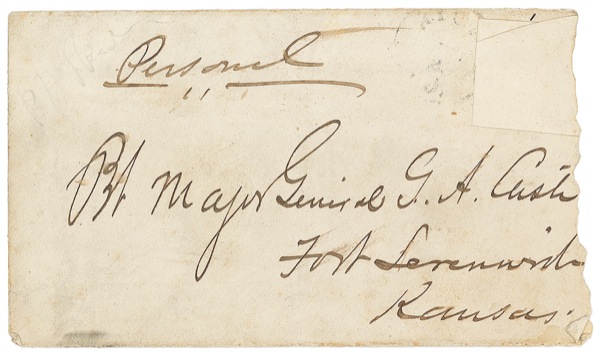
Union general (1831–1888) whose cavalry command blocked Lee’s escape at Appomattox. ALS signed “Sheridan,” four pages on two adjoining sheets (thefinal two pages in horizontal format), 5 x 8, June 25, 1869. Sheridan writes to George Custer in the aftermath of the Battle of Washita, seven years to the day before Custer met his end at Little Bighorn. In full: “I was in receipt of your confidential telegram. The Ryan partner did not get the Beef contract. I have no doubt but that the ring you spoke of will do. All in their power to defeat me in the law suit but the Dist. Atty. thinks he has all the necessary evidence in the case. I wish you would let me know all the information you have or may obtain on the subject. I have your application for West Point & will keep it here until Sherman comes. I expect him here before the 2d. of July. I wish you would write to him on the subject. He left Washington for St. Louis yesterday the 24th. I expect to go to New York to the Reunion if things look peaceful there but will not go if there is to be the old guards (?). Give my kind regards to Mrs. Custer.” Accompanied by the original mailing envelope addressed in Sheridan’s hand to “Bvt, Major General G. A. Custer, Fort Leavenworth, Kansas,” and marked “Personal” at upper left. The “ring” referred to by Sheridan is most likely the “Indian Ring,” a syndicate of military officials, lobbyists, politicians, and private contractors who profited handsomely from the ongoing war to “pacify” the Plains Indians. Custer had been court-martialed in 1867 for leaving his post while on duty. He maintained that he was simply being made a scapegoat for a failed campaign; Sheridan agreed, calling Custer back to duty in 1868. In the eyes of the army, Custer redeemed himself by his November 1868 attack on Black Kettle’s band on the banks of the Washita River. This was regarded as the first substantial U.S. victory in the Indian Wars, helping to force a significant portion of the Southern Cheyennes onto a U.S.-appointed reservation. While the Army considered Washita a great victory, many did not—and, in Sheridan’s paranoid mind, sought to embarrass him and Custer however they could. Sheridan’s department conducted the Red River War, the Ute War, and the Black Hills War, which eventually resulted in the death of his trusted subordinate. In fine condition, with intersecting folds, light show-through from bold text on opposite sides, and a few trivial brushes to text. The stamp has also been clipped from the envelope. An excellent association between these two military giants. R&R COA.

