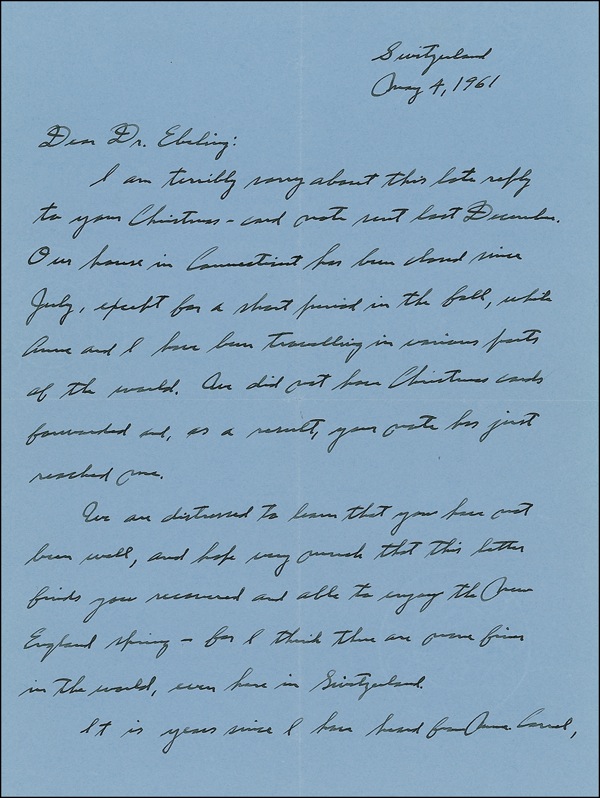
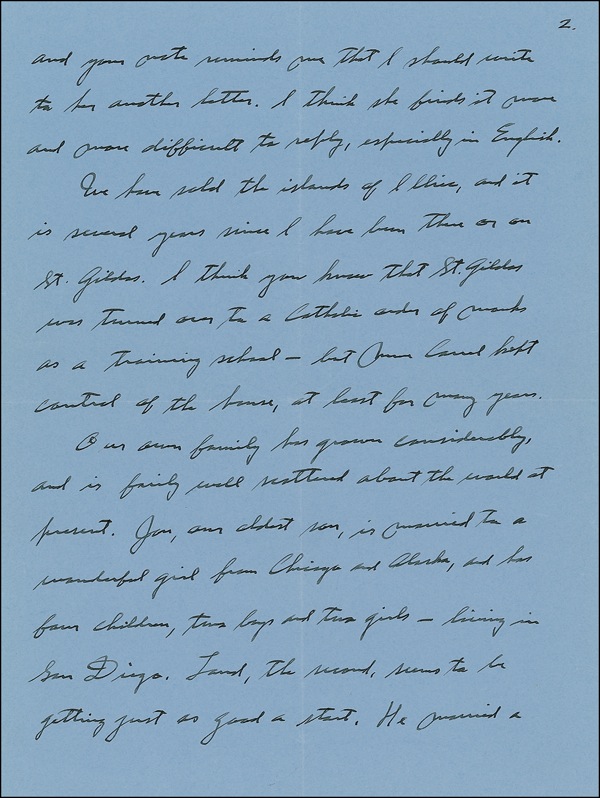
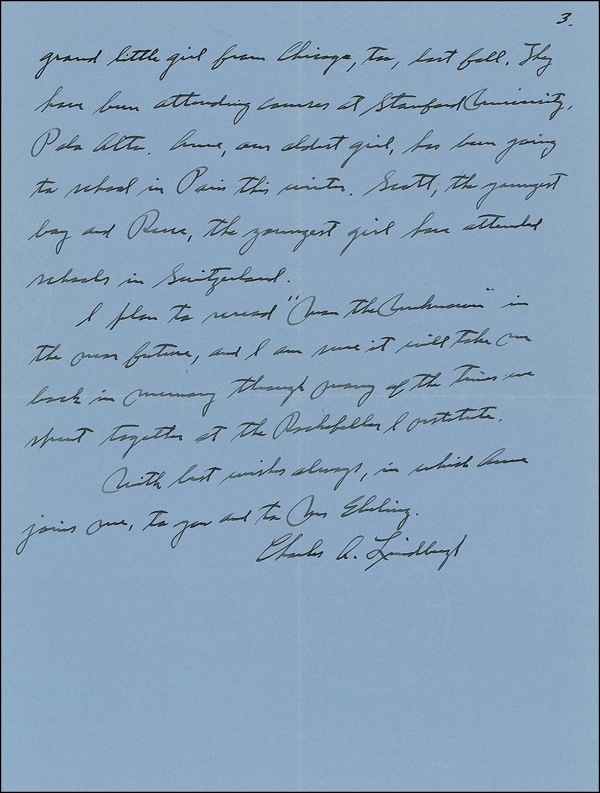
ALS signed “Charles A. Lindbergh,” three pages, 8 x 10.75, May 4, 1961. Lindbergh writes from Switzerland to Dr. Albert H. Ebeling in Jamaica, Vermont. In part: “It has been years since I have heard from Mrs. Carrel, and your note reminds me that I should write to her another letter. We have sold the islands of Illiec [where the Lindberghs had retreated to escape the glare of publicity following the kidnapping of their son], and it is several years since I have been there or on St. Gildas…. Our own family has grown considerably, and is fairly well scattered about the world at present. Jon, our oldest son, is married to a wonderful girl from Chicago and Alaska, and has four children, two boys and two girls—living in San Diego. Land, the second, seems to be getting just as good a start. He married a grand little girl from Chicago…. Anne, our oldest girl, has been going to school in Paris this winter. Scott, the youngest boy and Reese, the youngest girl have attended schools in Switzerland. I plan to reread ‘Man the Unknown’ in the near future, and I am sure it will take me back in memory through many of the times we spent together at the Rockefeller Institute….” Ebeling was a close associate of vascular researcher Alexis Carrel (1873–1944), recipient of the 1912 Nobel Prize in Medicine. In the 1930s, Lindbergh’s mechanical inclinations led to a collaboration with Carrel on a book titled The Culture of Organs, as well as on the development of a “perfusion pump” which allowed human organs to survive outside the body—a crucial advance in the development of organ transplants and open-heart surgery. Despite the acclaim lavished upon Lindbergh and Carrel, who appeared together on the cover of Time magazine in June 1938, their respective legacies were forever clouded by intertwined controversies. At a time when the Nazi regime was becoming ever more blatant in its aims, Carrel, a devoted eugenicist, vigorously promoted the notion of genetic “superiority” among an elite group of intellectuals, going so far as to advocate the use of gas chambers to rid humanity of “inferior” stock. During World War II, moreover, he was closely allied with a prominent collaborationist party in France and implemented a number of policies believed to have resulted in the execution of countless “defectives.” Carrel’s ties with Lindbergh only added fuel to the persistent, lifelong accusations of anti-Semitism against the flier, which would forever sully his image as an aviation hero. Accompanied by the original mailing envelope addressed in Lindbergh’s hand. Intersecting mailing folds (vertical fold to first name), otherwise fine, clean condition. R&R COA.

