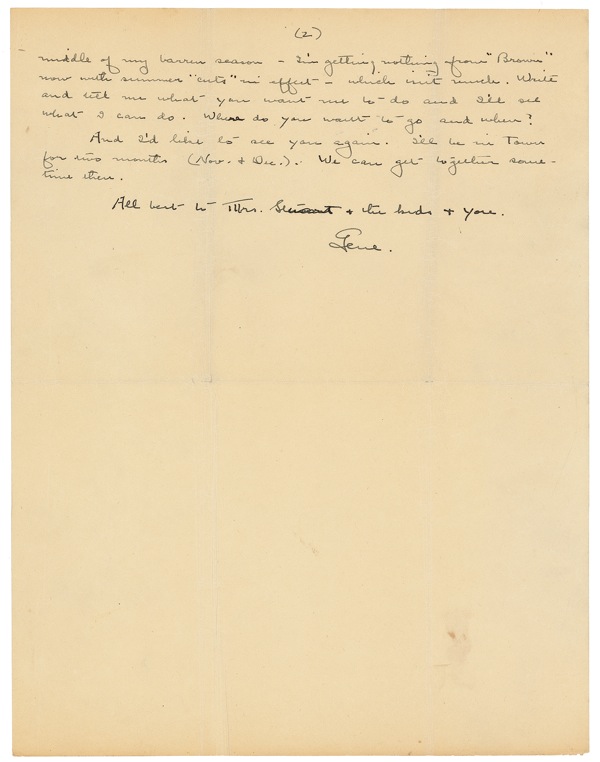
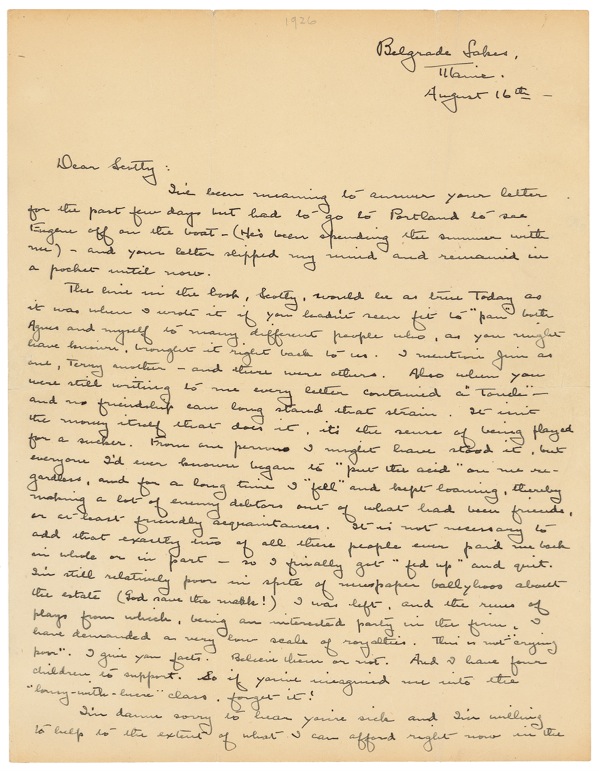
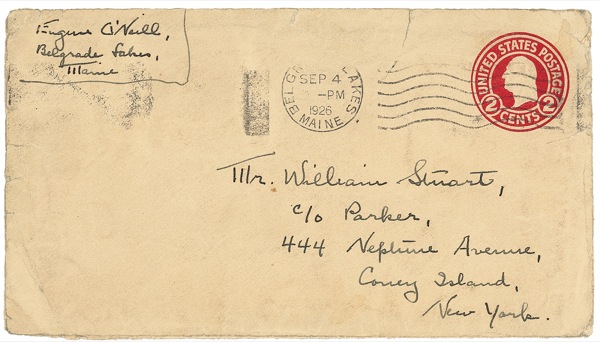
American playwright (1888–1953) who occupies a central place in the history of twentieth-century drama. Among his most famous works are The Iceman Cometh, Mourning Becomes Electra, and Long Day’s Journey into Night. A four-time winner of the Pulitzer Prize, he was also awarded the Nobel Prize in Literature in 1936. ALS signed “Gene,” two pages, 8.5 x 11, August 16 [1926]. O’Neill writes from Belgrade Lakes, Maine, to “Scotty.” In part: “The line in the book, Scotty, would be as true today as when I wrote it if you hadn’t seen fit to ‘pan’ both Agnes and myself to many different people, as you might have known, brought it right back to us…Also when you were still writing to me every letter contained a ‘touch’ - and no friendship can long stand that strain. It isn’t the money itself that does it, it’s the sense of being played for a sucker. From one person I might have stood it, but anyone I’d ever known began to ‘put the acid’ on me regardless, and for a long time I ‘fell’ and kept loaning, thereby making a lot of enemy debtors out of what had been friends, or at least friendly acquaintances. It is not necessary to add that exactly two of all these people have paid me back in whole or in part - so I finally got ‘fed up’ and quit. I’m still relatively poor in spite of newspaper ballyhoo about the estate (God save the mark!) I was left, and the runs of plays from which, being an interested party in the firm, I have demanded a very low scale of royalties. This is not ‘crying poor.’ I give you facts. Believe them or not. And I have four children to support. So if you’ve imagined me into the ‘lousy-with-lucre’ class, forget it! I’m damn sorry to hear you’re sick and I’m willing to help to the extent of what I can afford right now in the middle of my barren season - I’m getting nothing from ‘Brown’ [his play The Great God Brown, then running on Broadway] now with summer ‘cuts’ in effect - which isn’t much. Write and let me know what you want me to do and I’ll see what I can do.” Accompanied by an original mailing envelope, addressed in O’Neill’s hand to “William Stuart, c/o Parker, 444 Neptune Avenue, Coney Island, New York,” and signed in the return address area, “Eugene O’Neill, Belgrade Lakes, Maine.” William Stuart had previously appeared in productions of the Provincetown Players. Because O’Neill spent the summer of 1926 at Belgrade Lakes, his life, and perhaps, the literary world, was changed forever. Had he not summered in Maine that fateful year, deep in the creation of Strange Interlude, he may have not met a certain lady, and he may also have plunged back into a world of heavy drinking. O’Neill had only quit drinking a few months before, and he was determined as ever to continue to write. That certain lady, Carlotta Monterey, who would become his third wife, would one day fight to publish one of his greatest plays posthumously, just as he wished it, without changes. Eugene stated that he couldn’t have written it without her. The play, Long Day’s Journey into Night, would earn O’Neill a fourth Pulitzer Prize. Intersecting folds, a few scattered creases, and mild overall toning, otherwise fine condition. Auction LOA John Reznikoff/PSA/DNA and R&R COA.

