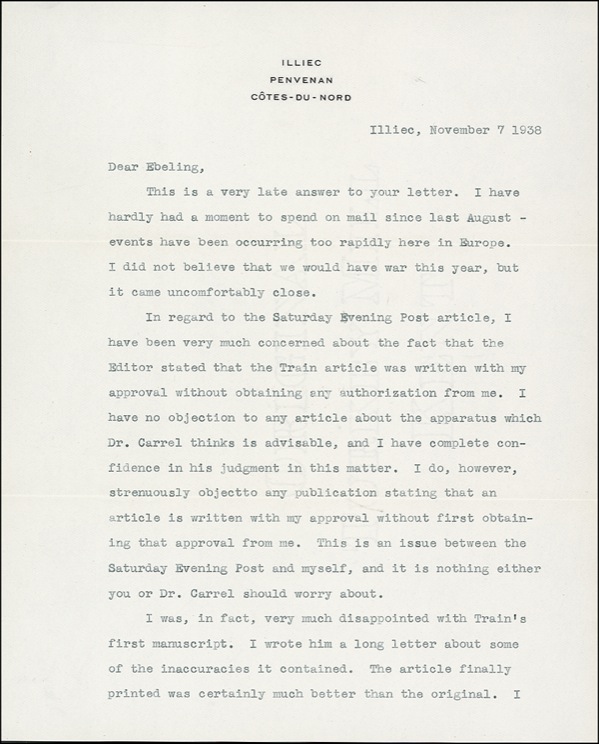
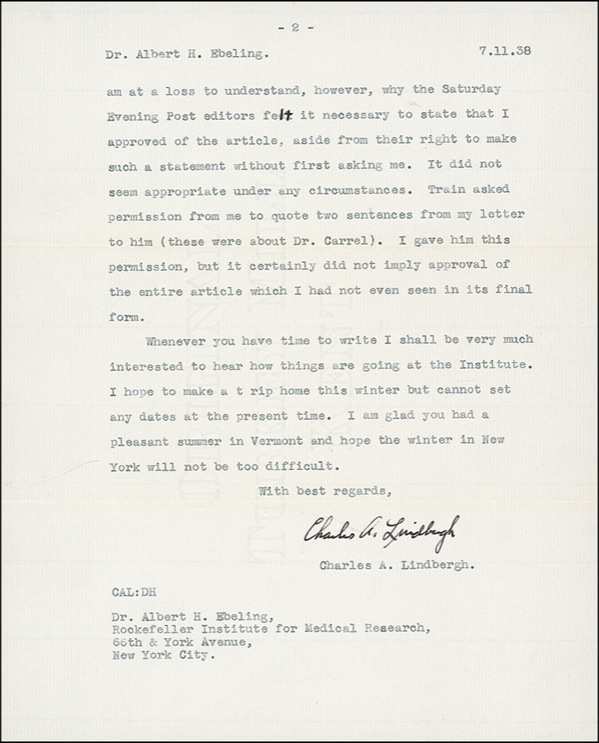
TLS, two pages, 8 x 10, Iliec, Côtes-du-Nord letterhead, November 7, 1938. Lindbergh writes to Dr. Albert H. Ebeling at the Rockefeller Institute for Medical Research. In part: “I have had hardly a moment to spend on mail since last August—events have been occurring too rapidly here in Europe. I did not believe that we would have war this year, but it came uncomfortably close. In regard to the Saturday Evening Post article, I have been very much concerned about the fact that the Editor stated that the Train article was written with my approval without obtaining any authorization from me. I have no objection to any article about the apparatus which Dr. Carrel thinks is advisable…. I do, however, strenuously object to any publication stating that an article is written with my approval without first obtaining that approval from me…. I was, in fact, very much disappointed with Train’s first manuscript. I wrote him a long letter about some of the inaccuracies it contained. The article finally printed was certainly much better than the original…. Train asked permission from me to quite two sentences from my letter to him (these were about Dr. Carrel). I gave him this permission, but it certainly did not imply approval of the entire article which I had not even seen in its final form…. I hope to make a trip home this winter but cannot set any dates at the present time….” Ebeling was a close associate of vascular researcher Alexis Carrel (1873–1944), recipient of the 1912 Nobel Prize in Medicine. In the 1930s, Lindbergh’s mechanical inclinations led to a collaboration with Carrel on a book titled The Culture of Organs, as well as on the development of a “perfusion pump” which allowed human organs to survive outside the body—a crucial advance in the development of organ transplants and open-heart surgery. Despite the acclaim lavished upon Lindbergh and Carrel, who appeared together on the cover of Time magazine in June 1938, their respective legacies were forever clouded by intertwined controversies. At a time with the Nazi regime was becoming ever more blatant in its aims, Carrel, a devoted eugenicist, vigorously promoted the notion of genetic “superiority” among an elite group of intellectuals, going so far as to advocate the use of gas chambers to rid humanity of “inferior” stock. During World War II, moreover, he was closely allied with a prominent collaborationist party in France and implemented a number of policies believed to have resulted in the execution of countless “defectives.” Carrel’s ties with Lindbergh only added fuel to the persistent, lifelong accusations of anti-Semitism against the flier, which would forever sully his image as an aviation hero. Accompanied by the original mailing envelope. In very fine, fresh condition. A superb letter with a most important association! R&R COA.

