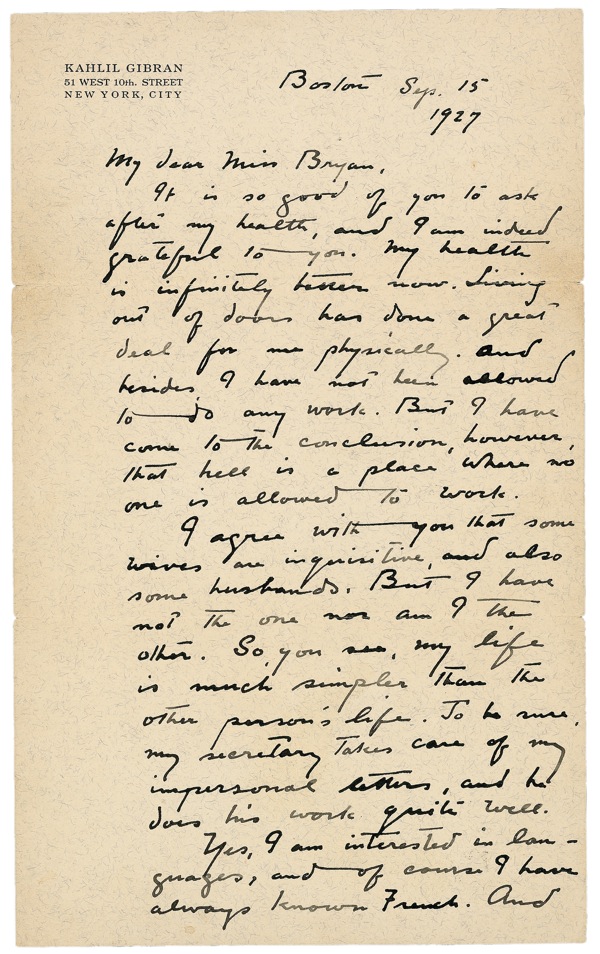
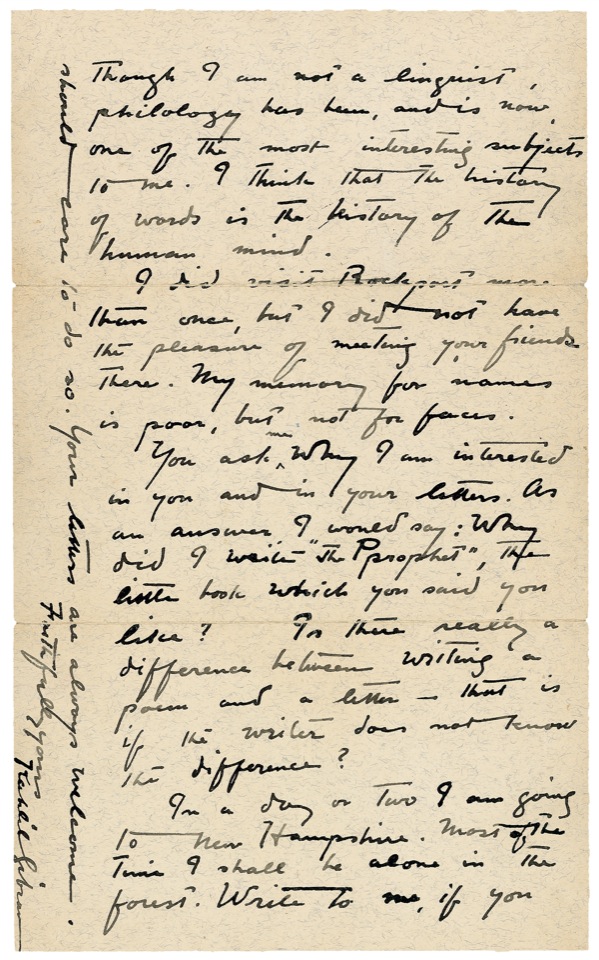
Lebanese-American artist and writer (1883–1931) best known for his writings on religion and for his best-selling 1923 spiritual-philosophical classic The Prophet, one of the emblematic texts of the 1960s counterculture in America. Rare and excellent ALS, one page both sides, 6.5 x 10.5, personal New York letterhead, September 15, 1927. Gibran writes from Boston, where he lived and studied from his early teenage years, to Mable [sic] G. Bryan in Augusta, Maine. In part: “It is so good of you to ask after my health, and I am indeed grateful to you. My health is infinitely better now. Living out of doors has done a great deal for me physically. And besides I have not been allowed to do any work. But I have come to the conclusion, however, that hell is a place where no one is allowed to work. I agree with you that some wives are inquisitive, and also some husbands. But I have not the one nor am I the other. So, you see, my life is much simpler than the other person’s life. To be sure, my secretary takes care of my impersonal letters, and he does his work quite well. Yes, I am interested in languages, and of course I have always known French. And though I am not a linguist, philology has been, and is now, one of the most interesting subjects to me. I think that the history of words is the history of the human mind.... You ask me why I am interested in you and in your letters. As an answer I would say: Why did I write ‘The Pprophet’ [sic], the little book which you said you like? Is there really a difference between writing a poem and a letter—that is if the writer does now know the difference? In a day or two I am going to New Hampshire. Most of the time I shall be alone in the forest. Write to me if you should care to do so.... Faithfully....” Gibran’s unusual and evidently deliberate misspelling of his best-known work is curious indeed, and may well have held some special significance for the writer. Accompanied by the original mailing envelope addressed in Gibran’s hand. A hint of subtle soiling and handling wear, and intersecting folds (tiny marginal separations along horizontal folds), otherwise fine condition. The writing is extraordinarily dark and bold. Gibran is extremely scarce in letters, particularly with content of this interest! Auction LOA John Reznikoff/PSA/DNA and R&R COA.

