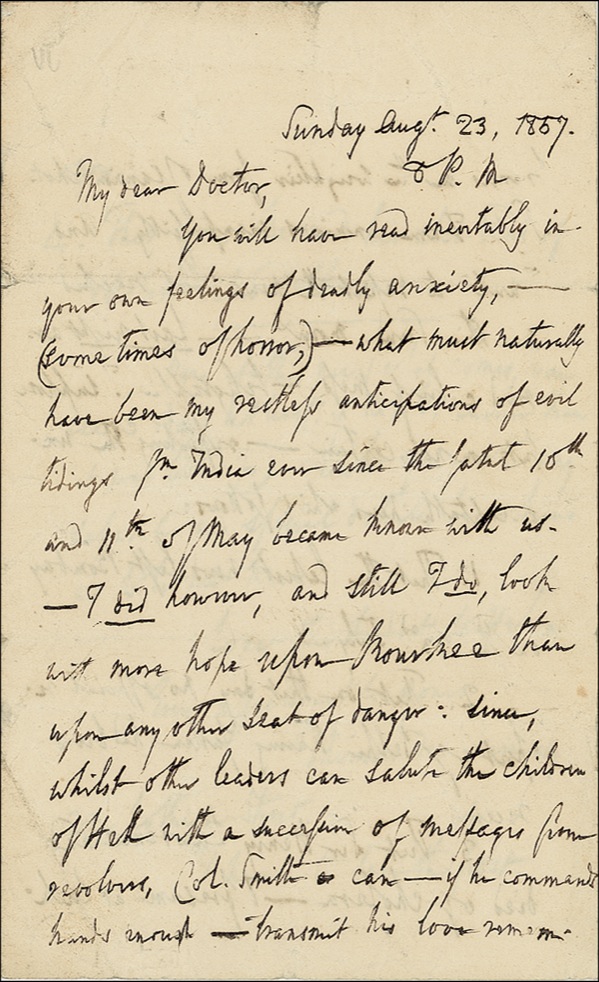
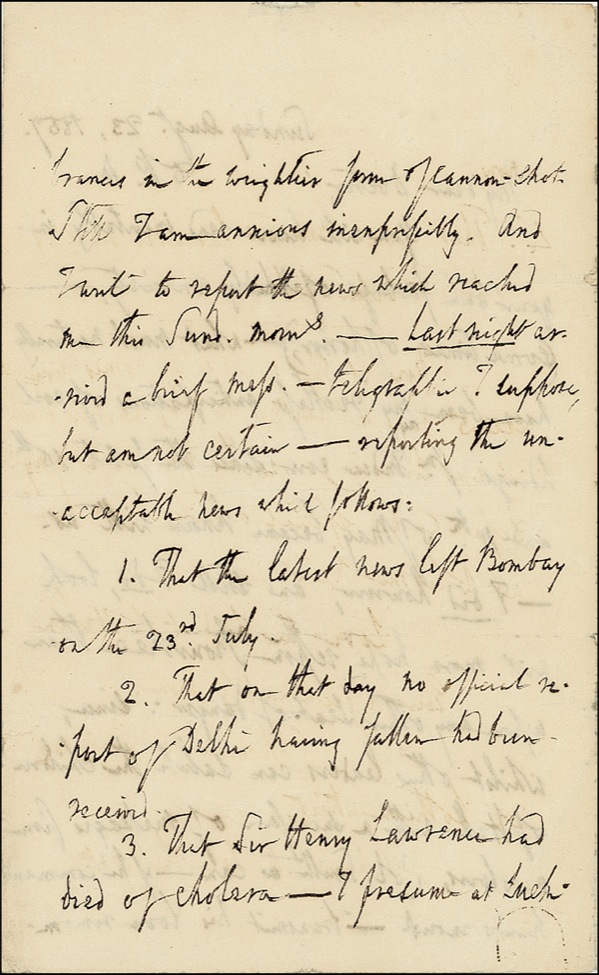
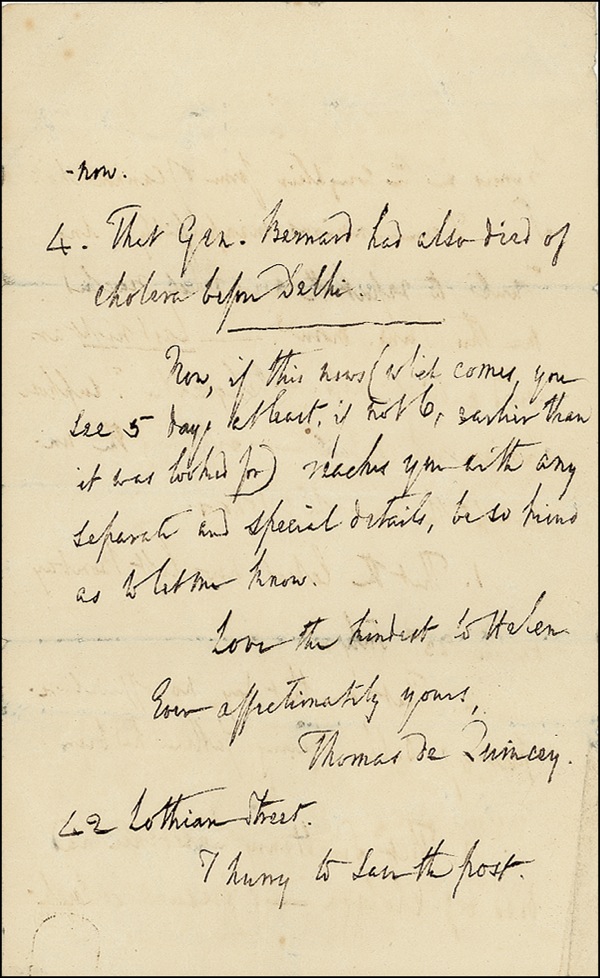
British author (1785–1859) best remembered for his now-classic memoir of his experiments with drugs, Confessions of an English Opium-Eater. Exceptional ALS, three pages on two adjoining sheets, 4.5 x 7.25, August 23, 1857. De Quincy writes to an unnamed “Doctor.” In part: “You will have read inevitably in your own feelings of deadly anxiety (sometimes of horror) what must naturally have been my restless anticipations of evil tidings f[ro]m India ever since the fatal 10th and 11th of May became known with us. I did however, and still I do, look with more hope upon Rourkee than upon any other seat of danger: since, whilst other leaders can salute the children of Hell with a succession of messages from revolvers, Col. Smith can—if he commands hands enough—transmit his love remembrances in the weightier form of cannon-shot. Still I am anxious inexpressibly…. Last night arrived a brief mess[age]—telegraphed I suppose, but am not certain—reporting the unacceptable news which follows: 1. That the latest news left Bombay on the 23rd July. 2. That on that day no official report of Delhi having fallen had been received. 3. That Sir Henry Lawrence had died of cholera—I presume at Lucknow. 4. That Gen. Bernard had also died of cholera before Delhi….” The Sepoy Rebellion unfolded in the summer of 1857 when the Sepoys, Indian soldiers trained by the British, staged a mutiny following a rumor that the cartridges for their new rifles were greased with lard and beef fat—a taboo for Muslims (who abhorred pork on religious grounds) and Hindus (who held cows sacred) alike. The uprising, part of a nascent movement for India’s independence from the British, was harshly quelled, and scores of Indian soldiers were severely punished, humiliated (by being sewn up in pig or cow carcasses) or killed. Mild scattered soiling and wrinkling, a few creases, and light show-through of ink, otherwise fine condition. Auction LOA John Reznikoff/PSA/DNA and R&R COA.

