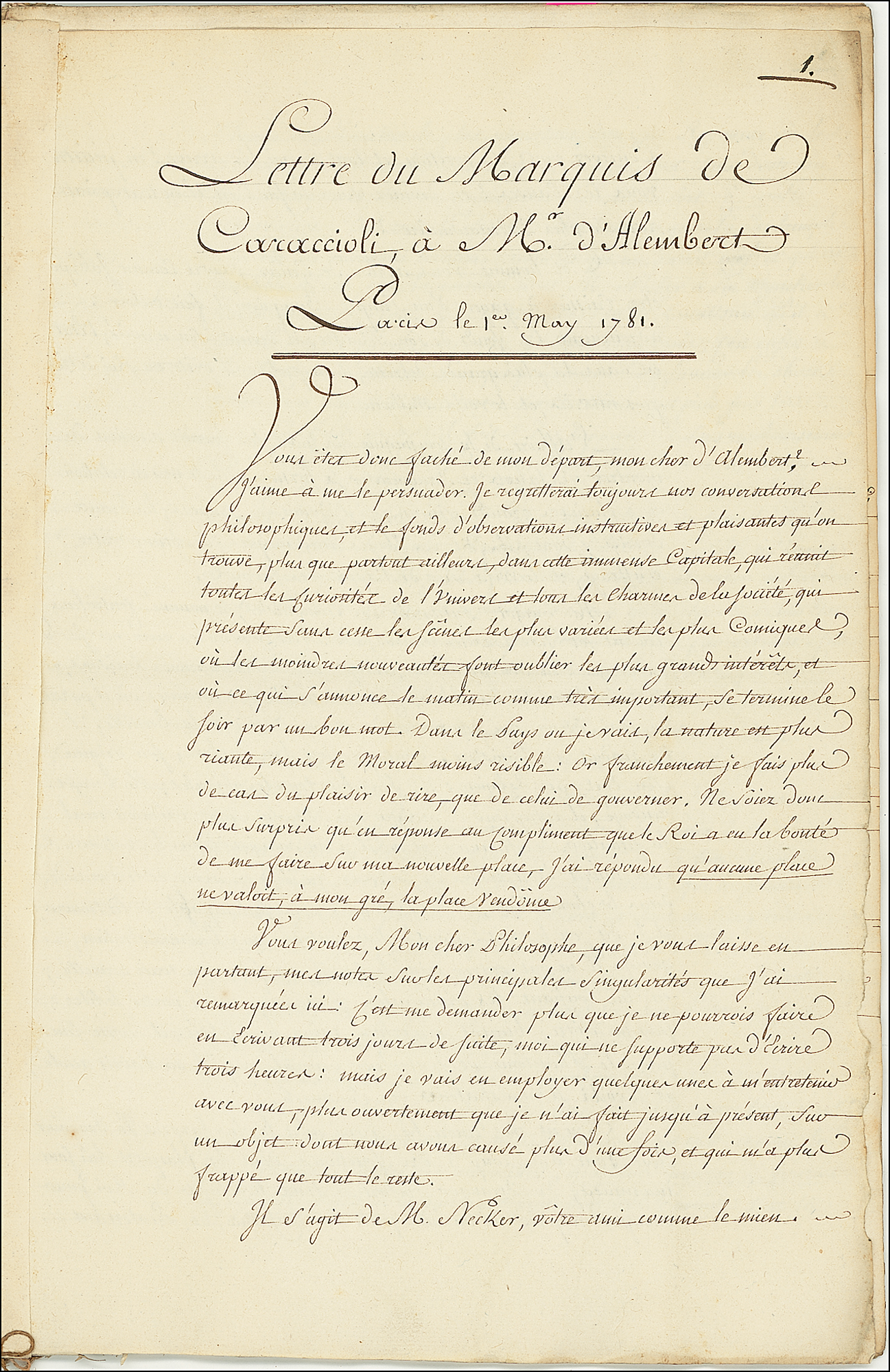
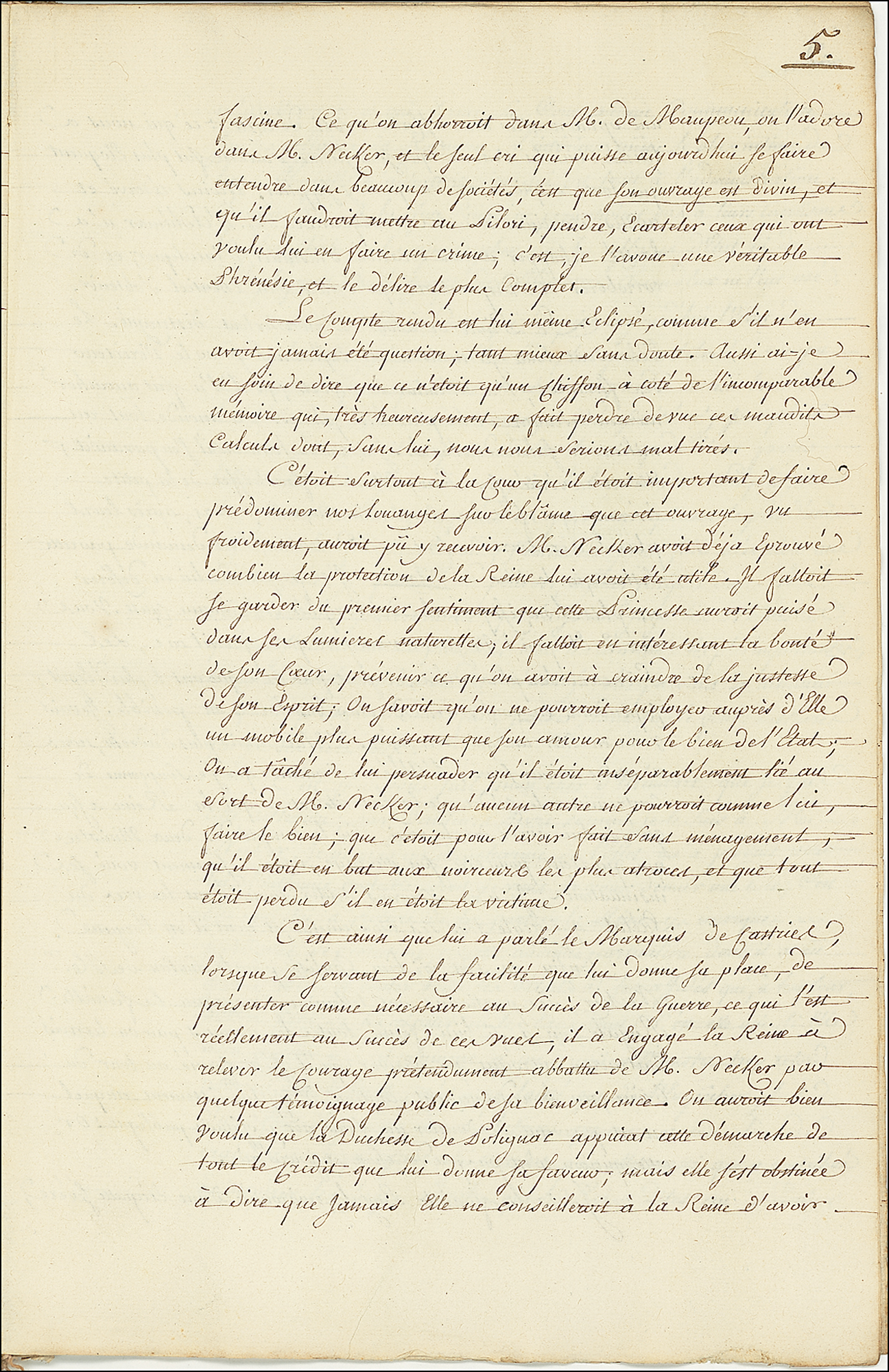
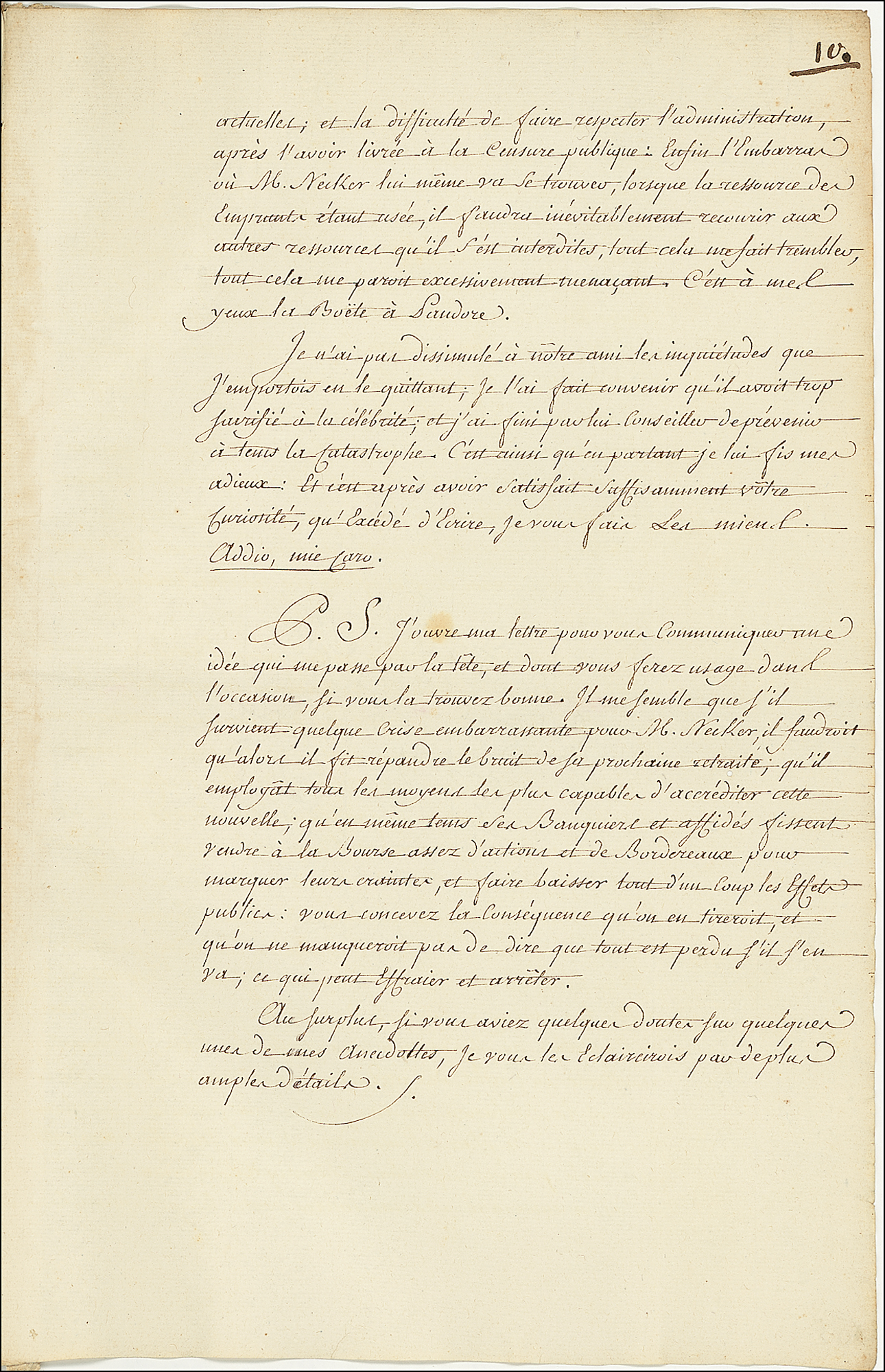
Prolific French writer, poet, historian, and biographer long time considered an “enemy of Philosophy” because of his broad apologetic production. Lengthy unsigned manuscript letter in French, 21 pages on eleven adjoining sheets, 9.25 x 14, May 1, 1781. Letter written to Jean le Rond D’Alembert, a French mathematician, physicist and philosopher, regarding Jacques Necker, Minister of Finance to King Louis XVI, whose lack of attention to the populace caused the French revolution. The Marquis de Caraccioli had served in Paris as Ambassador from the Italian court but displeased Louis XVI and was given permission to leave the country. He writes from Paris just prior to his departure to explain the inner workings of the French court, and in particular, his observations of the powerful Jacques Necker. Highlights from the letter include, “It concerns Mon. Necker, your friend and mine. Just imagine his position and all that happens to him? Do you realize the causes? Do you guess the end? Is there anything more extraordinary?…This man comes along from Geneva, poor as Job, to be a cashier of a simple banker. He skillfully manages the funds of his boss; he becomes his partner. The State is in the most distressed situation, he takes advantage of it; he makes loans to the King at very high rates of interest, and here he is - a millionaire.” He goes on to comment on Necker’s impressive rise to power, “Everything appeared to exclude him; his origin; his state; his religion. He overcame all obstacles. Mon. Turgot being sent away, he undertakes to prove that his successor has miscalculated the state of finances and that he did not know its resources. It was then in his interest to maintain that there were very great resources in the thing itself and to pretend that he alone was capable of finding them. He says so and he is believed.” Caraccioli also comments on Necker’s being appointed Minister of Finance by King Louis XVI. He writes, “He easily eliminates the phantom of Controller General and becomes Minister of Finances. It is not even that, that surprises me the most. A banker raised overnight to functions, most of which he is unfamiliar with. A foreigner preferred to over all the subjects of the King, to occupy a position of trust beside him. A Protestant appointed to the most important Ministry, in a kingdom where such Protestants are excluded from the most insignificant appointments; all that is undoubtedly a very strange affair. It is a very remarkable caprice of fate and very marvelous.” Near the closing, Caraccioli prophetically foretells the possibilities of revolution: “But what appears new to me resembles nothing on earth is the way in which Mon. Necker has managed to mystify the French Nation ever since he has had his place among them; it is the fanaticism he has managed to inspire in what you call ‘good society,’ and finally it is this excess of enthusiasm which is called forth in his favour even by the things which would have crushed any other man a hundred feet below ground!…After all what has he done? Suppressions without compensation, reforms without profits, unlimited loans, that is what he admires? He crushes an entire class of citizens, he brings grief to an infinite number of respectable families…He attacks property rights, what does it matter? They are only financial properties, one sees nothing improper with validating them. He destroys the reputation of those whom he robs of their estate property and their fortune. He starts by defaming and finishes by destroying them.” Document is accompanied by a partial translation and is housed in a custom-made linen and leather clamshell case, made specifically for this document. A light horizontal fold and some scattered light wrinkling and toning, otherwise fine condition. R&R COA.

